Showing posts with label Alexander Calder. Show all posts

09/04/25

TETAF NY 2025 - First Look - Artworks, Artists, Galleries

TETAF NEW YORK 2025
Park Avenue Armory, NYC
MAY 9 — 13, 2025

TETAF New York 2025
COURTESY OF TETAF
The European Fine Art Foundation - TEFAF - unveiled a preview of select works that will be featured at TEFAF New York 2025, taking place from May 9 – 13 (May 8 VIP day by invitation only). This "First Look" offers a glimpse of the exceptional range and caliber of artworks to be showcased at the Park Avenue Armory this year.

At TETAF New York 2025, 91 of the finest dealers and galleries from 13 countries and 4 continents will bring the best in Modern and Contemporary Art, Jewelry, Antiquities and Design to the vibrant art community of New York City. Besides the exhibitor stands in the Wade Thompson Drill Hall, TEFAF New York 2025 will also showcase exclusive curated spaces in the Armory's 16 period rooms. 

EMMA REYES 
PRESENTED BY LEON TOVAR GALLERY 
(STAND 366)

Emma Reyes
EMMA REYES
White Poppy, 1979
Work on paper
41 x 28 inches (104.14 x 71.12 cm)
PHOTO COURTESY OF LEON TOVAR GALLERY
White Poppy (1979) by Emma Reyes, depicts a fully bloomed white poppy alongside five buds in the shadows. This piece exemplifies Reyes’ signature style of vibrant compositions and close-up floral portrayals, which transform flowers into living beings, almost like portraits. Her work often seeks to restore humanity’s connection with nature, a theme central to White Poppy. The white poppy symbolizes a commitment to peace, an everpresent motif in Reyes' oeuvre.

ALBERTO GIACOMETTI 
PRESENTED BY GALERIE MARCILHAC 
(STAND 340)
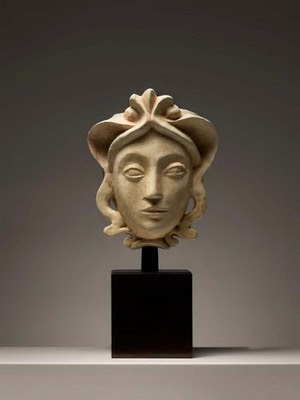
Alberto Giacometti
ALBERTO GIACOMETTI
Masque coiffure, c. 1933
Plaster sculpture with gilding traces
9.4 x 6.1 x 6.4 inches (24 x 15.5 x 16.5 cm)
PHOTO CECIL MATHIEU
COURTESY OF GALERIE MARCILHAC
Alberto Giacometti is considered one of the most famous figures of the French avant-garde of the 20th century. Giacometti, a genius sculptor, also showed his talent in the field of decorative arts as he modeled little objects of various shapes early on. Jean-Michel Frank was the first to detect the innovation potential of such an aesthetic applied to movable creations; in 1928, he commissioned his first objects to the sculptor.

This piece, a "Mask" or "Hairdressing mask" plaster sculpture with gilding traces, was designed by Alberto Giacometti in 1933 for Frank. The pieces for Frank reveal a mastering of the space and a stylistic purification – whether it manifest itself through geometrical of figurative shapes, which were rarely reached by the contemporaries of the artist; they can be lightened to real independent works of art, more than simple daily objects.
 
MANTUA NANGALA 
PRESENTED BY SALON 94 
(STAND 320)

Mantua Nangala
MANTUA NANGALA
Untitled, 2024
Acrylic on linen
96 x 72 inches (243.84 x 182.88 cm)
PHOTO COURTESY OF SALON 94
Mantua Nangala's Untitled (2024) visualizes her ancestral homeland in the Gibson Desert of Western Australia through intricate dots in varying shades of cream and white. This work embodies the stories passed down through generations of her family, particularly the Kanaputa women's creation narratives that shaped this desert landscape. Nangala’s painting transforms these inherited stories into rhythmic patterns that map both physical and spiritual geography. Mantua Nangala has long been associated with Papunya Tula, an arts collective that has helped revolutionize contemporary Aboriginal art. By adopting acrylic paints and canvas, they have moved their artists' traditions into the future while preserving their cultural legacy.


LINE VAUTRIN
PRESENTED BY GALERIE CHASTEL-MARÉCHAL 
(STAND 318)

Line Vautrin
LINE VAUTRIN
Mirror, c. 1960
Mirror and talosel
10.6 inches (27 cm)
PHOTO BY MARINA GUSINA
Born in Paris in 1913, Line Vautrin was an artist, designer and creator of jewelry and decorative objects. A unique and fiercely independent artist, she worked in post-war Paris to create pieces renowned for their intensity and poetry.

The round structure, embossed with honeycomb motifs, alternates openwork parts encircled with blue talosel and gilded mirror cabochons. The inner part features a crown of inlaid oval gilded and parma mirrors. The back of the mirror is dotted and presents the two talosel colors.

MARIE LAURENCIN
PRESENTED BY ALMINE RECH 
(STAND 322)

Marie Laurencin
MARIE LAURENCIN
Jeune Fille au bouquet, c. 1935
Oil on canvas
Unframed: 18.13 x 14.75 inches (45.9 x 37.5 cm)
Framed: 30.75 x 27.63 x 3.38 inches (78.1 x 70.2 x 8.6 cm)
© THE ESTATE OF MARIE LAURENCIN 
COURTESY OF THE ESTATE AND ALMINE RECH
PHOTO: DAN BRADICA
Marie Laurencin was never one to shy away from the title of "woman artist," embracing all things girlish with little hesitation or apology. Throughout her long and storied career, she not only elevated female sitters—rarely choosing to represent men—but also cultivated a deliberately dainty aesthetic. She favored pastel tones, naïve storybook figuration, and airy brushstrokes. Her pretty pictures of pretty girls were more than just an ode to the power and allure of the feminine. They also functioned as visual expressions of Laurencin’s fluid sexual identity, which caused her pursue love affairs with both men and women. As a recent retrospective at the Barnes Foundation contended, the artist possessed a singular queer aesthetic that "subtly but radically challenges existing narratives of modern European art."
 
PARK SEO-BO
PRESENTED BY TINA KIM GALLERY 
(STAND 358)

Park Seo-Bo
PARK SEO-BO
Ecriture No. 31-75, 1975
Pencil and oil on canvas
51.13 x 76.13 inches (129.87 x 193.37 cm)
PHOTO COURTESY OF THE PARKSEOBO FOUNDATION
This work belongs to Park Seo-Bo’s hallmark Ecriture series, which he first began developing in 1967. Ecriture began as a series of monochromes in which Park covered his canvas with a single color and then manipulated the still-wet surface with repetitive carving gestures—actions that resemble the writing of a script and draw from Eastern calligraphic traditions. In this earlier phase of the series, he used a pencil to create these repetitive marks, imbuing the canvas with intricate, rhythmic lines that evoke both the texture of handwriting and the process of meticulous craftsmanship. In the mid-1980s, he introduced hanji paper into the series, layering and scraping the pulp on the wet surface to create a new sequence of sculptural lines that seem to float above the canvas.

GURO MASK
PRESENTED BY GALERIE LUCAS RATTON 
(STAND 351)

Guro Mask
Guro Mask
1929
Wood and pigments
12.38 inches (31.5 cm)
PHOTO BY VINCENT GIRIER DUFOURNIER 
COURTESY OF GALERIE LUCAS RATTON 
This Guru mask from Côte d’Ivoire comes from the former collection of the renowned painter Maurice de Vlaminck (1876-1958). Used in the "Gu" cult, it represents a protective female figure, whose elevated status is expressed through the finesse and power of its features. The elongated shape of the face is sculpted with great precision, emphasizing the elegant curve of the prominent forehead, which subtly extends to the tip of the nose, perfectly balanced by the groove of the mouth. The slit eyes are topped with a pronounced brow ridge, enhancing the mask’s mysterious and charismatic expression. Every detail of this face, carved with remarkable delicacy, evokes both harmony and grace. The meticulous attention given to the representation of the female figure, combined with the incomparable patina, grants this masterpiece a sense of balance, delicacy, and majesty.

ROBERT COTTINGHAM
PRESENTED BY 
GALERIE GEORGES-PHILIPPE & NATHALIE VALLOIS 
(STAND 363)

Robert Cottingham
ROBERT COTTINGHAM
Meat Counter, 1966
Oil on canvas
40 x 60 inches (101.5 x 152.5 cm)
PHOTO COURTESY OF GALERIE GP & N VALLOIS
Meat Counter is one of Robert Cottingham's earliest paintings, and an extremely rare example of his work from the 1960s. It reveals the influence of his original career in advertising while also showcasing the early signs of his skill as a photorealist. Cottingham's attention to detail draws him towards reflections or marbling while keeping the painterly aspect of brushstrokes and swathes of color.

GUIDETTE CARBONELL
PRESENTED BY LEBRETON GALLERY 
(STAND 315)

Guidette Carbonell
GUIDETTE CARBONELL
Cocotte qui Freine, c. 1949
Ceramic, wrought iron
21 x 11 x 19 inches (53.34 x 27.94 x 48.26 cm)
PHOTO COURTESY OF LEBRETON GALLERY
Born in 1910 to a Catalan father and an Armenian-born mother who was a painter, Guidette Carbonell attended several painting workshops, before dedicating herself fully to ceramics. She made her debut at the Salon d'Automne in 1928. With her white enamels speckled with bright colors, she decidedly distanced herself from the austere and meticulous approaches of her predecessors. Close to the abstract painters of the School of Paris, she sought to simplify her forms, notably through a series of stylized luminous birds that she presented at the Jeanne Bûcher Gallery in 1949. She also explored materials by combining earth with pebbles or shards of glass to create decorative plates inspired by the imagination of Bernard Palissy.

JEAN PROUVÉ
PRESENTED BY GALERIE PATRICK SEGUIN 
(STAND 331)

Jean Prouve
JEAN PROUVÉ
Croismare school, 1948
Steel, wood and glass
1259.88 x 315 inches (32 x 8 m)
PHOTO COURTESY OF GALERIE PATRICK SEGUIN
The size of the building, the quality of its architectural treatment and the skills of the Atelier Jean Prouvé captured visitors’ attention as soon as it opened. The 255m² (2.744 sq ft) construction numbers seven central portal frames, over 9 feet high, and two external walkways that derive their elegance from the slenderness of the tubular portal frames. The facade panels, solid or glazed, give rhythm and contrast.

The monumental entrance canopy in folded sheet steel is an autonomous module supported by two struts, key elements in Jean Prouvé’s work. Two axial portal frames and the ridge beam of the Croismare school will be specially reassembled for TEFAF New York 2025. A model will also be presented, illustrating the scale of this demountable architecture, the largest ever designed by Jean Prouvé.

THE BLANCHARD OSIRIS
PRESENTED BY DAVID AARON LTD 
(STAND 212)

Osiris
The Blanchard Osiris
Circa 664-332 B.C.
Bronze
21.7 inches (55 cm)
PHOTO COURTESY OF DAVID AARON LTD
A bronze statuette of mummiform Osiris on a wooden base. The god wears the White Crown of Upper Egypt, with a central uraeus and chin strap, which would have originally attached to a false beard (now missing). The facial features are cast in fine detail, with slender eyebrows over recessed almond-shaped eyes with prominent cosmetic lines. The hands are crossed over the chest, and the lower ends of the crook and flail remain below the fists – originally these implements would have extended upwards towards the shoulders. Statuettes such as this were made in a range of sizes, and this is a notably large example. One of similar size is now in The Metropolitan Museum, New York (61.45).

HEMMERLE MUNICH
PRESENTED BY HEMMERLE 
(STAND 339)

Hemmerle Munich
HEMMERLE MUNICH
Hemmerle bangle, 2025
Spessartine garnets, knitted almandine, 
stainless steel, bronze, white gold
1.65 inches (42 mm) diameter
PHOTO COURTESY OF HEMMERLE
A unique creation showcasing artistry and innovation, this Hemmerle bangle seamlessly weaves history and craftsmanship into an exquisite contemporary jewel. Crafted using a revived 19th-century Austrian knitting technique, delicate almandine garnet beads are meticulously handknitted with silk threads to form an intricate, flexible structure that embraces the wrist with effortless elegance. The ends of the bangle are adorned with spessartine garnets, set in a striking combination of bronze and white gold on the reverse, creating a warm, harmonious tonality that highlights Hemmerle’s signature fusion materials. This one-of-a-kind creation is a testament to Hemmerle’s dedication to reviving historical techniques while pushing the boundaries of contemporary jewelry design.

ALEXANDER CALDER
PRESENTED BY GALERIE MIGNONI 
(STAND 302)

Alexander Calder
ALEXANDER CALDER
Voiles, 1973
Work on paper
30.69 x 22.44 inches (78 x 57 cm)
PHOTO COURTESY OF GALERIE MIGNONI

Alexander Calder initially began his artistic journey as a painter but didn’t explore gouache as a medium until a yearlong stay in Aix-en-Provence, France, in 1953, when he was in his mid-sixties. From that point forward, he continued to create works on paper alongside his sculptural practice. This more immediate medium allowed Calder to effortlessly translate the bold, vivid language of his sculptures into two dimensions. Working with speed and spontaneity, he employed dynamic lines and planes of his signature primary colors to convey geometric patterns, natural motifs, and metaphysical themes that inspired him.

ANNE IMHOF
PRESENTED BY SPRÜTH MAGERS 
(STAND 306)

Anne Imhof
ANNE IMHOF
Untitled (Silas), 2024
Bronze cast
50.88 x 46 x 9.63 inches (129 x 117 x 24.3 cm)
Edition of 3 + 1 AP
© ANNE IMHOF, KUNSTHAUS BREGENZ
COURTESY OF THE ARTIST AND SPRÜTH MAGERS
PHOTO: MARKUS TRETTER
Imhof ’s most recent works transform ongoing drawing practice into sculptural, patinated bronze reliefs in the tradition of artists from antiquity to the Italian Renaissance through August Rodin. In Untitled (Silas) (2024), Imhof ’s lines and shading are translated into three dimensions, the figures becoming literally embodied, with seductively smooth, bronzed skin. The scene depicts androgynous characters with limbs entwined, flanked by a dog and dolphins. This peaceful view is counteracted by the image of a mushroom cloud bursting on the horizon, which renders the protective embrace of the humans and animals especially poignant and mysterious. Expanding on themes of melancholy and allegory present throughout Imhof ’s oeuvre, the works on view at TEFAF New York 2025 exhibit the artist’s compelling synthesis of symbolic figural representations, imagined narratives, art and cultural history.

LOUIS COMFORT TIFFANY
PRESENTED BY DELORENZO GALLERY 
(STAND 354)

Louis Comfort Tiffany
LOUIS COMFORT TIFFANY
Tiffany Studios Wisteria Table Lamp, 1905
Leaded stained glass shade on a bronze base
Height: 27 inches (68.6 cm) Shade : 18 inches (45.7 cm)
PHOTO BY CHRISTIES
The Wisteria lamp was the first Tiffany lamp to feature an irregular bottom border. Each piece of glass is individually selected and cut, with over two thousand pieces required to create a single lamp. Considered a luxury item, Tiffany Wisteria lamps have always commanded some of the highest prices, both historically and today.

Its tree-like base was inspired by the Bella Sombra trees of Gibraltar. During a company retreat to Gibraltar, Tiffany and his collaborators—lamp designers Clara Driscoll and Agnes Northrup—were drawn to the tree’s strength and functionality.

The Wisteria lamp has been exhibited in major museums, including the Metropolitan Museum of Art, the Virginia Museum of Fine Arts, and the New-York Historical Society.

ZAHA HADID
PRESENTED BY DAVID GILL GALLERY 
(STAND 204)

Zaha Hadid
ZAHA HADID
Coffee Table Liquid Glacial, 2012
Color acrylic
15.7 x 106.3 x 35.4 inches (40 x 270 x 90 cm)
PHOTO COURTESY OF DAVID GILL GALLERY
Zaha Hadid’s coffee table Liquid Glacial, with its subtle rippling surface, recalls the motion of water captured in glistening acrylic. It embodies the soft transition of forms that is signature to Hadid’s architecture. The collection embraces cutting-edge 3D technology to defy its materiality and create works that remain atemporal. Since their debut collaboration with the Dune formations at the Venice Biennale in 2007, Hadid and Gill have strived to create furniture collections that push the boundaries of contemporary design, debuting Liquid Glacial in 2012 and Stellarluna and Ultrastellar in 2016, shortly before the architect’s passing.

TAHER ASAD-BAKHTIARI
PRESENTED BY HOSTLER BURROWS 
(STAND 203)

Taher Assad-Bakhtiriari
TAHER ASAD-BAKHTIARI
Tribal Weave, 2024
Gabbeh woven wool with exposed warp
118 x 98.5 inches (299.72 x 250.19 cm)
PHOTO COURTESY OF THE ARTIST AND HOSTLER BURROWS
Taher Asad-Bakhtiari (b. 1982, Tehran, Iran) offers a striking, contemporary take on hand-woven textiles and furnishings, mapping out a bold style of open-work tapestries which retool the kilim flatweaves and denselyknotted gabbeh rugs that have long defined his region’s cultural traditions. Asad-Bakhtiari’s fabric constructions feature large-scale triangular patterns, intersected by striated bars and lines. These minimalist forms override the logic of warp and weft, evoking landforms and the iconography of ancient civilizations. They also reference the repeated geometries of mid-century avant-garde design and the craft movement, such as those seen at Black Mountain College. Woven from hand-spun and naturally-dyed wool with the occasional inclusion of contemporary materials, these lace-like works seek to spur new creative wrinkles within a craft tradition dating back centuries.

WALDEMAR CORDEIRO
PRESENTED BY THE MAYOR GALLERY 
(STAND 310)

Waldemar Cordeiro
WALDEMAR CORDEIRO
Untitled, 1952
Enamel on plywood
9.25 x 12 inches (23.5 x 30.5 cm)
PHOTO COURTESY OF ESTATE OF THE ARTIST, 
THE MAYOR GALLERY AND LUCIANO BRITO
Waldemar Cordeiro, one of Brazil's greatest concrete art exponents of the 1950s, was a visionary artist and theorist, merging theory and practice in an impressive body of work. His significance is increasingly recognized globally, featured at the 2024 Venice Biennale, his centenary is being celebrated at the ZKM Karlsruhe, Germany in a retrospective. Born in 1925 in Rome, Waldemar Cordeiro moved to São Paulo after WWII and co-founded the "Ruptura" movement in 1952, challenging figuration in art. His works, including Untitled (1952), showcase a blend of sensory interplay and technological distancing. Later, Waldemar Cordeiro pioneered computer-based art, with notable pieces like The Woman Who is not B.B. (1971).

JOSEF FRANK
PRESENTED BY MODERNITY STOCKHOLM 
(STAND 370)

Josef Frank
JOSEF FRANK
Chest of drawers 'Flora,' model 1050, 1960
Mahogany, hand printed paper 'Nordens flora' 
by C.A. Lindman & brass handles.
29.9 x 52.36 x 17.3 inches (76 x 133 x 44 cm)
PHOTO COURTESY OF MODERNITY

This sophisticated chest of drawers, titled the 'Flora,' model 1050, is a classic creation by the celebrated Josef Frank for Svenskt Tenn in the 1930s. Renowned as one of Sweden's most influential designers, Josef Frank masterfully combined functionality with artistic design in this timeless piece. Crafted from premium mahogany, the chest is adorned with hand-printed paper from 'Nordens flora' by C.A. Lindman and complemented by elegant brass handles. The intricate botanical motifs honor the harmony between nature and design, creating a visually stunning and meaningful aesthetic.

ROMAN HEAD OF A BEARDED GOD
PRESENTED BY CHARLES EDE 
(STAND 356)

Roman head of a bearded god
c. 2nd century AD
Marble
7.9 inches (20 cm)
PHOTO COURTESY OF CHARLES EDE / JARON JAMES
This sculpture captures the head of a bearded male, possibly Zeus or Poseidon, but most likely Asclepius, god of medicine, carved from marble with added use of a hand drill. His luxuriant mane of hair is arranged in thick, flame-like locks which sweep upwards and off his forehead in layers from a centre parting, and fall around his face in voluted waves. His heavily lidded eyes gaze straight forwards and have incised irises and drilled crescentic pupils. There is a deep crease on his forehead, his nose is straight, and his full, slightly parted lips, are framed by a centrally divided beard of overlapping curls. Broken diagonally across the face with some restoration to the lips, the upper right side of the anastole-like hair restored.
 
LUCIO FONTANA
PRESENTED BY TORNABUONI ART 
(STAND 353
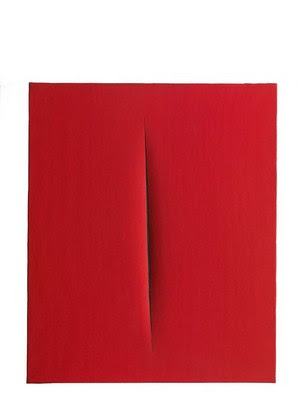
Lucio Fontana
LUCIO FONTANA
Concetto spaziale, Attesa, 1965
Water-based paint on canvas
25.9 x 20.9 inches (66 x 53 cm)
PHOTO COURTESY OF TORNABUONI ART
Lucio Fontana combined the highly saturated monochromatic purity of Klein’s canvases with Pollock’s violently physical action. Fontana’s gesture annihilated Pollock's proclivity toward additive mark-making and replaced it with a vandalistic destructiveness. Drawing attention to the materiality of the picture-plane, Fontana’s cuts question classical interpretations of a ‘figure-ground’ relationship; rather than striving toward an illusion of perspectival depth, Fontana’s punctures create forms within the canvas that embody a real third dimension of space. Moreover, the painting’s chromatic radiance amplifies the profound darkness of the plunging black recesses that aptly signify Fontana’s quest for ''the Infinite, the inconceivable chaos, the end of figuration, nothingness.'' (Lucio Fontana cited in Lucio Fontana, exhibition catalogue, London 1999).

SHIRLEY JAFFE
PRESENTED BY GALERIE NATHALIE OBADIA 
(STAND 364)

Shirley Jaffe
SHIRLEY JAFFE
Untitled, c. 1967
Oil on canvas
51.13 x 34.63 inches (130 x 88 cm)
PHOTO © GALERIE NATHALIE OBADIA
Based on the idea of a movement as the starting point, Jaffe assembles signs within the frame of the canvas, tempering their individual energies and adjusting her palette in order to achieve the overall formal and sensorial equilibrium of the composition. Never overloading the canvas with material so as not to muddy its communication with the viewer, Shirley Jaffe makes works that are states of play, freeze-frames of a flux, immortalizing fugacity, the frantic effervescence of mixed urban forms, isolating and adjusting them precisely on the canvas. The effect of disorientation is pronounced, yet the paintings continue to find their balance in this imbalance. The language of Jaffe’s architectures truly becomes the expression of a shared visual memory.

DANIEL RICHTER
PRESENTED BY GALERIE THADDAEUS ROPAC 
(STAND 345)
At TETAF New York 2025 Galerie Thaddaeus Ropac will present a painting by Daniel Richter titled Triumpf des Höhnischen, 1924 (Oil on canvas, 91.73 x 68.11 x 2.55 inches / 233 x 173 x 6.5 cm).
Daniel Richter’s most recent series of paintings shows anthropomorphic creatures against chromatic backgrounds. Rendered in a spectrum of bright, prismatic colors, the works oscillate between geometric rigidity and organic fluidity. The German artist first came to prominence in the 1990s when he transitioned into fine art from the world of music, where he began his career designing posters and record sleeves for punk bands. Daniel Richter combines motifs from art history, mass media and pop culture to create idiosyncratic, surreal worlds. Ever the innovator, his recent paintings tread a path between figuration and abstraction, typified by the chaotic entanglements of fragmented bodies. Evoking a sense of rebellious energy and electric vibrancy, making the figures both playful and defiant.
 
TETAF NEW YORK 2025

14/02/23

Calder/Tuttle @ Pace Gallery, Los Angeles - Tentative

Calder/Tuttle:Tentative
Pace Gallery, Los Angeles
January 21 – February 25, 2023

Pace presents an exhibition of work by Alexander Calder, selected and installed by artist Richard Tuttle, at its Los Angeles gallery. The show, titled Calder/Tuttle: Tentative, is presented in collaboration with the Calder Foundation. Brought to life through Tuttle’s vision, the exhibition focuses on Alexander Calder’s artistic output in 1939, bringing together small- and medium-scale sculptures—including a masterful untitled mobile that is being exhibited for the first time—as well as a selection of works on paper created by the artist that year. 

Concurrently with the exhibition at Pace, David Kordansky Gallery in LA presents works made by Richard Tuttle as freewheeling analogies to Alexander Calder’s storied practice and the contexts in which the artist worked. 

Best known for his mobiles, which transformed the modern conception of sculpture, Alexander Calder is widely regarded as one of the most important artists of the 20th century. He was also a favorite collaborator of the greatest architects of his time, and works related to three architectural commissions from 1939 will be included in the exhibition: Calder’s six intimately scaled maquettes made to complement architect Percival Goodman’s design for the Smithsonian Gallery of Art Architectural Competition, each of which feature lively forms poised on wires extending from trapezoidal bases; the nearly seven-foot-tall stabile Sphere Pierced by Cylinders (1939), created as part of Oscar Nitzschke’s architectural proposal for the Bronx Zoo; and finally, a hanging mobile related to Calder’s commission, Lobster Trap and Fish Tail (1939), for the main stairwell of Philip L. Goodwin and Edward Durrell Stone’s new building for The Museum of Modern Art on West 53rd Street in New York. The latter mobile makes its public debut at Pace in LA.

Additional highlights of the Calder exhibition at Pace in LA include Gothic Construction from Scraps (1939), a standing mobile that the artist constructed from rough-hewn metal forms discarded while making other works; Black Petals (1939), a freestanding black sculpture with elongated, abstract forms situated in a diagonal formation that seems to propel itself upwards; The Tuning Fork (ca. 1939), not exhibited for the past 40 years, in which an amalgam of differently weighted forms dynamically interact in myriad ways; and Little Mobile for Table’s Edge (ca. 1939), an unusual study of precarity and balance. In the way of works on paper, which represent a lesser known but significant aspect of Calder’s practice, the show will feature five vibrant compositions that examine relationships between otherworldly forms. Imbued with a dreamlike sensibility, these works, along with one monochromatic pencil drawing that serves as a study for an untitled mobile in the show, can be understood in conversation with Calder’s sculptures—featuring spirals, discs, flourishes, and other motifs that appear elsewhere in his oeuvre.

Richard Tuttle’s approach for the show at Pace in LA focuses on Alexander Calder’s intentions for his 1939 works and the greater context in which he produced them. The sculptures and works on paper by Calder in this exhibition were all made amid the outbreak of World War II. Tuttle questions the ways that aesthetic and philosophical exchanges between Europe and the United States in this period reflect in Calder’s practice. On a formal level, Tuttle explores enactments of verticality and horizontality—as well as plays of light and shadow—in Calder’s work. Tuttle’s vision for this exhibition, which centers on the ways that space discovered in the mobiles flows into two-dimensional abstract expressionist painting, disrupts long and widely held ideas about Calder’s impact on viewers and other artists during his lifetime and since his death.

Richard Tuttle has written a poem for his concurrent exhibitions in LA:
Tentative

Nothing is more
individual than
two artists. The
worth of one is

present behind
thoughts that keep the
other accustomed
in dance and light.

Art dies without
art to live its
life. Old helps new.
New helps old see.
Over the past six decades, Richard Tuttle has nurtured an idiosyncratic and diverse practice through which he investigates the ways in which light, scale, and systems of display flow into the world and make it better. Reveling in visual and logical quandaries, the artist has cultivated a developmental approach to art making that grows in range and inquiry with each new project. Much of Tuttle’s art defies easy categorization within any single medium, and his work is always marked by unconventional uses of beauty and poetry. At Pace in LA, Tuttle meditates on the fundamental formal elements that make up Calder’s two- and three-dimensional compositions. In the exhibition of his own work at David Kordansky Gallery, Tuttle reimagines Calder’s lyrical language of abstraction as concrete through his own distinctive, and utterly contemporary, artistic vocabulary. The show will feature a series of wall-based sculptures entitled Black Light and another group of works entitled Calder Corrected. Together, these presentations speak to the enduring presence and power of modernist abstraction in art today.

On the occasion of Calder/Tuttle:Tentative, Pace Publishing and David Kordansky Gallery produce a catalogue featuring new texts and poems by Richard Tuttle and a poem by Alexander S. C. Rower, president of the Calder Foundation and grandson of the artist.

RICHARD TUTTLE’s (b. 1941, Rahway, New Jersey) direct and seemingly simple deployment of objects and gestures reflects a careful attention to materials and experience. Rejecting the rationality and precision of Minimalism, Tuttle embraced a handmade quality in his invention of forms that emphasize line, shape, color, and space as central concerns. He has resisted medium-specific designations for his work, employing the term drawing to encompass what could otherwise be termed sculpture, painting, collage, installation, and assemblage. Overturning traditional constraints of material, medium, and method, Tuttle’s works sensitize viewers to their perceptions. His working process, in which one series begets the next, is united by a consistent quest to create objects that are expressions of their own totality.

ALEXANDER CALDER (b. 1898, Lawnton, Pennsylvania; d. 1976, New York, New York) utilized his innovative genius to profoundly change the course of modern art. Born into a family of celebrated, though more classically trained artists, he began by developing a new method of sculpting: by bending and twisting of wire, he essentially “drew” three-dimensional figures in space. He is renowned for the invention of the mobile, whose suspended, abstract elements move and balance in changing harmony. Coined by Marcel Duchamp in 1931, the word mobile refers to “motion” and “motive” in French. Some of the earliest mobiles moved by motors, although these mechanics were virtually abandoned as Calder developed objects that responded to air currents, light, humidity, and human interaction. He also created stationary abstract works that Jean Arp dubbed stabiles.

From the 1950s onward, Calder turned his attention to international commissions and increasingly devoted himself to making outdoor sculpture on a grand scale from bolted steel plates. Some of these major commissions include .125, for the New York Port Authority in John F. Kennedy Airport (1957); Spirale, for UNESCO in Paris (1958); Teodelapio, for the city of Spoleto, Italy (1962); Trois disques, for the Expo in Montreal (1967); El Sol Rojo, for the Olympics in Mexico City (1968); La Grande vitesse, which was the first public artwork to be funded by the National Endowment for the Arts (NEA), for the city of Grand Rapids, Michigan (1969); and Flamingo, for the General Services Administration in Chicago (1973).

Alexander Calder’s work is in the collections of The Museum of Modern Art, New York; Whitney Museum of American Art, New York; National Gallery of Art, Washington, D.C.; Hirshhorn Museum and Sculpture Garden, Smithsonian Institution, Washington, D.C.; Art Institute of Chicago; San Francisco Museum of Modern Art; Musée National d’Art Moderne, Centre Pompidou, Paris; Louisiana Museum of Modern Art, Humlebæk, Denmark; Leeum, Samsung Museum of Art, Seoul; and other major art institutions around the world. Long-term installations of Calder’s monumental sculptures can be found at the Walker Art Center, Minneapolis; Storm King Art Center, Mountainville, New York; Museo Nacional Centro de Arte Reina Sofía, Madrid; Moderna Museet, Stockholm; Kunstmuseum Basel; Tehran Museum of Contemporary Art; National Museum of Art, Osaka, Japan; Museo de Bellas Artes, Caracas; and elsewhere.

Recent exhibitions dedicated to Alexander Calder’s work have been held at The Museum of Modern Art, New York; Neue Nationalgalerie, Berlin; The Museum of Fine Arts, Houston; and the Montreal Museum of Fine Arts. A permanent exhibition is on view at the National Gallery of Art, Washington, D.C.

PACE LOS ANGELES
1201 South La Brea Avenue, Los Angeles, CA
www.pacegallery.com
_________________


Richard Tuttle @ David Kordansky Gallery, Los Angeles - Calder/Tuttle:Tentative

Richard Tuttle 
Calder/Tuttle:Tentative 
David Kordansky Gallery, Los Angeles 
January 21 – February 25, 2023 

David Kordansky Gallery presents Calder/Tuttle:Tentative, an exhibition featuring work by RICHARD TUTTLE inspired by the seminal American artist, Alexander Calder. Concurrently, Pace Gallery, in collaboration with the Calder Foundation, presents an exhibition of Alexander Calder works from 1939 selected and installed by Richard Tuttle. 

Calder/Tuttle:Tentative comprises several parts. At David Kordansky Gallery, Richard Tuttle presents a series of wall-based sculptures entitled Black Light and a group of works entitled Calder Corrected. Informed by an ongoing engagement with Calder’s work, aesthetic philosophy, and observational temperament, both series find Tuttle exploring a range of phenomena that are among the fundamental features of visual art: the visual and physical experience of color, the perception of geometry and mass, and the associative communications between abstract and natural forms. The works are not so much meditations on Calder as they are responses to—and from—the contexts in which Calder’s project emerged. In this sense, Richard Tuttle employs his own artistic vocabulary to refresh the contemporary take on Calder’s, shedding clarifying light not only on the abiding presence of modernist abstraction in art today, but on timeless facets of art’s presence in human lives.

This approach also guides Richard Tuttle’s curatorial process at Pace, where he has installed works by Calder in an attempt to foreground the intentions with and conditions under which they were made. While Tuttle has taken formal and historical considerations into account—focusing, for instance, on works made on the brink of World War II and reflecting on aesthetic and philosophical crosscurrents in Europe and the United States—he also creates space for foundational concepts of verticality, horizontality, light, and shadow to appear with bracing clarity. There are cases in which this process disrupts long-held ideas about why Calder’s work has made such an impact on viewers, and especially other artists, over the decades.

In the Black Light works, Richard Tuttle transposes these concerns into multivalent constructions that reveal craft and concept to be inseparable, if distinct, modes of understanding how art connects to its viewers and the world. The exhibition’s title serves as a waypost: if every aesthetic proposition or material experiment puts into motion a cascading series of effects and counter-effects, the experience of an artwork is always a tentative affair. Richard Tuttle’s objects address this condition by posing questions about how and where color appears, and reveling in its propensity for simultaneously containing, occupying, and portraying space. The Black Light works constitute a continuation of Tuttle’s reflections on the possibilities inherent in beams and beam-like forms, which found recent expression in a series of large- and small-scale sculptures the artist produced in 2022. However, they also provide a forum in which the artist can directly address the choreography of visible and invisible elements which provides a through-line in Calder’s project. In both cases, they find Richard Tuttle reframing concerns, particularly about art’s paradoxical relationship to dematerialization, which have preoccupied him for decades. Many of the works’ compositional details, including the pencil-drawn letters, numbers, and arrows that guided their making, as well as their varied brushwork, highlight the impossibility of separating surfaces from interiors. These two-dimensional elements carry palpable weight, leaving room for the planar paper elements that define their silhouettes to function as a kind of three-dimensional drawing.

The Calder Corrected drawings, meanwhile, are also sites where three-dimensional effects occur in what are ordinarily considered two-dimensional places. The vertical line that bisects each work, and that results when Tuttle removes facing pages from a sketchbook, is both a distinct physical presence and a felt void where lines, shapes, and colors seem to momentarily hide from view. In their gaps, the drawings harbor possibilities, prompts for the imagination to invent alternate readings even as it concedes the limitations of the physical world. Here too, Tuttle brings a variety of materials together, showing how ideas translate into facts—and vice versa—and how colors and shapes adhere to—and resist—the intentions according to which they are manipulated. For all of these reasons, and like the curatorial orientation Tuttle brings to rethinking Calder’s legacy more broadly, the works on view in this exhibition place emphasis on the processes by which artistic potentials become actualized. In so doing, they offer precise, and therefore tentative, representations of phenomena like gravity, language, emotion, and change that are as pervasive as they are abstract.

In 2022, Bard Graduate Center presented What Is the Object?, an exhibition co-curated by Richard Tuttle and Peter N. Miller from Tuttle’s collection of objects, which was presented alongside a series of never-before-exhibited artworks by the artist. Since the 1970s, Tuttle has been the subject of numerous solo exhibitions at museums throughout the world, including M WOODS, Beijing (2019); Phillips Collection, Washington, D.C. (2018); Kunstmuseum aan Zee, Ostend, Belgium (2017); Museo de Arte de Lima (2016); Metropolitan Museum of Art, New York (2016); and Whitechapel Gallery and Tate Modern, London (2014). In 2005–2007, a retrospective exhibition organized by the San Francisco Museum of Modern Art traveled to five additional institutions, including the Whitney Museum of American Art, New York, and The Museum of Contemporary Art, Los Angeles. His work is included in over sixty permanent collections, including the Los Angeles County Museum of Art; Metropolitan Museum of Art, New York; Museum of Modern Art, New York; Stedelijk Museum, Amsterdam; Dallas Museum of Art; and Museum Boijmans Van Beuningen, Rotterdam, the Netherlands. Richard Tuttle lives and works in New York and Abiquiú, New Mexico.

DAVID KORDANSKY GALLERY
5130 W. Edgewood Pl., Los Angeles, CA 90019
_______________


15/10/21

Alexander Calder @ Pace Gallery, Seoul

Calder 
Pace Gallery, Seoul 
Through November 20, 2021 

Pace presents an exhibition of works created by Alexander Calder between the 1950s and 1970s at its Seoul gallery. Best known for his mobiles, which transformed the modern conception of sculpture, Alexander Calder is widely regarded as one of the most important artists of the 20th century. Featuring eight sculptures, ten works on paper, and one painting, this show marks the gallery’s first presentation dedicated to Alexander Calder’s work since the opening of its New York space at 540 West 25th Street in 2019. 

The presentation in Seoul features a selection of sculptures created by Alexander Calder over the course of three decades. It includes quintessential hanging mobiles such as Untitled (1969) and Untitled (1963) as well as the stabiles Les Arêtes de poisson (maquette, 1965) and Gwenfritz (1:5 intermediate maquette, 1968), one of the models for Alexander Calder’s 35-foot-tall sculpture outside the Smithsonian National Museum of American History in Washington, D.C. Also included in the exhibition is the magnificent standing mobile Franji Pani (1955), made during Alexander Calder’s two-month trip to India, where he realized a series of sculptures at the behest of architect and collector Gira Sarabhai in exchange for a tour around the country.

The exhibition centers on ten vibrant works on paper, which represent a lesser known but significant aspect of the artist’s practice. The ink and gouache paintings in this presentation date to the 1960s and 1970s, ranging from works punctuated by dynamic black lines that bleed into variously colored backgrounds to those with starkly rendered spirals and geometric forms that visually echo his sculptural practice. The collector and art historian Jean Lipman wrote that this medium, which Alexander Calder focused on in his later years, suited the artist’s “high-spirited, rapid, and spontaneous expression.”

Another highlight of the exhibition is Alexander Calder’s oil painting The Black Moon (1964), which sets a crescent and a series of circles against a dreamy background of soft gray and yellow tones. The composition also features a large white spherical shape, whose blue outlines suggest a third dimension beyond the canvas. Notably, Alexander Calder’s first truly abstract works of art were part of a series of small oils made in the wake of a transformative visit to Piet Mondrian’s studio in October 1930. Alexander Calder was deeply impressed by the spatial dynamics of the studio, later writing that the visit “gave me a shock that started things.”

ALEXANDER CALDER (1898–1976) utilized his innovative genius to profoundly change the course of modern art. Born into a family of celebrated though more classically trained artists, he began his career by developing a new method of sculpting: by bending and twisting of wire, he essentially “drew” three-dimensional figures in space. He is renowned for the invention of the mobile, whose suspended, abstract elements move and balance in changing harmony.

Coined by Marcel Duchamp in 1931, the word mobile refers to “motion” and “motive” in French. Some of the artist’s earliest mobiles moved by a system of motors, although these mechanics were eventually abandoned as Alexander Calder developed works that responded to air currents, light, humidity, and human interaction. He also created stationary abstract works that Jean Arp dubbed stabiles.

From the 1950s onward, Alexander Calder turned his attention to international commissions and increasingly devoted himself to making outdoor sculpture on a grand scale. Some of these major commissions include .125, for the New York Port Authority in John F. Kennedy Airport (1957); Spirale, for UNESCO in Paris (1958); Teodelapio, for the city of Spoleto, Italy (1962); Trois disques, for the Expo in Montreal (1967); El Sol Rojo, for the Olympics in Mexico City (1968); La Grande vitesse, the first public artwork to be funded by the National Endowment for the Arts (NEA), for the city of Grand Rapids, Michigan (1969); and Flamingo, for the General Services Administration in Chicago (1973).

Alexander Calder is the subject of ongoing solo exhibitions at The Museum of Modern Art, New York, and the Neue Nationalgalerie, Berlin. The Museum of Fine Arts, Houston, opens the exhibition Calder-Picasso, and the presentation Calder Now, which situates Alexander Calder in dialogue with contemporary artists, will open at the Kunsthal Rotterdam in November.

Alexander Calder’s work is in the collections of The Museum of Modern Art, New York; Whitney Museum of American Art, New York; National Gallery of Art, Washington, D.C.; Hirshhorn Museum and Sculpture Garden, Smithsonian Institution, Washington, D.C.; Art Institute of Chicago; San Francisco Museum of Modern Art; Musée National d’Art Moderne, Centre Pompidou, Paris; Louisiana Museum of Modern Art, Humlebæk, Denmark; Leeum, Samsung Museum of Art, Seoul; and other major art institutions around the world. Long-term installations of Alexander Calder’s monumental sculptures can be found at the Walker Art Center, Minneapolis; Storm King Art Center, Mountainville, New York; Museo Nacional Centro de Arte Reina Sofía, Madrid; Moderna Museet, Stockholm; Kunstmuseum Basel; Tehran Museum of Contemporary Art; National Museum of Art, Osaka, Japan; Museo de Bellas Artes, Caracas; and elsewhere. New York were given by the artist to the Tate in 1969, arriving in London in 1970. This new display marks 50 years since the iconic paintings came to London, fulfilling Rothko’s wish to have his work hung beside the British painter he deeply admired.

PACE GALLERY SEOUL
2/3F, 267 Itaewon-ro, Yongsan-gu, Seoul
__________________


10/02/21

Alexander Calder @ MoMA, New York - Modern from the Start

Alexander Calder: Modern from the Start
MoMA, New York
March 14 - August 7, 2021

The Museum of Modern Art announces Alexander Calder: Modern from the Start, a focused look at one of the most wellknown and beloved artists of the 20th century through the lens of his relationship with MoMA. Alexander Calder: Modern from the Start will include approximately 70 artworks paired with film, historical photographs, and other archival materials drawn from MoMA’s collection and augmented by key loans from the Calder Foundation, New York. The exhibition is organized by Cara Manes, Associate Curator, with Zuna Maza and Makayla Bailey, Curatorial Fellows, Department of Painting and Sculpture.

The exhibition will take as a point of departure the idea that ALEXANDER CALDER (American, 1898–1976) assumed the unofficial role of the Museum’s “house artist” during its formative years. His work was first exhibited at MoMA in 1930, months after the institution opened its doors, and he was among only a handful of artists selected by the Museum’s founding director, Alfred H. Barr Jr., for inclusion in his two landmark 1936 exhibitions, Cubism and Abstract Art and Fantastic Art, Dada, Surrealism. To inaugurate the then-new Goodwin and Stone Building in 1939, Alexander Calder was commissioned to make a hanging mobile for its interior “Bauhaus Staircase”; the resulting Lobster Trap and Fish Tail still hangs there today.

Alexander Calder also worked closely with curator James Johnson Sweeney, in collaboration with artists Marcel Duchamp and Herbert Matter, on the checklist, catalogue, and installation of his major 1943 midcareer retrospective at MoMA, which introduced the artist, by then already known in Europe, to a broad American audience, through a survey of work made since his foundational years in the late 1920s living and working in Paris, at the heart of the international avant-garde. Throughout the 1940s and 1950s, Alexander Calder’s sculptures were a mainstay of the Abby Aldrich Rockefeller Sculpture Garden, where they have continued to reappear in the intervening decades. Ten years before his death, in 1966, Alexander Calder made an impressive gift of 19 artworks to MoMA in order to round out the institution’s holdings.

Aligned with the Museum’s commitment to exploring all facets of its collection, Modern from the Start will take a deep dive into the work of Alexander Calder and provide a timely opportunity to revisit his legacy. Following a loose chronology, the exhibition will present examples from the full scope of Alexander Calder’s work, from the earliest wire sculptures of the 1920s through the largescale mono- and polychrome stabiles and standing mobiles of his later years. Part of the exhibition will focus on the artist’s work up until his midcareer retrospective at MoMA in 1943, including the wire sculpture Josephine Baker (III) (c. 1927); A Universe (1934), the first work 2 by Alexander Calder to enter the  Museum’s collection; painted sculptural reliefs, works on paper, and rarely seen motorized works, all from the 1930s; a group of Constellation sculptures from the 1940s; and a selection of jewelry made by Alexander Calder for his family and friends.

Drawn from MoMA’s archives, photographs and correspondence between the artist and various collaborators, such as Alfred H. Barr Jr. and James Johnson Sweeney, will illuminate Alexander Calder’s close relationship with the Museum. The other section of the exhibition will trace the development of Alexander Calder’s practice after his 1943 retrospective at MoMA and will include the hanging mobile Snow Flurry, I (1948) from MoMA’s collection, along with a digitized film of Alexander Calder at work by Swiss artist Herbert Matter from 1950, and a selection of large-scale sculptures. Modern from the Start will be a celebration of Alexander Calder’s work, while also presenting new research and scholarship through the gallery presentation and an accompanying catalogue.

MoMA - MUSEUM OF MODERN ART
11 West 53 Street, New York, NY 10019
______________


07/06/19

Pace Gallery's Inaugural Exhibitions at New Chelsea Gallery, NYC

Pace Announces Inaugural Exhibition
Program for New Flagship Chelsea Gallery Opening September 2019

PACE GALLERY'S NEW CHELSEA BUILDING
Architectural rendering of the southeast façade 
of 540 West 25th Street, New York
Courtesy of Bonetti / Kozerksi Architecture

Pace Gallery announces its inaugural season of programming for its new flagship gallery in New York City, located at 540 West 25th Street. After almost six decades of history in Manhattan, Pace will cement its commitment to Chelsea with a new global headquarters in the heart of the neighborhood. Open to the public on September 14, 2019, Pace will present a series of exhibitions throughout the new building, including: an exhibition dedicated to twentieth century master Alexander Calder occupying the first floor gallery; a show of new paintings by celebrated New York-based artist Loie Hollowell on the second floor; an installation of new work by David Hockney on the third floor; and a presentation charting the evolution of Fred Wilson’s chandelier sculptures installed on the seventh floor. The inaugural exhibition represents several firsts, including Loie Hollowell’s premiere exhibition with Pace in New York. Additional details on each exhibition, accompanying publications, and related programming will be announced over the course of the summer.
“For nearly six decades, Pace has celebrated and advanced the work of creative pioneers,” said Marc Glimcher, Pace Gallery President and CEO. “They are our inspiration, mission, and the source of our vision. Pace has designed and crafted every element of our new global headquarters to provide a vehicle for artists to tell their stories as richly as they deserve to be told and as dynamically as our communities deserve to experience them. It is an honor to inaugurate this gallery with the work of artists who have been so instrumental in creating the fabric of our program; representing both our vibrant history and our exciting future.”
Pace’s new global headquarters is being developed by Weinberg Properties and designed by Bonetti / Kozerski Architecture, in close collaboration with Marc Glimcher. Spanning eight stories and measuring approximately 75,000 square feet, Pace’s new building more than doubles its current exhibition space in New York and features five distinct galleries, including both indoor and outdoor spaces. Each gallery allows for a broad range of installation styles and artistic media, with features such as an entirely column-free design, high loading capacities, and flexible lighting plans creating extraordinarily nimble galleries that can support a diverse approach to exhibition programming.

Inaugural Exhibitions

First Floor:
Alexander Calder

In close collaboration with the Calder Foundation, New York, Pace will inaugurate the 3,600-square-foot first-floor gallery with a focused exhibition dedicated to Alexander Calder. The exhibition will examine the breadth of the artist’s practice beginning in the mid-1920s and leading up to his creation in 1931 of the mobile—an unprecedented form of kinetic sculpture that created a true rupture in the trajectory of art. From his gestural Animal Sketchings and massless wire portraits of the 1920s to his abstract oil paintings of 1930 and the swift progression to motorized objects and hanging mobiles, this exhibition will capture the remarkable transition from potential to actual energy in Calder’s work and underscore his relentless pursuit of the vitality and life force in art.

Second Floor:
Loie Hollowell

The artist’s premiere exhibition with Pace in New York will take place in the new building’s second floor gallery. The exhibition will showcase a series of new large-scale paintings that continue Loie Hollowell’s investigation of bodily landscapes and sacred iconography through allusions to the human form. Drawing inspiration from artists like Agnes Pelton, Georgie O’Keefe, and Judy Chicago, Hollowell’s works abstract the most intimate parts of the human body into primal shapes, such as the mandora and the lingam, in an examination of sexuality, conception, birth, and motherhood. In each work, the artist utilizes color and dimensionality—at times manipulating the canvas with three-dimensional forms—to amplify the phenomenological presence of her corporeal compositions.

Third Floor:
David Hockney

The third-floor gallery will be dedicated to an exhibition of new work by David Hockney. This exhibition will present a 24-panel panoramic drawing and four additional individual drawings. Capturing the arrival of spring in Normandy, these works emphasize Hockney’s ability to unite multiple spatial and temporal experiences of a place into a single image. Influenced by such disparate sources as traditional Chinese scroll painting, contemporary time-based art, and the medieval Bayeux Tapestry, produced in England and housed nearby in Normandy, these new works showcase Hockney’s continued experimentation with the representation of space.

Sixth Floor:
Alexander Calder, Joel Shapiro, and Tony Smith

Offering panoramic views of the Manhattan skyline, the entire sixth floor is devoted to a 4,800 square-foot outdoor exhibition space that can accommodate large-scale sculptural installations. Partially covered by the seventh floor, the design of this space creates the sense of an outdoor room. Exhibitions on the sixth floor will rotate two to three times per year, and for the inaugural installation, Pace will present three monumental outdoor sculptures by three generations of sculptors: Alexander Calder, Joel Shapiro, and Tony Smith. 

Seventh Floor:
Fred Wilson

The seventh-floor exhibition will showcase the evolution of Fred Wilson’s celebrated chandelier sculptures, which the artist began in 2003 when he represented the United States at the 50th Venice Biennale with Speak of Me as I Am. Since then, Wilson’s Murano glass chandeliers, with their evolving shifts in scale, materials, and complexity, have become vehicles for the artist’s meditations on blackness, death, and beauty. Installed hanging from the gallery’s 19-foot-high ceilings, the presentation will include five chandelier sculptures from the artist’s first to his most recent, conceived for the 15th Istanbul Biennial in Fall of 2017.

Looking Ahead to 2019 and 2020

Taking full advantage of the dynamic programming the new building will support, Pace is planning a robust series of exhibitions over the course of 2019 and 2020 and will launch a new interdisciplinary series of live and moving-image programming.

In the late fall of 2019, Pace will present exhibitions dedicated to Mary Corse on the first floor; Chinese painter Li Songsong on the second; and longstanding gallery artist Richard Tuttle on the third. Corse’s exhibition of new paintings will be her first with the gallery in New York since joining Pace in 2018.

Looking ahead to 2020—the 60th anniversary of the gallery—Pace’s new headquarters will host major exhibitions by a diverse range of the gallery’s artists, including debut New York shows for new additions to Pace, such as Lynda Benglis and Arlene Shechet, as well as exhibitions dedicated to pioneers of the twentieth and twenty-first centuries, such as Jean Dubuffet, Isamu Noguchi, and Robert Ryman.

Pace is a leading contemporary art gallery representing many of the most significant international artists and estates of the twentieth and twenty-first centuries. Under the leadership of President and CEO Marc Glimcher, Pace is a vital force within the art world and plays a critical role in shaping the history, creation, and engagement with modern and contemporary art. Since its founding by Arne Glimcher in 1960, Pace has developed a distinguished legacy for vibrant and dedicated relationships with renowned artists. As the gallery approaches the start of its seventh decade, Pace’s mission continues to be inspired by our drive to support the world’s most influential and innovative artists and to share their visionary work with people around the world.

Pace advances this mission through its dynamic global program, comprising ambitious exhibitions, artist projects, public installations, institutional collaborations, and curatorial research and writing. Today, Pace has nine locations worldwide: two galleries in New York; one in London; one in Geneva; one in Palo Alto, California; one in Beijing; two in Hong Kong; and one in Seoul. 

PACE GALLERY
www.pacegallery.com