Showing posts with label Ayyam Gallery. Show all posts

07/10/25

Elias Izoli @ Ayyam Gallery, Dubai - "Inside Out '25" Exhibition

Elias Izoli
Inside Out '25
Ayyam Gallery, Dubai
18 September - 7 November 2025

Ayyam Gallery presents Inside Out '25 an exhibition featuring Elias Izoli’s most recent body of work. After a long hiatus from painting, Izoli returns with a new body of work centered around the circus of life.

A childhood fascination evolved into a profound reflection on the unpredictability and complexity of life as a Syrian citizen. In his latest series, Izoli uses the circus as a metaphor: its performers, from tightrope walkers to clowns and magicians, embody the tension between joy and survival. The circus and its family become a symbol of the broader social body, with each character representing the individuals who comprise the state’s fabric. With concealed motives that slowly unravel under closer inspection, Izoli reveals an environment we, as spectators, have only observed from the outside. He invites us inside the fortress-like walls, offering a view from within.

Rendered in his signature fragmented color style, each painting presents a portrait that speaks to resilience, illusion, and the spectacle of existence. Figures of entertainment, marred by despair and sadness, mirror Izoli’s reflections on the toll conflicts have on everyday life. Some hide behind curtains, others peer out, offering viewers a guarded gaze from within a fortress-like world. Each character remains confined within their own space, some carry suitcases, others’ gaze looms over the big top. Every gesture reflects the emotional heaviness and psychological barriers imposed by our world. The figures seem unable to escape or engage with a reality beyond their own, a world that exists within the fragile yet resilient walls of the circus tent.

Beyond their colorful attire, the circus troupe imagined by Izoli reveals deeper emotions: manipulation, sorrow, and anxiety juggle between the characters’ hands. Distraught feelings resurface, and the figures cease to represent joy or entertainment. Instead, they juggle life’s weight together with their daily struggles. Balance is key to this new take on Izoli’s distinctive use of collage-style painting. It emerges through the interplay between the vibrancy and coolness of his color palette, the joy and sorrow expressed through his chosen characters, and the tension between manipulation and the direct figurative clarity of his themes.

The roundness present in their bodies does not reflect an idealized physiology, but rather the emotional and psychological weight borne by these characters. A symbol of the quiet toll exacted by prolonged conflict and persistent worry in a world imposed upon us. It is this gravity that tethers them, making it difficult to envision an end to their actions as they juggle, balance, and navigate day-to-day realities that offer little to no means of escape.

This series marks a new direction in Izoli’s practice, yet remains rooted in the influence of those who came before him. The theme of balance resurfaces through a contemporary reinterpretation of Da Vinci’s Salvator Mundi, now reimagined in the shape-shifting form of a clown. Like a joker card in a game, the two paintings featuring this clown figure act as wildcards, capable of ending this tumultuous spectacle of emotions. Manipulation takes center stage in these works: vibrant colors, playful acts, and magical illusions draw the viewer in, only to mask the deeper realities beneath the surface. In this swirling performance, joy and despair are intertwined, both performed and concealed at once.

Artist Elias Izoli

Hypnotizing in their emotional depth, Elias Izoli’s works captivate viewers through melancholic facial expressions that reflect intrinsic thoughts.

Izoli’s painting technique can be described as a hybrid, interweaving traditional painting methods with elements of collage. Canvas cutouts form the base pattern upon which his subjects emerge. From children to circus performers, Izoli continuously shifts his focus to different figures while maintaining a consistent intention: to draw viewers into the emotional world of his subjects and create an environment in which both artwork and audience emotionally co-exist. Izoli’s subjects provoke a subtle sense of intrusion, yet they foster a strong empathetic connection with the viewer. The melancholic atmosphere, combined with his signature muted palette, invites the audience into these intimate and emotionally charged spaces.

His fascination with his predecessor, Louay Kayyali, led him to create a series using the same techniques and muted color palette that have defined his work since the beginning of his career. In this series, Izoli adopts Kayyali’s curvaceous, fluid forms to depict human figures, reflecting on the consumerist state of the world, a condition that erodes compassion and empathy, themes omnipresent in Izoli’s art.

After a long hiatus caused by the emotional and psychological toll of the Syrian conflict, Izoli has reclaimed his artistic voice, breathing new life into his canvases. His recent depictions of circus performers place life in a delicate balance, echoing the instability and tension inherent in each act portrayed. Melancholy once again pervades the works, etched into the grimaces of characters who, despite being symbols of joy and entertainment, radiate nostalgia and deep sadness.

Born in 1976, Elias Izoli lives and works in Damascus, Syria. Since 1993, his works have been showcased in numerous solo and group exhibitions, including several at Ayyam Gallery in Beirut and Dubai (2010, 2012, 2013, 2016, and 2018). 

AYYAM GALLERY 
B11, Alserkal Avenue, Street 8, Al Quoz Industrial 1, Dubai

23/02/24

Faisal Samra Exhibition @ Ayyam Gallery, Dubai - "Immortal Moment II - Coping with the Shock"

Faisal Samra
Immortal Moment II - Coping with the Shock
Ayyam Gallery, Dubai
27 February - 15 April 2024

Faisal Samra
FAISAL SAMRA
PSF-P2, 2023 
Charcoal, Ink & Oil on Canvas, 50.5 x 50.5 cm
© Faisal Samra, Courtesy Ayyam Gallery

Ayyam Gallery presents Immortal Moment II - Coping with the Shock, a solo exhibition featuring Faisal Samra’s recent body of work.

This exhibition showcases the second body of work from the Immortal Moment project, in which Faisal Samra creates artworks through the accumulation of instances, pushing the viewer to question the opportunities of a single moment. In the first chapter of this project, Faisal describes the technique as capturing a moment and immortalizing it in time through gestural performances, serving as an expression of emotions. However, now, he defines the outcome as a “shock”. This exhibition reveals the process of Coping with the Shock. 

While the concept of fight or flight is thoroughly examined in the fields of medicine and psychology, Faisal Samra introduces a novel conceptualisation of it through his artistic practice. At a moment of shock, either the moment dominates and controls us, or we absorb and adapt to it, metamorphosing into a new form. To survive and overcome the shock is what we call coping.

In the spirit of fight, the artist intervenes post gesture to cope with what chance and the laws of physics produce. The study of the improvised creation allows the artist to seek meaning within the abstraction. Therefore creating postshock creatures and figures. In a meditative process, the summation of dots and splashes of color amount to what the artist is looking for. Ultimately, this artistic endeavor becomes an endless cycle of documentation, acts, and gestures that trace time and immortalize it, one overcoming the other.

The cyclic timeline in capturing the essence of moments is evident in his concepts and the evolution of his artistic practice. In the Distorted Reality series (2005/2011), Faisal chose a moment from countless stills of filmed performances. In the subsequent project, Thriving Emotions - Immortal Moment the artist identifies the moment before anything else. The emphasis lay on the emotion conveyed through the spontaneous act of creating marks. The Immortal Moment project comes to a full circle in this exhibition: through gestural mark-making, Faisal Samra restructures the singular moment of action to birth a new series of moments to establish control amidst the unpredictable.

The dialogue between the abstract and figurative, conceptually or formalistically, is essential to Faisal Samra’s work. Time, being one of the most abstract ideas becomes figurative when Faisal visually notes down specific points in time through the use of charcoal and paint. The result is formalistically abstract, but the final creation becomes figurative through several interventions, which represent a culmination of temporal instances. 

FAISAL SAMRA - BIOGRAPHY

Long considered one of the Arab Gulf’s foremost artists and a pioneer of conceptual art in the Middle East, Bahrainiborn, Saudi national Faisal Samra incorporates digital photography, painting, sculpture, video, and performance in a creative repertoire that explores existentialist themes with the figure at its center. Since the mid-1970s, Faisal Samra has tested the conventional functions of media through meticulously structured works with experimentation and research as the guiding principles of his artistic practice. As his oeuvre has progressed and defied traditional modes of representation, he has rebelled against his own understanding of art, transitioning into new works that maintain three essential concepts: spontaneity, dynamism, and secrecy.

In 1974, Faisal Samra emigrated from Saudi Arabia to France to attend the Ecole Nationale Supérieure des Beaux-Arts (ENSBA), Paris. While studying at the esteemed institution, he immersed himself in the work of modern and contemporary European artists. This initial period of Faisal Samra’s development was distinguished by expressionist drawings and paintings that investigate the body in motion or at rest, establishing a conceptual basis for later videos, photographs, and installations, while also demonstrating his initial rejection of the prescribed forms of figuration. Upon graduating from the ENSBA in 1980, Faisal Samra settled in Saudi Arabia and continued to exhibit abroad. In the late 1980s, he returned to France, where he spent four years as an art consultant at the Institut du Monde Arabe. After nearly a decade of contributing to collective exhibitions across Europe, he held his first solo show at Etienne Dinet Gallery in Paris (1989). This milestone was followed by Le Pli (1991), a critically acclaimed exhibition at the Institut du Monde Arabe that established Faisal Samra as a leading artist from the Arab world. This period of his career was distinguished by early investigations of emotive and sensory approaches to art.

In the 1990s, Faisal Samra’s Heads and Other Body series introduced hanging art objects that blur the lines between painting and sculpture by liberating the treated canvas from the stretcher or frame and incorporating materials such as wire mesh, which create an armature for three-dimensional forms. This enabled Faisal Samra to explore the dynamics of an artwork as it is experienced in a particular setting while presenting constructive materials as its form and content. These formal and conceptual breakthroughs led to influential installation, video, and multimedia works that continued his career-long investigation of life, the space between birth and death, and how time can be reflected through the visual devices of art.

The artist’s selected solo exhibitions include the Ministry of Culture in Bahrain (2016); Bin Matter House, Bahrain (2015); Ayyam Gallery Al Quoz, Dubai (2014); Ayyam Gallery London (2014); Ayyam Gallery Jeddah (2013); HD Galerie, Casablanca (2012); Traffic Gallery, Dubai (2011); Albareh Gallery, Bahrain (2010); Galerie Nathalie Obadia, Paris (2009); XVA Gallery, Dubai (2007).

Recently, Faisal Samra has participated in collective exhibitions at the Bienalsur, Argentina (2019); OFF Biennale Cairo (2018, 2015); Musée Labinet, France (2017); Low Gallery, San Diego, USA (2016); Abu Dhabi Festival, UAE (2015); Busan Museum, South Korea; FotoFest, Houston (2014), Edge of Arabia, London (2012); Mori Art Museum, Tokyo (2012); Maraya Art Center, Sharjah (2010).

Faisal Samra’s works are housed in the collections of The British Museum, London; BuchDruckKunst e.V Art Book Museum, Hamburg; the National Museum, Mexico City; the Modern Art Museum, Cairo; Almansouria Foundation, Jeddah; Jameel Art Foundation, Jeddah; Jordan National Gallery of Fine Arts, Amman; Mathaf: Arab Museum of Modern Art, Doha; and Bahrain National Museum, Manama, among others. He has participated in biennials in Singapore and Cairo (2008) and is a jury member for the Alexandria Biennale, Egypt.

In 2012, Skira Editore published an eponymous monograph on the artist.

AYYAM GALLERY
B11, Alserkal Avenue, Street 8, Al Quoz 1, Dubai

26/12/23

Tammam Azzam @ Ayyam Gallery, Dubai - يوميات - Diary Exhibition

Tammam Azzam
يوميات - Diary
Ayyam Gallery, Dubai
8 January - 20 February 2024

Tammam Azzam
TAMMAM AZZAM
Railway, 2023 
Paper Collage on Canvas, 90 x 130 cm
© Tamman Azzam / Courtesy of Ayyam Gallery

Ayyam Gallery presents Diary, a solo exhibition featuring TAMMAM AZZAM’s recent body of work.
In the exhibition Diary, Tammam Azzam, an artist known for his profound explorations of the destruction and reconstruction of an image or space, showcases works that play with perspective. Horizon lines expand outward and urban vistas are cut into parts, interrupted like the lines of a window frame. In one untitled 2021 painting, the sky is a turquoise sea-blue, which complicates the boundaries of the subject, an earthy terrain referencing the lava fields in the south of Syria, where Azzam is from. The sea-sky’s color marks a tonality he has carried with him, visible in paintings of scenes from parts of Berlin, thus connecting different places in visual moments.

In four 2022 studies on paper, Azzam zooms in on a particular building in a Berlin neighborhood, mapping its rise with a rectangular grid of windows. At times the rectangles are left blank like empty plots and while in other cases they are filled in and fused. Through the use of color, the architecture — enveloped by a conventional sky or muddy green and red — becomes a subjective reality. 

2018 marked a significant turning point for Azzam, where he delved into paper collages. The papers he uses, varying from 30 to 110 grams, are layered, glued and constituted in detail through a meticulous use of color. His resulting broken-up façades move beyond the collapsed cityscapes evident in other signature works such as the largely monochrome 2014 series Storeys. Where much of Azzam’s previous work has been seen to index the war-torn country he left behind in 2016, his visual narratives construct an arc broader than displacement and memory. Pieced together in collages on canvas like intricate yet imperfect puzzles, the artist evokes a vision about to be formed. The painted paper collages are symbolic of the delicate balance between fragility and creation, between a weathered façade and fluid abstractions of nature. In Neukladow for example, a certain opacity in technique is tempered with washes and reflections of water.

In his depictions of empty roads that go beyond our field of vision, he creates a topography like veins of marble, disappearing in the distance. Each fragment in his work (of color, material, form) is a piece of time, a rhythm. And the entire picture is more than the sum of its parts. Take the 2023 collage of copper-toned tectonic plates which could equally be the earth’s crust or an icy lake shimmering in the sun. Just above the painting’s center the ground become a vertical, cracked wall. This kind of shift in vantage point impacts the work’s sense of dimension and texture as well as the ways in which the eye travels and rests — how we understand the world and time.

As Azzam bears witness to his surroundings, adopting a point of view that is never top-down but consistently frontal, he emphasizes a minute scale within more-than-human worlds. Empty of living beings and yet eerily familiar, these are instances of stillness and presence — situated after an event has already happened, or before an imminent occurrence.

Text by Nadine Khalil
TAMMAM AZZAM - BIOGRAPHY

Born in Damascus, Syria in 1980, Tammam Azzam received his artistic training from the Faculty of Fine Arts, University of Damascus with a concentration in oil painting. Alongside a successful career as a painter in Syria, Azzam was a prolific graphic designer, an experience that would inform his digital media work after relocating to Dubai with the start of the country’s conflict.

The initial phase of Tammam Azzam’s work was distinguished by a ‘hybrid form’ of painting with applications of various media that allowed him to arrive at tactile interactions between surface and form that multiply as compositions evolve. These semi-abstract works use unconventional materials such as rope, clothespins, and other found objects in order to accentuate the depth, texture, and space of laboured picture planes, creating a visible tension. Although outwardly different in appearance, the series that resulted from these early experiments were inspired by the artist’s changing perceptions of specific urban environments.

Following the start of the uprising in Syria, Tammam Azzam turned to digital media and graphic art to create visual composites of the conflict that resonated with international viewers. These widely distributed works are informed by his interest in the interventionist potential of digital photography and street art as powerful and direct forms of protest that are difficult to suppress. In early 2013, Tammam Azzam made worldwide headlines when his Freedom Graffiti print went viral on social media.

Recently, he has returned to painting with Storeys, a series of monumental works on canvas that communicate the magnitude of devastation experienced across his native country through expressionist compositions of destroyed cityscapes. Chronicling the current state of his homeland, Tammam Azzam delves into a cathartic exercise of reconstruction, storey by storey. Alongside these new paintings, he has produced a significant body of giclée prints and installations that depict the facets of cities through similar themes.

Tammam Azzam has contributed to large-scale international exhibitions such as the FUU-Street Art Festival, Sarajevo (2015); Vancouver Biennale, where he was in residence (2014); FotoFest Biennial, Houston (2014); Dak’Art: Biennial of Contemporary African Art, Dakar (2014); Alexandria Biennale (2014); and the 30th Biennial of Graphic Arts, Ljubljana (2013).

In recent years, Tamman Azzam has participated in solo and group exhibitions at such venues as Kornfeld Gallery, Berlin, German (2022), Museen in Sudtirol in Tirol, Italy (2020); Haines Gallery, San Francisco, CA, USA (2019); Ayyam Gallery - 11 Alserkal Avenue, Dubai (2019, 2016); Kornfeld Galerie, Berlin, Germany (2018); Bienal del Sur, Caracas (2017); Künstlerforum Bonn, Bonn (2017); For-Site Foundation, San Francisco (2017, 2016); European Capital of Culture-Pafos, Pafos (2017); City Museum of Odenburg, Oldenburg (2017); Künstlerverein Walkmühle, Wiesbaden (2016); Columbia University, New York (2016); Tainiothiki Twixtlab, Athens (2016); Banksy’s Dismaland, Weston-super-Mare (2015); Fondazione Giorgio Cini, Venice (2015); Framer Framed in de Tolhuistuin, Amsterdam (2015); Forum Factory, Berlin (2014); Lena & Roselli Gallery, Budapest (2014); Liquid Art House, Boston (2014); Rush Arts, New York (2014); Busan Museum of Art, Seoul (2014); 1x1 Art Gallery, New Delhi (2014).

In 2016, Tammam Azzam received an artist fellowship at the Hanse-Wissenschaftskolleg Institute for Advanced Study in Delmonhost.

AYYAM GALLERY
B11, Alserkal Avenue, Street 8, Al Quoz 1, Dubai

05/01/22

Muatasim Alkubaisy @ Ayyam Gallery, Dubai - (t)irony

Muatasim Alkubaisy: (t)irony
Ayyam Gallery, Dubai
12 January - 1 March 2022

Muatasim Alkubaisy
MUATASIM ALKUBAISY
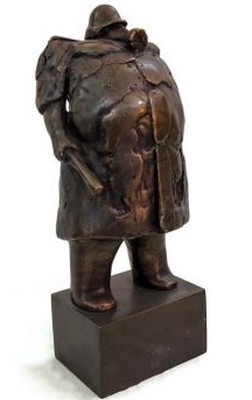
Democracy, 2019 
Bronze sculpture 
Edition of 8, 30 x 10 x 13 cm
© Muatasim Alkubaisy, courtesy of Ayyam Gallery

Ayyam Gallery presents (t)irony the first solo exhibition featuring Sharjah-based Iraqi sculptor Muatasim Alkubaisy’s work. 

(t)irony features Muatasim Alkubaisy’s largest body of work yet, composed of a selection of figures, portraying those that have been ruined by power. These non-deserving and corrupt characters utilize their positions to suffocate and belittle the common man. The artist transforms misery and discrimination into sophisticated and intricate characters through a delicate yet deliberate touch. He magnifies and exaggerates traits creating caricatural portraits, presenting a sarcastic consciousness, and exposing the arrogance of their behaviors and practices.
 
The figures are merely cartoon characters with puffed bellies and swollen jugular veins. Concealed by dress, their physical deformities, malignancy, and evil schemes still show through the bronze’s smooth surfaces. The intimidation, evil, and terror are deprecated into mockery, becoming objects.
 
The characters are situated in different environments, positioned with different stances, alone or in groups. Some read a paper or are on the toilet, trivializing and making them more humane, more attainable. Embedded, are tokens of symbolism, the rats representing vermin qualities such as filth, cruelty, and disease.

MUATASIM ALKUBAISY
 
For over two decades now, Muatasim Alkubaisy has shaped his career as a sculptor highlighting the serious and drastic changes taking place in post 2003 Iraq. In search for answers and pure expression, the artist freed himself from traditional forms and imitation, creating series of bodies encompassing his beliefs and identity. In his relentless quest to stand up against tyranny, slaughter, and diversity of degeneration, while staying true to his skill, tools, and training, the artist created ‘The Generals’ series. 
 
Muatasim Alkubaisy was born in Iraq, where he graduated from the Fine Art Academy in 1992. The artist now resides and works in Sharjah, the UAE. Furthering his career and savoir-faire, the artist is part of the University of Sharjah’s fine art faculty. His works are housed in private and public collections across the UAE and have been exhibited widely in Baghdad, Dubai, Abu Dhabi, and Paris.  
 
As a member of the Iraqi Fine Artists Association, he gained the first Young Artists Award in Baghdad in 2005. Among his key achievements are the gold-plated ceramic mural memorializing the late H.H. Sheikh Zayed bin Sultan Al Nahyan in Al Ain Museum.
 
Muatasim Alkubaisy’s solo exhibition include Agial gallery, Beirut (2019); Al Owais culture foundation, Dubai (2017); Etihad Modern Art Gallery, Abu Dhabi (2015); Abu Dhabi Cultural Foundation (2009); XVA-Gallery, Dubai (2008); and M-Gallery, Paris (2004). Selected group exhibitions include Barjeel Foundation (2020); Mono Gallery, KSA (2019); Al Owais Foundation (2019); and Sikka Art Fair (2016). A selection of Al-Kubaisy’s group exhibition include Abu Dhabi Art fair (2021, 2020, 2019); Mono Gallery, KSA (2019); DEN gallery, Kuwait (2019); Miso Art Fair, KSA (2019); Sikka Art Fair, KSA (2016).

AYYAM GALLERY
B11, Alserkal Avenue, Street 8, Al Quoz 1, Dubai

19/12/21

Samia Halaby @ Ayyam Gallery, Dubai - Flurrying

Samia Halaby: Flurrying
Ayyam Gallery, Dubai
Through 5 January 2022

Samia Halaby
SAMIA HALABY
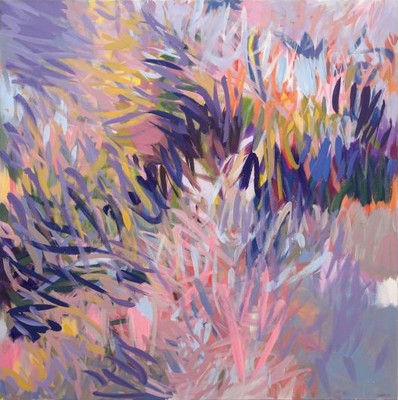
Written with a brush, 2019
Acrylic on Canvas, 152 x 152 cm
© Samia Halaby, courtesy Ayyam Gallery

Samia Halaby’s most recent works reflect everything but stillness, each canvas emulating space encompasses energy and movement, brimming intuitive complexity. Samia Halaby invites us to see nature and urban scenes through her vision, immortalizing a dynamic setting through brush strokes and color, creating infinite layers of moving parts. 

Continuing her previous explorations towards abstraction, Samia Halaby progressively removes all shapes and boundaries and focuses on motion and space only. While still introducing and studying the component of depth, distance, and location, the artist creates fore and backgrounds in which the stokes interpenetrate, creating a timeline of echoes and variations. 

This exhibition highlights both the more geometrical and more calligraphic approach, making a contrasting evolution. The product nonetheless aims to portray space and time and all that lies in between. Thus always creating an invisible set of relationships that our eyes measure and our minds comprehend intuitively. 
SAMIA HALABY: Artist Statement

The Sufi thinker Aby Hamed Muhammad al-Ghazali (1058-1111) noted that the seeing of the eye is limited by some failures while the mind is above these failures. As I think of space and air in painting, I am reminded of his words. Slowly, as I intuitively work on my paintings, my consciousness converts intuition into insights. I think of space in our educated visual perception and realize that, to us painters, space is measured as a distance between us and the concrete object we see through that space in the direction of our gaze. Within that space that we gaze at are things that move in the air. Their motion captures our gaze while our memory captures their path.

The set of new paintings has been in my studio, in the making for over a year. The paintings capture and trace everything that moves in the air, disturbing its relative stasis or affecting its motion. A few days ago, I could watch large snowflakes flurrying here and there up and down Franklin St. being pushed about and swirled by the air currents of the avenue and wind in the air. The odd partners, Al Ghazali and flurrying snowflakes, concretized for me what I have been painting during the past year.

I think of the canvas as space between me and the target of my gaze while my brush marks are activated by energy that puts them in motion. I want to remove all shapes with static boundaries and have only motion. I want eddying, fluctuating, flurrying, patterns of things being blown by the wind obtaining varying speed, adapting with cross currents. I want the energy that scatters, the paths made by all the parts that move to live in a canvas. Growth, gestation, decay, birth, and things I do not yet know make up the ambitious content of my work.  

I want no borders or boundaries. Shapes should be factored by things that constantly move and fluctuate in motion, always reacting to changing situations, turning into variations, not repetitions. Some moving parts lose energy and congeal together, creating islands of rest; such islands might be scattered by the entry of high energy motion in their midst. All shapes need to be born of the motion of things. 

We live in space and see all things moving in it. Space, air, water, and our bodies all are made of moving parts. I think of the canvas as space, and my brush-marks are activated by energy that puts them in motion. The final static, unmoving single image that is a painting should represent one condition in a continuing growth process.
ABOUT SAMIA HALABY

Born in Jerusalem in 1936, Samia Halaby is a leading abstract painter and an influential scholar of Palestinian art. Although based in the United States since 1951, Samia Halaby is recognised as a pioneer of contemporary abstraction in the Arab world.

Samia Halaby began her career in the early 1960s, shortly after graduating from Indiana University with an MFA in Painting. While teaching at the Kansas City Art Institute in 1964, she travelled to the Eastern Mediterranean as part of a faculty research grant and studied the geometric abstraction of the region’s Islamic architecture, which has continuously factored into her work. During this time, Halaby launched a series of experiments that would initiate a career-long investigation of the materialist principles of abstraction: how reality can be represented through form.

Also influenced by the abstract movements of the Russian avant-garde, Halaby works with the conviction that new approaches to painting can redirect ways of seeing and thinking not only within the realm of aesthetics but also as contributions to technological and social advancement. This underlying notion has led to additional experiments in drawing, printmaking, computer-based kinetic art, and free-from-the- stretcher painting.

Samia Halaby has been collected by international institutions since the 1970s, including the Solomon R. Guggenheim Museum of Art (New York and Abu Dhabi); Yale University Art Gallery; National Gallery of Art, Washington D.C.; Art Institute of Chicago; Cleveland Museum of Art; Institut du Monde Arabe; and the British Museum.

Selected solo shows for the artist include Ayyam Gallery, Al Quoz, Dubai (2017); Birzeit University Museum, Ramallah (2017); Beirut Exhibition Center, Lebanon (2015); Ayyam Gallery, London (2015, 2013); Ayyam Gallery, Al Quoz, Dubai (2014); Ayyam Gallery, DIFC, Dubai (2011); and Ayyam Gallery, Beirut (2010). She has participated in recent group shows at Katzen Art Center, American University Museum, Washington, USA (2017); Palestine Museum, Birzeit, Palestine (2017); Galerie Tanit, Munich, Germany (2017); The School of Visual Arts, New York, USA (2017); Ayyam Gallery, DIFC, Dubai (2017); Zürcher Gallery, New York, USA (2016); 3rd Qalandiya International Biennial (2016); Darat Al Funun, Amman (2015); the National Academy of Arts, New York (2015); The Guggenheim Museum, Abu Dhabi (2014); Broadway 1602, New York (2014); and Institut du Monde Arabe, Paris (2009). 

From the 1960s until the late 1980s, Samia Halaby taught at universities throughout the United States. She was the first full-time female associate professor at the Yale School of Art, a position she held for a decade. Her noteworthy contributions to American academia include a groundbreaking undergraduate studio art program that she introduced to art departments throughout the Midwest.

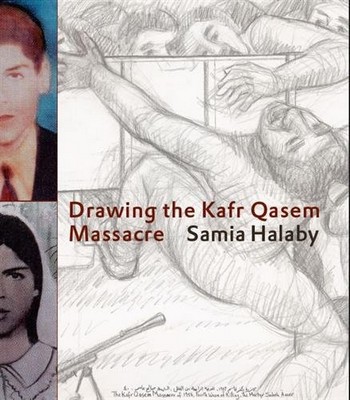
Samia Halaby’s writings on art have appeared in Leonardo: Journal of Arts, Sciences and Technology, Jerusalem Quarterly, and Arab Studies Quarterly, in addition to edited volumes, while her independently published survey Liberation Art of Palestine: Palestinian Paintings and Sculpture in the Second Half of the 20th Century (2002) is considered a seminal text of Palestinian art history. In 2017 Schilt Publishing released Halaby’s Drawing the Kafr Qasem Massacre while Palestine Books Inc published Growing Shapes: Aesthetic Insights of an Abstract Painter. In 2014 Booth-Clibborn Editions published the artist’s second monograph, Samia Halaby: Five Decades of Painting and Innovation.

Samia Halaby’s recently released book, Drawing the Kafr Qasem Massacre (Schilt Publishing, 2017) has been shortlisted for the prestigious Palestine Book Awards. 

Samia Halaby
SAMIA HALABY
Drawing the Kafr Qasem Massacre
Schilt Publishing, 2017

AYYAM GALLERY
B11, Alserkal Avenue, Street 8, Al Quoz 1, Dubai

02/10/21

Abdul Karim Majdal Al-Beik @ Ayyam Gallery, Dubai - Nota Bene

Abdul Karim Majdal Al-Beik: Nota Bene
Ayyam Gallery, Dubai
Through 5 November 2021

Abdul-Karim Majdal Al-Beik
Pain, 2012
Mixed Media on Canvas, 180 x 180 cm
© Abdul-Karim Majdal Al-Beik, Courtesy of Ayyam Gallery

Ayyam Gallery presents Nota Bene, a solo exhibition featuring works by ABDUL KARIM MAJDAL AL-BEIK. 

‘The walls alone know our secrets,’ wrote Imad Mustafa, a poet and one of Al-Beik’s closest friends. This nota bene is just one of many composed by Al-Beik. “If walls are the canvases of madmen, then these madmen are my teachers,” he once wrote. Walls are people’s palimpsest and the daubed drops of paint, their ink. Through the plaster and paint, Al-Beik tells us society’s stories.

Al-Beik’s creativity reflects wisdom and sensibility beyond his years. The artist notices how each wall possesses a different character that, over time, changes shape, texture, and color thanks to the sun and the rain. Al-Beik and his work register time, climate, and environment, life’s inevitables. Al-Beik infuses each canvas with the essence of his surroundings, revealing in the individuality each piece offers. Careful to maintain authenticity in his expression, basic wall-building materials are Al-Beik’s tools. To reconstruct the passage of time, he applies several layers to each canvas. 

Projecting himself into the future and stepping away from a cataloging approach. In this series, Abdul Karim wonders about the unfolding of the walls. Will they capture and absorb the violence and atrocities their owners witnessed? What layers will be added to portray and recreate the pain? Al-Beik shakes the need for authenticity to reality, now using these walls as a medium of expression. 

Diving into his imagination and taking from the DADA movement, Al-Beik introduces objects in his compositions. Guns and knives are scattered across the canvases, surrounded by gestural strokes capturing the intensity of the depicted period. Survival and death are translated through the scarecrows and crosses. Adjacent to these symbols are stitching marks, seemingly keeping everything together, acting as signs of hope. The walls and canvases become symbolic abstractions of reality. Throughout the process, Al-Beik questions these objects and their presence, has war taken over our lives? Can it be that arms are now replacing adolescent love letters and graffiti?

KARIM MAJDAL AL-BEIK

In his large-scale mixed-media works, Abdul Karim Majdal Al-Beik transforms unconventional materials such as charcoal, plaster, starch, ash, and burlap into evocative mediums that reproduce the patina of imbued surfaces. Basing his ‘combine paintings’ on the weathered layers of graffiti, markings, and cracks that can be found on the exterior surfaces of public spaces, he seeks to explore how such understated facets can serve as records of the oscillation of society over time. Replicating the outer textures, colours, and shapes of deteriorating facades, Majdal Al-Beik excavates the buried traces of past lives, passages that situate cities as reluctant witnesses.

With the start of the war in Syria, Majdal Al-Beik’s practice has reflected greater usage of assemblage through the addition of found objects such as small crosses, fabric strips, string, guns, and knives in order to communicate the stark circumstances of life under conflict. His more recent works include a series of conceptual sculptures and installations alongside paintings and photographs as part of the larger series Postponed Democracy (2014). Madjal Al Beik now lives and works in Berlin, Germany.

Born in a small village on the outskirts of Al-Hasakah, Syria in 1973, Abdul Karim Majdal Al-Beik trained at the Faculty of Fine Arts, Damascus. His works are housed in public and private collections throughout the Middle East and Europe and he has been the recipient of several awards, including those from the Latakia Biennale and the Shabab Ayyam competition for emerging artists. Selected solo and group exhibitions include Fondazione Giorgio Cini, Venice (2015); Ayyam Gallery London (2014); Ayyam Gallery Al Quoz, Dubai (2014); Ayyam Gallery DIFC, Dubai (2015, 2014, 2013); Ayyam Projects, Beirut (2014); Ayyam Gallery Beirut (2014, 2012); Ayyam Gallery Damascus (2008); National Museum of Aleppo (2006); Tehran Biennale for Art in the Islamic World (2005); UNESCO Palace, Beirut (2001); and the British Council, Damascus (2000). 

AYYAM GALLERY
B11, Alserkal Avenue, Street 8, Al Quoz 1, Dubai

28/07/21

Summer Exhibition @ Ayyam Gallery, Dubai - Asaad Arabi, Abdul Karim Majdal Al-Beik, Farzad Kohan, Mouteea Murad, Tammam Azzam, Thaier Helal

Summer Collective: Strata 
Asaad Arabi, Abdul Karim Majdal Al-Beik, Farzad Kohan, Mouteea Murad, Tammam Azzam, Thaier Helal 
Ayyam Gallery, Dubai 
Through 10 September 2021

Farzad Kohan
FARZAD KOHAN
Migration Stories #21, 2016
Mixed Media on canvas, 148 x 116 cm
© Farzad Kohan, courtesy Ayyam Gallery

Ayyam Gallery presents “Strata” a collective exhibition featuring works by Asaad Arabi, Abdul-Karim Majdal Al-Beik, Farzad Kohan, Mouteea Murad, Tammam Azzam, and Thaier Helal. 

The word “stratum” comes from the Latin meaning “something that has been laid down”; a stratum is a layer, whether abstract like the social strata of humanity or one of several physical parallel layers arranged one on top of another like cells in an organism. What the exhibition’s multi-media artworks have in common is the focus on strata. Not only does each layer reference significant themes in each artists’ work, but it also highlights essential techniques from each artists’ practice.

The physical layers of acrylic paint, glue, sand, collage, and paper are metaphors — each stratum becomes abstract, representing emotion and memories. In MOUTEEA MURAD’s work, each color illustrates a sentiment and point of view. The contrasts create a more extensive timeline, emitting a broader picture of reality and the artist’s struggles and triumphs. At times the layers represent chronology, layers of moments and instances. Just like sedimentation catalogs the globe’s past, the artists catalog their lives in the artworks. THAIER HELAL’s Untitled sculptural works echo strongly with this idea, as a matter of fact, the work is strongly influenced by the physical attributes of natural settings. ABDUL-KARIM MAJDAL AL-BEIK’s works archive stories by depicting Middle Eastern walls through the years, recording layers of posters, papers, and graffiti - creating a storyline. 

TAMMAM AZZAM and FARZAD KOHAN’s works highlight the idea of “Strata” through style. Both artists focus on collage in their practice, whether digital or conventional, Tammam Azzam’s introduction of material against the cityscape backdrop creates a function, aesthetic, and process. Farzad Kohan and ASAAD ARABI make out their shapes and figures through superimposed color while focusing on narratives of identity. 

AYYAM GALLERY
B11, Alserkal Avenue, Street 8, Al Quoz 1, Dubai

23/03/21

Thaier Helal @ Ayyam Gallery, Dubai - Abyss

Thaier Helal: Abyss
Ayyam Gallery, Dubai
22 March - 10 May 2021

Thaier Helal
THAIER HELAL
Sky Line, 2021
Acrylic on canvas, 165 x 165 cm
© Thaier Helal, courtesy Ayyam Gallery

Ayyam Gallery presents Abyss, a solo exhibition featuring THAIER HELAL’s most recent body of work. 

Taking his creative observation further, Thaier Helal continues to pose radical questions. He addresses many subjects concerning our existence, meaning, and current state of bitterness that drains the mind and soul. 

While furthering his previous body of work in ideology, Thaier Helal’s new work differs in texture, stepping away from his structural and sculptural approach, the artist expresses himself through flatness. While developing a trial and error process, focusing on layers of light and darkness, Thaier Helal threads a thin line between figurative and abstract. Thaier Helal succeeds in doing so through non-conformist perspectives, the artist’s technique plays with composition and vantage point. The artist’s fascination with nature is pushed backwards. The artist’s connection manifests itself through subdued earthy and cool tones placed deep within the darkness, symbols of elements of the unknown. 

The process of trial and error creates series of similar yet unique works, allowing the viewer to see through the strokes and gestures, making meaning out of form or lack thereof. The process givesThaier  Helal the opportunity for inner-discussion, with an ongoing interaction between the work and the artist. The interactions offer the artist moments of appreciation. The aim is for each viewer to see something personal that references past experiences, to take the viewer to the extremes of imagination. This technique amounts to artworks of hope and pain that hone on uncertainty. Are we heading towards a specific direction? Will we find meaning to any of it?

The repetition in Thaier Helal’s gestural abstraction allows him to answer questions in several ways, giving multiple ambiguous answers to open-ended issues. The artist is looking for solutions amidst the darkness, tokens of meaning and truth submerged in light and color across the canvases. The light is what remains untouched, resulting in an opportunity for color. Therefore rendering darkness as manmade, saturation of pigment becomes layers of missteps. In the series of small works on paper, the artist envisions common suffering, behind the horizontal strokes are faces masked by the same fate.

THAIER HELAL

Thaier Helal’s constant search for experimental forms has led him to include diverse media, arriving at approaches that often blur the lines between painting and assemblage. With an innovative painting style that has progressed over the course of two decades, Helal is recognised as working at the forefront of contemporary abstraction in the Middle East.

Born in 1967, Thaier Helal launched his career in his native Syria, where he studied with seminal painters at the Faculty of Fine Arts, University of Damascus. After relocating to the United Arab Emirates in the 1990s, he developed a distinct method of painting that incorporates unconventional materials such as glue, sand, and coal in an attempt to recreate the physical and sensory aspects of the world around him.

Thaier Helal begins each composition with a sketched grid that serves as a compositional base then builds on the surface of the canvas by applying several layers of mixed media, providing a sense of organisation to an otherwise spontaneous picture. This laboured formalism represents the artist’s conceptual rendering of the intrinsic code of nature, and extends to investigations of spatial dynamics as shaped by the fluctuation of society and culture. Thaier Helal communicates movement and energy through expressionist explosions of colour and automatic brushwork, alluding to organic formations.

In the years following the outbreak of the Syrian conflict, Thaier Helal has explored various printmaking techniques and appropriated imagery in works that isolate the mechanisms of war and represent the growing militarisation of global society. Recent works by the artist that use found objects, such as plastic beads and miniature toys, allude to the adverse  effects  of  globalisation,  the  advent  of  consumerist  culture,  and  the  power struggles that have triggered these phenomena.

As a longtime resident of the Gulf, Thaier Helal has contributed to the regional art scene with an extensive exhibition history that includes solo exhibitions at such venues as the Sharjah Art Museum (2000), in addition to  awards from  Tehran’s Contemporary Painting Biennial (2005) and the Sharjah Biennial (1997). Thaier Helal has also influenced the development of local painting as a Senior Member of the Sharjah Arts Institute, and a Professor at the Fine Arts College, University of Sharjah, where he has encouraged emerging artists.

Recent solo and group exhibitions for the artist include Ayyam Gallery 11 Alserkal Avenue, Dubai (2018, 2017); Ayyam Gallery Beirut (2015), Ayyam Gallery London (2015); Ayyam Gallery DIFC (2014); Samsung Blue Square, Seoul (2014); and Busan Museum of Art (2014). Thaier Helal’s works are housed in private and public collections throughout the Arab  world,  including  the  Sheikh  Mohammed  Bin  Rashid Al  Maktoum  Collection, U.A.E.

A monograph on the artist was published by Ayyam Gallery in 2014.

AYYAM GALLERY
B11, Alserkal Avenue, Street 8, Al Quoz 1, Dubai

04/05/19

Noor Bahjat @ Ayyam Gallery, Dubai - Vantage Point

Noor Bahjat: Vantage Point
Ayyam Gallery, Dubai
29 April - 3 June 2019

NOOR BAHJAT
Doll Maker, 2018
Oil on canvas, 70 x 50 cm
(c) Noor Bahjat, Courtesy Ayyam Gallery, Dubai

Ayyam Gallery, in collaboration with the Samawi Foundation, presents Vantage Point, a solo exhibition by Noor Bahjat.

Noor Bahjat was one of the first participants in the ‘Young Artist in Residency Program’ (established in 2014) founded by the Samawi Foundation in effort to support promising emerging artists. During the span of her two-year residency in Ayyam Gallery’s Dubai studio, Noor Bahjat developed her painterly expressionistic style with a primary focus on figurative subject matter. Vantage Point reveals Noor Bahjat’s latest artistic development and represents a follow-up exhibition since her graduation solo-exhibition with Ayyam Gallery in 2015.

Noor Bahjat’s colourful portraits investigate unconventional representations of women, primarily focusing on the female experience and their respective surroundings. Intimate human actions and various manifestations of “beauty” are her inspiration, allowing ideas of transformation to drift into dream-like compositions. The artist’s recurring use of obstruct bodies or subversive spaces are meant to give her protagonist alternative identities, thus tapping into the significance of masquerade as indicators of social, psychic, and political conditions of modern life.

With energetic brushstrokes and a strong game of contrasts, Noor Bahjat takes her canvases out of their static form. Creating surrealist still-lives that contain neither a beginning nor an end, Noor Bahjat allows her subconscious to take over and lead her to include vibrant reoccurring scenes of underwater elements or nature. Through this process, the artist intends to represent the bleakness of reality while offering a starkly contrasted alternative with her fantastical settings.

In her most recent works, Noor Bahjat appropriates and re-contextualizes collage images from the mass media to create dynamic and multi-layered compositions that offer a juxtaposition to her pastel canvases. By creating metaphoric and bold collisions and combinations of fragmented imagery, Noor Bahjat is able to address the dominant role of media that filters our daily experiences and influences our perception of the socially constructed roles of women, popular culture and society.

NOOR BAHJAT is a surrealist self-portrait artist working in a painterly expressionistic style with a primary figurative subject matter. Creating deeply atmospheric canvases with her reoccurring female protagonist, Bahjat is able to address the intricacies of life as seen through her eyes. Following a visit to the Philippines in 2016, Noor Bahjat’s palette and visual narrative drastically changed. Her style began moving away from dark and static compositions and further awards illuminated backgrounds incorporating elements of nature and water within her portraits. Allowing her subconscious to take control, Noor Bahjat depicts densely filled imaginative narratives in still-life settings that yearn toward a more simple life.

Born in Damascus, Syria in 1991, Noor Bahjat now lives and works in the United Arab Emirates. Noor Bahjat studied at the Faculty of Fine Arts, University of Damascus from which she graduated with Honors. Although struggling with perspective throughout her entire degree, Noor Bahjat was able to transform this weakness into strength with her iconic still-life style. Her work is housed in public and private collections throughout the Middle East, Asia and Europe. Solo and group exhibitions include Ayyam Gallery, Dubai (2019, 2015); Atassi Foundation, Dubai (2019); Ward Gallery, Dubai (2019); Gallerie Stephanie, Manial (2018, 2016); Art Space DA:MDAA, Seoul (2017); Maraya Art Centre, Sharjah (2017); Gli Acrobati Gallery, Turin (2017).     

AYYAM GALLERY
B11, Alserkal Avenue, Street 8, Al Quoz 1, Dubai
www.ayyamgallery.com

26/03/19

Sadik Kwaish Alfraji @ Ayyam Gallery, Dubai - The River That Was in the South

Sadik Kwaish Alfraji 
The River That Was in the South
Ayyam Gallery, Dubai
Through 25 April 2019

Sadik Kwaish Alfraji
SADIK KWAISH ALFRAJI
The River That Was in the South
Still image, 5 minutes, 2019
Courtesy the artist and Ayyam Gallery, Dubai

Ayyam Gallery presents The River That Was in the South, a solo exhibition of Sadik Kwaish Alfraji presenting his latest works. 

Artist Statement 

These are visions coming from afar, from a generation I haven’s seen, and a life I haven’t lived, yet I grew up in the arms of its legacy.

It is my grandfather’s generation who lived suspended between his own Southern heaven and the toll of its existence.

There, where the fistful power of feudalism and misery, where the beauty of life mixed up with cruelty bred an endless vortex of dreams and nightmares.

To overcome their wasted dreams and the phantoms of agony and loss; sorrow and grief would identify their world and encompass their perception of things, becoming a feature of their existence.

And with a devotion that is a mixture of lust for life and abstemiousness, they are to create songs of sorrow and tales where happiness takes the colour of grief and where anguish is replaced with joy, where reality blends with the myth with words of agony, love, yearnings, partings, desolation, death and the absence of justice.

A generation living in that paradise of the South, yet unable to own their life nor their fates, in spite of all the efforts and aspirations, ending up carrying their songs and stories, their dreams and fears, leaving behind the crops and reed houses to migrate. In hope of finding a better life.

The dream of migration always seems rosy.

And the paths of migration glisten like gold painting a bright horizon. It would be followed with devotion not knowing that they would end up living on the brinks of the cities.

A migration that would have lasted for three generations, burdened with the
same misery and loss.

Eternal migrants standing on the verge of cities carrying the same passion.

And I stand here with the same passion - on the side of the canals in Amsterdam - viewing the paths of departure, listening to the murmur of the streams stretching down to that southern land, carrying me to that slim snaky river of Rfayaah, wandering along the marshes and on its way watering the songs of love and hope, fading after a while, leaving but drought, absence and separation behind.

These works are an attempt to touch the vis ions of those migrants and those of us, “We” who are still on the move, driven by our everlasting yearnings to visualize a heaven we shall forever stand on its edges.

ABOUT SADIK KWAISH ALFRAJI

Sadik Kwaish Alfraji explores what he describes as ‘the problem of existence’ through drawings, paintings, video animations, art books, graphic art, and installations. The shadowy protagonist who often appears in Alfraji’s multimedia works represents a black void, a filter that allows him to explore the intricacies of life. By rendering his solitary character as a charcoal-coloured silhouette and minimising the formal properties of his compositions, Sadik Kwaish Alfraji captures the expressed movements and subtle inflections of the body in psychologically laden environments. The artist often records his own narrative in black and white scenes of this recurring figure, particularly the loss, fragmentation, and lapses in time that underline exile.

Born in Baghdad, Iraq in 1960, Sadik Kwaish Alfraji lives and works in Amersfoort, Netherlands. He received a Bachelor of Fine Art in Painting and Plastic Art from the Academy of Fine Arts, Baghdad in 1987 and a High Diploma in Graphic Design from CHK Constantijn Huygens, Netherlands in 2000.

The artist’s solo shows include Casa Arabe, Madrid (2018), Maraya Art Centre (2017); Red Star Line Museum, Belgium (2016); Galerie Tanit, Munich (2016); Ayyam Gallery Beirut (2015); Ayyam Gallery Al Quoz, Dubai (2015); Beirut Exhibition Center (2014); Ayyam Gallery London (2015, 2013); Ayyam Gallery DIFC, Dubai (2011); Stads Gallery, Amersfoort, Netherlands (2010); Station Museum, Houston (2008); Stedelijk Museum, Den Bosch (2007). Selected group exhibitions include 9th Asia Pacific Triennial of Contemporary Art (2018); the Iraq Pavilion of the 57th Venice Biennale (2017); British Museum, London (2017); TRIO Biennial, Rio de Janeiro (2015); P21 Gallery, London (2015); the British Museum, London (2015); 56th Venice Biennale, Italy (2015); Abu Dhabi Festival, Abu Dhabi (2015); Maraya Art Centre, Sharjah (2015); LACMA, Los Angeles (2015); FotoFest Biennial, Houston (2014); Samsung Blue Square and Busan Museum of Art, South Korea (2014); Ikono On Air Festival, online and broadcasted (2013); Mori Art Museum, Tokyo (2012); Institut du Monde Arabe (2012); and Centro Cultural General San Martin, Buenos Aires (2012).

Sadik Kwaish Alfraji’s works are housed in private and public collections including the British Museum, London; LACMA, Los Angeles; Museum of Fine Arts, Houston; Mathaf: Arab Museum of Modern Art, Doha; Berjeel Art Foundation, Sharjah; Novosibirsk State Art Museum, Russia; Cluj-Napoca Art Museum, Romania; Jordan National Gallery of Fine Arts, Amman; The Khalid Shoman Foundation, Amman; and The National Museum of Modern Art, Baghdad.

A monograph on the artist edited by Nat Mueller was published in 2015 (Schilt Publishing, Amsterdam).

AYYAM GALLERY
B11, Alserkal Avenue, Street 8, Al-Quoz, Dubai
www.ayyamgallery.com

03/03/19

Samia Halaby @ Art Dubai 2019 with Ayyam Gallery, Dubai

Samia Halaby
Ayyam Gallery, Dubai
@ Art Dubai 2019
20 - 23 March, 2019

Ayyam Gallery announces its participation in the 13th edition of Art Dubai from 20 - 23 March, 2019 at Madinat Jumeirah with a solo presentation by Samia Halaby.

Born in Jerusalem in 1936, Samia Halaby is a leading abstract painter and an influential scholar of Palestinian art. Although based in the United States since 1951, Samia Halaby is recognised as a pioneer of contemporary abstraction in the Arab world.

Samia Halaby began her career in the early 1960s, shortly after graduating from Indiana University with a MFA in Painting. While teaching at the Kansas City Art Institute in 1964, she travelled to the Eastern Mediterranean as part of a faculty research grant and studied the geometric abstraction of the region’s Islamic architecture, which has continuously factored into her work. During this time, Halaby launched a series of experiments that would initiate a career-long investigation of the materialist principles of abstraction: how reality can be represented through form.

Also influenced by the abstract movements of the Russian avant-garde, Halaby works with the conviction that new approaches to painting can redirect ways of seeing and thinking not only within the realm of aesthetics but also as contributions to technological and social advancement. This underlying notion has led to additional experiments in drawing, printmaking, computer-based kinetic art, and free-from-the-stretcher painting.

Samia Halaby has been collected by international institutions since the 1970s, including the Solomon R. Guggenheim Museum of Art (New York and Abu Dhabi); Yale University Art Gallery; National Gallery of Art, Washington D.C.; Art Institute of Chicago; Cleveland Museum of Art; Institut du Monde Arabe; and the British Museum.

Selected solo shows for the artist include Ayyam Gallery Al Quoz, Dubai (2017);  Birzeit University Museum, Ramallah (2017); Beirut Exhibition Center (2015); Ayyam Gallery London (2015, 2013); Ayyam Gallery Al Quoz, Dubai (2014); Ayyam Gallery DIFC, Dubai (2011); and Ayyam Gallery Beirut (2010). She has participated in recent group shows at the School of Visual Arts, New York, USA (2017); Ayyam Gallery DIFC, Dubai (2017); 3rd Qalandiya International Biennial (2016); Darat Al Funun, Amman (2015); the National Academy of Arts, New York (2015); The Guggenheim Museum, Abu Dhabi (2014); Broadway 1602, New York (2014); and Institut du Monde Arabe, Paris (2009).

From the 1960s until the late 1980s, Samia Halaby taught at universities throughout the United States. She was the first full-time female associate professor at the Yale School of Art, a position she held for a decade. Her noteworthy contributions to American academia include a groundbreaking undergraduate studio art program that she introduced to art departments throughout the Midwest.

Samia Halaby’s writings on art have appeared in Leonardo: Journal of Arts, Sciences and Technology, Jerusalem Quarterly, and Arab Studies Quarterly, in addition to edited volumes, while her independently published survey Liberation Art of Palestine: Palestinian Paintings and Sculpture in the Second Half of the 20th Century (2002) is considered a seminal text of Palestinian art history. In 2017 Schilt Publishing released Halaby’s Drawing the Kafr Qasem Massacre while Palestine Books Inc published Growing Shapes: Aesthetic Insights of an Abstract Painter. In 2014 Booth-Clibborn Editions published the artist’s second monograph, Samia Halaby: Five Decades of Painting and Innovation.

AYYAM GALLERY, DUBAI, UAE
www.ayyamgallery.com

10/01/19

Tammam Azzam @ Ayyam Gallery, Dubai

Tammam Azzam: 2007 - 2017: New Retrospective
Ayyam Gallery, Dubai 
8 January - 28 February 2019

Tamman Azzam
TAMMAM AZZAM
Untitled, Laundry series, 2011
Iron, 99 x 85 cm
(c) Tamman Azzam, Courtesy Ayyam Gallery, Dubai

Ayyam Gallery Dubai presents Tammam Azzam's exhibition 2007 - 2017: New Retrospective, a selected collection of his body of work over the past ten years. 

Tammam Azzam’s creations put forth an image of Syria, his native home, throughout the turmoil and changes, which it has undergone over the past years. Though perhaps unintentionally, Azzam has been able to document it’s evolution from beginning tensions of unrest to the aftermath created on both the country’s physical landscape and his own personal journey he was forced to embark on.

Through these changes, his approach to his practice has also undergone transformations. Most notably, the evolution of his Laundry series illustrates his ever deepening exploration of media and representation. Hinting at the Arab idiom “Don’t air your dirty laundry in public”, Tammam Azzam explores the visual possibilities of depiction, while suggesting the country should resolve their issues neatly and quietly at home before having them aired in public.

Upon relocating to Dubai at the outbreak of the war, Tamman Azzam’s practice took an unexpected turn. With neither the time nor space for a full time artistic practice, Azzam began working with digital media. From this, was born the Syrian Museum series, which rose him to international recognition after his piece, Freedom Graffiti went viral. This series, along with others produced at the time, makes reference to both the beauty and destruction human kind is capable of creating. 

Whether it be a longing for city escapes present in Metalica, or a chronologizing of his own journey seen through his evolving use of colors, each series reflects key stages in the artist’s life. His latest Paper Series, returns to the ideas playing between reality and abstraction, originally seen in his debuting Horizon series. A build up from his past ten years of experience, this series demonstrates the lasting influences of his experimentations. Bringing forth the study of new horizons from the perspective of a matured artist, the Paper series bridges together Tammam Azzam’s entire body of work, while demonstrating his talent for refinement in the face of abstraction and restraint in the face of reality.

Born in Damascus, Syria in 1980, TAMMAM AZZAM received his artistic training from the Faculty of Fine Arts, University of Damascus with a concentration in oil painting. Alongside a successful career as a painter in Syria, Azzam was a prolific graphic designer, an experience that would inform his digital media work after relocating to Dubai with the start of the country’s conflict.

The initial phase of Tammam Azzam’s work was distinguished by a ‘hybrid form’ of painting with applications of various media that allowed him to arrive at tactile interactions between surface and form that multiply as compositions evolve. These semi-abstract works use unconventional materials such as rope, clothespins, and other found objects in order to accentuate the depth, texture, and space of laboured picture planes, creating a visible tension. Although outwardly different in appearance, the series that resulted from these early experiments were inspired by the artist’s changing perceptions of specific urban environments.

Following the start of the uprising in Syria, Tammam Azzam turned to digital media and graphic art to create visual composites of the conflict that resonated with international viewers. These widely distributed works are informed by his interest in the interventionist potential of digital photography and street art as powerful and direct forms of protest that are difficult to suppress. In early 2013, Azzam made worldwide headlines when his Freedom Graffiti print went viral on social media.

Recently, he has returned to painting with Storeys, a series of monumental works on canvas that communicate the magnitude of devastation experienced across his native country through expressionist compositions of destroyed cityscapes. Chronicling the current state of his homeland, Azzam delves into a cathartic exercise of reconstruction, storey by storey. Alongside these new paintings, he has produced a significant body of giclée prints and installations that depict the facets of cities through similar themes.

Tammam Azzam has contributed to large-scale international exhibitions such as Art Dubai (2018); the FUU-Street Art Festival, Sarajevo (2015); Vancouver Biennale, where he was in residence (2014); FotoFest Biennial, Houston (2014); Dak’Art: Biennial of Contemporary African Art, Dakar (2014); Alexandria Biennale (2014); and the 30th Biennial of Graphic Arts, Ljubljana (2013).

In recent years, Tammam Azzam has participated in solo and group exhibitions at such venues as Ayyam Gallery, Dubai (2018); Gallerie Kornfeld, Berlin (2018); Bienal del Sur, Caracas (2017); Künstlerforum Bonn, Bonn (2017); For-Site Foundation, San Francisco (2017, 2016); European Capital of Culture-Pafos, Pafos (2017); City Museum of Odenburg, Oldenburg (2017); Künstlerverein Walkmühle, Wiesbaden (2016); Columbia University, New York (2016); Tainiothiki Twixtlab, Athens (2016); Ayyam Gallery - 11 Alserkal Avenue, Dubai (2016); Banksy’s Dismaland, Weston-super-Mare (2015); Fondazione Giorgio Cini, Venice (2015); Framer Framed in de Tolhuistuin, Amsterdam (2015); Forum Factory, Berlin (2014); Lena & Roselli Gallery, Budapest (2014); Liquid Art House, Boston (2014); Rush Arts, New York (2014); Busan Museum of Art, Seoul (2014); 1x1 Art Gallery, New Delhi (2014).

In 2016, Tammam Azzam received an artist fellowship at the Hanse-Wissenschaftskolleg Institute for Advanced Study in Delmonhost.

AYYAM GALLERY
B11, Alserkal Avenue, Street 8, Al-Quoz, Dubai
www.ayyamgallery.com

01/02/18

Rashid Al Khalifa @ Ayyam Gallery, Dubai

Rashid Al Khalifa: Hybrids
Ayyam Gallery, Dubai
20 January – 10 March 2018


RASHID AL KHALIFA
Untitled, Into a Different Dimension series, 2014 
Matte enamel on aluminium, 190 x 190 cm
Courtesy the artist and Ayyam Gallery

Ayyam Gallery Dubai (11 Alserkal Avenue) presents Hybrids, a solo exhibition by Rashid Al Khalifa.

Hybrids presents a selection of wall-mounted installations from six different series from 2010 to 2017.

Over the past four decades, Rashid Al Khalifa has continuously explored the nature of experientiality of art whilst asserting the importance of its context over art for art’s sake. Rashid Al Khalifa has experimented with a multitude of painting styles, including Realism, Impressionism, and Individualism. Over the past decade, he has turned to Abstraction and Colour Field.

In his recent works, Rashid maintains a focus on the aesthetics of what postmodernists identify as re-contextualisation of an art genre. Investigating varying articulations of seriality within his oeuvre, as well as geometry, surface, and colour, the artist creates simple yet deeply resonant works. Rashid Al Khalifa’s installations are ‘hybrids’ of painting and sculpture, where he increasingly experiments with three-dimensionality using aluminum, stainless steel, and other mediums.

With the circle serving as a starting point in many of his works, it evolves to become a circular hole in the convex aluminium surface, adding another spatial dimension to his work. In his 120 x 120 cm untitled work from his Into a Different Dimension series, Rashid Al Khalifa creates a perfectly circular hole in the middle of the convex square-shaped aluminium, painting the background with blues. The reflective surface draws the viewer in, creating the basis of an intimate relationship with the work.

In the 2015 Shape of Time series, Rashid Al Khalifa continues to present variations on the circle and the square. In this series, the artist creates folds with detached sections of the circles, highlighting fragile connections between the shapes. Through these works, the artist presents the viewer with a challenge of entering into a relationship with each piece through a deep understanding of the quiet authority of these works.

Through his research and his three-dimensional works – with seemingly limitless permutations of simple geometric forms – Rashid Al Khalifa explores the phenomenological relationship between work, viewer, and architecture.


RASHID AL KHALIFA
Untitled, Shape of Times series, 2015 
Matte enamel on aluminium, 120 x 120 cm
Courtesy the artist and Ayyam Gallery

RASHID AL KHALIFA

Beginning his career in the late 1960s, Rashid Al Khalifa has exhibited in Bahrain and internationally. He presented his seminal quasi-kinetic works in a solo exhibition at the Middle East Institute in Washington DC in 1982. In 2010, a large-scale retrospective exhibition entitled Convex: A New Perspective was held at the Bahrain National Museum.

Rashid Al Khalifa was the first president of the Bahrain Arts Society and currently holds the title of Honorary President. He has participated in numerous solo and group exhibitions internationally. Solo exhibitions include Shuman Arts Organisation, Amman, Jordan (1997), De Caliet Gallery, Milan, Italy, and El Kato Kayyel Gallery, Milan (1996). His work as also been featured in group exhibitions such as La Biennale di Venezia, Venice, Italy (2017 and 2015), Third Mediterranean Biennale, Sakhnin Valley (2017), Bahrain Arts Society, Manama, Bahrain (2016), tRIO Bienal, Rio de Janeiro, Brazil (2015), Issoudin Museum, Issoudin, France (2015), Galerie Gmurzynska, Art Basel Miami Beach (2010) Bahrain National Musuem, Manama (2002), Taipei Art Exhibition, Tapei, Taiwan (1999), Sharjah Biennial, Sharjah, UAE (1999), and Art America Exhibition, Miami, USA (1997). 

AYYAM GALLERY, AL QUOZ, DUBAI
11 Alserkal Avenue - Al Quoz
www.ayyamgallery.com

Athier Mousawi @ Ayyam Gallery, Dubai - All Things Come Apart

Athier Mousawi: All Things Come Apart
Ayyam Gallery, Dubai
23 January – 8 March 2018

Athier Mousawi
ATHIER MOUSAWI
All Things Come Apart 9 (detail), 2017
Acrylic on linen canvas, 180 x 167 cm

Ayyam Gallery Dubai (DIFC) presents All Things Come Apart, a solo presentation of paintings by Athier Mousawi.

All Things Come Apart explores the changing of state from order to disorder, attempting to capture the perfect composition that harmoniously exists in between. In these new works the artist makes a number of aesthetic and conceptual shifts – a departure from his more recognisable amalgamation of geometric and free flowing, boldly colourful forms.

Rather than using loose shapes, squiggles, and structural lines to simply capture ideas on discarded bits of paper, these preliminary marks have become the very basis of the works. Seamlessly fused with bubbles, material textures, geometric shapes, and bodily elements, the artist creates layers for his floating and spacious compositions. One of the main constructs within these works is the newly introduced three dimensional elevation. The introduction of this to his scenes adds a surrealist mood to the works: the treatment of shadows and the weighing of the elements somehow create a believability to the fantastical and impossible arrangement of forms, floating in a dreamlike space.

Athier Mousawi’s definitive idea of what ‘futuristic’ looked like was strongly fused with the Metaphysical Painting movement, the Futurists, and the Memphis movements throughout Europe in the early twentieth century, as well as early visual effects defined by the late 80s and early 90s aesthetic: bright colours and crude grid-based computer animation. The play between colours and elements within these works try to echo this transitional effect.

ATHIER MOUSAWI

Athier Mousawi (b.1982) is a British Iraqi visual artist whose work over recent years has centred on posing unanswerable questions against undefined answers and forming a visual narrative between the two. Since graduating with an MA in Design and Illustration from Central St. Martins, London in 2007, the subject of much of his work has been Iraq and his diasporic relationship to his intrinsic yet foreign homeland.

Separate to his artistic practice, Athier Mousawi has worked extensively as an educator in the United Kingdom and abroad. For three consecutive years, beginning in 2007, Athier worked as a British Museum Arab Artist in Residence, working in schools throughout the UK. In 2011, he was selected to serve as the Chasing Mirrors Artist in Residence at the National Portrait Gallery, leading workshops in community centres across London. Athier has also worked in a number of refugee camps as a workshop leader in Lebanon, Turkey, and Jordan, and in 2014 was invited by the Palestinian Museum as a Visiting Artist to conduct workshops with children in the West Bank. In 2015, he was selected to work at the artist-run interdisciplinary space Beirut Art Residency.

Selected solo and group exhibitions include Ayyam Gallery Beirut (2017), Ayyam Gallery Dubai (2016), Nest Gallery, Geneva, Switzerland (2014), Ayyam Gallery London (2014), Edge of Arabia, London, UK and Jeddah, Saudi Arabia (2013), Cuadro Fine Art Gallery, Dubai, UAE (2013), National Portrait Gallery, London, UK (2011), The Royal Academy, London, UK (2011), Tashkent International Art Biennale, Tashkent, Uzbekistan (2011).

AYYAM GALLERY
Gate Village 3, DIFC, Dubai
www.ayyamgallery.com