Farzad Kohan
Migration Stories
Ayyam Gallery, Dubai DIFC
15 November 2016 - 23 February 2017
FARZAD KOHAN
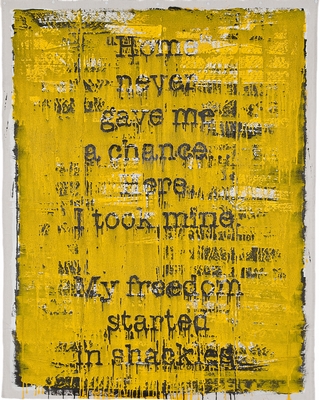
Migration Stories #19, 2016
Mixed media on canvas, 147 x 115 cm
Ayyam Gallery Dubai DIFC presents Migration Stories, the solo show of Los Angeles-based artist Farzad Kohan. In his latest body of work, Kohan records the experiences of migrants who have resettled in the United States or Europe, mostly from the Middle East. Detailing their stories with text-based paintings that are written in American typewriter font, the artist adopts the role of a documentarian. This is also suggested with the vertical folded canvases of the series, which recall letters or messages that are shared in secret or tucked away for safekeeping.
Farzad Kohan sourced the transcribed stories from social media, asking friends, colleagues, and acquaintances to share the crucial moments that defined the process of migration for them. Filmmakers, artists, and scholars are among the over two-dozen people that replied to Kohan’s request. Some responded with partial memories of leaving home as children, while others offered harrowing accounts of fleeing due to political persecution or the outbreak of war. The formal characteristics of each work are tailored to the represent these individual narratives, as thin layers of different media are applied over the surface of the canvas, creating a tactile background that is saturated with colour. Text is then stenciled onto the painting, evoking the fleeting yet assertive nature of anonymous graffiti as Kohan’s respondents disclose their experiences without having to reveal their identities. Multigenerational and from diverse communities, his invisible figures represent a cross-section of today’s ever-increasing migrant population.
The complexities of resettling in a foreign country are further chronicled in form as Farzad Kohan uses oil and water based media that separate upon contact. As the artist attempts to bring together these materials, he provides an apt metaphor of the difficulties that are faced by millions who must resettle and reestablish the concept of home in a new place. In many ways, this notion of home shapes a significant portion of the self, and is instrumental to the formation of one’s identity. By mapping their experiences, Kohan paints biographical portraits of uprooted lives.
Farzad Kohan’s exhibition coincides with a special programme that is part of Dubai Watch Week, a non-commercial, international event dedicated to the craft and industry of watchmaking. From November 15 until 19, Ayyam Gallery Dubai (DIFC) will host a display that is part of a larger effort to educate the public on the artistry and history of watches. A second opening for Migration Stories will be held on 23 November in conjunction with DIFC’s Art Nights, a biannual event that presents new exhibitions, performances, and art installations.
FARZAD KOHAN: BIOGRAPHY
Farzad Kohan’s sculptures and paintings explore themes like love, migration, and identity, and often incorporate appropriated media and found objects. Partially inspired by his personal history and surroundings, Kohan places an emphasis on form, allowing the successive stages of art making to become analogous to diasporic experience, as diverse, sometimes opposing, elements are sampled, brought together, and accumulated. These apparent stages are integral parts of each finalised work. Farzad Kohan’s formalistic process is revealed, for example, as he layers then strips abstract works through painting, collage, décollage, and sanding, creating built-up yet weathered surfaces that are at once chaotic and methodical. Allusions to the passage of time, gradual transformations, and hidden stories are found in the tactile details of his treated panels.
Text has also been central to Farzad Kohan’s compositions, as he uses Farsi or Arabic script to add narrative elements. In Love Letters, a series of works on paper, he describes moments of longing and desire with poetic confessions that are written across the lower portion of his compositions. The artist’s verses correspond with the colour schemes and textured surfaces of specific works, as abstraction is used to detail the different sensations of romantic love. With his most recent series of paintings, Kohan records the migration stories of others through excerpted texts or quotes that are written across the canvas in American typewriter font, as though creating an archival document. The forms of these untitled works are inspired by the very process of migration, and reflect the difficulties of assimilation with techniques that attempt to unify repellent materials like oil and water based media.
Alongside his sculptures and paintings, Farzad Kohan has experimented with installation, and also maintains a large body of works on paper that he expands on a daily basis. Although Kohan’s ink drawings reflect similar themes, their figures signal a representational departure for the artist, as the thin, black outline of a recurring man is delicately rendered and accentuated with Persian letters and numbers in addition to other enigmatic symbols.
Born in Tehran, Iran in 1967, Farzad Kohan lives and works in Los Angeles, California, where he first trained as a sculptor in the late 1990s. Kohan has held solo exhibitions at Ayyam Gallery Dubai, DIFC (2016, 2013) and Seyhoun Gallery, Los Angeles (2006). Selected group exhibitions for the artist include Arena 1 Gallery (Advocartsy), Los Angeles (2016, 2015); Mim Gallery, Los Angeles (2015); Ayyam Gallery, Beirut (2015); Francis Boeske Projects, Amsterdam (2015); ABRA Gallery, Los Angeles (2011); Human Rights Awareness Tour, USA (2008); J Ferrari Gallery, Los Angeles (2008); Eagle Rock Center for the Arts (2008); and Phantom Galleries, Los Angeles (2007).
AYYAM GALLERY DUBAI DIFC
Gate Village 3, DIFC, Dubai
www.ayyamgallery.com