Showing posts with label Islam. Show all posts

06/11/21

Arts de l’Islam : 18 expositions - 18 villes - Un passé pour un présent - Une coproduction Réunion des musées nationaux - Grand Palais et musée du Louvre

 Arts de l’Islam 
Un passé pour un présent 
18 expositions - 18 villes : Angoulême, Blois, Clermont-Ferrand, Dijon, Figeac, Limoges, Mantes-la-Jolie, Marseille, Nancy, Nantes, Narbonne, Rennes, Rillieux-la-Pape, Rouen, Saint-Denis, Saint-Louis à La Réunion, Toulouse, Tourcoing
20 novembre 2021 - 27 mars 2022

Arts de l'Islam
Arts de l’Islam
Un passé pour un présent
Affiche de l’exposition © H5

Depuis sa création en 2012, le département des Arts de l’Islam du Louvre offre au public une immersion au sein des cultures islamiques, de l’Espagne à l’Inde, du VIIème au XIXème siècle, et révèle l’importance des échanges anciens, étroits et féconds tissés entre la France et l’Orient. Témoins artistiques et historiques, les œuvres d’art illustrent la diversité culturelle et confessionnelle au sein du monde islamique depuis treize siècles. Elles sont le reflet de la circulation des idées et des hommes mais aussi de l’héritage pluriel du patrimoine français. Face aux fanatismes religieux, la culture se doit d’être sans relâche un rempart et un levier pour transmettre, ouvrir à l’autre, redonner des clés de compréhension de passés croisés pour construire un avenir partagé.

C’est dans cette perspective que le ministère de la Culture a demandé au musée du Louvre et à la Réunion des musées nationaux – Grand Palais d’organiser à l’automne 2021 un projet destiné à un très large public, et aux jeunes générations en particulier, pour poser un nouveau regard sur les arts et les cultures de l’islam.

Du 20 novembre 2021 au 27 mars 2022, 18 expositions dans autant de villes de France sont ainsi présentées au public, dans un musée, une médiathèque, une bibliothèque, un espace culturel.

Pour chaque accrochage, 10 œuvres, à la fois historiques et contemporaines, issues du département des Arts de l’Islam du musée du Louvre et de collections nationales et régionales, incarneront la richesse des cultures de l’Islam et leur inscription dans l’histoire de France depuis plus de 1 300 ans. Plus de 180 œuvres au total sont ainsi présentées au public : une lampe de mosquée du XIe siècle provenant de Jérusalem (musée du Louvre), un chandelier de l’époque de Saladin signé par un artiste de Mossoul racontant la vie de Jésus (musée du Louvre), des boîtes de toilettes en ivoire du XIIIe siècle ayant appartenu aux duchesses de Bourgogne, provenant de l’abbaye de Cîteaux et aujourd’hui au musée des Beaux-Arts de Dijon, une œuvre de l’artiste Hiwa K, One room apartment (FRAC Normandie) ou bien les Collages de Topak Ev de l’artiste française d’origine turque Nil Yalter.

Cette initiative vise également à éclairer le public sur la grande diversité des territoires et des populations concernées par l’Islam. La civilisation islamique est autant arabe que turque, indienne qu’iranienne, asiatique ou maghrébine… Les œuvres présentées feront valoir une large variété de pratiques et sensibilités artistiques, évoquant des scènes de vie, la nature, le désir amoureux, un simple décor de palais ou de mosquée.

Si l’exposition Arts de l’Islam, Un passé pour un présent incite à la curiosité, la manifestation est peut-être avant tout une invitation à venir s’émouvoir. Rien n’empêche d’ailleurs quiconque de vouloir s’organiser un tour de France en 18 étapes pour découvrir autant de témoignages livrés par ses œuvres. Dialogue entre les œuvres passées et présentes, chaque exposition propose une œuvre d’un artiste contemporain d’un pays du monde islamique, reflet d’une vision du monde actuel et du rapport à leur héritage.

Une attention particulière sera portée à la médiation culturelle grâce à la conception de plusieurs outils pédagogiques : un livret d’une quinzaine de pages présentant l’exposition, des cartels développés, la diffusion d’un film dans chaque lieu d’exposition offrant une échappée dans les pays d’origine de ces œuvres et un site internet de ressources numériques compatible au format smartphone et consultable notamment durant la visite des expositions. En outre, une programmation culturelle associée à l’exposition est mise en œuvre dans chaque ville (conférences, débats, spectacles vivants, cinéma…), animée par des équipes de médiateurs et, dans certains lieux, par des étudiants de l’école du Louvre. Un espace de discussion pouvant accueillir entre 20 et 30 personnes est intégré à chaque exposition.

S’appuyant sur une étroite collaboration avec le ministère de l’éducation nationale, de la jeunesse et des sports, chacune de ces expositions a été spécifiquement conçue pour s’adresser aux élèves et à leurs professeurs. Un plan national de formation, décliné dans chacune des académies d’accueil des expositions, sera proposé à l’automne afin d’accompagner les professeurs dans l’appropriation des œuvres présentées et les aider à construire des séquences pédagogiques pluridisciplinaires, associant notamment éducation artistique et culturelle et éducation morale et civique. En contribuant à la formation des professeurs sur la connaissance de la civilisation islamique et de l’histoire de ses relations avec la France et l’Europe, ce plan a vocation à enrichir la culture humaniste des élèves et à nourrir leur rapport à l’altérité qui sont au fondement de l’Ecole. 

Lieux d'exposition dans chacune des villes :

Musée du Papier  
134 rue de Bordeaux, 16000 Angoulême

Bibliothèque Abbé-Grégoire
4-6 place Jean-Jaurès, 41000 Blois

Musée d'art Roger-Quilliot
Quartier historique de Montferrand
Place Louis-Deteix, 63100 Clermont-Ferrand

Musées des Beaux-Arts
Palais des Ducs et des États de Bourgogne
Place de la Sainte-Chapelle, 21000 Dijon

Musée Champollion - Les Ecritures du Monde
Place Champollion, 46100 Figeac

Galerie des Hospices
2 rue Félix Eboué, 87000 Limoges

Musée de l'Hôtel-Dieu
1 rue Thiers, 78200 Mantes-la-Jolie

Bibliothèque l'Alcazar 
58 cours Belsunce, 13001 Marseille

Galerie Poirel
3 rue Victor Poirel, 54000 Nancy

Passage Sainte-Croix
9 rue de la Baclerie, 44000 Nantes

Chapelle des Pénitents Bleus
3 place Roger-Salengro, 11100 Narbonne

Musée des Beaux-Arts
20 Quai Émile Zola, 35000 Rennes

Médiathèque L'Échappée
83 avenue de l’Europe, 69140 Rillieux-la-Pape

Musée de la Céramique
1 rue Faucon, 76000 Rouen

Musée d'art et d'histoire Paul Éluard
22bis rue Gabriel Péri, 93200 Saint-Denis

Musée des arts décoratifs de l'océan Indien
Domaine de Maison Rouge
17a chemin Maison Rouge, 97450 Saint-Louis

Musée des Arts Précieux Paul-Dupuy
13 rue de la Pleau, 31000 Toulouse

Maison Folie Hospice d'Havré
100 rue de Tournai, 59200 Tourcoing

Commissariat général de l’ensemble des expositions :
Yannick Lintz, directrice du département des Arts de l’Islam du musée du Louvre

Une coproduction Réunion des musées nationaux - Grand Palais et musée du Louvre

06/10/16

Arts of the Islamic World @ Sotheby's London

Arts of the Islamic World auction
Sotheby's London
19 October 2016

Sotheby’s Arts of the Islamic World auction on 19 October 2016 will present rare and exquisite objects that tell the story of over a thousand years of artistic exchange and influence in the Islamic world.

This October’s sale will open with a selection of fifty manuscripts and calligraphies from the renowned collection of the late Jafar Ghazi. Each of these works bears witness to the high esteem in which calligraphy was held in Turkey, the Middle East and Persia from the medieval period up until the end of the Ottoman era. Further highlights include a beautiful turquoise-set and enamelled necklace from North India, known as ‘The Palmerston Necklace’, exemplifying the high quality craftsmanship of Indian jewellers in the nineteenth century; a silver-inlaid tray stand from Mamluk Egypt typifying the calligraphic monumentality so favoured by high-ranking Mamluk patrons and a rare painting depicting the Ottoman Sultan Bayezid I by the school of Veronese, circa 1580.

Arts of the Islamic World is one of four sales this October celebrating interwoven artistic traditions Art of the Middle East and India. The week of exhibitions and auctions will also include the bi-annual sale of 20th Century Art: Middle East, Modern & Contemporary South Asian Art and the prestigious Khosrovani-Diba Collection, which comprises a selection of important Indian miniature paintings.

Highlights


A portrait of Sultan Bayezid I, School of Veronese, Italy,
circa 1580 (est. £150,000-200,000)
Photo courtesy of Sotheby's

Sultan Bayezid I (r.1389-1402), also known as Yildirım ('The Thunderbolt'), was the fourth ruler of the Ottoman Empire. During his reign, he expanded his empire into the Balkans and Anatolia, defeating a Christian army to secure his position in the region. His attempt to further increase Ottoman prestige by engaging in the Battle of Ankara led to his demise following his defeat in 1402 at the hands of Timur’s forces. This portrait of the Sultan, depicted in three-quarter view looking over his shoulder and wearing a large turban and richly embroidered cloak, was directly influenced by a painting of Paolo Veronese’s portrait of Sultan Bayezid housed in the Collection Bayerische Staatsgemäldesammlungen, Munich. The discovery of the present painting is important as it re-emphasises the significance of Veronese’s original series of fourteen portraits of Ottoman Sultans, all now in Munich, which inspired the creation of at least three, if not more, subsequent sets which were painted between the late sixteenth to nineteenth century.


PROPERTY OF THE LATE JAFAR GHAZI
Sa'adi (d.1292 AD), Kulliyat, signed by Na’im al-Din al-Katib, Persia, Timurid,
dated 890 AH/1486 AD and 899 AH/1494 (est. £80,000-120,000)
Photo courtesy of Sotheby's

The sale will open with a selection of fifty manuscripts and calligraphies from the well-known collection of the late Jafar Ghazi. Each of these works bears witness to the high esteem in which calligraphy was held in Turkey, the Middle East and Persia from the medieval period up until the end of the Ottoman era. A highlight of this group is a superb Timurid manuscript of Sa’adi’s Kulliyat, in almost pristine condition, complete with fine, crisp illumination and tooled and filigree-work binding. The manuscript includes Sa’adi’s entire work with the addition of the preface by ‘Ali ibn Bistun. Na’im al-Din, who worked in Shiraz, copied different parts of the Kulliyyat at different times and that it took him at least nine years to complete this manuscript.


A rare openwork silver cooling vessel (karlik), with the tughra of Abdülhamid II
(r.1876-1909) and glass interior, Turkey, 19th century (est. 40,000—60,000)
Photo courtesy of Sotheby's

This rare silver cooling vessel or karlik was produced during the reign of Abdülhamid II (r.1876–1909), the last Ottoman sultan to exert effective authority before the rise of the Young Turk revolutionaries. Only a handful of these silver cooling vessels survive, of which this particular karlik is unique in containing a glass cooling vessel within the silver exterior. Liquid was kept cool by means of snow contained in a small compartment of the glass vessel. The presence of this glass vessel gave the Ottoman craftsman more freedom in the design of the silver exterior, allowing him to create an intricate pierced floral pattern, another feature unique to this karlik.


A rare Nasrid or post-Nasrid chair, Andalusia,
late 15th/16th century (est. £200,000—300,000)
Photo courtesy of Sotheby's

The Nasrid Dynasty ruled Granada and the territory of al-Andalus for over two hundred years and oversaw a splendid artistic patronage that is still hugely admired today. Expanding on a tradition inherited from the Almohad dynasty of North Africa, the Nasrids developed a sophisticated visual language based on complex geometric designs. Designed with curving legs and armrests, this imposing chair derives its shape from ancient Roman 'Sella Curulis', throne-like seats reserved for government dignitaries, which spread to the Near and Middle East. The technique used to decorate these chairs, including the present example, is typically Nasrid, and is exemplary of the luxurious micromosaic furniture that flourished in Granada at the time. Chairs from the Nasrid period are extremely rare, particularly as their popularity meant that they continued to be copied into the nineteenth century. The Metropolitan Museum of Art holds six examples in its collection, all attributed to circa 1500, and each with a repeat ivory-inset design of geometric stellar compositions .


A Mamluk silver-inlaid brass tray stand, Egypt,
14th-century (est. £150,000-200,000)
Photo courtesy of Sotheby's

When Andalusian historian Ibn Khaldun first arrived in Cairo, the capital city of the Mamluks, in 1382 AD, he described the city as ‘the centre of the universe and the garden of the world’. Not only were the monumental mosques and palaces impressive architecturally, but they also housed vast collections of wealthy and generous patrons.

A brass tray stand with silver-inlaid decoration from Mamluk Egypt typifies the calligraphic monumentality so favoured by high-ranking Mamluk patrons. This likely belonged to a highly placed official at the Mamluk court – its beautiful thuluth inscription heaping praise on its patron - and is one of a few dozen that have survived to the present day. Its form and design proved so popular that porcelain imitations have been found as far afield as China, made perhaps to evoke the splendour of the distant Mamluk court. Further examples are in the British Museum, London, the Victoria and Albert Museum, London, the Museum of Islamic Art, Doha and the Metropolitan Museum of Art, New York.


An Ottoman sabre (Karabela) with silver-gilt mounts set
with turquoise and gold-inlaid jade panels, Turkey,
second half 17th-century (est. £30,000-50,000)
Photo courtesy of Sotheby's

This exquisite karabela, Ottoman-made for a Polish audience, is a unique illustration of the fascinating szlachta culture that straddled East and West and drew from the rich artistic traditions of both.

A richly-decorated ceremonial Karabela was a highly-treasured gift among members of the Polish nobility or szlachta. The prestige of the weapon was closely tied to the culture and ideology of Sarmatism, which held that the people of the Polish-Lithuanian Commonwealth were descended from the ancient people who inhabited the steppes north of the Black Sea in Roman times.

Many members of the szlachta considered the Ottoman Turks and Crimean Tatars, also of nomadic descent, their peers, even if they were bitter enemies on the battlefield. Thus their arms and armour were modelled on the curved swords and scale armour of the Turks. This example hails from the collection of Karel Javůrek (1815 – 1909), a known academic painter from Poland.


A turquoise-set and enamelled gold necklace, North India,
19th century, (Est. £10,000—15,000)
Photo courtesy of Sotheby's

Sumptuous yet restrained in colour and design, this necklace exemplifies the elegance of nineteenth-century Indian jewellery. Passed down since the nineteenth century through the Cecil family, this necklace is referred to as the ‘Palmerston' necklace as according to family oral tradition it was gifted by the 3rd Viscount Palmerston (1784-1865) to an ancestor in the nineteenth century. Mounted entirely with turquoise stones within gold settings, the underside of this necklace reveals rich green, red and white enamel tones and detailed floral motifs typical of Mughal ornamentation. The turquoise itself most probably came from a Persian mine, and it is extremely rare to see it used exclusively on Indian jewels, who usually favour colourful combinations of stones. This may be an indication of the influence of English taste in the Subcontinent and was possibly originally created as a private commission.


A fine illuminated Qur'an, copied by Suleyman al-Uskudari, Turkey, Ottoman,
dated 1087 AH/1676 AD (est. £120,000—150,000)
Photo courtesy of Sotheby's

Suleyma Uskudari (d.circa 1686) studied under Mehmed Efendi of Belgrade, and went on to teach calligraphy at the Topkapi Palace. A further Qur'an, written a year earlier than the present example, is in the Museum of Turkish and Islamic Arts, Istanbul.


A gem-set and enamelled agate box, India,
19th-century (est. £30,000-50,000)
Photo courtesy of Sotheby's

Exemplifying the high quality craftsmanship hailing from India, this opulent box combines the inclusion of colourful gemstones set into floral patterns using fine gold wires. The technique for juxtaposing semiprecious stones into others, such as agate, reached its zenith under Mughal rule and this trend continued into the 19th-century.

For more information visit: http://www.sothebys.com/MiddleEastIndia

02/07/16

The Art of the Qur’an: Treasures from the Museum of Turkish and Islamic Arts

The Art of the Qur’an: Treasures from the Museum of Turkish and Islamic Arts
The Freer | Sackler, Washington DC
October 15, 2016 - February 20, 2017
 

Qur’an
Afghanistan, Herat, Timurid period, 1434
Ink, color, and gold on paper
Each page 35.3 x 25 cm
Istanbul, Museum of Turkish and Islamic Arts, TIEM 294

 Qur’an folio
Near East, Abbasid period, 10th century
Ink, gold, and color on parchment
20.9 x 28.3 cm
Istanbul, Museum of Turkish and Islamic Arts, SE 611

The first major exhibition of Qur’ans (Korans) in the U.S., “The Art of the Qur’an: Treasures from the Museum of Turkish and Islamic Arts,” will open at the Arthur M. Sackler Gallery Oct. 15 and continue through Feb. 20, 2017.

The exhibition was organized by the Sackler in collaboration with the Museum of Turkish and Islamic Arts in Istanbul. It will feature more than 60 of the most important Qur’an manuscripts ever produced from the Arab world, Turkey, Iran and Afghanistan.

Celebrated for their superb calligraphy and lavish illumination, these manuscripts span almost 1,000 years of history—from eighth-century Damascus, Syria, to 17th-century Istanbul. Many of the works, which will be on view outside of Turkey for the first time, are critical to the history and appreciation of the arts of the book.This landmark exhibition tells the individual stories of some of these extraordinary manuscripts, their makers and their owners. Visitors will learn how the Qur’an was transformed from an orally transmitted message to a written, illuminated and bound text produced by highly accomplished artists from the Islamic world.

These Qur’ans were originally created for some of the most powerful rulers of the Islamic world. As the finest examples of their kind, long after their completion the manuscripts were sought out and cherished as prized possessions by the Ottoman ruling elite, whose power once extended from southeast Europe to northern Africa and the Middle East. They were offered as gifts to cement political and military relationships or recognize special acts, and they were also given to public and religious institutions to express personal piety and secure political power and prestige. Donations of Qur’ans to libraries and public institutions by royal women expressed their commitment to contemporary religious and social life.


 Qur’an
Calligrapher: Abd al-Qadir b. Abd al-Wahhab b. Shahmir al-Husayni
Iran, Shiraz, Safavid period, ca. 1580
Ink, color, and gold on paper
Each page 58 x 39 cm
Istanbul, Museum of Turkish and Islamic Arts, TIEM 247

Qur'an (juz)
Iraq, Baghdad, Il-Khanid period, 1307-8
Gold, color, and ink on paper
70.8 x 48.5 cm
Istanbul, Museum of Turkish and Islamic Arts, TIEM 538 

Shortly before 1914, when the Ottoman Empire was in political turmoil, its government decided to transfer to Istanbul all valuable works of art that had been donated to mosques, schools, shrines and other religious institutions across the empire. These included thousands of the most ornate Qur’an manuscripts and loose folios, which are housed today in the Museum of Turkish and Islamic Arts, located in the heart of the historical city, opposite the so-called Blue Mosque.

“This exhibition offers a unique opportunity to see Qur’ans of different origins, formats and styles and begin to appreciate the power and beauty of the calligraphy as well as intricacy of the illuminated decoration,” said Massumeh Farhad, the Freer and Sackler’s chief curator and curator of Islamic art. “Although each copy of the Qur’an contains an identical text, the mastery and skill of the artists have transformed it into a unique work of art.”

“The Museum of Turkish and Islamic Arts in Istanbul has one of the most extraordinary collections of Qur’ans in the world, yet its holdings are little known even to many experts,” said Julian Raby, The Dame Jillian Sackler Director of the Arthur M. Sackler Gallery and Freer Gallery of Art. “This exhibition provides an unparalleled opportunity for audiences in the United States to appreciate the artistry of Muslim scribes and craftsmen over more than a millennium, in regions from North Africa to Afghanistan.”

The Freer and Sackler galleries have one of the most comprehensive collections of Islamic art in the U.S. A number of important Qur’ans from the museums’ permanent collections will be on display in the exhibition.


Qur’an
Calligrapher: Khalil Allah b. Mahmud Shah
Turkey, Ottoman period, September 1517
Ink, color, and gold on paper
Each page 37 x 29 cm
Istanbul, Museum of Turkish and Islamic Arts, TIEM 224

A multi-author, full-color catalog published by the Freer and Sackler will feature a series of essays on the Qur’an, its calligraphy, illumination and organization as a text, as well an introduction to the formation of the Museum of Turkish and Islamic Arts. The catalog will also include detailed discussions of each of the artworks in the exhibition.

A website will offer additional resources on the art of the Qur’an for online and on-site visitors. These include videos, “closer looks” at several manuscripts, an interactive map and curriculum plans. In addition to extensive public programs, an international symposium on the art of the Qur’an will be held December 1–3.

“The Art of the Qur’an: Treasures from the Museum of Turkish and Islamic Arts” is organized by the Freer and Sackler and the Museum of Turkish and Islamic Arts in Istanbul. Koç Holding is the exhibition’s principal sponsor, with major support provided by Turkish Airlines and Roshan Cultural Heritage Institute and additional support from the El-Hibri Foundation. It has been curated by Farhad and Simon Rettig, assistant curator at the Freer and Sackler.

The Freer and Sackler have presented other major exhibitions featuring important religious objects and publications, including “In the Beginning: Bibles Before the Year 1000” in 2006 and “The Tibetan Shrine from the Alice S. Kandell Collection” in 2010. The museums most recently collaborated with the Topkapi Palace Museum in Istanbul on “Style and Status” in 2005.

The Freer and Sackler Galleries
www.asia.si.edu

04/07/11

Selma Alacam, Nicolo Degiorgis. Exhibition curated by Luigi Fassi at ar/ge kunst Galerie Museum, Bolzano, Italy

Photos & Videos exhibition: Selma Alaçam - Nicolò Degiorgis
ar / ge kunst Galerie Museum, Bolzano, Italy 
Curated by Luigi Fassi
Through 30 july 2011

NICOLO DEGIORGIS
Nicolò Degiorgis
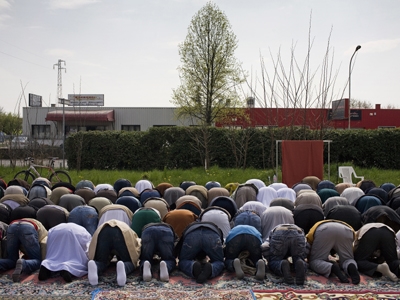
Hidden Islam - Islamic makeshift places of worship in north - east Italy, photographs and slide show (2009-11)
Courtesy of the artist

The artists Selma Alaçam (born 1980, lives and works in Karlsruhe, Germany) and Nicolò Degiorgis (born 1985, lives and works in Bolzano, Italy) analyse within their work the crucial subject matter of the relationship between Islamic culture and contemporary Western culture as it exists in Europe. How informed is mainstream public opinion in Europe about Islamic immigration to the European continent, and about the perspectives on integration of the people who actually come from Muslim countries? Moving from the particular matters of their own cultural perspective, Alaçam and Degiorgis develop individual strategies for their artistic research, with both following the common goal of emphasizing a wide range of elements which are suppressed within the public debate in Europe. In this way, both artists contribute to an increasingly complex and articulated reflection on the subject matter which they deal with.

NICOLO DEGIORGIS
Nicolò Degiorgis
Hidden Islam - Islamic makeshift places of worship in north - east Italy, photographs and slide show (2009-11)
Courtesy of the artist


Hidden Islam (2009-2011) is a photographic project by NICOLO DEGIORGIS, an investigation of Muslim prayer rooms spread all over Northern Italy. Degiorgis' work began as participation within a research project on the instruments and methods of multicultural integration conducted by the University of Trieste. Degiorgis took photographs of the improvised prayer rooms in which the Muslims in contemporary Italy exercise their faith, i.e. spaces found at the outskirts of big cities, abandoned and precarious locations such as former garages and industrial buildings. The photographic selection chosen by the artist connects specific private and cultual details of Islamic religiosity with images that document the diasporic nature of Italian Islam during recent years. Here, precariousness and decline become characteristics of survival, as the iconic signs of an anonymous and hostile metropolitan area. Thus, Degiorgis shows photographic images that are configured much like complex texts, in which the nullification of the architectural and urbanist context of the periphery of Italian cities appears to be subjected to the possible sense of relief determined by the rise of a different and migratory culture – such as the Islamic culture – which nowadays is present across the entire national territory. These images are consistently framed by liturgical scenes of prayers conducted within the places photographed. Breaks of light and improvised details of the image narrate the physical presence of the prayer, the moment of unification and consistency of the collective history of the Muslim communities in Italy. In this way, Hidden Islam traces another complex and problematic picture of contemporary Italy, and reveals the difficulties of this country to conceive itself as a contemporary society that has completely developed a sense of civil progress. 

SELMA ALACAM
Selma Alaçam
Istiklal Marsi / Turkish National Anthem (2010)
DVD loop; 4:28 min
source: YouTube
Courtesy of the artist

The work of SELMA ALACAM is focused on the question of identity. Within her work, the artist analyses in many ways her relationship to her own history as a dual citizen of Germany and Turkey who has grown up in Germany according to the educational models of Islam. Using family documents, ready-mades and self portraits, the artist employs a range of conceptual instruments that deal with a sort of reflection, not far removed from feminism, on the role of identity and social history.

Isolated and Protected (2009) is a video installation consisting of seven monitors on which the artist shows domestic scenes of Turkish Muslim families in Germany. Nonetheless, the visibility of the screen is obstructed by patterns on a curtain which veils the screen. The decorative patterns follow the Arabic tradition of applying them on the outside of windows of private homes in order to protect the residents from being visible to onlookers outdoors. The spectator therefore has only limited and partial access to what is happening, an interrupted visibility that “isolates and protects” the image from the gaze of strangers. In this way it is also a symbol of the complex system of communication and cultural exchange between Western and the Islamic societies in contemporary Europe. 

The video work Haare (2009) also intervenes with a similar aspect, with the artist here showing herself as she combs her hair. At the end she puts a wig on her head which is identical to her own hair. The scene shows a strategy used by many young Turkish women in order to remain loyal to Islamic interdict (which forbids women to show their own hair) while at the same time refusing to abandon the ambition to dress up. The gesture of the artist alludes in this way – quite ambiguously and without direct comment – to a possible modernisation inside Islam as it exists in Europe, and to a young generation of Muslims that are challenged to re-conceive the rules of their own religion in order to participate in Western life.

SELMA ALACAM
Selma Alaçam
Istiklal Marsi / Turkish National Anthem (2010)
DVD loop; 4:28 min.
source: YouTube
Courtesy of the artist

The video work Turkish National Anthem (2010) shows the political sensibility of the artist. It consists of video fragments the artist downloaded from YouTube which display some Turkish children in various private and public contexts while they sing with great emphasis and emotion the national anthem of their country. Left with no comments or alterations, the work provokes a restless sense of discomfort and unease in the spectator, because the national anthem appears as an aggressive instrument, a model of division between those who can identify themselves with it and those who are excluded.

Free entrance

Support: Provincia Autonoma di Bolzano, Alto Adige, Deutsche Kultur
Fondazione Cassa di Risparmio, Alto Adige
Città di Bolzano, Ufficio Cultura

AR / GE KUNST
GALERIE MUSEUM
Via Museo 29
39100 Bolzano
ITALY

www.argekunst.it