Showing posts with label Richard Prince. Show all posts

10/10/25

Richard Prince: Posters Exhibition @ Galerie Max Hetzler, Marfa, Texas

Richard Prince: Posters
Galerie Max Hetzler, Marfa, Texas
Through 7 December 2025

Richard Prince Poster
Richard Prince 
Untitled, 2016 
Courtesy of Richard Prince Studio

Hetzler presents Posters, a solo exhibition of works by Richard Prince, for the gallery’s annual presentation in Marfa, Texas, through December 7, 2025.

One of the foremost representatives of appropriation art, Richard Prince has been recontextualising images and ideas from mass media, advertising and entertainment since the 1970s. Often based on products of everyday American culture, his practice is one of ‘post-production’, which reworks cultural phenomena and their attributes to rewrite received narratives and our understanding of history.

The present exhibition brings together a large body of Richard Prince’s Poster works on canvas and on paper, created between 2014 and 2024. The large canvases show reproductions of advertisements for mail-order posters, as were often found at the back of magazines in the second half of the 20th century. Hugely popular at the time, these printed images represent touchstones of early counter-cultural magazines, which are among Richard Prince’s long-term interests. The motifs of political slogans and far-out art in the form of cheap posters are singled out and chosen by the artist. They find their origins in the hippie head-shop culture of the late ’60s, which also encompassed magazines, music and comedy records. Taped-off and blocked-out from the pages where they were listed, the images have been blown up so that the resulting works are far larger than the original posters.

In their seemingly arbitrary selection, the poster images combine anti-war slogans, reproductions of Modern art, graphic-design interpretations of nude couples, and pictures of cats in sometimes humorously disparate compilations. The revolutionary attitude of the late ’60s student protests is juxtaposed against the self-indulgence of hippie culture in this side-by-side illustration of popular visual language.

If cultural attitudes are transported through everyday imagery, then  Richard Prince makes them transparent by applying the focus of his artistic practice to these source materials. Method and implication are translated into different contexts and, with his meticulous attention to detail, the artist decodes the communication of contemporary visual language and the ideas which are concealed within it.

Artist Richard Prince

Richard Prince (b. 1949, Panama Canal Zone) lives and works in Upstate New York. Prince’s work has been the subject of numerous solo exhibitions in international institutions, including Georgia Museum of Art, Athens (2024); Louisiana Museum of Art, Humblebaek; The Karpidas Collection (both 2022–2023); Museum for Modern Art, Weserburg (2021); Museum of Contemporary Art Detroit (2019–2020); Museo de Arte Latinoamericano de Buenos Aires Malba; Espace Louis Vuitton, Beijing; Astrup Fearnley Museet, Oslo (all 2018); Los Angeles County Museum of Art (2017–2018); Kunsthaus Bregenz (2014); Picasso Museum, Malaga (2012); Le Consortium, Dijon (2011); Serpentine Gallery, London; Walker Art Center, Minneapolis (both 2008); Guggenheim Museum, New York (2007–2008); Kunsthalle Zürich (2002); Museum für Gegenwartskunst, Basel (2001); and MAK, Vienna (2000), among others. The artist participated in the Venice Biennale in 2007 and 2003, as well as the Whitney Biennial in 2004, 1997, 1987 and 1985.

Works by Richard Prince are in the collections of international museums including the Art Institute of Chicago; Astrup Fearnley Museet, Oslo; The Broad, Los Angeles; Centre Pompidou, Paris; Fondation Louis Vuitton, Paris; Institute of Contemporary Arts, Boston; Kunstmuseum Basel; Los Angeles County Museum of Art; The Metropolitan Museum of Art, New York; Modern Art Museum of Fort Worth; Museum of Contemporary Art, Chicago; Museum of Contemporary Art, Los Angeles; The Museum of Modern Art, New York; Palazzo Grassi, Pinault Collection, Venice; San Francisco Museum of Modern Art; Solomon R. Guggenheim Museum, New York; Tate, London; Victoria and Albert Museum, London; and Whitney Museum of American Art, New York, among others.

GALERIE MAX HETZLER
1976 Antelope Hills Road, Marfa, Texas

Richard Prince: Posters
Galerie Max Hetzler, Marfa, Texas, 17 May – 7 December 2025

17/03/11

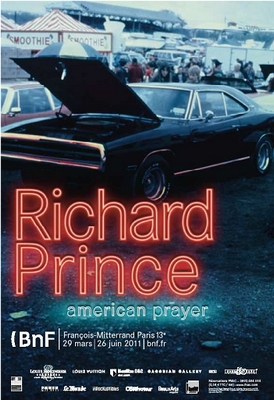
Richard Prince exhibit at BnF in Paris, France - An American Prayer

Richard Prince: An American Prayer 
BnF - Bibliothèque nationale de France, Paris
Curators: Bob Rubin, Marie Minssieux-Chamonard 
March 29 - June 26, 2011


RICHARD PRINCE, American Prayer at BnF - Photograph (c) Richard Prince

AN AMERICAN PRAYER is a book of poems by Jim Morrison, who would have traded rock stardom for recognition as a legitimate artistic figure in a heartbeat. Seven years after his death, “An American Prayer” was the name of a posthumous album of his poetry recorded to music by the remaining Doors. On March 29, “American Prayer,” an exhibition of American literature and ephemera from the collection of American artist RICHARD PRINCE opens at the Bibliothèque nationale de France. Also on view will be artworks by Prince relating to books, an important source of both inspiration and materials for artistic practice, including two never-before-seen examples of his famous “Nurse” paintings from his personal collection.  

In a purpose-built structure meant to evoke the wood-shingled houses of l’amérique profonde, Richard Prince displays 40 of his American / English series (sculptures based on the first American and English editions of his favorite works) with 24 Untitled (original)s, which reunite pulp paperbacks with their original cover art. A selection of Prince artwork which derives from and/or pays homage to the book and the mechanically reproduced image – works from the series Publicities, Gangs, Cartoons, and even Hoods – encircle vitrines with treasures from the most important collection of twentieth-century Americana still in private hands.

(c) Richard Prince / Rob McKeever,
courtesy of Gagosian Gallery

Finally, a “Reading Room” provides a conceptual tour d’horizon of the complex interactions of art and the text in the digital age. The “greatest hits” of the Prince and BnF collections – precious books and manuscripts from the likes of James Joyce and Louis-Ferdinand Celine you can’t touch without getting arrested – are intercut with livres ireel (imaginary books) and iPads stuffed with Prince’s prolific output of artist's books. Part bibliographic exhibition, part art installation, the show toys with the viewer’s preconceived notions of image and text, while presenting a fascinating taxonomy of American subcultures: cowboys, bikers, hoboes, hippies, and spacemen.


(c) Richard Prince / Rob McKeever,
courtesy of Gagosian Gallery


A book collector for nearly forty years, Prince has amassed a remarkable trove of works from what he describes as the “BeatHippiePunk” era: 1949 (the year of his birth) to 1984. It starts with the “Beats” – Kerouac, Ginsberg, and Burroughs, for sure, but also Nabokov (whose personal library relating to Lolita Prince owns) and J.D. Salinger. He has a particular faible for Hunter S. Thompson, whose Hell’s Angels and Fear and Loathing in Las Vegas figure prominently in the mix; the hugely influential underground cineaste Jack Smith; Mario Puzo, whose manuscript for The Godfather will be on display; Truman Capote, whose letters to the convicted murderer Perry Smith are in the collection and Jimi Hendrix, as well as Robert Crumb and Yoko Ono…and of course Thomas Pynchon, Ken Kesey, Tom Wolfe, and Terry Southern. Prince has a special interest in a number of American writers better known and loved in France: Richard Brautigan, Philip K. Dick, Jim Thompson, and Chester Himes. Prince’s holdings of letters include Jimi Hendrix’s handwritten letters home to his father while he was in the army, and, later, on the road with Little Richard’s band; Kerouac’s letters to Malcolm Cowley, editor of On the Road; and a plethora of missives from those two incognito novelists, J.D. Salinger and Thomas Pynchon. 

This would be an amazing aggregation of Americana from Mr. X, but the fact that it comes from Richard Prince is what makes this uniquely interesting. Prince’s collecting and his artistic practices are hard to separate…so why try?


An illustrated CATALOGUE accompanies the exhibition. Published by GAGOSIAN GALLERY in association with the Bibliothèque nationale de France, the catalogue includes text excerpts from many of the aforementioned by books in the artist’s collection as well as essays by exhibition curators Bob Rubin and Marie Minssieux-Chamonard, and rare book collector John McWhinnie.


BNF - BIBLIOTHEQUE NATIONALE DE FRANCE
Quai François Mitterrand
75713 PARIS

15/07/10

Gagosian Gallery NYC Madison Summer Shows 2010

SUMMER SHOWS

Gagosian Gallery, New York, Madison Avenue

July 8 - September 3, 2010

Three exhibitions on three floors at Gagosian Gallery, New York, Madison Avenue this summer:

The 6th Floor group show features Richard Prince, Ed Ruscha, Richard Serra and Christopher Wool

The 5th Floor show features a selection of works by German artist Anselm Reyle

The 4th Floor group show features Mike Kelley, Florian Maier-Aichen and Anselm Reyle.

GAGOSIAN GALLERY
980 Madison Avenue
New York, NY 10075

Summer Hours: Mon-Fri 10am-6pm

07/09/03

Richard Prince: Nurse Paintings, Barbara Gladstone Gallery, New York

Richard Prince: Nurse Paintings
Barbara Gladstone Gallery, New York
September 20 – October 25, 2003

Barbara Gladstone Gallery presents an exhibition of new paintings by Richard Prince. Never before seen in the U.S., Richard Prince’s “Nurse” paintings reflect his distinctive approach to popular culture. An avid book collector, Prince appropriates covers of pulp novels that present the iconic white-uniformed Nurse and then applies layer upon layer of rich, brilliant hues to his printed canvases. The paint acts both to obscure and reveal the images lying beneath as Richard Prince, through a film of paint, consciously allows traces of background to emerge in ghost-like forms while the Nurses themselves and their corresponding titles are left visible.

Through his repetition and reworking of the Nurse novel covers Richard Prince plays upon the anonymity of the figures and the inevitably unstable issues of identity, authenticity and authorship. Richard Prince’s painterly brushstrokes, drips and splatters that pervade the canvas and shroud the Nurses also evoke the era of the pulp novel, the era of Abstract Expressionism. Thus, Richard Prince allows us to reconsider the post-war aesthetic through the codes of mass culture as unearthed for us by the keen eye of an ardent bibliophile. The Nurses partake in Richard Prince’s game of irony as the intense colors and near theatrical play of light reveal them to be seductresses of a hypnotically fictional world. One increasingly becomes aware of the sneaking suspicion that something sinister lies within these emblems of caring and nurturing.

Richard Prince was born in 1949 and lives and works in upstate New York. A retrospective of Richard Prince's paintings and photographs was held in 2002 at the Kunstmuseum Wolfsburg, which conjoined the previous exhibition of paintings at Kunsthalle Zurich and photographs at Museum für Gegenwartskunst Basel. Other solo exhibitions include: MAK Center for Art and Architecture, Schindler House, Los Angeles; MAK Vienna; Kestner Gesellschaft, Hannover; Museum Boymans-van Beuningen, Rotterdam; San Francisco Museum of Modern Art; Kunstverein and Kunsthalle, Dusseldorf; IVAM Centre del Carme, Valencia; and the Whitney Museum of American Art, New York.

BARBARA GLADSTONE GALLERY
515 West 24th Street, New York, NY 10011