Showing posts with label WI. Show all posts

27/10/24

Robert Longo: The Acceleration of History @ Milwaukee Art Museum

Robert Longo: The Acceleration of History
Milwaukee Art Museum
October 25, 2024 – February 23, 2025

The Milwaukee Art Museum presents Robert Longo: The Acceleration of History, an exhibition that features nearly 40 monumental drawings, sculptures, and videos created by the artist over the past decade. The presentation emphasizes Longo’s hyperrealistic charcoal drawings.
“Robert Longo’s work is visually compelling in its exceptional detail and powerful in its reflection of his view of contemporary culture. In this age of constant immersion of images from advertisements to news footage, Longo’s drawings break through the visual deluge in captivating ways,” said Marcelle Polednik, PhD, Donna and Donald Baumgartner Director. “We look forward to engaging our audiences with his most recent body of work, a long-overdue and distinct opportunity.”
Born in 1953 in Brooklyn, Robert Longo has long examined how media images affect people. Rising to prominence in the 1980s as a leading figure of the Pictures Generation alongside Cindy Sherman and Barbara Kruger, Longo continues to explore the effects of our image-saturated culture. Through his practice, he engages with how people filter, retain, and process the incredible number of images we consume on a routine basis. Today, Robert Longo is widely known for his ambitiously scaled charcoal drawings that reflect on the construction of symbols of power and authority, including images of animals and nature as well as global conflicts and protest movements.

Though based on images from various media sources, Longo’s meticulous drawings are not exact transcriptions. Instead, he combines elements from multiple images with art historical archetypes and compositional elements in an effort to create what the artist considers “a perfect image.” Longo’s drawings result in a new understanding of the source images, one which reflects his views on the subject matter’s significance and urgency. Furthermore, through their monumental scale and technical precision, the images he depicts invite viewers to pause and spend time reflecting on the subject matter.
“Robert Longo’s ability to capture both the essence and experience of an image through his monumental charcoal drawings is unparalleled,” said Margaret Andera, Senior Curator of Contemporary Art. “His subject matter can range from the profound, to the inspiring, to the tragic, and the works resonate with a power that comes from the combination of Longo’s thorough consideration of the image and his meticulous technique.”
The Acceleration of History is the first solo presentation of Longo’s work in the Midwest in more than three decades. It presents this audience with a unique opportunity to engage with Longo’s more recent work and reflect on his response to the compelling issues of our time, such as the divisive U.S. political climate, war, and environmental crises. The exhibition prominently features Longo’s series The Destroyer Cycle, which he began in 2014, along with works from other series including Hungry Ghosts and Gang of Cosmos. Highlights from the exhibition include:

- Untitled (American Eagle 2017), 2017, depicts the sharp profile and soft feathers of a bald eagle, an emblem of the United States; 

- Untitled (Kenny Britt, St. Louis Rams; Hands Up), 2016, depicts a single St. Louis Rams football player standing with his hands raised and head slightly bowed in the “hands up, don’t shoot” gesture. The drawing captures the player’s stance of protest and highlights the intersection of sports and social justice following the 2014 police shooting of Michael Brown in Ferguson, MO, and subsequent protests;

- Untitled (State of the Union, Washington DC, USA, February 5, 2019), 2019, depicts former President Trump’s second State of the Union address at which many congresswomen wore white, referencing the suffragette movement. Longo draws particular attention to the more than 100 women serving in the House of Representatives of the 116th Congress;

- Untitled (Iceberg for Greta Thunberg), 2020, illustrates a tremendous wall of ice above the ocean’s surface. Serving as commentary by Longo on climate change, the drawing is based on photographs he captured during his travels to Newfoundland, Canada, where he witnessed entire sheets of ice breaking off glaciers and falling into the ocean;

- Untitled (Nascar Crash, Daytona), 2021, captures the chaotic and violent nature of a racecar crash, emphasizing the dramatic energy of the sport and serving as an allegory for society’s media consumption; and

- Untitled (The Three Graces; Donetsk, Ukraine; March 14, 2022), 2022, portrays a wedding storefront display of gowns in Donetsk, Ukraine, damaged by bullets from Russian forces. The drawing captures the stark contrast between the delicate beauty of the gowns and the harsh violence of the conflict.

Along with the monumental drawings are Longo’s large-scale, spherical installation Death Star; The Year of 2018. Created in 2022, this captivating work is composed of 40,000 .308 caliber bullets, aluminum, steel l-beams, and chains, measuring 21 feet in diameter. The number of bullets corresponds to the number of gun-related deaths in the U.S. in 2017. The sculpture serves as a commentary by the artist on gun violence and the pervasive threat of mass shootings in contemporary society—a recurring theme in Longo’s work. The Acceleration of History also includes two of Longo’s videos and two additional sculptures.

The exhibition continues the Museum’s longstanding relationship with the contemporary artist. Its collection is home to two lithographs by Robert Longo: Men in the Cities, Joanna (1983) and Men in the Cities, Larry (1983). One month before the exhibition opens, on September 21, the Museum recognized Robert Longo as the 2024 honoree at the Art:Forward Gala, an annual benefit that supports the Museum’s contemporary art program.

In addition to the Milwaukee Art Museum, Longo’s work has been exhibited around the world and is included in the collections of the Museum of Modern Art, New York; Whitney Museum of American Art, New York; National Gallery of Art, Washington, D.C.; Centre Pompidou, Paris; and Tate, London; among others. Beyond his drawings and sculpture, Robert Longo has directed music videos like R.E.M.’s “The One I Love” (1987) and movies such as Johnny Mnemonic (1995) with Keanu Reeves. During the exhibition’s run, the Museum and Milwaukee Film will partner to screen Johnny Mnemonic: In Black and White at the Oriental Theatre on November 21, at which Robert Longo will be present and participate in a post-screening discussion.

Robert Longo: The Acceleration of History was curated by Margaret Andera, Senior Curator of Contemporary Art at the Milwaukee Art Museum. 

A catalogue with essays written by Margaret Andera, journalist Tom Teicholz, and artist Rashid Johnson accompanies the exhibition.

MILWAUKEE ART MUSEUM
700 N. Art Museum Dr., Milwaukee, WI 53202

09/11/22

The Ashcan School and The Eight: “Creating a National Art” @ Milwaukee Art Museum

The Ashcan School and The Eight: “Creating a National Art”
Milwaukee Art Museum
September 23, 2022 - February 19, 2023

Robert Henri
Robert Henri
(American, 1865–1929)
Dutch Joe (Jopie van Slooten), 1910
Oil on canvas
Gift of the Samuel O. Buckner Collection M1919.9
Photo by John R, Glembin
Courtesy of the Milwaukee Art Museum

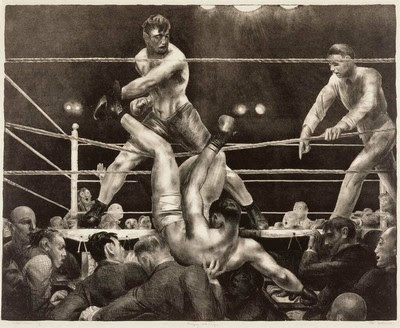
George Wesley Bellows
(American, 1882–1925)
Dempsey and Firpo , 1923–24
Lithograph
Gift of Philip Pinsof M1956.28
Photo by John R. Glembin
Courtesy of the Milwaukee Art Museum

Arthur Bowen Davies
Arthur Bowen Davies
(American, 1862–1928)
Rhythms , ca. 1910
Oil on canvas 
Gift of Mr. and Mrs.Donald B. Abert in memory of Harry J.Grant M1966.57
Photo by John R. Glembin
Courtesy of the Milwaukee Art Museum

The Milwaukee Art Museum presents The Ashcan School and The Eight: “Creating a National Art,” a major exhibition exploring the work of the turn-of-the-century Ashcan School and The Eight—widely recognized today as America’s first modern art movement. Mining the Museum’s expansive collection of works by the Ashcan School, The Eight, and affiliated artists—one of the largest and most significant collections of these works in the United States—the exhibition examines these artists’ rejection of traditional art practices and institutions and the impact of this subversion on the trajectory of American modern art. Recontextualizing the pieces in this collection, the show also draws connections between the social issues depicted in these works and those still prevalent in the U.S. today.

So named for their first major exhibition in 1908 at New York City’s Macbeth Gallery, Eight American Painters, The Eight is comprised of artists Robert Henri, Arthur Bowen Davies, William Glackens, Ernest Lawson, George Luks, Maurice Prendergast, Everett Shinn, and John Sloan, all of whom embraced new modes of artistic representation and eschewed exhibition practices that they considered restrictive and conservative. Often embracing a loose painterly style to portray subjects previously deemed inappropriate for high art and museums, these artists—who one critic lionized as “creating a national art,” while another later disparaged as painters of “ashcans,” unwittingly giving them the name by which they would become commonly known—captured the realities of everyday life in the American city at a moment of great transformation: early in their careers, they frequently depicted scenes of immigrants, tenements, urban spaces, and shifting cultural dynamics, social values, and identities. Featuring nearly 150 paintings, drawings, pastels, and prints, The Ashcan School and The Eight presents both iconic and rarely seen pieces by these artists, demonstrating the breadth of their practices and the continued relevance of their work in examining and reflecting the reality of urban America’s working class.
“The Ashcan School and The Eight: ’Creating a National Art,’ is an opportunity to engage new audiences with key works from our esteemed collection that are emblematic of the seismic shift in the ethos of this contingent of American artists who were working at the turn of the 20th century,” said Brandon Ruud, exhibition curator and former Abert Family Curator of American Art at the Milwaukee Art Museum. “Their break from longstanding tradition to instead portray a more authentic depiction of the American experience forged a new national art that prioritized an unfiltered representation of urban and working-class life and catalyzed the evolution of American modern art in the process.”
The Ashcan School and The Eight: “Creating a National Art” builds on the Milwaukee Art Museum’s leadership in the presentation and collection of Ashcan School works of art. Since the early 1900s, the Museum has stewarded works from the Ashcan School, leading up to a transformative gift from the Abert Family, Milwaukee philanthropists who purchased nearly 50 works across media by the Ashcan School and The Eight for the express purpose of donating to and expanding this portion of the Museum’s collection. The Ashcan School and The Eight: “Creating a National Art” advances the Milwaukee Art Museum’s commitment to developing scholarly discourse around these artists’ revolutionary practices, presenting these radical works to new generations of museumgoers, and creating connections across American modern and contemporary history.

Among the notable works featured in the exhibition are:

- Robert Henri’s Dutch Joe (Jopie van Slouten) from 1910, the first Ashcan painting to enter the Museum’s collection.
- Robert Henri’s The Art Student and El Matador (both 1906), pivotal paintings that started the trajectory of the artist’s career and contributed to the group’s break with the National Academy of Design.
- Arthur Bowen Davies’s Rhythms (ca. 1910), George Benjamin Luks’s Bleecker and Carmine Streets, New York (ca. 1905), and Robert Henri’s Chinese Lady (1914), all paintings from the Abert Collection.
- John Sloan’s Isadora Duncan (1911), a painting that epitomizes the Ashcan School’s interest in performance and theater.
- Stuart Davis’s Tenement Scene (1912), an early, rare painting inspired by Davis’s initial study with Robert Henri.
“We are thrilled to welcome visitors from our Milwaukee community and beyond to explore the Museum’s unparalleled collection of works by artists of the Ashcan School and The Eight,” stated Marcelle Polednik, Donna and Donald Baumgartner Director of the Milwaukee Art Museum. “Five decades ago, the Abert family purchased nearly 50 works by members of the Ashcan School for the Museum’s collection, enabling us to tell the rich story of these important artists and their contributions to the field. This exhibition is an exciting opportunity to revisit these works and others that we have acquired in the years since, and to present them in new ways that both educate and inspire our audiences, while also celebrating the Abert family’s exemplary gift to the Museum.”
The Ashcan School and The Eight: “Creating a National Art” is accompanied by a 172-page catalog with over 200 color illustrations, thematic essays, and an illustrated checklist of the Museum’s entire Ashcan collection. This publication not only indexes these works but also activates them as a catalyst for new scholarship by a team of noted experts, who explore the contexts and concerns that shaped American modernism at the beginning of the 20th century. Contributors and essayists include Brandon Ruud, Abert Family Curator of American Art at the Milwaukee Art Museum; John Fagg, Senior Lecturer in American Literature and Cultures at the University of Birmingham, England; Margarita Karasoulas, Curator of Art at the Bruce Museum in Greenwich, Connecticut; and Nikki Otten, Associate Curator of Prints and Drawings at the Milwaukee Art Museum; with a foreword by the Museum’s director, Marcelle Polednik, PhD.

MILWAUKEE ART MUSEUM
700 N. Art Museum Drive, Milwaukee, WI 53202

14/11/21

Derrick Adams @ Milwaukee Art Museum - Our Time Together - Large-Scale Mural Installation

Derrick Adams: Our Time Together
Large-Scale Mural Installation
Milwaukee Art Museum

Derrick Adams
Derrick Adams
(American, b. 1970)
Our Time Together (detail), 2021 
Inkjet print on vinyl. 1130 in. x 179 in
Commissioned by the Milwaukee Art Museum
© Derrick Adams

Derrick Adams
Artist Derrick Adams in his Brooklyn studio  
Photo courtesy of Derrick Adams Studio 

A commissioned large-scale wall mural and sculptural installation was unveiled October 29 at the Milwaukee Art Museum. Created by Brooklyn-based artist Derrick Adams, Our Time Together is a 93-foot work that reframes historical Black narratives.  
“In Our Time Together, I highlight Milwaukee by representing commercial and social spaces known within the Black community,” said Derrick Adams. “These dwellings, and those who occupy them, are essential to the cultural, political and creative growth of American society, which is then spread out to a global audience. The installation reflects my respect and admiration for the perseverance of Black Americans in their pursuit of happiness and speaks to transformation, belonging and normalcy.” 
Inspired by Victor Hugo Green’s The Negro Motorist Green Book, a traveler’s guide for Black Americans during the Jim Crow era, Adams celebrates the rituals of everyday Black life and leisure. The monumental wall mural includes references to important sites of Black culture in Milwaukee including Gee’s Clippers, Coffee Makes You Black and the Wisconsin Black Historical Society, combined with vernacular photographs from the civil rights movement of the 1950s and 1960s and dynamic figures that Adams created. By referring to sites of intergenerational congregation, ordinary moments and pop culture, the imagery references a richer and more nuanced understanding of Black life in America, beyond historical trauma. 
“Through his monumental wall mural and sculptural installation, Adams underlines the importance of commemorating—and archiving—ordinary daily activities as central to shaping community and collective identity,” said Lisa Sutcliffe, Herzfeld Curator of Photography and Media Arts, Milwaukee Art Museum. “We’re honored to share and support this site-specific commission, which celebrates Black-owned businesses and culture, and asks important questions about the role of media and visual imagery in the construction of identity and cultural value.” 
The Green Book was revolutionary in its day as a travel guide that listed Black-owned businesses, restaurants and lodgings that were safe for Black travelers in the 1930s through the 1960s, during the height of the Jim Crow era of racial segregation.  

Derrick Adams visited Milwaukee in 2018 and 2019 to explore sites of importance in the Black community, including the Wisconsin Black Historical Society. He also met with Black artists and business owners, researched places listed in the Green Book, and viewed an archive of civil rights era photographs from local newspapers. Derrick Adams has stressed the importance of archives to Milwaukee, where none of the historic Green Book sites still exist. For Adams, pointing to the significance of these archives is a vital form of honoring Black innovation, Black stories and resilience in the face of adversity. 

On view through 2024, Our Time Together is the first in the Museum’s On Site series to activate the East End. The exhibition series, which began in 2001, invites contemporary artists to make new works that respond to a specific location within the Museum. Artists previously featured in the series include Chakaia Booker, Liam Gillick and Andrea Zittel. 
“On Site: Derrick Adams allows the Museum to take a different approach in programming. We have three years to explore the amazing themes of this commission: to gather together, archive Black everyday experiences and histories, and honor Black-owned businesses and service industries,” said Kantara Souffrant, Curator of Community Dialogue, Milwaukee Art Museum. “I want to use this time to co-build with community partners, organizations, and Black artists, to create events and opportunities together that help us strengthen Milwaukee’s arts ecosystem and promote a more unified community.” 
The Milwaukee Art Museum extends its sincere thanks to the 2021 Visionaries: Donna and Donald Baumgartner, Murph Burke, Joel and Caran Quadracci, and Sue and Bud Selig. The Visionaries support the Museum through annual sponsorship of three critical pillars within the Strategic Direction: Art Relevant to the Community, Robust Community Programming and Expansive Hospitality.  

Critical leadership support for Our Time Together has been provided by the Presenting Sponsors: Bader Philanthropies, with support of community engagement and installation activities, and the Milwaukee Art Museum’s Contemporary Art Society, with support for the commission and acquisition of the work. Generous Supporting Sponsorship is provided by the Herzfeld Foundation. 

MILWAUKEE ART MUSEUM
700 N. Art Museum Dr. Milwaukee, WI 53202

Updated Post 14-11-2023

12/10/21

Woody De Othello @ John Michael Kohler Arts Center, Sheboygan - Hope Omens

Woody De Othello: Hope Omens 
John Michael Kohler Arts Center, Sheboygan, WI 
Through September 25, 2022 

Woody De Othello
Woody De Othello 
TBD (Blue red vessel), 2021 
TBD Ceramic and glaze
Base: 32 x 24 x 24 inches 
Vessel: 22 x 22 x 18 inches
(c) Woody De Othello, Courtesy of the 
John Michael Kohler Arts Center

An exhibition of ceramics by the artist WOODY DE OTHELLO is on view at the John Michael Kohler Arts Center. Woody De Othello: Hope Omens presents a series of nearly 20 large anthropomorphic vessels based on African spiritual objects that, among other things, address the tumultuous nature of the last year.

Woody De Othello is best known for his large-scale sculptures of familiar domestic objects, which are often imbued with a kind of human personage. For Hope Omens, he presents an entirely new body of work. 

Many of the sculptures were produced using molds that Woody De Othello created during his Arts/Industry Pottery residency at the Kohler Co. factory in early 2020. While he was in residence, the world outside the factory began to shift with the beginning of the pandemic. The residency was cut short by several weeks and forced Othello to bring home some of the molds to continue his work.

“Woody De Othello’s work has always been prescient in its combination of humor, history, and composition. But the saliency of this newest body of work speaks poignantly and pointedly about the time we are living in, reaffirming the role that artists can play in articulating a kinder and more just world for us all. The Arts Center is thrilled to be showing these works for the first time,” said Laura Bickford, curator, John Michael Kohler Arts Center.

Woody De Othello draws on African nkisi, or objects that are believed to be invested with spiritual energy. Breath and breathing are ideas often expressed in Othello’s vessel-like forms covered in mouths. Many of his new works feature hands and arms, evoking embrace and consolation, or ears and mouths, offering meditations on listening, hearing, and being present.

“Working has allowed me to process what is going on, with the convergence of the pandemic and personal interest at this moment in time,” said Othello. “I am moved and inspired by many elements—African ceramics, jazz music, Afrofuturism, and a brighter color palette. I also have been thinking about how vessels can be metaphors for emotional and physical space, and how we find comfort.”

A new sound piece by Oakland, CA, musician Cheflee accompanies Woody De Othello’s sculptures. Made in response to the work in the exhibition, the ambient composition is designed to subtly guide the viewer through the space, creating an immersive environment. Some of the vessels emanate sound from within, as if imbued with a spirit.

WOODY DE OTHELLO was born in Miami, Florida, in 1991. His first solo museum exhibition was held in 2019 at the San Jose Museum of Art. That same year his work was on view at Art Basel Miami Beach, and in 2018 his work was included in the FRONT International Cleveland Triennial for Contemporary Art. Gallery exhibitions of his work have been held in New York, London, San Francisco, and Los Angeles. His work is in the collections of the Los Angeles County Museum of Art; San Francisco Museum of Modern Art; San Jose Museum of Art; and Institute of Contemporary Art, Miami. He holds a B.A. from Florida Atlantic University and a M.F.A from California College of Arts. Othello lives and works in Oakland, CA. 

JOHN MICHAEL KOHLER ARTS CENTER
608 New York Avenue, Sheboygan, WI

17/04/20

James Cagle: Excavation, 1974 - Online - Madison Museum of Contemporary Art

James Cagle: Excavation
Madison Museum of Contemporary Art
Exhibition Film available online during MMoCA closure

James Cagle, Excavation, 1974
JAMES CAGLE
Excavation, 1974
16mm color film (digitized), with sound, 5:00 minutes
Courtesy of the artist and the New York Filmmakers’ Cooperative

Madison Museum of Contemporary Art has placed James Cagle’s film Excavation (1974) on the MMoCA.org website to ensure that everyone can see the work during the museum’s closure.

Excavation, along with James Cagle’s photographic series, A Final Meditation on Art, on display in MMoCA’s State Street Gallery, opened just two weeks before the museum closed as a public safety measure due to the coronavirus. A Final Meditation on Art will be on view in the museum through July 26, 2020. Excavation is scheduled to remain on view in the Imprint Gallery through May 24.

James Cagle, Excavation, 1974
JAMES CAGLE
Excavation, 1974
16mm color film (digitized), with sound, 5:00 minutes
Courtesy of the artist and the New York Filmmakers’ Cooperative

Excavation demonstrates James Cagle’s engagement with structural filmmaking, an avant-garde movement that emerged in the 1960s and emphasized the physical properties of film, rather than film as a narrative tool. Excavation is an example of a “flicker film,” a specific type of structural filmmaking where rapid sequences of imagery flash across the screen to create a strobelike, flickering effect.

Composed of both still photographs and live footage, Excavation employs extremely short-shot juxtapositions to create disorienting collisions of imagery. To create this piece, James Cagle undertook a painstaking and time-intensive editing process, alternating between exposing one frame of film and blacking out the next.

James Cagle, Excavation, 1974
JAMES CAGLE
Excavation, 1974
16mm color film (digitized), with sound, 5:00 minutes
Courtesy of the artist and the New York Filmmakers’ Cooperative

Through staccato bursts of light, we are shown a flashing collage of seascapes and gravel roads, a woman’s face and the naked female form, pointing fingers and pulsating shapes. For James Cagle, this film symbolized a personal exploration of, in his words, “techniques and ideas that have accumulated over the years, but had been without expression for one reason or another.” A dynamic visualization of his thoughts, it “excavates” both the private workings of his inner world, and also the material components of filmmaking.

The film and images are courtesy of the New York Film-Makers Co-op and New American Cinema Group.

Generous support for Imprint Gallery programming has been provided by Willy Haeberli in memory of Gabriele Haberland.

MADISON MUSEUM OF CONTEMPORARY ART - MMoCA
227 State Street, Madison, WI 53703
mmoca.org

01/02/04

Pennsylvania Impressionism at Woodson Art Museum, Wausau, Wisconsin

Earth, River, and Light: Masterworks of Pennsylvania Impressionism
Leigh Yawkey Woodson Art Museum, Wausau, WI
February 7 - April 10, 2004

Two exhibitions of American Impressionist paintings – one featuring historic works of Pennsylvania Impressionism, the other focusing on contemporary works from the Mid-Atlantic region – open February 7 at the Leigh Yawkey Woodson Art Museum.

Earth, River, and Light: Masterworks of Pennsylvania Impressionism includes 47 works by a diverse collection of artists who became known collectively as the Pennsylvania Impressionists. The exhibition presents a comprehensive survey of this important 20th century American art movement that was fueled by a passion to capture on canvas the dynamic effects of light and atmosphere on the environment.

American Impressionism was firmly rooted in the American soil. During the late 19th and early 20th centuries, artists increasingly spurned cities, preferring instead to live and work in the numerous art colonies that sprang up throughout the country. One of the best known of these colonies began in 1898 on the banks of the Delaware River north of Philadelphia, in the picturesque Bucks County village of New Hope. Here, artists found an ample supply of "painting-ready" bucolic settings featuring streams, pastures, quarries, farmhouse, and colonial villages.

The Pennsylvania Impressionists played a dominant role in the American art world of the teens and twenties. Their work was celebrated for its freedom from European influence and was praised as being the first truly national artistic expression. Many of the artists both studied and taught at the Pennsylvania Academy of the Fine Arts in Philadelphia, and their stylistic roots hearkened back to the "Academy Realism" practiced by Thomas Eakins.

Edward Redfield (1969-1965), generally acknowledged as the stylistic leader of the New Hope painters, passionately believed that the vitality of a place could only be captured by an artist whose senses were actively engaged. Painters had to see, hear, smell, feel, and even taste what they put on their canvases. To accomplish this, he often endured great physical hardships while making his famous snow scenes, sometimes standing for hours in knee-deep snow with his canvas strapped to a tree.

Edward Redfield’s vigorously realistic, unsentimental brand of Impressionism influenced several generations of artists. However, what most characterized Pennsylvania Impressionism was not a single, unified style, but rather the emergence of many mature distinctive voices: Daniel Garber’s luminous, poetic renditions of the Delaware River; Fern Coppedge’s colorful village scenes; Robert Spencer’s Ashcan School-influenced views of mills and tenements; John Fulton Folinsbee’s moody snowscapes; and William L. Lathrop’s deeply felt, evocative Bucks County vistas.

Earth, River, and Light: Masterworks of Pennsylvania Impressionism is organized by the James A. Michener Art Museum, Doylestown, Pennsylvania, and is curated by Brian H. Peterson. The exhibition is accompanied by a major publication on Pennsylvania Impressionism, principally authored by Peterson.

As a complement to Earth, River, and Light, Woodson Art Museum curator Andrew McGivern has organized an exhibition of contemporary works by artists who are carrying on the traditions of the Pennsylvania Impressionists. "Sunlight and Shadow" presents 24 works by 11 members of the Mid-Atlantic Plein Air Painters Association. Like their predecessors, they, too, find endless inspiration in subjects bathed in natural light and enjoy the challenge of painting quickly outdoors in the face of changing atmospheric conditions. The group’s mission is to promote an appreciation of and participation in the art of outdoor painting.

LEIGH YAWKEY WOODSON ART MUSEUM
700 North 12th Street [Franklin and 12th Streets], Wausau, Wisconsin 54403-5007
www.lywam.org

05/10/03

Laura Owens at Milwaukee Art Museum

Laura Owens 
Milwaukee Art Museum
October 18, 2003 - January 18, 2004 

Los Angeles-based artist Laura Owens is one of the most highly regarded young painters working today. The exhibition Laura Owens, on view in the Milwaukee Art Museum's Vogel/Helfaer Contemporary Galleries is the first major monographic survey of the artist's work and traces her development from 1997 to the present. Incorporating a wide and imaginative range of subjects and techniques, her work moves with ease between high and low, personal and social, figuration and abstraction. The exhibition, Laura Owens' most significant presentation to date, features approximately 20 paintings and several drawings, including a group of new large-scale works created for this presentation. 

Laura Owens is part of an international movement of emerging painters who investigate the formal issues of the medium through a highly personal blend of abstract and representational imagery. Her work incorporates an eclectic range of visual references, including English embroidery, Chinese and Japanese landscape painting, European and American modernism, and her own photography. Her unique style moves from landscape to abstraction with energetic, thick brushstrokes, fanciful childlike doodles, whimsical collage and sophisticated fine line drawings. 

"Laura Owens is one of the most important painters to emerge in the past decade," said Margaret Andera, exhibition coordinator at MAM and associate curator. "We are happy to be able to have her work on view for Milwaukeeans and visitors to enjoy." 

The Milwaukee Art Museum's presentation of Laura Owens allows viewers to track the artist's development and to forge links between works that, in many cases, have never been shown together. Laura Owens is creating significant new, large-scale paintings for the exhibition. Among them is Untitled (2002), a spacious desert landscape comprised of washes of color, strange sponge effects, and cacti drawn in outline with paint squeezed from a tube. 

Laura Owens' paintings, which challenge traditional concepts of painting, are often grandly scaled. They envelop the viewer and incorporate the walls and floors of the room in which they were made or exhibited. Her practice takes the exhibition site into account and she frequently plays with the installation of works to enhance their meaning. Installed on one wall but spaced apart, her two-panel painting Untitled (1999) features monkeys who beckon to each other across the blank space between them. The viewer who stands between the two canvases ends up occupying the virtual space of the work of art. Another work, Untitled (2000) is one of a pair of works created for an installation at Inverleith House in Edinburgh; it was both inspired by and made to compete with the view from the gallery windows of the surrounding botanical garden. 

Laura Owens' work has been included in the most important surveys of new painting, including Examining Pictures (Whitechapel Art Gallery, London and Museum of Contemporary Art, Chicago, 1999), Painting at the End of the World (Walker Art Center, 2001), Painting on the Move (Kunstmuseum, Kunsthalle, and Museum für Gegenwartkunst, Basel, 2002), as well as the 1999-2000 Carnegie International and Drawing Now: Eight Propositions (The Museum of Modern Art, 2002-03). 

Born in 1970 in Euclid, Ohio, Laura Owens is a graduate of the Rhode Island School of Design, Providence; Skowhegan School of Painting and Sculpture, Maine; and the California Institute of Arts, Valencia. She currently lives and works in Los Angeles. Since her first solo show in 1995, Laura Owens has exhibited extensively and has enjoyed wide international exposure and substantial critical acclaim. Her works are in the collections of MOCA, the Centre Georges Pompidou in Paris, and the Guggenheim Museum in New York. 

The exhibition is organized by the Museum of Contemporary Art, Los Angeles and coordinated at MAM by Margaret Andera, associate curator. The exhibition is accompanied by a major catalogue, with essays by exhibition curator Paul Schimmel and art historian Thomas Lawson. Nationally, Laura Owens is made possible by the generous support of Mark S. Siegel, The Pasadena Art Alliance, Kathi and Gary Cypres, David Hockney and Betye Monell Burton. 

The exhibition comes to the Milwaukee Art Museum after its debut at MOCA and showing at the Aspen Art Museum (August 2 - September 28, 2003). After MAM, the exhibition travels to the Museum of Contemporary Art, North Miami (March 4 - May 9, 2004).

MILWAUKEE ART MUSEUM
700 N. Art Museum Drive, Milwaukee, WI 53202
www.mam.org

Updated 02.07.2019

07/09/03

Concrete Abstraction: Aaron Siskind Photographs, Madison Art Center

Concrete Abstraction: Aaron Siskind Photographs
Madison Art Center
September 7, 2003 - January 4, 2004

Concrete Abstraction: Aaron Siskind Photographs celebrates one of the giants of American photography. The exhibition spans the artist’s career, from his first major series documenting Harlem in the 1930s to subsequent works in which urban graffiti is transformed into visual poetry. As the artist told an interviewer late in life, “There are things in motion, there are things in conflict…but I am trying to make a picture out of it.”

Aaron Siskind is best known for black and white images—buildings or landscapes photographed in extreme close-up—whose formal abstraction invites comparison to works of the Abstract Expressionists. He dedicated a series of his mature photographs to Franz Kline, one of the New York painters with whom he was friends. For his part, Aaron Siskind’s legacy lay in using straight photography to create compelling compositions, capturing what he called “the drama of objects.”

Though many of the images in Concrete Abstraction document the artist’s travels at home and abroad, the title is often the only indication of the locale. In Jerome, Arizona (1949) the paint peeling from the side of a building betrays the print’s flat surface; a rock formation on Martha’s Vineyard (1950) is an object lesson in balance and proportion. In two photographs taken in Brazil, colorfully painted beach stools captured in full sunlight make for a breathtaking departure from five decades of black and white imagery.

As the centenary of Aaron Siskind’s birth, 2003 has brought a long overdue re-assessment of Sikind’s unique contribution to the medium. “If Siskind had lived his life as an artist only, his place in photography’s history would be secure” writes exhibition curator James Rhem, “but he was also one of photography’s most influential teachers in the twentieth century.” The artist’s commitment to teaching is commemorated in Two of My Students, the earliest image in the exhibition. An affectionate memento, the portrait also announces Aaron Siskind’s keen eye for architectural details that would dominate his mature works.

Born in New York in 1903, Aaron Siskind devoted most of his life to teaching, first in the New York school system, then at the Institute of Design (successor to the New Bauhaus and later merged with the Illinois Institute of Technology) Chicago. He published his first book of photographs in 1959 and had his first major retrospective at the George Eastman House, Rochester, in 1965. He continued to make photographs into his eighties, before establishing the Aaron Siskind Foundation in 1984. Aaron Siskind died in 1991 at the age of 87.

Guest curator James Rhem is an independent scholar and critic who lectures frequently on photography and has contributed art reviews to newspapers around the country. This is his first exhibition to be presented at the Art Center. Working closely with the Aaron Siskind Foundation, Rhem authored the recently published volume on Aaron Siskind for Phaidon’s popular “55” series on photography.

Concrete Abstraction: Aaron Siskind Photographs is a Bassett Exhibit Series Event. Generous support has also been provided by the Steinhauer Charitable Trust; the Dane County Cultural Affairs Commission with additional funds from the Madison Community Foundation and the Overture Foundation; the Terry Family Foundation; The Art League of the Madison Art Center; the Exhibition Initiative Fund; the Madison Art Center’s 2003-2004 Sustaining Benefactors; and a grant from the Wisconsin Arts Board with funds from the State of Wisconsin.

MADISON ART CENTER
211 State Street, Madison WI 53703
www.madisonartcenter.org

27/07/03

Rolling Sculptures The Art of Harley-Davidson at Milwaukee Art Museum

Rolling Sculptures: The Art of Harley-Davidson
Milwaukee Art Museum
August 1 - September 14, 2003

Rolling Sculptures: The Art of Harley-Davidson is the first museum-quality presentation to explore the timeless design and styling of America's most iconic motorcycles. Developed and curated by Harley-Davidson Motor Company as part of its official 100th Anniversary activities, with guidance from Willie G. Davidson, Harley's senior vice president of styling and grandson of one of the company's founders, the exhibition includes rare renderings, models and drawings that have never been seen before by the public. 

Often referred to as "rolling sculptures," Harley-Davidson motorcycles are recognized around the world for their stunning visual appeal. This exhibition explores the artistry that is the essence of the Milwaukee motorcycle maker's products, and features a number of important milestones in the company's rich design history. The milestones include the development of highly styled "factory customs" first introduced in the 1970s; the creation of tank designs, logos and other graphics; and the development of the new V-Rod line which adds a new dimension to the famous Harley-Davidson look. 

MILWAUKEE ART MUSEUM
700 N. Art Museum Drive, Milwaukee, WI 53202
www.mam.org

Updated 03.07.2019

13/07/03

Danny Lyon's "The Bikeriders": Pictures and Audio from the 1960s at Milwaukee Art Museum

Danny Lyon's "The Bikeriders": Pictures and Audio from the 1960s
Milwaukee Art Museum
Through September 14, 2003

Danny Lyon's "The Bikeriders": Pictures and Audio from the 1960s takes a new look at photojournalist Danny Lyon's seminal series The Bikeriders, which documented motorcycle club culture in the Midwest. Two special aspects of this exhibition are the inclusion of previously unreleased images from the original vintage negatives, and audio recordings of interviews Lyon conducted with racers and members of the Chicago and Milwaukee motorcycle club he knew when he was shooting the series. 

By including both audio and visual, Danny Lyon's "The Bikeriders" attempts to communicate the authentic and intimate relationship of the artist to his subject, and give visitors both a realistic and romantic window into the biker world of the 1960s. 

Danny Lyon (born 1942) is one of the most significant documentary photographers and filmmakers of the late twentieth century. His career began in the early 1960s when he photographed for the Student Nonviolent Coordinating Committee (SNCC) in their campaign for Civil Rights in the South. Other major projects include a series on Midwest motorcycle club members, inmates in Texas penitentiaries, demolition derby drivers, the destruction of Lower Manhattan through urban renewal, revolutions in Haiti and life in inner city Brooklyn. The exhibition is guest curated at MAM by Michael Davidson and Tom Kenney.

MILWAUKEE ART MUSEUM
700 N. Art Museum Drive, Milwaukee, WI 53202
www.mam.org

Updated 30.07.2019

09/03/03

Rodney Graham, Madison Art Center - Films and Videos Retrospective

Rodney Graham
Madison Art Center
March 9 - May 25, 2003

The Madison Art Center presents the first North American retrospective of the films and videos of Vancouver-based artist Rodney Graham. In six works dating from 1994 through 2001, Graham explores the power of film and the nature of illusion. The exhibition touches on the mechanics of cinema as well as the lasting appeal of such well-known genres as the Western and the adventure movie.

In Corruscating Cinnamon Granules (1996), an apparent celestial vision is revealed to be the result of spreading household spice on an electric cooking element in a darkened kitchen. As with much of the artist’s output, the works transcend the apparent banality of their subject matter to raise profound questions about nature, technology and the human condition in a highly engaging and original way.

A trilogy of short Hollywood-inspired 35mm films starring the artist himself forms the centerpiece of the exhibition. In Vexation Island (1997), How I Became a Ramblin’ Man (1999) and City Self/Country Self (2000), Rodney Graham appears in various historical guises performing simple, ritualized actions that run the gamut from maudlin to slapstick. The events depicted are made all the more enigmatic—though no less captivating—by the fact that the films are viewed on a continuous loop.

The exhibition is framed by two works in which Graham embarks on solitary journeys. Halcion Sleep (1994) is a single-take video of the pajama-clad artist asleep in the back of a van as it travels the outskirts of Vancouver. The Phonokinetoscope (2001), Graham’s latest film, has the artist bicycling through a Berlin park after taking a hallucinogenic.

Documentary in style, these works forgo the psychedelia typically associated with altered states, focusing instead on the social and historical underpinnings of escapism.

At 53, Rodney Graham is prototypical of a generation of artists to come of age in the 1970s: conceptually oriented, fluent in various media, and highly literate in both academic and popular culture. While the artist has said he would like to have been a writer or a musician, in fact he not only scripts but records the soundtracks for his films. But Graham may best be described as a philosopher for the twenty-first century, or a kind of Everyman for the Information Age—equally at home with Freud and MTV, making meaning where art and entertainment meet. 

Rodney Graham’s work has been the subject of numerous museum and gallery exhibitions throughout North America and Europe, including a major survey last fall at the Whitechapel Art Gallery, London. In 1997 Rodney Graham represented Canada in the Venice Biennale. A photographer as well as a film maker and recording artist, he is best known for an ongoing series of large-format photographs of inverted oak trees.

Rodney Graham is organized by the Madison Art Center. The exhibition has been made possible through the generous support of J.H. Findorff & Son Inc.; the Dane County Cultural Affairs Commission with additional funds from the Madison Community Foundation and the Overture Foundation; the Elizabeth Firestone Graham Foundation; Duncan Highsmith; The Art League of the Madison Art Center; the Exhibition Initiative Fund; the Madison Art Center’s 2002-2003 Sustaining Benefactors; and a grant from the Wisconsin Arts Board with funds from the State of Wisconsin.

MADISON ART CENTER
211 State Street, Madison WI 53703
www.madisonartcenter.org

20/06/02

Art of the Animated Film at Woodson Art Museum, Wausau, WI

From Mickey to the Grinch: Art of the Animated Film
Leigh Yawkey Woodson Art Museum, Wausau, WI
June 22 - August 25, 2002

The Leigh Yawkey Woodson Art Museum welcomes 20th century film legends to Wausau when "From Mickey to the Grinch: Art of the Animated Film" opens on June 22.

Before there was Shrek or Buzz Lightyear or Roger Rabbit, there was Mickey Mouse, Pluto, Pinocchio, Dumbo, the Jetsons and Flintstones, Pogo, and a half-century’s worth of ’toon personalities – all painstakingly hand-drawn by scores of animators. "From Mickey to the Grinch" pays homage to these characters and the processes that brought them to life.

Among the nearly 160 works comprising the exhibition, all drawn from the collection of animator George Nicholas (1910-1996), are animation cels, animation and concept drawings, and model sheets – the all-important prototypes that ensured each character was rendered consistently from sheet to sheet. Scripts and assignment sheets and other film ephemera also provide a look into the art of classic film animation – an art form that gave rise to today’s computer-generated and manipulated films.

George Nicholas spent a long, successful career working with such major animation studios as Walt Disney, Chuck Jones, Walter Lantz, MGM, and Hanna-Barbera. His collection explores the art, history, and process of American animation art from its early beginnings in the 1930s up through the revival of full-length feature films in the mid-1970s.

The timing of "From Mickey to the Grinch" couldn’t be better since old-fashioned hand-drawn films are making a comeback this summer after years of being overshadowed by computer animation. Dreamworks’ "Spirit: Stallion of the Cimarron" and Disney’s "Lilo & Stitch" are, according to John Horn in Newsweek (May 27, 2002), "challenging the conventional wisdom that gee-whiz technology attracts audiences."

Whether old, young, or simply young at heart, Woodson Art Museum visitors can relive the joy they experienced – and still feel – while watching cartoon film classics like Walt Disney Studio’s Snow White, Sleeping Beauty, Fantasia, and Lady & the Tramp. Favorite characters like Mickey Mouse, Goofy, Donald Duck, and Tom (the cat) are among the Woodson’s guests during "From Mickey to the Grinch" as are characters from popular animated television shows including Dr. Seuss’s Horton, Yogi Bear, and Quick Draw McGraw.

An added attraction to the summer’s playbill is the Animation Station, where visitors can create their own animations – frame by frame – from characters they draw or make using cut paper, clay, or action figures. Built-in video production equipment allows tapes to be replayed on a monitor or recorded on a videocassette to take home. Also, classic animated films can be viewed at two stations in the galleries.

From Mickey to The Grinch: Art of the Animated Film was organized by the Erie Art Museum, Erie, Pennsylvania. 

LEIGH YAWKEY WOODSON ART MUSEUM
700 North 12th Street [Franklin and 12th Streets], Wausau, Wisconsin 54403-5007
www.lywam.org

04/11/01

Milton Avery: The Late Paintings, Milwaukee Art Museum

Milton Avery: The Late Paintings
Milwaukee Art Museum
November 30, 2001 - January 27, 2002

The first survey to explore the late paintings of one of the most influential American modernists, Milton Avery: The Late Paintings premieres at the Milwaukee Art Museum. Along with Milton Avery: The Late Paintings, the Milwaukee Art Museum exhibits Wisconsin Collects Avery. This exhibition contains MAM’s Avery artworks, as well as works from Wisconsin institutions and private collections.

Milton Avery: The Late Paintings, organized by the American Federations of Arts and supported by the National Patrons of the AFA, comprises more than 50 exemplary paintings produced in the last two decades of Milton Avery’s life (1885–1965). The works feature nudes, interiors, seascapes, landscapes and Avery’s eloquent Self-Portrait (1947), depicting the artist with brush in hand surrounded by his own paintings. The paintings were executed between 1947, when Milton Avery had his first gallery retrospective, My Daughter, March (a survey of his own art and a celebration of his daughter’s life), and 1963, when he was forced to stop painting due to poor health.

During his lifetime, Milton Avery combined aspects of Impressionist subject matter with Abstract Expressionism, American interest in the everyday and Abstract Expressionist color and handling, effectively uniting American traditions and modernism. He is celebrated for his bold experiments with color and his spare, graceful style. In the 1950s and early 60s, Milton Avery intensified the contradictions between representation and abstraction in increasingly larger canvases, some measuring as much as five by six feet, and explored extreme simplification of forms.
“Avery’s common subjects and simple forms invite viewers to take the images at face value, but upon careful examination, his paintings reflect a powerful play between realism and abstraction,” said Russell Bowman, director of the Milwaukee Art Museum and curator of the exhibition at the Museum. “They also have a wit and vitality that make them wonderfully accessible.”
Frequently considered the last of the American painterly figurative artists, Milton Avery is reassessed in this survey as a pioneer and forerunner of a new generation of artists. He had an enduring influence on mid-century American art and was an inspiration to younger Abstract Expressionists such as Adolph Gottlieb and Mark Rothko, both life-long friends of Avery. In Avery’s eulogy, Mark Rothko acknowledged the debt that he and others owed, “For Avery was a great poet inventor who invented sonorities never seen nor heard before. From these we have learned much and will learn more for a long time to come.”

Wisconsin Collects Avery

The exhibition Milton Avery: The Late Paintings allows the Milwaukee Art Museum to highlight its own Avery collection and the acquisition of Milton Avery works among Wisconsin collectors. The Museum owns seven Avery paintings, which are displayed as part of its Bradley Collection. Collecting of Avery’s work in Milwaukee was led by art patron Mrs. Harry Lynde Bradley’s special interest in the artist combined with the David Barnett Gallery’s numerous exhibitions of works from the Avery estate in the 1980s and 90s. Comprised of more than 30 works, Wisconsin Collects Avery includes paintings, watercolors, drawings and prints; and reflects the full range of works produced during the artist’s career.

After the presentation in Milwaukee, Milton Avery: The Late Paintings travels to the Norton Museum of Art, West Palm Beach, Florida, where it is on view from February 16 through April 14, 2002.

PUBLICATION: A fully illustrated catalogue published by the American Federation of Arts and Harry N. Abrams, Inc., accompanies the exhibition. Milton Avery: The Late Paintings features an extensive essay by Robert Hobbs, examining the philosophical underpinnings of Avery’s style and the ways in which modernist themes culminate in his late work. It also appraises the role that Avery played in the formation of the Color Field painters of Abstract Expressionism. A seminal essay on Milton Avery by Clement Greenberg that originally appeared in the December 1957 issue of Arts Magazine, and was later revised by the author, is reprinted. The renowned critic placed Avery in the vanguard of a tradition that united abstraction and representation, applying American ingenuity and an international sensibility. More than 110 pages containing approximately 52 colorplates and 35 black-and-white illustrations. 10 x 10 inches. Paperbound; $25.

MILWAUKEE ART MUSEUM - MAM 
700 N. Art Museum Drive, Milwaukee, WI 53202

01/05/01

O'Keeffe's O'Keeffes: The Artist's Collection at the Milwaukee Art Museum + Georgia O'Keeffe Museum

O'Keeffe's O'Keeffes: The Artist's Collection
Milwaukee Art Museum
May 4 - August 19, 2001

The Milwaukee Art Museum presents O'Keeffe's O'Keeffes: The Artist's Collection, the first exhibition to showcase the artist's works from her own collection and to explore how her management of this collection shaped her public image. An intimate portrait of Georgia O'Keeffe, the exhibition features many of the works she treasured for their beauty and significance, including works which she kept hidden from public view. O'Keeffe's O'Keeffes presents visitors with a groundbreaking voyage through Georgia O'Keeffe's life as an artist, collector and craftswoman of her own legacy. It reveals a woman who actively worked to control the public perceptions of herself and of her work, demonstrating that Georgia O'Keeffe was much more than the secluded painter of desert subjects that many believe her to be.

O'Keeffe's O'Keeffes: The Artist's Collection encompasses 73 works, spanning more than 50 years of art, from the 1910s through the 1960s. The exhibition draws from the Milwaukee Art Museum's significant collection of Georgia O'Keeffe's work, which is the fourth largest of its kind of any museum in the United States. O'Keeffe's O'Keeffes is the premiere exhibition in the Museum's new exhibition galleries, located in the new Santiago Calatrava-designed Quadracci Pavilion. 

After the Milwakee Art Museum, the exhibition will travel to the Georgia O'Keeffe Museum, where it will be on view September 14, 2001 through January 13, 2002.

O'Keeffe's O'Keeffes is co-organized by the Milwaukee Art Museum and the Georgia O'Keeffe Museum and is curated by Barbara Buhler Lynes, Curator of the Georgia O'Keeffe Museum and Director of the Georgia O'Keeffe Museum Research Center, with Russell Bowman, Director of the Milwaukee Art Museum.
"We are delighted to have the opportunity to present the first exhibition exploring Georgia O'Keeffe's motivations as an artist, collector and patron of her own work," said Russell Bowman. "It is especially fitting that we focus on the work of this Wisconsin-born artist as we begin to open our new Quadracci Pavilion and celebrate the increased opportunities our newly expanded Museum will provide for visitors from the region and beyond."
This major exhibition explores a new perspective on the artist's life and celebrated career and demonstrates how O'Keeffe managed her collection and career in a way that countered stereotypes about her life and work. During the early years of her career, O'Keeffe's artistic output was managed by Alfred Stieglitz, the renowned photographer who became her husband in 1924. Following Stieglitz's death, Georgia O'Keeffe assumed responsibility for the administration of her career and she created a lifestyle - through the carefully phased sale of her work - that allowed her freedom to paint. At the core of this was a fluid system for ranking her work that determined which works would be made available for sale or exhibition, which would be lent or given to private and public collections, which retained, and which reacquired. By presenting a broad selection of works that O'Keeffe held in her collection or placed with public institutions, O'Keeffe's O'Keeffes offers insight into the artist's personal and artistic assessments and what motivated her to lend, sell or keep certain works out of public view.

Georgia O'Keeffe and her Collection

At the time of her death in 1986, O'Keeffe owned more than half of her body of work. Her personal collection, distinguished by its range and depth, included more than 700 sketches spanning from 1901 to 1984; originals and casts of the three sculptures; all of her works in clay; and approximately 350 works in oil and on paper created from 1915 to the mid 1970s. The collection also included approximately 250 works previously unknown to scholars and the public.
"Georgia O'Keeffe is one of America's best-known yet most enigmatic artists. The mythology that has grown up around her - her relationship with Alfred Stieglitz and her persona of self-reliant individualist taking refuge in the desert - has obscured her contributions as an artist of the very first rank," said Barbara Buhler Lynes. "We are very pleased to partner with the Milwaukee Art Museum on this important exhibition which will illuminate a dramatically new aspect of O'Keeffe's career."
Nearly one-third of the works O'Keeffe owned at her death were produced during the first seven of the more than 70 years of her mature career. More than half of these early works were abstractions, many of which had not been seen since they were first exhibited around 1920. Other early abstractions - some of which are among her most outstanding achievements - were never exhibited, including a number of early charcoal drawings, watercolors and most of the important Series paintings of 1918 ?1920 which are featured in O'Keeffe's O'Keeffes. O'Keeffe's secreting of these early abstractions and her decision to make them unavailable for exhibition are part of several strategies that she adopted in an attempt to discourage Freudian interpretations of her art, which Stieglitz applied early in her career and which remained central to much of the critical appraisal of her work. She was also aware that the market for the abstractions was not particularly strong and she retained these works, a decision that was likely part of a conscious strategy to control the perception of her work, the market for her work, as well as to maintain control of works that she regarded as particularly important. While she chose to define herself as a painter of landscapes, flowers, and bones, she recognized the importance of her early abstractions to her own history and to American art.

O'Keeffe's O'Keeffes presents works in the context of the artist's somewhat flexible ranking system which provides a broader understanding and appreciation of O'Keeffe's personal motivations and assessments. For example, substantial differences in prices provide insight into O'Keeffe's rationale for selling and her reticence to part with certain works because they were of particular importance to her personally. Georgia O'Keeffe also carefully controlled how works entered the public domain. In addition to sales of her work, she regulated gifts and bequests to institutions which further shaped public access to and perception of her work.

The Milwaukee Art Museum's Georgia O'Keeffe Collection

The Milwaukee Art Museum is a leading repository for Georgia O'Keeffe's work. Most of the Museum's first 11 O'Keeffes were gifts of Mrs. Harry Lynde Bradley. In fact, the artist graciously attended the 1975 opening of the Museum's last major addition which houses the Bradley collection. During the late 1990's, the Museum received a gift of 10 additional O'Keeffe works, from the Georgia O'Keeffe Foundation and Jane Bradley Pettit, who continued and expanded her mother's legacy. With this acquisition and one additional work from the Georgia O'Keeffe Foundation, the number of O'Keeffe works in the Milwaukee Art Museum's permanent collection is now at 22, making the Milwaukee Art Museum an important center for the study and presentation of this celebrated artist's work. All the works will be permanently installed at the Milwaukee Art Museum when the exhibition concludes its travels.

O'Keeffe's O'Keeffes: Exhibition Catalogue

A scholarly exhibition catalogue includes color reproductions of all the works showcased in O'Keeffe's O'Keeffes. The catalogue also includes a preface by Russell Bowman and George King, directors of the Milwaukee Art Museum and the Georgia O'Keeffe Museum respectively, an introduction by Bowman, and an extensive examination by Barbara Buhler Lynes of O'Keeffe's intentions as both collector and distributor.

O'Keeffe First Exhibition in Museum's New Galleries

The Milwaukee Art Museum is currently undergoing a $100 million renovation and expansion project that encompasses a dramatic new 142,050-square-foot addition, the Santiago Calatrava-designed Quadracci Pavilion; renovated gallery spaces; and the Cudahy Gardens, a new public garden. This ambitious project significantly expands the Milwaukee Art Museum's role as a comprehensive art institution and strengthens its position as a cultural cornerstone for the Milwaukee community and region, as well as a cultural center of national importance. On May 4, visitors will have their first opportunity to view the Museum's new exhibition galleries - located in a portion of the new building designed by Calatrava - and the extensive, renovated permanent collection galleries located in the existing buildings designed by Eero Saarinen and David Kahler. The opening of these galleries will be marked by a day of festivities and free admission to the O'Keeffe exhibition. Other portions of the Quadracci Pavilion will open September 14.

MILWAUKEE ART MUSEUM
700 N. Art Museum Drive, Milwaukee, WI 53202