Showing posts with label films. Show all posts

23/11/25

Val Lee @ Hayward Gallery, London - 'The Presence of Solitude' Exhibition

Val Lee
The Presence of Solitude
Hayward Gallery, London
Through 11 January 2026

Val Lee - Buenos dias mujeres
Val Lee 
Buenos días mujeres (2019) 
Photo by Yollotl Alvarado, courtesy the artist 

Val Lee - Charting the Contours of Time
Val Lee 
Charting the Contours of Time (2023) 
Photo by Takuya Matsumi, courtesy the artist 

The Hayward Gallery, in partnership with the RC Foundation, Taiwan (R.O.C.) [*], presents Val Lee: The Presence of Solitude. This is the first solo exhibition in the UK by Taiwanese artist Val Lee and the fourth exhibition in the RC Foundation Project Space Exhibition Series, which showcases the next generation of emerging international artists.

Val Lee: The Presence of Solitude takes place in the HENI Project Space in the Southbank Centre’s Hayward Gallery – a space that offers the opportunity for audiences to see exhibitions from emerging international artists for free.

Val Lee - The Landless Events
Val Lee
The Landless Events (2022)
Photo by Chen Etang, courtesy the artist

Val Lee - The Landless Events
Val Lee
The Landless Events (2022)
Photo by Chen Etang, courtesy the artist

Bringing together film, photography and costume, the exhibition highlights Lee’s longstanding exploration of isolation and solitude. By creating disjointed and ambiguous narratives with unidentifiable figures, her work makes viewers feel as though time and meaning have been displaced. This feeling of alienation encourages us to think about how our personal experiences and collective memories are shaped by state and political systems.

The exhibition features new iterations of two existing works: Valley in the Minibus (2024) and The Sorrowful Football Team (2025). Valley in the Minibus explores the concept of ‘non-places’, defined by French anthropologist Marc Augé as transitory spaces that people pass through (such as airports, motorways, shopping centres) and become anonymous. Building on the original work and live event that took place over several weekends, a group of strangers travel through a winding landscape in a van with a creature-like masked and costumed figure. A new video commission introduces the same masked figure DJing completely alone in an anonymous space. Three full body, long haired costumes and veiled masks used in the work are on display as part of the installation. Present but disconnected from the audience, the presentation highlights the artist's interest in creating connections and intimacies through isolated experiences.

Val Lee - Valley of the Minibus
Val Lee
Valley of the Minibus (2025)
Photo by Pitzu Liu, courtesy the artist 

Val Lee - Valley of the Minibus
Val Lee
Valley of the Minibus (2025)
Photo by Pitzu Liu, courtesy the artist 

Val Lee - Valley of the Minibus
Val Lee
Valley of the Minibus (2025)
Photo by Pitzu Liu, courtesy the artist 

Reimagined for the exhibition as a slide projection, The Sorrowful Football Team (2025) depicts a blind football team playing a match in the snow in Northern Japan. Blind football is an organised sport designed for players who are blind or visually impaired. Here, Lee utilises it as a metaphor to reflect on the impact of political repression experienced under the White Terror rule in Taiwan between 1947-1987 as well as the possibility of finding light in solitary darkness.

Val Lee - The Sorrowful Football Team
Val Lee
The Sorrowful Football Team (2025) 
Courtesy the artist 

Val Lee - The Sorrowful Football Team
Val Lee
Valley of the Minibus (2025) 
Photo by Pitzu Liu, courtesy the artist 

Val Lee - The Sorrowful Football Team
Val Lee
Valley of the Minibus (2025) 
Photo by Pitzu Liu, courtesy the artist 

Val Lee - The Sorrowful Football Team
Val Lee
The Sorrowful Football Team (2025) 
Courtesy the artist 
Yung Ma, Senior Curator of the Hayward Gallery, says: “Straddling visual and live art, Val Lee has embraced different principles to forge an artistic language that invokes various experiences, past and present. While the exhibition explores the deeply felt presence of solitude in her recent works, it is ultimately a hopeful gesture about finding connections in the most unexpected places.”

Val Lee says: "Presenting this work at Hayward Gallery allows me to further explore ambiguous fields—where collectivity is not given, but quietly rehearsed in the blank spaces of perception. I’m glad to share this piece in London at Hayward Gallery - where form, time, and relation can stay in flux."
Previous artists who have exhibited in the HENI Project Space include Huang Po-Chih, Heecheon Kim, Amol K Patil, Thabiso Sekgala and Hicham Berrada. The exhibition marks the fourth iteration of The RC Foundation Project Space Exhibition Series and makes up an important part of the Southbank Centre’s vast array of free programming for all to enjoy.

Val Lee: The Presence of Solitude is curated by Hayward Gallery Senior Curator, Yung Ma, and Curatorial Assistant, Felix Choong. Additional support provided by the Ministry of Culture, Taiwan (R.O.C.).

Val Lee: The Presence of Solitude is presented alongside Gilbert & George 21ST CENTURY PICTURES at the Hayward Gallery, as well as Teresa Solar Abboud’s Mother Tongue: a monumental new public art commission, outside the gallery.

Artist Val Lee

Val Lee (b. 1981, Taipei) is a director and visual artist working across expanded cinema, performance, and moving image. Trained in Filmmaking and Sociology at SUNY, Lee founded the art collective Ghost Mountain Ghost Shovel in 2008. Their work constructs temporal scenarios that reframe space, spectatorship, and perception, often exploring systemic violence, war, and affective states through nonlinear, disorienting environments. Lee’s works have been shown internationally including the 13th Gwangju Biennale, Grand Palais, HKW Berlin, MEP, MOCA Taipei, and others, with performances at TFAM, Kyoto Art Center, and the Taiwan National Theater. Honours include the Taishin Arts Award in 2017 and support from the Asian Cultural Council and C-LAB.

RC Foundation, Taiwan (R.O.C.)

Founded in 1995 by Rong Chuan Chen, RC Foundation has been a visionary force in promoting Taiwanese contemporary art on the global stage. An active champion in fostering cultural and artistic exchanges, RC Foundation has been supporting artists, curators and independent art spaces from Taiwan through grants and partnerships, both locally and internationally. These long-term relationships have nurtured and enriched numerous artistic projects from different perspectives, generating invaluable connections between Taiwan's contemporary art practitioners and their global counterparts.

HAYWARD GALLERY
Southbank Centre, Belvedere Road, London

Val Lee: The Presence of Solitude
Hayward Gallery, London, 7 October 2025 - 11 January 2026

05/10/25

Michel Auder @ Martos Gallery, NYC - 'Ghostwriter' Exhibition

Michel Auder: Ghostwriter
Martos Gallery, New York
September 11 - October 25, 2025

The figure of the ghostwriter—like a body double or shadow self—touches the fragile threshold between who we are and how we are perceived by others, between the stories we tell ourselves and the ways others inscribe us into their memories.

Embodying a kind of haunting, spectral presence, where another’s voice and agency subtly inhabit one’s space, the ghostwriter challenges the clear boundaries of the individual subject or author.

Throughout his life-long practice, Michel Auder has used the moving image to reflect on his own life, New York’s artistic milieu, and the world at large, often recording semi-staged performances and portraits of fellow artists from the downtown scene. His eye and his camera, in a Proustian sense, serve as instruments for capturing reality, while his ever-shifting approach to archive and memory organizes events into fluid, evolving realms of meaning.

This exhibition brings together traces, meshes, and specters of various poetic exercises, where ghostwriting—understood here loosely and fleetingly as a shadow of the self—becomes a way to practice distortion, unsettling both authenticity and the very concept of identity.

At the entrance to the gallery, Michel Auder presents Chasing the Dragon (1982), a fictional autobiography in which a day from the artist’s life—filtered, edited, mediated, and performed by another actor—becomes the “ghost” of the person, a doubled identity that can never fully capture its subject. The work also conjures the spectral presence of a long-gone New York City, an uncanny body-double on the verge of austerity and collapse.

The film Meshes of Derivatives (2025) explores emerging technology as a ghostwriting apparatus, where the vast archives amassed by our phones and the algorithmic organization of memory orchestrate a constant transformation of remembering and forgetting, choice and interpretation.

Finally, two new films—Hunters and MichelangelobyMichelauder (2025)—draw on personal imagery, existing works re-filmed by the artist, found footage, and material exchanged with the author of this text. These works direct the viewer toward the iconography of power and submission. By presenting art historical motifs in a dialogue with his characteristic subjective narration and a contemporary visual atlas, Auder offers surprising insights into the notions of erotic and spiritual self-abandonment. He explores these questions through the interchangeability of power roles and radical vulnerability, as seen in the depictions of Michelangelo’s captives and sleeping subjects. His lens lingers on states of total absorption in sleep and defenselessness, on folds of marble, heavy eyelids, and parted lips. Equality, dedication, and surrender intertwine in this hot mess, decoding different modes of being together with others. Here perhaps, we are all ghosts writing someone else's story.

MARTOS GALLERY
41 Elizabeth Street, New York, NY 10013

18/08/25

mk2 Bibliothèque × Centre Pompidou : Programmation Cinéma, Septembre → Décembre 2025

mk2 Bibliothèque × Centre Pompidou
Programmation Cinéma
Septembre → Décembre 2025

mk2 Bibliothèque
Façade du mk2 Bibliothèque (BnF)
Photo © mk2

À partir de septembre 2025, et pendant les cinq années de rénovation du bâtiment historique du Centre Pompidou, les cinémas du Centre Pompidou et la Cinémathèque du documentaire à la Bpi s'installent au mk2 Bibliothèque.

Les précédentes collaborations entre le Centre Pompidou et mk2, notamment la rétrospective intégrale et exposition « Abbas Kiarostami, les chemins de la liberté » en 2021, ainsi que l’exposition « Corps à Corps, Histoire(s) de la photographie » en 2023, qui mettait en dialogue la collection de photographies du Centre Pompidou− Musée national d’art moderne et celle de Marin Karmitz, fondateur de mk2, ont naturellement conduit à ce partenariat.

Rebaptisé et habillé aux couleurs du Centre Pompidou, l’actuel mk2 Bibliothèque (entrée BnF) situé au cœur du bâtiment de la Bibliothèque nationale de France François−Mitterrand, face à l’entrée de la bibliothèque, devient mk2 Bibliothèque × Centre Pompidou et accueille dans ses quatre salles et son atrium rétrospectives, cycles, festivals, avant-premières, rendez-vous réguliers, rencontres et masterclasses conçus par le Centre Pompidou et la Cinémathèque du documentaire de la Bibliothèque publique d’information. Ponctuellement, une partie de cette programmation prend également place au mk2 Bibliothèque, sur le parvis, à proximité immédiate. 

La pluridisciplinarité qui définit le Centre Pompidou s’y incarne en une programmation de lectures, performances, concerts, installations, et créations XR à partir des images en mouvement.

À l’image de la collection du Musée national d’art moderne qu’il conserve, enrichit et expose, le Centre Pompidou s’attache, pour sa programmation cinéma, à la mise en avant de la création moderne et contemporaine internationale et à ses interactions avec la société. La programmation au mk2 Bibliothèque × Centre Pompidou est structurée par de grandes invitations à des cinéastes d’avant-garde, emblématiques comme moins repérés, à travers rétrospectives, commandes d’œuvres, expositions et publications, et ponctuée d’événements consacrés à des figures émergentes. Elle donne également une place importante à la Cinémathèque idéale des banlieues du monde, développée depuis 2020 par le Centre Pompidou et les Ateliers Médicis avec rendez-vous mensuels, avant-premières, restaurations, weekends dédiés, workshops et séminaires.

Comme elles le faisaient dans le bâtiment historique du Centre Pompidou, les images en mouvement dialoguent avec d’autres formes de pensée et de création au sein de rencontres, festivals, performances et concerts pour rendre compte du croisement des pratiques, de l’élan et de la vitalité qu’il insuffle au cinéma, un art en constante mutation. En préfiguration du Centre Pompidou 2030, la programmation au mk2 Bibliothèque continue d’explorer ces mutations et est un laboratoire de nouvelles manières d’imaginer et de faire vivre la programmation du cinéma et autour du cinéma, dans toute la variété de ses formes artistiques, en mobilisant les ressources de la pluridisciplinarité qui font l’identité du Centre Pompidou. Dans cette perspective, la proximité immédiate avec la BnF est aussi l’opportunité de collaborations inédites autour des programmes, des fonds et des ressources des deux établissements.


Radu Jude, Kontinental 25
 
Ours d'Argent du Meilleur Scénario à la Berlinale 2025
Sortie en salle le 24 septembre 2025

RADU JUDE, CINÉASTE INTRANQUILLE
RÉTROSPECTIVE INTÉGRALE | AVANT-PREMIÈRES | MASTERCLASSE | RENCONTRES | LIVRE
23 septembre  11 octobre 2025

EN PRÉSENCE DU CINÉASTE ET DE NOMBREUX INVITÉS

L’oeuvre du réalisateur roumain Radu Jude est, à bien des égards, le secret le mieux gardé de la cinéphilie contemporaine. Sa profusion et son amplitude – 28 films de tous formats depuis le début des années 2000, fictions, documents et expérimentations – ne sont parvenues en France qu'en petite partie, dans le sillage de l’Ours d’Or attribué en 2021 à Bad Luck Banging or Loony Porn à la Berlinale. Et pour cause : Radu Jude construit à une vitesse ébouriffante une filmographie qui traverse tous les territoires avec une grande fluidité formelle, bousculant le cinéma en le confrontant aux impasses mémorielles et aux aberrations actuelles pour le porter, avec la vigueur de la farce, à son plus haut degré d'intranquillité. Radu Jude s’est rapidement imposé comme l’une des voix les plus stimulantes du cinéma européen. Une Europe post-communiste et post-capitaliste, vue depuis la Roumanie, qui est précisément au centre de son travail et sur laquelle il pose un regard décapant, libre de toute allégeance et de toute bienséance.

Aussi singulière qu’elle soit, son oeuvre échappe à la définition tant elle est à la fois d’une immense fureur politique, d’une implacable précision historique, dialectique et filmique mais aussi d’une grande drôlerie, toujours impertinente et farcesque – Radu Jude reprenant à son compte la célèbre formule de Karl Marx selon laquelle l’histoire se répète toujours « la première fois comme une grande tragédie, la seconde fois comme une farce sordide ».

La clé, peut-être, pour appréhender cette oeuvre plurielle et fascinante est à chercher dans l’articulation de la colère intacte et palpable du cinéaste à son refus de tout cynisme, de toute paresse intellectuelle manichéenne comme de toute complaisance compassionnelle. Parce qu’il tient en haute estime le cinéma et ses spectateurs, il choisit plutôt de les confronter, avec un sérieux humour corrosif, à l’Histoire de l’Europe et à la mauvaise farce que joue un passé mal digéré – notamment dans ses documentaires et fictions sur le génocide des juifs par le pouvoir roumain pendant la Seconde Guerre mondiale, dont le remarquable Peu m’importe si l’Histoire nous considère comme des barbares en 2018. C’est avec la même curiosité et la même lucidité qu’il embrasse à la fois les inventions du présent et ses violences multiples comme peu de cinéastes le font aujourd’hui – N’attendez pas trop de la fin du monde, en 2023, mettait ainsi en vis-à-vis l’exploitation au travail et le défouloir sur les réseaux sociaux.

Dans un carton initial de Caricaturana, un court métrage réalisé en 2021, Radu Jude cite Baudelaire à propos du caricaturiste Honoré Daumier, dans un quatrain qui pourrait aussi bien servir de portrait du cinéaste :
« C’est un satirique, un moqueur ;
Mais l’énergie avec laquelle
Il peint le Mal et sa séquelle,
Prouve la beauté de son coeur »
Une rétrospective intégrale de son travail est présentée au mk2 Bibliothèque × Centre Pompidou, en présence du cinéaste et de nombreux invités. Cette dernière s’ouvre sur l’avant première de Kontinental ‘25 (Ours d’Argent du Meilleur Scénario, Berlinale 2025) dont la sortie en salles est assurée dans la foulée le 24 septembre 2025 par Météore Films et se clôture sur Dracula, film encore inédit de Radu Jude, présenté en première française avant sa sortie en salle le 15 octobre.

The Film Gallery présente parallèlement une exposition autour de Sleep #2 et The Exit of the Trains sous forme d’installation multi-écrans du 22 septembre au 25 octobre 2025.

Un livre, publié par les éditions de l'OEil et le FIDMarseille, en partenariat avec Le Centre Pompidou, paraît à cette occasion, rassemblant des extraits du journal du cinéaste, un long entretien et divers textes.


Hervé Gloaguen
© Hervé Gloaguen

L’INVENTAIRE DELEUZE
CONFÉRENCES | PROJECTIONS | LECTURES | PERFORMANCES | ATELIERS | SÉANCES D’ÉCOUTE
7 novembre → 9 novembre 2025

« Un jour peut-être le siècle sera Deleuzien », écrivait Michel Foucault. Cent ans après la naissance de Gilles Deleuze, les échos de sa pensée sont au coeur des enjeux de l’époque, de la place des machines aux pulsations du désir, des devenirs-femmes émancipateurs à l’organisation des peurs par les néofascismes. À l’occasion de ce centenaire, le Centre Pompidou réunit aux côtés des lectrices et lecteurs de Deleuze de grandes voix de la création de tous horizons, français et internationaux.

S’inspirant de L'Abécédaire, série de dialogues télévisés avec Claire Parnet en fil rouge, l’inventaire des résonances contemporaines de l’oeuvre de Deleuze est dressé autour d’une programmation de conférences, projections, lectures, performances, ateliers et séances d’écoute. En parallèle, un colloque consacré à son ouvrage L’Image-temps dont c’est le quarantième anniversaire se déroule à l’université Paris 8 à partir du 5 novembre

Lecteur de Friedrich Nietzsche ou Baruch Spinoza, auteur avec Félix Guattari d’ouvrages où l’inconscient se fait révolutionnaire, Gilles Deleuze peuple la philosophie d’innombrables « personnages conceptuels ». Il y insuffle une inventivité dont la publication de ses cours fait aujourd’hui redécouvrir l’intensité vivante. Du vent de liberté né de mai 1968 à la lutte du peuple palestinien ou au développement de nouvelles formes de contrôle, sa pensée fut en prise directe avec les mouvements politiques de son temps : elle revient en boomerang interroger le nôtre.

Inspirateur d’innombrables artistes dans tous les domaines, cité tout autant par les peintres que par les musiciens ou les hackers, Gilles Deleuze fit du cinéma l’un des laboratoires de sa philosophie, et consacra deux grands livres au lien entre pensée et images – l’intervention qu’il donna à la FEMIS sur l’acte de création fit événement pour plus d’une génération de cinéastes. Quel meilleur cadre, alors, que des salles de cinéma pour faire résonner cet héritage et le conjuguer au futur ?

Aux côtés de L’Abécédaire et de la conférence à la FEMIS, d’autres films travaillant les archives audiovisuelles autour de Gilles Deleuze sont projetés – notamment ceux du duo d’artistes Silvia Maglioni et Graeme Thompson. L'artiste Frank Smith quant à lui, auteur de Deleuze Memories (2025), réalise un film spécialement pour l'occasion autour d'un texte de Deleuze. Il s’agit aussi d’explorer les concepts développés dans L’Image-temps et L’Image-mouvement à travers Europe 51 de Roberto Rossellini mais aussi des films contemporains (The Thoughts That Once We Had (2015) de Thom Andersen), de s’intéresser au contexte de certains moments clé de son parcours (l’université de Vincennes et la clinique de La Borde à travers des films documentaires) et enfin, de découvrir Gilles Deleuze acteur dans George qui ? de Michèle Rosier.


Rachid Djaidani
Rachid Djaidani, pour Rushes de cinéastes

LA CINÉMATHÈQUE IDÉALE DES BANLIEUES DU MONDE
LE GRAND WEEK END
PROJECTIONS | RENCONTRES | AVANT-PREMIERES
14 novembre → 17 novembre 2025

Du 14 au 17 novembre, la Cinémathèque idéale des banlieues du monde, portée depuis 2021 par les Ateliers Médicis à Clichy-Montfermeil et le Centre Pompidou, qui questionne la représentation des périphéries à travers l’image en mouvement – se déploie au mk2 Bibliothèque × Centre Pompidou en même temps qu’au tout nouveau cinéma Alice Guy, à Bobigny, pour un weekend composé de projections et de rencontres.

Au programme, des avant-premières et des inédits, des films récemment restaurés, et l’occasion de retrouver de grands invités et les personnalités qui ont marqué l’année de la Cinémathèque idéale des banlieues du monde.


Derek Jarman - Carravagio
Caravaggio
Derek Jarman, 1986 
© British Film Institute

Derek Jarman - The Last of England
The Last of England
, Derek Jarman, 1987 
© Malavida Films

DEREK JARMAN
RÉTROSPECTIVE INTÉGRALE | RÉÉDITION DE FILMS REMASTÉRISÉS | PERFORMANCES | RENCONTRES
28 novembre → 16 décembre 2025

AVEC LA PARTICIPATION DE TILDA SWINTON ET DE NOMBREUX INVITÉS

Peintre, cinéaste, écrivain, militant des droits homosexuels, pionnier de la culture queer et jardinier : l’oeuvre de Derek Jarman s’incarne en de nombreuses formes et perspectives, faisant preuve d’une érudition considérable et d’une vitalité toujours renouvelée. Inscrits dans un continuum de pensée, de vie et de création, réalisés à l’époque du conservatisme thatchérien, ses films sont autant d’objets flamboyants qui confrontent les questions esthétiques et les problématiques sociales, chargés d’une force politique demeurant intacte. Le Centre Pompidou propose une rétrospective de ses longs métrages remastérisés - dont cinq ressortent parallèlement en salle grâce à Malavida Films - et de nombreux de ses courts en super 8, présentant la diversité de son geste, de la fiction à des formes personnelles, diaristiques ou expérimentales.

Parallèlement, la maison d'édition Actes Sud publie la traduction française de l'un des journaux de Derek Jarman, Modern Nature.

Alors que l’artiste, incarnant une figure de l’avant-garde et de l’underground anglais, a travaillé de façon extrêmement collective, entouré d’amis et de collaborateurs de longue date, cette rétrospective se veut polyphonique, peuplée de la parole de proches, dont Tilda Swinton, de témoins et d’héritiers, qui accompagnent de nombreuses séances.

Né en 1942 à Northwood, dans le Middlesex, Derek Jarman étudie à la Slade School of Fine Art (University College de Londres) et développe en premier lieu une pratique du film expérimental en 8mm. Il y reviendra régulièrement tout en travaillant en parallèle à la réalisation de longs métrages, pour lesquels il explore notamment des trames plus narratives. À commencer par Sebastiane (1976), autour du martyr de Saint Sébastien, premier film britannique avec des images positives de la sexualité gay. Son succès le plus retentissant, Caravaggio (1986), cinquième de ses longs métrages, est largement diffusé et lui vaut un Ours d’argent à la Berlinale. Ce film inaugure également sa collaboration avec l’actrice Tilda Swinton, ils feront huit films ensemble. La même année, sa séropositivité est diagnostiquée. Il en fait publiquement état ainsi que des traitements et de la maladie même, qui entraîne une cécité. Son dernier long métrage, Blue (1992), associe une riche bande sonore à un écran monochrome bleu. Ce film fait partie de la collection du Centre Pompidou, ainsi que trois courts métrages du cinéaste.

Derek Jarman, décédé en 1994, laisse une empreinte remarquable sur la création actuelle avec une oeuvre post-punk s’intéressant tout autant à la musique qu’à la peinture, au théâtre, à la poésie, à l’histoire, à la religion ou à la philosophie. Outre ses films, ses peintures ont fait l’objet d’expositions telle que « Dead Souls Whisper » au CRÉDAC (Ivry-Sur-Seine) en 2021. L’artiste a également laissé quantité d’écrits rendant compte de l’étendue de ses passions et de ses connaissances – scripts de ses films, journaux, ou encore un fabuleux texte sur les couleurs et leurs imaginaires, Chroma, rédigé alors qu’il perdait la vue. Dernier et fameux versant de son travail, le Prospect Cottage et son jardin sur la côte venteuse anglaise, dans le Kent, à quelques centaines de mètres de la centrale nucléaire de Dungeness. Au fil du temps, l’aménagement du lieu – fleurs et plantes sélectionnées pour survivre à un climat rigoureux, pieux de bois flotté, outils de jardinage, tableaux, sculptures – devient un symbole de son combat contre la maladie. C’est aussi un endroit de travail pour lui et ses amis, racheté en 2020 grâce à un appel aux dons en vue de sa préservation.

CENTRE POMPIDOU, PARIS

14/08/25

Eija-Liisa Ahtila @ Marian Goodman Gallery, Paris - "On Breathing" Exhibition

Eija-Liisa Ahtila: On Breathing 
Marian Goodman Gallery, Paris 
September 5 – October 4, 2025 


Eija-Liisa Ahtila - On Breathing
Eija-Liisa Ahtila
On Breathing, 2024 
Single channel installation. Image 4K UHD 
Audio 2.0. 9 min. 45 sec. en boucle. Crystal Eye 2024 
© Eija-Liisa Ahtila, courtesy Marian Goodman Gallery

Marian Goodman Gallery Paris presents a new exhibition by Eija-Liisa Ahtila, which features the French premiere of two new large-scale video installations, On Breathing and APRIL ≈ 61°01' 24°27', 2024. A master of cinematic installations, Ahtila challenges the idea of moving image perspective and constructs an experience of several co-existing temporalities and spaces for the viewers. A continuation of her research over the last decade, the works in the exhibition each explore in their own way forms of ecological narrative and their modes of presentation. Since abandoning a more anthropocentric viewpoint, Ahtila has been seeking to make visible the non-human world, with a focus on trees in particular. While On Breathing depicts the subtle intertwinement of tree branches with the morning mist, APRIL captures the silent passage of one season to the next through spatial movements among the trees and the attentive observation of a forest ecosystem.

On the ground floor of the gallery, the nine-minute projection On Breathing, 2024,is a visual poem in which the focus is the slow and hypnotic movement of the evaporative mist surrounding an oak tree. This morning phenomenon is typical of autumn and winter conditions when the sea remains warmer than the surrounding air and ground. The displacement of the fog and its sound in the branches poetically suggest a vegetal respiration: "The air around the oak tree seems tangible, and the space inside it becomes actual, as if the breathing of the tree were, for a moment, perceivable."

Eija-Liisa Ahtila, who frequently deploys multi-channels and split-screen installations to simultaneously unfold several aspects of one narrative, superimposes layers of video to conjure different temporalities. The wandering of the fog and its interplay with the leaves, the rhythm and the camera angles, all result in a unique, animated tableau.

Considering her recent works as a continuum, Eija-Liisa Ahtila notes that each creative process naturally leads to the next. Since 2011, she has gradually replaced human protagonists with trees and living organisms, resulting in a series of works that address the ecological narrative within the moving image. This new direction questions the contemporary relationship between nature and humanity, as well as the artificial boundary between us and other living beings. "I have attempted to develop visual approaches and methods of storytelling that might show us a way out of anthropocentrism and enable the presence of nonhuman species in our imaginary."

On the gallery lower level, APRIL ≈ 61°01' 24°27', 2024, first exhibited at the Kröller-Müller Museum in the Netherlands, immerses the visitors in the forest of Aulanko Nature Park, Finland, near Ahtila's hometown. Known as a natural environment unsullied by human activity, the forest was filmed for two consecutive seasons in 2022 and 2023, between the end of March and May. If the title of the work evokes the month associated with the regeneration of nature, the 12-meter-long, 8-channel installation shows the subtle transition from late winter to summer. The suite of eight sequences follows a chronological order, showing the forest from the first moments of snowmelt on the left to the premature arrival of summer on the far right.

The scale and horizontal nature of the installation are reminiscent of her iconic work Horizontal, 2011, which came from her desire to represent a giant spruce tree in its entirety. Eija-Liisa Ahtila not only chose to capture the tree by filming it in several horizontal sections, thus avoiding the distortions inherent in the use of a wide-angle lens, but she also decided to present the tree as an horizontal installation on a series of 6 projection screens.

With APRIL, the forest as an ecosystem - where trees and a multitude of organisms and plants constantly interact with each other -  is, for the first time, the center of the artist's attention. The source of the work stems from life in a forest where each singular being is an integrated element of the whole, and the whole is simulaneously within that singular being. To create a cinematic language suited to her subject that immerses us in the forest, the camera movements in the eight sections are fluid and asynchronous, alternating between slow motion and momentary stops. "The theme of APRIL is the spatiality of being, the constant change and shape-taking of the forest, that is its fundamental quality," says Eija-Liisa Ahtila.

Eija-Liisa Ahtila was born in Hämeenlinna, Finland in 1959. She has been honored with numerous prizes over the past two decades that include, most recently, becoming Commander, First Class, of the Order of the White Rose of Finland (2020). She works and lives in Helsinki.

Eija-Liisa Ahtila's work has been widely exhibited since the early 1990s. Horizontal is prominently featured in The Power of Trees, on view until 14 September 2025 at Shirley Sherwood Gallery of Botanical Art, Kew Gardens, Richmond, near London. Most recently she has had solo exhibitions at Serlachius Manor, Finland (2024); Kröller-Müller Museum (2024), The Netherlands; the Ulrich Museum of Art, Wichita, US (2022); the National Gallery of Art, Vilnus, Lithuania (2021); the M Museum, Leuven, Belgium and the Serlachius Museum Gösta, Mänttä, Finland (both 2018). She has also had solo exhibitions at the Australian Centre for the Moving Image, Melbourne, Australia (2017); Guggenheim Bilbao, Spain (2016); Albright-Knox Gallery, Buffalo, New York and Oi Futuro, Rio de Janeiro, Brazil (both 2015); Kiasma, Helsinki, Finland (2013); Moderna Museet, Stockholm, Sweden (2012); Carré D'Art, Nîmes, France (2012); Museo del Palacio de Bellas Artes, Mexico City, Mexico (2012); Art Institute of Chicago, Illinois (2011); Parasol Unit, London, UK (2010); Jeu de Paume, Paris, France (2008), amongst many others. Ahtila was a jury member at the Venice Film Festival in 2011 and the President of the Jury at the FIDMarseille in 2013 (Festival international de cinéma de Marseille).

MARIAN GOODMAN GALLERY
79 rue du Temple, 75003 Paris

22/04/25

Milica Tomic @ Kunsthaus Graz - "On Love Afterwards" Retrospective Exhibition

Milica Tomić
On Love Afterwards
Kunsthaus Graz
27 June - 12 October 2025

Artist Milica Tomic Video
MILICA TOMIC
One day, instead of one night, 
a burst of machine-gun fire will flash, 
if light cannot come otherwise (2009), Belgrade, 
Photo: Srđan Veljović

Artist Milica Tomic Video
MILICA TOMIC
One day, instead of one night, 
a burst of machine-gun fire will flash, 
if light cannot come otherwise (2010), Copenhagen
Photo: Srđan Veljović

On Love Afterwards investigates how art can open up and explore the topics of responsibility, visibility and injustice. In line with Milica Tomić’s practice, the show considers exhibiting as a verb rather than the exhibition as subject. Her complex approach evolves around the object, but the focus is not on the object itself as much as on the negative space surrounding it, the space that enables it.

This means that the works contain complex layers that unfold in front of the viewer. When Milica Tomić confronts us with the image or portrait of a woman it is never solely as a representation of female identity – instead, the artist exposes the political and social nuances which construct that identity. Similarly, she deals with the specificity of an image of war in a way that recognises that the image and its brutality go far beyond their depiction. Thus her works aim to fill in the blank space surrounding the missing image, while asking the viewer to think about the conditions of production and construction of such an image.

In her projects she has made a shift from individual to collective artistic practice, exploring and testing out new forms of collectivity. She is a founding member of the Yugoslav art and theory group Grupa Spomenik (or Monument Group) and founder of the interdisciplinary project and working group Four Faces of Omarska.

The exhibition offers an overview of her practice and presents a number of projects including Ungelöst XY (1997), I am Milica Tomić (1998), The Portrait of My Mother (1999), Alone (2001), Reading Capital (2004), One day, Instead of One Night, a Burst of Machine-Gun Fire will Flash, if Light Cannot Come Otherwise (2009), Last Letter (2010), Container, Reconstruction of a Crime (2004-2011).

Over the course of the exhibition, each of the works on show are contextualised by an archive that intertwines with them. The role of this fluctuating archive is to invite viewers to explore and delve into a particular topic. At the same time, it situates the pieces exhibited here as part of a larger research process continuing in the background.

Artist Milica Tomic Video
MILICA TOMIC
I am Milica Tomić 1998 
One-channel video installation, 
c, sound, 9’58’’, loop, video stills

Milica Tomić was born in Belgrade, Yugoslavia and since 2014 has served as the Chair of the Institute for Contemporary Art at Graz University of Technology in Austria. This retrospective exhibition offers an insight into her practice by means of selected projects. Her work continuously returns to the questions of absence, memory, political violence and social asymmetries. Tomić’s art practice is research-based and spans the mediums of photography, video, installation art, discursive, educational art, performance and socio-political engagement.

Curators: Andreja Hribernik, Irena Borić

KUNSTHAUS GRAZ
Lendkai, 8020 Graz, Austria

22/03/25

Corneliu Poromboiu @ Visions du Réel 2025 - Invité spécial - Biographie - Filmographie

Corneliu Poromboiu
Invité spécial de Visions du Réel 2025
4 – 13 avril 2025

Corneliu Poromoiu
Corneliu Porumboiu
Photographie courtesy Visions du Réel

Corneliu Porumboiu, 12h08 à l’est de Bucarest
Corneliu Porumboiu
, 12h08 à l’est de Bucarest, 2005
Image courtesy Visions du Réel

Le réalisateur roumain, Corneliu Porumboiu sera l’Invité spécial de la 56e édition du Festival Vision du Réel. Corneliu Porumboiu prendra part à Vision du Réel 2025 à l’occasion d’une masterclass et d’une rétrospective de tous ses longs métrages. Empreint d’humour noir, le cinéma de Corneliu Porumboiu joue sur l’absurdité qui a imprégné la société roumaine, passée brutalement du joug communiste au capitalisme débridé après la chute de Nicolae Ceausescu et la révolution de 1989. Composée d’oeuvres majeures, sa filmographie fait de Corneliu Porumboiu l’un des cinéastes européens les plus appréciés et respectés du 21e siècle.

Corneliu Porumboiu, Policier, Adjectif, 2009
Corneliu Porumboiu
, Policier, Adjectif, 2009
Image courtesy Visions du Réel

Corneliu Porumboiu, Le Trésor, 2015
Corneliu Porumboiu
, Le Trésor, 2015
Image courtesy Visions du Réel

Né à Vaslui (Roumanie) en 1975, Corneliu Porumboiu compte à son actif treize films (dont 6 courts métrages), sur une carrière s’étendant sur près de vingt ans. Il s’est fait connaître sur la scène internationale grâce à son premier long métrage, 12h08 à l’est de Bucarest, lauréat de la prestigieuse Caméra d’or au Festival de Cannes en 2006. Ses longs-métrages, tels que Policier, Adjectif (2009) et Le Trésor (2015), ont également été salués par la critique et ont remporté d’autres distinctions à Cannes, consolidant sa place de conteur talentueux et l’imposant comme l’un des réalisateurs majeurs du nouveau cinéma roumain – aux côtés de Cristian Puiu, Lucian Pintilie, Radu Jude, Andrei Ujica ou Christian Mungiu. 

Inspiré par une démarche réaliste et politique, le cinéma de Corneliu Porumboiu arpente l’histoire sociale récente de la Roumanie, en assumant avec malice sa dimension parfois tragi-comique. A travers des dialogues ciselés à l’humour pince-sans-rire, une esthétique discrète mais rigoureuse qui met en œuvre des cadres finement composés et de longs plans séquences, il façonne l’observation méticuleuse de personnages perplexes s’efforcant de comprendre une réalité opaque et d’y trouver une forme d'épanouissement. 

Corneliu Porumboiu, Les Siffleurs, 2019
Corneliu Porumboiu
, Les Siffleurs, 2019
Image courtesy Visions du Réel

Son dernier long métrage, Les Siffleurs (2019) – présenté dans la compétition Un Certain Regard du Festival de Cannes –, un polar paranoïaque captivant et grinçant a été un nouveau succès critique et confirme le penchant pour l’absurde du cinéaste roumain – un aspect qu’il considère inhérent à son pays.

Corneliu Porumboiu, Match retour, 2014
Corneliu Porumboiu
, Match retour, 2014
Image courtesy Visions du Réel

Corneliu Porumboiu, Football infini, 2018
Corneliu Porumboiu
, Football infini, 2018
Image courtesy Visions du Réel

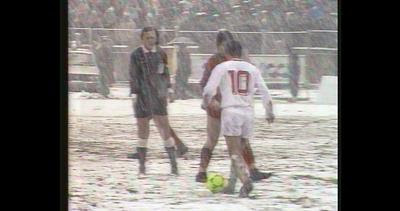
Corneliu Porumboiu s’est aussi intéressé au monde du football, sujet éminemment personnel puisque son père était arbitre professionnel international. Dans Match retour (2014), père et fils commentent, dans un dispositif minimal, un match de 1988 arbitré par le père, en pleine tempête de neige, sous l’œil des caméras de la télévision propagandiste roumaine. Son autre documentaire, Football infini (2018) est une plongée dans sa ville natale, Vaslui, en compagnie d’un ami d’enfance, haut fonctionnaire travaillant en préfecture et obsédé par une idée fixe : améliorer les règles du football ou le remplacer par un nouveau sport plus équilibré.
« Portés par un humour singulier et extrêmement référencé, les films de Corneliu Porumboiu, qui souvent s’apparentent à des fables, offrent un regard critique et décalé sur les mutations de la société roumaine avec affection et grande finesse. C’est un très grand cinéaste que nous rêvions d’accueillir depuis longtemps ; il sera passionnant d’aborder son œuvre à travers le prisme du rapport au réel. » commente Emilie Bujès, directrice artistique de Visions du Réel. 
BIOGRAPHIE- FILMOGRAPHIE DE COUNELIU PORUMBOIU

Corneliu Porumboiu a suivi des études en réalisation à l’Université nationale de théâtre et de cinéma de Bucarest de 1999 à 2003. En 2005, il écrit et met en scène son premier long métrage intitulé 12h08 à l’est de Bucarest. Ce film a été sélectionné dans la section Quinzaine des Réalisateurs et a remporté la Caméra d’or du premier film ainsi que le Label Europe, un prix décerné par les distributeurs de films.

En 2009, Corneliu Porumboiu écrit et réalise son deuxième long métrage Policier, Adjectif. Il remporte le prix FIPRESCI et le Prix du Jury dans la section Un Certain Regard au Festival de Cannes en 2009.

En 2013, Corneliu Porumboiu sort son troisième long métrage, Métabolisme ou quand le soir tombe sur Bucarest, dont la première a eu lieu au Locarno Film Festival. Il a ensuite réalisé le documentaire Match retour, qui a été présenté au Forum de la Berlinale en 2014.

Son long métrage Le Trésor a remporté le prix Un Certain Talent dans la section Un Certain Regard du Festival de Cannes 2015. 

En 2018, Corneliu Porumboiu est de retour avec un documentaire sportif intitulé Football infini qui a été à nouveau inclus dans la sélection du Forum de la Berlinale.

En 2019, il achève sa cinquième réalisation, un film intitulé Les Siffleurs qui a fait l’objet d’une projection inaugurale à la 72e édition du prestigieux Festival de Cannes, où il était en compétition.

VISIONS DU REEL

09/03/25

Sarah Maldoror Films @ Centre Pompidou, Paris (Text in English)

Sarah Maldoror
Centre Pompidou, Paris 
Cinéma 1 | Level 1
April 3 - 7, 2025 

Sarah Maldoror - Portrait
Sarah Maldoror @ Christine Lipinska 
Courtesy Annouchka de Andrade et Henda Ducados

Associated programme to the Black Paris exhibition

The "Black Paris" exhibition features the work of artist Sarah Maldoror, including one of her major productions, And the Dogs Were Quiet. Filmed in the collections of the Musée de l’Homme in 1978, this motion picture is built around filmed excerpts of Aimé Césaire’s drama And the Dogs Were Silent. During the exhibition, the Centre Pompidou’s cinemas are paying tribute to this unique filmmaker whose work documents and questions the present more than ever before.

A five-day event that includes screenings (all accompanied by artists and witnesses on whom Sarah Maldoror’s work has had a lasting influence), readings, encounters, and the presentation of previously unseen archives, invites the public to hear the filmmaker’s voice in the present. Restored versions of the films Monangambé (1969, 17 min), And the Dogs Were Quiet (1978, 13 min), Le masque des mots (1987, 47 min) and Regards de mémoire (2003, 24 min) will be presented for the first time in France thanks to the support of MansA – Maison des Mondes Africains. Sarah Maldoror’s 1979 trilogy composed of Carnaval in the Sahel (28 min), Fogo, Fire Island (34 min) and Carnaval in Bissau (18 min) will also be shown.

Filmmaker Sarah Maldoror’s life and career tie in with all currents of activism in the 20th century: surrealism, Négritude, Pan-Africanism, feminism and communism. 

Born Marguerite Sarah Ducados in 1929 to a mother from Gers and a Guadeloupean father, she chose the pseudonym Maldoror, inspired by Lautréamont’s The Songs of Maldoror, rediscovered by the Surrealists during the interwar period. In 1956, Sarah Maldoror founded Les Griots, the first Black theater troupe in Paris. She later studied filmmaking in Moscow before directing her first short film, Monangambééé, in 1969. Her first feature film released in theaters, Sambizanga (1972), widely regarded as her masterpiece, was restored by Martin Scorsese’s Film Foundation. 

Sarah Maldoror passed away in 2020, leaving behind a legacy of over 40 films, including both fiction and documentaries of varying lengths, shot in France, Algeria, Guinea-Bissau, Angola, and Colombia, as well as numerous unrealized projects. Her work, deeply poetic and artistically driven, consistently explored struggles for independence, especially in African nations, alongside her companion, Angolan poet and anti-colonialist activist Mario Pinto de Andrade.
“We will never be free as long as you see us the way you do. We must free you from the idea you have of Black people so that we can be free Black people...” Sarah Maldoror declared to writer Marguerite Duras in a 1958 interview, encapsulating the direction of her life’s work.
She adapted and brought to the screen the portraits of numerous artists and intellectuals of the 20th century, including Aimé Césaire, Léon-Gontran Damas, Caribbean poet René Depestre, Cuban artist Wifredo Lam, French figures Louis Aragon and Robert Doisneau, and Mexican painter Vlady Rusakov. Maldoror also collaborated with filmmakers such as Chris Marker, Gillo Pontecorvo, and William Klein.

As part of ongoing tributes, Sarah Maldoror’s work was featured in the exhibition "After the End: Maps for Another Future" at the Centre Pompidou-Metz from January 2025, and in the "Regards Satellites" festival at the L’Écran cinema in Saint-Denis, from January 29 to February 9, 2025. Carlotta Films released restored editions of Sambizanga, Monangambééé, and the Carnaval trilogy in a special box set in early 2025, accompanied by a dedicated issue of Avant-Scène Cinéma in February focusing on Sambizanga.

In spring 2025, the Museum of Modern Art (MoMA) in New York hosts a complete retrospective of her films, followed by another in São Paulo in 2026.

CENTRE POMPIDOU, PARIS

13/11/24

The Complete Robert Frank: Films and Videos, 1959–2017 @ MoMA, The Roy and Niuta Titus Theaters

The Complete Robert Frank: Films and Videos, 1959–2017
MoMA, The Roy and Niuta Titus Theaters
November 20 – December 11, 2024

It’s Real (C’est vrai)
. 1990 
France. Directed by Robert Frank 
Courtesy The June Leaf and Robert Frank Foundation/
The Museum of Fine Arts, Houston

Hunter.
1989 
West Germany. Directed by Robert Frank
Courtesy The June Leaf and Robert Frank Foundation/
The Museum of Fine Arts, Houston

Last Supper
. 1992. 
Switzerland/USA. Directed by Robert Frank 
Courtesy The June Leaf and Robert Frank Foundation/
The Museum of Fine Arts, Houston

Life Dances On…
1980 
USA. Directed by Robert Frank
Courtesy The June Leaf and Robert Frank Foundation/
The Museum of Fine Arts, Houston

Life Dances On…
1980 
USA. Directed by Robert Frank
Courtesy The June Leaf and Robert Frank Foundation/
The Museum of Fine Arts, Houston

Life-Raft Earth
. 1969 
USA. Directed by Robert Frank
Courtesy The June Leaf and Robert Frank Foundation/
The Museum of Fine Arts, Houston

Pull My Daisy
. 1959 
USA. Directed by Alfred Leslie, Robert Frank 
Courtesy The June Leaf and Robert Frank Foundation/
The Museum of Fine Arts, Houston

In conjunction with the gallery exhibition Life Dances On: Robert Frank in Dialogue and the installation Robert Frank’s Scrapbook Footage, MoMA presents a complete retrospective of Robert Frank’s films and videos, many of them in new digital preservations and remasters, together with a modest selection of films relating to the artist and his circle of family, friends, and collaborators. Recognizing his important relationship with MoMA, Frank donated all of his unique film and video materials to its collection in 2015. These works span the entirety of Frank’s moving-image career, from his 1959 Beat psychodrama Pull My Daisy (co-directed by Alfred Leslie and starring the poets Allen Ginsberg, Peter Orlovsky, and Gregory Corso; the artists Larry Rivers and Alice Neel; and the actress Delphine Seyrig; with narration by Jack Kerouac) to his 2008 video Fernando, a touching portrait of a Swiss artist friend, and Harry Smith at the Breslin Hotel, 1984 (2017).

Conversations in Vermont
. 1971
USA. Directed by Robert Frank 
Courtesy The June Leaf and Robert Frank Foundation/
The Museum of Fine Arts, Houston

About Me: A Musical
. 1971 
USA. Directed by Robert Frank 
Courtesy The June Leaf and Robert Frank Foundation/
The Museum of Fine Arts, Houston

Robert Frank’s films profoundly altered his approach to making images. Out of restlessness and a passion for experimental risk-taking, Robert Frank all but abandoned photography for filmmaking in the late 1950s. When he returned to still photography in the early 1970s, his work had become less precious and singular. Instead, he subjected his still images to a variety of manipulations: scratching and painting directly on the negative or emulsion surface, and collaging and creating montages. The photographs began to resemble film sequences or storyboards: multiple frames of images with implied narratives and use of written texts as commentary. Films like Conversations in Vermont (1969) and About Me: A Musical (1971), autobiographical portraits of family life and community, were direct antecedents to deeply personal, intimate projects like his 1972 artist book The Lines of My Hand. The films’ seemingly improvisational quality also led to an interest in the immediate gratifications of Polaroids.

Me and My Brother
. 1965-68 
USA. Directed by Robert Frank 
Courtesy The June Leaf and Robert Frank Foundation

The series includes The Sin of Jesus, Frank’s 1961 adaptation of an Isaac Babel short story; OK End Here (1963), an intimate chamber piece featuring an original score by Ornette Coleman; and Me and My Brother (1965–68), his first feature, a faux vérité involving Allen Ginsberg, Joseph Chalkin (founder of the off-Broadway Open Theater company), Peter Orlovsky, and Orlovsky’s catatonic schizophrenic brother Julius. They are important documentary records of bohemian artist life in 1950s and ’60s New York; tender portraits of friends (Danny Seymour, the Chinese artist Sanyu, the newspaper delivery man in his rural second hometown of Mabou, Nova Scotia); painfully raw confrontations with the personal tragedies of his daughter’s accidental death and his son’s mental illness; diaristic travelogues; and thoughtful interrogations of the artist’s own divided loyalties between work and family.

Cocksucker Blues
. 1972 
USA. Directed by Robert Frank 
Courtesy Promotour BV/ 
The June Leaf and Robert Frank Foundation/
The Museum of Fine Arts, Houston

Robert Frank’s interest in the malleability of truth, in setting up conditions for improvisation within a scripted or premeditated framework, is perhaps best exemplified by his end-of-the-road movie Candy Mountain (1987), a collaboration with the novelist Rudy Wurlitzer, and his notorious Cocksucker Blues (1972). “After seeing these pictures you end up finally not knowing any more whether a jukebox is sadder than a coffin,” Jack Kerouac wrote in his introduction to Robert Frank’s landmark 1958 photographic essay The Americans. Nearly 15 years later, Robert Frank would use Super 8 camera stills from that same journey along Route 66 for the back cover of the Rolling Stones’ Exile on Main St., while also following the band on their promotional concert tour of the album—their first cross-country trip since Altamont, with Truman Capote, Terry Southern, Andy Warhol, and Princess Lee Radziwill as hangers on. Chronicling the loneliness and weary hedonism of life on the road—Robert Frank would later say, “This totally excludes the outside world. To never get out, to never know what city you are in…I cannot get used to it”—Cocksucker Blues was suppressed for years and seen only in bowdlerized, bootleg form. Don DeLillo, in his novel Underworld, would write of the film’s “washed blue light, a kind of crepuscular light, a tunnel light that suggested an unreliable reality.” 

Organized by Joshua Siegel, Curator, Department of Film. Thanks to The June Leaf and Robert Frank Foundation, Peter Williamson, Laura Israel, and Nicholas Dawidoff.