Showing posts with label 2027. Show all posts

02/10/25

Martin Puryear: Nexus @ Museum of Fine Arts Boston + Cleveland Museum of Art + High Museum of Art

Martin Puryear: Nexus
Museum of Fine Arts, Boston
September 27, 2025 – February 8, 2026
Cleveland Museum of Art
April 12 – August 9, 2026
High Museum of Art
September 25, 2026 – January 17, 2027

For more than half a century, the preeminent sculptor Martin Puryear (born 1941) has captivated the public with works of astonishing beauty and elaborate craftsmanship, whose sources of inspiration range from global cultures and social history to the natural world. Co-organized by the Museum of Fine Arts, Boston (MFA), and the Cleveland Museum of Art (CMA), Martin Puryear: Nexus is the first substantial survey of the artist’s work in nearly two decades. Assembling some 50 works from across Puryear’s career, the exhibition focuses on his use of a rich variety of materials and media—from sculptures in wood, leather, glass, marble, and metal to rarely shown drawings and prints.

After debuting at the MFA, where it is on view in the Linde Family Wing for Contemporary Art, the exhibition travels to the Cleveland Museum of Art from April 12 through August 9, 2026, followed by the High Museum of Art in Atlanta from September 25, 2026 through January 17, 2027. Martin Puryear: Nexus is accompanied by a catalogue produced by the Cleveland Museum of Art.

Martin Puryear: Nexus reflects the artist’s singular practice, one that combines the distinctive techniques of production with the formal histories he has encountered through a lifetime of movement, research, and study. The exhibition begins with works on paper from the early 1960s and follows Puryear’s subsequent innovations in form, material, and process. Rooted in new scholarship, Martin Puryear: Nexus illuminates the ways in which the artist’s unique vocabulary has been shaped by his enduring interests in global traditions of material culture, African American history, and the natural world.
“With this exhibition we are pleased to feature an exceptional artist of our time and powerful works that speak to Martin Puryear's creativity and exceptional craftsmanship, and the lifelong learning that has fueled his practice,” said Pierre Terjanian, the MFA’s Ann and Graham Gund Director. “The sculptures included in this survey extend a compelling invitation to engage with themes of culture, identity, and history. We are grateful to our colleagues at the Cleveland Museum of Art for their partnership in making this project possible.”

“Martin Puryear’s art is staggeringly beautiful and also moving in the way that it invites us to see with fresh eyes the world we inhabit,” said William M. Griswold, Sarah S. and Alexander M. Cutler Director, the Cleveland Museum of Art. “Given the remarkable range of aesthetic traditions, cultural histories, and techniques of making that Puryear integrates in his work, we are especially pleased to present his career retrospective at museums with comprehensive collections from around the world, and spanning thousands of years of history.”
Martin Puryear: Nexus - Exhibition Highlights

Martin Puryear, Self (1978, The Joslyn Art Museum)

One of Puryear’s most iconic sculptures, Self shows the importance of dynamic formal oppositions in the artist’s work. At once a dark monolithic mass, Self is light and hollow, enclosing a hidden interior volume. It was assembled piece by piece through cold molding, a technique that Puryear learned through boat-building and which he has integrated into some of his most celebrated sculptures.

Martin Puryear, Night and Day (1984, Nasher Sculpture Center)

A rarely exhibited work, Night and Day reflects Puryear’s enduring interest in natural manifestations of black and white, which divide the two halves of the work’s semicircular arch. One end of the arch sits on the floor, while the other hovers just above it.

Martin Puryear, On the Tundra (1986, Museum of Fine Arts, Boston)

Puryear’s interest in the natural world and ornithology are reflected in his creation of this cast iron sculpture, an abstracted form suggesting a falcon perched on a rock. It was partially inspired by a work from the MFA’s collection: a 1619 portrait of a gyrfalcon by the Mughal court painter Mansur (active around 1590­–1630). Mansur’s painting—a reproduction of which hangs in Puryear’s studio—was immediately compelling for him not only within the history of ornithological portraiture but also as a representation of geopolitical trade routes, as the gyrfalcon is not native to India and likely arrived via diplomatic trade channels from Europe. The exhibition also includes On the Tundra (Winter) (2022, collection of the artist), a recent iteration of the original sculpture in white marble.

Martin Puryear, Confessional (1996–2000, Museum of Fine Arts, Boston)

Composed partly of wire mesh covered with tar, this work evokes a hollow inner space that is visible and obscured at the same time. Its title suggests one possible reading, delineating the wooden platform as a place upon which a confessor—implicitly, the viewer—may kneel and “confess.” Confessional is included only in Boston’s presentation.

Martin Puryear, Big Phrygian (2010–14, Glenstone Museum)

This colossal sculpture is the most dramatic representation of Puryear’s sustained engagement with the lineage of the Phrygian cap. This headdress signified formerly enslaved people in ancient Rome and later became a symbol of resistance to persecution during the French and American Revolutions. In the exhibition it is shown alongside the etching Phrygian (Cap in the Air) (2012, Museum of Fine Arts, Boston).

Martin Puryear, Hibernian Testosterone (2018, courtesy of the artist and Matthew Marks Gallery)

This large, wall-mounted sculpture reproduces in full scale the 12-foot antlers of the Irish elk, an extinct species of deer common during the Ice Age. Scientists of the 1700s had a theory that its antlers—which likely evolved to help the species survive combat and demonstrate sexual prowess and whose growth was propelled by testosterone—contributed to its extinction as they eventually became too heavy for the animal to hold up. Martin Puryear distills this parable-like history from the animal kingdom into a straightforward visual statement, suspending the antlers from an inverted cross.

Martin Puryear, Aso Oke (2019, Jack Shear Collection)

Encountered by visitors before they enter the exhibition, this monumental sculpture, cast in bronze, borrows its form from the fila gobi, a ceremonial cap worn by the Yoruba people of Nigeria. The intricate open latticework is a recurring technique used by Martin Puryear throughout his career.

Martin Puryear, A Column for Sally Hemings (2021, collection of the artist)

One of Puryear’s few indoor site-specific sculptures, this was created for the US Pavilion at the 2019 Venice Biennale. Responding to the pavilion’s architecture, which was modeled on Monticello—the primary residence and plantation of Thomas Jefferson—the work’s fluted base echoes the Doric columns between which visitors passed to enter the exhibition space in Venice. The sculpture’s title refers to Sally Hemings (1773­–1835), the enslaved Black woman, with whom Jefferson had at least six children.

Martin Puryear: Nexus also features a film that documents Puryear’s most recent outdoor work Lookout (2023), a permanent site-specific commission for the Storm King Art Center. In Cleveland and Atlanta, additional film footage as well as prints, drawings, and documentation of other public commissions will also be on view, demonstrating how Puryear extends his studio practice into the public realm and maintains his commitment to craft and concept on a monumental scale.

Artist Martin Puryear

Over the past five decades, Martin Puryear has created a body of work based on abstract organic forms rich with psychological, cultural, and historical references. His labor-intensive sculptures are made by hand at his studio in upstate New York. They combine practices adapted from many different traditions, including wood carving, joinery, and boat building, as well as more recent technology. As a student, Puryear studied ornithology, falconry, and archery, and in the 1960s he volunteered with the Peace Corps in west Africa, where he was exposed to the region’s Indigenous crafts. Since then he has continued to travel extensively, observing a range of cultures and their unique approaches to object making. “I think there are a number of levels at which my work can be dealt with and appreciated,” he has said. “It gives me pleasure to feel there’s a level that doesn’t require knowledge of or immersion in the aesthetic of a given time or place.”

Martin Puryear was born in Washington, D.C., in 1941. His first one-person exhibition took place in 1968, and since then he has exhibited throughout the world, including public commissions in Europe, Asia, and the U.S. His work was featured in Documenta 9, and in 1989 he represented the U.S. at the Bienal de São Paulo, where he was awarded the festival’s Grand Prize. In 2007, the Museum of Modern Art in New York organized a survey of his work, which traveled to the National Gallery of Art in Washington, D.C., the San Francisco Museum of Modern Art, and the Modern Art Museum of Fort Worth. In 2015, the Art Institute of Chicago organized an exhibition of 50 years of his works on paper, which traveled to the Morgan Library and Museum in New York and the Smithsonian American Art Museum in Washington, D.C. Martin Puryear received a MacArthur Foundation award in 1989 and a National Medal of Arts from President Obama in 2011. In 2019 he represented the U.S. at the 58th Venice Biennale. His recent commissions include outdoor works at Madison Square Park, the Storm King Art Center, and the Deichman Library in Oslo.

Martin Puryear: Nexus - Exhibition Catalogue

Martin Puryear: Nexus is accompanied by an expansive and richly illustrated catalogue. Designed and published by the Cleveland Museum of Art, with distribution by Yale University Press, the publication is anchored by five essays authored by a new generation of scholars: Rizvana Bradley, Joan Kee, Emily Liebert, Michelle Millar Fisher, and Ugochukwu-Smooth Nzewi.

Martin Puryear: Nexus - Exhibition Catalogue
Martin Puryear: Nexus
Exhibition Catalogue Cover
Published by the Cleveland Museum of Art
Image courtesy Yale University Press
Artwork © Martin Puryear
240 Pages, 10.50 × 13.00 in, 212 color + b-w illus.
Published October 2025

Additional perspectives enter the book through series of responses to individual works, contributed by thinkers and makers from a range of disciplines, many of whom are long-time interlocutors of the artist. They include Nairy Baghramian, Alex Da Corte, Thelma Golden, Maya Lin, Kerry James Marshall, Julia Phillips, Charles Ray, and Billie Tsien. Alongside these contemporary perspectives, the catalogue features archival materials that have never before been published.

Martin Puryear: Nexus - Exhibition Curators

The exhibition is co-curated by Emily Liebert, Lauren Rich Fine Curator of Contemporary Art, Chair of Art of the Americas, Modern and Contemporary Art, The Cleveland Museum of Art, and Reto Thüring, Head of Culture at the Foundation for Art, Culture, and History in Winterthur, Switzerland and former Beal Family Chair, Department of Contemporary LArt at the Museum of Fine Arts, Boston with Gabriella Shypula, Leigh and Mary Carter Director’s Research Fellow, The Cleveland Museum of Art. The MFA’s presentation is organized by Ian Alteveer, Beal Family Chair, Department of Contemporary Art with Daisy Alejandre, Curatorial Assistant, Contemporary Art. The High’s presentation is organized by Michael Rooks, Wieland Family Senior Curator of Modern & Contemporary Art.

MFA - MUSEUM OF FINE ARTS BOSTON
465 Huntington Avenue, Boston, Massachusetts 02115

29/09/25

An Indigenous Present @ ICA Boston - An Exhibition spanning 100 years of Contemporary Indigenous Art - Institute of Contemporary Art/Boston + Frist Art Museum, Nashville + Frye Art Museum, Seattle

An Indigenous Present
ICA Boston
October 9, 2025 - March 8, 2026

The Institute of Contemporary Art/Boston (ICA) opens An Indigenous Present, a thematic exhibition spanning 100 years of contemporary Indigenous art. The exhibition includes new commissions and significant works by 15 artists who use strategies of abstraction to represent personal and collective narratives, describe specific and imagined places, and build upon cultural and aesthetic traditions. Co-organized by artist Jeffrey Gibson and independent curator Jenelle Porter, the exhibition offers an expansive consideration of Indigenous art practices that highlights a continuum of elders and emerging makers, and premieres newly commissioned site-specific works by Raven Chacon, Caroline Monnet, and Anna Tsouhlarakis. An Indigenous Present emerges from Gibson and Porter’s 2023 landmark publication of the same name, which, through a collaborative process, brought together work by Native North American artists exploring diverse approaches to concept, form, and medium. Their engagement with artists during the making of the book inspired this exhibition—one that demonstrates the endless variability of abstraction and its capacity to hold multiple forms and histories. 

An Indigenous Present debuts at the ICA, before traveling to the Frist Art Museum in Nashville (June 26—September 27, 2026) and the Frye Art Museum in Seattle (November 7, 2026—February 14, 2027). 
“This exhibition is one take on the field of contemporary art and culture by Native and Indigenous makers. Some of these artists have been working for decades, and I follow in their path; others are at an earlier stage in their career, and I see new routes and possibilities in their respective practices. Together, they are amplifying the histories that have come before them and building a new context for present and future artists,” said Jeffrey Gibson.

​​Jenelle Porter added: ​“Since curating Jeffrey’s first solo museum exhibition at the ICA in 2013, he and I have continued to think together about ways to enlarge art histories. This exhibition is a proposal, one that explores the ways that these artists challenge the often arbitrary, historical categorizations of art by Indigenous makers​.”​ 
The exhibition unfolds across 10 galleries, beginning with a focus on the work of George Morrison and Mary Sully, two important forebearers in the development of contemporary Indigenous art during the first half of the 20th century. Throughout the exhibition, works by emerging artists are positioned in dialogue with those by more established makers. Kay WalkingStick and Dakota Mace explore seriality and repetition in bodies of work realized in the 1970s and 2020s, respectively. WalkingStick’s Chief Joseph Series—dedicated to the heroic Niimíipuu / Nez Perce chief—presents a grid of 32 paintings that characterize the artist’s decades-long devotion to serial forms and storytelling. Mace’s So’ II (Stars II) is composed of 40 unique chemigram prints that draw on Diné (Navajo) design histories and heritage. In another artistic dialogue, George Morrison and Teresa Baker evoke the land and light of their own ancestral homelands through an interplay of color and form. George Morrison, who trained alongside Abstract Expressionists painters in New York in the 1950s, is known for vibrant compositions, especially those inspired by the horizon near his Lake Superior, MN, home. Theresa Baker composes with yarn, paint, willow, and hide on irregularly cut artificial turf to create large-scale abstractions that convey her memories of place, such as the Northern Plains of her youth, as well as legacies of color field painting and collage.

At the ICA, An Indigenous Present includes two new commissions that expand the exhibition beyond the galleries. An immersive sound work by Raven Chacon will fill the ICA’s Founders Gallery overlooking Boston Harbor. Monnet’s site-specific installation for the museum’s Sandra and Gerald Fineberg Art Wall is composed of commercial building materials—such as Tyvek and roofing underlayment—that are sewn into a fractal-based composition inspired, in part, by Boston’s 600-year history of land reclamation and the ICA’s harbor location. The fractal patterns, or population “blooms,” derive from Anishinaabeg designs that, for the artist, symbolize interconnectedness, knowledge transmission, and kinship. Throughout the run of the exhibition, the ICA will host a series of performances of Raven Chacon’s scores and sound works, a film series curated by artist Sky Hopinka in the ICA’s Barbara Lee Family Foundation Theater, and a number of other public programs. 

An Indigenous Present - Artist List

Teresa Baker (Mandan/Hidatsa; born 1985 in Watford City, ND)
Raven Chacon (Diné; born 1977 in Fort Defiance, Navajo Nation)
Sky Hopinka (Ho-Chunk Nation; born 1984 in Bellingham, WA)
Sonya Kelliher-Combs (Iñupiaq/Athabascan; born 1969 in Bethel, AK)
Gabrielle L’Hirondelle Hill (Cree and Métis; born 1979 in Comox, British Columbia)
George Longfish (Seneca and Tuscarora; born 1942 in Ohsweken, Ontario)
Dakota Mace (Diné; born 1991 in Albuquerque, NM)
Kimowan Metchewais (Cree; born 1963 in Oxbow, Saskatchewan; died 2011, St. Paul, Alberta)
Caroline Monnet (Anishinaabe [Algonquin] and French; born 1985 in Ottawa, Ontario)
George Morrison (Ojibwe; born 1919 in Chippewa City, MN; died 2000, Red Rock, MN)
Audie Murray (Cree and Métis; born 1993 in Saskatoon, Saskatchewan)
Jaune Quick-to-See Smith (citizen of the Confederated Salish and Kootenai Nation; born 1940 in St. Ignatius Mission, Flathead Reservation, MT; died 2025, Corrales, NM)
Mary Sully (Susan Mabel Deloria) (Yankton Dakota; born 1896 in Standing Rock Reservation, ND; died 1963, Omaha, NE)
Anna Tsouhlarakis (Navajo/Creek/Greek; born 1977 in Lawrence, KS)
Kay WalkingStick (Cherokee and Anglo; born 1935 in Syracuse, NY)

An Indigenous Present is organized by Jeffrey Gibson and Jenelle Porter, guest curators, with Erika Umali, Curator of Collections, and Max Gruber, Curatorial Assistant.  

ICA - INSTITUTE OF CONTEMPORARY ART / BOSTON
25 Harbor Shore Drive, Boston MA 02210

28/09/25

Nick Cave: Mammoth @ Smithsonian American Art Museum, Washington DC - The museum’s largest-ever commission by a single artist

Nick Cave: Mammoth
Smithsonian American Art Museum, Washington DC
February 13, 2026 - Jananuary 3, 2027

Nick Cave Photograph in his studio
Nick Cave, Artist in his studio
Courtesy of the artist and Jack Shainman Gallery 
Photograph by James Prinz

The Smithsonian American Art Museum will debut “Nick Cave: Mammoth,” a monumental new body of work by internationally acclaimed artist NICK CAVE. Commissioned by the museum, “Mammoth” marks Cave’s first solo exhibition in Washington, D.C. and represents the museum’s largest-ever commission by a single artist.  

“Mammoth” is Cave’s most personal project to date. Drawing on his childhood in Chariton County, Missouri—where his grandparents farmed and where the quilts, tools and clothing they made were a part of everyday life—Nick Cave roots this installation in family history, landscapes and craft traditions. He transforms these sources into a world animated by memory and the transformative possibilities of the imagination. Combining sculpture, video and found objects, the exhibition reflects on the artist’s own creative impulse and invites audiences to consider their relationship to the natural world and the everyday objects and histories that shape our lives.  
“‘Nick Cave: Mammoth’ builds on the museum’s commitment to present artists whose work speaks to the American experience and fosters connection,” said Jane Carpenter-Rock, acting Margaret and Terry Stent Director of the Smithsonian American Art Museum. “It is an honor to support a new body of work by one of today’s leading artists, the museum’s most significant commission to date by a single artist and to present it in dialogue with the sweep of American art across our galleries.”

“‘Mammoth’ is a conversation across time, a meditation on how and why we make, and how we live with what we inherit,” said Sarah Newman. “Nick Cave gathers fragments of daily life—toys, tools, keepsakes, even the remains of ancient creatures—and transforms them into a shared space of memory and imagination. His work is a powerful reminder that objects are often more than things; they carry our histories, our knowledge, and the stories that carry us forward.”
Nick Cave remakes a suite of galleries on the museum’s third floor into a series of immersive environments. Against a 60-by-20-foot hand-beaded tapestry laid over a landscape of Chariton County, Missouri, towering lifeguard chairs rise—some crowned with massive skeletal mammoth heads, others draped in hides. In the center of the space, a glowing, 700-square-foot light table holds thousands of found objects—from vintage tools, juggling balls and pie plates to his grandmother’s thimble collection—arranged like paleontological specimens. Some remain recognizable; others have been transformed into masks, creatures and contraptions that feel alive with spirit and intention.

The mammoths come alive in “Roam,” a video projected across four walls of an adjoining gallery that follows the massive creatures as they wander through present-day Chicago. In another space, Cave presents bronze sculptures from his “Amalgams” series, which fuse casts from his own body with natural forms such as flowers, birds and trees. These works, surrounded by metal tole flowers and antique cast-iron doorstops—including those from his grandparents’ home—evoke both loss and renewal, the solace of nature and the imprint of inheritance.

The installation will be activated by a site-specific performance.

Artist Nick Cave

Nick Cave (born 1959, Fulton, Missouri; lives and works in Chicago) is an artist and educator working between the visual and performing arts through a wide range of mediums including sculpture, installation, video, sound and performance. His work builds upon generations of Black artists and artisans, from quilters such as his own grandmothers to the assemblers of yard art in the American South, who imbued cast-off materials with new meaning. Nick Cave has harnessed this transformative impulse throughout his work—most famously in his series of “Soundsuits,” part sculpture and part garment, which conceal their wearers’ identities at the same time as they metamorphose into others.  

Nick Cave earned a bachelor’s degree in fine art at Kansas City Art Institute, a master’s degree from Cranbrook Academy of Art in Bloomfield Hills, Michigan, and is currently director of the graduate program in fashion at the School of the Art Institute of Chicago. His work is in many museum collections, including the Smithsonian American Art Museum (Washington, D.C.), the Hirshhorn Museum and Sculpture Garden (Washington, D.C.), the Philadelphia Museum of Art, the Whitney Museum of American Art (New York), the Museum of Modern Art (New York), the Museum of Contemporary Art Chicago and the Crystal Bridges Museum of American Art (Arkansas). In 2022, he completed a multi-part commission from the Metropolitan Transportation Authority in New York City for a glass mosaic and video work “Each One, Every One, Equal All” that is on view in the Times Sq-42 St Station. Other recent projects and exhibitions include the major retrospective “Nick Cave: Forothermore” at the Museum of Contemporary Art Chicago (2022); “The Let Go” at Park Avenue Armory (2018); and “Nick Cave: Until” at the Massachusetts Museum of Contemporary Art (2016).  

Publication: A richly illustrated catalog, published in association with D. Giles Limited, will accompany the exhibition. The book offers an intimate look into Cave’s creative process, featuring found and personal objects that inspired him, annotated with his own handwritten notes and drawings. The publication includes essays by Newman, Gwendolyn DuBois Shaw and Cherise Smith, and a major new poem by J Drew Lanham.

“Nick Cave: Mammoth” is organized by Sarah Newman, the James Dicke Curator of Contemporary Art, with support from Anne Hyland, curatorial associate.

SAAM - SMITHSONIAN AMERICAN ART MUSEUM 
8th and G Streets, NW, Washington, DC 20004

14/08/25

Big Things for Big Rooms @ Hirshhorn Museum, Washington DC - An Exhibition of Large-scale Artworks since the late 1960s

Big Things for Big Rooms
Hirshhorn Museum, Washington DC
November 21, 2025 – July 4, 2027 

Sam Gilliam Art
Sam Gilliam 
Light Depth, 1969 
Acrylic on canvas; 120 × 900 in. (304.8 × 2286 cm) 
Gift from the Trustees of the Corcoran Gallery of Art 
(Museum Purchase, Gallery Fund), 2018

Mika Rottenberg Art
Mika Rottenberg 
Tropical Breeze (exterior), 2004.
Installation view, Sneeze to Squeeze, Magasin III, Stockholm, 2013 
Single-channel video installation; 3:45 min. 
Exterior; 96 × 96 × 240 in. (243.84 × 243.84 × 609.6 cm) 
Gift of the Berezdivin Collection, San Juan, Puerto Rico, 2024 
Courtesy of Hirshhorn Museum and Sculpture Garden 
Photo: Christian Saltas 
Courtesy the artist, Magasin III, Stockholm; and Hauser and Wirth

Smithsonian’s Hirshhorn Museum will open “Big Things for Big Rooms,” an exhibition tracing the development of immersive large-scale artworks since the late 1960s. The presentation of 10 artworks—five on view for the first time at the Museum—is drawn largely from the Hirshhorn’s collection. “Big Things for Big Rooms” offers a multisensorial examination of how artists create installation works that expand the boundaries of an artwork and the role of the visitor. 

“Big Things for Big Rooms” is organized into two parts. The first introduces the development of “Environments,” expansive installations by pioneering artists such as Robert Irwin, whose work defined the Light and Space movement, and Land artist Richard Long. The second half demonstrates how contemporary artists like Paul Chan, Olafur Eliasson, and Mika Rottenberg are expanding upon these foundational ideas in different ways, often using everyday materials. 

The exhibition is organized by the Hirshhorn’s head curator, Evelyn C. Hankins, with the support of curatorial assistant CJ Greenhill Caldera.
“This exhibition connects the profound creativity of the 1960s to the contemporary artists who are reshaping our sense of the world and our place in it,” said Museum Director Melissa Chiu. “Presented as a continuum from ‘Revolutions: Art from the Hirshhorn Collection, 1860–1960,’ which inaugurated our 50th-anniversary season, ‘Big Things for Big Rooms’ manifests these essential art-historical developments while demonstrating the significance of installation art in the Hirshhorn’s permanent collection.”
Rooted in artist and critic Allan Kaprow’s groundbreaking 1958 concept of “Environments,” which he defined as artworks that require visitors to actively engage with or even complete them, “Big Things for Big Rooms” begins with the Hirshhorn’s inaugural presentation of Sam Gilliam’s painting “Light Depth” (1969). Sam Gilliam experimented with dynamic, color-washed canvases, or Drapes, removing them from their stretchers and allowing their forms to change in response to each presentation. Extending 75 feet, the sweeping, frameless “Light Depth,” long considered to be Gilliam’s most important Drape, spills from the wall of the Museum’s first gallery, blurring the boundaries among painting, sculpture, and installation art.

Following “Light Depth” are other pioneering works, including Dan Flavin’s “‘monument’ for V. Tatlin” (1967), an arrangement of fluorescent fixtures that deploys light to define the space and involve the visitor. Also on view is Lygia Pape’s “Ttéia 1,A” (1979/2025), a geometric installation of shimmering metallic threads that anticipates the individual’s movement within the gallery.

As the exhibition unfolds, its focus shifts toward contemporary global artists, including Spencer Finch and Eliasson, who are envisioning immersive art for the 21st century. Highlights include recent Hirshhorn acquisitions such as Rottenberg’s “Tropical Breeze” (2004), a gallery-filling shipping container that functions as a screening room, and a recent site-responsive installation by Rashid Johnson, an assembly of objects of personal and cultural resonance (including live plants, books, ceramics, and shea butter) positioned within a minimalist sculptural framework that can be further activated by gatherings, performances, and reflection. The exhibition concludes with Chan’s “3rd Light” (2006), a mesmerizing choreography of digital projection, shadows, and objects exploring themes of transcendence, creation, and cyclical time. 

HIRSHHORN MUSEUM
Hirshhorn Museum and Sculpture Garden
Independence Ave SW and 7th St SW, Washington, DC 20560

13/08/25

Adam Pendleton: Love, Queen @ Hirshhorn Museum, Washington DC - A Landmark Exhibition

Adam Pendleton: Love, Queen
Hirshhorn Museum, Washington DC
Through January 3, 2027 

Adam Pendleton Portrait Photograph
Portrait of Adam Pendleton
© Adam Pendleton. Photo: Matthew Septimus 

Adam Pendleton Art
Adam Pendleton 
WE ARE NOT (Composition), 2024 
Silkscreen ink and black gesso on canvas 
19 x 15 in. (43.3 x 38.1 cm) 
© Adam Pendleton. Photo: Andy Romer

The Smithsonian’s Hirshhorn Museum and Sculpture Garden presents “Adam Pendleton: Love, Queen,” a landmark exhibition by Adam Pendleton. The artist presents new and recent paintings as well as a single-channel video work. Pendleton’s first solo exhibition in Washington, DC, highlights his unique contributions to contemporary American painting while making use of the architecture of the Museum and the history of the National Mall.
“Introducing Adam Pendleton’s recent work in our 50th year is intentional,” said Hirshhorn Director Melissa Chiu. “His exhibition reflects the Hirshhorn’s mission as a 21st-century art museum that amplifies the voices of artists responding to history and place in real time. ‘Adam Pendleton: Love, Queen’ invites our almost one million annual visitors to think about the complexities of abstraction within the American experience, and its potential to forge associations among our shared past, present and future.”

“I am delighted to exhibit my work on the occasion of the Hirshhorn’s 50th anniversary,” said Adam Pendleton. “It presents a meaningful opportunity to engage, in subtle and poetic ways, with the Museum’s architecture, position on the National Mall and legacy of showing significant abstract and conceptual work.”
Adam Pendleton is known for his visually distinct and conceptually rigorous paintings that he begins on paper with drips, splatters, sprays, geometric shapes, words and phrases, and inky fragments reminiscent of broken letters. These visual experiments are at times carefully controlled and at others freely improvised. He photographs these initial compositions and then layers them using a screen-printing process, purposefully blurring the distinctions between the act of painting, the act of drawing and the act of photography.

“Adam Pendleton: Love, Queen” features Adam Pendleton’s “Black Dada,” “Days,” “WE ARE NOT,” and new “Composition” and “Movement” paintings. An encounter with any of these works, typically composed of two colors on black-gessoed grounds, brings forth the immediacy of gestural abstraction, the considered execution of minimal and conceptual art, and the playfulness of concrete poetry. “Painting is as much an act of performance as it is an act of translation and transformation,” the artist has stated.

The artist also debuts “Resurrection City Revisited (Who Owns Geometry Anyway?),” a new video work that is projected floor to ceiling. The work makes use of still and moving images of Resurrection City, the multiday encampment erected on the National Mall in the spring and summer of 1968, which is considered to be the culmination of Dr. Martin Luther King Jr.’s Poor People’s Campaign. Strobing in and out of darkness, the documentary material is interspersed with found footage and punctuated by flashes of geometric forms, dissolving the boundaries between abstraction and representation. The film’s score, by multi-instrumentalist composer Hahn Rowe, integrates a reading by the late poet and cultural critic Amiri Baraka with an orchestration of brass, woodwinds and drums.

In its totality, “Adam Pendleton: Love, Queen” offers a powerful counterpoint to the Museum’s collection surveys that are concurrently presented in adjacent galleries. The exhibition is organized by Evelyn C. Hankins, the Hirshhorn’s head curator, with support from former curatorial assistant Alice Phan. “It is an honor to invite Adam Pendleton to respond to the Hirshhorn’s singular architecture and location,” said Hankins. “‘Adam Pendleton: Love, Queen’ speaks to the vision of our anniversary—a period of simultaneous reflection and forward thinking, a space in which Pendleton has been operating for almost two decades.”

“Adam Pendleton: Love, Queen” is accompanied by an exhibition catalogue with scholarly essays, Studio Hirshhorn and Hirshhorn Eye videos, and free public programs.

Artist Adam Pendleton

Adam Pendleton (b. 1984, Richmond, Virginia) is a central figure among a cross-generational group of painters redefining the medium as it relates to process and abstraction. In 2024, he was honored with the Rosenthal Family Foundation Award for Painting from the American Academy of Arts and Letters.

His work has been shown at major museums around the world. Recent solo and group exhibitions include “Adam Pendleton: Blackness, White, and Light,” at mumok—Museum moderner Kunst Stiftung Ludwig Wien, Austria (2023–2024); “Adam Pendleton: To Divide By,” at the Mildred Lane Kemper Art Museum, St. Louis, Missouri (2023–2024); “Whitney Biennial 2022: Quiet as It’s Kept,” at the Whitney Museum of American Art, New York (2022); “Adam Pendleton: These Things We’ve Done Together,” at the Montreal Museum of Fine Arts, Canada (2022); and “Adam Pendleton: Who Is Queen?,” at the Museum of Modern Art, New York (2021–2022).

Pendleton’s work is part of numerous public collections, including those of the Museum of Modern Art; the Solomon R. Guggenheim Museum, New York; the Studio Museum in Harlem, New York; the Carnegie Museum of Art, Pittsburgh; the Museum of Contemporary Art Chicago; the Museum of Contemporary Art San Diego; the Mildred Lane Kemper Art Museum; the Montreal Museum of Fine Arts; and Tate London.

HIRSHHORN MUSEUM
Hirshhorn Museum and Sculpture Garden
Independence Ave SW and 7th St SW, Washington, DC 20560

Adam Pendleton: Love, Queen
Hirshhorn Museum and Sculpture Garden, Washington DC
April 4, 2025 - January 3, 2027

15/07/25

A Nation of Artists @ Philadelphia Museum of Art & Pennsylvania Academy of the Fine Arts - A Landmark Exhibition of American Art Celebrating the United States’ 250th Anniversary

A Nation of Artists
Philadelphia Museum of Art
Pennsylvania Academy of the Fine Arts
April 12, 2026 - September 2027

The Philadelphia Museum of Art, Pennsylvania Academy of the Fine Arts, and The Middleton Family Present a Landmark Exhibition of American Art Celebrating the United States’s 250th Anniversary.

Jasper Johns, Flag
Jasper Johns 
Flag, 1960-66 
Encaustic and printed collage on paper laid down on canvas, 
17 1/2 x 26 3/4 (framed 34 3/4 x 44 inches) 
The Middleton Family Collection

Gilbert Stuart, George Washington
Gilbert Stuart  
George Washington (The Lansdowne Portrait), 1796 
Oil on canvas, 96 x 60 inches (243.84 x 152.4 cm)  
The Pennsylvania Academy of the Fine Arts, 
Bequest of William Bingham 

Jaune Quick-to-See Smith
Jaune Quick-to-See Smith 
 
What is an American?, 2001-2003   
Lithograph, chine collé, monotype, 
68 x 40 inches (172.72 x 101.6 cm)   
Gift of Ofelia Garcia

Barkley L. Hendricks
Barkley L. Hendricks 
J. S. B. III, 1968  
Oil on canvas, 48 x 34 3/8 inches (121.92 x 87.3125 cm)  
Gift of Mr. and Mrs. Richardson Dilworth

Two of America’s most esteemed cultural institutions—the Philadelphia Museum of Art (PMA) and the Pennsylvania Academy of the Fine Arts (PAFA)—announced A Nation of Artists, a historic collaboration with the private Middleton Family Collection that unites three extraordinary collections of American art. This unprecedented, once-in-a-lifetime exhibition will be presented exclusively at both PMA and PAFA to honor America’s 250th anniversary. It will open for public enjoyment from April 2026 to September 2027.

Featuring more than 1,000 works across the two museums, A Nation of Artists will be the most expansive presentation of American art ever mounted in Philadelphia. Though shaped by distinct curatorial visions at the PMA and PAFA, the exhibition is unified by shared themes exploring the richness of American art. Selections from The Middleton Family Collection—one of the country’s most significant private holdings—will be interwoven at both venues to offer fresh insight into the story of American art and experience.
“Our aspiration is that this exhibition is for everyone—no prior knowledge of art or history required,” noted John S. Middleton. “We believe in the power of storytelling to connect people and are thrilled to partner with these two storied institutions to share the works that have brought our family so much joy and inspiration. Like baseball, art has the power to bring people together and surprise us when we least expect it. With every viewing, there’s something new to discover. It’s an honor to help bring American art to life in a new way during this very special 250th commemoration of our country’s founding.
John Wallace
John Wallace
Untitled, 1939 
Oil on panel  36 x 19 ¾ inches (91.4 x 50.2 cm)  
A.E. Gllatin Collection, 1952 
Philadelphia Museum of Art

Horace Pippin
Horace Pippin 
John Brown Going to His Hanging, 1942 
Oil on canvas, 24 1/8 x 30 1/4 inches (61.2775 x 76.835 cm)   
John Lambert Fund 

Spanning three centuries of diverse mediums—from portraiture and sculpture to furniture, textiles, decorative arts, and photography—A Nation of Artists will trace the ever-evolving story of American creativity. Visitors will experience everything from the early realism of Charles Willson Peale to the shimmering brushwork of John Singer Sargent, the expressive intensity of Horace Pippin, and the impressionist elegance of Mary Cassatt—all shaped by the crosscurrents of cultural exchange, historic events, and imagination. The exhibition will further spotlight modern and contemporary artists whose work provides differing perspectives and interpretations of life in America today, including sculptural installations and multimedia works by Jaune Quick-to-See Smith, Rina Banerjee, and Mickalene Thomas.

Frederic Edwin Church
Frederic Edwin Church 
Pichincha, 1867 
Oil on canvas  31 × 48 3/16 inches (78.7 × 122.4 cm); 
Framed: 63 × 46 × 6 inches (160 × 116.8 × 15.2 cm)   
125th Anniversary Acquisition 
Gift of the McNeil Americana Collection, 2004 
Philadelphia Museum of Art.
“What makes American art so powerful is not only where it was created but also who made it—and why,” said Sasha Suda, the George D. Widener Director and CEO of the Philadelphia Museum of Art. “A Nation of Artists will present a broad and vibrant picture of artistic expression that was happening across the country through both familiar icons and voices that have historically been overlooked. We couldn’t be more excited and inspired to partner with PAFA and The Middleton Family on this extraordinary cultural milestone, and we look forward to welcoming everyone—from neighbors down the street to visitors from across the region, the country, and around the world—to be part of this celebration.”
As the birthplace of American democracy, Philadelphia will serve as a cultural and historic hub for the America 250 semiquincentennial celebrations, hosting global events including the 2026 FIFA World Cup, the PGA Championship, and the MLB All-Star Game, among many other exhibitions, sports events, and major conventions. A Nation of Artists will place the city at the heart of the nation’s creative legacy, reflecting both the historic depth and the city’s continued influence on American culture.
“This historic collaboration places Philadelphia’s artistic legacy on full display—offering the world a celebration of creativity, identity, and nationhood that can’t be experienced anywhere else,” said Angela Val, President and CEO of Visit Philadelphia. “Only in Philadelphia—where our independence was declared, our constitution debated and established, and our first states united—could an exhibition of this scale and significance come to life.”
Thomas Eakins
Thomas Eakins 
Portrait of Dr. Samuel D. Gross (The Gross Clinic), 1875 
Oil on canvas, 8 feet × 6 feet 6 inches (243.8 × 198.1 cm) 
Gift of the Alumni Association 
to Jefferson Medical College in 1878 
and purchased by the Pennsylvania Academy of the Fine Arts 
and the Philadelphia Museum of Art in 2007 with the generous 
support of more than 3,600 donors, 2007

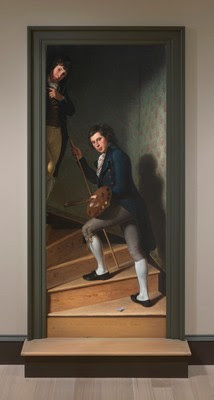
Charles Willson Peale
Charles Willson Peale  
Staircase Group (Portrait of Raphaelle Peale 
and Titian Ramsay Peale I), 1795  
Oil on canvas,  7 feet 5 1/2 inches × 39 3/8 inches   
The George W. Elkins Collection, 1945   
Philadelphia Museum of Art

Wharton E. Esherick
Wharton E. Esherick  
Library Ladder Steps with Elephant 
and Donkey Shaped Finals, 1935  
Hickory, Oak  34 ¾ x 18 x 23 ¼ inches   
125th Anniversary Acquisition
Gift of Rachel Bok Goldman and Allen S. Goldman, M.D., 2001   
Philadelphia Museum of Art

Woman's Dress: Bodice, Skirt, and Belt
, 1866-1868 
Artist/maker unknown 
Magenta silk satin with black silk satin and black cotton lace   
Center Front Length (Skirt): 41 inches (104.1 cm), Waist (Bodice): 
23 inches (58.4 cm), Waist (Skirt): 22 inches (55.9 cm)   
Gift of Mr. and Mrs. W. W. Keen Butcher, 1997. 
Philadelphia Museum of Art

Bringing together two world-class institutions, A Nation of Artists will be a collaborative, two-venue exhibition with distinct perspectives, curated by the teams at the Philadelphia Museum of Art and the Pennsylvania Academy of the Fine Arts, in partnership with The Middleton Family. Highlighting the richness and diversity of American art, the exhibition spans generations and artistic traditions, featuring contributions from Indigenous, African American, immigrant, and historically underrepresented artists who have helped to shape the nation’s cultural story.

Celebrating its 150th anniversary in 2026, PMA’s installation will offer a sweeping panorama of American art from about 1700 to 1960. Through iconic masterworks and bold juxtapositions, visitors will trace the evolution of American identity and visual culture—exploring tensions between high and low, elite and common, abstraction and realism. Set within PMA’s Beaux-Arts building, the installation will affirm the museum’s civic role in shaping the future of art and culture.

This exhibition will also mark the reopening of PAFA’s fabled Historic Landmark Building, designed by Frank Furness and opened in 1876, unveiling a bold new installation of the museum’s permanent collection, enhanced by numerous works from The Middleton Family Collection. The reimagined installation will offer a contemporary lens on American art, grounded in PAFA’s legacy of inclusion and innovation. As the nation’s first art museum and school, founded by Charles Willson Peale in 1805, PAFA continues to shape how American artists evolve—through formal study, experimentation, community, and creative risk—supported by its exhibitions, certificate programs, and public initiatives.
“This is a transformative moment for PAFA and for Philadelphia,” said Harry Philbrick, Interim Director of the Pennsylvania Academy of the Fine Arts. “As we reopen our Historic Landmark Building, we invite audiences into a renewed experience—one that reflects both our storied legacy and our forward-looking vision. This exhibition, enriched by rarely seen works from The Middleton Family Collection, will offer a compelling and inclusive narrative of American art. It’s a powerful expression of PAFA’s ongoing commitment to education, artistic excellence, and public engagement—especially meaningful in a landmark year for our nation.”
Edward Hopper
Edward Hopper 
The Lee Shore, c. 1941 
Oil on canvas; 28 1/4 x 43 in. (71.8 x 109.2 cm) 
The Middleton Family Collection

Childe Hassam
Childe Hassam 
Up the Avenue from Thirty-Fourth Street, 1917  
Oil on canvas, 36 in × 29.93 in (~91.4 × 76.0 cm)   
The Middleton Family Collection

John Singer Sargent
John Singer Sargent 
Group with Parasols (A Siesta), c. 1904 
Oil on canvas; 26 1/8 × 34 1/4 in. (66.4 × 87 cm) 
The Middleton Family Collection

The Middleton Family Collection
Presented publicly for the first time, more than 120 works from The Middleton Family Collection, assembled over five decades, will bring added depth and dimension to A Nation of Artists. John S. Middleton, widely admired as the managing partner of the Philadelphia Phillies, and his wife Leigh Middleton, a champion in the fight to end homelessness, have been passionate art collectors throughout their nearly 50-year marriage. Masterworks not previously available for public exhibition will offer fresh perspectives on the story of American creativity and history.

A Nation of Artists is organized by the Philadelphia Museum of Art and the Pennsylvania Academy of the Fine Arts.

PHILADELPHIA MUSEUM OF ART
2600 Benjamin Franklin Parkway, Philadelphia, PA 19130

12/04/25

Ruth Asawa: Retrospective Exhibition @ SFMOMA, San Francisco - MoMA, NYC - Guggenheim Bilbao - Fondation Beyeler

Ruth Asawa: Retrospective
San Francisco Museum of Modern Art
April 5 – September 2, 2025

The San Francisco Museum of Modern Art (SFMOMA) presents Ruth Asawa: Retrospective, the first major national and international museum retrospective of the groundbreaking work of RUTH ASAWA (1926–2013). Premiering at SFMOMA, this first posthumous retrospective features the entire spectrum of the artist’s awe-inspiring practice. Sculpture, drawings, prints, paintings, design objects and archival material from US-based public and private collections offer an in-depth look at her expansive output and its inspirations, exploring the ways her longtime San Francisco home and garden served as the epicenter of her creative universe, and highlighting the ethos of collaboration and inclusivity that informed her numerous public sculpture commissions and unwavering dedication to arts advocacy.
Ruth Asawa: Retrospective is deeply aligned with SFMOMA’s vision to be both local and global—presenting Bay Area artists with profound significance that also have the potential to be highly impactful and relevant on an international scale,” said Christopher Bedford, Helen and Charles Schwab Director of SFMOMA. “This exhibition provides an opportunity to celebrate the legendary Ruth Asawa, who was both a widely acclaimed artist and a hometown inspiration whose impact can be very much felt today.”
Ruth Asawa: Retrospective features more than 300 works spanning six decades of the artist’s career, engaging in the full range of materials and techniques that Asawa employed. Her signature looped-wire sculptures shares gallery space with lesser-known works in other mediums that supply valuable insight into the interconnectedness and relentlessly experimental nature of her artistic vision. In addition to Asawa’s own work, the exhibition includes a select number of works by peers and mentors with whom Ruth Asawa engaged in creative dialogue including Josef Albers, Imogen Cunningham, Buckminster Fuller, Ray Johnson, Hazel Larsen Archer, Merry Renk and Marguerite Wildenhain.

Ruth Asawa: Retrospective is an exhibition partnership between SFMOMA and The Museum of Modern Art, New York (MoMA) and co-curated by Janet Bishop, Thomas Weisel Family Chief Curator and Curator of Painting and Sculpture, SFMOMA and Cara Manes, Associate Curator, Department of Painting and Sculpture, MoMA.
“It is an immense privilege to present the full range of Ruth Asawa’s life’s work through this retrospective,” said Janet Bishop. “Not only was Asawa an exceptionally talented artist—among the most distinguished sculptors of the 20th century and a major contributor in so many other mediums—but she lived her values in everything she did, modeling the importance of the arts and opening up creative opportunities for others at every turn.”
RUTH ASAWA RETROSPECTIVE 
EXHIBITION HIGHLIGHTS

Ruth Asawa: Retrospective unfolds across more than 14,000 square feet in the Barbara and Gerson Bakar and Mimi and Peter Haas Galleries on SFMOMA’s fourth floor. Following a loosely chronological arc, a dozen sections present Asawa’s extensive body of work within the unfolding narrative of her life and career.

Ruth Asawa was born in Norwalk, California, in 1926 and raised on a farm. In 1942, the teenage Asawa and her family were unjustly displaced to incarceration camps, along with many other people of Japanese descent, in the wake of Executive Order 9066. After the end of World War II, Asawa enrolled in the experimental Black Mountain College near Asheville, North Carolina. The opening gallery of the exhibition will highlight her highly generative studies at the college from 1946 to 1949. With the encouragement of Black Mountain College teachers including Josef Albers, Buckminster Fuller and Max Dehn, Asawa flourished, creating drawings with undulating lines, repeating patterns and studies of positive and negative space that would resonate in later work. This gallery also features Asawa’s 1947 trip to Toluca, Mexico, during which she learned a looped-wire technique used for basketry that would prove fundamental to her sculptural practice of the following decade and beyond.

In 1949, Ruth Asawa moved from North Carolina to San Francisco—the city she would call home for the rest of her life—and exhibited at SFMOMA (then the San Francisco Museum of Art) for the first time. A gallery devoted to the 1950s in San Francisco will reveal a decade of tremendous productivity, including the development of the artist’s signature innovation—hanging looped-wire sculptures with forms within forms and interlocking lobes, no two alike—that she exhibited locally, nationally and internationally. An adjacent gallery will include Asawa’s designs for commercial projects including fabric patterns and wallpaper.

In 1962, Ruth Asawa received the gift of a desert plant that inspired her next major body of work: tied-wire sculptures, some wall-mounted, some suspended and some displayed directly on the floor. A gallery focused on nature will examine the artist’s deep affinity with the organic world and its relationship to her practice in both two and three dimensions.

In a shift in register from the unfolding of Asawa’s artistic innovations across time, the exhibition features a gallery evoking the Noe Valley home and studio that was the hub of the artist’s creative and family life for more than half a century, from the early 1960s until her passing in 2013. This section reconvenes a grouping of wire sculptures of various forms and sizes that Asawa is known to have hung from the rafters in her living room, as well as a selection of the artist’s sketchbooks and examples of her material experiments in clay, copper, electroplating and bronze. Highlights of the space are Asawa’s original hand-carved redwood doors from the house and works she displayed by other artists, including Josef Albers, Ray Johnson, Peggy Tolk-Watkins and Marguerite Wildenhain.

Another section spanning several decades features the artist’s miniatures: a dozen of her tiniest wire sculptures—the smallest measuring just over one inch in diameter—that are installed in cases that invite close looking. The continued inspiration of the artist’s garden is revealed in a final gallery featuring a stunning array of Asawa’s late drawings of plants, bouquets and flowers produced during the 1990s and early 2000s.

Throughout the retrospective, Asawa’s contemporaneous arts advocacy and public sculpture practice from the 1960s forward are highlighted. Video, photographs, maquettes and archival materials  illuminate Asawa’s fountains at San Francisco’s Ghirardelli Square (Andrea, 1968); Union Square (San Francisco Fountain, 1973); and Bayside Plaza, Embarcadero (Aurora, 1986), as well as projects connected to Japanese American incarceration in San Jose (Japanese American Internment Memorial, 1990–94) and at San Francisco State University (Garden of Remembrance, 2000-02).

RUTH ASAWA RETROSPECTIVE 
EXHIBITION VENUES + DATES 2025 - 2027

SFMOMA: April 5–September 2, 2025

MoMA, NY: October 19, 2025–February 7, 2026

Guggenheim Bilbao: March 20–September 13, 2026

Fondation Beyeler: October 18, 2026–January 24, 2027

RUTH ASAWA RETROSPECTIVE - CATALOGUE

Ruth Asawa Restrospective Catalogue
Ruth Asawa: Retrospective
Edited by Janet Bishop and Cara Manes
Published by SFMOMA / Yale University Press
336 Pages, 9.37 x 12.70 in, 325 color + b-w illustrations
Hadcover - IBSN: 9780300278859
Published: April 2025
An extensively illustrated 336-page catalogue published by SFMOMA in association with Yale University Press accompanies the exhibition. Texts on key aspects of Asawa’s art and creative practice contextualize this visual survey. Lead essayists include Anne Anlin Cheng, Janet Bishop, Cara Manes, and Jennie Yoon and Marci Kwon. Additional contributors include Genji Amino, Isabel Bird, Caitlin Haskell, Charlotte Healy, Corey Keller, Ruth Ozeki, Marin Sarvé-Tarr, Jeffrey Saletnik and Dominika Tylcz.
RUTH ASAWA RETROSPECTIVE - ORGANIZATION

Ruth Asawa: Retrospective is an exhibition partnership between the San Francisco Museum of Modern Art (SFMOMA) and The Museum of Modern Art, New York (MoMA). The exhibition is co-curated by Janet Bishop, Thomas Weisel Family Chief Curator and Curator of Painting and Sculpture, SFMOMA; and Cara Manes, Associate Curator, Department of Painting and Sculpture, MoMA; with Marin Sarvé-Tarr, Assistant Curator, and William Hernández Luege, Curatorial Associate, Painting and Sculpture, SFMOMA; and Dominika Tylcz, Curatorial Assistant, Department of Department of Painting and Sculpture, MoMA.

SFMOMA - SAN FRANCISCO MUSEUM OF MODERN ART
151 Third Street, San Francisco, CA 94103