Showing posts with label exhibition Germany. Show all posts

16/11/13

Candida Höfer, Düsseldorf Exhibition, Museum Kunstpalast

Candida Höfer: Düsseldorf
Museum Kunstpalast, Düsseldorf
Through 9 February 2014 


For the first time, Museum Kunstpalast is showing an overview exhibition of CANDIDA HOFER, comprising approximately 70 works created exclusively in Dusseldorf in the course of 40 years. The presentation includes large-scale individual works, work groups, projections and an early film by the artist, which she shot jointly with Tony Morgan in the Düsseldorf ice cream parlour Da Forno in 1975. Most of the works have never been shown to the public.

Candida Höfer work is closely linked with the city of Düsseldorf. It was here where her first solo exhibition was staged in a gallery, and here she came across new and very different motifs time and again ever since she began to study with Bernd Becher at the Academy of Art. 
"Düsseldorf" stands for beginnings. But it is not only about the work of that time, "Düsseldorf" also shows th ways in which I work today. So it is about work back then and work today. It is about change -- Candida Höfer.
Candida Höfer’s oeuvre is characterised by cool objectivity, a keen interest in structures and order in public spaces, and by a precise grasp of details. Apart from large-scale interiors, such as the Düsseldorf Opera Deutsche Oper am Rhein and Schauspielhaus theatre, or the photographs of the interiors of a number of art institutions, such as Museum Kunstpalast or the Julia Stoschek Collection, the exhibition also shows pictures from her first photographic series Turks in Germany. 

As regards the development of Candida Höfer’s work, some of her recent works are illuminating, such as the pictures of the Neue Stahlhof, which point towards a new, more abstract direction. While in the past the artist most frequently revealed correlations in her pictures, she today concentrates on an individual object, such as a staircase, on which she put a spotlight.

While Candida Höfer initially chose a hand camera and accepted that blurring occurred, she today uses a digital large-format caméra, which requires long exposure times, but offers a wealth of image editing options. She takes décisions regarding the work's size, colours and choses whether it remains an individual picture or is integrated into a series.

Like Andreas Gursky, Axel Hütte, Tata Ronkholz or Thomas Struth, Candida Höfer is part of the internationally renowned "Dusseldorf School of Photography". Candida Höfer's large-format architectural photographs have been widely shown, including the documenta in Kassel, the Venice Biennial, and in numerous solo exhibitions in Europe, Asia and the USA.

Candida Höfer, who lives and works in Cologne, completed a traineeship in the renowned photographie studio Schmölz-Huth from 1963 until 1964 and subsequently studied artistic photography with Arno Jansen at the Kölner Werkschule until 1968. Having worked in Werner Bokelberg's photographie studio, she resumed studies in 1973 with Ole John in the film class of the Dusseldörf Academy of Art. Here, she subsequently studied with Bernd Becher from 1976 until 1982.

From 1997 until 2000 Candida Höfer was Professor of Photography at the Hochschule für Gestaltung Karlsruhe. She is member of the Freie Akademie der Künste Hamburg and of the North Rhine-Westphalian Academy of Sciences, Humanities and the Arts in Düsseldorf. 

Catalogue 
Accompagnying the exhibition, a comprehensive 192 pages catalogue in German and English is published by Richter|Fey Verlag, with contributions by Lothar Baumgarten, Benjamin H. D. Buchloh, Fanni Fetzer, Friedrich Wolfram Heubach, Candida Höfer, Gabriele Hofer-Hagenauer, Erika Krugel, Gunda Luyken, Michael Oppitz and Friedemann von Stockhausen. 

Special edition 
On occasion of the exhibition two photographs dated 2011 are released as a special edition: Benrather Schloss IV 2011 and Dreischeibenhaus Düsseldorf IV 2011. 

Stiftung Museum Kunstpalast 
Kulturzentrum Ehrenhof, Ehrenhof 4-5, 40479 Düsseldorf, Germany
www.smkp.de

Related Post: Candida Höfer at Galleria Borghese, Rome

02/11/13

Jutta Jentges Exhibition, Galerie Art Cru Berlin

Jutta Jentges 
Galerie ART CRU Berlin 
Through 16 November 2013

JUTTA JENTGES 
Uber die Meere 1, 2000
Acryl auf Hartfaser und Pappmachée, 64x54
Image Courtesy Galerie ART CRU Berlin

Galerie ART CRU Berlin is showing around 30 works by JUTTA JENTGES. She finished her studies at the Academy of the Arts in Nurenmberg in 1987 and exhibited among other places in Fürth, Bielefeld, Leipzig, Hamburg and 1999 at the Goethe Institute Sydney. After her retreat from the public since 2005, Galerie ART CRU Berlin presents a broad show of works by the artist - and her first one in Berlin. 

JUTTA JENTGES (b. 1961, Erlangen) is fascinated by the perfection of the imperfect since more then 30 years. She creates collages and assemblages out of wood and metal left overs, plastic and paper shreds, fabrics, scrap and broken glass. She joins found objects and materials and paints figures like angels, saints, animals and fools on them. By combining old, thrown-away junk of the consumer society with her newly applied painting unique works are coming into being.

JUTTA JENTGES 
Morgenland, 2002 
Acryl- und Bleistift auf Holz, 45x95
Image Courtesy Galerie ART CRU Berlin 

Her motifs, painted with a simplistic, primary symbolism seem like they came from another world. For Jutta Jentges painting is at the same time a religious practice and a rigorous examination of herself torn between the tensions of life. Her works show men and transcendental beings between religion and sexuality, between wildness and holiness. The spirituality of the images is however constantly grounded by the material presence of her installations, sometimes even broken by it. Inside the richness of the junk used by Jutta Jentges the artist keeps a special fascination for wooden materials. She integrates –carefully and ruthless at the same time – the unadorned fragility, roughness and rawness of the old boards with all of their wounds and holes into her assemblages. Their uniqueness is based on this very union of the antithetic elements in the work of Jutta Jentges: the openly shown fragile momentariness of the used materials and the timeless auratic beauty of her idiosyncratic, iconic style of painting.

Jutta Jentges' Selected exhibitions: 1990, Galerie Kohlenhof, Nuremberg; 1991, Galerietage Fürth; 1994 World Congress for social psychiatry, Hamburg; 1995 Galerie Durchblick e.V. Leipzig; 1997 Ravensburger Spinnerei Bielefeld, 1998, Kunsthaus Nuremberg, 1999 Goetheinstitut, Sydney, Australia

Galerie ART CRU Berlin
Kunsthof, Oranienburger Str. 27, 10117 Berlin, Germany
www.art-cru.de 

31/03/11

David LaChapelle Photos Exhibition at Kestner, Hanover

Photo Exhibition: David LaChapelle 
Earth laughs in flowers 
Kestnergesellschaft, Hanover 
Through May 8, 2011

In the first institutional solo exhibition in Germany of work by the famous American photographer DAVID LACHAPELLE (b 1964), the Kestnergesellschaft presents a series of new photographs. The series Earth Laughs in Flowers, which was created this year, refers to art-historical visual traditions but never loses sight of LaChapelle’s own artistic language. 

David LaChapelle 
Decadence: the insufficiency of all things attainable 
2008 
Edition 5/7 
Digital C-Print on Corrugated Cardboard 
266.9 x 914.4 x 134.3 cm 
© David LaChapelle 
Courtesy Fred Torres Collaborations; Galerie Rafael Jablonka, Köln 

The large-format still lifes in this series, with titles such as The Lovers, Concerning the Soul, Risk, or  America, seamlessly take up the principle of exaggeration that characterized the portraits of celebrities like Madonna, Pamela Anderson, Michael Jackson, Björk or David Bowie through which David LaChapelle himself has become famous since the 1990s. The portraits always contained art-historical references, along with a fear of emptiness, a love of bad taste, an ugly beauty, but David LaChapelle’s recent works now show an explicit compositional affinity to Baroque floral still lifes (as we can see with the work Early Fall). Plants, fruits and objects, in place of human bodies, now bear witness to human pride, to the finiteness of life with its obsessions and compulsions, to pleasure and suffering. 

David LaChapelle 
Early Fall 
2008-2011 
Chromogenic print 
190,5 x 127 cm 
© David LaChapelle 
Courtesy Fred Torres Collaborations; Galerie Rafael Jablonka, Köln 

The title of the exhibition can also be read in the sense of the vanitas portrayals of impermanence and futility: the quotation ‘Earth laughs in flowers’ comes from the poem ‘Hamatreya’ by Ralph Waldo Emerson in which flowers are the earth’s laughter at the arrogant attitude of human beings who believe they can own the earth, although they themselves are transient and must return to it. But the title also speaks of an affirmative and allencompassing attitude, as LaChapelle himself puts it and seeks to translate into his pop visual language. His works are intended to be inclusive and easy to understand, and they address a wide audience. 

This is achieved through strategies of heightened media staging – as in the portraits – but also through universal motifs that are culturally rooted – as in Jesus is My Homeboy (2003), which is also shown in the exhibition. In this series LaChapelle worked with people from the street to stage scenes from the life of Jesus that are astonishing in their true-to-life, contemporary realization. This series is complemented by two paintings from the State Gallery of the Lower Saxony State Museum. These two works, Christuskopf [Head of Christ] (1904) by Erich Brunkal and The Entombment of Christ, a copy after Raffael by Casabene, enable the new works by David LaChapelle to be compared with and referred to traditional Christian iconography. 

 David LaChapelle 
Intervention (from the series Jesus is My Homeboy) 
2008
182.9 x 279.4 cm
© David LaChapelle
Courtesy Fred Torres Collaborations; Galerie Rafael Jablonka, Köln 

DAVID LACHAPELLE studied visual art at the North Carolina School of the Arts before moving to New York. There he studied at the Art Students League and the School of Visual Arts, and while still a student was invited by Andy Warhol to work for the magazine Interview. David LaChapelle has had solo exhibitions at the Tel Aviv Museum of Art, Kunst Haus Wien, the Fotografiska Museet Stockholm and elsewhere. His work has appeared in numerous group shows, for example at the Brooklyn Museum and the Helmut Newton Foundation.

Curator: Kristin Schrader

DAVID LACHAPELLE EARTH LAUGHS IN FLOWERS 
A catalogue in German and English was published in cooperation with DISTANZ-Verlag with  an introduction by Dr. Veit Görner and texts by Dr. Thomas Andratschke and Kristin Schrader. 38 Euros.

Kestnergesellschaft 
30159 Hanover 
Germany

30/11/10

Drawing Machines at Gregor Podnar Gallery Berlin

Cimento dell’armonia e dell’invenzione:
or, The Drawing Machines
Galerija Gregor Podnar, Berlin
Through January 8, 2011

Artists: William Anastasi, Anna Barham, Emanuele Becheri, Alighiero Boetti, Ane Mette Hol, Albin Karlsson, Tim Knowles, Nick Laessing, Sol LeWitt, Giovanni Morbin, Marc Nagtzaam, Goran Petercol, Diogo Pimentão, Steve Roden, Jean Tinguely.

Cimento dell’armonia e dell’invenzione (“Trial of Harmony and Invention”) is the title of a 1969 work by ALIGHIERO BOETTI, a series of drawings in which he traced the lines of sheets of graph paper following a different path each time. A work that opposes established order (“armonia”) and the creation of something new (“invenzione”). The idea of both being at odds with each other is interesting, especially if it is applied to machinery and draughtsmanship.

The exhibition focuses on artists who produce drawings with machines or mechanisms following the path opened by JEAN TINGUELY’s drawing (and painting) machines Méta-Matics, but also by self imposed rules echoing the mathematical basis of mechanical procedures, such as Alighiero Boetti himself, SOL LEWITT, WILLIAM ANASTASI...

In fact, from the mid XXth century on, artistic drawing has been partly predicated upon drawing machines or mechanisms. Even in a broader and historical view, which has certainly influenced this phenomenon, drawing has been associated with mechanics in a combination of recreational and scientific uses. From the Jacquet-Droz automaton, which could draw (1772) to a machine inscribing on a sheet of paper the trajectory of a falling body, invented by Arthur Morin (1864), drawing has been both imitated and used. Etienne-Jules Marey, the inventor of chronophotography and other breathtaking experimental devices, researched the graphic translation of the body’s movements through the sphygmograph and the cardiograph, for instance, which were able to “draw” the beating of the human heart.

At first, it could seem odd that drawing, a hand-based craft par excellence, was to be included in the domain of machine-made articles. But on closer inspection, automata imitating the skills of the draughtsman upset the standards by which drawing is normally adjudged as such and announce modernity: they demonstrate the mechanic aspect of drawing without destroying its appeal. Rather, they increase it. A triangular relation between the viewer, the artist and the machine, is thus implemented. The act of creation is assumed by others, namely the machine itself, while the artist operates like one. Drawing with, or like, a machine implies an alliance of the hand, the eye, the mind, the device, the artifact, the formula and the rule.

The contemplative and epistemological role of mimesis and utility are at stake here. For from this point on, the extraction of drawn data as well as the graphic transposition of the movement of matter moulds a different and modern beauty, largely based on abstraction and, the moment drawing becomes the result of self-applied rules or exterior factors, chance-based opportunities for the unpredictable emerges. Charles Baudelaire sensed this rather early when he confessed that a fine drawing captivates us beyond what it depicts ( in L’Oeuvre et la vie d’Eugène Delacroix, 1863).

On the other hand, freed from intention and traditional ideas of quality, and fascinated by machines, the artist chooses to work programmatically. Therefore, this abstract beauty is sometimes generated by a hand carefully automated by seriality and a rigorous set of rules.

But to return to Alighiero Boetti, a debate is then established as to what, exactly, one considers “harmony” and “invention” to be: would the mechanical aspect of drawing (i.e., order) be harmony? But aren’t machines, as actual mechanism or as rules and protocols, inventions? Should one consider chance itself to be the source of “invention”, as opposed to a system? Thus does this show aim to reveal the complexity and ambiguity that lurks behind such seemingly definite categories.

Cimento dell’armonia e dell’invenzione: or, The Drawing Machines showcases historical and recent works exploring this path of contradictions between the skilled machine and the automated draughtsman, connected by the mesmerizing appeal of their abstract productions, and so much more.

The exhibition is curated by SIMONE MENEGOI and accompanied by a writing of JOANA NEVES, The Drawing Automaton, or the Mechanics of Drawing.

GALERIJA GREGOR PODNAR BERLIN
Lindenstr. 35 - 10969 Berlin - Germany

www.gregorpodnar.com 

13.11.2010 - 08.01.2011

02/11/10

Red Dot Design Museum Germany Essen

red dot design museum in Germany


red_dot_design_museum_exterior_view_far

Exterior view of red dot design museum
Photo: Simon Bierwald


With more than 1,500 exhibits, the red dot design museum in the former boiler house of the Zeche Zollverein Coal Mine Industrial Complex houses the largest exhibition of contemporary design worldwide. The exhibition has a very long tradition that reaches back as far as the mid-1950s. It was the Krupp company that founded the predecessor to the Design Zentrum Nordrhein Westfalen, the “Industrieform” association, together with the BDI [“Bundesverband der deutschen Industrie”: Federation of German Industries]. In 1955, the “Permanent Industrieform Exhibition” was opened in the ”Small House” of Villa Hügel, the legendary abode of the Krupp family in Essen. The consumer goods exhibition was considered a standard-setting presentation that served as a model for industry and consumers. The exhibition attracted around 450,000 visitors in the first two years alone.

  red_dot_design_museum_exterior_view

Exterior view of red dot design museum
Photo: Simon Bierwald

Today there are more than 4,000 square meters of exhibiting space showing only contemporary products. Visitors will recognise many of these consumer goods and will maybe even have one or two of the products at home. The exhibits share a very special feature that distinguishes them from other everyday items, namely their excellent design. 


Peter_Zec_Portrait_by_Michael_Dannenmann

Peter Zec
Photo: Michael Dannenmann

The design expert and professor of business communications, Professor Dr Peter Zec, is the intellectual and creative head of red dot and gives design-related lectures all over the world.


Good design – par for the course in the design museum 

But what is good design, and what makes the industrial products on exhibition special? Each exhibit has a special shape that is generally designed to match the specific task of the product. Good design stems from a balanced combination of four qualities: the quality of the function, aesthetics, use, and responsibility.

Every year, design experts from all over the world decide which products will be displayed in the red dot design museum. They make up the jury for one of the world’s most important design competitions: the red dot design award. In the course of long sessions, they test and discuss the products, assess their innovative design quality based on different criteria depending on their task and purpose, and ultimately decide which items from the wide variety of areas – living, traffic, kitchen, bathroom, leisure, work, health, communication, and many more – have earned the ”red dot” mark of quality and thus a place in the museum.    

The red dot design museum offers its visitors an overview of excellent contemporary design with the aim of promoting an understanding and an appreciation of the quality of products. The products on show in the museum testify to a developed contemporary product culture that plays a key role in shaping life in our modern society. 


 rddm_pending_audi__by_Simon_Bierwald

The "Schürerstand" of the red dot design museum with its pending Audi
This hall is often referred to as the "Cathedral of Industrial Architecture"
Photo: Simon Bierwald


The contrast between old and new – product culture and architecture 

The house has a museum character that is exuded mainly by its impressive architecture. The former boiler house of the Zeche Zollverein Coal Mine Industrial Complex is often reverentially referred to as the “cathedral of industrial culture”. Built between 1928 and 1932 by the Bauhaus-inspired architects Fritz Schupp and Martin Kremmer, it served as the powerhouse of the Zeche Zollverein Coal Mine Industrial Complex for many years. The complex, which was abandoned in 1986, is viewed as one of the most significant industrial monuments of the 20th century, and was listed as a UNESCO World Heritage Site in 2001. The Zeche Zollverein Coal Mine Industrial Complex was thus added to the list of protected cultural monuments including such prestigious monuments as the Egyptian pyramids and the Taj Mahal. In 1996, the Design Zentrum Nordrhein Westfalen decided to move together with its exhibition – now the red dot design museum – from Essen city center to the attractive Coal Mine Complex. 

 rddm_Fundamenthalle_photo_by_Simon_Bierwald "Fundamenthalle" (basement) of the red dot design museum
Photo: Simon Bierwald

rddm_Kesseldach_photo_by_Simon_Bierwald The "Kesseldach" (top of the boilers) of the red dot design museum
Photo: Simon Bierwald


The Design Zentrum commissioned the British architect Lord Norman Foster to convert the boiler house. He designed the new domicile, transforming the boiler house into an inspiring location for exhibitions and events. The new architecture with glass and concrete achieves a subtle blend with the old structure made of glass, red steel structure work and brick. The path leads along the steel girders, past pipes and fired tiles to the ‘floating‘ gallery level that never ceases to provide new and exciting views of the exhibition. 

Nowadays the red dot design museum provides a breathtaking backdrop for contemporary industrial products, making them protagonists in an environment that has been redefined from a former place of production to a room for communication. In the past, just three men worked here for every shift, but now thousands of people flock to the red dot design museum each year. 


 rddm_WhiteHall_by_Simon_Bierwald

View into the "White Hall" of the red dot design museum
Photo: Simon Bierwald


Design on stage 

Making good design tangible, exhibiting the quality of daily objects and making these available to the public, thus providing some direction and encouraging an appreciation of quality – these are the tasks of the red dot design museum. 

The permanent exhibition, which presents new products each year, is complemented by different special exhibitions relating to the topic of design. In addition, all winners of the product design competition are displayed in a special exhibition every year in summer before they are integrated in the museum. The prizewinners of the communication design competition are presented every year in December at another special exhibition. 


Red Dot Design museum
Zeche Zollverein Coal Mine Industrial Complex 
Hall 7
Gelsenkirchener Str. 181
45309 Essen
Germany

www.red-dot.de/museum 

Opening times of the red dot design museum
Tuesday to Thursday 11 am - 6 pm
Friday to Sunday, public holidays 11 am - 8 pm

12/10/10

Andy Warhol Headlines Exhibition 2011 2012 NGA

Warhol: Headlines
National Gallery of Art, Washington

September 25, 2011 - January 2, 2012

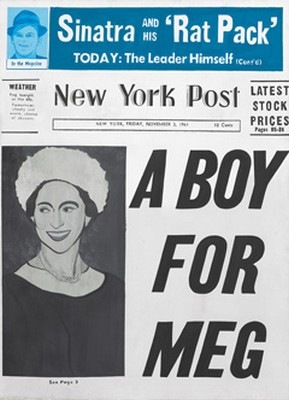
ANDY WAHROL, A Boy for Meg, 1962, oil on canvas, National Gallery of Art  

ANDY WARHOL, A Boy for Meg, 1962, oil on canvas. One of the artist's earliest hand-painted headline canvases. © National Gallery of Art, Washington, Gift of Mr. and Mrs. Burton Tremaine. Courtesy National Gallery of Art.


The first exhibition to examine works that Andy Warhol created on the theme of news headlines will premiere at the National Gallery of Art, Washington. On view from September 25, 2011, to January 2, 2012, WARHOL: HEADLINES will define and bring together works the artist based largely on the tabloid news, demonstrating his career-long obsession with the sensational side of contemporary news media. Source materials for the art will be presented for comparison, revealing Warhol's role as both editor and author. The exhibition is organized by Molly Donovan, associate curator, modern and contemporary art, National Gallery of Art, Washington DC.

The rich headline motif will be traced through some 80 works representing the full variety of its treatment in Warhol's practice, ranging from paintings, drawings, prints, photography, and sculpture to film, video, and television. A major, yet previously unexplored theme running through Warhol's entire career, the headline encompasses many of his key subjects, including celebrity, death, disaster, contemporary events, and the artist as subject.

After Washington, the exhibition will be on view at:

Museum für Moderne Kunst, Frankfurt
February 11 - May 13, 2012

Galleria nazionale d'arte moderna, Rome
June 11 - September 9, 2012

The Andy Warhol Museum, Pittsburgh
October 14, 2012 - January 6, 2013

ANDY WAHROL (1928-1987) is often cited, next to Jackson Pollock, as among the top American artists of the last century. Others name him, alongside Pablo Picasso, as one of the most important 20th-century artists in the world. Wherever one places him, Warhol's reach is indisputable. His visual vocabulary has become a part of the vernacular from which it originally came. Even his prescient 1968 statement "in the future everyone will be famous for fifteen minutes" has become as ubiquitous as the 24-hour news cycle itself.

"Andy Warhol continues to inform our culture in limitless ways through a variety of media," said Earl A. Powell III, director, National Gallery of Art. "We are proud to offer this scholarly, visually compelling exhibition and catalogue of one of the world's most famous and influential artists, providing new information and insights to all visitors, from Warhol specialists to the general public." .

Warhol obsessively scoured newspapers for their stories and images, and he kept many of them in his Time Capsules, most of which he never made into works of art. Those he elevated to the status of art, however, tell a tale that parallels and intersects the artist's own life story at times, collapsing his life and work into one epic account of post-World War II America.

The exhibition opens with the artist's earliest hand-painted headline canvases, including the National Gallery of Art's A Boy for Meg (1962), based on supermarket tabloids—a major influence on American mass culture. From his drawings in the late 1950s while working as a commercial illustrator through his transition into the fine arts in the early 1960s, Warhol explored the powerful underside of journalistic culture. By featuring stories on the joys of celebrity royals, as in A Boy For Meg; Hollywood scandals, such as Eddie Fisher's breakdown in Daily News (1962); and the tragedies of everyday people, as in 129 Die in Jet (1962), in equal measure, Warhol revealed the commodified news value assigned to the passions and disasters of contemporary life. In 1968 Warhol himself became the subject of front page news after he was shot by actress Valerie Solanas. On the occasion of his death in 1987, Warhol was again the subject of the headlines owing to his own celebrity.

Throughout his career, Warhol devoted himself to time-based media (film, video, and television) and even launched his own cable television show (Andy Warhol's T.V.). The exhibition will present the three Screen Tests in which the sitters are reading the newspaper and will show for the first time the artist's 1974 video diary of Factory superstar Brigid Berlin reading the news. Also to be seen for the first time is an outtake from an episode of Andy Warhol's T.V featuring Keith Haring discussing his own use of found tabloid headlines in his first street art interventions.

Later works include black-and-white photographs of newspaper boxes, Warhol's grids of "sewn" photographs featuring newspaper headlines, silkscreened paintings, and his collaborations from the 1980s with younger artists Haring and Jean-Michel Basquiat. 

The exhibition catalogue will include scholarly essays by Molly Donovan; John J. Curley, associate professor of art history, Wake Forest University; John Hanhardt, senior curator for media art, Smithsonian American Art Museum, and Matt Wrbican, archivist, The Andy Warhol Museum, Pittsburgh.

The exhibition is organized by the NATIONAL GALLERY OF ART, Washington DC

www.nga.gov

19/09/10

La Boheme at Museum Ludwig Cologne - The Staging of Artists in photography of the 19th and 20th century

“La Bohème”. The Staging of Artists in photography of the 19th and 20th century
Museum Ludwig, Cologne
25 September 2010 - 9 January 2011

In his 1851 novel Scènes de la Vie de Bohème, the French author Henri Murger created the image of the artist as an outsider who, in the midst of the middle class era, lived in romantic poverty. Bohemian life, viewed through rose-tinted glasses and elevated to undying popularity by Puccini’s opera, constituted in Murger’s view a transitional stage: “Bohemia is the first stage in artistic life; it is the preface to the Academy, the hospital, or the Morgue.” The term became synonymous with the 19th century artist who was dependent on an anonymous market and, while free of constraints, had to sell the fruits of his labours without the patronage of the courts. In the middle of this period in which the legend of the Bohemian swelled to bolster the artists’ feelings of self-confidence, came the invention of photography. Just how far this colourful approach to life was mirrored in photographic stagings of artists are examined in this exhibition at Museum Ludwig. It traces out the idea of the Bohemian milieu in photographic portraits, scenes and stagings.

The span of the work covered here extends from the earliest Daguerreotypes to the striking portraits by Nadar and the opulent artists’ banquets of the 1920s. Thus for instance Louis Alphonse de Brébisson staged around 1842 a group of friends painting and playing instruments as the quintessence of a romantic artists’ association in Bohemia. Felix Tournachon, known as Nadar, was not only a leading member of the Parisian Bohemians, he also created legendary portraits of his friends and contemporaries. No less ingenious was the collaboration between David Octavius Hill and Robert Adamson, whose group photographs such as Edinburgh Ale aimed at positioning themselves close to the artistic Bohemia. Historical pageants and so-called tableaux vivants tell of the lengths people went to dress up, not least for the artists’ and academy balls in the 19th century. Also on show are numerous poetic stagings done after historical models by David Wilkie Wynfield, a Pre-Raphaelite photographer, and Julia Margaret Cameron.

Paris remained however the metropolis of art and artists, and so the self-stagings from around 1900 by the artists of Montmartre and Montparnasse, such as Modigliani and Picasso, testify to their will to style. Likewise the figure of the dandy rose up amid this milieu in 19th century France. Stunning examples of this include the self-representations of the Pictorialists, such as Alfred Stieglitz and Frank Eugene Smith. The outlandish costumes in which the author Pierre Loti dressed up and the studio scenarios created for instance by Alphonse Mucha were also directly imbued with typical French flair. A special highlight will be the photographs of Ernst Ludwig Kirchner, in which self-staging was wed with deep psychological introspection. Opulent and fanciful were the artists’ parties of the 1920s; on show will be examples from the Malkasten Düsseldorf, from Cologne, Hamburg, and from the Bauhaus in Weimar and Dessau, photographed by leading photographers such as August Sander and T. Lux Feininger.

The Museum Ludwig, Cologne

The Museum Ludwig is one of Germany’s most important museums for 20th century art and contemporary art. It was founded in 1976 when Peter and Irene Ludwig presented the City of Cologne with 350 works of modern art. These works predominantly consist of American Pop Art paintings, objects, and sculptures (e.g. by Lichtenstein, Rosenquist, Warhol, and Wesselmann). In this genre the Museum Ludwig boasts the most significant collection outside the USA. A collection of Russian Avant-garde art spanning the years between 1905 and 1935 (Gontcharova, Larionow, Exter, Popova, Malevich, Rodchenko) also came to the museum. In 1986 the Museum Ludwig, together with the Wallraf Richartz Museum, obtained a building of its own situated between Cologne Cathedral, the Rhine river and the central train station. Cologne architects Peter Bussmann and Godfrid Haberer designed the building, which also houses the Philharmonic Hall.

The collection of Cologne lawyer Dr. Josef Haubrich (1889-1961) became part of the Museum Ludwig as well. Immediately after World War II Haubrich had presented the City of Cologne with his collection of Expressionist paintings (Erich Heckel, Karl Schmidt-Rottluff, Ernst Ludwig Kirchner, August Macke, Otto Mueller) and other exponents of Classical Modernism (Marc Chagall, Otto Dix).

In 1994 Peter and Irene Ludwig donated a significant part of their Picasso collection (90 works) to the City of Cologne which made it necessary for the Wallraff Richartz Museum to move to a building of its own. On 31 October 2001, on the occasion of its re-opening, Irene Ludwig donated a further 774 works by Picasso to the Museum Ludwig. Consequently the Museum Ludwig now owns the third largest Picasso collection worldwide, after Barcelona and Paris. It comprises a representative cross-section of all of the artist’s creative periods, covering all genres, materials, and techniques.

1977 saw the start of the photographic collection, very early on for a contemporary art museum. The museum managed to purchase around 1000 photographs from L.Fritz Gruber, the initiator of the photokina fairs. As a result, several icons of 20th century photography became part of the museum’s collection. In addition, important loans and donations were received, among them industrial photography by A. Renger-Patzsch and photographic works by Russian avant-garde artists. With the Agfa Collection the Museum Ludwig owns an internationally renowned collection on the history of 19th century photography.

Also in the 1970s, the Museum Ludwig began to collect video and film works. As early as 1974 the first 16mm films, among others by Bruce Nauman, Richard Serra, Joan Jonas, and ten further artists were purchased. Since then the museum has continuously expanded its collection. Since 2000 the Museum Ludwig has made a special point of collecting and presenting works representing the technical media in the context of contemporary art. The substantial acquisitions, e.g. of works by Aernout Mik, Renee Green, and Mike Kelley can be seen in this context.

05/05/10

Spencer Finch, Amabilis Insania - Nordenhake, Berlin


Spencer Finch, Amabilis Insania
Galerie Nordenhake, Berlin
April 30 - June 5, 2010

Galerie Nordenhake in Berlin presents an exhibition by US artist SPENCER FINCH (born in 1962, lives in New York). The artist conceived new drawings, photographs and a light installation but also a sound installation and a sculpture. Themes uniting the diverse works in the show are the complexities and pleasures of apprehending sensations. Most of the works deal with misperceptions or misapprehensions. They are treated not necessarily as failure but as pleasurable moments hinting at a seeing prior to recognition and rationalisation.

The seduction of misperception is suggested in a group of photographs: in reality representations of cherry blossoms in a pond, they appear as delicate images of clouds in the sky bringing to mind Alfred Stieglitz’ series of abstract photographs “Equivalence”. In another work, the white concrete sculpture sitting directly on the gallery floor recalls a pile of snow. A similar irritation of our perception evokes the sound installation.

The artist maps the limits of his own field of vision in a drawing that compares far peripheral and central vision, but it also contrasts linguistic and visual descriptions of colour. Spencer Finch recorded the colour of a car rushing by on a highway once it appeared in his field of vision and painted his colour impression with pigments on paper. Like a researcher, he adds a written account of the vehicle's actual colour and form. The central vision differs from the perception in peripheral areas of the eye in respect to colour and form and proves it as erroneous.

The uncertainty of perception — that there is more to reality than our bodily senses could register — is implied in the series of eight drawings after false-colour images. The colourful oil pastels look entirely abstract but are in fact truly representational as they render thermograms of the light falling through the window in the artist’s studio over the course of one day.

Spencer Finch is known for a multi-layered artistic practice in which he explores the mechanism and mysteries of perception. Many of his poetic and witty works aim at preserving the memory of a sensorial experience, be it a pile of snow or moonlight in Venice. He bases his unconventional and meticulous representations on extended research and rigorous measurement while his art acknowledges the difference and distance of all representation and reinforces the beauty of the fleeting nature of the observed world.

Spencer Finch's artworks were previously presented in Berlin by Galerie Nordenhake in two exhibitions Spencer Finch: In Praise of Shadows (2007-2008) and Spencer Finch: Prussian Blue (2005).

NORDENHAKE
Gallery's website: www.nordenhake.com