Showing posts with label Andy Warhol Museum. Show all posts

25/09/25

Andy Warhol: Vanitas @ The Andy Warhol Museum, Pittsburgh

Andy Warhol: Vanitas 
The Andy Warhol Museum, Pittsburgh 
October 10, 2025 – March 9, 2026 

Andy Warhol Self-Portrait
Andy Warhol
, Self-Portrait, 1986 
© The Andy Warhol Foundation for the Visual Arts, Inc.

Andy Warhol, Sleep
Andy Warhol
, Sleep, 1963 
© The Andy Warhol Museum

The Andy Warhol Museum presents Andy Warhol: Vanitas, an exhibition which explores the ephemeral nature of life as seen through the eyes of one of the most iconic artists of the 20th century. Andy Warhol, a pivotal figure in the Pop Art movement, was strongly influenced by his Byzantine Catholic upbringing and the religious iconography that pervaded his early life. This spiritual undercurrent appears throughout his oeuvre, where themes of mortality, vanity and the passage of time are recurrent motifs.

Andy Warhol  - Details of Renaissance Paintings - Leonardo da Vinci The Annunciation
Andy Warhol 
Details of Renaissance Paintings 
(Leonardo da Vinci The Annunciation 1472), 1984 
© The Andy Warhol Foundation for the Visual Arts, Inc.

This exhibition examines Warhol’s contemplation of life’s transient nature through the lens of three themes: Mortality, Vanitas and Temporality. Each theme offers a lens through which his fascination with death, the fleeting nature of beauty and the passage of time can be understood. Warhol explored these themes in his work with seriousness, and he infused them with irony and humor, showcasing his unique, often philosophical and contemplative, perspective.
“Museum audiences have increasingly taken an interest in exploring other aspects of Warhol’s career beyond his well-known Pop Art masterpieces,” said Amber Morgan, director of collections and exhibitions. “Andy Warhol: Vanitas, while perhaps seeming a bit dark in theme, speaks to Warhol’s willingness to confront universal big questions and explore multiple paths in his search for answers.”
Andy Warhol, Skull - Drawing
Andy Warhol
, Skull, 1976 
© The Andy Warhol Foundation for the Visual Arts, Inc.

Andy Warhol, Skull
Andy Warhol
, Skull, 1976 
© The Andy Warhol Foundation for the Visual Arts, Inc.

Andy Warhol, Self-Portrait with Skull
Andy Warhol
, Self-Portrait with Skull, 1978
© The Andy Warhol Foundation for the Visual Arts, Inc.

Vanitas, derived from the Latin word for “vanity”, refers to a genre of still-life painting that thrived in the 17th century, amongst others in The Netherlands and Flanders. It typically features collections of symbolic objects representing the transience of life, the emptiness of worldly pleasure and the inevitability of death. These works are designed to remind viewers of their mortality and the insignificance of worldly goods and pleasures. Rich in symbolic imagery, vanitas prints often depict skulls, extinguished candles, wilting flowers, soap bubbles and timepieces, all serving as memento mori (Latin for “remember that you must die”). The Vanitas theme was a constant subject for Warhol in works featuring skulls, disasters and tragic beauty. The exhibition includes a small selection of vanitas Dutch artworks on loan from the Rijksmuseum in Amsterdam
“The SCHUNCK Museum is grateful to collaborate with The Warhol on this exhibition, inspired by the 17th-century Dutch and Flemish Vanitas tradition in painting,” said Fabian de Kloe, artistic director at the SCHUNCK museum. “Vanitas invites reflection on themes such as faith, identity and mortality—echoing not only the Catholic heritage of the Southern Netherlands but also the personal and spiritual explorations in Andy Warhol’s work. Rooted in two post-industrial cities, Pittsburgh and Heerlen, this partnership creates space to reflect on our shared histories and how these timeless questions continue to shape our lives today.”
Andy Warhol: Vanitas is curated by Patrick Moore, former director of The Warhol, in collaboration with the SCHUNCK museum.

THE ANDY WARHOL MUSEUM
117 Sandusky Street, Pittsburgh, PA 15212

22/03/25

Mario R. Rossero: New Director of The Andy Warhol Museum

Mario R. Rossero
New Director of The Andy Warhol Museum

Mario R. Rossero
Mario R. Rossero

Carnegie Museums of Pittsburgh announced that Mario R. Rossero has been named the new director of The Andy Warhol Museum and vice president of Carnegie Museums. Rossero is currently executive director of the National Art Education Association (NAEA), the leading professional membership organization for visual arts, design and media arts educators. Before joining NAEA, he served as senior vice president of education for the Kennedy Center in Washington, D.C., held a variety of leadership positions in Chicago Public Schools and served as the senior program officer for arts education at Pittsburgh Public Schools. A native of the Pittsburgh region, Mario R. Rossero began his career as an artist educator at The Warhol and an art teacher at Shaler Area School District. He will join the museum on March 31.
“This is really a full-circle moment for Mario and The Warhol, where Mario began his career just three years after the museum opened in 1994,” said Steven Knapp, president and CEO of Carnegie Museums. “While taking on increasingly complex leadership roles throughout his impressive career, Mario has maintained a sincere and infectious enthusiasm for the mission of the arts, which includes making innovation and creativity more accessible to all. In each of his roles, he has excelled as a collaborative leader and a community convener, and we’re delighted to welcome him back to Pittsburgh and The Warhol.”
While executive director of the NAEA, which has more than 15,000 members in the United States and 25+ foreign countries, Mario R. Rossero and his team won an $8.5 million U.S. Department of Education grant to transform arts education in the United States by partnering with music, dance and theater education associations to create collaborative arts learning communities across the country. In his role as senior vice president for education at the Kennedy Center, he led a team of 60 people and 35 programs that reached 1.4 million students and educators worldwide.

Mario R. Rossero joined the Kennedy Center after serving in a variety of leadership roles with Chicago Public Schools. As chief of core curriculum, he provided leadership and strategy to offer a robust education for all students, including in the fields of literacy, mathematics, science, social science, the arts and global citizenship. As director of arts education, he led the charge to increase access to all art forms, developing for the first time a district-wide Arts Education Plan that encompassed 700 schools and 400,000 students.
“I am thrilled to join The Warhol at this unique moment in time to build upon the museum’s history and look towards a future of increased community engagement and creative innovation, all rooted in Warhol’s art, life and legacy,” Mario R. Rossero said. “For me this is a homecoming, returning to an institution that played a pivotal role in my early career, shaping my approach and trajectory as an artist, educator and organizational leader. I am excited to share lessons learned from a national lens to invest in the Pittsburgh community and to leverage the opportunity that The Pop District provides for greater sustainability and furthering Warhol’s story and impact.

“The breadth of Warhol’s portfolio—as graphic designer, boundary-pushing artist, filmmaker, music producer and pop culture celebrity—paired with his personal story as a young steel city kid making his way to New York City and the international art world offers so many connections for audiences of all ages, identities and interests,” Mario R. Rossero added.
“On behalf of the NAEA Board of Directors, we congratulate Mario on his new role as the director of The Andy Warhol Museum,” said Wanda B. Knight, NAEA president. “We value his leadership, vision and commitment to the visual arts, design and media arts education community—especially during his successful tenure at NAEA. We are confident that he will continue to advocate for all artists, educators and learners in the next phase of his career.”
Mario R. Rossero received a BA in art & education from Washington and Jefferson College and an MSEd in supervision and administration in visual arts from a joint program between Bank Street College of Education and Parsons School of Design.

THE ANDY WARHOL MUSEUM
117 Sandusky Street, Pittsburgh, PA 15212

12/10/10

Andy Warhol Headlines Exhibition 2011 2012 NGA

Warhol: Headlines
National Gallery of Art, Washington

September 25, 2011 - January 2, 2012

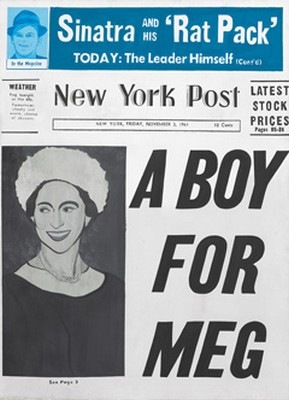
ANDY WAHROL, A Boy for Meg, 1962, oil on canvas, National Gallery of Art  

ANDY WARHOL, A Boy for Meg, 1962, oil on canvas. One of the artist's earliest hand-painted headline canvases. © National Gallery of Art, Washington, Gift of Mr. and Mrs. Burton Tremaine. Courtesy National Gallery of Art.


The first exhibition to examine works that Andy Warhol created on the theme of news headlines will premiere at the National Gallery of Art, Washington. On view from September 25, 2011, to January 2, 2012, WARHOL: HEADLINES will define and bring together works the artist based largely on the tabloid news, demonstrating his career-long obsession with the sensational side of contemporary news media. Source materials for the art will be presented for comparison, revealing Warhol's role as both editor and author. The exhibition is organized by Molly Donovan, associate curator, modern and contemporary art, National Gallery of Art, Washington DC.

The rich headline motif will be traced through some 80 works representing the full variety of its treatment in Warhol's practice, ranging from paintings, drawings, prints, photography, and sculpture to film, video, and television. A major, yet previously unexplored theme running through Warhol's entire career, the headline encompasses many of his key subjects, including celebrity, death, disaster, contemporary events, and the artist as subject.

After Washington, the exhibition will be on view at:

Museum für Moderne Kunst, Frankfurt
February 11 - May 13, 2012

Galleria nazionale d'arte moderna, Rome
June 11 - September 9, 2012

The Andy Warhol Museum, Pittsburgh
October 14, 2012 - January 6, 2013

ANDY WAHROL (1928-1987) is often cited, next to Jackson Pollock, as among the top American artists of the last century. Others name him, alongside Pablo Picasso, as one of the most important 20th-century artists in the world. Wherever one places him, Warhol's reach is indisputable. His visual vocabulary has become a part of the vernacular from which it originally came. Even his prescient 1968 statement "in the future everyone will be famous for fifteen minutes" has become as ubiquitous as the 24-hour news cycle itself.

"Andy Warhol continues to inform our culture in limitless ways through a variety of media," said Earl A. Powell III, director, National Gallery of Art. "We are proud to offer this scholarly, visually compelling exhibition and catalogue of one of the world's most famous and influential artists, providing new information and insights to all visitors, from Warhol specialists to the general public." .

Warhol obsessively scoured newspapers for their stories and images, and he kept many of them in his Time Capsules, most of which he never made into works of art. Those he elevated to the status of art, however, tell a tale that parallels and intersects the artist's own life story at times, collapsing his life and work into one epic account of post-World War II America.

The exhibition opens with the artist's earliest hand-painted headline canvases, including the National Gallery of Art's A Boy for Meg (1962), based on supermarket tabloids—a major influence on American mass culture. From his drawings in the late 1950s while working as a commercial illustrator through his transition into the fine arts in the early 1960s, Warhol explored the powerful underside of journalistic culture. By featuring stories on the joys of celebrity royals, as in A Boy For Meg; Hollywood scandals, such as Eddie Fisher's breakdown in Daily News (1962); and the tragedies of everyday people, as in 129 Die in Jet (1962), in equal measure, Warhol revealed the commodified news value assigned to the passions and disasters of contemporary life. In 1968 Warhol himself became the subject of front page news after he was shot by actress Valerie Solanas. On the occasion of his death in 1987, Warhol was again the subject of the headlines owing to his own celebrity.

Throughout his career, Warhol devoted himself to time-based media (film, video, and television) and even launched his own cable television show (Andy Warhol's T.V.). The exhibition will present the three Screen Tests in which the sitters are reading the newspaper and will show for the first time the artist's 1974 video diary of Factory superstar Brigid Berlin reading the news. Also to be seen for the first time is an outtake from an episode of Andy Warhol's T.V featuring Keith Haring discussing his own use of found tabloid headlines in his first street art interventions.

Later works include black-and-white photographs of newspaper boxes, Warhol's grids of "sewn" photographs featuring newspaper headlines, silkscreened paintings, and his collaborations from the 1980s with younger artists Haring and Jean-Michel Basquiat. 

The exhibition catalogue will include scholarly essays by Molly Donovan; John J. Curley, associate professor of art history, Wake Forest University; John Hanhardt, senior curator for media art, Smithsonian American Art Museum, and Matt Wrbican, archivist, The Andy Warhol Museum, Pittsburgh.

The exhibition is organized by the NATIONAL GALLERY OF ART, Washington DC

www.nga.gov

15/01/06

The Downtown Show: The New York Art Scene, 1974–1984 at Grey Art Gallery & Fales Library, NYU

The Downtown Show: 
The New York Art Scene, 1974–1984
Grey Art Gallery & Fales Library, NYU
January 10 - April 1, 2006

Downtown New York has been an epicenter of creative ferment for more than 150 years. One decade, from 1974 to 1984, is the subject of a landmark exhibition premiering at two New York University institutions: the Grey Art Gallery, NYU’s fine arts museum, and Fales Library, the repository of its special collections. The Downtown Show: The New York Art Scene, 1974–1984 is the first retrospective to chart the rich cross-section of artists and activities that coexisted and often overlapped during this heady time in Lower Manhattan, and will be on view at both locations. Featuring approximately 375 paintings, sculptures, drawings, videos, and photographs as well as over 70 items from the Downtown Collection of Fales—the world’s most extensive archive of books, journals, posters, and ephemera relating to the Downtown scene from 1970 to the present—the show views Downtown as both geography and metaphor, and illuminates how this 10-year period radically altered the face of American art and culture.

Some 25 years later, the exhibition and its accompanying publication, The Downtown Book: The New York Art Scene, 1974–1984 (Princeton University Press), untangle the knot of multiple narratives that became intertwined during Downtown’s heyday. What distinguishes The Downtown Show from earlier exhibitions is its focus on a broad section of Lower Manhattan’s artistic community, beginning with the enactment of the “Loft Law,” which made it legal for artists to live in SoHo’s sprawling industrial spaces, and concluding with the rise of the East Village’s narrow, storefront galleries and Ronald Reagan’s re-election. Emerging out of the deflated optimism of the Summer of Love, New York’s Downtown scene attracted artists, musicians, performers, filmmakers, writers, and others who could afford the then-low rents of SoHo lofts and Lower East Side tenements. In a rapidly evolving Downtown landscape, they ferociously churned out work that was populist and subversive, utopian and raw, antic and angry.
“The vernacular of Downtown was a disjunctive language of profound ambivalence, broken narratives, subversive signs, ironic inversions, proliferate amusements, criminal interventions, material surrogates, improvised impersonations, and immersive experientiality,” observes Carlo McCormick, The Downtown Show’s guest curator and a well-known critic. 

Marvin Taylor, editor of The Downtown Book and director of Fales Library, adds: “Downtown artists adopted an anarchic attitude that violated the gap between high art and mass culture, removed the production and reception of avant-garde art from its isolation within elite circles, and directly addressed social and political concerns. They also irreverently pushed the limits of traditional artistic categories—visual artists were also writers, writers developed performance pieces, performers incorporated videos into their works, and everyone was in a band.”
In keeping with the experimental spirit of Downtown’s interdisciplinary practices, Carlo McCormick has organized the work of approximately 175 artists, writers, performers, and musicians into eight themes. Installed salon style, this provocative framing invokes the invigorating dissonance of the Downtown scene. The eight sections comprise: 

1) Interventions—a preface and introduction that posits a connection between the proliferation of not-for-profit exhibition venues and artworks engaging Downtown urban settings and architecture; 

2) Broken Stories—a fresh look at the innovative narrative techniques developed during the decade not only by writers, but also filmmakers and visual artists; 

3) De-Signs—an investigation of the artistic use of advertising’s shorthand signs and strategies, which in turn set the stage for more theoretical works grounded in postmodern theory; 

4) Salon de Refuse—a section that brings together works that harnessed the surrounding detritus to create a “trash culture” of their own that challenged traditional hierarchical distinctions; 

5) Body Politics—a presentation of art concerned with sexuality and identity politics; 

6) Sublime Time—an exploration focusing on the period’s search for the sublime in the wake of minimalism’s reductive and formal concept of beauty; 

7) The Portrait Gallery—a space featuring photographic, sculptural, and painted images of key Downtown denizens, which creates a vibrant “portrait” of this dynamic community; and, in conclusion, 

8) The Mock Shop—a recreation of the stores—featuring low-cost artists’ multiples and other artworks—that critiqued consumer culture in many Downtown shows and other collaboratives.

The Downtown Show intentionally presents a mélange of generations: works by Vito Acconci, Joan Jonas, Leon Golub, Carolee Schneemann, and Lawrence Weiner will be displayed alongside pieces by Karen Finley, Robert Longo, Christian Marclay, Cindy Sherman, and Laurie Simmons. Leading off the “Interventions” section, for example, is Gordon Matta-Clark’s Days End, which depicts the artist’s slicing of Pier 52 in 1975. This sets the stage for pieces by David Wojnarowicz and other artists who likewise took their art to the streets, drawing inspiration from Downtown New York’s desolate industrial landscape. Ida Applebroog’s multi-paneled narratives herald the resurgence of figuration out of the austerity of minimalism in “Broken Stories.” Also presented in this section are books by Downtown denizens such as Spalding Grey and Lynne Tillman (featuring illustrations by Kiki Smith) along with manuscripts by Kathy Acker and Eric Bogosian. In “Sublime Time,” documentation of Tehching Hsieh’s One Year Performance, 1980–81, which demonstrates an interest in expanded notions of temporality will be installed alongside abstract paintings by Ron Gorchov and Peter Halley. “Sublime Time” not only encompasses mesmeric or meditative artworks and compositions, but also conjures the atmosphere of the late-night club scene and even New York City itself, where time—even without the mind-altering drugs then so prevalent—often seemed to either slow down inexorably or speed by in a blinding flash. Fales Library and Special Collections—housed in NYU’s Bobst Library down the street from the Grey Art Gallery—will feature the “De-Signs” and “Body Politics” sections. In the former, selections from Jenny Holzer’s The Living Series, 1980–82, enameled signs proclaiming terse statements, will hang along side the stencils John Fekner employed in spray-painting proclamations on the city’s brick walls and concrete overpasses. “De-Signs” references graffiti and introduces the Punk music scene. Similarly, “Body Politics” includes Lynda Benglis’s infamous 1974 Artforum ad, performance documentation of Ethyl Eichelberger, and Nan Goldin’s color photographs. Also featured will be a selection of musical extracts from SoHo’s Loft Jazz era, Techno, and Punk Rock.

Interspersed throughout is a rich array of Fales Library’s archival material—artists’ journals as well as exhibition announcements, posters, and other ephemera—which together represent not only a significant body of the period’s material culture but also vivid reminders of its personal histories. As Marvin Taylor makes clear, “In order to restore the vitality of this period, we must attempt to put the human elements, the individual experiences, motives, and aspirations—the agency if you will—back into the cultural memory.” In the words of Carlo McCormick, “The Downtown scene is all about collision—don’t follow the footsteps. Instead, track the skidmarks.”

The Downtown Book

The Downtown Book: The New York Art Scene, 1974–1984 provides the first comprehensive overview of this important period. Although there is no shortage of commentary on the Downtown scene—including its already mythic subculture of Punk—few accounts rise above hagiography. Published by Princeton University Press, The Downtown Book probes the trends that arose in the 1970s and early ’80s and solidified New York’s reputation as arbiter of the postmodern American avant-garde. Its seven essays are intercut with twelve personal reminiscences from pioneers, practitioners, and provocateurs of the scene. Providing a lively survey of the media, trends, and culture of the Downtown scene, The Downtown Book offers an illuminating counterpart to the exhibition and makes a substantial contribution to the greater understanding of late 20th-century culture.

Exhibition Tour

After closing in New York, The Downtown Show travels to the Andy Warhol Museum in Pittsburgh, Pennsylvania, from May 20 to September 3, 2006, and the Austin Museum of Art, in Austin, Texas, from November 18, 2006, to January 28, 2007.

GREY ART GALLERY
100 Washington Square East, New York, NY 10003

FALES LIBRARY
Elmer Holmes Bobst Library
70 Washington Square South, 3rd Floor