Showing posts with label exhibition Washington. Show all posts

23/03/12

Street Photography at National Gallery of Art, Washington DC - I Spy: Photography and the Theater of the Street, 1938-2010


I Spy: Photography and the Theater of the Street, 1938-2010
National Gallery of Art, Washington DC
Curator: Sarah Greenough
April 22 - August 5, 2012

This exhibition is devoted to street photographs by some of the genre's greatest photographers: Walker Evans (1903-1975), Harry Callahan (1912-1999), Robert Frank (b. 1924), Bruce Davidson (b. 1933), Philip-Lorca diCorcia (b. 1951), and Beat Streuli (b. 1957). "The Gallery is pleased to continue its long tradition of exhibitions devoted to the innovative ways in which photographers have captured and explored the urban environment," said Earl A. Powell III, director, National Gallery of Art. "I Spy also showcases the Gallery's strong holdings in this genre, featuring more than 20 works from the collection along with nine promised gifts."

Philip-Lorca diCorcia 
Head #22, 2001
chromogenic print,121.92 x 152.4 cm (48 x 60 in.)
National Gallery of Art, Washington, Charina Endowment Fund
© Philip‑Lorca diCorcia

Since the invention of small hand-held cameras and faster films in the late 19th century, photographers have recorded everyday life in the urban environment. Mining the city rich potential, they have explored its varied subject matter —people, architecture, and modes of transportation— to celebrate the cacophony and diversity of modern life, as well as its rapid pace.

The photographers represented in this exhibition have creatively pursued this genre by setting rigid parameters on how they made their works. Like children playing the game "I Spy" by looking through the narrow frame of a car window, these photographers restricted the ways they made their pictures as a means of selecting and ordering the chaos of the city. Walker Evans hid the camera from the unsuspecting public and photographed without even looking through the lens, Robert Frank photographed only what could be seen from the windows of a bus moving through the city, and Philip-Lorca diCorcia and Beat Streuli placed their cameras in single spots to capture photographs of random passersby. But all these photographs and videos court chance and serendipity, and all these artists view the street as a perpetually fascinating spectacle.

Arranged both chronologically and monographically, I Spy: Photography and the Theater of the Street, 1938-2010 explores these ideas through the presentation of nearly 90 works, including a video and a digital still sequence. Evans, Callahan, and Frank embarked on their projects as a challenge to create images in a fundamentally different manner than they previously had; diCorcia and Streuli incorporate such devices into their regular practice. All the works address questions of voyeurism, surveillance, and privacy.

The exhibition includes photographs made by Walker Evans between 1938 and 1941 on the New York subways with a camera concealed beneath his coat, as well as those he took standing on a street corner in Bridgeport, Connecticut, in 1941. Harry Callahan is represented with an evocative group of photographs of women lost in thought on the busy Chicago streets in 1950. Robert Frank's elegant, almost balletic suite of photographs made from the windows of a bus moving through New York City in 1958 will also be presented, as will a series of bold, aggressive color photographs by Bruce Davidson taken on the New York subways between 1980 and 1985.

Contemporary artists Philip-Lorca diCorcia and Beat Streuli have pushed this genre still further in works made in the 1990s and into the 21st century. Mining the latent theatricality of the street, diCorcia erected scaffolding and lights in busy urban areas to create a series of monumental portraits of hapless pedestrians who chanced to pass in front of his camera.

The exhibition concludes with two works by the Swiss artist Beat Streuli made on the streets of New York: a digital still sequence, reconfigured expressly for this show from its original display in 2002, and a video made in 2009. Using a telephoto lens to capture richly saturated scenes, Beat Streuli reveals not only the congestion and heterogeneity of modern urban life, but also its beauty. As he transforms the ordinary into the iconic, he shows the isolation and anonymity of the individual in a crowd. In addition, his work calls into question the surveillance photography now so routinely captured by governments and corporations, and it makes us realize ever more keenly how in our daily lives we are both watching the world around us and are being scrutinized by it.

The exhibition curator is Sarah Greenough, senior curator and head, department of photographs, National Gallery of Art.

I Spy: Photography and the Theater of the Street, 1938–2010 was organized by the National Gallery of Art, Washington DC, USA. For information visit the Gallery's Web site at www.nga.gov.

Supports: The exhibition is made possible through the generous support of The Ryna and Melvin Cohen Family Foundation and the Trellis Fund. Tru Vue has provided in kind support of Optium Acrylic Glazing for the works of art.

12/10/10

Andy Warhol Headlines Exhibition 2011 2012 NGA

Warhol: Headlines
National Gallery of Art, Washington

September 25, 2011 - January 2, 2012

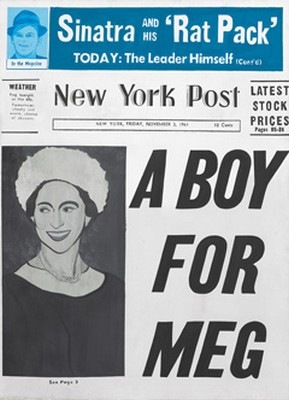
ANDY WAHROL, A Boy for Meg, 1962, oil on canvas, National Gallery of Art  

ANDY WARHOL, A Boy for Meg, 1962, oil on canvas. One of the artist's earliest hand-painted headline canvases. © National Gallery of Art, Washington, Gift of Mr. and Mrs. Burton Tremaine. Courtesy National Gallery of Art.


The first exhibition to examine works that Andy Warhol created on the theme of news headlines will premiere at the National Gallery of Art, Washington. On view from September 25, 2011, to January 2, 2012, WARHOL: HEADLINES will define and bring together works the artist based largely on the tabloid news, demonstrating his career-long obsession with the sensational side of contemporary news media. Source materials for the art will be presented for comparison, revealing Warhol's role as both editor and author. The exhibition is organized by Molly Donovan, associate curator, modern and contemporary art, National Gallery of Art, Washington DC.

The rich headline motif will be traced through some 80 works representing the full variety of its treatment in Warhol's practice, ranging from paintings, drawings, prints, photography, and sculpture to film, video, and television. A major, yet previously unexplored theme running through Warhol's entire career, the headline encompasses many of his key subjects, including celebrity, death, disaster, contemporary events, and the artist as subject.

After Washington, the exhibition will be on view at:

Museum für Moderne Kunst, Frankfurt
February 11 - May 13, 2012

Galleria nazionale d'arte moderna, Rome
June 11 - September 9, 2012

The Andy Warhol Museum, Pittsburgh
October 14, 2012 - January 6, 2013

ANDY WAHROL (1928-1987) is often cited, next to Jackson Pollock, as among the top American artists of the last century. Others name him, alongside Pablo Picasso, as one of the most important 20th-century artists in the world. Wherever one places him, Warhol's reach is indisputable. His visual vocabulary has become a part of the vernacular from which it originally came. Even his prescient 1968 statement "in the future everyone will be famous for fifteen minutes" has become as ubiquitous as the 24-hour news cycle itself.

"Andy Warhol continues to inform our culture in limitless ways through a variety of media," said Earl A. Powell III, director, National Gallery of Art. "We are proud to offer this scholarly, visually compelling exhibition and catalogue of one of the world's most famous and influential artists, providing new information and insights to all visitors, from Warhol specialists to the general public." .

Warhol obsessively scoured newspapers for their stories and images, and he kept many of them in his Time Capsules, most of which he never made into works of art. Those he elevated to the status of art, however, tell a tale that parallels and intersects the artist's own life story at times, collapsing his life and work into one epic account of post-World War II America.

The exhibition opens with the artist's earliest hand-painted headline canvases, including the National Gallery of Art's A Boy for Meg (1962), based on supermarket tabloids—a major influence on American mass culture. From his drawings in the late 1950s while working as a commercial illustrator through his transition into the fine arts in the early 1960s, Warhol explored the powerful underside of journalistic culture. By featuring stories on the joys of celebrity royals, as in A Boy For Meg; Hollywood scandals, such as Eddie Fisher's breakdown in Daily News (1962); and the tragedies of everyday people, as in 129 Die in Jet (1962), in equal measure, Warhol revealed the commodified news value assigned to the passions and disasters of contemporary life. In 1968 Warhol himself became the subject of front page news after he was shot by actress Valerie Solanas. On the occasion of his death in 1987, Warhol was again the subject of the headlines owing to his own celebrity.

Throughout his career, Warhol devoted himself to time-based media (film, video, and television) and even launched his own cable television show (Andy Warhol's T.V.). The exhibition will present the three Screen Tests in which the sitters are reading the newspaper and will show for the first time the artist's 1974 video diary of Factory superstar Brigid Berlin reading the news. Also to be seen for the first time is an outtake from an episode of Andy Warhol's T.V featuring Keith Haring discussing his own use of found tabloid headlines in his first street art interventions.

Later works include black-and-white photographs of newspaper boxes, Warhol's grids of "sewn" photographs featuring newspaper headlines, silkscreened paintings, and his collaborations from the 1980s with younger artists Haring and Jean-Michel Basquiat. 

The exhibition catalogue will include scholarly essays by Molly Donovan; John J. Curley, associate professor of art history, Wake Forest University; John Hanhardt, senior curator for media art, Smithsonian American Art Museum, and Matt Wrbican, archivist, The Andy Warhol Museum, Pittsburgh.

The exhibition is organized by the NATIONAL GALLERY OF ART, Washington DC

www.nga.gov