Showing posts with label masterpieces. Show all posts

23/09/25

East Asian Art Rediscovered Treasures @ Cincinnati Art Museum

Rediscovered Treasures 
Cincinnati Art Museum
September 19, 2025 — January 18, 2026

This exhibition reveals the untold stories behind East Asian masterpieces long housed in the Cincinnati Art Museum’s (CAM) collection. Featuring approximately 60 objects—ranging from Japanese armor and Chinese scrolls to Korean lacquer—Rediscovered Treasures brings to light transformative discoveries made possible by decades of scholarship, archival research and conservation efforts. 

While many of the featured works entered the museum in the late 19th and early 20th centuries, they remained un-accessioned or misidentified due to a lack of staff expertise in Asian art at the time. Since 2002, when the museum formally established its Asian art department, ongoing research led by Hou-mei Sung, PhD, Curator of East Asian Art, has dramatically improved the understanding of these objects. Their rediscovery has not only reframed the museum’s collection, but has also illuminated Cincinnati’s early cultural ties to East Asia.

Among the exhibition’s highlights are three exceptional works: the fan-favorite Japanese bronze “magic mirror,” which reveals an image of Amida Buddha under special lighting, making CAM one of the few museums in the world to house such an object; a Qing dynasty portrait of a court lady, identified through research as an imperial portrait of Lady Nian, possibly painted by the Jesuit artist Giuseppe Castiglione; and a Meiji period sumo wrestler’s embroidered apron, recently linked to the tragic career of Otokoyama Osuke, a promising young wrestler immortalized in a ukiyo-e print by Utagawa Kuniaki II. Each piece offers a unique story of rediscovery that enriches the understanding of East Asian art and culture.
“This exhibition is both a reflection of CAM’s mission to preserve and interpret cultural heritage and a celebration of the exciting process of rediscovery,” said Hou-mei Sung. “Many of these works, once overlooked or mislabeled, now tell vibrant stories of art, of individual lives, and of historical connections that extend far beyond Cincinnati.”
The exhibition is organized in three thematic sections. Uncovering Hidden Gems spotlights artworks recovered from storage and newly identified, including Japanese scrolls linked to Cincinnati artist Robert Frederick Blum and samurai armor tied to CAM’s early supporters and a trailblazing Japanese doctor. Revealing Identities feature reclassified works with newly attributed artists, corrected origins and uncovered meanings. Preserving Legacies highlights the scientific and technical efforts behind preserving these treasures, with insights from CAM conservators Cecile Mear and Kelly Rectenwald.

CINCINNATI ART MUSEUM
Thomas R. Schiff galleries (234 and 235)
953 Eden Park Drive, Cincinnati, OH 45202

26/08/25

Turner and Constable: Rivals and Originals @ Tate Britain, London

Turner and Constable: Rivals and Originals
Tate Britain, London
27 November 2025 – 12 April 2026

JMW Turner
J.M.W. Turner
Self Portrait, c. 1799 
Image courtesy of Tate

John Constable by Ramsay Richard Reinagle
John Constable 
by Ramsay Richard Reinagle c. 1799 
NPG 1786 
© National Portrait Gallery, London

Tate Britain presents the first major exhibition to explore the intertwined lives and legacies of Britain’s most revered landscape artists: JMW Turner (1775–1851) and John Constable (1776–1837). Radically different painters and personalities, each challenged artistic conventions of the time, developing ways of picturing the world which still resonate today. Staged across the 250th anniversary years of their births, this exhibition will trace the development of their careers in parallel, revealing the ways they were celebrated, criticised and pitted against each other, and how this pushed them to new and original artistic visions. It will feature over 170 paintings and works on paper, from Turner’s momentous 1835 The Burning of the Houses of Lords and Commons, lent by Cleveland Museum of Art and not seen in Britain for over a century, to The White Horse 1819, one of Constable’s greatest artistic achievements, last exhibited in London two decades ago.

JMW Turner
JMW Turner 
The Burning of the Houses of Lords 
and Commons, 16 October 1834, 1835 
Cleveland Museum of Art. 
Bequest of John L. Severance 1942.647

John Constable
John Constable 
The White Horse, 1819 
© The Frick Collection, New York 
Photo: Joseph Coscia Jr

Born only a year apart - JMW Turner in London’s crowded metropolis and John Constable to a prosperous family in the Suffolk village of East Bergholt - their contrasting early lives will begin the exhibition. JMW Turner was a commercially minded, fast-rising young star who first exhibited at the Royal Academy in 1790 aged just 15, and created ambitious oil paintings like recently-discovered The Rising Squall, Hot Wells, from St. Vincent’s Rock, Bristol, before he turned 18. By contrast, largely self-taught John Constable undertook sketching tours to create early watercolours like Bow Fell, Cumberland 1807 and demonstrated a fierce commitment to perfecting artistic techniques, not exhibiting at the Royal Academy until 1802. Having both emerged amid an explosion in popularity of landscape art, the two were united however, in their desire to change it for the better.

The exhibition explores how both artists developed distinct artistic identities within the competitive world of landscape art, spotlighting their methods, evolution and overlap. Constable built his reputation on the Suffolk landscapes of his childhood, opting to sketch in oils outside amid the vast views of Dedham Vale and the river Stour, which often recurred in his work. Tate Britain will include his painting box and sketching chair, with visitors able to chart the development of Constable’s skilful draughtsmanship and radical handling of paint to add ‘sparkle’. A group of Constable’s cloud studies will be brought together for the exhibition. Reflective of his belief that the sky was key to the emotional impact of a painting they are now one of the most celebrated aspects of his output and underpinned the powerful skyscapes in the artist’s monumental six-foot canvases. Late works such as Hampstead Heath with a Rainbow 1836 will illustrate his deft interweaving of personal and historic memories.

JMW Turner
JMW Turner
 
The Passage of Mount St Gothard from the centre 
of Teufels Broch (Devil’s Bridge), 1804 
© Abbot Hall, Kendal (Lakeland Arts Trust)

By contrast, Turner travelled widely across Britain and Europe filling sketchbooks with quick pencil studies. This offered creative inspiration, influencing sublime Alpine scenes such as The Passage of Mount St Gothard from the Centre of Teufels Broch (Devil’s Bridge) 1804, as well as commercial opportunities to have prints made after his watercolours. The exhibition explores how Turner developed original ways to apply paint and depict light, capturing the raw power of nature. Some of Turner’s most celebrated late works will feature, including Ancient Italy – Ovid Banished from Rome, first exhibited in 1838 and not shown in London in over 50 years.

John Constable
John Constable 
Salisbury Cathedral from the Meadows, c. 1829
Image courtesy of Tate

By the 1830s, both Turner and Constable became recognised for taking landscape painting in bold new directions. The stark differences between their work spurred art critics to pit them against one another and to cast them as rivals. In 1831 Constable himself played into this, placing his and Turner’s work side by side at the Royal Academy exhibition. This showing of Turner’s Caligula’s Palace and Bridge next to Constable’s Salisbury Cathedral from the Meadows, prompted a flurry of comparisons between the sun-drenched heat of Turner’s mythical Italian scene and Constable’s damply atmospheric Britain; they were ‘fire and water’. Now placed head-to-head at Tate Britain, the artists’ most distinctive and impressive paintings will highlight how, despite their differences, they made landscape a genre worthy of grand canvases and prime importance.

Creators of some of the most daring and captivating works in the history of British art, Turner and Constable changed the face of landscape painting with their two competing visions, elevating the genre with their recognition of its endless potential to inspire. The exhibition will end with a new film featuring contemporary artists Frank Bowling, Bridget Riley, George Shaw and Emma Stibbon reflecting on the enduring legacy of Turner and Constable.

TATE BRITAIN
Millbank, London SW1P 4RG

11/03/25

Jean Dubuffet @ Pace Gallery, NYC - "The Hourloupe Cycle" Major Exhibition

Jean Dubuffet
The Hourloupe Cycle
Pace Gallery, New York
March 13 – April 26, 2025

Pace Gallery presents a major exhibition of works from Jean Dubuffet’s celebrated Hourloupe cycle. On view at the gallery’s 540 West 25th Street location in New York, the exhibition has been conceived to celebrate the 50th anniversary of the Fondation Dubuffet last year.

It brings together a selection of important paintings, sculptures, and architectural models from public and private collections, including the monumental canvas Nunc Stans—among the largest paintings that Jean Dubuffet ever created—on loan from the Guggenheim Museum in New York.

One of the great innovators of post-war European painting, Jean Dubuffet looked to the margins of society—to the art of outsiders, mediums, the incarcerated, and the institutionalized—to liberate his own creativity. He coined the term “Art Brut” to describe the raw aesthetic of such outsiders, challenging the conventions of the period. Ahead of his time as both an artist and a philosopher, Dubuffet’s works posed fundamental questions about the nature of reality, leaving an indelible mark on the history of Modernism.

With the Hourloupe, Jean Dubuffet used his practice as a means to reinvent the everyday in an alternate world. He posited the parallel universe of the Hourloupe, which the viewer was invited to imaginatively inhabit, to critique the consensus of reality—as if one might step through a portal in the humdrum existence of waking life into an alternative space of fantasy and possibility. Pace gallery’s exhibition in New York showcases the dictionary of biomorphic forms that Jean Dubuffet invented as part of the Hourloupe’s visual language of experience and sensation. Charting the artist’s use of a recurring alphabet of forms across painting, sculpture, and architecture, the show reflects his lifelong effort to disrupt and refashion our modes of perception.

The Hourloupe cycle was the longest lasting series of Dubuffet’s career, comprising works created between 1962 and 1974. Pace, which has represented the artist since 1967, was the first American gallery to exhibit sculptures from L’Hourloupe in its inaugural exhibition of the artist’s work in 1968. A foundational figure in the gallery’s history, Jean Dubuffet has been the subject of more than 20 solo exhibitions at Pace over the course of seven decades.

The Hourloupe style emerged in the early 1960s from Dubuffet’s Paris Circus period, the result of casual experiments with felt-tip markers. Creating absent-minded doodles in red, black, and blue pen while chatting on the telephone, Jean Dubuffet arrived at a visual language resembling a web of meandering lines. These lines create interlocking shapes of negative space, which lock together like puzzle pieces. Over the course of more than ten years, he produced some of his best-known drawings, paintings, sculptures, and large-scale public environments in this style, comprising the cycle known as L’Hourloupe.

Anchoring Pace’s presentation is Nunc Stans (1965), a 26-foot-long painting on loan from the collection of the Guggenheim Museum in New York for the first time. This masterpiece of L’Hourloupe contains an inventory of characters and forms that recur throughout the cycle and the exhibition. The work’s title refers to the philosophical concept of eternity—the notion that there is no such thing as past and present, but only an eternal ‘now.’
“If Dubuffet teaches anything, it is that there are no conclusions, and no true beginnings,” the late critic Peter Schjeldahl once observed. “There is only the middle, the presentness of life.”
The exhibition also includes the 1966 painting Fusil Canardier, in which Jean Dubuffet reimagines a punt gun as an animated creature, suggesting the metamorphic powers of L’Hourloupe to render alive what was previously inanimate. This uncanniness is reflected in the more figurative sculptures from the cycle, three of which are on view at Pace exhibition. In these large-scale works, including L'Incivil (1973–2014) and Le Facetieux (1973–2014), faces and limbs are abstracted and contorted but, like Fusil Canardier, retain a sense of anatomical familiarity.

Sculpture and architecture were central to Dubuffet’s process in the Hourloupe cycle. He realized his sculptural works first in polystyrene, which he produced by cutting through the material with a hot wire, creating maquettes for forms that would then be realized at a larger scale. The exhibition at Pace features Banc-Salon (1974–2024), a hybrid between a sculpture and an architectural bench, on which visitors are welcomed to sit beneath a sculptural cloud suspended from above. The show also includes the original nine-by-12-foot model of Dubuffet’s monumental, habitable environment, the Jardin d'email (1968), which the artist realized for grounds of the Kröller-Müller Museum in the Netherlands in 1974 and remains on view today. These works are presented with two wall-mounted ceramic compositions from 1965, as well as Comptoir amoncelant (1968), a still life of a food-laden counter. Together, these works express the artist’s aim to transpose domestic and quotidian scenes from our reality into the parallel universe of L'Hourloupe.

Pace’s exhibition is presented in collaboration with the Fondation Dubuffet. Founded by the artist himself, the Fondation Dubuffet’s mission is to protect and promote the work of Jean Dubuffet.

JEAN DUBUFFET

Jean Dubuffet (b. 1901, Le Havre, France; d. 1985, Paris) believed that art must be part of ordinary life and sought artistic authenticity outside of established conventions and an annihilation of hierarchical values. Jean Dubuffet looked to the margins of the everyday—the art of incarcerated and institutionalized people, mediums, and isolated provincials—to liberate his own creativity, coining the term “art brut.” His interest in the tactile possibilities of abstract art, its texture and materiality, evolved early on with the use of media such as sand, glass, and tar—an employment of matter that characterized his work as well as the Art Informel movement of the 1940s and 50s. In keeping with his exploration of the quotidian, his use of line and color was redefined in his mature work of the 60s, dominated by his renowned Hourloupe series, the longest cycle of artwork in the artist’s oeuvre, which spanned twelve years from 1962 to 1974. Jean Dubuffet maintained an active career in his later years, prolifically creating paintings, works on paper, and monumental sculpture.

Jean Dubuffet’s work has been featured in over 400 solo exhibitions throughout the world, including over thirty traveling exhibitions. He has been the subject of numerous retrospectives at institutions including the Museum of Fine Arts, Dallas (1966); Solomon R. Guggenheim Museum, New York (1973, 1981); Kunst Foreningen Copenhagen (1988); National Museum of History, Taipei, Taiwan (1998); and the National Museum of Modern and Contemporary Art, Deoksugung, South Korea (2006). Notable recent exhibitions include Metamorphoses of Landscape, Fondation Beyeler, Riehen, Switzerland (2016); Drawings, 1935–1962, The Morgan Library and Museum, New York (2016); The Photographic Tool, Musée de l’Elysée, Lausanne, Switzerland (2018); Le Voyageur sans boussole, Centre Pompidou, Málaga, Spain (2018); L’arte in gioco. Matière e spirito 1943–1985, Fonazione Palazzo Magnani, Reggio Emilia, Italy (2018); Jean Dubuffet and Venice, Palazzo Franchetti-Cavalli, Venice (2019); Jean Dubuffet, Barbican Art Centre, London (2020–2021); Jean Dubuffet: Ardent Celebration, Museo Guggenheim, Bilbao, Spain (2022); and Jean Dubuffet. Rebonds: From One Work to Another, Fondation Dubuffet, Paris (2023–2024).

Jean Dubuffet’s work is held in over sixty public collections worldwide, including The Art Institute of Chicago; Centre Georges Pompidou, Paris; Columbus Museum of Art, Ohio; Fine Arts Museums of San Francisco; Hirshhorn Museum and Sculpture Garden, Smithsonian Institution, Washington, D.C.; Los Angeles County Museum of Art; The Metropolitan Museum of Art, New York; Solomon R. Guggenheim Museum, New York; and Tate, London, among many others

PACE GALLERY NEW YORK
540 West 25th Street, New York City 

03/12/24

Michelangelo & Men - Exhibition @ Teylers Museum, Haarlem

Michelangelo & Men
Teylers Museum, Haarlem
15 October 2025 - 25 January 2026

Michelangelo Buonarotti
(1475-1564) 
Study for an ignudo in the Sistine Chapel, c. 1511
Collection Teylers Museum
Image courtesy Teylers Museum

Five hundred and fifty years after his birth, Teylers Museum is paying homage to one of the most celebrated artists in history. The exhibition Michelangelo & Men zooms in on the glorious leading role the male body played in both the life and art of Michelangelo Buonarroti (1475-1564). An international first: never before has an exhibition been entirely dedicated to this theme. Michelangelo & Men sheds new light on Michelangelo’s thoughts and actions, while also drawing parallels to the present day.

Michelangelo: Naked and muscular

Michelangelo was fascinated by the male body. Featuring in nearly all his artworks, he often portrayed it naked, muscular, and in provocative and expressive poses. The most important piazza in Florence formed the backdrop for Michelangelo’s five-metre-tall marble statue of a nude man: David. And in the Sistine Chapel in Rome — right in the heart of the Vatican, the centre of the Roman-Catholic church — he painted a ceiling teeming with male nudes. Both David and The Creation of Adam are artworks that are so deeply embedded in our collective memory that we often take them for granted. In Michelangelo's own time, however, these works were revolutionary, and over the course of history they were frequently considered controversial.

Michelangelo: Multiple perspectives

Michelangelo & Men examines the male body in Michelangelo’s work and life from all angles: from the outside influences of his predecessors and classical antiquity, to his own extensive anatomic knowledge and use of male models. Also highlighted is the theoretical and religious significance of the male body to Michelangelo, as well as his presumed personal predilection for me. In the exhibition a number of contemporary voices furthermore reflect on how Michelangelo represented the male figure: from queer to Roman Catholic, and from feminist to fitfluencer. In this way the exhibition also addresses timeless themes like gender, sexuality, and beauty ideals.

Michelangelo: Drawings, sculptures, and letters

In 1790, the then recently opened Teylers Museum acquired a large collection of Italian drawings in Rome, including 22 drawings by Michelangelo. Counted among the most beautiful drawings he ever made, these works form the backbone of the exhibition. This world-class collection belonging to the oldest museum in the Netherlands is supplemented with over twenty international loans.As well as drawings, these also include sculptures, a letter, and a fragment from a poem written by Michelangelo. Also shown are a book and a number of drawings and prints by friends, students, and followers of the artist. The works were loaned from organizations like The Royal Collection at Windsor Castle, The British Museum in London, the Uffizi in Florence, and the Louvre in Paris. Art-historical highlights that have never been shown in the Netherlands before will be brought to Haarlem, including The Dream from The Courtauld Gallery in London, and Study for the Libyan Sibyl from The Metropolitan Museum of Art in New York. As drawings are vulnerable to light they are rarely exhibited. Seeing all these phenomenal artworks by Michelangelo together —in the Netherlands — is therefore a once in a lifetime opportunity.

TEYLERS MUSEUM
Spaarne 16, 2011 CH Haarlem

05/10/24

Exceptional Picture Frames @ Museo Nacional Thyssen-Bornemisza, Madrid

Exceptional Picture Frames
Museo Nacional Thyssen-Bornemisza, Madrid
7 October 2024 - 21 January 2025

The Museo Nacional Thyssen-Bornemisza is presenting a display of eleven paintings from its permanent collection dating from the 14th to 17th centuries with frames - three of them the original ones - that reveal the artistic importance of this element. Made in Spain, France, Italy, Germany and the Netherlands, they exemplify a wide variety of styles which reflect both the artistic period in which they were made and changing tastes, principally in relation to furniture, while contributing additional aesthetic value to the works they accompany, embellish and protect. 

While the collection does not include a large number of the original frames, it does feature many old and important examples. Baron Hans Heinrich Thyssen-Bornemisza paid particular attention to this aspect of collecting and in the 1980s commissioned two scholarly studies of the frames in his collection. The examples chosen for the present exhibition are of a high technical and stylistic level, making them unique and valuable objects in themselves. They also provide additional information which assists in a more complete understanding of the historical and artistic context of the works they surround. 

Lorenzo Veneziano 
Portable Triptych with a central Crucifixion, ca. 1370 - 1375 
Tempera and gold on panel
Central panel: 83.6 x 30.7 cm
Lateral wings: 83 x 15 cm
Venician frame from 14th century
Carved and gilded wood. Original
Museo Nacional Thyssen-Bornemisza, Madrid

Jan van Eyck
The Annunciation Diptych, ca., 1433-1435
Oil on panel
Left wing ( The Archangel Gabiel): 38.8 x 23.2 cm
Right wing (The Virgin Mary): 39 x 24 cm
Frame: Flemish, 15th century
Carved and polychromed wood. Original
Museo Nacional Thyssen-Bornemisza, Madrid

Of the eleven paintings included in the exhibition, three have their original frames. One is the Portable Triptych with a central Crucifixion (ca. 1370-75) by Lorenzo Veneziano. Its frame, of a type termed “architectural”, is carved from the same panel on which the artist painted the work and imitates the portico of a Gothic church. Secondly, The Annunciation Diptych (around 1433-35) by Jan van Eyck falls within the tradition of Northern European Renaissance altarpieces and is unique in the fact that the artist painted two, trompe-l'oeil frames; a principal one imitating reddish marble and a secondary one that simulates grey stone, seemingly marble or alabaster. 

Wolfgang Beurer 
Portrait of Johann von Rückingen (recto), 1487
Oil on panel, 37,3 x 27.5 cm
Frame: German, 15th century
Carved wood. Original
Museo Nacional Thyssen-Bornemisza, Madrid

Wolfgang Beurer 
Figure with Coat-of-arms (verso), 1487
Oil on panel, 37,3 x 27.5 cm
Frame: German, 15th century
Carved wood. Original
Museo Nacional Thyssen-Bornemisza, Madrid

Finally, Portrait of Johann von Rückingen (recto) and Figure with Coat-of-arms (verso) (1487) by Wolfgang Beurer has a typically German Renaissance frame with pictorial decoration on the vertical moulding, indicating that it was made specifically for the painting.

Jacopo Bassano
The Parable of the Sower, ca., 1560
Oil on canvas, 139 x 129 cm
Frame: Tuscan, ca. 1650-1700
Curved and gilded wood
Museo Nacional Thyssen-Bornemisza, Madrid

The frames in this display have characteristics and elements which reveal the diversity of styles and techniques used in the different geographical areas and chronological periods in which they were made. These features include the different types of decoration; from the zigzags and circular motifs on the possibly Spanish frame used for Portrait of a Young Man (1490s) by Andrea Solario to the foliate motifs on others such as the frame employed for Portrait of Doge Francesco Venier (ca. 1554-56) by Titian, made in Italy in the 17th century, and that of The Parable of the Sower (around 1560) by Jacopo Bassano, a style of decoration known as “Auricular Medici” which was devised to re-frame the paintings displayed by Cardinal Leopoldo de’ Medici in the Pitti Palace in Florence.

El Greco 
Christ with the Cross, ca. 1587 - 1596
Oil on canvas, 66 x 52.5 cm
Frame: French, Louis XIII style
Curved and gilded wood
Museo Nacional Thyssen-Bornemisza, Madrid

Foliate decoration is also to be seen on the moulding of the two works by El Greco present in the exhibition, which furthermore create interesting interplays of light and shade that add volume to the paintings and frames as a whole. These are Christ with the Cross (ca. 1587-1596), which has a French, Louis XIII-style frame, and The Immaculate Conception (ca. 1608-14), painted in collaboration with the artist’s son Jorge Manuel Theotokópoulos, which has a typical Spanish Baroque frame. 

Also notable is the use of parcel-gilt or luminolegno on the frame of View of a River Port with the Castel Sant'Angelo by the Master of the Monogram IDM, a technique employed in the Veneto based on the interaction of the gilding and the wood, and the sobriety of The West Façade of the Church of Saint Mary in Utrecht (1662) by Pieter Jansz. Saenredam, which has a Baroque frame typical of Holland and southern Germany, of a dark tone and made in hardwood with a decoration known as Dutch ripple.

The most recent frame in the exhibition is the one surrounding the painting by Michiel Sweerts Boy in a Turban holding a Nosegay (ca. 1658-61), which dates to between 1735 and 1750. Made in Rome, this type of frame was widely used in the 18th century and was named after two Italian painters, Carlo Maratta and Salvator Rosa. 

Curator: Mar Borobia, head of Old Master Painting at the Museo Nacional Thyssen-Bornemisza.

Technical curator: María Eugenia Alonso, curator of Old Master Painting at the Museo Nacional Thyssen-Bornemisza.

Museo Nacional Thyssen-Bornemisza
Room 17 of the Permanent Collection
Paseo del Prado, 8. 28014, Madrid

26/05/24

Best of German & Pop Art Auction @ Ketterer Kunst, Munich - 70th Anniversary Auction

Best of German & Pop Art 
Ketterer Kunst, Munich 
Anniversary Auction June 7/8, 2024 

The seventieth anniversary of KETTERER KUNST is celebrated with a sensational array of works. The highest estimate price tag in the house’s history has been put on Alexej Jawlensky’s marvelously elegiac "Spanische Tänzerin" in a blazing red dress, called up in the Evening Sale on June 7. Made in 1909, the pivotal work from the formative years of German Expressionism, in private hands for over ninety years, had only been known from a black-and-white photograph. Estimated at 7 to 10 million euros, it is particularly convincing for the fact that it is new to the market, as well as for the highly stylized Murnau landscape study it boasts on its reverse. A second market sensation is Ernst Ludwig Kirchner's "Tanz im Varieté" from 1911, a time when the artist group "Brücke" set out to revolutionize the art world from its new base in Berlin. With unknown whereabouts for a long time, its existence was only documented by a black-and-white photo. Family-owned for eighty years, it is now up for sale at an estimate of 2 to 3 million euros.

Traditionally, German Expressionism is among Ketterer Kunst's core fields of expertise. Accordingly, the strong range of works in both our Evening Sale and Day Sale (June 8) featuring key works of Erich Heckel, Karl Schmidt-Rottluff, Max Pechstein, Heinrich Campendonk and Gabriele Münter, most of which are priced in five- to six-figure realms. In addition, the auction also includes works on paper from the legendary Hermann Gerlinger Collection, which Ketterer Kunst has sold over the past three years.

Savvy collectors and informed investors alike will find plenty of reasons to make a purchase in this anniversary auction, reflecting on the singularity of an artwork even in challenging times and duly assessing its quality, provenance and novelty on the market. And eventually seize the opportunity. Needless to say this is also true for works of post-war and contemporary art, works like those of Ernst Wilhelm Nay from the 1960s as well as Konrad Klapheck's machine paintings (an artist for whom Ketterer Kunst set a new price record in the last auction). There is still more, for example, a large-scale "Finger Painting" by Georg Baselitz from 1972 and a portrait that Gerhard Richter made of his artist friend Günter Uecker in a grayish sfumato in 1964.

In addition to a number of Kirchner objects, a remarkable private collection compiled with intellectual focus and curiosity, includes a series of Henry Moore sculptures. In the course of a lengthy relationship with the artist, Dr. Theo Maier-Mohr has acquired 'Sheep Pieces' that include maquettes and large outdoor sculptures, as well as prime pieces of Moore's 'Family Groups', hence covering and honoring the central themes that drove the great sculptor.

This time around, we also put a strong focus on American Pop Art, however, rather in terms of quality than quantity. The key piece in this array is a monumental, ironically provocative motif by James Rosenquist ("Playmate", 1966), while Andy Warhol's complete series of ten color silkscreens "Flowers" from 1970 and an impressive wall sculpture by the late Pop veteran Frank Stella follow suit. Robert Rauschenberg, a decidedly flexible maverick among the pop art rebels, quickly found his own path. The evidence we provide in our auction is the bicycle ("Bicycloid VII", 1992) with colored neon tubes, which is now doing its rounds in an auction for the very first time. 

Highlights Contemporary Art

James Rosenquist
James Rosenquist 
Playmate, 1966 
Oil on canvas in four parts, wood, metal wire 
Estimate price: € 1,000,000 - 1,500,000
Photo courtesy of Ketterer Kunst

Rare on the auction market: Striking eroticism in an over-sized format from the heyday of American Pop Art. The work "Playmate" (1966) by James Rosenquist - the protagonist of American Pop Art with a great sense of humor – was part of the legendary "Playboy" magazine campaign "Playmate as Fine Art" in 1967. Other contributing artist were, among others, Andy Warhol, Tom Wesselmann and George Segal.

Andy Warhol
Andy Warhol 
Flowers (10 sheets), 1970 
10 color silkscreens 
Estimate price: € 800,000 - 1,200,000
Photo courtesy of Ketterer Kunst

Andy Warhol's ten-part series "Flowers" is another icon of American Pop Art and rarely comes to the market as matching set. 

Georg Baselitz
Georg Baselitz  
Finger Painting - Birch, 1972 
Oil on canvas.
Estimate price: € 800,000 - 1,200,000
Photo courtesy of Ketterer Kunst

Georg Baselitz's "Finger Painting - Birch" from 1972 is one of his early works with the characteristic "upside down" motif. Works from this pioneering creative phase are extremely rare.

Henry Moore
Henry Moore 
Working Model for Sheep Piece, 1971 
Bronze with green-brown patina.
Estimate price: € 600,000 – 800,000
Photo courtesy of Ketterer Kunst

One of Henry Moore's rare large-scale outdoor sculptures on the auction market. Further casts of our work can be found in museum collections in California, Michigan and Japan. Part of the same German private collection since its creation. Further works from the Dr. Maier-Mohr Collection are offered in the Evening Sale and the Contemporary Art Day Sale on Friday, June 7, 2024, as well as in our Modern Art Day Sale on Saturday, June 8, 2024 (see extra catalog "A Private Collection - Dr. Theo Maier-Mohr"). 

Gerhard Richter
Gerhard Richter 
Herr Uecker, 1964 
Oil on canvas.
Estimate price: € 450,000 – 650,000
Photo courtesy of Ketterer Kunst

Gerhard Richter's sought-after early black-and-white paintings from the 1960s are based on photographs. Richter subsequently "inpainted" his motifs in the moist paint enlarged to the dimensions of the canvas, dissolving the contours into soft blackand-white modulations. The famous painterly blur that would become his artistic trademark, first appeared in Richter's paintings of the early 1960s. Gerhard Richter's portrait of his fellow artist and friend Günther Uecker, the important "ZERO" protagonist, was created in the context of a small series of portraits that Richter created on the initiative of the legendary Düsseldorf gallery owner Alfred Schmela for his first solo exhibition in September 1964. "Herr Uecker" is one of the last early Richter portraits still in German private ownership.

Ernst Wilhelm Nay
Ernst Wilhelm Nay 
Ene mene ming mang. 1955 
Oil on canvas 
Estimate price: € 400,000 – 600,000 
Photo courtesy of Ketterer Kunst

Ernst Wilhelm Nay's painting "Ene mene ming mang" is of museum quality, showing a particularly harmonious color scheme in a large format from the group of the famous "Scheibenbilder" (Disk Paintings). As early as in 1957, Nay showed two works from this series in the exhibition "German Art of the Twentieth Century" at the Museum of Modern Art. Comparable works can be found in, among others, the Museum Folkwang, Essen, the Bavarian State Painting Collections, Munich and the Solomon R. Guggenheim Museum, New York. 

Frank Stella
Frank Stella 
The Pequod Meets the Rosebud (D-19, 1X), 1991 
Mixed media on aluminum 
Estimate price: € 200,000 – 300,000
Photo courtesy of Ketterer Kunst

As an important representative of Minimal Art and Abstract Expressionism, Frank Stella's work "The Pequod Meets the Rosebud (D-19, 1X)" from the important Moby Dick series unfolds an overwhelming expansive monumentality with an explosion of form and color.

Robert Rauschenberg
Robert Rauschenberg 
Posse Stir (Galvanic Suite), 1989 
Mixed media. Acrylic and lacquer on galvanized steel 
123,5 x 306 cm, incl. the original frame.
Estimate price: € 200,000 – 300,000
Photo courtesy of Ketterer Kunst

Robert Rauschenberg
Robert Rauschenberg 
Bicycloid VII, 1992 
Bicycle, with colored neon tubes on aluminum base. 151 x 190 x 56 cm.
Unique piece from a series of 7 bicycle sculptures.
Estimate price: € 100,000 – 200,000 
Photo courtesy of Ketterer Kunst 

Robert Rauschenberg's collaged compositions realized in silkscreen were groundbreaking for Pop Art. Our Evening Sale includes both a large-format radiant work from Rauschenberg's important "Galvanic Suite" (1988-1991) as well as the bicycle sculpture "Bicycloid VII", a futuristic hybrid between ready-made and neon sculpture. Both works were acquired directly from the artist through the Swiss gallery Jamileh Weber and have been part of an important southern German private collection since.

Konrad Klapheck
Konrad Klapheck 
Die Technik der Eroberung, 1965 
Oil on canvas 
Estimate price: € 180.000 – 240.000 
Photo courtesy of Ketterer Kunst 

'Die Technik der Eroberung' is a masterful presentation of a surreal puzzlement as a symbol of a sensual-erotic quest. Konrad Klapheck tells a story of seduction in subtle colors with surprising accents in green and red. The work has featured in several important Klapheck exhibitions since 1966 

Highlights Modern Art

Alexej von Jawlensky
Alexej von Jawlensky 
Spanische Tänzerin, 1909 
Oil on cardboard
Estimate price: € 7,000,000 – 10,000,000 
Photo courtesy of Ketterer Kunst 

"Spanische Tänzerin” (Spanish Dancer) - An ecstatic and exuberant expressionist masterpiece by Alexej von Jawlensky. In 1909, he was at the absolute peak of his creativity. Paintings from this short and colorful creative phase are almost exclusively owned by international museums today. A powerful avant-garde double strike: the radiant, highly stylized oil study on the reverse is reminiscent of the painting "Murnauer Landschaft" from 1909, created in a smaller format the same year, it is part of the collection of the Städtische Galerie im Lenbachhaus in Munich today. Shortly after it was made, the painting found a home in the renowned modern art collection of Josef Gottschalk in Düsseldorf, and remained in the family for over nine decades. 

Ernst Ludwig Kirchner
Ernst Ludwig Kirchner 
Tanz im Varieté, 1911 
Oil on canvas
Estimate price: € 2,000,000 – 3,000,000 
Photo courtesy of Ketterer Kunst

Spectacular rediscovery: Ernst Ludwig Kirchner's "Tanz im Varieté" has been hidden in a German private collection for 80 years. Until now, the work was only known from a black-and-white photograph. The grand painting from the best "Brücke" period was part of the seminal "Brücke" exhibition at the Fritz Gurlitt Art Salon in Berlin (1912) shortly after it was created.

Heinrich Campendonk
Heinrich Campendonk 
Landschaft mit Tieren, around 1913 
Oil on cardboard, laid on fiberboard and mounted on the stretcher
Photo courtesy of Ketterer Kunst 

Heinrich Campendonk's "Landschaft mit Tieren" (Landscape with Animals), around 1913, dates from the artist's most innovative creative period: he showcased his talent in exhibitions of the "Blue Rider" and the Rhenish Expressionist in 1911 and 1913. In dialog with Franz Marc, he developed his distinctive pictorial language. This largeformat work was presented in major exhibitions at the leading galleries of the time (Walden and Flechtheim) and is now offered with an estimate price of € 600,000 - 800,000.

Ernst Ludwig Kirchner
Ernst Ludwig Kirchner 
Im Wald, 1910 
Oil on canvas
Estimate price: € 400,000 – 600,000
Photo courtesy of Ketterer Kunst 

Erich Heckel
Erich Heckel 
Zwei Menschen im Freien, 1909/10 
Oil on canvas
Estimate price: € 400,000 – 600,000 
Photo courtesy of Ketterer Kunst 

A rare opportunity! Erich Heckel, Ernst Ludwig Kirchner and Max Pechstein spent the summer of 1910 at the Moritzburg Ponds with a number of friends and models, painting in the woods and by the ponds. In the forests and lakes around Moritzburg, the artists occasionally set up their easels in a row to capture one and the same scene, which explains why the naked couple in Kirchner's painting "Im Wald" is also depicted in Heckel's "Zwei Menschen im Freien".

Hermann Stenner
Hermann Stenner 
Kaffeegarten am Ammersee, 1911 
Oil on canvas
Estimate price: € 90,000 – 120,000
Photo courtesy of Ketterer Kunst 

From the Hermann-Josef Bunte Collection: This auction puts Stenner in the foreground with 14 important works from a total of 27 lots from the Bunte Collection. In addition, works by other artists from the Hölzel circle are also on offer. Ackermann, Kinzinger, Graf, Eberhard, as well as works by Sagewka and Böckstiegel again.

In "Kaffeegarten am Ammersee", Stenner boldly combined impressionist lightness and bright colors with highly concentrated surfaces. This works should become one of his most accomplished paintings from the summer sojourn in Dießen on Lake Ammer.

Highlights 19th Century Art

Max Liebermann
Max Liebermann 
Die Colomierstraße in Wannsee, 1917 
Oil on canvas
Estimate price: € 200.000 - 300.000 
Photo courtesy of Ketterer Kunst 

After the outbreak of World War I in 1914, the house on Wannsee, hidden in the picture on the right, became Max Liebermann's artistic retreat. This was where he created his most sought-after works. Our painting also boasts an important provenance: it was part of the estate of Albert Janus, important collector and patron of the Folkwang Museum. In 2010, it was exhibited on the occasion of the 100th anniversary of the Liebermann Villa on Wannsee.

Max Liebermann
Max Liebermann 
Wannseegarten - Haus mit roten Stauden, 1926 
Oil on canvas
Estimate price: € 400,000 – 600,000 
Photo courtesy of Ketterer Kunst 

In his celebrated paintings of the garden at his Wannsee villa, Max Liebermann liberated form and color in an unprecedented way. Wannsee paintings of this luminosity are extremely rare on the auction market.

Franz von Stuck
Franz von Stuck
 
Der Engel des Gerichts, around 1922 
Oil on panel
Estimate price: € 100,000 – 150,000
Photo courtesy of Ketterer Kunst 

For over 20 years, Franz von Stuck's " Der Engel des Gerichts" (The Angel of Judgement) was on permanent loan at the Künstlerhaus am Lenbachplatz in Munich. A fascinating interpretation and daring modernization of the age-old motif in the rebellious zeitgeist prevailing at the turn of the century. The work has been privately owned since its creation and is now available on the auction market for the first time.

DATES
June 7, 2024 Contemporary Art Day Sale, Evening Sale in Munich
June 8, 2024 19th Century, Modern Art Day Sale in Munich
Until June 15, 2024 Online Sale - parallel to the saleroom auction

Preview Shows of the Top Lots in Munich
Ketterer Kunst, Joseph-Wild-Str. 18, 81829 Munich
June 1, 2024 12 - 6 p.m.
June 2, 2024 11 a.m. - 5 p.m.
June 3 - 4, 2024 10 a.m. - 6 p.m.
June 5, 2024 10 a.m. - 8 p.m.
June 6, 2024 10 a.m. - 5 p.m.

KETTERER KUNST

08/04/24

Jean-Michel Basquiat Paintings @ Phillips' Auctions, New York & Hong Kong - "Basquiat’s World: Works Formerly from the Collection of Francesco Pellizzi"

Basquiat’s World: Works Formerly from the Collection of Francesco Pellizzi
Phillips, New York & Hong Kong
14 & 31 May, 2024

Jean-Michel Basquiat
Untitled (ELMAR), 1982
68 x 93 1/8 in. (172.7 x 236.5 cm)
Estimate: $40-60 million
To be Offered on 14 May in New York
Image courtesy of Phillips

A testament to the auction house’s unwavering commitment to the legacy of Jean-Michel Basquiat, Phillips will offer three magnificent paintings by the artist this Spring, all formerly from the original collection of Francesco Pellizzi and the Pellizzi Family. Professor Pellizzi was the co-founder and editor of the journal Res, Anthropology and Aesthetics, published by the Peabody at Harvard and Chicago University Press. Each of the works was acquired by Pellizzi from Annina Nosei in the early 1980s, a pivotal point in the artist’s career, and remained in his collection for decades. Phillips’ Evening Sales in New York and Hong Kong mark the first time that these important works will be offered publicly. Untitled (ELMAR), 1982, and Untitled (Portrait of a Famous Ballplayer), 1981, will be sold in New York on 14 May, with Native Carrying Some Guns, Bibles, Amorites on Safari, 1982, being offered two weeks later in Hong Kong on 31 May. Prior to the sales, the three works are unveiled in New York for an exhibition open from 8-14 April, followed by a tour to Los Angeles from 23-25 April, marking the last time that they will be on view together.
Robert Manley, Deputy Chairman and Worldwide Co-Head of Department, said, “Phillips is proud to have become the house of Basquiat over the past decade. From the sale of Flexible for $45 million from the artist’s estate, to the $85 million sale of Untitled, 1982, from the Maezawa Collection, to our role as a lead sponsor of the Basquiat family’s King Pleasure exhibition, Phillips’ celebration of the artist’s genius extends beyond the saleroom. We are now honored to announce this incredible group of works, boasting some of Basquiat’s most iconic imagery with equally impressive provenance and exhibition history. An inspired collector, Francesco Pellizzi acquired timeless works that underscore Basquiat's enduring significance and artistic vision, as they continue to inspire and provoke thought forty years later.”
A classicist and an anthropologist by training, who had studied with Claude Lévi-Strauss in Paris, Professor Pellizzi wrote in one of his many essays on art*, “A ‘good eye,’—I’ve always had trouble understanding what that expression meant—is, if anything, the capacity to connect with what is truly unprecedented (hence “disturbing” if only for a little while).”

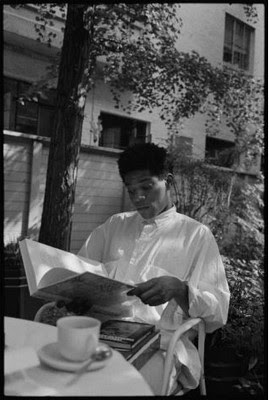
Jean-Michel Basquiat at the
Pellizzi residence in New York, NY, 1984
Photo by Francesco Pellizzi
© Francesco Pellizzi

Francesco Clemente, Andy Warhol, and Jean-Michel Basquiat 
at the Pellizzi residence in New York, NY, 1984
Photo by Francesco Pellizzi
© Francesco Pellizzi

Leading the group of works being offered is Untitled (ELMAR), created in 1982 and acquired by the Pellizzi Family just two years later [illustrated page one]. At nearly eight feet wide, the monumental work is a cornerstone of el Jean-MicBasquiat's golden year, during which he transitioned from street art to gallery success. Emblematic of Basquiat’s best works, Untitled (ELMAR) is rich in iconography and self-referential imagery. On the left, a “fallen angel” figure, birdlike and adorned with the recurring crown-of-thorns motif—which doubles as a halo—hovers above a luminous blue sea of scribbled waves and the text “ELMAR”, suggesting a modern-day Icarus on the verge of descent. To the right, a radiant archer, also crowned, releases two arrows in his direction. Untitled (ELMAR) ultimately reflects Jean-Michel Basquiat's exploration of duality within his own identity and encapsulates the essence of the artist at the peak of his creative powers.

Untitled (ELMAR) has a significant history; it was included in an exhibition dedicated to the Collection of Francesco Pellizzi at the Hofstra Museum in New York in 1989, and later presented at Gagosian Los Angeles as part of a memorial exhibition in 1998, marking the 10-year anniversary of Basquiat’s death. It was notably featured on the cover of the accompanying catalogue. More recently, the work was prominently exhibited in the artist’s historical 2018 retrospective at the Fondation Louis Vuitton in Paris.

Jean-Michel Basquiat
Untitled (Portrait of a Famous Ballplayer), 1981
50 1/8 x 43 1/2 in. (127.3 x 110.5 cm)
Estimate: $6.5-8.5 Million
To be offered on 14 May in New York
Image courtesy of Phillips

Jean-Michel Basquiat's groundbreaking transition from street art to canvas reached a pivotal moment in 1981 as seen in Untitled (Portrait of a Famous Ballplayer). This seminal piece, executed during a transformative period in Basquiat's career, stands as a testament to his exploration of race, identity, and American culture, which would endure throughout the rest of his career. It was exhibited at historic shows such as Nosei’s Jean-Michel Basquiat Memorial Exhibition, which opened in December 1988, just a few months after his passing and coinciding with what would have been the artist’s 28th birthday.

In Untitled (Portrait of a Famous Ballplayer), Jean-Michel Basquiat juxtaposes symbols of the "all-American" sport with his depiction of a Black central figure donning a baseball uniform, as well as his signature text and crown motifs. Basquiat challenges societal norms and confronts stereotypes, inviting viewers into a complex dialogue on inclusion and exclusion within American culture. Basquiat's use of the phrase “FAMOUS NEGRO ATHLETES” (with “NEGRO ATHLETES” notably crossed out) serves as a potent commentary on race, identity, and representation. It also reflects Basquiat's own experiences as a Black artist living and working in a predominantly white art world.

Jean-Michel Basquiat
Native Carrying Some Guns, Bibles, Amorites on Safari, 1982
72 1/8 x 71 3/4 in. (183.2 x 182.2 cm)
Estimate: $12-18 Million / HK$90-120 Million
To be offered on 31 May in Hong Kong
Image courtesy of Phillips

Since Phillips became a key operator in Asia in 2015, the company has been dedicated to presenting the best Western artworks to collectors and enthusiasts in the region. The company’s significant growth in Asia underscores the activity of Asian collectors acquiring works by the most important international artists. Jean-Michel Basquiat is a perfect example of this, with collectors in Asia being drawn to the artist’s oeuvre, which resonates deeply with the region's rich artistic traditions. In 2022, Phillips sold Untitled, 1982, from the collection of Japanese entrepreneur Yusaku Maezawa, with the buyer also being a private collector in Asia. Given Basquiat’s enduring appeal and resonance in Asia, Phillips offers Native Carrying Some Guns, Bibles, Amorites on Safari, 1982, at Phillips Hong Kong on 31 May.

In this work, a Black figure dominates the canvas with its arms raised, confronting a colonial poacher. The artwork merges intricate draftsmanship with street art gestures and takes on such significant subjects such as slavery and empire. Through a direct portrayal and the incorporation of text, Jean-Michel Basquiat critiques colonial commerce, encapsulating his broader themes of colonization, commercialization, and African American history. Reduced to caricatures, the figures symbolize “native” and “colonizer”, evoking explicit critiques of white imperialism. Native Carrying Some Guns, Bibles, Amorites on Safari reflects Jean-Michel Basquiat’s acute awareness of societal issues and stands as an emblematic representation of his oeuvre, capturing the intensity of his artistic vision.

* Francesco Pellizzi, in 1979-1989 AMERICAN, ITALIAN, MEXICAN ART, from the Collection of Francesco Pellizzi

AUCTION DATES:
New York | 14 May | Untitled (ELMAR), 1982, and Untitled (Portrait of a Famous Ballplayer), 1981
Hong Kong | 31 May | Native Carrying Some Guns, Bibles, Amorites on Safari, 1982

EXHIBITION DATES:
New York | 8-14 April | All Three Works
Los Angeles | 23-25 April | All Three Works
Taipei | 4-5 May | Native Carrying Some Guns, Bibles, Amorites on Safari, 1982
New York | 4-14 May | Untitled (ELMAR), 1982, and Untitled (Portrait of a Famous Ballplayer), 1981
Hong Kong | 22 May – 31 May | Native Carrying Some Guns, Bibles, Amorites on Safari, 1982

PHILLIPS NEW YORK – 432 Park Avenue, New York, NY 10022
PHILLIPS HONG KONG – G/F, WKCDA Tower, West Kowloon Cultural District, No. 8 Austin Road, West Kowloon

09/12/23

Michelangelo and Beyond @ ALBERTINA Museum, Vienna - Exhibition + Catalogue

Michelangelo and Beyond
ALBERTINA Museum, Vienna
15 September 2023 - 14 January 2024

Michelangelo Buonarroti
Male Nude Seen from Rear, c. 1504
Black chalk, heightened with white, 20 x 27 cm
The ALBERTINA Museum, Vienna

Michelangelo Buonarroti
Seated Nude Youth and Two Arm Studies, 1510/11 
Red chalk, heightened with white, 28 x 19 cm
The ALBERTINA Museum, Vienna

The master of the Renaissance: Michelangelo is one of a handful of artists whose fame has been unwavering for centuries. Although his art and his ideals are deeply rooted in the attitudes of the time – the heyday of the Renaissance and the progressive 16th century – the impact of his work extends into the present day.

Every century experiences its own Michelangelo Renaissance, and in doing so revives the historic ideal of the perfect male nude developed by the prominent Florence native on an unrivalled scale through his drawings for the incomplete fresco the Battle of Cascina, the Ignudi in the Sistine Chapel and the Dying Slave for the tomb of Pope Julius II.

Michelangelo and Beyond deals with the emergence and the power, the decrease in significance and the decline of a canon – a canon on which Michelangelo and his works made a lasting impression 500 years ago – and how the generations that followed have approached this template since.

The depiction of the human body

The richly populated portfolio of graphic pieces at the ALBERTINA allows for examination of the Michelangelo ideal, which is strikingly conveyed in both his drawings and his sculptures as the athletic and powerful male nude, whose inner tension appears to want to burst out of the body.

The new status of the drawing as its own work of art in the 15th century solidified the artistic concept and the temperament of the artist, and was reflected by the high demand of collectors for these valuable items. The provenance of the drawings by the Renaissance master at the ALBERTINA shows Peter Paul Rubens to be the owner in the 17th century, which highlights the importance of the Italian genius for subsequent generations of artists.

Albrecht Dürer
Albrecht Dürer
Adam and Eve, 1504
The ALBERTINA Museum, Vienna

Raffaello Santi
Raffaello Santi 
A Young man Carrying an Old Man, 1514
The ALBERTINA Museum, Vienna

Hendrick Goltzius
Hendrick Goltzius
The Gret Hercule, 1589
The ALBERTINA Museum, Vienna

Rembrandt Harmensz. van Rijn
Rembrandt Harmensz. van Rijn 
Naked Woman Seated on a Mound, c. 1631 
The ALBERTINA Museum, Vienna

Egon Schiele
Egon Schiele 
Nude Self-Portrait, Grimacing, 1910 
The ALBERTINA Museum, Vienna

On the one hand, the classical nude as we encounter it in the drawings in the ALBERTINA Museums’ Collections, from Michelangelo to Raffael and Beccafumi to Bandinelli, da Volterra and Salviati, always strives for the harmonious balance between generic formulas like standardised poses, the study of the anatomy according to ancient sculptures or the full-scale outline of body parts according to the formalised proportions of the Vitruvian man, and emulating nature on the other hand.

With their opposing positions, artists Rembrandt and Rubens shape the Baroque period. Rubens deals with the real, living model and brings back ancient nakedness in a new guise.

Rembrandt, on the other hand, doesn’t shy away from portraying the ugliness of the authentic body, of people in their impermanence and weakness. In doing so, he strikes a harsh contrast with the athletic body of Buonarroti.

In Classicism, the image of the beautiful and muscular naked male body continues. Almost 200 years after the death of Florence’s master, the Michelangelesque canon finds its sequel in the prevalent depiction of the ideal nude. The painters of the time, such as Anton Raphael Mengs or Pompeo Girolamo Batoni, create works that return to Michelangelo with their precision in shaping the musculature, the portrayal of complicated poses and perspective foreshortening contingent on complex postures. They are particularly reminiscent of his superlative drawings, associated with works like the Battle of Cascina or the ceiling fresco in the Sistine Chapel.

Just as slavishly and anachronistically, artists in the time of Klimt and Schiele imitate the heroic, athletic design, but more outwardly, superficially, without the intellectual depth of Buonarroti. This canon, shaped by Michelangelo, finally reaches its peak, as the depiction of the male nude as a symbol of a heroic individual finds increasingly diminishing resonance in modern society.

The exhibition bears the historic sign that for centuries, only men drew men, and women were also only drawn by men. A man defined the canon of the male nude to the extent of that of the female nude. Michelangelo himself drew very few naked women, instead lending the male body a feminine grace.

A woman in art is like the dark side of the moon: you know it exists, but it’s terra incognita. In a few typical examples from the 17th and 18th centuries, the exhibition displays the unrealistic ideal of the woman. For a long time, the depiction of a naked woman was discriminated against and discredited for identifying with vices, immorality and sexual instincts. The immorality of women leads to death and sin in the form of Eve; the sexual instinct of Luxuria appears vain and naked. The virtuous are largely cloaked in flowing robes. The antithesis of virtuously veiled women describes the naked woman as a female force, as a witch, as a seductive Venus.

The outlook at the end of the exhibition has been chosen as an example. It represents a century in which Michelangelo’s canon has lost its authority and devotes itself to the opposition between Secessionist beauty by means of Gustav Klimt’s curvy ideal of the woman and the ugliness and pathologizing of the first nude not robbed of its sexuality by Egon Schiele.

Curators: 
Klaus Albrecht Schröder, Achim Gnann, Eva Michel, Martina Pippal, Constanze Malissa


Michelangelo and Beyond
Michelangelo and beyond
Editors: Eva Michel and Klaus Albrecht Schröder
Published by Prestel Verlag, 2023
English & German, 264 pages, 28,5 x 24,5 cm, Hardcover
ISBN: 9783791391168
Accompanying the exhibition Michelangelo and Beyond an exhibition catalogue of the same title is published. On 264 pages numerous contributions examine the rediscovery of the ancient Greco-Roman idea of the ideal body by Michelangelo, as well as his influence on artists far beyond his time into the 20th century. Through emulation, evolution or absolute rejection of Michelangelo’s ideal, artists like Raffael, Dürer, Rembrandt, Rubens, Klimt and Schiele developed their own perceptions of the body.

The ALBERTINA Museum
Albertinaplatz 1 - 1010 Vienna