Showing posts with label designer. Show all posts

22/10/25

Sebastian Errazuriz @ Philadelphia Art Museum - 'Double Take' Mid-career Survey Exhibition

Sebastian Errazuriz: Double Take
Philadelphia Art Museum
November 22, 2025 – August 16, 2026

Sebastian Errazuriz Design
SEBASTIAN ERRAZURIZ
Lightning Strike Lamp, 2025
Designed by Sebastian Errazuriz

Sebastian Errazuriz Design
SEBASTIAN ERRAZURIZ
Chicken Lamp III, 2014
Edition of 12 
Designed by Sebastian Errazuriz

Sebastian Errazuriz Design
SEBASTIAN ERRAZURIZ
The Represented Self, 2020 
Designed by Sebastian Errazuriz

Sebastian Errazuriz Design
SEBASTIAN ERRAZURIZ
The Represented Self, 2020 
Designed by Sebastian Errazuriz

The Philadelphia Art Museum presents Sebastian Errazuriz: Double Take, a mid-career survey by artist and designer Sebastian Errazuriz (b. 1977, Chile). The exhibition explores Errazuriz’s multi-hyphenate practice spanning art, craft, design, and technology, from antiquity-inspired furniture to multimedia work informed by artificial intelligence.  

Alongside the exhibition, Sebastian Errazuriz will be honored with the 39th Collab Design Excellence Award. Collab is the museum's affinity group for modern and contemporary design and has celebrated diverse international designers who have made important contributions that advance all disciplines of design. Collab was established in 1986 and presents the award annually. Previous awardees have included Florence Knoll Bassett, Naoto Fukasawa, Zaha Hadid, Ingo Maurer, George Nakashima, Gaetano Pesce, Patricia Urquiola, and Marcel Wanders, among others.  

Sebastian Errazuriz Design
SEBASTIAN ERRAZURIZ
Magistral Chest, 2014
Designed by Sebastian Errazuriz

Sebastian Errazuriz Design
SEBASTIAN ERRAZURIZ
Bust Shelf Green Marble, 2018
Designed by Sebastian Errazuriz

Sebastian Errazuriz Design
SEBASTIAN ERRAZURIZ
Bust Shelf Green Marble (Detail), 2018
Designed by Sebastian Errazuriz

Errazuriz’s creative imagination challenges upheld ideas of what design should be and, moreover, asks what it could be. Embracing humor and appropriation, his limited-edition and unique pieces often have a subtext that goes beyond form or function to include personal narratives, political messages, and cultural commentary. While many of Errazuriz’s pieces are functional, his work upends a number of conventions established within the design industry, including the notions that form should follow function, or that materials should be used where most appropriate.  

Sebastian Errazuriz: Double Take presents over 20 years of making, including early conceptual works that take nature and existing found objects as sources of inspiration. The exhibition features furniture, mirrors, and other products that the designer creates from appropriated and digitally manipulated Greco-Roman antiquities from museum collections. Also on display will be a range of the designer’s “kinetic” cabinets, defined by their moveable elements. Errazuriz is interested in disrupting the idea that cabinets must consist of a box with two front doors, regardless of their design. Instead, objects in Double Take propose a dynamic way of living with furniture that rotates, spins, and fans out in different directions.  

Sebastian Errazuriz Design
SEBASTIAN ERRAZURIZ
Piano Shelf, 2014
Designed by Sebastian Errazuriz

Sebastian Errazuriz Design
SEBASTIAN ERRAZURIZ
IMAGINE, 2025 
Designed by Sebastian Errazuriz

A final, monumental installation features a full-wall graphic made up of drawings that Sebastian Errazuriz has created through the use of artificial intelligence. Overlaid is a new work, which spells out the word “IMAGINE” in neon lights, the letters flashing in alternating patterns to alight only “AGI” at certain points. Unlike current AI models which are trained for specific tasks, the concept of AGI, or artificial general intelligence, involves systems possessing human-like cognitive abilities, allowing them to learn new skills, adapt to novel situations, and demonstrate common sense and creativity without explicit pre-programming. This focal point of the exhibition explores Errazuriz’s fascination with, and apprehension about, the potential impact of AI on artists, designers, and culture more broadly. 

Sebastian Errazuriz Design
SEBASTIAN ERRAZURIZ
Fan Cabinet, 2014
Designed by Sebastian Errazuriz

Sebastian Errazuriz Design
SEBASTIAN ERRAZURIZ
Narcissus Bowl, 2022
Designed by Sebastian Errazuriz
“The diverse body of work by Sebastian Errazuriz conveys imagination and cleverness, while also bewildering those who encounter it. The pieces are meant to be lived with, but, at the same time, are provocations. They have an air of mystery around their function and meaning,” said Tiffany Lambert, The Lisa Roberts and David Seltzer Curator of Modern and Contemporary Design. “This survey exemplifies one way to understand and challenge how design can impact our daily lives.” 
PHILADELPHIA ART MUSEUM
Alter Gallery (Gallery 276) 
2600 Benjamin Franklin Parkway, Philadelphia, PA 19130

28/08/25

Harri Koskinen @ Galerie Forsblom, Helsinki - "Magnitude" Exhibition

Harri Koskinen: Magnitude
Galerie Forsblom, Helsinki 
August 22 – September 21, 2025
 
Harri Koskinen one of Finland’s most renowned designers, presents a new exhibition shaped by compelling, multi-layered themes that navigate borderlands between the mythical and the contemporary. Elements subtly reminiscent of survival gear suggest preparation for an uncertain future, serving as a quiet reminder of today’s volatile global climate. At the same time, the exhibition drifts into the realm of myth and adventure. Rather than creating ominous imagery, Harri Koskinen explores the delicate tension between the material form and conceptual depth of his work.

The exhibition presents a selection of unique glass sculptures, both free-blown and mold-cast. Glass, with its reactive sensitivity, naturally lends itself to the creation of multi-layered forms. As a material born from the transformation of sand through intense heat, then cooled into solid form, glass inherently embodies shifting states of matter. Koskinen’s minimalist visual vocabulary resonates beautifully with the fragility of his medium. Most of the featured sculptures were handcrafted at the historic glassworks in Iittala and Riihimäki, with select pieces produced in Switzerland. This marks Koskinen’s fifth solo exhibition at Galerie Forsblom.

HARRI KOSKINEN (b. 1970), is a highly versatile designer known for his conceptual approach. His practice spans both serial production and one-offs. Over the course of his distinguished career, he has served as design director at Iittala and collaborated with prestigious international brands including Artek, Genelec, Hermès, Issey Miyake, Muu, and Svenskt Tenn. Among his many accolades are the Torsten and Wanja Söderberg Prize, the Compasso d’Oro Award, and the Pro Finlandia Medal. Harri Koskinen lives and works in Espoo and Helsinki.

GALERIE FORSBLOM
Yrjönkatu 22, 00120 Helsinki

17/06/25

Nathalie Du Pasquier Exhibition @ Nivola Museum, Orani, Italy

Nathalie Du Pasquier
Volare Guardare Costruire
Museo Nivola, Orani
May 17 – September 14, 2025

Nathalie Du Pasquier
Portrait of Nathalie Du Pasquier
Photo by Ilvio Gallo

Museo Nivola presents Volare Guardare Costruire (to fly, to look, to build), a site-specific project by Nathalie Du Pasquier, a French artist and designer based in Milan.

Conceived especially for the museum’s spaces, the exhibition takes the form of a retrospective dedicated to the artist’s painting production from her beginnings to the present day. At the same time, it is an environmental installation that merges painting, architecture, and design. The exhibition unfolds through a series of structures designed by the artist, transforming the museum into a space to walk through, explore, and inhabit.

The exhibition thus initiates a dialogue between the artist’s ephemeral architectures and the historical structure of the building – the former washhouse of Orani, now the beating heart of Museo Nivola.

Inside these “rooms” and on the walls of the museum are works created from the 1980s to today, which tell the story of the evolution of Du Pasquier’s visual language: a lexicon made of figuration and abstraction, in which human figures and the narrative dimension gradually give way to the theme of still lifes, made of simple and everyday objects, which delicately evoke the human presence, and then again to geometric shapes and abstract constructions. The whole is bathed in a midday light that gives the paintings a metaphysical air, almost as if we were in front of modern versions of Morandi’s canvases or, in other ways, of the purist ones of Le Corbusier and Ozenfant.

The title, Volare Guardare Costruire, refers to three phases of Nathalie Du Pasquier’s pictorial production. Volare (to fly) evokes the moment of detachment from the design of design objects towards the freer practice of painting. And it is perhaps no coincidence that many of the works of this phase present scenes seen from above, with a bird’s eye view, a symbol of the power of the imagination, of its ability to soar high and expand freely.

Guardare (to look) refers to a second phase, to the need to abandon purely imaginative scenes to dedicate oneself to a quiet and precise observation of reality, even of the most everyday and apparently insignificant objects, which instead reveal to an interested gaze, extraordinary forms, precious details and the ability to understand within oneself the complexity of existence. They are visions that the artist defines as “very silent and very still”, which invite one to rediscover the pleasure of the sensitive world through silent and attentive observation.

Dissatisfied, at times, with the sensible appearance of reality, Nathalie Du Pasquier finally dedicates herself to Costruire (to build), creating original structures, small three-dimensional abstract constructions that are then portrayed with the brush, brought back to the two-dimensional plane of her canvases. Thus, she triggers a complex dynamic between reality and representation, which is a wonderful metaphor for painting.

With this exhibition, the Nivola Museum confirms its commitment to promoting the dialogue between art, design and architecture, offering an immersion in the visionary world of an artist who continues to reinvent the rules of seeing and building.

Nathalie Du Pasquier (Bordeaux, 1957) moved to Milan in 1979. Co-founder of the Memphis collective, since the mid-1980s she has devoted herself mainly to painting, developing an unmistakable visual universe where formal research combines with a profound reflection on space and perception. Her works have been exhibited at Villa Noailles Hyères (Toulon, France), Kunsthal Aarhus (Aarhus, Denmark), GFZT Museum of Contemporary Art (Leipzig, Germany), Camden Arts Center (London), Kunsthalle Wien (Vienna) and MACRO in Rome.

Curated by Giuliana Altea, Antonella Camarda, Luca Cheri

NIVOLA MUSEUM
MUSEO NIVOLA
Via Gonare 2 08026 Orani

17/03/25

Richard Paul Lohse @ Hauser & Wirth Basel

Richard Paul Lohse 
Hauser & Wirth Basel 
26 February – 26 April 2025 

Hauser & Wirth Basel presents an exhibition of paintings and works on paper by the legendary Swiss concrete artist and graphic designer RICHARD PAUL LOHSE (1902 – 1988), spanning the 1950s until the 1980s. A leading representative of the Zürcher Konkrete movement, alongside artists like Max Bill, Verena Loewensberg and Camille Graeser, Lohse was a radical thinker who combined a belief in the expressive power of color with the democratic potential of art during the early- and mid-20th century. His work also made a significant impact on the development of graphic design. 

From the 1940s onwards, Lohse’s modular and serial paintings employed systematic structures that aimed to standardize pictorial means. Showcasing works from his most iconic series of paintings using grids of colored squares—versions of which were exhibited at Documenta Kassel in 1982—this exhibition offers visitors a rare opportunity to experience his groundbreaking artistic approach firsthand. Tracing Lohse’s evolution from early explorations of modularity to the large-scale serial compositions that cemented his place at the forefront of 20th-century abstraction, the exhibition reveals how subtle shifts in form and color transform visual perception.

This presentation precedes a major traveling European retrospective, beginning at MASI Lugano in September 2025.

Few artists have redefined the language of abstraction as profoundly as Richard Paul Lohse. His background in graphic design and typography shaped his structured approach to painting. Inspired by De Stijl and Mondrian, he differed in his method—where Mondrian worked intuitively, Lohse adhered to strict systems. Rejecting subjective expression, he aimed to establish a universal visual language based on mathematical precision and systematic order. His serial compositions and modular systems eliminated hierarchy, reinforcing his belief in social progress and democratic ideals.

Richard Paul Lohse was not just a painter—he was a thinker, designer and activist who shaped the visual culture of postwar Europe. Seeing visual communication as a tool for social change, Lohse was politically active in the 1930s and later joined the resistance during World War II. In 1937, together with Leo Leuppi, he founded ‘Allianz, Vereinigung moderner Schweizer Künstler,’ which defined Swiss concrete art. He was involved with leading modernist figures such as Jean Arp, Georges Vantongerloo, Le Corbusier, Antoine Pevsner and Friedrich Vordemberge-Gildewart, whose ideas shaped his approach to abstraction. As editor of ‘werk, bauen + wohnen’ (1947–1956) and co-founder of ‘Neue Grafik’ (1958–1965), he influenced the postwar dialogue between art, graphic design and technology, bridging the gap between industrial precision and avant-garde aesthetics.

Among the highlights of the exhibition is ‘Vier Kreuzgruppen verbunden’ (1956–1957), a square composition of four interlocking grid structures, illustrating his early exploration of chromatic rhythm and modular configurations. Lohse’s methodical yet engaging works immerse viewers in rhythm, color and structure, as seen in ‘9 vertikale systematische farbmengengleiche Reihen’ (1950–1980), a meticulously organized oil-on-canvas demonstrating his principle of equal color quantity, ensuring each hue appears with equal frequency and balance across the grid.

‘30 vertikale systematische Farbreihen mit roten Diagonalen’ (1943–1970), with its precise vertical sequences intersected by red diagonals, exemplifies his mastery of seriality and dynamic structure. The exhibition invites visitors to explore variations like ‘30 vertikale systematische Farbreihen mit zwei Bändern,’ revealing how minor changes in modular arrangements generate dramatically different visual effects. In large-scale serial paintings like ‘15 systematische Farbreihen mit heller Betonung B’ (1987), similar to those shown at Documenta 7 in Kassel (1982), he anticipated the logic of early computing, echoing the infinite scalability and repetition found in digital aesthetics.

Richard Paul Lohse continued refining gradual color transitions in his later works such as ‘Diagonalstufung Gelbrot – Blaurot’ (1980–1986) and ‘Diagonalstufung Gelbrot – Blaugrün,’ allowing for direct comparison of his approach to chromatic gradation within a strict geometric framework. He also experimented with color sequences on paper, using graphite and colored pencil, as in ‘Komplementäre Gruppen durch sechs horizontale gleiche Farbreihen’ (1950). These studies were later developed into finished drawings, including the 1961 version of the same title, and were often translated onto canvases with vibrant oil paint.

A key figure in Swiss concrete art, Richard Paul Lohse gained international recognition through exhibitions such as Willem Sandberg’s 1961 show at the Stedelijk Museum, Amsterdam, and Switzerland’s representation at the Venice Biennale in 1972. He participated in major exhibitions, including the ‘Allianz’ exhibition at Kunsthaus Zürich (1942), the ‘Konkrete Kunst’ exhibition at Kunsthalle Basel (1944), the ‘arte astratta e concreta’ exhibition at the Palazzo Exreale, Milan (1947), the 8th São Paulo Biennial (1965) and the Documenta, Kassel (1968, 1982). His influence was further cemented with the Art Prize of the City of Zurich (1973), reinforcing his impact on concrete and systematic art.

On the occasion of the exhibition, Hauser & Wirth Publishers will display a small selection of Lohse’s work as a graphic designer in their bookshop in Zurich.

HAUSER & WIRTH BASEL
Luftgässlein 4 - 4051 Basel

05/05/24

Charles Jeffrey LOVERBOY Exhibition @ Somerset House, London

Charles Jeffrey LOVERBOY 
Somerset House, London 
8 June – 1 September 2024 

Somerset House presents the first ever UK exhibition of Glaswegian born designer, illustrator, stylist, radical creative, and Somerset House resident Charles Jeffrey – celebrating 10 years of his fashion house LOVERBOY. The exhibition examines Charles Jeffrey’ sensational impact on the global fashion scene, from club to catwalk, and includes the full spectrum of his prolific output, with newly commissioned works.

Charles Jeffrey is one of Somerset House Studios’ original resident artists - whose studio is still based within Somerset House’s community of cultural innovators. He graduated from London’s Central Saint Martins in 2015, founding his own fashion label Charles Jeffrey LOVERBOY shortly thereafter. It was named after the cult club night he had hosted weekly in East London to fund his studies and an internship in the haute couture ateliers of Christian Dior in Paris.

The exhibition is anchored by the collaborative spirit nurtured during Charles Jeffrey’s time at art school and that now sits at the root of his gender-inclusive brand’s narrative. Championing wearability and style for all, with fans including Harry Styles and Tilda Swinton, LOVERBOY has been lauded for ripping up the fashion rule book, and transcending the boundaries of art, design and music. Merging traditional tailoring with a punk ethos, its collections are both distinctly contemporary and yet also grounded in British subcultural traditions. With its colourful and cutting-edge designs, Charles Jeffrey LOVERBOY champions self-expression and artistry – a voice that is threaded throughout his work across mediums and the decade.

The exhibition is displayed across three rooms within Somerset House. It includes artistic collaborations, films, illustration, painting, memorabilia, and never-before-seen material. Through a series of sensorially-led spaces rendered in LOVERBOY’s signature playful style, the exhibition  provides an accessible and engaging insight into creative production and the fashion industry. It also provides the space to celebrate a new generation of young London creatives. 

Each room has its own distinctive vision. Presented with an immersive multimedia installation, assembled from the LOVERBOY archive, the exhibition showcases Charles Jeffrey’s creative process across each space. The first room introduces his artistic inspirations, followed by a closer look into the development of his craft and codes, culminating in the final room featuring the brand’s most iconic and extravagant designs. It will be an engrossing insight into Charles Jeffrey’s journey and an opportunity to see his designs up close like never before.

Designer Charles Jeffrey said:
“I’m so excited to have this moment to share my journey in fashion at Somerset House. It's not just about celebrating 10 years of Loverboy; it's about sharing our approach to fashion; being creative, approachable, and not taking ourselves too seriously.”

We're here to shine a light on what we've built and to show that if we can do it, so can you. Visitors can expect to see our journey, our quirks, and have a good laugh along the way. It's about making fashion accessible and fun, reminding everyone that at the end of the day, it's about expressing who you are.”
LOVERBOY is a creative force springing forth from the mind of Scottish Creative Director and Designer, Charles Jeffrey. Based in London – in the catacombs of historic Somerset House, to be exact – LOVERBOY continues to build on its stellar start in the fashion industry, taking on new challenges and reaching new customers year on year. From humble beginnings in Charles’s East London bedroom, LOVERBOY is now an international fashion powerhouse, carried in over 90 stores across the world, and employing a team of ten full-time staff. Drawn to the inherent magic in queerness, Charles and his collaborators create fashion dreamscapes, adding new layers to the brand’s story with each passing season. Together they weave the folkloric thread of Scottish history into the rich tapestry of London’s queer nightlife and music scenes.

A radical sensibility informs all LOVERBOY’s output, and the brand is proudly committed to making clothes that can be worn by anyone, in any conceivable way. With LOVERBOY entering its eighth year, Charles and his team of fashion visionaries are taking this approach to new heights, drawing inspiration from art, music and unconventional sources of queer joy. Renewed connection to nature, the body and notions of queer wellness are all key creative stimuli in LOVERBOY’s current future-facing phase. The brand will also continue to renew its focus on collaboration through partnerships with artists in residence who act as contributors to the design process. 


SOMERSET HOUSE
Strand, London, WC2R 1LA

16/11/23

Africa Fashion @ Portland Art Museum

Africa Fashion
Portland Art Museum
November 18, 2023 – February 18, 2024

Models holding hands, Lagos, Nigeria, 2019 by Stephen Tayo
Courtesy Lagos Fashion Week

Sanlé Sory 'Je Vais Décoller, 1977' 
© Sanlé Sory / Tezeta. Courtesy David Hill Gallery

Self-portrait, Gouled Ahmed, Addis Foam, Ethiopia

Mbeuk Idourrou collection, Imane Ayissi, Paris 
Autumn/Winter 2019. 
Photo: Fabrice Malard / Courtesy of Imane Ayissi

Africa Fashion opens at the Portland Art Museum after acclaimed runs at London’s Victoria and Albert Museum and the Brooklyn Museum. This first-of-its-kind exhibition, making its only West Coast stop at PAM, honors the irresistible creativity, ingenuity, and unstoppable global impact of contemporary African fashions. Garments and textiles dating from the mid-twentieth century to the present day, contextualized by a range of cultural touchstones such as Drum magazines, Fela Kuti and Miriam Makeba record albums, and studio photography from Sanlé Sory, celebrate the transformative and liberatory power of self-fashioning. The New Yorker’s art critic Hilton Als called Africa Fashion a “vital and necessary exhibition.”

The exuberance and cosmopolitan nature of the contemporary African fashion scene unfolds through more than 50 outfits designed by over 40 designers hailing from 21 countries, who are shifting the geography of the global fashion world. Elegant minimalist garments by Mmusomaxwell, Katush, and Moshions push back on stereotypes that African fashions are exclusively colorful and brightly patterned; knitwear by Maxhosa echoes traditional Xhosa beadwork patterns; shimmering silk and layers of raffia combine in a fuchsia pink couture outfit by Imane Ayissi; and striking ensembles by Selly Raby Kane and Bull Doff reference Afrofuturism.
“Africa Fashion means the past, the future and the present at the same time,” said fashion designer Artsi, founder of Moroccan design house Maison ArtC. “The joy of life and the joy of colour is completely different and very particular to the continent. It’s a language of heritage, it’s a language of DNA, it’s a language of memories.” 
Design by Chris Seydou 
© Nabil Zorkot

Kofi Ansah 'Indigo' Couture 1997 - Narh & Linda 
Photo © 1997 Eric Don-Arthur www.EricDonArthur.com

Alchemy collection, Thebe Magugu, 
Johannesburg, South Africa, Autumn/Winter 2021 
Photography: Tatenda Chidora
Styling + Set: Chloe Andrea Welgemoed
Model: Sio

Africa Fashion employs a cross-cultural and cross-continental approach throughout the exhibition galleries, centering multiple and varied African voices and perspectives. Starting with the African independence and the liberation years that sparked a radical political and social reordering across the continent, the exhibition explores how fashion, alongside music and the visual arts, formed a key part of Africa’s cultural renaissance, laying the foundation for today’s fashion revolution. A section on textiles presents vintage woven kente cloth alongside printed kanga cloths and Dutch Wax cottons, showing how the making and wearing of traditional textiles in the moment of independence became a strategic political act.

During this period, groundbreaking designers worked fluidly both on the continent and internationally. Garments included in the exhibition by vanguard creatives Alphadi (b.1957), Kofi Ansah (1951-2014), Naïma Bennis (1940-2008), Shade Thomas-Fahm (b.1933), and Chris Seydou (1949-1994), embody the artistic expression of the cultural renaissance.
“I feel like there’s so many facets of what we’ve been through as a continent that people don’t actually understand,” said South African designer Thebe Magugu. “Now more than ever, African designers are taking charge of their own narrative and telling people authentic stories, not the imagined utopias.”
'Chasing Evil' collection, IAMISIGO, Kenya, 
Autumn/Winter 2020
Courtesy IAMISIGO 
Photo: Maganga Mwagogo

DAKALA CLOTH ensemble, 
'Who Knew' collection, 
Abuja, Nigeria, Spring/Summer 2019
Image courtesy Nkwo Onwuka 
© Kola Oshalusi

The sophisticated fashions at the heart of Africa Fashion simultaneously celebrate long-held traditions of cultural self-expression through clothing and the significant contributions of contemporary designers of African descent to the international fashion scene.

Portland’s creative community also takes a turn on the catwalk for this presentation of Africa Fashion as well. Togo-born designer Komi Jean Pierre Nugloze of N’Kossi Couture is included in the exhibition, showcasing two of his contemporary designs. And Portland-based LEVER Architecture collaborated with the Museum on an innovative exhibition design, including a single organic display platform that welcomes visitors to admire the contemporary garments from all angles.

Africa Fashion is accompanied by a catalog published by V&A Publishing.

Africa Fashion
Africa Fashion
- Exhibition book
Christine Checinska (Editor)
Published by V&A
224 pages
ISBN : 9781838510275

Curated by the Victoria & Albert Museum’s Christine Checinska, Ph.D., Senior Curator of African and Diaspora Textiles and Fashion, with Project Curator Elisabeth Murray; curated for Portland by Julia Dolan, Ph.D., The Minor White Senior Curator of Photography.

PORTLAND ART MUSEUM
1219 SW Park Avenue Portland, OR 97205

Riccardo Dalisi @ MAXXI, Rome - Retrospective exhibition "Radicalmente"

Riccardo Dalisi: Radicalmente
MAXXI, Rome
10 November 2023 – 3 March 2024

Riccardo Dalisi
Riccardo Dalisi con un "robot-caffettiero", anni Ottanta
Foto di Ugo Magliacano 
Courtesy Archivio fotografico Alessi

Riccardo Dalisi
Riccardo Dalisi in his studio, Naples 
Photo by Fulvio Cutolo 
Courtesy Archivio Riccardo Dalisi

MAXXI presents a major retrospective dedicated to RICCARDO DALISI (Potenza 1931 – Naples 2022), a year after his death.

Riccardo Dalisi was one of the most multifaceted Italian designers of recent decades. He was unconventional, revolutionary, and hard to classify. Moving freely between architecture and design, art and craftsmanship, participation and social engagement, academic research, and popular traditions, he explored paths and methods that, though often misunderstood, stand out as ground-breaking today, when facing the great challenges of our times as far as design is concerned.

Riccardo Dalisi
Riccardo Dalisi 
Pavone chair designed for Zanotta in 1981 
Courtesy Zanotta SpA

Riccardo Dalisi
Riccardo Dalisi 
Mariposa bench designed for Zanotta in 1984 
Courtesy Zanotta SpA

The MAXXI exhibition presents Riccardo Dalisi's work for the first time in its extreme diversity and vastness. From creative workshops with children in Naples (those in Rione Traiano are depicted in a series of photographs by Mimmo Jodice) to his revolutionary work in the field of design (such as ultra-poor design, characterized by poor techniques and recycled materials, including sculptures, lamps, and tin objects created by migrant laborers and unemployed people). From built architecture (such as the Borsa Merci in Naples, created with Michele Capobianco and Massimo Pica Ciamarra in 1964, or the "creative restoration" interventions in the Irpinia villages struck by the 1980 earthquake) to imagined architecture with visionary, impossible projects, utopian plans, and ironic yet provocative drawings that, as a whole, evoke a surreal, poetic, and critical world. The exhibition also presents the artistic revival of popular culture and tradition, with paintings and sculptures, often in large format, where characters of Neapolitan and Mediterranean culture are brought to life.

Riccardo Dalisi
Riccardo Dalisi 
Tecnica povera, 1973
Sedia in cartapesta, 1973
Courtesy Archivio Riccardo Dalisi

Riccardo Dalisi
Riccardo Dalisi
La caffettiera-vestale, Golfo di Napoli, 1985
Archivio Fotografico Alessi

Riccardo Dalisi
Riccardo Dalisi
Pifferaio Magico / Pied Piper, Rame e verderame /
 Copper and verdigris, 2015
Photo by Fulvio Cutolo, 2016
Courtesy Archivio Riccardo Dalisi

Also exhibited for the first time is the Sedia del cece (Chickpea Chair), a series of drawings that Dalisi asked from Andy Warhol, Joseph Beuys, Ettore Sottsass, Enzo Mari, Bruno Munari, Paolo Portoghesi, Superstudio, Archizoom, Zziggurat, 9999, Aldo Rossi, Franco Purini, Franco Raggi, Ugo La Pietra, Gae Aulenti, Hans Hollein, and many others. It is inspired by a small chair made by a Neapolitan girl using scrap wood and a clothespin, with a chickpea laid on it.

Among his most famous works is the reinterpretation of the Neapolitan coffee maker, the result of research carried out between 1979 and 1987 for the Alessi company, awarded the Compasso d'Oro (“Golden Compass”). It was conducted with the craftsmen of Rua Catalana in Naples and Alessi technicians in Piedmont, generated, in addition to a model that went into production, hundreds of objects halfway between a coffee maker and a puppet, in which functional research, anonymous design, and the ritual dimension of coffee merge into the forms of "Totocchi" (Totò + Pinocchio), warriors, knights, robots, Pulcinella, and other fairy-tale and mythological characters.

Riccardo Dalisi
Riccardo Dalisi 
Sketch realised for publication 
“Riccardo Dalisi Decrescita. Architettura della nuova innocenza” 
Corraini editore, 2006
Courtesy Archivio Riccardo Dalisi

Through drawings, sketches, furnishings, embroidery, objects, books, sculptures, paintings, photographs, archive documents, films, and other materials, the radical and revolutionary nature of the "Dalisi method" is revealed. Curator Gabriele Neri writes, "By exalting interdisciplinary trespassing, the overturning of the concept of the author, the 'creative disorder,' irony, and play, the potential of residue and dross, Dalisi fought to reaffirm the 'tolerant strength of the community sense, for which everyone, even the least efficient and the outcast, is useful, necessary.' His work hovers between utopia and reality and transforms what we thought were marginal themes and territories into pivotal points of discussion and engagement, especially in times of crisis that force us to rethink our relationship with the project and the world."

Riccardo Dalisi
Riccardo Dalisi 
Non solo pensiero, 1997
Courtesy Archivio Riccardo Dalisi

Riccardo Dalisi
Riccardo Dalisi
Ultrapoverissimo, latta cucita e fil di ferro /
 sewn tin and wire, Naples, 2003
Foto di Fulvio Cutolo, 2005

The exhibition also highlights the fruitful interactions between Riccardo Dalisi and artists, designers, architects, and critics, including Mimmo Jodice (to whom MAXXI pays tribute with the exhibition of a core of images from the Mediterraneo series at the Archive Center), Alessandro Mendini, Giancarlo De Carlo, Massimo Pica Ciamarra, Mimmo Paladino, Ettore Sottsass, and many others.

His work blossomed in the cultural and artistic climate of Naples in the sixties and seventies. It is the expression of a "Mediterranean" nature resistant to a homogenizing, disastrous modernity. However, it has always drawn from much broader influences, both geographically and disciplinarily—pedagogy, semiotics, linguistics, sociology, theatre, etc.—which the exhibition aims to highlight.

The setting-up by Novembre Studio evokes the image of an upside-down, alternative world, much like Dalisi's perspective on reality. The dreamlike figures that the master drew and sculpted over the years guide the visitor through an out-of-scale landscape, telling the story of his poetics in a thorough, radical way.

The exhibition also includes the outcomes of research conducted, starting from the traces of the Neapolitan architect, by the artist-photographer Vincenzo Castella, in collaboration with NABA - Nuova Accademia di Belle Arti (“New Academy of Fine Arts”), involving a group of young visual artists from the Academy. Through the displayed photographs, the plunges into the workshops of the tinsmiths of Rua Catalana, the streets of the Spanish Quarters, among the "garitte" ("watchtowers") built at Palazzo Reale, and in the buildings constructed in Ponticelli and Rione Traiano, which in the seventies were the stage for pioneering workshops conducted with children. 

A book, curated by Gabriele Neri, has been published for the exhibition. It is dedicated to the "Sedia del cece" series, edited by Corraini, featuring drawings by Riccardo Dalisi, Andy Warhol, Joseph Beuys, Ettore Sottsass, Enzo Mari, Bruno Munari, Paolo Portoghesi, Superstudio, Archizoom, Zziggurat, 9999, Aldo Rossi, Franco Purini, Franco Raggi, Gae Aulenti, Hans Hollein, Ugo La Pietra, etc. The volume includes accounts by scholars and designers and an essay by the curator. Texts by Lorenza Baroncelli, Stefano Boeri, Sara Catenacci, Domitilla Dardi, Paolo Deganello, Piero Frassinelli, Claudio Gambardella, Fulvio Irace, Ugo La Pietra, Anna Maria Laville, Iolanda Lima, Gabriele Neri, Gianni Pettena, Franco Purini, Franco Raggi, Lia Rumma, Angela Tecce.

Fondazione MAXXI | Museo nazionale delle arti del XXI secolo
Via Guido Reni, 4A - 00196 Roma 

14/10/23

Josef Hoffmann @ Art & History Museum, Brussels - "Josef Hoffmann - Falling for Beauty" Retrospective Exhibition

Josef Hoffmann - Falling for Beauty
Art & History Museum, Brussels
6 October 2023 - 14 April 2024

The Art & History Museum in Brussels presents the exhibition JOSEF HOFFMANN - Falling for Beauty. This exhibition provides an exceptional opportunity to discover an artist who understood beauty as an absolute requirement for individual and social transformation.

In October 1955, Viennese architect and designer JOSEF HOFFMANN (1870-1956) travelled to Brussels on the occasion of the 50th anniversary of the Stoclet House, the project that came to be known as a “palace” and shaped his life and career. The enduring myth surrounding this building as well as the particular product culture that emerged from  the craftsmanship of the Wiener Werkstätte (Viennese workshops), has dominated the approaches to his practice to this day. The exhibition JOSEF HOFFMANN - Falling for Beauty wishes to offer a broader perspective by presenting Hoffmann’s artistry, for the first time in Belgium, as it develops through  six decades of production. 

The timeless beauty of Hoffmann’s creations not only shows his relevance as a historical phenomenon but also as a source of inspiration for different generations of students, at the Vienna School of Arts and Crafts and elsewhere, making him especially an international reference for postmodern practices. Considering the challenge of introducing Josef Hoffmann in Brussels, this retrospective aims to provide a deeper insight in Hoffmann’s ideals and their evolution both due to and regardless of the diverse ideological and social circumstances in which they took form. The exhibition features a variety of well-known works together with rare pieces from private collections. The narrative is nourished by biographical details and new material on previously overlooked aspects; all to further extend our consideration of a leading figure in the field of modern design.

The sections of the exhibition are oriented around one or more architectural models ––including a new model of Hoffmann’s pavilion for the Werkbund exhibition in Cologne in 1914––that serve as epitomes and key references to consider constellations of furniture, objects, designs, textiles, and documents. In this regard, a juxtaposition of multiple narratives is proposed, covering every aspect of Hoffmann’s artistic production: architecture, design, decorative arts, scenography, writing and teaching. In addition, focus will go to his creative method as well as his use of colour.

This project is developed in collaboration with the Applied Art Museum of Vienna (MAK) and takes as its point of departure  the major scientific work presented in the exhibition JOSEF HOFFMANN: Progress Through Beauty (2020/2021), curated by Matthias Boeckl, Rainald Franz, Christian Witt-Dörring. The exhibition is a central event of the 2023 Art Nouveau year in Brussels.

ART & HISTORY MUSEUM, BRUSSELS
Parc du Cinquantenaire 10 - 1000 Brussels

17/04/23

Augusto Betti: Artist + Designer @ Fondazione Sozzani, Milan - Restrospective Exhibition Curated by Gherardo Tonelli

Augusto Betti: artista + designer 
Curated by Gherardo Tonelli 
Fondazione Sozzani, Milan 
April 16 – May 14, 2023 

On the occasion of miart and Milan Design Week 2023, Fondazione Sozzani in collaboration with Paradisoterrestre presents the exhibition Augusto Betti. Artista e designer, curated by Gherardo Tonelli. The result of a process of rediscovery and re-evaluation of the fascinating figure of Augusto Betti, the retrospective is dedicated to one of the least known and most surprising creative mind of the 20th century and features his work, which is complex and diverse but always consistent.

Painter and artist experimenting with new theories and materials, pupil of Giorgio Morandi and Giovanni Romagnoli at the Academy of Fine Arts in Bologna; designer and above all teacher; close associate of Silvio Ceccato, Director of Centro di Cibernetica e di Attività Linguistiche of the University of Milan and Gerardo Filiberto Dasi (Centro Pio Manzù, Rimini). A rich and stimulating life for Augusto Betti who, out of reluctance and character, relegated the outcomes of his creative production to an intimate and private dimension. On the rare occasions when he decided to participate in shows and exhibitions, his name appeared together with important figures in contemporary art such as Marina Apollonio, Agostino Bonalumi, Enrico Castellani, Gianni Colombo, Dadamaino, Lucio Fontana, Ugo La Pietra, Piero Manzoni, and Elio Marchegiani, and his work gained recognition from distinguished critics, including Umbro Apollonio, Giulio Carlo Argan, Palma Bucarelli, Carla Lonzi.

For Augusto Betti, art was not an aesthetic but an emotional quest. Stepping outside the classical canons, he found himself deeply exploring different areas: from energy and psychology to the mysteries of life. The exhibition delves into a forward-looking research projected into the future. It is rooted in the historical period in which it was undertaken but, at the same time, is surprisingly contemporary.

Alongside his artworks, on view also design pieces now part of Paradisoterrestre catalogue. Among these, the Noodle armchair (1967), created to explain to students the importance of free gestures in the generation of ideas, and the ceramic tea set - a material of choice from his hometown of Faenza – which Betti describes as his "most successful design object" (1975). Presented for the first time the re-editions of the Prisma armchair and sofa (1971), conceived during lectures to his students, and the Glass coffee table (1967), a smoked glass element whose cubic conformation allows for different compositional variations.

From the archive managed by his daughter Cristiana Betti come the very rare artworks from the "cassette" series (1959-1961); the resin and fiberglass sculptures Pulsazioni (1964), Scatola dei sentimenti (1964), Struttura equilibrante (1964), Obelisco (1965), Ballerina (1965), Vibrazioni (1967), Orgonoscopio (1967), Camera con lenti (1969); and also Austere chair and table (1967), Parete luce lamp (1967), Foemina chair (1967), Ciclope chair (1972).

AUGUSTO BETTI (1919-2013) became an orphan at the age of nine. The eldest of his siblings, he worked in the Focaccia and Melandri ceramic workshop. He could not pursue the art studies he loved but managed to attend evening classes at the local Municipal School of Drawing. In 1935 he enrolled in the mechanical construction course at the Aeronautical Institute in Forlì. 
During World War II, he was a mechanical engineer with Primo Stormo da Caccia in Udine, with missions in North Africa, Greece, Algeria. At the end of the war, he began to paint: his first painting was Il ritratto di Jole (1945), the portrait of his young wife. 
In 1946 he held his first solo painting exhibition at the Gamberini gallery in Forlì. In 1947 he was admitted to the Academy of Fine Arts in Bologna, where his teachers were Giorgio Morandi and Giovanni Romagnoli. Here he deepened his fresco technique. At the same time, he worked in Decio Podio's painting restoration workshop, where he acquired a remarkable sensitivity and mastery of color. He participated in a series of figurative painting exhibitions. Despite his success, also commercial, in 1955 he opened a laundry-business with his wife to be free to devote himself to experimentation in the artistic field. 
He named his first abstract artworks “cassette (boxes)”, because they were made from square wooden boxes, about a meter wide and a dozen centimeters deep, closed by transparent material, in which he inserted elements that created changing plays of light and movement depending on the point of view. He also began to experiment with the countless possibilities of new synthetic materials. In the same years he created the “semisfere (half-spheres)”, made using the bottom of demijohns as a mold, which were hung and projected colored moving images on the walls. His work met the interests of Silvio Ceccato, director of Centro di Cibernetica e di Attività Linguistiche of the University of Milan, with whom he collaborated for several years. He also collaborated for a very long period with Centro Pio Manzù in Rimini, contributing, among other things, to the organization of the Convegni Internazionali Artisti Critici e Studiosi d’Arte, at which he met the major artists and art critics of the time, several of whom became his friends.
In 1963 a solo exhibition was held at Palazzo del Turismo in Riccione as part of the events of the XII Convegno Internazionale Artisti Critici e Studiosi d’Arte. From 1965 to 1984 he taught Professional Drawing at the Art Institute of Faenza. Particularly interested in the processes
by which creativity develops, which he believed to be inherent in every human being from childhood, he carried out in-depth personal studies in this field.
He then devoted himself to design, and with Habitat Sintoni of Faenza, he realized: the Noodle armchair, the Parete luce floor lamp, the Foemina and Austere table and chair, and the Glass coffee table (1967); the Flou sofa and armchair and the Oscillante armchair (1968), the Prisma sofa and armchair (1971), and the Ciclope chair (1972).
In 1967 he participated with Orgonoscopio at VI Biennale d’arte Repubblica di San Marino - Nuove tecniche d’Immagine, chaired by Giulio Carlo Argan, Palma Bucarelli, Umbro Apollonio, Gian Alberto dall'Acqua. In 1968 he participated in the group show Achromes in Milan alongside Agostino Bonalumi, Enrico Castellani, Gianni Colombo, Lucio Fontana, Piero Manzoni and others. From 1980 to 1986 he assumed the chair of Theory of Perception at the Istituto Industrie Artistiche in Faenza. His hometown Faenza dedicated to him in 2001 the exhibition Forme della vita at Palazzo delle Esposizioni and in 2006 the exhibition at Galleria della Molinella. His solo exhibition Riflessi promoted by the Municipality of Palazzuolo sul Senio dates back to 2003.
Since 2022, historic Italian design brand Paradisoterrestre has embarked on a journey to rediscover and enhance the work of Augusto Betti with the exhibition Augusto Betti – Trasversale • Pulsazione • Ritmo at Paradisoterrestre gallery in Bologna and by including in its catalogue the re-editions of design pieces such as Noodle armchair, the tea set designed in 1975, Prisma armchair and sofa, Glass coffee table.

Paradisoterrestre is a historic Italian design brand, Dino Gavina's last major enterprise conceived in the late Seventies and inaugurated in 1983. In 2017 Gherardo Tonelli relaunched the brand, with a catalogue ranging from re-editions of historical pieces - designed among the others by Roberto Matta, Kazuhide Takahama and Man Ray - to new collections in collaboration with designers and artists such as Pierre Gonalons, Tobia Scarpa, Paola Pivi and Allen Jones.
In 2018 Paradisoterrestre opened a gallery in Bologna, a hybrid space between art and design, where major exhibitions took place: ULTRAMATTA - Roberto Matta's amazing adventure in the world of design (2019); TOBIA SCARPA - Dall’arte della misura silenziosamente (2020); Paola Pivi - Rock the art (2021), Augusto Betti - Trasversale • Pulsazione • Ritmo (2022) and Cento % Dino (2022).


Fondazione Sozzani was established in 2016 by Carla Sozzani and is dedicated to the promotion of culture through photography, fashion, the fine arts, and applied arts. The Foundation has has assumed the patronage of Galleria Carla Sozzani and continues all relevant public functions that the Gallery has supported since 1990.

FONDAZIONE SOZZANI
corso Como 10 – 20154 Milano
_____________


28/01/23

La Cité Universitaire de Jean Prouvé @ Galerie Perrotin, Paris

La Cité Universitaire de Jean Prouvé
Galerie Perrotin, Paris
19 janvier — 25 février 2023

Perrotin Matignon présente La Cité Universitaire de Jean Prouvé, une exposition réalisée en collaboration avec la Galerie Downtown/François Laffanour. Conçues pour les résidences universitaires, ces créations iconiques de Jean Prouvé exposées sont mises en regard avec un ensemble audacieux d’œuvres de second marché qui questionnent le rapport au monde de l’académie et son esthétique.

Figure emblématique de l’aventure moderniste au XXe siècle, Jean Prouvé (1901-1984) fut à la fois architecte, ingénieur, constructeur et designer. Homme engagé dans les réflexions sociales de l’après-guerre, le créateur nancéien conçoit des meubles pratiques aux formes épurées ayant pour but l’alliance entre l’art et l’industrie. Il utilise une approche à la fois fonctionnelle et humaniste pour mettre ses créations à la portée de tous. Après ses débuts dans la ferronnerie d’art (pratique à l’origine de remarquables rampes d’escaliers, lampes, grilles d’ascenseur, ferronnerie de portes) il se tourne rapidement vers la construction architecturale suite à la découverte de la soudure et de l’acier inoxydable. L’idée maîtresse de Jean Prouvé est celle du principe constructif, selon lequel «il n’y a pas de différence entre la construction d’une maison et celle d’un meuble». Ses bâtiments comme ses meubles exposent leurs systèmes d’articulation et d’assemblage, dévoilent les forces en présence qui s’exercent les unes contre les autres, tels que les piètements de sa chaise standard, «en forme d’égale résistance», pensée pour ne pas casser quand on se balance. 

Le contexte d’après-guerre incite la France à trouver des solutions innovantes en terme d’équipements pour les résidences universitaires, logements les plus courants pour les étudiants français à l’époque. Parmi les grands chantiers entrepris par Jean Prouvé, les Cités Universitaires occupent une place centrale. Il se consacre d’abord à l’aménagement de la Cité Universitaire Monbois à Nancy en 1933, où il imagine le mobilier de soixante-dix chambres alliant modernité, sobriété et ergonomie, et à l’ameublement de la faculté de droit de l’université d’Aix-Marseille en 1952. Ensuite, la résidence universitaire Jean Zay à Antony en région parisienne, conçue entre 1954 et 1955 selon une structure «à l’américaine» particulièrement moderne, fait intervenir plusieurs designers et architectes dont Jean Prouvé lui-même. En plus des salles communes et de la cafétéria, le constructeur aménage cent quarante-huit chambres qui prennent la forme d’ensembles simples à l’agencement symétrique avec lits, chaises, bureaux dont la série «Antony» deviendra l’emblème: un mobilier simple, économique pouvant résister au passage des étudiants, et du temps.

Ed Ruscha
Ed Ruscha
If, 2007 
Acrylic on linen, 201/8×24 1/8 in. 
Courtesy of the artist and Perrotin

Sterling Ruby
Sterling Ruby
SP29, 2008
Spray paint on canvas. 100×144in | 254×365, 76cm
Courtesy of the artist and Perrotin

C’est dans la relecture de cet univers proposée au sein du 8 Avenue Matignon que le royaume des graffiti évoqué par les œuvres de Keith Haring (1958-1990) et de Sterling Ruby (1972) tisse un lien avec les broderies d’Alighiero Boetti (1940-1994), pièces phares de l’art d’après-guerre italien au croisement entre écriture et géométrie. La fascination pour l’urbanisme de Fernand Léger (1881-1955) se révèle dans des paysages aux formes nouvelles, tandis que dans l’œuvre de Peter Halley (1953) c’est la ville de New York avec sa géographie complexe et cellulaire qui devient le terrain de ses recherches. Le parcours s’enrichit également des œuvres de KAWS (1974) et de Yoshitomo Nara (1959) dont le caractère tantôt fantasque, tantôt ludique fait écho aux personnages de bande dessinée. Sont également exposées des oeuvres de Ed Ruscha, Mark Grotjahn, Joseph Kosuth, Sol Lewitt, Joan Miro, François Morellet ainsi que de Francis Picabia.

PERROTIN PARIS MATIGNON
8 avenue Matignon, 75008 Paris

20/02/22

Henning Wagenbreth @ Centre de design de l'UQAM, Montréal - Le design graphique pour les 6 à 99 ans

Henning Wagenbreth 
Le design graphique pour les 6 à 99 ans
Centre de design de l'UQAM, Montréal
24 février – 10 avril 2022

Henning Wagenbreth
HENNING WAGENBRETH
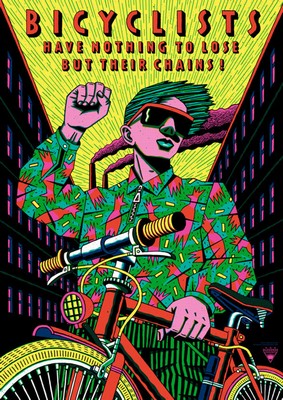
Les cyclistes n’ont rien à perdre que leurs chaînes !
Affiche en sérigraphie 4 couleurs en ton direct
Imprimée par Lézard Graphique, Brumath, France
Crédit photo : Centre de design de l'UQAM

Henning Wagenbreth
HENNING WAGENBRETH
The Mazookas
Pique-niques du dimanche
Illustrations de Henning Wagenbreth
Crédit photo : Centre de design de l'UQAM

Henning Wagenbreth
HENNING WAGENBRETH
L’usine Wagenbreth d’illustrations
Affiche en sérigraphie 5 couleurs en ton direct
Imprimée par Squadro, Bologna, Italie
Crédit photo : Centre de design de l'UQAM

Un OVNI s’est posé à Montréal, déversant sa cargaison d’objets graphiques inusités au Centre de design de l’UQAM. L’affichiste et illustrateur berlinois Henning Wagenbreth en est le commandant de bord. Son univers se compose de personnages de bandes dessinées qui assurent dans presque toutes les œuvres une présence humaine plus ou moins caricaturée, de robots, de fusées, de machines infernales, que l’on peut retrouver à travers diverses créations.

Ce designer graphique exerce ses talents tous azimuts : illustrations, affiches, livres, timbres, pochettes de disques, jeux, costumes et décors de théâtre, marionnettes. Son graphisme coloré, foisonnant et déconstruit se donne des airs naïfs, mais est parfaitement pensé et maîtrisé. Identifiable parmi tous, sa touche originale a fait la renommée internationale de son auteur.

Henning Wagenbreth
HENNING WAGENBRETH
Petit-déjeuner en plein air
Affiche en sérigraphie 4 couleurs en ton direct
Imprimée par Lézard Graphique, Brumath, France
Crédit photo : Centre de design de l'UQAM

Henning Wagenbreth
HENNING WAGENBRETH
Festival du film d’animation hollandais
Affiche en sérigraphie 4 couleurs en ton direct
Imprimée par Lézard Graphique, Brumath, France
Crédit photo : Centre de design de l'UQAM

Henning Wagenbreth
HENNING WAGENBRETH
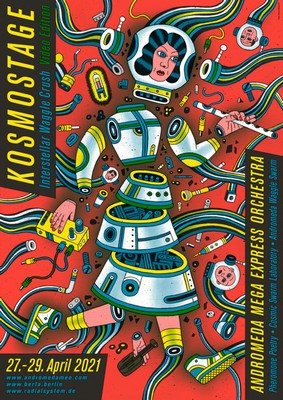
Kosmostage, 2021
Affiche en sérigraphie 4 couleurs en ton direct
Imprimée par Lézard Graphique, Brumath, France
Crédit photo : Centre de design de l'UQAM

Henning Wagenbreth
HENNING WAGENBRETH
Zones de transit
Livre édité par Kunstbibliothek Berlin, 120 illustrations
Crédit photo : Centre de design de l'UQAM

Élevé en Allemagne de l’Est, Henning Wagenbreth participe, jusqu’à la chute du mur de Berlin, à un certain activisme anti-régime. Depuis, son regard critique sur nos sociétés s’exerce à travers des images destinées à nous faire réfléchir. Son commentaire social ou politique s’accompagne le plus souvent d’une pointe d’humour, un peu sarcastique, d’une satire sensible. L’approche ludique du graphisme de Henning Wagenbreth lui permet de séduire le client pour ensuite, au second regard, l’amener à se questionner sur des sujets sérieux, voire sombres. L’idée finale n’est pas de plaire, mais de passer le message. « La lisibilité de mon idée est importante. J’attrape les gens avec une image intéressante et après ils regardent le reste », affirme-t-il avec un sourire en coin. Visiblement, pour Henning Wagenbreth, on peut rire de tout. Encore faut-il savoir comment.

Outre les très grandes affiches en sérigraphie, qui caractérisent l’œuvre de Wagenbreth, l’exposition rassemble des créations de formats différents, réalisées grâce à des techniques d’impression variées. Elle amène les visiteurs à découvrir le travail de Wagenbreth, jongleur d’idées et d’illustrations dont l’univers graphique évoque l’Art brut. Les illustrations sont constituées de morceaux découpés, sortes de puzzles géométriques auxquels s’ajoutent des typographies composites que Wagenbreth aime dessiner. Le tout s’agence dans une cacophonie visuelle pouvant rappeler les cadavres exquis des surréalistes. L’affichiste s’amuse et nous entraîne irrésistiblement dans son monde, un monde de poésie visuelle, d’enfants sensibles, parfois blessés par l’état de nos sociétés.

Henning Wagenbreth
HENNING WAGENBRETH
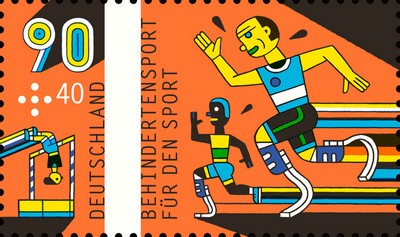
Handisport – Pour le sport
Timbres de la série annuelle sur le sport, créés par Henning Wagenbreth 
Crédit photo : Centre de design de l'UQAM 

Henning Wagenbreth
HENNING WAGENBRETH
Behindertensport – Für den Sport, 145, 2015
Timbres de la série annuelle sur le sport, créés par Henning Wagenbreth 
Crédit photo : Centre de design de l'UQAM 

Henning Wagenbreth
HENNING WAGENBRETH
Appels à l’aide – 36 courriels d’escroquerie provenant d’Afrique 
Livre édité par Gingko Press, 42 pages 
Crédit photo : Centre de design de l'UQAM 

HENNING WAGENBRETH est né en 1962 à Eberswalde, en Allemagne de l’Est, et a étudié à la Kunsthochschule Berlin-Weißensee de 1982 à 1987. Depuis, il œuvre principalement comme illustrateur. Il crée du graphisme et ses propres caractères de typographie, et inclut la connaissance des techniques artisanales et industrielles dans son processus de création. Il vit à Berlin, mais a aussi séjourné à Paris et à San Francisco. Il illustre et conçoit des graphismes de tous formats, du timbre à la bannière, des peintures uniques ou des impressions produites en série, livres, affiches, journaux et magazines. Parfois, il vagabonde vers l’animation et le théâtre. Avec le groupe The Mazookas, il combine discours visuel par projection et musique. Depuis 1994, il est professeur de communication visuelle à l’Universität der Künste Berlin. Il a reçu le prix du « plus beau livre au monde » de la Stiftung Buchkunst en 2000 et de nombreux autres pour ses affiches et ses livres. Wagenbreth a présenté plusieurs expositions à travers le monde et est membre de l’Alliance graphique internationale (AGI) depuis 2002.

Le commissaire de l'exposition, MARC H. CHOKO, est professeur émérite à l’École de design de l’Université du Québec à Montréal (UQAM), où il a enseigné de 1977 à 2018. Il a été directeur de recherche à l’Institut national de la recherche scientifique (INRS) Urbanisation, Culture et Société de 1985 à 2005 et directeur du Centre de design de l'UQAM de 1999 à 2008. Passionné par les affiches, il les collectionne depuis sa jeunesse. Depuis le début des années 1980, il a organisé des expositions, dont plusieurs à titre de commissaire, et a publié de nombreux ouvrages reconnus dans le domaine. De 2008 à 2018, il a été responsable du cours Design graphique et culture à l’École de design de l’UQAM. Marc H. Choko consacre dorénavant ses activités professionnelles à la publication de livres, à la production d’expositions et à des conférences sur le graphisme et sur l’affiche.

CENTRE DE DESIGN DE L’UQAM
1440 rue Sanguinet, Montréal, Québec H3X 3X9