Showing posts with label Bogosi Sekhukhuni. Show all posts

22/08/25

Infant: Banned Skills @ Whitney Online Gallery space for Internet and new media art - artport

INFANT: BANNED SKILLS
Whitney Museum of American Art, New York
2025 - artport - Online Gallery

Infant Artist Duo
INFANT
Still from BANNED SKILLS, 2025
© INFANT

The Whitney Museum of American Art launched BANNED SKILLS, a digital art project by artist duo INFANT, sidony o’neal and Bogosi Sekhukhuni, on artport, the Whitney’s online gallery space for Internet and new media art. Commissioned for artport, the work serves as the portal to engage with INFANT’s evolving conceptual framework, XENOFORMALISM. The artists designed BANNED SKILLS as an interactive entry point to explore new speculative understandings of formal systems like math, science, and design. The project reveals how seemingly contrasting ideas can align to generate new aesthetic or ideological orders.

BANNED SKILLS is a nonlinear aesthetic narrative that prompts viewers to consider various aspects of humanity and established understandings of objects or histories. Unfolding along two distinct paths, the work’s primary navigation tool utilizes the psychological phenomenon of the bouba-kiki effect. The phenomenon, first presented in the 1920s, reflects deliberate associations between speech sounds and visual shapes with the word bouba often associated with smooth, rounded shapes and kiki with sharp, angular ones. Within BANNED SKILLS, users begin their experience in a “NEST” where the kiki and bouba forms exist, selecting one of the two shapes to take them along different paths. Along these journeys, users interact with a range of artifacts from art, architecture, design, and sound to explore cultural representations through unexpected groupings, placing the objects in conversation with one another. Encounters with juxtapositions of cultural artifacts—from the Gameboy Advanced SP Tribal Edition to the necklace made from precisely designed whale bones—invite users to gain new perspectives and draw connections. In the top-left corner of the screen, an interactive virtual music device lets users toggle between the kiki- and bouba-coded soundscapes, further emphasizing the visual juxtapositions. After users explore both spaces, a final third environment will appear.
“BANNED SKILLS hopes to use participation as a way around the problem of ‘talking at’ the viewer, working with, not against, postures of engagement from the early 2000's gaming boom that feel familiar and nostalgic simultaneously,” said David Lisbon, Curatorial Assistant at the Whitney. “This is the first artport project that dives into this cross-section of the post digital and is a form of practice that garners attention because of its utility across levels of understanding. Considering the intersections of art and design have become a prominent narrative for emerging forms of contemporary engagement.”
The artists designed the virtual experience of BANNED SKILLS as a starting point for exploring their concept of XENOFORMALISM (XF). The prefix “XENO,” meaning strange or foreign in Greek, suggests an unfamiliar type of formalism. XF can be imagined as a category of filters to guide users in unpacking and connecting histories of visual aesthetics, sonic landscapes, and science. The work offers an aesthetic approach to new understandings of cultural representations, using histories of science fiction and digital culture—including gaming and computer graphics—as speculative introductions. The branching sequences INFANT has formed in BANNED SKILLS encourages viewers to reexamine how meaning is formed and reinforced within art, art history, design, science, and science fiction, and how these fields shape and contribute to collective cultural memory.

INFANT’s BANNED SKILLS was organized by David Lisbon, Curatorial Assistant at the Whitney Museum, and commissioned for artport, the Museum’s online gallery space for Internet and new media art commissions. artport is organized by Christiane Paul, Curator of Digital Art at the Whitney. 

ARTIST DUO INFANT

Sidony O’Neal (b. 1988) is a conceptual artist whose work and interdisciplinary research is informed by mathematics, architectural systems, and the histories of objects, from 15th Century locking mechanisms to plastic industrial pallets. Their works explore human relationships to objects, labor, and technology.

Their work has been featured in exhibitions at Et al., San Francisco, CA; Lewis Center for the Arts at Princeton University, Princeton, NJ; Dracula’s Revenge, New York, NY; Portland Institute for Contemporary Art, Portland, OR; Veronica, Seattle, WA; Third Born, Mexico City, Mexico; ICA at Maine College of Art and Design, Portland, ME; and Sculpture Center, Long Island City, NY. O’Neal has had residencies at MASS MoCA, North Adams, MA; and Banff Centre, Banff, AB, among others. Their performances have been featured at Kunstverein Düsseldorf, Volksbühne Berlin, and Performance Space New York. O'Neal is the recipient of awards and fellowships including the Oregon Arts Commission's Joan Shipley Award and a Hodder Fellowship from the Lewis Center for the Arts at Princeton University. In 2023, they were awarded a Hallie Ford Fellowship. O'Neal is co-founder of design firm INFANT.

Bogosi Sekhukhuni (b. 1991) is an artist and designer who reflects on cultures and histories of technology. Working across a range of media such as sculpture, video, set design, furniture design and performance, Sekhukhuni suggests ways to think about the mechanics of futurity.

Since 2012, Sekhukhuni’s work has been featured in both solo and group exhibitions, including Role Play, Fondazione Prada, Milan; Age of You, Jameel Arts Centre, Dubai; Art in the Age of Anxiety, Sharjah Art Foundation, Sharjah; The Art Happens Here: Net Art’s Archival Poetics, New Museum, New York; Bogosi Sekhukhuni, Foxy Production, New York; Rencontres de Bamako, African Biennale of Photography, Mali; and Simunye Summit 2010, Stevenson Gallery, Johannesburg. They have been awarded the Prix Net Art Award, Rhizome, New York (2017). Sekhukhuni is a founding member of the artist group NTU and has worked closely with CUSS Group. Sekhukhuni is co-founder of the design firm INFANT.

ABOUT ARTPORT

artport is the Whitney Museum’s portal to Internet art and an online gallery space for net art and new media art commissions. Launched in 2001, artport provides access to original commissioned artworks, documentation of net art and new media art exhibitions at the Whitney, and new media art in the Museum’s collection. Recent commissions include Ashley Zelinkskie’s Twin Quasar (2024); Maya Man’s A Realistic Day In My Life In New York City (2024); Holly Herndon and Mat Dryhurst’s xhairymutantx (2024); Nancy Baker Cahill’s CENTO (2024); Peter Burr’s Sunshine Monument (2023); Rick Silva’s Liquid Crystal (2023); Auriea Harvey’s SITE1 (2023); Amelia Winger-Bearskin’s Sky/World Death/World (2022); Mimi Ọnụọha’s 40% of Food in the US is Wasted (How the Hell is That Progress, Man?) (2022); and Rachel Rossin’s THE MAW OF (2022). Access these and more projects at whitney.org/artport.

Whitney Museum of American Art, New York City

07/02/22

Meriem Bennani, Juno Calypso, Cao Fei, Mary Reid Kelley, Patrick Kelley, Beatrice Marchi, Darius Mikšys, Narcissister, Haruka Sakaguchi, Griselda San Martin, Tomoko Sawada, Bogosi Sekhukhuni, Amalia Ulman @ Osservatorio, Fondazione Prada, Milan - Role Play - Curated by Melissa Harris

Role Play
Meriem Bennani, Juno Calypso, Cao Fei, Mary Reid Kelley and Patrick Kelley, Beatrice Marchi, Darius Mikšys, Narcissister, Haruka Sakaguchi & Griselda San Martin, Tomoko Sawada, Bogosi Sekhukhuni, Amalia Ulman
Curated by Melissa Harris
Osservatorio, Fondazione Prada, Milan
19 February - 27 June 2022

Juno Calypso
Juno Calypso
Die Now, Pay Later, 2018
Courtesy of the artist and TJ Boulting

Amalia Ulman
Amalia Ulman
Excellences and Perfections, 2014
Courtesy of the artist and Deborah Schamoni

Fondazione Prada presents “Role Play”, an exhibition curated by Melissa Harris, at the Osservatorio in Milan.

Comprising a selection of photographic, video and performing works by 11 international image-based artists, this project explores the notions of the search, projection and invention of possible alternative identities, hovering between authentic, idealized, and universal selves. Playing with gender tropes, stereotypes, sense of place, and future perspectives, the artists who make up “Role Play” interrogate individuality as we know it and as it might be. Roleplaying, creating alter-egos, and proliferation of selves are possible strategies for understanding each individual’s essence and persona.

As underlined by Melissa Harris: 
“Since the early twentieth century, projects engaging roleplay have further contemplated identity, liberating artists to gender-bend and time-travel and envision their selves in myriad ways, in turn reflecting on their very is-ness—even when that is in flux. An alter ego, persona, or avatar may be aspirational; it may relate to one’s personal and cultural history and sense of otherness; it may be a form of activism, or a means of maneuvering through entrenched, even polarized positions, toward empathy: putting oneself in another’s shoes.”
Since its invention, one of the most suitable visual languages to investigate otherness is undoubtedly photography. Through different genres —portrait, self-portrait, reportage— and alternative approaches —from narrative to conceptual research— photography is the ideal medium for self-reflection, given its objective nature and thus its perceived authenticity. The evolution of photography, its transformation in filmic languages, the widespread diffusion of online social communities and virtual platforms, the future developments of the Metaverse and the subsequent emergence of digital avatars have intensified the urgency to explore self and others through role-playing, reinforcing our obsession with alternative selves.

“Role Play” features works by artists Meriem Bennani, Juno Calypso, Cao Fei, Mary Reid Kelley and Patrick Kelley, Beatrice Marchi, Darius Mikšys, Narcissister, Haruka Sakaguchi & Griselda San Martin, Tomoko Sawada, Bogosi Sekhukhuni, and Amalia Ulman in a light installation project, conceived by the creative agency Random Studio for the two exhibition floors of Osservatorio.

Meriem Bennani
Meriem Bennani
Guided Tour of a Spill (CAPS Interlude), 2021
Video still
Courtesy of the artist and François Ghebaly Gallery

Meriem Bennani

Meriem Bennani
Guided Tour of a Spill (CAPS Interlude), 2021
Video still
Courtesy of the artist and François Ghebaly Gallery

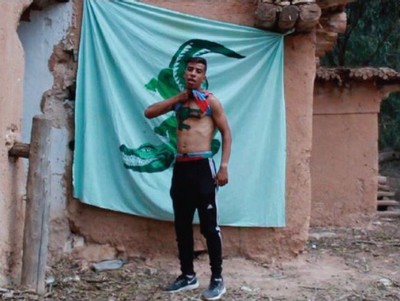
The video by Meriem Bennani (b. 1988, Rabat, Morocco), Guided Tour of a Spill (CAPS Interlude) (2021), is defined by the artist as “a speculative documentary set in the future where every member of the cast (most of them being family members) play themselves, but have to role-play as if they were in the future and on an island called the CAPS”. This work is a mashup of amateur videos from Moroccan and Middle Eastern online channels combined with Getty footage and heterogeneous materials from her audiovisual archive. It is part of her extended project Life on the CAPS, focused on a fictional island in the middle of the Atlantic that becomes a place of diasporic culture and resistance.

Juno Calypso
Juno Calypso
A Clone of Your Own, 2017
Courtesy of the artist and TJ Boulting

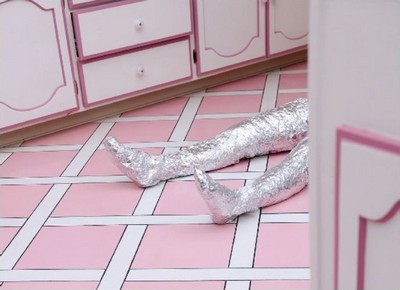
Juno Calypso (b. 1989, London, UK) with her photographic series What To Do With a Million Years? (2018) documents a mansion entirely decorated with pink elements and built underneath Las Vegas in the 70s to shelter in case of a nuclear attack. The house is a simulated environment currently owned by a mysterious group attempting to achieve immortality and eternal youth.

Cao Fei
Cao Fei
Cosplayers, 2004
Courtesy of the artist, Vitamin Creative Space and Sprüth Magers

Cao Fei
Cao Fei
Cosplayers, 2004
Courtesy of the artist, Vitamin Creative Space and Sprüth Magers

The figure of the cosplayer (a young individual dressed as a game character) is at the centre of the video of the same name made in 2004 by Cao Fei (b. 1978, Guangzhou, China). This cinematic work is an experiment that employs a surrealistic plot to give its protagonists the ability to traverse the city at will and to engage in combat within their imaginary world. They expect their costumes will grant them true magical power, enabling the wearer to transcend reality and put themselves above all worldly and mundane concerns.

Mary Reid Kelley and Patrick Kelley
Rape of Europa, 2021
Video still
Courtesy the artists

Mary Reid Kelley and Patrick Kelley
Rape of Europa, 2021
Video still
Courtesy the artists

Mary Reid Kelley (b. 1979, Greenville, South Carolina, US) and Patrick Kelley (b. 1969, Minneapolis, Minnesota, US) evoke through their video The Rape of Europa (2021) two parallel worlds —mythological (Europa’s, as suggested by Titian in 1562 and inspired by Ovid’s Metamorphoses) and historical— while addressing the subjugation and exploitation of women in the process. Never heavy-handed, their humor and poetics also consider some of the contradictions of white feminism.

Beatrice Marchi
Beatrice Marchi
When Katie Fox met the Evil Turtle, 2021-22
Video still
Courtesy the artist and SANDY BROWN, Berlin

Beatrice Marchi
Beatrice Marchi
When Katie Fox met the Evil Turtle, 2021-22
Video still
Courtesy the artist and SANDY BROWN, Berlin

Beatrice Marchi (b. 1986, Gallarate, Italy) presents her new project Immaturity, maturity and Christmas (2021-22), consisting of a video and a performance focused on one of her alteregos, Katie. The ambiguous characters invented and interpreted by the artist address existential and social issues while ironically challenging traditions and gender stereotypes. As explained by the artist, “Katie would like to be a coherent person. She would never want to change in body or mind; she would not want to fit in with the adult world; she would want to stay young and behave throughout her life as she did during her adolescence: as a mean girl.”

Darius Mikšys
Darius Mikšys
A Piece of Peace, 2006
Courtesy ERMES ERMES

Darius Mikšys
Darius Mikšys
A Piece of Peace, 2006
Courtesy ERMES ERMES

The photographic series by Darius Mikšys (b. 1969, Kaunas, Lithuania) titled A Piece for A Peace (2006) results from an online game performance in which the artist attempted to raise his leadership by offering players to do a group photo session.

Narcissister
Narcissister
Breast Work, 2019
Video still
Courtesy of the artist

Narcissister
Narcissister
Organ Player, film still, 2018
Courtesy of the artist

Artist and performer Narcissister (US) works at the intersection of contemporary dance, visual art, and activism. “Role Play” includes her most recent video, Breast Work (2020), the trailer to her autobiographical film, Narcissister Organ Player (2018) and, as well as a selection of her masks. Narcissister Organ Player premiered at Sundance Film Festival and the Locarno International Film Festival and is a hybrid performance/documentary work. It explores how ancestral and familiar data is stored in our bodies, impacting the lives we lead. Breast Work is an activist short film investigating how prohibitions on female toplessness are grounded in fear of and desire to control the female body.

Haruna Sakaguchi and Griselda San Martin
Typecast Project, 2019
Courtesy of the artists

Haruna Sakaguchi and Griselda San Martin
Typecast Project, 2019
Courtesy of the artists

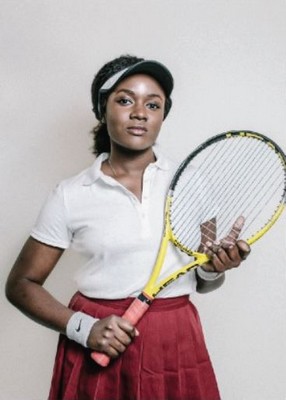
Typecast (2019) is a satirical portrait series by documentary photographers Haruka Sakaguchi (b. 1973, Osaka, Japan) and Griselda San Martin (b. 1978, Barcelona, Spain), addressing the lack of diversity in the US entertainment and film industry. While ethnic minorities constitute nearly half of the US population, only 14% of leading roles have been played by people of colour. To highlight this reality and reflect on racial bias perpetuated by media representation, they photographed actors embodying the typecast roles offered frequently and parts they aspire to play.

Tomoko Sawada
Tomoko Sawada
OMIAI♡, 2001
Credits of the artist
Courtesy ROSE GALLERY

Tomoko Sawada
Tomoko Sawada
OMIAI♡, 2001
Credits of the artist
Courtesy ROSE GALLERY

For her photographic series, OMIAI♡ (2001), Tomoko Sawada (b. 1977, Kobe, Japan) transformed herself —through the aid of costumes, wigs, make-up, and weight gain— into thirty different characters. These portraits mimic photographs traditionally produced as part of the Japanese custom of omiai, or the first meeting of couples whose marriages are being arranged, during which families exchange pictures of their children in the hope of finding a suitable partner for them.

Bogosi Sekhukhuni
Bogosi Sekhukhuni
Consciousness Engine 2: absentblackfatherbot, 2014
Bogosi bot Avatar still
Courtesy of the artist

Bogosi Sekhukhuni
Bogosi Sekhukhuni
Consciousness Engine 2: absentblackfatherbot, 2014
Dual-channel video installation
Credits: Foxy Production

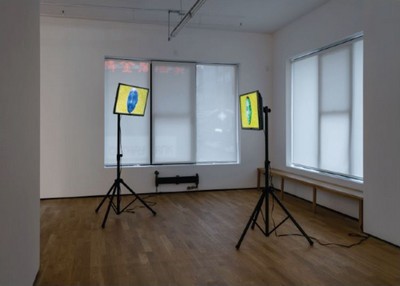
Consciousness Engine 2: absentblackfatherbot (2013) by Bogosi Sekhukhuni (b. 1991, Johannesburg, South Africa) is a two-screen video installation that simulates the artist’s relationship with his estranged father as part of his ongoing investigation into human consciousness in an age of digital networks. The avatars of the two speakers, two disembodied heads, animated in 3D, bring to life with robotic voices an intense conversation drawn from Facebook chats that took place when the artist was eighteen years old.

Amalia Ulman
Amalia Ulman
Excellences and Perfections, 2014
Courtesy of the artist and Deborah Schamoni

Amalia Ulman (b. 1989 Buenos Aires, Argentina) described Excellences and Perfections (2014) as “a 5 month online durational performance, constructed from images, videos, captions and comments. Instagram here served as a stage for me to exist as a character, to role-play.” This scripted online work investigated the aestheticization of everyday life in social media through the careful use of sets, props, and communication strategies. The project was only announced as an artistic performance afterwards, further blurring the boundaries between the authentic and the artificial, reality and its stereotypical representation.

“Role Play” will generate its own “alter-ego” at Prada Aoyama Tokyo in the form of another show including works by Juno Calypso, Beatrice Marchi, Haruka Sakaguchi and Griselda San Martin, Tomoko Sawada, and Bogosi Sekhukhuni. Prada will present this second exhibition in Tokyo from 11 March to 20 June 2022 with the support of Fondazione Prada.

The project is accompanied by an illustrated publication in the Quaderni series, published by Fondazione Prada, including an imagined text by Rrose Sélavy (Melissa Harris) and visual and written contributions by all the artists involved in “Role Play.”

Melissa Harris is editor-at-large of Aperture Foundation, where she has worked for more than twenty-five years, including as editor-in-chief of Aperture magazine from 2002 to 2012; under her leadership, the magazine received many honors, including ASME’s National Magazine Award for General Excellence. Melissa Harris has also edited more than forty books for Aperture. As a curator, Harris has curated photography exhibitions for Osservatorio Fondazione Prada (“Surrogati”, 2019), Aperture, the Philadelphia Museum of Art; the Lumière Brothers Center for Photography, Moscow; the Peggy Guggenheim Collection, Venice; Villa Pignatelli, Naples; and Visa pour l’Image, Perpignan, among other venues. Melissa Harris teaches at New York University in the Tisch School of the Arts, Department of Photography & Imaging / Emerging Media, and occasionally at Yale University. She served on New York City’s Community Board 5 for several years, and is a trustee of the John Cage Trust. A Wild Life, her biography on the photographer Michael Nichols, was published by Aperture in Summer 2017. She is currently working on a biography of Josef Koudelka, to be published by Aperture in 2023 (with French and Czech coeditions planned as well).

OSSERVATORIO FONDAZION PRADA
Galleria Vittorio Emanuele II, 20121 Milano