Showing posts with label Arab. Show all posts

19/04/24

Artist Akram Zaatari @ Thomas Dane Gallery, Naples - "Father and Son" Exhibition

Akram Zaatari: Father and Son
Thomas Dane Gallery, Naples
23 April - 13 July 2024

Thomas Dane Gallery presents Father and Son, a solo exhibition of Akram Zaatari. The exhibition is  Akram Zaatari’s third with the gallery and the artist’s first major solo exhibition in Italy.      

Akram Zaatari (b. 1966, Saida) has played a critical role in developing the formal, intellectual and institutional infrastructure of Beirut's contemporary art scene. He has produced more than fifty films and videos, a dozen books and countless installations of photographic material, all sharing an interest in writing histories and the search for records and objects, keeping track of their changing hands, the retrieval of narratives and missing links that have been hidden, misplaced, lost, found, buried or excavated. The act of digging itself has become emblematic of his practice while acting to restore connections lost over time, or due to war and displacement. Akram Zaatari has dedicated a large volume of his work to the research and study of photographic practices in the Arab world and has made uncompromising contributions to the wider discourse on preservation and archival practice.

Rooted in this research practice, Akram Zaatari’s exhibition in Naples retraces the element of restitution in the artist’s work, expressed mainly through text, documents and photographs that revisit descriptions and recreate objects or ties that once existed but are now lost. The exhibition features works across many media from the last two decades, beginning with his two-hour-long video, Ain el Mir (2002), in which the artist looks for a buried letter that never reached its destination. It spans through to Akram Zaatari’s most recent body of work, Father and Son (2024), in which the sarcophagi of two Phoenician Kings (father and son), separated since antiquity, are reunited. The project is accompanied by a series of new works on paper that look at the Mediterranean as a locus of exchange, extraction and movement across millennia.

Amongst these works Archeology (2017), Photographic Currency (2019) and Venus of Beirut, (2022), and a new work, Ibrahim and the Cat, For Inji Efflatoun (2024), all engage in the process of recreating objects that have either vanished or were never produced. The brass relief Ibrahim and the Cat – made with artisans in Naples – gives new form to a forgotten photograph taken by the father of Egyptian artist Inji Efflatoun for the purpose of making a painting that was never produced.

Akram Zaatari’s idea of ‘giving life to things that do not exist in the present’ also applies to the recreation of a stone monolith used to seal King Tabnit’s tomb, which was completely destroyed when his sarcophagus was extracted in 1887.  All that Refuses to Vanish (2022) was made from drawings and notes left by Ottoman statesman and painter Osman Hamdi during his excavation of the Sidon Necropolis.

Akram Zaatari lives and works in Beirut, Lebanon. Recent exhibitions include: Against Photography. An Annotated History of the Arab Image Foundation, Sharjah Art Foundation, Sharjah, UAE (2019); The Script, New Art Exchange, Nottingham, England (2018); The Fold, Contemporary Arts Center, Cincinnati OH (2018); Letter to a Refusing Pilot, Moderna Museet, Malmö, Sweden (2018); Against Photography. An Annotated History of the Arab Image Foundation, MACBA, Barcelona, Spain (2017); travelling to: K21, Düsseldorf, Germany (2018); Museum of Modern and Contemporary Art, Seoul, Korea (2018); Double Take: Akram Zaatari and the Arab Image Foundation, National Portrait Gallery, London, England (2017); This Day at Ten, Kunsthaus Zürich, Zürich, Switzerland (2016); Unfolding, Moderna Museet, Stockholm, Sweden (2015); Akram Zaatari: The End of Time, The Power Plant, Toronto, Canada (2014); Lebanese Pavilion at the 55th Venice Biennale, Venice, Italy (2013); Projects 100: Akram Zaatari, Museum of Modern Art, New York NY, (2013); This Day at Ten / Aujourd’hui à 10, Magasin Centre National d’Art Contemporain de Grenoble, France (2013); Tomorrow Everything Will be Alright, MIT List Visual Arts Center, Cambridge MA (2012); The Uneasy Subject, MUAC, Mexico City, Mexico (2012); Museo de Arte Contemporáneo de Castilla y León, León, Spain (2011). 

Additionally, Akram Zaatari’s work has been part of Sharjah Biennial 14, Sharjah, UAE (2018); the 12th Istanbul Biennial, Istanbul, Turkey (2011); The Yokohama Triennale, Yokohama, Japan (2014); the 55th and 52nd Venice Biennale, Venice, Italy (2013 and 2007); dOCUMENTA (13), Kassel, Germany (2012); 27th São Paulo Biennial, São Paulo, Brazil (2006); the 6th Gwangju Biennale, Gwangju, South Korea (2006); and the 15th Biennale of Sydney, Sydney, Australia (2006). 

Akram Zaatari’s work is included in the collections of Centre Pompidou, Paris, France; Louis Vuitton, Paris, France; Bristol Museum & Art Gallery, Bristol, England; Tate Modern, London, England; MCA Chicago, Chicago IL; Guggenheim Museum, New York NY; Museum of Modern Art, New York NY; Hammer Museum, Los Angeles CA and Walker Art Center, Minneapolis MN.

The Father and Son project is also the artist’s doctoral project in Arts at ENSAPC and the Cy University, France, under the direction of François Pernot, Alejandra Riera and Bénédicte Savoy.

THOMAS DANE GALLERY
Via Francesco Crispi 69, 80122 Naples

26/12/23

Mathaf: Arab Museum of Modern Art, Doha, Qatar - Text + Photographs

Mathaf: Arab Museum of Modern Art, Doha, Qatar

Mathaf: Arab Museum of Modern Art
Buidlding Exterior
Architect: Jean-François Bodin
Photo Courtesy of Qatar Museums

Mathaf: Arab Museum of Modern Art
Buidlding Exterior
Architect: Jean-François Bodin
Photo Courtesy of Qatar Museums

Mathaf: Arab Museum of Modern Art
Buidlding Exterior
Architect: Jean-François Bodin
Photo Courtesy of Qatar Museums

The Museum offers a welcoming, vibrant environment that invites evolving discussions about modern art in the region and beyond. Home to a permanent collection that offers a distinctively unique comprehensive overview of modern and contemporary art from North Africa and the Middle East, Mathaf ("museum" in Arabic) also performs a vital role as a centre for dialogue and scholarship and a resource for fostering creativity. 

Mathaf was opened in 2010 by Qatar Museums in partnership with Qatar Foundation (QF) and is located in Education City. It is located in a former school building in Qatar Foundation’s Education City, which was transformed by French architect Jean-François Bodin. The Museum was founded by H.E. Sheikh Hassan bin Mohammed bin Ali Al Thani, who began collecting in the 1980s with the acquisition of works by Qatari artists. 

Mathaf: Arab Museum of Modern Art
Buidlding Interior
Photo Courtesy of Qatar Museums

Mathaf: Arab Museum of Modern Art
Buidlding Interior
Photo Courtesy of Qatar Museums

Mathaf: Arab Museum of Modern Art
Buidlding Interior
Photo Courtesy of Qatar Museums

Mathaf: Arab Museum of Modern Art
Buidlding Interior
Photo Courtesy of Qatar Museums

Sheikh Hassan later broadened his focus to include works by 20th-century artists throughout the Middle East, North Africa, and the Arab Diaspora and objects that inspired many Arab modern artists, such as pre-Islamic works from ancient Mesopotamia and Egypt. An initial group of works assembled by Sheikh Hassan was donated to the public institution. 

Over the past decade, Mathaf has hugely contributed to research and debate around modern art contemporary art, made available to scholars and audiences through the Mathaf Encyclopedia of Modern Art and the Arab World. The Museum made itself a meeting point for scholars from across the region around education programmes, conferences, and publications. It has served as a dynamic platform for artists by facilitating the creation and exploration of contemporary works.

Mathaf presents a world-class temporary exhibition programme each year, featuring internationally acclaimed modern and contemporary artists whose work plays an important role in opening conversations on the social and political shifts in the history and contemporary life of the Arab world, investigating the way societies are structured, and interrogating the role art plays in our local and regional contexts. Since opening in 2010, the museum has held solo exhibitions of artists including Adel Abdessemed, Etel Adnan, El Anatsui, Dia Al-Azzawi, Yto Barrada, Cai Guo-Qiang, Huguette Caland, Mona Hatoum, M F Husain, Fateh al-Moudarres, Shirin Neshat, Raqs Media Collective, and Wael Shawky. 

Abdellah Karroum
Abdellah Karroum
Photo Courtesy of Qatar Museums

Abdellah Karroum was the director of Mathaf from june 2013 through 2021.

Zeina Arida
Zeina Arida
Photo Courtesy of Qatar Museums

Zeina Arida is the director of Mathaf: Arab Museum of Modern Art. An expert in the arts, culture and heritage of the Arab world with a focus on photography, archives and modern and contemporary art, Zeina Arida reopened the Sursock Museum in Beirut after a ten-year renovation and expansion project, initiating local and international partnerships, presenting exhibitions, public programmes, and library and archives programmes, turning the museum into a local and international landmark. After the museum was damaged by the Beirut blast in 2020, she raised more than $2.5 million for the reconstruction of the building and the restoration of the artworks. From 1997 to 2014, Zeina Arida was the director of the Arab Image Foundation (AIF), where she co-initiated Middle East Photograph Preservation Initiative (MEPPI), a strategic multi-year programme designed to raise awareness of the importance of preserving the region’s photographic heritage. 

MATHAF: ARAB MUSEUM OF MODERN ART
Education City, Doha, Qatar

06/03/22

Mohamed Al Mazrouei @ Aisha Alabbar Gallery, Dubai - NO

Mohamed Al Mazrouei | NO
Aisha Alabbar Gallery, Dubai
2 March – 29 May 2022

Aisha Alabbar Gallery presents NO, a solo exhibition by prominent Emirati artist and poet MOHAMED AL MAZROUEI. Comprised new and existing works that date back to the 1980s, NO becomes a gesture to follow a thread in his practice and shows his interest in language’s dynamism.

The concept behind Mohamed Al Mazrouei’s first exhibition at Aisha Alabbar gallery comes from a textile remnant found along the street in Cairo. The artist noticed how this fragment with the English word “NO” reflected his current intention and orientation, feeling alienated, not geographically, but as a personal feeling of estrangement or expression of nostalgia.

Having spent the first part of his life in Egypt before moving to the UAE nearly four decades ago, Al Mazrouei’s work is perhaps best described as autobiographical. The works in the exhibition play on memory by taking moments from childhood and indirectly to speak to how our understanding of language is shaped during this time. When concepts are cemented, the image fades. Influenced by the exploration of identity and inspired by African masks, his work draws on sources from around the world. One cannot look at his female figures without recalling the portraits created by Schiele or Basquiat, nor Mahmoud Said’s seductive canvases, which feature exaggerated colours and forms, ‘adopted’ by the Egyptian surrealist movement in the early 1940s.

Known for bold expressions, especially in his paintings of figures, portraits and visual experiments, Mohamed Al Mazrouei uses colour independently, free from restrictions or rules. He is often labelled a ‘neo-expressionist’, although his practice cannot be classified into a one-dimensional category. Strong lines and dark eyes delineate his figures. The faces and bodies are intentionally distorted to emphasise desire, petulance, and rage, at times in a provocative and horrifying manner. In Untitled 64 (1998), Al Mazrouei applies vibrant colours juxtaposed with black lines on a colour block background. He balances primitive instincts with mastered awareness to create his unique visual language. Or in Untitled 4 (2013) and Untitled 10 (2012), the faces lack distinct features, and are suggestive of the fading memory of his youth.

Portraiture also comprises a large part of his practice. Whether in paintings or in works on paper, he continually reinterprets a subject using the technique of mixed abstraction figuration. Although created 13 years apart, Untitled 120 (2007) and Untitled 123 (1994) show variations in the use of eccentric gestures and facial expressions, through which Mohamed Al Mazrouei conveys urgency by relentlessly interrogating the body and suggests self-reflection in blending corporeality and sensuality that poses existential questions.

Mohamed Al Mazrouei’s “NO” finds recurrence essential: elements are determinedly repeated within the same piece, a subject is repeated in several pieces, or a theme is repeated through psychological manifestation. The artist develops a unique visual language through repetition, where elements are experienced as pure forms, balanced between primitive instincts and learned awareness.

MOHAMED AL MAZROUEI (Tanta, 1962) is an Emirati artist, poet, and writer. He studied ancient languages at the Faculty of Languages and Translation at Al Azhar University in Cairo. He moved to Abu Dhabi in the early Eighty’s to eventually become instrumental to the Cultural Foundation and establish himself as a prominent artist, writer, photographer as well as manager of the Emirates Writer’s Union. He has written and published nine books of short stories and poems. His art practice – mainly painting in a signature Neo-Expressionist style – allows viewers to enter the world of his vast imagination. His artworks are rich with figurative iconography and include many humanoid forms. Mohamed Al Mazrouei’s paintings depict a feeling of fervour and urgency that invites the viewer to follow every brushstroke. The human face and figure are often his preferred subjects to paint. However, with a rich, non-linear training, Mazrouei’s approach to the abstract incorporates black and white in absolute purity. Like letters or musical notes, lines and colours fuse to create a composition that strives for a sense of equilibrium. His delineation of a particular object challenges traditional shapes, begging the eye to decipher elements of his compositions. In the past four decades spanning his career, Mohamed Al Mazrouei held several solo exhibitions in the UAE and abroad, including Raw Cooked (2017), AB43 Contemporary, Zurich, Switzerland; Prototype (2016), Mojo Gallery, Dubai, UAE; Maidens of Fair (2012), Abu Dhabi Theatre, Abu Dhabi, UAE; and The Smell (1990), Cultural Foundation, Abu Dhabi, UAE. Additionally, he participated in several important exhibitions, including Portrait of a Nation I and II (2022 and 2017), Manarat Al Saadiyat, Abu Dhabi, UAE; Artists and the Cultural Foundation: The Early Years (2018), Cultural Foundation, Abu Dhabi, UAE; (Alibadah): Hashel Al Lakmi and Mohamed Al Mazrouei (2018), NYUAD Art Gallery – Project Space, Abu Dhabi, UAE; Noah’s Ark: the 34th Emirates Fine Art Society’s Annual Exhibition(2016), Sharjah Art Museum, Sharjah, UAE; There Are Too Many Walls but Not Enough Bridges (2015), Kunstzeughaus, Rapperswil/Zurich, Switzerland; Sky Over the East (2014), Emirates Palace, Abu Dhabi, UAE; 3 rd Emirati Expressions: Realised (2013), Manarat Al Saadiyat, Abu Dhabi, UAE; MinD/Body: Body Art and Performance in the Gulf (2013), Ductac’s Gallery of Light, Dubai, UAE; the 3rd Al Kharafi Biennial (2010), Kuwait City, Kuwait; and the 1st Sharjah Biennial (1993), Sharjah, UAE. Mohamed is the recipient of many prestigious awards, including the Jury Prize (2012) at the 30th Emirates Fine Arts Society Exhibition, Sharjah, UAE and the 1st Award in Photography from Cultural Foundation, Abu Dhabi, UAE. Furthermore, his works can be found in prominent public and private collections in the UAE, such as ADMAF, Cultural Foundation, and UAE Ministry of Foreign Affairs in Abu Dhabi; Barjeel Art Foundation in Sharjah; and the Qatari Ministry of Culture in Doha; in addition to several private collections around the world.

AISHA ALABBAR GALLERY
S1 Mag Warehouse 101, Al Quoz 2, Dubai
_______________


05/01/22

Muatasim Alkubaisy @ Ayyam Gallery, Dubai - (t)irony

Muatasim Alkubaisy: (t)irony
Ayyam Gallery, Dubai
12 January - 1 March 2022

Muatasim Alkubaisy
MUATASIM ALKUBAISY
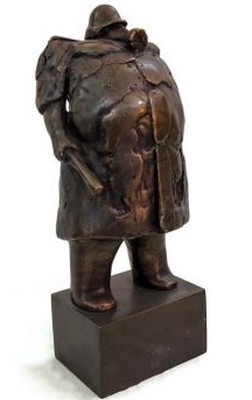
Democracy, 2019 
Bronze sculpture 
Edition of 8, 30 x 10 x 13 cm
© Muatasim Alkubaisy, courtesy of Ayyam Gallery

Ayyam Gallery presents (t)irony the first solo exhibition featuring Sharjah-based Iraqi sculptor Muatasim Alkubaisy’s work. 

(t)irony features Muatasim Alkubaisy’s largest body of work yet, composed of a selection of figures, portraying those that have been ruined by power. These non-deserving and corrupt characters utilize their positions to suffocate and belittle the common man. The artist transforms misery and discrimination into sophisticated and intricate characters through a delicate yet deliberate touch. He magnifies and exaggerates traits creating caricatural portraits, presenting a sarcastic consciousness, and exposing the arrogance of their behaviors and practices.
 
The figures are merely cartoon characters with puffed bellies and swollen jugular veins. Concealed by dress, their physical deformities, malignancy, and evil schemes still show through the bronze’s smooth surfaces. The intimidation, evil, and terror are deprecated into mockery, becoming objects.
 
The characters are situated in different environments, positioned with different stances, alone or in groups. Some read a paper or are on the toilet, trivializing and making them more humane, more attainable. Embedded, are tokens of symbolism, the rats representing vermin qualities such as filth, cruelty, and disease.

MUATASIM ALKUBAISY
 
For over two decades now, Muatasim Alkubaisy has shaped his career as a sculptor highlighting the serious and drastic changes taking place in post 2003 Iraq. In search for answers and pure expression, the artist freed himself from traditional forms and imitation, creating series of bodies encompassing his beliefs and identity. In his relentless quest to stand up against tyranny, slaughter, and diversity of degeneration, while staying true to his skill, tools, and training, the artist created ‘The Generals’ series. 
 
Muatasim Alkubaisy was born in Iraq, where he graduated from the Fine Art Academy in 1992. The artist now resides and works in Sharjah, the UAE. Furthering his career and savoir-faire, the artist is part of the University of Sharjah’s fine art faculty. His works are housed in private and public collections across the UAE and have been exhibited widely in Baghdad, Dubai, Abu Dhabi, and Paris.  
 
As a member of the Iraqi Fine Artists Association, he gained the first Young Artists Award in Baghdad in 2005. Among his key achievements are the gold-plated ceramic mural memorializing the late H.H. Sheikh Zayed bin Sultan Al Nahyan in Al Ain Museum.
 
Muatasim Alkubaisy’s solo exhibition include Agial gallery, Beirut (2019); Al Owais culture foundation, Dubai (2017); Etihad Modern Art Gallery, Abu Dhabi (2015); Abu Dhabi Cultural Foundation (2009); XVA-Gallery, Dubai (2008); and M-Gallery, Paris (2004). Selected group exhibitions include Barjeel Foundation (2020); Mono Gallery, KSA (2019); Al Owais Foundation (2019); and Sikka Art Fair (2016). A selection of Al-Kubaisy’s group exhibition include Abu Dhabi Art fair (2021, 2020, 2019); Mono Gallery, KSA (2019); DEN gallery, Kuwait (2019); Miso Art Fair, KSA (2019); Sikka Art Fair, KSA (2016).

AYYAM GALLERY
B11, Alserkal Avenue, Street 8, Al Quoz 1, Dubai

19/12/21

Samia Halaby @ Ayyam Gallery, Dubai - Flurrying

Samia Halaby: Flurrying
Ayyam Gallery, Dubai
Through 5 January 2022

Samia Halaby
SAMIA HALABY
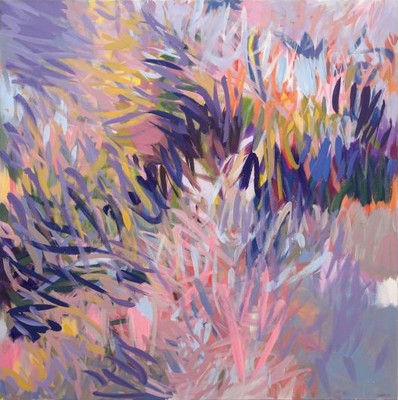
Written with a brush, 2019
Acrylic on Canvas, 152 x 152 cm
© Samia Halaby, courtesy Ayyam Gallery

Samia Halaby’s most recent works reflect everything but stillness, each canvas emulating space encompasses energy and movement, brimming intuitive complexity. Samia Halaby invites us to see nature and urban scenes through her vision, immortalizing a dynamic setting through brush strokes and color, creating infinite layers of moving parts. 

Continuing her previous explorations towards abstraction, Samia Halaby progressively removes all shapes and boundaries and focuses on motion and space only. While still introducing and studying the component of depth, distance, and location, the artist creates fore and backgrounds in which the stokes interpenetrate, creating a timeline of echoes and variations. 

This exhibition highlights both the more geometrical and more calligraphic approach, making a contrasting evolution. The product nonetheless aims to portray space and time and all that lies in between. Thus always creating an invisible set of relationships that our eyes measure and our minds comprehend intuitively. 
SAMIA HALABY: Artist Statement

The Sufi thinker Aby Hamed Muhammad al-Ghazali (1058-1111) noted that the seeing of the eye is limited by some failures while the mind is above these failures. As I think of space and air in painting, I am reminded of his words. Slowly, as I intuitively work on my paintings, my consciousness converts intuition into insights. I think of space in our educated visual perception and realize that, to us painters, space is measured as a distance between us and the concrete object we see through that space in the direction of our gaze. Within that space that we gaze at are things that move in the air. Their motion captures our gaze while our memory captures their path.

The set of new paintings has been in my studio, in the making for over a year. The paintings capture and trace everything that moves in the air, disturbing its relative stasis or affecting its motion. A few days ago, I could watch large snowflakes flurrying here and there up and down Franklin St. being pushed about and swirled by the air currents of the avenue and wind in the air. The odd partners, Al Ghazali and flurrying snowflakes, concretized for me what I have been painting during the past year.

I think of the canvas as space between me and the target of my gaze while my brush marks are activated by energy that puts them in motion. I want to remove all shapes with static boundaries and have only motion. I want eddying, fluctuating, flurrying, patterns of things being blown by the wind obtaining varying speed, adapting with cross currents. I want the energy that scatters, the paths made by all the parts that move to live in a canvas. Growth, gestation, decay, birth, and things I do not yet know make up the ambitious content of my work.  

I want no borders or boundaries. Shapes should be factored by things that constantly move and fluctuate in motion, always reacting to changing situations, turning into variations, not repetitions. Some moving parts lose energy and congeal together, creating islands of rest; such islands might be scattered by the entry of high energy motion in their midst. All shapes need to be born of the motion of things. 

We live in space and see all things moving in it. Space, air, water, and our bodies all are made of moving parts. I think of the canvas as space, and my brush-marks are activated by energy that puts them in motion. The final static, unmoving single image that is a painting should represent one condition in a continuing growth process.
ABOUT SAMIA HALABY

Born in Jerusalem in 1936, Samia Halaby is a leading abstract painter and an influential scholar of Palestinian art. Although based in the United States since 1951, Samia Halaby is recognised as a pioneer of contemporary abstraction in the Arab world.

Samia Halaby began her career in the early 1960s, shortly after graduating from Indiana University with an MFA in Painting. While teaching at the Kansas City Art Institute in 1964, she travelled to the Eastern Mediterranean as part of a faculty research grant and studied the geometric abstraction of the region’s Islamic architecture, which has continuously factored into her work. During this time, Halaby launched a series of experiments that would initiate a career-long investigation of the materialist principles of abstraction: how reality can be represented through form.

Also influenced by the abstract movements of the Russian avant-garde, Halaby works with the conviction that new approaches to painting can redirect ways of seeing and thinking not only within the realm of aesthetics but also as contributions to technological and social advancement. This underlying notion has led to additional experiments in drawing, printmaking, computer-based kinetic art, and free-from-the- stretcher painting.

Samia Halaby has been collected by international institutions since the 1970s, including the Solomon R. Guggenheim Museum of Art (New York and Abu Dhabi); Yale University Art Gallery; National Gallery of Art, Washington D.C.; Art Institute of Chicago; Cleveland Museum of Art; Institut du Monde Arabe; and the British Museum.

Selected solo shows for the artist include Ayyam Gallery, Al Quoz, Dubai (2017); Birzeit University Museum, Ramallah (2017); Beirut Exhibition Center, Lebanon (2015); Ayyam Gallery, London (2015, 2013); Ayyam Gallery, Al Quoz, Dubai (2014); Ayyam Gallery, DIFC, Dubai (2011); and Ayyam Gallery, Beirut (2010). She has participated in recent group shows at Katzen Art Center, American University Museum, Washington, USA (2017); Palestine Museum, Birzeit, Palestine (2017); Galerie Tanit, Munich, Germany (2017); The School of Visual Arts, New York, USA (2017); Ayyam Gallery, DIFC, Dubai (2017); Zürcher Gallery, New York, USA (2016); 3rd Qalandiya International Biennial (2016); Darat Al Funun, Amman (2015); the National Academy of Arts, New York (2015); The Guggenheim Museum, Abu Dhabi (2014); Broadway 1602, New York (2014); and Institut du Monde Arabe, Paris (2009). 

From the 1960s until the late 1980s, Samia Halaby taught at universities throughout the United States. She was the first full-time female associate professor at the Yale School of Art, a position she held for a decade. Her noteworthy contributions to American academia include a groundbreaking undergraduate studio art program that she introduced to art departments throughout the Midwest.

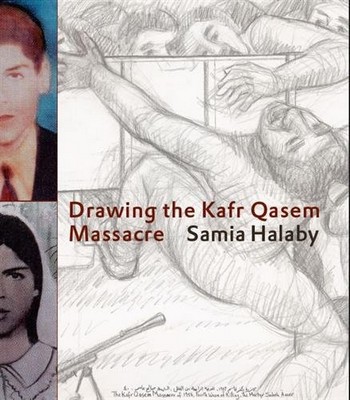
Samia Halaby’s writings on art have appeared in Leonardo: Journal of Arts, Sciences and Technology, Jerusalem Quarterly, and Arab Studies Quarterly, in addition to edited volumes, while her independently published survey Liberation Art of Palestine: Palestinian Paintings and Sculpture in the Second Half of the 20th Century (2002) is considered a seminal text of Palestinian art history. In 2017 Schilt Publishing released Halaby’s Drawing the Kafr Qasem Massacre while Palestine Books Inc published Growing Shapes: Aesthetic Insights of an Abstract Painter. In 2014 Booth-Clibborn Editions published the artist’s second monograph, Samia Halaby: Five Decades of Painting and Innovation.

Samia Halaby’s recently released book, Drawing the Kafr Qasem Massacre (Schilt Publishing, 2017) has been shortlisted for the prestigious Palestine Book Awards. 

Samia Halaby
SAMIA HALABY
Drawing the Kafr Qasem Massacre
Schilt Publishing, 2017

AYYAM GALLERY
B11, Alserkal Avenue, Street 8, Al Quoz 1, Dubai