Showing posts with label 2021. Show all posts

30/01/22

Paul Klee, entre-mondes @ LaM, Villeneuve d'Ascq

Paul Klee, entre-mondes
LaM, Villeneuve d'Ascq
Jusqu'au 27 février 2022

Paul Klee
PAUL KLEE
Abendliche Figur (Figure du soir), 1935, 53 
Aquarelle sur papier ; 48 x 31 cm 
LaM, Musée d'art moderne, d'art contemporain et d'art brut de Lille Métropole 
Photo : Philip Bernard

Paul Klee
PAUL KLEE
Zweifrucht-Landschaft II (Paysage aux deux fruits II), 1935, 49 
Gouache sur papier ; 13 x 33 cm. 
Collection particulière
Photo DR Laure

Le LaM, Lille Métropole Musée d'art moderne, d'art contemporain et d'art brut, à Villeneuve d'Ascq, présente une exposition consacrée à l’oeuvre de PAUL KLEE (1879-1940). Représenté dans le fonds permanent du musée par trois oeuvres issues de la collection de Roger Dutilleul et Jean Masurel, Paul Klee est l’un des rares artistes incontournables de la donation à ne pas avoir encore fait l’objet d’une exposition monographique. A cette occasion, le musée pose un regard inédit sur son oeuvre en mettant en lumière son intérêt pour la question des « origines de l’art ». A travers un parcours rythmé en quatre grands chapitres, l’exposition revient sur la façon dont les dessins d’enfants, l’art préhistorique, l’art extraoccidental et ce qu’on appelle alors « l’art des fous » ont permis à Paul Klee de repenser son art et de le situer, particulièrement après le traumatisme de la Première Guerre mondiale, à la charnière de différents mondes : entre quête des origines et appartenance à la modernité. Réalisée en co-production avec le Zentrum Paul Klee de Berne, où elle a été présentée du 7 mai au 29 août 2021, et réunissant pas moins de 120 oeuvres, l’exposition Paul Klee, entre-mondes crée des dialogues originaux entre des oeuvres provenant des différentes périodes de création de l’artiste et un ensemble d’objets et de documents issus de sa collection personnelle.

Paul Klee
PAUL KLEE
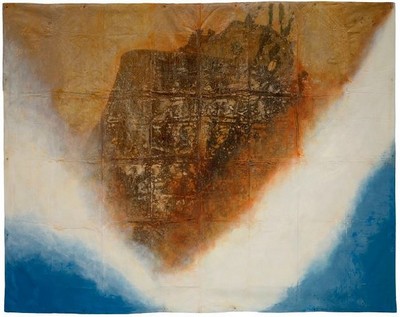
17 Gewürze (17 épices), 1932, 69
Peinture à l’eau, peinture à l’huile (?) et encre sur tissu 
contrecollé sur carton ; 47,3 x 56,9 cm
LaM, Musée d'art moderne, d'art contemporain et d'art brut de Lille Métropole 
Photo : Philip Bernard

Paul Klee
PAUL KLEE
Versunkene Insel (L’île engloutie), 1923
Aquarelle sur papier vergé contrecollé sur carton ; 46,2 x 65,3 cm
LaM, Musée d'art moderne, d'art contemporain et d'art brut de Lille Métropole 
Photo : Philip Bernard

PAUL KLEE : D’UN MONDE À L’AUTRE

Né à Münchenbuchsee, près de Berne, en 1879 et décédé à Locarno en 1940, Paul Klee a longuement hésité entre la peinture et la musique. Il se forme finalement aux arts plastiques à Munich, fait un long séjour en Italie et visite Paris à deux reprises, en 1905 et 1912. Secouée par plusieurs mouvements de rupture artistique, Munich reste son port d’attache jusqu’à la guerre. Il y rencontre Vassily Kandinsky et les membres du Cavalier bleu (Blaue Reiter), groupement d’artistes qui s’intéressent, entre autres, à l’art populaire et aux dessins d’enfants. Un voyage en Tunisie en 1914 le conforte dans sa voie : « La couleur et moi sommes un. Je suis peintre ».

Malgré cette affirmation qui ponctue de longues années d’introspection, Paul Klee se place toujours dans un monde intermédiaire : entre peinture et musique, entre figuration et abstraction, entre Orient et Occident, entre pratique et théorie, entre hier et aujourd’hui. Ne cherchant pas à reproduire le visible, mais à donner forme à l’invisible, il élabore sa démarche dans son journal et dans son enseignement. Il rejoint en 1920 le Bauhaus, école d’arts appliqués fondée à Weimar par l’architecte Walter Gropius. Pendant une décennie, il y élabore une oeuvre singulière, jamais complètement gagnée par le constructivisme dominant. Il est bientôt remarqué par les surréalistes français qui voient en lui un « peintre mental » selon les mots d’Antonin Artaud. Les années 1930 le voient s’installer à Düsseldorf puis à Berne, tandis que son oeuvre accède à une reconnaissance internationale, notamment aux États-Unis. Peu de temps avant sa mort, il attire l’oeil de Roger Dutilleul et Jean Masurel, à l’origine de la collection d’art moderne du LaM.

PAUL KLEE : « COMMENCEMENTS PRIMITIFS »

Comme de nombreux artistes d’avant-garde, Paul Klee, artiste habité par un doute perpétuel, cherche de nouvelles formes d’expression picturale. Dès 1902, après son séjour en Italie, il réalise que l’art de l’Antiquité et de la Renaissance ne répondent pas aux aspirations artistiques de la modernité. Pour sortir de l’impasse des canons académiques et pouvoir créer quelque chose de neuf, il lui faut identifier la « source originelle » à laquelle – selon les représentations de l’époque – puise toute forme d’art : « J’aimerais être comme nouvellement né, ne rien connaître de l’Europe, absolument rien ; ignorer les écrivains et les modes, être quasiment primitif », note-t-il dans son journal.

Dans un compte-rendu de la première exposition du Cavalier bleu rédigé en 1912, il se fait le défenseur « des commencements primitifs d’un art tels qu’on en trouverait plutôt dans les musées ethnographiques ou simplement chez soi, dans la chambre d’enfant ». Il évoque également l’art des « aliénés » sur lequel il jette un regard bienveillant et prend « profondément au sérieux, plus sérieusement que toutes les pinacothèques, dès lors qu’il s’agit aujourd’hui de réformer la peinture ».

De multiples sources sont ainsi convoquées par Paul Klee pour redéfinir l’art comme un moyen de « recueillir ce qui monte des profondeurs et le transmettre plus loin ».

PAUL KLEE : SOURCES CROISÉES

Le parcours de l’exposition met en exergue les quatre voies choisies par Paul Klee pour explorer ces « profondeurs » - l’art des asiles, les dessins d’enfants, l’art extra-occidental et l’art préhistorique - tout en proposant un contrepoint critique sur le mythe d’un retour aux sources de la création permis par le recul historique. Sans chercher à rattacher précisément chaque oeuvre à une source formelle, il ouvre un large spectre d’associations au public, le laissant libre d’élaborer des rapprochements d’une salle à l’autre et de tisser ses propres interprétations. Plusieurs périodes y sont abordées par le prisme de la quête des origines : le contexte du Cavalier bleu à Munich, celui de Dada à Zurich et du surréalisme à Paris, les années d’enseignement au Bauhaus et enfin la réception de Paul Klee aux États-Unis dans les années 1930.

Un catalogue publié en allemand et en français aux éditions Flammarion accompagne l’événement, avec des textes de Fabienne Eggelhöfer, Osamu Okuda, Sébastien Delot, Jeanne-Bathilde Lacourt, Savine Faupin, Christophe Boulanger, Maria Stavrinaki et Morad Montazami.

Commissariat
Fabienne Eggelhöfer, Conservatrice en chef du Zentrum Paul Klee, Berne
Sébastien Delot, Directeur conservateur du LaM, Villeneuve d’Ascq
Jeanne-Bathilde Lacourt, Conservatrice en charge de l’art moderne au LaM, Villeneuve d’Ascq
Assisté·es de Grégoire Prangé au LaM et de Livia Wermuth au Zentrum Paul Klee

LaM, Lille Métropole Musée d'art moderne, d'art contemporain et d'art brut
1 allée du Musée, 59650 Villeneuve d'Ascq

20/01/22

Yutaka Matsuzawa @ Empty Gallery, Hong Kong - Vanishing in the Wilderness - Curated by Alan Longino and Reiko Tomii

Yutaka Matsuzawa
Vanishing in the Wilderness
Empty Gallery, Hong Kong
Through February 19, 2022

I don’t, in fact, write for the dead, but for the living—though of course
for those who know that the dead too exist.

Paul Celan, Microliths, They Are Little Stones, 1969

Empty Gallery presents Yutaka Matsuzawa: Vanishing in the Wilderness. Co-curated by Alan Longino and Reiko Tomii, and realized with the generous assistance of the Matsuzawa family, this exhibition represents the first overview of this pivotal artist’s practice in Sinophone East Asia. Widely considered the leading pioneer of Japanese conceptual art, Matsuzawa’s practice synthesized a diverse array of Eastern and Western knowledge— including parapsychology, Pure Land Buddhism, quantum physics— in the pursuit of artistic strategies for expressing the immaterial sphere. Split like an atom between the gallery’s two levels —generative both separately and together—the 19th floor features canonical works from Matsuzawa’s post-revelation period, while the 18th floor presents earlier paintings and collages spanning the mid 1950s through the early 1960s— works which have rarely been shown outside of Japan.

This exhibition begins with a call for proposals from 1964. Calling for artists to exhibit their work with Matsuzawa in the highlands of central Japan, three aphoristic directions instructed would-be participants:

            Don’t Believe Matter
            Don’t Believe Mind
            Don’t Believe Senses

As instructions, they are formally conscious of the dominant Conceptual art being practiced globally at the time. However, as poetry, they conjure a speculative world that helps the individual temporarily return to a world of dissolution and disappearance.

Vanishing, disappearing, dropping out. In the 1950s and 60s, many artists were experimenting with these concepts. Burning and destroying works, or wholly removing themselves from the art world as they saw it, their activities nevertheless left traces through which we can reconstruct these techniques of disappearance. However, Matsuzawa, individually and in association with his colleagues, forged a path that was at once more internal and less demonstrative than those of his international peers. This path moved beyond the simple physical removal of the artist’s body or artwork to embrace the conscious disintegration of the perceiving individual. This removal is illustrated best by co-curator, Reiko Tomii, who notes that the concept of “being in the wilderness,” or zaiya, is similar to the Chinese xiaye (下野), literally meaning to “descend to the wilderness” and historically denoting a “departure from state power.” Matsuzawa firmly rooted his radical conceptual art practice in this wilderness, which he frames as a place where the presence of living beings and ancestors is deeply intertwined. 

In this exhibition at Empty Gallery, Matsuzawa’s Banner of Vanishing (1964) occupies a position of central importance. The message in the banner appears simple enough, proclaiming: Humans, Let’s Vanish, Let’s Go, Let’s Go, Gate, Gate — Anti-Civilization Committee. It asks the visitor to accompany the artist in moving beyond a world based on matter, and in doing so, to pursue an alternative to material civilization. While the language of the banner can be read superficially as pessimistic or nihilistic, Matsuzawa’s intentions were in fact the opposite. Rather than focusing on the surface language that Matsuzawa employed, it is necessary to focus on a physical quality of the work that he considered immaterial in nature. Specifically, his use of pink. In Matsuzawa’s vision, pink came to symbolize the presence of the spiritual. Less a color and more a form, the occasional yet conscious deployment of pink in his oeuvre was part of a strategy to enable the viewer to access the immaterial world in its most invisible nature. 

            Notes on Pink:

            1. In the pink of oblivion there must be innumerable seasons, each both more and less factual than the one before it.

            2. A pink result was found as the oldest color on record, at over 1.1 billion years old. The oceans, which contained photosynthetic organisms that produced this colored chlorophyll, might even have once been colored pink. As one co-author of the report commented, it was “truly an alien world.”

Matsuzawa’s work might be imagined as a remnant of this alien, future-past world. Its memory tinted pink from the world it came from, and an image for what worlds may come. A meditative exercise by the artist titled, White Infinity 1 (1967), asks the participant to experience within one’s consciousness an infinite expansion of white paper in a two-dimensional fashion. The Banner of Vanishing might be seen as extending a similar concept––the emptiness that it aspires towards ultimately allowing even the gallery to vanish and disappear. Existing in total darkness, the threads of the work’s future unravelling found frozen in space with the world having since disappeared.

On the 18th floor Matsuzawa’s earlier works are arranged as processional bodies, where proverbs and parables may arrive to the visitor. Abstract in form and often incorporating elements of collage, they are worked over in oil, pastel, self-mixed pigments, and ink. Notably more colorful and expressive than the post-1964 works which Matsuzawa became most well-known for, they were completed at a time in art history when, under increasing ideological pressure, Abstract Expressionism was beginning to fossilize into Minimalist painting. Lee Krasner, recognized as one of the leading critics and practitioners of Abstract Expressionism, stated: 

            the attempt at purity of a [Abstract art] work is alarming. It terrifies me in a sense. It’s rigid, as against being alive. 

These experimental works did not aim towards any sense of formal purity, they instead partook of a form of art that asked artists only to “splash about from the wine of one’s heart.” This phrase, adopted from the early ink paintings of Sesshū, asks artists to not aim towards refinement, but instead to live and create—drunkenly and openly—in the dazzle of the heart’s openness. With the whole of art history under review, they did not adhere to any particular genre or movement. Instead Matsuzawa sought to construct a new system of belief. Though they diverge aesthetically from the conceptual attitudes of his later works, they reflect the same metaphysical engagement with the myriad worlds lying beyond our material plane. Matsuzawa’s practice does not hinge upon art as emotional conveyance, but rather upon the belief that art may foment new trajectories and parameters for sensing what worlds exist elsewhere. 

Matsuzawa would often speak of a shift happening within his artworks—like a momentary ripple in the fabric of sober consensus reality. Like the exhibition, which moves back in time to Matsuzawa’s beginnings, this text also looks back. 

Slipping backwards, through the membrane of closed eyes, as pink moments drift silently in the dark, a fetal caress echoing from a prior mother and a spirit which whispers on air: let’s go. 

Text by Alan Longino

YUTAKA MATSUZAWA (1922-2006) is considered a pioneer of Japanese conceptual art. Born in Shimo Suwa in central Japan, he studied architecture during the war and upon witnessing the after effects of the firebombing of Tokyo in March 1945, he proclaimed upon his graduation from school that he wished “to create an architecture of invisibility.” After giving up his architectural practice, he wrote poetry, made paintings, and worked as both an artist and teacher in his hometown. In the formulation of his practice, Matsuzawa began to develop a unique understanding of conceptual art that both elevated and transcended the typical notions of conceptual art in the Western, Euro-centric art worlds.

ALAN LONGINO is a Ph.D. student in art history at the University of Chicago. His work focuses on artists of East Asia as well as the Southern U.S. An on-going project of his considers the presence of telepathy within information as a source of image production. His writing has appeared in Heichi and the Haunt Journal of Art, from UC Irvine.

REIKO TOMII is an independent art historian and curator, who investigates post-1945 Japanese art which constitutes a vital part in world art history of modernisms. Her early works include her contribution to Global Conceptualism (Queens Museum of Art, 1999), Century City (Tate Modern, 2001), and Art, Anti-Art, Non-Art (Getty Research Institute, 2007). She is co-director of PoNJA-GenKon, a listserv group of specialists interested in contemporary Japanese art. With PoNJA-GenKon, she has organized a number of symposiums and panels in collaboration with Yale University, Getty Research Institute, and other major academic institutions. Her recent publication is Radicalism in the Wilderness: International Contemporaneity and 1960s Art in Japan (MIT Press, 2016) received the 2017 Robert Motherwell Book Award. In 2019, based on the book, she curated Radicalism in the Wilderness: Japanese Artists in the Global 1960s, which included a major section on Matsuzawa Yutaka, at Japan Society Gallery in New York. In 2020, she received the Commissioner for Cultural Affairs Award from the Japanese government for cultural transmission and international exchange through postwar Japanese art history.

EMPTY GALLERY
18th & 19th Floor, Grand Marine Center
3 Yue Fung Street, Tin Wan, Hong Kong
_______________


05/01/22

Hughie O’Donoghue @ Marlborough Gallery, London - Deep Water and the Architecture of Memory

Hughie O’Donoghue
Deep Water and the Architecture of Memory
Marlborough, London
Through 15 January 2022

Hughie O’Donoghue
HUGHIE O'DONOGHUE
Blue Water, 2018
Mixed media on prepared tarpaulin, 237 x 302 cm
© Hughie O'Donoghue, courtesy Marlborough, London

Marlborough London presents Hughie O’Donoghue: Deep Water and the Architecture of Memory, an exhibition of large-scale works by Hughie O’Donoghue RA (born 1953).

At the core of this new body of work is the artist’s deep-rooted interest in interrogating the way memory is forged through generations. Drawing on his own memories as a child, the substantial works on tarpaulin exhibited in the show depict the MV Plassy which was wrecked in a storm off the coast of Inisheer in 1960. The shipwreck, which has been a recurring motif in O’Donoghue’s practice for over twenty years, has an imposingly theatrical, almost sculptural presence. Glowing with phosphorescent shades of rusty reds and yellows, the ship seems to witness its own slow demise whilst the sea around it remains a continuously moving yet immutable force.

Materiality is a focal aspect of this striking body of work. Primarily using repurposed materials such as sackcloth and sandbags, Hughie O’Donoghue creates an idiosyncratic tension between the realism of his imagery and the physicality of the works. This contrast is achieved through a complex superposition of photographic images with layers of resin, acrylic and oil paint whilst also embracing the irregularities of the materials. The subtly nuanced hues of his compositions are testament to Hughie O’Donoghue’s interest in the tradition of oil painting and were inspired by the lavish colours of Old Master painters such as Titian, whose works he studied as an artist-in-residence at the National Gallery in 1984.

Deep Water and the Architecture of Memory celebrates the artist’s unique ability to excavate history in an almost archaeological manner in order to investigate contemporary questions of memory and identity. Charged with metaphorical, though never fully formulated subject matters, the works in this exhibition invite the viewer to immerse themselves in the artist’s thought and working process, ultimately challenging them to confront their own relationship with identity.

Born in Manchester in 1953, Hughie O’Donoghue lives and works in London and County Mayo, Ireland. He obtained an MA in Fine Art at the Goldsmiths College, London, and was an artist-in-residence at the National Gallery, London, in 1984 and at St John’s College, Oxford, in 2000. Hughie O’Donoghue was elected a member of the Royal Academy of Arts, London, in 2009. His work has been widely exhibited in Britain and Europe. An exhibition of his work will open at the National Gallery of Ireland in March 2022.

The exhibition is accompanied by a fully illustrated catalogue featuring an introduction by Thomas Marks and an essay by Hughie O’Donoghue.

MARLBOROUGH GALLERY
6 Albemarle Street, London W1S 4BY


30/12/21

5e biennale de l’Art Brut, Collection de l'Art Brut, Lausanne : Croyances

5e biennale de l’Art Brut: Croyances
Collection de l'Art Brut, Lausanne
Jusqu'au 1er mai 2022

Noviadi Angkasapura
Noviadi Angkasapura
Sans titre, 2015
Mine de plomb et stylo-bille sur papier, 14,8 x 20,9 cm
Photo : Atelier de numérisation – Ville de Lausanne (AN)
Collection de l’Art Brut, Lausanne

Victor Simon
Victor Simon
Christ-Roi, 1941
Huile sur toile, 59 x 48 cm
Photo : Atelier de numérisation – Ville de Lausanne (AN)
Collection de l’Art Brut, Lausanne

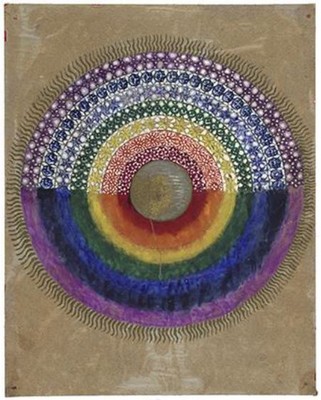
Catherine de Porada
Catherine de Porada
L’union primordiale, entre 1942 et 1950
Gouache sur papier, 26 x 21 cm
Photo : Atelier de numérisation – Ville de Lausanne (AN)
Collection de l’Art Brut, Lausanne

En se plaçant sous le thème des croyances, la 5e biennale de l’Art Brut révèle une nouvelle facette des fonds du musée lausannois. Près de trois cents dessins, peintures, assemblages, sculptures, écrits et broderies dus à quarante-trois auteurs ont été sélectionnés et constituent une sorte d’éventail des possibles, avec aussi bien des illustrations de divinités et de saints, que des compositions abstraites d’un grand raffinement, des peintures à caractère symboliste et des objets rituels. L’exposition invite à faire dialoguer les univers de ces différents créateurs, bien que leurs mondes demeurent uniques et très exclusifs. Les principaux angles d’approche retenus regroupent des œuvres en lien avec la religion, un ensemble de productions dites spirites, une grande pluralité de travaux issus de mythologies personnelles, ainsi que quelques pièces réalisées par des adeptes des sciences occultes ou de la radiesthésie.

Laure Pigeon
Laure Pigeon
 
Pierre, 1964
Encre sur papier, 65 x 50 cm
Photo : Atelier de numérisation – Ville de Lausanne (AN)
Collection de l’Art Brut, Lausanne

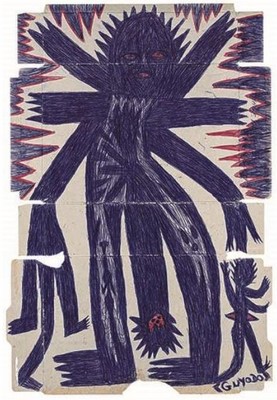
Guyodo
Guyodo 
Sans titre, sans date
Stylo à bille sur carton d’emballage, 59 x 40,5 cm
Photo : Atelier de numérisation – Ville de Lausanne (AN)
Collection de l’Art Brut, Lausanne

Michel Nedjar
Michel Nedjar
Sans titre, entre 1976 et 1982 
Assemblage de tissu, racines, papier, fil de fer et
matériaux divers, le tout enduit, haut. : 26,5 cm
Photo : Atelier de numérisation – Ville de Lausanne (AN)
Collection de l’Art Brut, Lausanne

Si nombre d’auteurs d’Art Brut vivent en marge de la société, ils restent néanmoins profondément empreints de religion. Celle-ci tient en effet une place importante dans leur éducation et leur quotidien, et colonise leur imaginaire. Quant aux spirites ou médiums, ils affirment être en relation avec l’au-delà et guidés dans leur pratique artistique par des défunts ou des forces surnaturelles, se soustrayant ainsi à la paternité de leurs travaux. Cependant, c’est bien souvent par modestie ou crainte d’être perçus comme illégitimes que ces autodidactes se retranchent derrière cet alibi. L’exposition présente aussi des créations investies de pouvoirs magiques par leurs auteurs, censées notamment remplir une fonction protectrice ou jouer le rôle de talisman.

Charles Boussion
Charles Boussion
Icône Bernadette, 2015
Feutre, correcteur blanc et collage sur papier glacé 
42 x 29,9 cm
Photo : Atelier de numérisation – Ville de Lausanne (AN)
Collection de l’Art Brut, Lausanne

Giovanni Battista Podestà
Sans titre, sans date
Peinture sur toile, 60 x 35 cm
Photo : Atelier de numérisation – Ville de Lausanne (AN)
Collection de l’Art Brut, Lausanne

Philippe Ducollet Michaëlef
Vierges, entre 2006 et 2020
Mine de plomb, encre de Chine et crayon de couleur sur papier
42 x 29,7 cm
Photo : Atelier de numérisation – Ville de Lausanne (AN)
Collection de l’Art Brut, Lausanne

Les auteurs d’Art Brut ne se distinguent pas tant des autres artistes par leurs interrogations métaphysiques, mais bien par les moyens inédits qu’ils inventent et les procédés qu’ils mettent en œuvre pour y répondre et se relier au monde. En quête d’explications sur les fondements de l’être, sur la vie, la mort ou, plus humblement, sur leur propre destin, pour la plupart en rupture de ban avec la société, marginaux ou anticonformistes, ils ne trouvent à priori pas de réponses dans les dogmes et les repères habituels. Ils conçoivent leurs propres croyances, élaborant des théories singulières et construisant des systèmes de pensée originaux. Et, quand ils s’en remettent à des traditions religieuses, ils les réinterprètent en un geste de réappropriation.

Commissariat : Anic Zanzi, conservatrice à la Collection de l’Art Brut

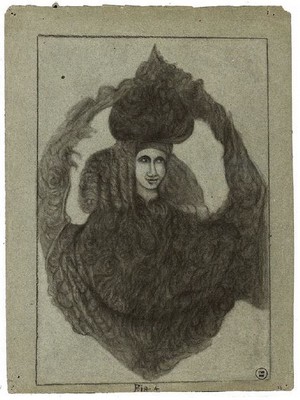
Comte de Tromelin
Comte de Tromelin
Sans titre, ca 1903
Crayon noir sur papier, 32,5 x 24 cm
Photo : Atelier de numérisation – Ville de Lausanne (AN)
Collection de l’Art Brut, Lausanne

Madge Gill
Madge Gill
Sans titre, s.d.
Broderie de laine, 125 x 150 cm
Photo : Atelier de numérisation – Ville de Lausanne (AN)
Collection de l’Art Brut, Lausanne

PUBLICATION

Le n° 5 de la série éditoriale « Art Brut, la collection », intitulé Croyances, accompagne l’exposition et apporte différents éclairages sur la thématique des croyances dans l’Art Brut. Deux éditions séparées (français et anglais). 

Emmanuel Grimaud, Sarah Lombardi et Anic Zanzi 
Croyances, Lausanne/ Milan
Collection de l’Art Brut/ 5 Continents Editions, 2021,
« Art Brut, la collection », sous la direction de Sarah Lombardi,
168 pages, plus de 100 illustrations couleur, disponible en français et en anglais

LISTE DES AUTEURS PRÉSENTÉS DANS L’EXPOSITION

ALOÏSE [CORBAZ]
NOVIADI ANGKASAPURA
CHARLES BOUSSION
MARIE BOUTTIER
FLEURY-JOSEPH CRÉPIN
ANTONIO DALLA VALLE
FERNAND DESMOULIN
JANKO DOMSIC
PHILIPPE DUCOLLET-MICHAËLEF
ELIJAH
MINNIE EVANS
JILL GALLIENI
MADGE GILL
JULES GODI
FENGYI GUO
GUYODO
WERNER HERTIG
AUGUSTIN LESAGE
RAPHAËL LONNÉ
SIMONE MARYE
JOSEPH MOINDRE
EDMUND MONSIEL
MARC MORET
MICHEL NEDJAR
ATAA OKO
MICHAEL PANKOKS
LAURE PIGEON
GIOVANNI BATTISTA PODESTÀ
CATHERINE DE PORADA
JANE RUFFIÉ
F. SEDLAK
VICTOR SIMON
PALMERINO SORGENTE
NI NYOMAN TANJUNG
THEO
JOHANN THOMA
JEANNE TRIPIER
LE COMTE DE TROMELIN
VICTOR-FRANÇOIS
AUGUST WALLA
ADOLF WÖLFLI
MARIA WNEK
HENRIETTE ZÉPHIR

COLLECTION DE L'ART BRUT
Avenue des Bergières 11, 1004 Lausanne

29/12/21

Sadamasa Motonaga @ Peder Lund Gallery, Oslo

Sadamasa Motonaga
Peder Lund, Oslo
Through February 19, 2022

SADAMASA MOTONAGA was born in 1922 in the Mie Prefecture of Japan. In 1955, he became a member of the legendary Gutai group (1954-72), famous for its pioneering performances and innovative methods in the field of painting, sculpture, and installation art. The name of the Gutai group derived from the Japanese word gutaiteki, meaning ‘concrete’ or ‘specific’, and its members aimed to create innovative, peerless art that would be one of its kind. Typical for members of this group, Motonaga’s work can be seen in opposition to the devastation of the war, as he chose to produce joyful paintings, cheerful sculptures, and lively performances.

Sadamasa Motonaga is credited with breaking down the barriers between the genres of manga, graffiti, and fine art, and he was one of the first artists to connect high and low culture in Japan in the late 1950s. His groundbreaking oeuvre was an inspiration for the “Superflat” generation who expanded on his innovative ideas in Japan in the 1990s. His early works share the same vibrant dynamic and energy that are widely praised in the works of his western contemporaries, such as the abstract expressionists Cy Twombly, Jackson Pollock, and Philip Guston while his late works offer a striking reflection of the emerging global convergence of street art, bad art, and high abstraction as for example found in the work of Jean-Michel Basquiat, Keith Haring, Albert Oehlen, and Martin Kippenberger, among others. Parallels to these western counterparts are receiving more focus from curators, scholars, and other art experts; already enjoying legendary status in Asia, appreciation for Sadamasa Motonoga’s work and important place in art history is still on the rise in western circles.

The presented works at Peder Lund were created between 1968–1975 and represent hence one of the most important decades in the artist’s production. Similar works from this period are for example held by the National Museum of Modern Art, Kyoto, Japan; The National Museum of Art, Osaka, Japan; and the Museum of Modern Art, New York, NY, USA. In 1971, Motonaga withdrew from the Gutai group. However, his work ethos and curiosity to explore new methods for his compositions never stopped, and Sadamasa Motonaga worked daily until he died in Kobe, Japan in 2011.

For his outstanding oeuvre, Sadamasa Motonaga was honored with several prestigious honors, including, the Prize for Excellence at the 6th Contemporary Art Exhibition of Japan, 1964; Grand Prix from the Shincho Foundation and the Grand Prix at the 4th International Biennale Exhibition of Prints, Seoul, 1983; Medal of Chevalier of the Order of Arts and Letters, 1988; the Japanese Government Medal of Honor with Purple Ribbon for academic and artistic achievement, 1991; Osaka Art Prize, 1992; Kobe Shimbun Peace Prize, 1996; and the Culture Merit Award from the Mie Prefecture, 2002.

Many retrospective exhibitions have been dedicated to the artist in Japan, most notably at the Hyōgo Prefectural Museum of Art, Kobe, 1998; Hiroshima City Museum of Contemporary Art, Hiroshima, 2003; Nagano Prefectural Museum of Art, Nagano, 2005; and Mie Prefectural Art Museum, Tsu, 2009. In 2015, the Dallas Museum of Art, Dallas, TX, USA, organized the first survey of Motonaga’s oeuvre outside Japan, alongside the work of his Gutai colleague Kazuo Shiraga. In the last decades, several retrospectives of the Gutai Art Association have been held at international institutions such as the National Gallery of Modern Art, Rome, Italy, 1990; Institut Mathildenhöhe, Darmstadt, Germany, 1991;  Jeu de Paume, Paris, France, 1999; Museo Cantonale d’Arte, Lugano, Switzerland, 2010; National Art Center, Tokyo, Japan, 2012; Solomon R. Guggenheim Museum, New York, NY, USA, 2013; Musee Soulages, Rodez, France, 2018.

Sadamasa Motonaga’s work is held by several major museums in Japan, as well as renowned institutions abroad such as the Dallas Museum of Art, Dallas, TX, USA; Glenstone, Potomac, MD, USA; and Museum of Modern Art, New York, NY, USA.

PEDER LUND
Tjuvholmen allé 27, 0252 Oslo
___________


24/12/21

Anselm Kiefer @ Grand Palais Éphémère, Paris - Exposition Anselm Kiefer Pour Paul Celan

Anselm Kiefer Pour Paul Celan 
Grand Palais Éphémère, Paris 
17 décembre 2021 - 11 janvier 2022 

Anselm Kiefer
Anselm Kiefer Pour Paul Celan
Affiche de l'exposition
Für Paul Celan das Geheimnis der Farne
© Anselm Kiefer
Photo : Georges Poncet
Conception graphique : Atelier Pierre Pierre
© Réunion des musées nationaux - Grand Palais, 2021

Quinze ans après avoir inauguré la série des Monumenta au Grand Palais en 2007, Anselm Kiefer est le premier plasticien à investir l’intégralité de l’espace du Grand Palais Éphémère, à l’invitation de la Rmn – Grand Palais pour un projet inédit.

Avec Pour Paul Celan, Anselm Kiefer poursuit son travail sur la mémoire européenne dont la France et l’Allemagne sont les grands acteurs. Dans cette exposition des sculptures, installations, et 19 toiles de grand format interagissent avec la poésie inapaisée du grand poète de langue allemande, Paul Celan.

L’oeuvre de Paul Celan a sans cesse été présent dans les peintures d’Anselm Kiefer, depuis l’adolescence et la découverte du poème « Todesfuge » (« Fugue de mort »), et se poursuit jusqu’à aujourd’hui avec ce nouvel ensemble de peintures. Ce dialogue se densifie au cours des dernières années et notamment en 2020 à la faveur de la période d’isolement du confinement.

Dans les extraits de son journal rédigés pendant la préparation de l’exposition au Grand Palais Éphémère, Anselm Kiefer écrit :
Celan ne se contente pas de contempler le néant, il l’a expérimenté, vécu, traversé.

(...)

la langue de paul celan vient de si loin, d’un autre monde auquel nous n’avons pas encore été confrontés, elle nous parvient comme celle d’un extraterrestre. nous avons du mal à la comprendre. nous en saisissons ça et là un fragment. nous nous y accrochons sans jamais pouvoir cerner l’ensemble. j’ai humblement essayé, pendant soixante ans. désormais, j’écris cette langue sur des toiles, une entreprise à laquelle on s’adonne comme à un rite.

(...)

l’exposition au grand palais : comment mettre celan dans une salle construite pour des olympiades ? n’est-ce pas une entreprise impossible, blasphématoire ? tes grands tableaux dans lesquels tu cites celan : n’est-ce pas comme si tu placardais celan sur des colonnes morris ? ne devrais-tu pas mettre le feu aux tableaux, les brûler en public ?
Selon le penseur et cinéaste Alexander Kluge, les tableaux d’Anselm Kiefer font vivre les vers de Celan, qu’ils commentent, et en retour les vers du poète donnent vie aux peintures. Ici les disciplines artistiques s’emparent des conflits de l’histoire, même si, toujours selon Alexander Kluge, « un Bauhaus pour la prévention de la guerre, » ça n’existe pas.

Cette exposition se déroule au moment où la France prend la présidence de l’Union européenne. Elle en est une forme de prologue, comme si, selon les mots d’Anselm Kiefer, « Madame de Staël s’adressait à l’Allemagne ». Les peintures de Pour Paul Celan sont posées dans l’espace dénué de scénographie classique et de cimaises, sans chronologie, comme les mémoires non traitées de notre existence humaine.

Le Grand Palais Éphémère, espace monumental de 10.000m2 conçu par l’architecte Jean-Michel Wilmotte, est l’environnement vivant de cette installation. L’Ecole Militaire ainsi que les bâtiments modernes de l’UNESCO au Sud, feront écho aux leitmotivs qui hantent l’oeuvre de l’artiste : l’histoire politique de l’Europe traversé e par ses conflits.

Un catalogue de l’exposition accompagne le projet, rassemblant des textes du philosophe Emanuele Coccia, de l’artiste Edmund de Waal, du cinéaste Alexander Kluge et du conservateur Ulrich Wilmes ainsi que des extraits du journal d’Anselm Kiefer.

Commissariat : Chris Dercon, Président de la Rmn – Grand Palais

GRAND PALAIS EPHEMERE
2 Place Joffre, 75007 Paris

22/12/21

James Ensor @ Gladstone Gallery, NYC - An Intimate Portrait - Exhibition + Catalogue

James Ensor. An Intimate Portrait 
Gladstone Gallery, New York 
Through January 15, 2022 

Gladstone Gallery presents an exhibition of historic works by Belgian artist James Ensor, a monumental figure in the late 19th-century Belgian avant-garde and a singular influence in the development of Expressionism. Curated by Sabine Taevernier, this show brings together paintings, drawings, and etchings, made between 1888 and 1896, alongside one of the most prolific and significant periods of creation during James Ensor’s lifetime. Spanning a diverse collection of subjects and figures, the works in this exhibition demonstrate the artist’s perceptive eye in capturing both his internal strife and the external variables that impacted him and the artists, friends, and family he was surrounded by.

Born in 1860 in the seaside town of Ostend, Belgium, James Ensor would spend time between his hometown and Brussels, which offered him a diversity of experiences and friendships with significant figures who deeply influenced Ensor throughout his lifetime. He had a challenging childhood in Ostend with his merchant parents, as he and family members dealt with depression, anxiety, and alcoholism that eventually led to his father’s death and caused great internal strife for the artist. His main refuge was his attic studio, where James Ensor surrounded himself with his paintings, drawings, and collection of found masks that inspired his realistic and imaginary narratives. In Brussels, where James Ensor spent most of his winters, he found companionship with the Rousseau family, who housed him during his excursions away from the beachfront. Comprised of academics, artists, and doctors, the Rousseau family would discuss science and politics, but also music, literature, and visual art, opening him up to a variety of interdisciplinary perspectives and multifaceted modes of thinking. Primarily perceived as a reclusive thinker and worker, James Ensor’s interpersonal relationships were essential forms of communication and understanding of the political, cultural, and fantastical world around him that greatly influenced the nature of and approach to his practice.

A comprehensive exhibition catalogue published by the gallery with essays by Susan M. Canning, Sabine Taevernier, Herwig Todts, and Xavier Tricot accompanies the show, and includes a series of essays that further explore the themes presented in this presentation.

James Ensor
JAMES ENSOR
Published by Gladstone Gallery on the occasion of the exhibition James Ensor. An Intimate Portrait, Curated by Sabine Taevernier, at Gladstone Gallery, 130 East 64th Street, New York, November 2021 - January 2022
GLADSTONE GALLERY
130 East 64th Street, New York, NY 10065

19/12/21

Samia Halaby @ Ayyam Gallery, Dubai - Flurrying

Samia Halaby: Flurrying
Ayyam Gallery, Dubai
Through 5 January 2022

Samia Halaby
SAMIA HALABY
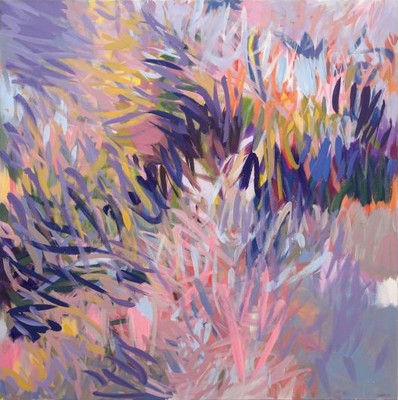
Written with a brush, 2019
Acrylic on Canvas, 152 x 152 cm
© Samia Halaby, courtesy Ayyam Gallery

Samia Halaby’s most recent works reflect everything but stillness, each canvas emulating space encompasses energy and movement, brimming intuitive complexity. Samia Halaby invites us to see nature and urban scenes through her vision, immortalizing a dynamic setting through brush strokes and color, creating infinite layers of moving parts. 

Continuing her previous explorations towards abstraction, Samia Halaby progressively removes all shapes and boundaries and focuses on motion and space only. While still introducing and studying the component of depth, distance, and location, the artist creates fore and backgrounds in which the stokes interpenetrate, creating a timeline of echoes and variations. 

This exhibition highlights both the more geometrical and more calligraphic approach, making a contrasting evolution. The product nonetheless aims to portray space and time and all that lies in between. Thus always creating an invisible set of relationships that our eyes measure and our minds comprehend intuitively. 
SAMIA HALABY: Artist Statement

The Sufi thinker Aby Hamed Muhammad al-Ghazali (1058-1111) noted that the seeing of the eye is limited by some failures while the mind is above these failures. As I think of space and air in painting, I am reminded of his words. Slowly, as I intuitively work on my paintings, my consciousness converts intuition into insights. I think of space in our educated visual perception and realize that, to us painters, space is measured as a distance between us and the concrete object we see through that space in the direction of our gaze. Within that space that we gaze at are things that move in the air. Their motion captures our gaze while our memory captures their path.

The set of new paintings has been in my studio, in the making for over a year. The paintings capture and trace everything that moves in the air, disturbing its relative stasis or affecting its motion. A few days ago, I could watch large snowflakes flurrying here and there up and down Franklin St. being pushed about and swirled by the air currents of the avenue and wind in the air. The odd partners, Al Ghazali and flurrying snowflakes, concretized for me what I have been painting during the past year.

I think of the canvas as space between me and the target of my gaze while my brush marks are activated by energy that puts them in motion. I want to remove all shapes with static boundaries and have only motion. I want eddying, fluctuating, flurrying, patterns of things being blown by the wind obtaining varying speed, adapting with cross currents. I want the energy that scatters, the paths made by all the parts that move to live in a canvas. Growth, gestation, decay, birth, and things I do not yet know make up the ambitious content of my work.  

I want no borders or boundaries. Shapes should be factored by things that constantly move and fluctuate in motion, always reacting to changing situations, turning into variations, not repetitions. Some moving parts lose energy and congeal together, creating islands of rest; such islands might be scattered by the entry of high energy motion in their midst. All shapes need to be born of the motion of things. 

We live in space and see all things moving in it. Space, air, water, and our bodies all are made of moving parts. I think of the canvas as space, and my brush-marks are activated by energy that puts them in motion. The final static, unmoving single image that is a painting should represent one condition in a continuing growth process.
ABOUT SAMIA HALABY

Born in Jerusalem in 1936, Samia Halaby is a leading abstract painter and an influential scholar of Palestinian art. Although based in the United States since 1951, Samia Halaby is recognised as a pioneer of contemporary abstraction in the Arab world.

Samia Halaby began her career in the early 1960s, shortly after graduating from Indiana University with an MFA in Painting. While teaching at the Kansas City Art Institute in 1964, she travelled to the Eastern Mediterranean as part of a faculty research grant and studied the geometric abstraction of the region’s Islamic architecture, which has continuously factored into her work. During this time, Halaby launched a series of experiments that would initiate a career-long investigation of the materialist principles of abstraction: how reality can be represented through form.

Also influenced by the abstract movements of the Russian avant-garde, Halaby works with the conviction that new approaches to painting can redirect ways of seeing and thinking not only within the realm of aesthetics but also as contributions to technological and social advancement. This underlying notion has led to additional experiments in drawing, printmaking, computer-based kinetic art, and free-from-the- stretcher painting.

Samia Halaby has been collected by international institutions since the 1970s, including the Solomon R. Guggenheim Museum of Art (New York and Abu Dhabi); Yale University Art Gallery; National Gallery of Art, Washington D.C.; Art Institute of Chicago; Cleveland Museum of Art; Institut du Monde Arabe; and the British Museum.

Selected solo shows for the artist include Ayyam Gallery, Al Quoz, Dubai (2017); Birzeit University Museum, Ramallah (2017); Beirut Exhibition Center, Lebanon (2015); Ayyam Gallery, London (2015, 2013); Ayyam Gallery, Al Quoz, Dubai (2014); Ayyam Gallery, DIFC, Dubai (2011); and Ayyam Gallery, Beirut (2010). She has participated in recent group shows at Katzen Art Center, American University Museum, Washington, USA (2017); Palestine Museum, Birzeit, Palestine (2017); Galerie Tanit, Munich, Germany (2017); The School of Visual Arts, New York, USA (2017); Ayyam Gallery, DIFC, Dubai (2017); Zürcher Gallery, New York, USA (2016); 3rd Qalandiya International Biennial (2016); Darat Al Funun, Amman (2015); the National Academy of Arts, New York (2015); The Guggenheim Museum, Abu Dhabi (2014); Broadway 1602, New York (2014); and Institut du Monde Arabe, Paris (2009). 

From the 1960s until the late 1980s, Samia Halaby taught at universities throughout the United States. She was the first full-time female associate professor at the Yale School of Art, a position she held for a decade. Her noteworthy contributions to American academia include a groundbreaking undergraduate studio art program that she introduced to art departments throughout the Midwest.

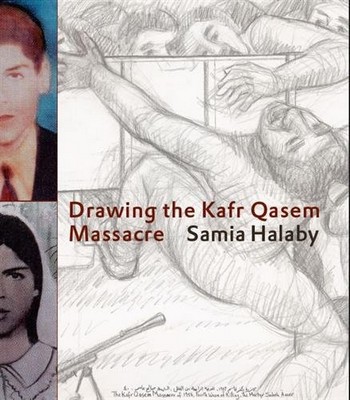
Samia Halaby’s writings on art have appeared in Leonardo: Journal of Arts, Sciences and Technology, Jerusalem Quarterly, and Arab Studies Quarterly, in addition to edited volumes, while her independently published survey Liberation Art of Palestine: Palestinian Paintings and Sculpture in the Second Half of the 20th Century (2002) is considered a seminal text of Palestinian art history. In 2017 Schilt Publishing released Halaby’s Drawing the Kafr Qasem Massacre while Palestine Books Inc published Growing Shapes: Aesthetic Insights of an Abstract Painter. In 2014 Booth-Clibborn Editions published the artist’s second monograph, Samia Halaby: Five Decades of Painting and Innovation.

Samia Halaby’s recently released book, Drawing the Kafr Qasem Massacre (Schilt Publishing, 2017) has been shortlisted for the prestigious Palestine Book Awards. 

Samia Halaby
SAMIA HALABY
Drawing the Kafr Qasem Massacre
Schilt Publishing, 2017

AYYAM GALLERY
B11, Alserkal Avenue, Street 8, Al Quoz 1, Dubai

Giovanni Benedetto Castiglione @ Kunsthaus Zurich - "Baroque Brilliance – Drawings and prints by Giovanni Benedetto Castiglione"

Baroque Brilliance – Drawings and prints by Giovanni Benedetto Castiglione
Kunsthaus Zürich
10 December 2021 - 6 March 2022

The Kunsthaus Zürich presents the first exhibition in a German-speaking country devoted to the graphic oeuvre of virtuoso Baroque artist GIOVANNI BENEDETTO CASTIGLIONE (1609–1664). This innovative master, whose graphic works bear the influence of Rembrandt, invented the monotype technique in the 17th century. His painterly brush drawings in oils were an important source of inspiration for artists who came after him. The exhibition includes rarely seen works from numerous European collections.

Giovanni Benedetto Castiglione embodies everything that makes the Baroque so enduringly fascinating: its celebration of inspired artistic brilliance, opulent magnificence and a striving to enrapture the viewer’s senses. Yet Castiglione, who hailed from Genoa and was also dubbed ‘Il Grechetto’, has been overshadowed by Italy’s more celebrated artists. The last comprehensive exhibition to focus on his graphic works called him a ‘lost genius’. He carved out a path of his own between Titian, Bernini and Poussin – artists whom he greatly admired – and left behind a highly individual body of work that curators Jonas Beyer and Timothy J. Standring have condensed into a representative exhibition of some 80 works on paper.

GIOVANNI BENEDETTO CASTIGLIONE: DRAWINGS WITH A DELICATE TOUCH

With an almost instinctive mastery of drawing that was every bit the equal of his painting, Giovanni Benedetto Castiglione was a unique artist of the 17th century. He committed his motifs to paper with astonishing nonchalance, employing a remarkable technique to do so: he mixed his pigments with linseed oil – probably in response to the rapidly executed oil sketches on primed wooden panels popularized by Rubens and van Dyck – and, depending on how heavily he loaded his brush, could produce everything from flowing, painterly lines to rough, expressive strokes. The spontaneity with which he guided his oil-laden brush across the paper prompted contemporary observers to label his brushwork ‘grazioso’ and ‘facile’: ‘facile’, that is, in the sense of simple but not simplistic, referring instead to the supreme virtuosity of an artist who perfected the skill of seeming effortlessness and apparent ease in tackling what was in fact a challenging task.

GIOVANNI BENEDETTO CASTIGLIONE: A FAVOURITE AMONG CONNOISSEURS

Castiglione’s drawings in oils, which have been described as miniature ‘drawn paintings’, were not simply preparatory studies for larger pieces but works of art in their own right; and this no doubt explains the admiration in which they were held by celebrated artists such as Tiepolo and Fragonard. His works were also much appreciated by legendary art aficionados including Count Francesco Algarotti. To this day, the largest assembly of drawings by Giovanni Benedetto Castiglione is in the illustrious hands of the British Royal Collection; the Kunsthaus is fortunate to be showing more than a dozen of the finest sheets from Windsor Castle. They are joined by works from equally precious holdings, including the Devonshire Collections at Chatsworth House and the Collection Frits Lugt, which is held by the Fondation Custodia in Paris. 

GIOVANNI BENEDETTO CASTIGLIONE: DRAWINGS, ETCHINGS, MONOTYPES

However, Castiglione’s drawings are only one side to his talents. He is equally peerless in his practice of printmaking. His etchings stand in the tradition of the ‘capriccio’, dealing with subjects that are as enigmatic as they are eccentric, such as scenes from the apocrypha and mythology, played out between objects from time immemorial distributed around the picture space and exposed to the elements. His unmistakeable style is also in evidence in the etchings. A significant part of their appeal lies in the manner of their execution: Giovanni Benedetto Castiglione worked with restlessly drawn networks of lines and tiny, intertwined hook strokes that spread across the picture surface almost like natural growths. Moreover, that search for a highly individual formal language most probably explains Castiglione’s unending experimentation with new means of expression. One is the monotype, which he is credited with inventing. Unsurprisingly the monotype process, which involved painting directly onto a plate and then making a print from it, is regarded as a hybrid technique. The result is somewhere between drawing and print, marking Giovanni Benedetto Castiglione out once again as a crossover artist working in diverse media, and allowing him to achieve highly dramatic chiaroscuro effects that are without parallel in the graphic arts of his time.

GIOVANNI BENEDETTO CASTIGLIONE: THE APPEAL OF THE SEEMINGLY UNFINISHED

Castiglione’s attachment to an aesthetic of the apparently unfinished and fragmentary gives his work a decidedly modern aspect. Many of his etchings look like exercises that are not fully elaborated, placing them on a level with the prints of his great contemporary Rembrandt. Castiglione’s drawings, meanwhile, are often committed to paper so swiftly that it is literally possible to retrace the process of their creation. They lack finish – deliberately so, because Giovanni Benedetto Castiglione wanted viewers to be enthralled by his virtuoso signature. 

KUNSTHAUS ZURICH
Heimplatz 1, 8001 Zurich

Miquel Barceló @ Thaddaeus Ropac, London - Ceramics

Miquel Barceló: Ceramics
Thaddaeus Ropac, London
8 December 2021 – 5 February 2022

Miquel Barceló’s new works – shown in his first exhibition of ceramics in London – reveal his inventive approach to the medium. One of the most renowned Spanish artists of his generation, ceramics have long been central to his practice, which also encompasses paintings, performances and installations. Inspired by ancient techniques from Mali and his native Mallorca, Barceló’s ceramic sculptures are captured in a moment of dissolution or becoming, a state of ‘continuous transformation’. They seem to evolve before our eyes into other forms: sprouting leaves, rippling with marine life or folding in on themselves.
Each work is experimental. Each work is a trial run for another that will probably never exist. I think this is as true of my painting as my ceramics – or any other thing I make. 
Miquel Barceló
The artist first began working with clay in the early 1990s, when he established a studio in Mali and was introduced to the ancient Dogon earthenware methods. ‘I learned the Neolithic technique,’ he explains. ‘I gathered clay from the places the potters have been going to for centuries.’ He became versed in the fundamentals of creation – ‘starting at the absolute beginning’ – using humble materials such as earth, animal dung and straw, which were baked at low heat or dried in the sun. In this way, he connected with prehistoric artistic creations, which have survived as pottery shards or paintings on cave walls. Barceló’s time in West Africa proved formative, both for his life and his work. Here, he forged an intimate connection with the earth as a material for his artworks and his body as a tool for creation. 

Traces of these unconventional beginnings are apparent in his irreverent approach to the medium and emphasis on a sense of visceral materiality. For Miquel Barceló, artistic creation is a direct way of relating to the world around him and the ceramics bear the marks of his bodily engagement: ‘When baked with wood fire, clay keeps track of every trace, no matter how slight. Even the slightest contact, a brush with the fingers, will leave a clear trace in the clay after firing.’ The central role of the body is exemplified in his Paso Doble performance, which he conceived with choreographer Josef Nadj for the Avignon Festival in 2006. Barceló describes it as ‘a way of staging the tools and gestures of my work with clay. The body as a tool. The body in positive and negative, mould and cast.’ The Paso Doble performance has since been staged in New York, Madrid, Zurich, Barcelona, Paris, Athens and Mali as a tribute to those who introduced him to the art of ceramics.

Upon returning to Mallorca, Miquel Barceló began creating ceramics in an old brick factory, using the clay from his region as his ancestors did before him. ‘The clay from my village is renowned for its whiteness and fineness,’ he recalls. ‘This clay was extracted for centuries from a little hill called Puig de Sant Nicolau where I used to play as a child. Not one pebble – a mountain of white clay, slippery as soap.’ Traditionally used to create vessels decorated with motifs such as shells, sea urchins, flowers and seahorses, this idea of ‘clay collage’ becomes something entirely new in Barceló’s hands. The vessels are intentionally deconstructed and expressively distorted, with ripples and folds or perforations that open them up to the surrounding space. In gestural, expressive strokes of paint, he depicts the simplified forms of fish and bulls, botanical and human figures, recalling the cave paintings in Lascaux where he spent time alongside palaeontologists. Miquel Barceló’s painterly approach also becomes a form of metamorphosis that bridges different media: ‘The subject of many of these works is painting, how clay becomes painting, canvas, drawing. In short, a transmutation.’ 

This idea of metamorphosis is fundamental to the artist, who recently created original watercolours for a new edition of Franz Kafka’s La Métamorphose, first published in 1915. This transformation is made manifest in his ceramics, which also undergo an alchemical change when fired in the kiln: the malleable clay becomes hardened, brittle, and may even crack due to the high heat. These chance effects are integral to his ceramics: ‘They are often fissured and I accept the cracks with joy as part of the work.’ 

The medium has become central to Miquel Barceló’s artistic production, forming the basis of several large-scale works. In 2007, he created a 280 square metre terracotta mural for the Palma de Mallorca Cathedral that addresses the biblical miracle of the loaves and the fishes. A year later, he unveiled an installation of thousands of marine stalactites which descend from the domed ceiling of the Human Rights and Alliance of Civilisations Chamber in the United Nations’ Palais des Nations in Geneva. He also created an ephemeral mural for the Bibliothèque Nationale, Paris in 2016, applying gestural smears of clay to its windows before scratching out the outlines of human and animal forms that reference prehistoric paintings.

Miquel Barceló was born in 1957 in Felanitx, on the island of Mallorca, and now divides his time between his birthplace and Paris. As a young artist, his participation in the São Paulo Biennial in 1981 and documenta 7 in Kassel in 1982 helped establish his international reputation. Deeply influenced by poetry, he exhibited more than 300 drawings illustrating Dante’s Divine Comedy at the Louvre Museum in 2004. He represented Spain at the 53rd Venice Biennale in 2009, presenting ceramics alongside his paintings. Numerous retrospectives of his work have been hosted by renowned institutions, including the Centre Pompidou, Paris; Museo Nacional Centro de Arte Reina Sofía, Madrid; and the Museo Rufino Tamayo, Mexico City. In 2019, a monographic exhibition of Miquel Barceló’s ceramics took place at the Museo Internazionale delle Ceramiche, Faenza. His solo exhibition Metamorfosis was shown at the Museo Picasso, Málaga in 2021, followed by an exhibition at the Tokyo Opera City Art Gallery in 2022.

THADDAEUS ROPAC
37 Dover Street, London W1S 4NJ
____________


17/12/21

Wendy Ewald @ Stephen Bulger Gallery, Toronto - The Pictures Woke the People Up: Canada, Colombia and American Alphabets

Wendy Ewald
The Pictures Woke the People Up: Canada, Colombia and American Alphabets
Stephen Bulger Gallery, Toronto
Through 15 January 2022

The Stephen Bulger Gallery presents “The Pictures Woke the People Up: Canada, Colombia and American Alphabets”, their first solo exhibition with acclaimed photographer WENDY EWALD which announces the gallery's representation of her work. For over fifty years, Wendy Ewald has collaborated on art projects with children, families, women, and teachers in Labrador, Colombia, India, South Africa, Saudi Arabia, Holland, Mexico, Morocco, the United Kingdom, and the United States.

Working as a photographer and teacher, Wendy Ewald’s projects emphasize a method of collaboration that challenges the distinctions between photographer and subject. Adopting a variety of approaches, she creates projects based on a reciprocal vs. hierarchical approach. Her goal is to provide the vision of her subjects rather than merely make images of them. Through her documentary investigations of places and communities, Ewald probes questions of identity and cultural differences. In her work with children and women, she encourages them to use cameras to record themselves, their families, and their communities, and to articulate their fantasies and dreams.

This exhibition presents a selection of work from various stages of her career. During Wendy Ewald’s college years, starting in 1969, she worked with Indigenous children in Sheshatshiu, Labrador and in Eskɨnuopitijk, New Brunswick. She observed that her photography was restrained partially by a reticence to disturb her subjects. Her students’ approached their work in a more dynamic fashion. While photographing the same scene as 14-year-old Merton Ward, she was struck by the difference.  Her photographs were clear renderings of the evidence before her, whereas his portrayed life on the reservation was more expressive. She successfully applied to the Polaroid Foundation for cameras and film for her students, which enabled her to work there for four summers. We will exhibit vintage prints from that period, a film, as well as colour work made during visits to the region 39 years later.     

After working in the Appalachian Mountains in the 70s, Wendy Ewald travelled to Latin America to create work within another rural community. She was awarded a Fulbright Scholarship in 1982 to photograph and teach photography in a Colombian village. She hoped that by working outside her native language she would be forced to rely on her visual skills. She was also introduced to Alicia Vásquez, a single mother living with three young sons in an invasion barrio in Bogota. Over time, she shared her life story with Ewald who brought her books of classical literature. Her mother María and other members of the family told their stories which prompted Ewald to illustrate the family’s memoir. Alicia was uncomfortable around a camera. Photographs made by Ewald and the children she taught in the village of Ráquira are interwoven with transcribed and edited stories of the Vásquez family. Our exhibition displays an excerpt from the book of this work, MAGIC EYES: Scenes From An Andean Girlhood.

In 1991, Wendy Ewald became a senior research associate at Duke University’s Center for Documentary Studies and founded the Literacy through Photography program for Durham Public Schools in North Carolina. During this time, she became aware of the language barrier amongst immigrant and local communities. She recognized the prevalence of cultural descriptors in North American children’s alphabet primers (i.e ‘C’ is for ‘Car’) and collaborated with children from different backgrounds to create primers of their own. She asked students to think of words for each letter of the English and Spanish alphabets and assign them visual signs specific to their culture. Wendy Ewald photographed the signs, objects, or scenes selected. When the large-format negatives were developed, the children altered them with Sharpies, adding the letter and word they illustrated. Our exhibition will include alphabets from several communities.

Wendy Ewald has received many honors, including a MacArthur Fellowship, a Guggenheim Fellowship, and grants from the National Endowment for the Arts, The Andy Warhol Foundation, the Rauschenberg Foundation, and the Fulbright Commission. She was also a senior fellow at the Vera List Center for Art and Politics at the New School from 2000-2002. She has had solo exhibitions at the International Center of Photography, New York, the Center for Creative Photography, Tucson, the George Eastman House, Rochester, Nederlands Fotomuseum, Rotterdam, the Fotomuseum, Wintherthur, Switzerland, the Corcoran Gallery of American Art, Washington, DC, and The Queens Museum, New York, among others. Ewald’s work was included in the 1997 Whitney Biennial. She has published fourteen books, her fifth, a retrospective documenting her projects entitled Secret Games, was published by Scalo in 2000. Two books were published in 2005. A third, To The Promised Land was published in 2006 to accompany an outdoor installation in Margate, England, with “new starts” and refugees commissioned by ArtAngel. She was an artist in residence at Amherst College for eleven years where she taught the course, Collaborative Art: The practice and theory of working with communities. This Is Where I Live, which maps Israel/Palestine through 14 different communities, was published by MACK in 2015 in conjunction with a traveling exhibition, “This Place”. America, Border, Culture, Dreamer a collaboration with young immigrants to the US was published by Little Brown in Fall 2018 to accompany a public art installation in Philadelphia. Her film for PBS, Portraits and Dreams, was released in 2020 accompanied by an expanded update of the original book published in 1985. Wendy Ewald’s project for “Towards a Common Cause: Art, Social Change, and the MacArthur Fellows Program at 40” continues until December 19, 2021, throughout Chicago, presented by the Smart Museum. The book The Devil is Leaving his Cave, will be published by MACK Books in 2022. From November 8 ­– 28, 2021, Wendy Ewald and artist Zak Hajjaoui have collaborated on a billboard that will be on display at the corner of Richmond Street East and Parliament Street, Toronto, as part of For Freedoms North American “Billboards” exhibition. For Freedoms is an artist-led organization that models and increases creative civic engagement, discourse, and direct action.


Wendy Ewald
Wendy Ewald, Katherine Hyde, Lisa Lord
Literacy and Justice through Photography
© Teachers' College Press

Wendy Ewald
Wendy Ewald, Alexandra Lightfoot
I Wanna Take Me a Picture
© Beacon Press
In addition to her artistic practice, Wendy Ewald has published two books for teachers and families, I Wanna Take Me a Picture and Literacy and Justice through Photography. She has been collaborating with partners in Tanzania for the past ten years to create photographic teaching materials for the national primary and secondary school curriculums. In 2021 she developed a course in teaching and learning through images for Humanities and Education students at the University of Dodoma, Tanzania.
STEPHEN BULGER GALLERY
1356 Dundas Street West, Toronto, ON M6JIY2