Showing posts with label Charline von Heyl. Show all posts

31/07/25

Charline von Heyl @ The George Economou Collection, Marousi / Athens - "The Giddy Road to Ruin" Exhibition

Charline von Heyl 
The Giddy Road to Ruin
The George Economou Collection, Marousi / Athens
14 June 2025 – March 2026

Charline von Heyl
Charline von Heyl 
The Giddy Road to Ruin, 2015
Acrylic on canvas, 62 x 54 inches (157.5 x 137 cm)
© Charline von Heyl
Courtesy of Galerie Gisela Capitain, Cologne and Petzel New York
Photo: Butcher Walsh

The George Economou Collection presents The Giddy Road to Ruin, the first survey exhibition by German-American artist CHARLINE VON HEYL (b. 1960) in Greece. 

Across three floors of gallery space, The Giddy Road to Ruin features select works from the last several decades. The earliest is an outstanding painting from the George Economou Collection—an emblematic example of the artist’s practice—Untitled (11/93, I) (1993), while the most recent is her first-ever photographic work, Athens, made in 2024.

The title of the exhibition, The Giddy Road to Ruin, derives from her 2015 painting of the same name and may be interpreted as a reflection of her thinking as well as the nature of painting itself. Displayed at the exhibition’s beginning and considered within the context of Greece’s ancient and modern landscape, the painting takes on greater significance, especially in relation to its presentation alongside the Athens (2024) collages. In these graphic images we experience the echoes and rumblings of both the present and history.

Charline von Heyl is one of the most significant painters of her generation. Educated in Germany in the 1980s and inspired by both senior artists and contemporaries—including Martin Kippenberger, Rosemarie Trockel, and Michael Krebber, as well as Albert Oehlen, Jutta Koether, and Cosima von Bonin—her work began to carve out new territory, particularly after her move to New York in 1996. While her paintings share the rigor and intensity of theirs, Charline von Heyl’s work eschews irony in favor of a more openly amused humor and a certain nimbleness in the synthesis of mind and hand.

Once in the United States, Charline von Heyl developed a novel, constructive, and strategic approach to creating and solving artistic problems that allows each painting to be “a self-generating machine that finds its own soul.” Her work is neither wholly abstract nor representational but simultaneously both. Her art succeeds by embracing visual and conceptual contradictions, keeping viewers intrigued by the seemingly impossible combinations of subjects, compositions, and styles that result in deeply satisfying yet puzzling works. In many of her paintings, forms appear both in stasis and in flux simultaneously, as evident in works such as Demons Dance Alone (2022) or World Rabbit Clock (2022). Shapes seem to be concurrently at the fore and in the background, as seen in her depiction of bowling pins—a recurring image in her vocabulary, particularly well-represented in two paintings from 2015 on mid-twentieth-century barkcloth fabric that are located on the second floor of the exhibition. To the indiscriminate eye, the contradictory styles in von Heyl’s paintings might seem irreconcilable, yet they all coexist within the singularly coherent universe of her art.

While a series of four densely composed paintings on barkcloth are a through line from the first floor, the appearance of two stolid and iconic works on the second floor signal a change of mood in the exhibition. The heraldic devices in Untitled (11/93, I) (1993) carry ominous, even militaristic overtones, in contrast to the insouciant black-and-white cut-out shapes of Time Waiting (2010), which harken back to mid-century travel advertisements’ filtered interpretation of Cubism. These works stand in stark contrast to the owl paintings from 2020–2021, in which the generally solitary birds—symbols of good fortune and wisdom—gather, against type, into a multitude. This capacious theme, with its potential for great and even adorable variation, offered a lighthearted interlude for Charline von Heyl to paint and for the viewer to enjoy encountering the third floor of the exhibition.

Here the opening salvo is a boldly blue bird in the large, rectangular painting Animal Delinquency (2021). Ultramarine fowl are partially obscured by two smudged-out, variegated forms of two other creatures—owls, perhaps? The collapse of subjects and the spaces they inhabit creates an apprehensive experience. The scroll-like structure of Banish Air from Air (2017) also features bird-like forms flying through interlocking patterns of words, lines, and shapes. At its center is a variation of her repeated, defiant yet playful female power figure, also seen in The Giddy Road to Ruin.

The painting Ninfa (2021) continues the subtle theme of feminine power in her work. Pulchritude is rendered as outlandish, with blue lips and a graceful line suggesting a chin overtaken by a coalescence of black and ochre biomorphic forms resembling birds. The head itself transforms into a dense field of patterns, becoming increasingly abstract. The fifteen diverse, rigorous while and whimsical black-and-white drawings that comprise Drawings Group 2 (2006) elaborate on and connect to the inscriptive elements—sometimes appearing as ideograms or Rorschach-like forms— not unlike Banish Air from Air. They also echo the structure and palette of Athens earlier in the exhibition. Each work on view is replete with such recursive connections, dissonances, and discontinuities—eye-opening and mind-boggling revelations await.

Charline von Heyl: The Giddy Road to Ruin is co-curated by Adam D. Weinberg and Skarlet Smatana, the director of The George Economou Collection, in close collaboration with the artist. A publication with essays by Adam D. Weinberg and artist Helen Marten accompanies the exhibition.

THE GEORGE ECONOMOU COLLECTION
80 Kifissias Ave, 15125 Marousi, Athens

18/12/23

Jacob Samuel and Contemporary Etching @ MoMA, New York - "New Ground: Jacob Samuel and Contemporary Etching" Exhibition

New Ground: Jacob Samuel 
and Contemporary Etching 
MoMA, New York
October 29, 2023 – March 16, 2024

Barry McGee
Barry McGee 
Untitled from Drypoint on Acid, 2006 
Etching and aquatint with chine collé and 
collage addition from a portfolio of seven drypoints 
with chine collé (three with collage additions), 
one drypoint and aquatint with chine collé and collage additions, 
one etching with chine collé and spraypaint additions, 
and one etching and aquatint with chine collé 
and collaged screenprint additions. 
Composition and sheet: 7 13/16 x 6 3/8″ (19.8 x 16.2 cm). 
Ann and Lee Fensterstock Fund 
The Museum of Modern Art, New York 
© 2022 Barry McGee

Wangechi Mutu
Wangechi Mutu  
Untitled from Eve, 2006. 
Etching and aquatint with collage additions 
from a portfolio of five etchings 
(two with aquatint and collage additions, 
one with collage additions) and three aquatints 
(two with collage additions) 
Composition (irreg): 8 9/16 x 5 1/2″ (21.7 x 14 cm); 
sheet: 10 7/16 x 7 7/8″ (26.5 x 20 cm). 
Linda Barth Goldstein Fund 
The Museum of Modern Art, New York 
© 2022 Wangechi Mutu

Jannis Kounellis
Jannis Kounellis 
Untitled from 1999, 1999 
One from a portfolio of twelve etching, drypoint, 
and aquatints with chiné colle (one with blind embossing) 
Plate: 5 5/16 × 7 5/8″ (13.5 × 19.4 cm); 
sheet: 13 3/4 × 15 1/8″ (35 × 38.4 cm) 
Acquired through the generosity of John Baldessari, 
Catie and Donald Marron, and Mary M. and Sash A. Spencer 
The Museum of Modern Art, New York. 
© 2022 Jannis Kounellis

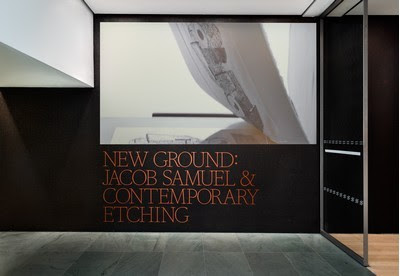
The Museum of Modern Art presents New Ground: Jacob Samuel and Contemporary Etching, a focused exhibition on the work of master printer and publisher Jacob Samuel (American, b. 1951). The exhibition highlights Jacob Samuel’s championing of the foundational printing technique of etching, his innovative approach to collaborating with contemporary artists, and works that push the limits of the medium. MoMA began acquiring works published by Jacob Samuel in 1988 and, three decades later, it holds his entire catalogue of more than 60 projects. New Ground selectively draws from this expansive body of work by a diverse range of artists, including Mona Hatoum, Rebecca Horn, Jannis Kounellis, Wangechi Mutu, Barry McGee, and Christopher Wool.

Over the course of four decades, Jacob Samuel collaborated with more than 60 artists, traveling extensively to do so. Through a traditional but maximally flexible approach, he was driven to prove that etching could be a successful contemporary medium. The exhibition will draw from a range of these collaborative projects. For example, Jacob Samuel made it possible for the artist Rebecca Horn to avoid working in reverse, generally considered a requirement in printmaking, by printing her delicate webs of red lines on custom-made transparent paper, which was ultimately inverted. Moreover, his design and use of a portable aquatint box allowed him to travel to artists’ studios, which allowed Jannis Kounellis to use sculptural processes, not easily transferred to a printshop setting, on copper etching plates. But this belief in traditional processes did not prevent him from embracing other techniques in order to achieve an artist’s vision. Works by Wangechi Mutu and Barry McGee include elements of collage, and are trimmed to the image size, without the expected borders of a printed image. Successive projects with Christopher Wool over the course of over twenty years are particular evidence of a generative partnership. New Ground highlights Jacob Samuel’s breadth of knowledge, historical expertise, and unwavering commitment, which made him an ideal partner for artists new to the medium.

Mona Hatoum
Mona Hatoum 
Untitled from hair there and every where, 2004 
One from a portfolio of ten etchings with chine collé. 
Plate: 7 7/8 x 6 7/8″ (20 x 17.5 cm); 
sheet: 16 x 14″ (40.6 x 35.6 cm). 
Carol and Morton H. Rapp Fund 
The Museum of Modern Art, New York 
© 2022 Mona Hatoum

Charline von Heyl
Charline von Heyl 
Untitled from Black Sun: 
The Brief Transit and Violent Eclipse of Harry Crosby, 2013 
One from a portfolio of eight etchings with drypoint, roulette, 
aquatint, and chine collé. Plate: 7 13/16 × 6 7/8″ (19.9 × 17.4 cm); 
sheet: 16 15/16 × 15″ (43 × 38.1 cm). 
Acquired through the generosity of John Baldessari, 
Catie and Donald Marron, and Mary M. and Sash A. Spencer. 
The Museum of Modern Art, New York. 
© 2022 Charline von Heyl

Jonas Wood
Jonas Wood 
Untitled from 8 Etchings, 2014 
One from a portfolio of eight etchings with chine collé. 
Plate: 8 3/4 × 7 13/16″ (22.3 × 19.9 cm); 
sheet: 15 15/16 × 13 15/16″ (40.5 × 35.4 cm). 
Acquired through the generosity of John Baldessari, 
Catie and Donald Marron, and Mary M. and Sash A. Spencer. 
The Museum of Modern Art, New York. 
© 2022 Jonas Wood

Jacob Damuel - MoMA
Installation view of New Ground: Jacob Samuel 
and Contemporary Etching, on view at 
The Museum of Modern Art from October 29, 2023, 
through March 16, 2024. 
Photo: Jonathan Dorado

Born and raised in Santa Monica, California, JACOB SAMUEL began his career as a master printer for the Abstract Expressionist painter Sam Francis. Having worked extensively on Francis’s monumental, multicolour aquatints for eighteen years, Jacob Samuel was drawn instead to publish a very different type of work under his own name: small scale, serial, and generally printed in a single tone. A continually expanding network of friends and creators made introductions, and Jacob Samuel began to work with some of the most influential artists of the 20th and 21st century. He collaborated with painters, sculptors, performance artists, and musicians to make etchings that reflected their overall artistic practices. Despite the diverse range of artists, certain common themes arise with consideration of Jacob Samuel’s imprint as a whole: the depiction or impression of the body on a printing matrix, for example, or a system of images that unfolds across multiple sheets of paper. Many of the projects include texts written by the artists, a further invitation to close looking. As with everything published by Jacob Samuel, each project has a custom-designed housing that expands the work’s presence into three dimensions. The breadth, variety, and, above all, creativity in the works he published with an exceptional list of artists is evidence of his success in bringing the tradition of old master printmaking to contemporary artistic practices.

The exhibition is accompanied by the first publication dedicated to the work of the master printer Jacob Samuel. The richly illustrated catalogue features an essay by curator Esther Adler, interviews with a dozen of the artists Jacob Samuel has worked with, and a highly researched checklist detailing every project published by Jacob Samuel.

New Ground: Jacob Samuel and Contemporary Etching is organized by Esther Adler, Curator, and Margarita Lizcano Hernandez, Curatorial Assistant, Department of Drawings and Prints.

MoMA - MUSEUM OF MODERN ART
11 West 53 Street, New York, NY 10019