Showing posts with label etchings. Show all posts

02/06/25

Richard Diebenkorn: Prints from Two Decades @ Crown Point Press Gallery, San Francisco

Richard Diebenkorn 
Prints from Two Decades
Crown Point Press, San Francisco
Through June 30, 2025

Richard Diebenkorn
RICHARD DIEBENKORN
Spade Drypoint, 1982
© Richard Diebenkorn Foundation
Coutesy of Crown Point Press

I’m making my drawing in spite of the metal. I think I’m going to make a straight line, and it says, ‘Oh, no you don’t!—Richard Diebenkorn, 1962
Crown Point Press presents Richard Diebenkorn: Prints from Two Decades, a radiant exhibition of prints made by the artist during a series of residencies at the Press between 1980 and 1990. Organized with the Richard Diebenkorn Foundation and Crown Point Executive Director, Valerie Wade, the show takes place on the occasion of the highly anticipated release of Richard Diebenkorn: The Catalogue Raisonné of Prints (Yale University Press, 2025), which includes new scholarly essays, more than 850 significantly scaled images, and a richly illustrated chronology of Diebenkorn’s printmaking years. The works on view in the Crown Point Gallery were created in the final decade and a half of the artist’s life, the “high point” in his printmaking oeuvre, writes Starr Figura, Curator in the Department of Drawings and Prints at the Museum of Modern Art. In her essay Richard Diebenkorn, Printmaker, she adds that the objects made during this period “rank among the most extraordinarily luminous and elegantly structured prints ever produced.”

Richard Diebenkorn (1922–1993) was highly accomplished in printmaking and worked with professional print shops over a period of more than 30 years (1962–1992). Master Printer Kathan Brown at Crown Point Press published a selection of his earliest intaglio prints in 1965 as 41 Etchings Drypoints. “It was Crown Point Press in San Francisco and the intaglio print processes it offered that captivated him the most: etching, drypoint, aquatint, and related techniques for incising an image into a metal printing plate,” Starr Figura adds, which “provided endless horizons for his work.”

In 1980, the artist began his Clubs and Spades series of works on paper containing symbols and heraldic imagery that had fascinated him since he was a young person; the iconography appeared in his prints as early as 1963. A series of intaglio prints made at the Press in which he deployed clubs, spades, and crosses in the early 1980s is “the first occasion,” Starr Figura writes, “when Diebenkorn’s prints start to rival the saturated color, imposing presence, and painterly ambition of his paintings on paper.” Spade Drypoint (1982) evinces his love of the drypoint process with its aggressive lines, while a shimmering aquatint with scraping made the same year, Green Tree Spade, is remarkable for its vividness and texture.

Ne Comprends Pas and Oui, both from 1990, were made during one of his most productive residencies at the Press. Oui, with its floating, broken detritus, marked a return to reversal techniques, which he had experimented with nearly a decade prior in 1981. Emily York, in Magical Secrets about Aquatint: Spit Bite, Sugar Lift and Other Etched Tones Step-by-Step (Crown Point Press, 2008), recalls that Renée Bott made an aquatint reversal of Ne Comprends Pas, which became Oui. “Diebenkorn mainly drew with asphaltum to make Ne Comprends Pas, a predominantly black image in which the drawn forms come through as the white of the paper. After finishing the print, he wondered what it would look like if the lines were dark on light,” writes Emily York.

The very experimental, geometric Passage I and Passage II were made during the same time as Ne Comprends Pas and Oui and were also created with the reversal process. Richard Diebenkorn added a strip of color to Passage I, as he did with his most celebrated print, Green, published in 1986 by the Press. “It wasn’t the first time that Dick had done that,” and “not a lot of artists that I’ve worked with have done that,” says Renée Bott, from a wide-ranging interview conducted by Karin Breuer, Curator in Charge of the Achenbach Foundation for Graphic Arts, Fine Arts Museums of San Francisco and featured in the volumes. “He kept looking at it and…it wasn’t complete to him without adding something.”

The exhibition culminates in the weightless 1990 etchings Domino I and Domino II which are, observes Starr Figura, “among the most richly textured and densely composed images that Diebenkorn had ever produced.” As Diebenkorn’s “Ocean Park geometries seem on the brink of dissolving…there is the sense of familiar forms and structures being opened up, loosened, and softened.”

Special Film
A new and special film with the late Kathan Brown and Valerie Wade, and together with Andrea Liguori, Executive Director of the Richard Diebenkorn Foundation and Editor, Richard Diebenkorn: The Catalogue Raisonné of Prints, explores the artist’s history with the Press and the “golden era”of printmaking during the 1980s. Andrea Liguori, in a tender interview conducted with Kathan Brown in late 2023, unearths brightly hued paper scraps discovered during filming that the artist had used to construct an iconic print image. The film was produced at Crown Point Press by Matthew Pendergast and is now available on crownpoint.com and diebenkorn.org.

CROWN POINT GALLERY
20 Hawthorne Street, San Francisco, CA 94105

RICHARD DIEBENKORN: PRINTS FROM TWO DECADES
CROWN POINT PRESS, May 23 – June 30, 2025

06/03/25

Edvard Munch: Technically Speaking @ Harvard Art Museums, Cambridge

Edvard Munch: Technically Speaking
Harvard Art Museums, Cambridge
March 7 - July 27, 2025

Edvard Munch
EDVARD MUNCH
Two Human Beings (The Lonely Ones), 1894
Etching and drypoint
Harvard Art Museums/Fogg Museum, 
The Philip and Lynn Straus Collection, 2023.559 
Photo © President and Fellows of Harvard College

Edvard Munch
EDVARD MUNCH
Two Human  Beings (The Lonely Ones), 1899 
Woodcut, printed in four colors of ink
Harvard Art Museums/Fogg Museum, 
The Philip and Lynn Straus Collection, 2023.602
Photo © President and Fellows of Harvard College

Edvard Munch
EDVARD MUNCH
Two Human Beings (The Lonely Ones), 1906–8.
Oil on canvas 
Harvard Art Museums/Busch-Reisinger Museum, 
The Philip and Lynn Straus Collection, 2023.551
Photo © President and Fellows of Harvard College

The Harvard Art Museums present an exhibition of works by Edvard Munch that examines the artist’s innovative techniques and the recurring themes across his paintings, woodcuts, lithographs, etchings, and combination prints. Highlighting the collaborative partnership between curatorial and conservation experts at the museums, the exhibition reveals new and ongoing technical research into Munch’s practice and shares recent discoveries about his materials and highly experimental methods. 

The exhibition showcases 70 works, primarily from the Harvard Art Museums collections. Thanks to a transformative gift from Philip A. and Lynn G. Straus, the museums now house one of the largest and most significant collections of artwork by Munch in the United States—a collection that is also distinctive for its technical variety. Key loans from the Munch Museum in Oslo include two paintings and eight examples of the artist’s materials used for printmaking, seven of which have never before been on display in the United States. 

Norwegian artist Edvard Munch (1863–1944) is well known for his innovative experiments in painting and printmaking. He often rendered the same subject matter in both mediums—repeatedly over decades—to investigate their distinctive possibilities. His highly expressive work deals with psychological themes of isolation, separation, anxiety, illness, and death, but also attraction and love. Technically Speaking explores Munch’s fascination with materiality, uncovers new avenues for thinking about his work, and delves into his unconventional techniques and the various themes he returned to again and again over many years.
“This exhibition showcases an exciting selection of Munch’s paintings and prints from a career that spanned more than 60 years,” said Elizabeth M. Rudy. “We are thrilled to present his work through a lens that is perfect for a university museum—one that reinforces our teaching and research mission—by sharing the results of our recent investigations into his techniques and materials.”
The exhibition begins with several iterations of Two Human Beings (The Lonely Ones), depicting a man and a woman standing at a shoreline, side by side yet isolated from one another. First painted by Munch in 1892 (a work later destroyed in an accident at sea), the motif is repeated in an etching from 1894 that depicts the original painting and five subsequent woodcuts that Munch produced between 1899 and 1917. The prints reveal the various intriguing woodcut and etching techniques the artist utilized and also show how he manipulated his jigsaw woodblocks to print different parts of a single work in different colors. They are displayed in the exhibition with the original steel-faced copperplate and jigsaw woodblock that were used to produce the prints. Two paintings on display continue the motif: the artist’s 1906–8 version from the Busch-Reisinger Museum’s collection is based on his woodcuts, and a later (final) version from around 1935, on loan from the Munch Museum, reverts to the composition of the couple used by Munch in his 1892 painting.
“Two Human Beings (The Lonely Ones) remains one of Munch’s most well-known subjects, and we are extremely fortunate to be able to trace his engagement with it over a period of more than 40 years and through nine works in our collections, supplemented by the generous loan of his last painting of the motif and two related matrices from the Munch Museum,” said Lynette Roth. “Together, they demonstrate the close relationship between painting and printmaking in Munch’s practice, his dedication to certain motifs over time, and his embrace of chance effects.”
Several other groupings highlight additional recurring themes in Munch’s work and how he experimented with their representation. Three woodcuts from the Woman’s Head against the Shore series show how Munch selectively printed his jigsaw woodblocks, omitting one of the pieces (the water) in one of the impressions. Four prints from The Kiss series—an etching and three woodcuts—portray a couple embracing in front of different backgrounds. Prints from Melancholy I and Melancholy III, on display with a rare example of Melancholy II, which Munch printed himself with his small hand-crank press, are shown with five of the artist’s original carved woodblocks. Four variations of Vampire II demonstrate how Munch sometimes combined lithographs with hand coloring and used woodblocks to add color as well. Also on display are three versions of Man’s Head in Woman’s Hair, including one used by Munch as a poster advertising an exhibition of his work at Diorama Hall in Kristiania (now Oslo).

Over the last several months, the works in the exhibition from Harvard’s collections have undergone technical study, including pigment analysis, selective treatments such as cleaning and varnish removal, and most of the prints were rematted and reframed. The painting Two Human Beings (1906–8) was varnished at some point in its history, which is not consistent with Munch’s practice of leaving his canvases without a unified glossy surface; this varnish has been removed. Train Smoke (1910) needed paint stabilization and cleaning to remove atmospheric grime, and Winter in Kragerø (1915) had its varnish removed to reveal a more vibrant snowy scene. This work was carried out by staff from the Straus Center for Conservation and Technical Studies, including Ellen Davis, Associate Paintings Conservator; Abby Schleicher, Assistant Paper Conservator; and Kate Smith, Senior Conservator of Paintings and Head of the Paintings Lab, and their findings are presented in the exhibition. Additionally, all six paintings on display from Harvard’s collections were reframed with new, historically accurate frames.
“Munch’s deep experimentations in painting and printmaking meant that he was constantly reworking his canvases and layering many different types of print techniques, which can become complicated to describe,” said Peter Murphy. “As research was underway and our conservators and curatorial team were deciphering how he created many of his works, I set out to break down the technical terms we were using in a friendly, digestible way. We hope that visitors will find the glossary useful, not only in the exhibition, but as something that can be kept and referenced beyond the show.”
The exhibition is curated by Elizabeth M. Rudy, Carl A. Weyerhaeuser Curator of Prints, and Lynette Roth, Daimler Curator of the Busch-Reisinger Museum; with Peter Murphy, Stefan Engelhorn Curatorial Fellow in the Busch-Reisinger Museum. This is the first major presentation at Harvard to examine Munch’s techniques and materials through the lens of the Strauses’ collection in 30 years, following the 1983 exhibition and publication Edvard Munch: Master Printmaker (organized by Charles W. Haxthausen and written by Elizabeth Prelinger) and Norma S. Steinberg’s 1995 exhibition and catalogue Munch in Color.

HARVARD ART MUSEUMS
32 Quincy Street, Cambridge, MA 02138

02/04/24

Käthe Kollwitz Retrospective Exhibition @ MoMA, NYC

Käthe Kollwitz
The Museum of Modern Art, New York
March 31 – July 20, 2024

Käthe Kollwitz
Käthe Kollwitz
 
Self-Portrait en Face with Right Hand 
(Selbstbildnis en face mit rechter Hand), c. 1900  
Pastel on paper, 24 15/16 × 19 3/16″ (63.3 × 48.8 cm) 
Private Collection, Germany. © Kienzle | Oberhammer

Käthe Kollwitz
Käthe Kollwitz
 
Female Nude, from Behind, on Green Cloth 
(Weiblicher Rückenakt auf grünem Tuch), 1903 
Crayon and brush lithograph with scraping needle, 
printed in two colors on brown paper. 
Composition: 22 13/16 x 17 15/16″ (58 x 44 cm); 
sheet: 24 x 18 ¼” (61 x 46.3 cm). 
Kupferstich-Kabinett, Staatliche Kunstsammlungen Dresden. 
© Kupferstich-Kabinett, Staatliche Kunstsammlungen Dresden, 
photo: Herbert Boswank

Käthe Kollwitz
Käthe Kollwitz 
The Lovers (Liebesgruppe), 1913 
Plaster. 29 ¼ x 18 x 19″ (74.3 x 45.7 x 48.3 cm) 
Museum of Fine Arts, Boston. 
Gift of Mr. and Mrs. Hyman W. Swetzoff 
in memory of Mr. and Mrs. Solomon Swetzoff 
Photograph © 2024 Museum of Fine Arts, Boston

The Museum of Modern Art announces the first-ever New York City museum retrospective devoted to Käthe Kollwitz, and the first major international loan exhibition of her work in the United States in more than 30 years. Käthe Kollwitz presents a focused exploration of the artist’s career in approximately 110 rarely seen examples of her drawings, prints, and sculptures drawn from public and private collections in the US and Europe. Organized chronologically, the exhibition traces the development of Kollwitz’s work from the 1890s through the 1930s, a period of unprecedented turmoil in German history marked by the social ills of industrialization in the late 19th century and the traumas of war and political upheaval in the early 20th century. Crucial examples of the artist’s most important projects showcase her commitment to socially critical subject matter, and key selections of preparatory studies and working proofs highlight her creative process. Käthe Kollwitz is organized by Starr Figura, Curator, with Maggie Hire, Curatorial Assistant, Department of Drawings and Prints.

Käthe Kollwitz (German, 1867–1945) was born in the Prussian city of Königsberg (now Kaliningrad, Russia). She initially trained as a painter but quickly turned to drawing and printmaking, which she saw as the most effective mediums for social criticism. She also worked occasionally in sculpture. In the early decades of the 20th century, when many artists were experimenting with the language of abstraction, Käthe Kollwitz remained committed to figuration and an art of social purpose. During an era when the leading figures in all fields were almost exclusively men, she was widely acknowledged as one of history’s most outstanding graphic artists, and became one of the few women artists to achieve international renown in her own lifetime.

As a woman confronting the injustices of her era, Käthe Kollwitz radically asserted a female point of view as a necessary and powerful agent for change. Unflinching in her pursuit of raw emotional honesty, she continually reworked her central themes of motherhood, grief, and resistance from one work to the next. Her drive was fueled by a bold ambition for herself as an artist and a dedication to bringing visibility to women and the working class. 
Starr Figura explains, “Kollwitz forged an art of compassion and social conscience that resonates as powerfully today as it did in her lifetime, and this exhibition aims to reintroduce her at a moment when her commitment to social and political change is of renewed, even urgent, relevance.”
Käthe Kollwitz
Käthe Kollwitz 
Woman with Dead Child (Frau mit totem Kind). 1903 
Etching with chine collé. 
Plate: 16 1/4 × 18 9/16″ (41.2 × 47.1 cm); 
sheet: 21 7/16 × 27 11/16″ (54.5 × 70.3 cm). 
The Museum of Modern Art, New York. 
Acquired through the generosity of the 
Contemporary Drawing and Print Associates. 
Digital image © 2024 The Museum of Modern Art, 
New York, photo by Robert Gerhardt

Käthe Kollwitz
Käthe Kollwitz 
Woman with Dead Child (Frau mit totem Kind). 1903 
Brown and blue pastel on paper 
18 15/16 × 23″ (48.1 × 58.4 cm) 
Käthe Kollwitz Museum Cologne 
Image courtesy Käthe Kollwitz Museum Cologne

Käthe Kollwitz
Käthe Kollwitz 
Woman with Dead Child (Frau mit totem Kind). 1903 
Line etching, drypoint, and sandpaper, 
with imprint of laid paper and Ziegler’s transfer paper, 
overworked with charcoal and blue wash, heightened with white. 
Sheet (trimmed to and within plate mark): 
16 5/16 × 18 5/8″ (41.5 × 47.3 cm) 
Yale University Art Gallery, New Haven, CT 
Gift of Molly and Walter Bareiss 
Image © Yale University Art Gallery

Among the pivotal works in the exhibition are Käthe Kollwitz’s iconic etching Woman with Dead Child (1903), accompanied by a revelatory sequence of studies, state proofs, and handcolored working proofs that chart the artist’s process of conceiving and reconceiving its composition. During a period when childhood mortality was a devastating reality, Käthe Kollwitz used the traditional Christian subject of the Pietà as a point of departure in her images of a mother grieving the loss of a child. 

Other highlights of the exhibition include Peasants’ War (1902-08), a print cycle that drew attention to the struggles of the working class, and War (1921-22, published 1923), a portfolio of seven woodcuts memorializing the anguish of World War I from the point of view of those left behind—parents, widows, and children.

Käthe Kollwitz
Käthe Kollwitz 
Self-Portrait en Face (Selbstbildnis en face), c.1904 
Lithograph. Composition: 17 5/16 x 13 3/8″ (44 x 34 cm); 
sheet: 18 7/8 × 13 3/8″ (47.9 × 34 cm). 
Jointly owned by The Museum of Modern Art, New York 
(The Abby Aldrich Rockefeller Endowment for Prints, 
and gift of Jack Shear, Marlene Hess and James D. Zirin, 
Alice and Tom Tisch [in honor of Marlene Hess], 
Kathy and Richard S. Fuld, Jr., Emily Rauh Pulitzer, 
Maud I. Welles, Ronnie Heyman [in honor of Marlene Hess], 
and Carol and Morton Rapp) 
and Neue Galerie New York 
(Gift of Jo Carole and Ronald S. Lauder). 
Digital Image © 2024 The Museum of Modern Art, New York, 
photo by Robert Gerhardt

Together with the loans of many extraordinary drawings and unique prints that have rarely, if ever, been exhibited in New York, the exhibition features several important works from MoMA’s collection, including, most notably, Self-portrait en face (1904). One of the most remarkable self-portraits made in the early years of the 20th century, it was acquired jointly by The Museum of Modern Art and Neue Galerie in 2021. Käthe Kollwitz and its accompanying major publication explore the artist’s legacy and her place in an expanded narrative of modernism.

The exhibition is accompanied by a catalogue, edited by Starr Figura and featuring texts by Kirsty Bell, Maggie Hire, Dorothy Price, and Sarah Rapoport, that explores crucial aspects of Kollwitz's art, career, and legacy, including her professional life and connections in Berlin, her groundbreaking approach to the subject of women’s grief, and her work’s reception in the US. 

MoMA
11 West 53 Street, New York, NY 10019

18/12/23

Jacob Samuel and Contemporary Etching @ MoMA, New York - "New Ground: Jacob Samuel and Contemporary Etching" Exhibition

New Ground: Jacob Samuel 
and Contemporary Etching 
MoMA, New York
October 29, 2023 – March 16, 2024

Barry McGee
Barry McGee 
Untitled from Drypoint on Acid, 2006 
Etching and aquatint with chine collé and 
collage addition from a portfolio of seven drypoints 
with chine collé (three with collage additions), 
one drypoint and aquatint with chine collé and collage additions, 
one etching with chine collé and spraypaint additions, 
and one etching and aquatint with chine collé 
and collaged screenprint additions. 
Composition and sheet: 7 13/16 x 6 3/8″ (19.8 x 16.2 cm). 
Ann and Lee Fensterstock Fund 
The Museum of Modern Art, New York 
© 2022 Barry McGee

Wangechi Mutu
Wangechi Mutu  
Untitled from Eve, 2006. 
Etching and aquatint with collage additions 
from a portfolio of five etchings 
(two with aquatint and collage additions, 
one with collage additions) and three aquatints 
(two with collage additions) 
Composition (irreg): 8 9/16 x 5 1/2″ (21.7 x 14 cm); 
sheet: 10 7/16 x 7 7/8″ (26.5 x 20 cm). 
Linda Barth Goldstein Fund 
The Museum of Modern Art, New York 
© 2022 Wangechi Mutu

Jannis Kounellis
Jannis Kounellis 
Untitled from 1999, 1999 
One from a portfolio of twelve etching, drypoint, 
and aquatints with chiné colle (one with blind embossing) 
Plate: 5 5/16 × 7 5/8″ (13.5 × 19.4 cm); 
sheet: 13 3/4 × 15 1/8″ (35 × 38.4 cm) 
Acquired through the generosity of John Baldessari, 
Catie and Donald Marron, and Mary M. and Sash A. Spencer 
The Museum of Modern Art, New York. 
© 2022 Jannis Kounellis

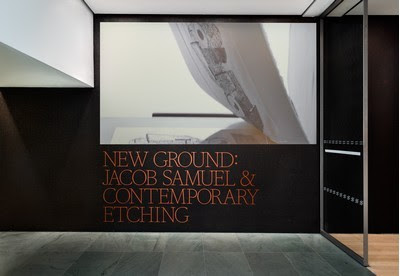
The Museum of Modern Art presents New Ground: Jacob Samuel and Contemporary Etching, a focused exhibition on the work of master printer and publisher Jacob Samuel (American, b. 1951). The exhibition highlights Jacob Samuel’s championing of the foundational printing technique of etching, his innovative approach to collaborating with contemporary artists, and works that push the limits of the medium. MoMA began acquiring works published by Jacob Samuel in 1988 and, three decades later, it holds his entire catalogue of more than 60 projects. New Ground selectively draws from this expansive body of work by a diverse range of artists, including Mona Hatoum, Rebecca Horn, Jannis Kounellis, Wangechi Mutu, Barry McGee, and Christopher Wool.

Over the course of four decades, Jacob Samuel collaborated with more than 60 artists, traveling extensively to do so. Through a traditional but maximally flexible approach, he was driven to prove that etching could be a successful contemporary medium. The exhibition will draw from a range of these collaborative projects. For example, Jacob Samuel made it possible for the artist Rebecca Horn to avoid working in reverse, generally considered a requirement in printmaking, by printing her delicate webs of red lines on custom-made transparent paper, which was ultimately inverted. Moreover, his design and use of a portable aquatint box allowed him to travel to artists’ studios, which allowed Jannis Kounellis to use sculptural processes, not easily transferred to a printshop setting, on copper etching plates. But this belief in traditional processes did not prevent him from embracing other techniques in order to achieve an artist’s vision. Works by Wangechi Mutu and Barry McGee include elements of collage, and are trimmed to the image size, without the expected borders of a printed image. Successive projects with Christopher Wool over the course of over twenty years are particular evidence of a generative partnership. New Ground highlights Jacob Samuel’s breadth of knowledge, historical expertise, and unwavering commitment, which made him an ideal partner for artists new to the medium.

Mona Hatoum
Mona Hatoum 
Untitled from hair there and every where, 2004 
One from a portfolio of ten etchings with chine collé. 
Plate: 7 7/8 x 6 7/8″ (20 x 17.5 cm); 
sheet: 16 x 14″ (40.6 x 35.6 cm). 
Carol and Morton H. Rapp Fund 
The Museum of Modern Art, New York 
© 2022 Mona Hatoum

Charline von Heyl
Charline von Heyl 
Untitled from Black Sun: 
The Brief Transit and Violent Eclipse of Harry Crosby, 2013 
One from a portfolio of eight etchings with drypoint, roulette, 
aquatint, and chine collé. Plate: 7 13/16 × 6 7/8″ (19.9 × 17.4 cm); 
sheet: 16 15/16 × 15″ (43 × 38.1 cm). 
Acquired through the generosity of John Baldessari, 
Catie and Donald Marron, and Mary M. and Sash A. Spencer. 
The Museum of Modern Art, New York. 
© 2022 Charline von Heyl

Jonas Wood
Jonas Wood 
Untitled from 8 Etchings, 2014 
One from a portfolio of eight etchings with chine collé. 
Plate: 8 3/4 × 7 13/16″ (22.3 × 19.9 cm); 
sheet: 15 15/16 × 13 15/16″ (40.5 × 35.4 cm). 
Acquired through the generosity of John Baldessari, 
Catie and Donald Marron, and Mary M. and Sash A. Spencer. 
The Museum of Modern Art, New York. 
© 2022 Jonas Wood

Jacob Damuel - MoMA
Installation view of New Ground: Jacob Samuel 
and Contemporary Etching, on view at 
The Museum of Modern Art from October 29, 2023, 
through March 16, 2024. 
Photo: Jonathan Dorado

Born and raised in Santa Monica, California, JACOB SAMUEL began his career as a master printer for the Abstract Expressionist painter Sam Francis. Having worked extensively on Francis’s monumental, multicolour aquatints for eighteen years, Jacob Samuel was drawn instead to publish a very different type of work under his own name: small scale, serial, and generally printed in a single tone. A continually expanding network of friends and creators made introductions, and Jacob Samuel began to work with some of the most influential artists of the 20th and 21st century. He collaborated with painters, sculptors, performance artists, and musicians to make etchings that reflected their overall artistic practices. Despite the diverse range of artists, certain common themes arise with consideration of Jacob Samuel’s imprint as a whole: the depiction or impression of the body on a printing matrix, for example, or a system of images that unfolds across multiple sheets of paper. Many of the projects include texts written by the artists, a further invitation to close looking. As with everything published by Jacob Samuel, each project has a custom-designed housing that expands the work’s presence into three dimensions. The breadth, variety, and, above all, creativity in the works he published with an exceptional list of artists is evidence of his success in bringing the tradition of old master printmaking to contemporary artistic practices.

The exhibition is accompanied by the first publication dedicated to the work of the master printer Jacob Samuel. The richly illustrated catalogue features an essay by curator Esther Adler, interviews with a dozen of the artists Jacob Samuel has worked with, and a highly researched checklist detailing every project published by Jacob Samuel.

New Ground: Jacob Samuel and Contemporary Etching is organized by Esther Adler, Curator, and Margarita Lizcano Hernandez, Curatorial Assistant, Department of Drawings and Prints.

MoMA - MUSEUM OF MODERN ART
11 West 53 Street, New York, NY 10019

12/11/21

Christiane Baumgartner @ Cristea Roberts Gallery, London - Wish you were here

Christiane Baumgartner 
Wish you were here 
Cristea Roberts Gallery, London 
Through 4 December 2021 

Cristea Roberts Gallery, London, presents a major new body of work by German artist CHRISTIANE BAUMGARTNER (b. 1967), concerned with the movement and the play of light across the horizons of land and sea.

The centrepiece of the exhibition, unveiled for the first time in the UK, is the largest and most ambitious work ever made by Christiane Baumgartner; sequential views of a cascading waterfall, measuring over nine metres in width. Christiane Baumgartner, who combines contemporary technology in the form of digital video and photography alongside time-honoured printing techniques to create monumental woodcuts, is also display her first depictions of a sunrise, and a new series of ‘reverse drawings’ featuring abstract configurations of colour.

The exhibition title originates from a new monumental print by the artist entitled Wish you were here, 2020, that in turn derives from Christiane Baumgartner’s affection for the Baltic coast of Germany, a place where she camped every summer when she was growing up. Wish you were here and related print Weststrand, 2021, which both depict the local skyline, stem from a result of Christiane Baumgartner’s still frequent visits to the coastline, areas of which have more hours of sunlight than any other location in Germany.

At the centre of the exhibition is Stairway to Heaven, 2019, which consists of five monochrome woodcuts derived from photographs Baumgartner took of a large waterfall outside Quebec City, Canada. The depictions of tumbling, cascading, and spraying water, are tightly hung with the horizon lines created by the water’s surface aligned, creating a focal point for the viewer’s eye that also conveys the potentially destructive of this ever-changing natural phenomenon. The woodblocks for this work took several months to complete before Christiane Baumgartner printed the edition, alongside others, by hand, in her studio in the famous Leipzig Cotton Mill in East Germany.

Smaller works in the show include Christiane Baumgartner’s first depictions of a sunrise in Totes Meer, 2021, and Early Morning, 2021, Promise, 2021, which captures sunlight breaking through clouds, The Visit, 2021, which illustrates a bright flash of sunlight reflected on water below, and Prometheus I - III, 2021, a series of three woodcuts that capture different views of the setting sun. Many of Christiane Baumgartner’s prints take the form of sequences of images illustrating the same scene, captured moments apart. Pink Moon, 2019, a series of six woodcuts depicting the moon on the horizon, is taken from stills of a film Christiane Baumgartner recorded whilst driving across a German island in the Baltic Sea, on a late spring evening.

A unique woodcut measuring over two metres in height, from Christiane Baumgartner’s new Contre-jour series, is also displayed in the gallery. The title of the work, which means “against daylight”, refers to a photographic technique in which the camera is pointing directly towards the source of light. This large-scale woodcut records daylight shining through a wooded landscape against a blue backdrop. Christiane Baumgartner’s recent use of colour in her woodcuts, also appears in her etchings and drawings. Over the past two years Christiane Baumgartner has been creating what she describes as ‘reverse drawings.’ To make these the artist inks small wooden blocks with a single colour, presses a piece of Japanese paper onto each surface, and draws on the versos. To make the series Französische Suiten I–VII, 2019, Christiane Baumgartner repeated this process up to twenty times, so that the resulting drawings range in colour from dark and earthy tones to vibrant colours. Französische Suiten I–VII is exhibited alongside a second suite, Ruby Tuesday, from Christiane Baumgartner's 2020 Diaries series.

CRISTEA ROBERTS GALLERY
43 Pall Mall, London SW1Y 5JG
_________________


19/05/19

Georg Baselitz @ Alan Cristea Gallery, London - Devotion

Georg Baselitz: Devotion
Alan Cristea Gallery, London
16 May - 22 June 2019

Devotion is the first major exhibition of prints by German artist Georg Baselitz (b. 1938) to be presented in the UK in over 25 years. The exhibition features 32 etchings based on self-portraits of artists that Georg Baselitz admires or is influenced by, including Frank Auerbach, Cecily Brown, Tracey Emin, Erich Heckel, Ernst Ludwig Kirchner, Joan Mitchell, Robert Rauschenberg, Mark Rothko and Andy Warhol, amongst others. This selection of both Georg Baselitz's predecessors and his peers offer us an insight into the mind of the artist; each self-portrait has been carefully selected and reimagined in Baselitz's own unique style.

Devotion forms part of a wider project which includes paintings and drawings, all on the same subject, inspired by time Georg Baselitz spent at the Kunstmuseum, Basel, preparing for an exhibition in 2018. Here he viewed a full-length portrait of Guillaume Apollinaire and his muse, painted by Henri Rousseau (The Poet and his Muse. Portrait of Guillaume Apollinaire and Marie Laurencin, 1909). Georg Baselitz observed that even a portrait made of another person, is always a self-portrait of the artist; "I have painted a lot of portraits of myself and my wife in recent years, many dressed as others - sometimes as my parents, sometimes as Lenin and Stalin, but mostly as Otto Dix's parents ... Last year I bought a lot of old Italian framed and painted portraits to go in them. In the end I didn't put the portraits into the old frames, but Rousseau's double portrait in Basel in its old painted frame still haunted me. My mind was a jumble of portraits, frames and Rousseau, our anti-realist painter."

Devotion is Georg Baselitz's first exhibition at Alan Cristea Gallery, London. To coincide with the Bienniale di Venezia a major survey of Georg Baselitz's work, curated by Kosme de Barañano, will open at the Gallerie dell'Accademia, Venice, from 8 May - 8 September 2019. This is the first exhibition by a living artist in the museum.

ALAN CRISTEA GALLERY
43 Pall Mall, London SW1Y 5JG
www.alancristea.com

31/12/15

The Etching Revival from Daubigny to Twachtman, Cincinnati Art Museum, Ohio

The Etching Revival from Daubigny to Twachtman 
Cincinnati Art Museum, Ohio
February 13 - May 8, 2016

Charles-François Daubigny
French, 1817-1878
Le Gué, 1865
Etching
Cincinnati Art Museum, Gift of Herbert Greer French
1940.174

Explore the renaissance of etching from the late 1850s through the turn of the century in Europe and the United States with the new Cincinnati Art Museum exhibition The Etching Revival from Daubigny to Twachtman, on view February 13–May 8, 2016. Featuring more than 100 monochromatic prints from dozens of artists, the exhibition also includes a wood etching press from the early 1900s, along with plates and tools used to create the etchings. Etching is one of the first original art movements in America and it played an important role in developing the public’s aesthetic appreciation of the graphic arts. 

Charles Meryon
Charles Meryon
France, 1821-1868
The Admiralty, Paris, 1865
Etching (fifth state)
Cincinnati Art Museum, Bequest of Herbert Greer French
1943.625

The Process
Etching involves using a substance to bite into metal surfaces with acid in order to create a design. Etching was attractive to painters because it allowed them to capture the fleeting effects of nature rapidly with freedom and spontaneity. The process coincided with artist’s desire to work directly from nature, to sketch en plein air to create landscapes and seascapes. 

Ties to Cincinnati
Cincinnatians featured in the exhibition include early etching practitioners Mary Louise McLaughlin, Henry Farny, Lewis Henry Meakin and John Twachtman. Working abroad in the 1880s, Covington, Ky.-born Frank Duveneck and his students, known as the "Duveneck Boys,” pursued etching in Venice with James McNeill Whistler. Some of Duveneck’s gifts will also be featured in the exhibition.

The Cincinnati Etching Club, the second etching club in America after the New York Etching Club, was founded in 1879 and actually gifted a group of prints to the Art Museum in 1882. These etchings were among the first pieces of art acquired by the Art Museum.

Mary Louise McLaughlin
American, 1847-1939
Beeches in Burnet Woods, 1883
Etching
Cincinnati Art Museum, Gift of The Cincinnati Etching Club
1882.257

John Henry Twachtmann
American, 1853-1902
Cincinnati Landscape, 1879-80
Etching
Cincinnati Art Museum, Gift of Frank Duveneck
1917.453

John Henry Twachtmann
John Henry Twachtman
United States, 1853-1902
Snow Landscape, 1879-83
Etching
Cincinnati Art Museum, The Albert P. Strietmann Collection and various funds
1983.24

The Artists and History
The American Etching Revival was inspired by the earlier French and British mid-century etching revivals by Barbizon artists, such as Charles François Daubigny, Camille Corot, and Jean-François Millet, who made preparatory drawings for etchings out of doors to capture natural landscapes and romanticized scenes of peasants at work at the time of the industrial revolution. 

The etchings of Whistler and Sir Francis Seymour Haden influenced the next generation of artists. In 1862, the Society of Etchers organization in France inspired a new generation of independent etchers including Edouard Manet, Charles Meryon, and Maxine Lalanne, and Impressionists Edgar Degas and Mary Cassatt. The success of this movement was fostered in both Europe and America by publishers, artistic printers and critics. 

“It’s fascinating to look at these etchings and to learn the history behind them,” said Cincinnati Art Museum Curator of Prints Kristin Spangenberg. “They showcase an emerging art form and also the very beginnings of the Cincinnati Art Museum’s permanent collection.”

The exhibition, generously supported by the Sutphin Family Foundation, is located on the second floor in the Schiff Gallery (G234). 

The Etching Revival from Daubigny to Twachtman coincides with the Taft Museum of Art’s exhibition, Daubigny, Monet, Van Gogh: Impressions of Landscape (February 20 – May 29, 2016). 

Cincinnati Art Museum, Ohio
www.cincinnatiartmuseum.org

30/06/13

Starting from Scratch: The Art of Etching from Dürer to Dine, Philadelphia Museum of Art

Starting from Scratch: The Art of Etching from Dürer to Dine
Philadelphia Museum of Art 
Through August 11, 2013

The exhibition Starting from Scratch: The Art of Etching from Dürer to Dine showcases some of the Philadelphia Museum of Art’s finest etchings and includes major acquisitions and masterworks, many on display at the Museum for the first time. The exhibition spans five centuries and features prints by major artists—from Rembrandt and Goya to Brice Marden and Kara Walker—that illustrate the many ways artists have embraced this medium to create original and inventive work.

The development of etching is traced from its first use in metal workshops in fifteenth-century Germany to its application by contemporary American artists. Multimedia and interactive elements demonstrate the characteristics of various etching techniques and offer insight into the artist’s process.

Six works by Rembrandt showcase the innovations he brought to the use of the technique, and include Christ Crucified between Two Thieves (The Three Crosses) (1653-55), an important recent acquisition by the Museum. The great French artist Jacques Callot, a seminal figure in the history of etching, is represented by The Siege of Breda (1627), a grand battle map and landscape that is on view at the Museum for the first time.

Rare first edition prints from Giovanni Battista Piranesi’s portfolio Imaginary Prisons (about 1749) illustrate the effects of combining several techniques to create haunting images of mysterious architecture. Other virtuoso displays of technique are presented in Francisco Goya’s series The Proverbs (Los Proverbios) (1819-23), which showcases his revolutionary use of aquatint in imagery that ranges from whimsical to satirical. A series of dark expressionistic images of World War I by Otto Dix exploits the corrosive qualities of the medium to communicate violence and decay.

Etchings by James Abbott McNeill Whistler and Camille Pissarro demonstrate subtle qualities of light and atmosphere. A sense of nineteenth-century Parisian life is captured in prints by Edgar Degas and Mary Cassatt, who shared a mutual interest in experimental etching. Works on display include Edgar Degas’ Mary Cassatt at the Louvre: The Paintings Gallery (1879–80), an etching that he continually reworked and reprinted, creating more than twenty variations of the image.

EDGAR DEGAS
Mary Cassatt at the Louvre: The Paintings Gallery, 1879-80
Hilaire-Germain-Edgar Degas, French, 1834 - 1917. Etching, soft-ground etching, aquatint, and drypoint, Plate: 11 7/8 x 4 15/16 inches (30.2 x 12.5 cm) Sheet: 14 3/16 x 8 3/16 inches (36 x 20.8 cm). 
Philadelphia Museum of Art, Purchased with the John D. McIlhenny Fund, 1941.
Image courtesy of the Philadelphia Museum of Art

Noted artists have often used etching to explore variations on a theme. Featured in the exhibition are four prints from Pablo Picasso’s Vollard Suite (1930-37), in which the artist repeatedly explores themes of attraction and voyeurism through allegories of the mythological Minotaur, the artist’s alter ego. John Marin’s multiple abstract studies of New York’s Woolworth Building from 1913 show his fascination with what was at the time the world’s tallest building. Several versions of the famous skyscraper are on view from the Museum’s master set of Marin prints, the most complete collection in the world. A selection from the Museum’s unparalleled collection of Edward Hopper prints illustrates the development of the artist’s distinctive style.

Jim Dine's Braid (1972), Brice Marden’s Cold Mountain Series, Zen Study 5 (1990), and a print from Kara Walker's 2010 series An Unpeopled Land in Uncharted Waters trace the medium's enduring legacy through to the present day.

Curators: James R. Wehn, Margaret R. Mainwaring Curatorial Fellow of Prints, Drawings, and Photographs; and Shelley R. Langdale, Associate Curator of Prints and Drawings.

Philadelphia Museum of Art 
Muriel and Phillip Berman Gallery
Museum's website: www.philamuseum.org