Showing posts with label George Condo. Show all posts

26/03/25

On Ugliness: Medieval and Contemporary @ Skarstedt London - A rare convergence of paintings, sculptures and photographs spanning the twelfth century to the present day

On Ugliness 
Medieval and Contemporary
Skarstedt London
February 27 – April 26, 2025

Skarstedt London presents On Ugliness: Medieval and Contemporary, a rare convergence of paintings, sculptures and photographs spanning the twelfth century to the present day. Taking its title from Umberto Eco’s seminal publication On Ugliness, this curated presentation examines the grotesque as a universal theme, tracing its evolution across a millennium of artistic output. Four medieval stone heads form the crux of this exhibition, their contorted faces- ranging from grimaces to sneers- serve as a touchstone throughout art history and play a formative role in contemporary interpretations of the grotesque.

The exhibition features work by George Condo, Nicole Eisenman, Jameson Green, Martin Kippenberger, Barbara Kruger, Jacob de Litemont, Pablo Picasso, Stefan Rinck, Pensionante del Saraceni, Cindy Sherman, Thomas Schütte and a selection of unknown artists working between the twelfth and fourteenth centuries.

Although the grotesque has been dismissed and deplored by various critics over the past millennium, it remains a recurrent fascination, continuously re-imagined by each generation. As a result, its etymology is in constant flux. Some argue that the grotesque is a collective tool for conceptualising difference and change, while others see it as a means of liberation, freeing the artist from earthly constraints. Regardless of the motif or iconography, the grotesque reveals aspects of the world that elude comprehension, therefore our experience of the genre should result in bafflement.

The most prevalent expression of the grotesque is through metamorphosis or hybridity – a motif discovered in the Roman Emperor Nero’s Villa Aurea upon its excavation in the fifteenth century. The ornamental scenes, later dubbed grottesche (‘from a cave’) captivated artists from Raphael to Pablo Picasso, who revelled in hybridity - first understood through his early proto-cubist works. During this period, he experimented with fragmentation and metamorphosis as exemplified in Tête de femme (1908), an exquisite drawing inspired by African and Iberian artefacts. Similarly, Nicole Eisenman explores corporeal distortion in Maquette: Sketch for a Fountain (Reclining Figure) (2019), where the figure’s exaggerated limbs merge into an amorphous whole. Whilst not traditionally beautiful, Eisenman imbues a serene reverie into the figure, originally conceived for a body of water.

George Condo and Jameson Green embrace metamorphosis, using it as a vehicle for anthropological exploration. Condo’s self-declared 'psychological cubism' dissects the human psyche through fragmentation and distortion, revealing its most sensitive aspects. In Study for Metamorphosis I (2006), the protagonist possesses an undeniably human spirit despite her animalistic appearance, while the compositional techniques pay homage to portraiture masters like Rembrandt and Velazquez. On the other hand, Jameson Green’s Head Study #26 (2024) is morphed beyond recognition, using an imagined hybrid creature to confront the challenging themes of racism and corruption.

The grotesque is deeply rooted in art history, yet it defies the ideals of harmony, proportion, and beauty. This is epitomised by Thomas Schütte’s landmark Wicht series (2006), a collection of twelve grotesque heads, of which one is featured. The bronze head, mounted high on a steel console, explores the complexities of the human condition, recalling the distorted medieval stone heads included in this exhibition. Often tucked under roofs, cornices, or atop columns in ecclesiastical buildings, these grotesque heads contrast with the serene saints and apostles that adorn the same spaces. Their exaggerated expressions lend them an air of irreverence, prompting James Lingwood to compare Schütte’s Wicht figures to ‘gargoyles looking down from the sides of medieval cathedrals.’[1] While their original purpose remains uncertain, some scholars interpret them as marginal jokes, lightening the solemnity of religious settings, others view them as caricatures or evil spirits. Regardless of intent, they have been described as ‘the most original physiognomic inventions of the art of the Middle Ages.’[2]

Stefan Rinck’s small-scale contemporary carvings engage with this same grotesque tradition, echoing the hybrid, exaggerated forms of the medieval heads. Carved from natural materials like sandstone or diabase, Rinck’s sculptures mimic the rough-hewn textures of their medieval counterparts, instilling a sense of permanence in his creations. His practice also draws on medieval illustrated encyclopaedias known as bestiaries, which catalogue real and imaginary animals, further rooting his work in the visual and conceptual language of the Middle Ages.

During the medieval period, expressive faces were linked to sin, while an ordered, expressionless face reflected discipline and morality. Conversely, Renaissance and Baroque artists sought to capture the essence of the individual, often at the expense of beauty. With the rise of humanist philosophy in the fourteenth century, the artistic focus shifted from the divine to the human epitomised through an exceptionally rare portrait of King Louis XI of France (circa 1469), attributed to Jacob de Litemont. King Louis XI’s profile is starkly contrasted against a dark background, with his regal status signified by a rich red velvet robe. Nevertheless, his face is unidealised, marked by a crooked nose, heavy features, and baggy eyes. Devoid of flattery, this harsh portrayal reflects the period’s tendency to depict sovereigns with a ‘disarming and intimate sincerity.’[3] The shift towards naturalism intensified in the seventeenth century with Caravaggio’s radical use of live models and violent scenes. Followers like Pensionante del Saraceni (active in Rome circa 1610) emulated his work, particularly in A Boy Being Bitten by a Freshwater Crayfish, embracing his aptitude for theatrical, violent imagery.

The transition towards naturalism paved the way for social satire, as seen in the works of Martin Kippenberger, Cindy Sherman, and Barbara Kruger. Developed in the nineteenth century, it remained a potent force in fine art and popular culture, influencing Kippenberger’s sardonic critique of the artist and art market. His provocative sculpture Fred the Frog Rings the Bell (1990) depicts a crucified frog, his alter-ego, externalising the existential anxiety of exhibiting one’s work. While Kippenberger’s grotesque satire reflects personal turmoil, Sherman and Kruger use unsettling imagery to explore identity politics. In Untitled #140 (1985) from the Fairy Tale series, Cindy Sherman transforms into a pig, exposing what lies behind a polished façade. The self, she suggests, is a stage, shaped through metamorphosis. On the other hand, Barbara Kruger’s Untitled (Striped 2) (2019) overlays a disturbed male face with declarative statements, using monumental scale and advertising techniques to expose the power structures behind identity, desire, and consumerism.

Each work on view simultaneously delights and disgusts, confronting the viewer with distorted faces, surreal imagery, and hybrid forms, oscillating between the hellish and the carnivalesque. On Ugliness highlights the power of the grotesque to defy artistic conventions through exaggeration, fragmentation, and metamorphosis—an enduring genre that has captivated civilisations throughout history.

[1] James Lingwood, quoted in Public/Political: Thomas Schütte, Germany 2012, p. 157.
[2] C. Little, Set in Stone: The Face in Medieval Sculpture, New Haven and London, Yale University Press, p.5.
[3] J. Dupont, ‘A Portrait of Louis II Attributed to Jean Perréal’, The Burlington Magazine, 1947, vol. 89, p. 236.

SKARSTEDT LONDON
8 Bennet Street, London SW1A 1RP

24/01/25

George Condo @ Hauser & Wirth and Sprüth Magers, New York City - "Pastels" Exhibition

George Condo: Pastels
Sprüth Magers New York
29 January – 1 March 2025
Hauser & Wirth New York
29 January – 12 April 2025

GEORGE CONDO
Abstract Male Portrait, 2024
Acrylic, pastel and metallic paint on paper
203.2 x 198.1 cm / 80 x 78 in
Photo: Thomas Barratt
© George Condo
Courtesy the artist and Hauser & Wirth

GEORGE CONDO
The Redhead, 2024
Acrylic and pastel on paper
198.1 x 152.4 cm / 78 x 60 in
Photo: Matt Grubb
© George Condo
Courtesy the artist and Hauser & Wirth

GEORGE CONDO
Collision Course, 2024
Acrylic and pastel on paper
198.1 x 152.4 cm / 78 x 60 in
Photo: Thomas Barratt
© George Condo
Courtesy the artist and Hauser & Wirth

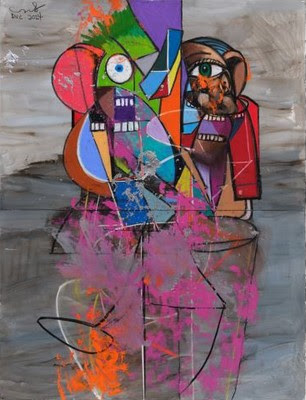
George Condo’s two-part exhibition, ‘Pastels,’ spanning galleries at both Sprüth Magers and Hauser & Wirth in New York City, offers a glimpse into the artist’s creative process and unbound inventiveness through the medium of pastel. Condo’s new works challenge the limits of improvisation within this medium—spontaneously deploying gesso, fields of color and dramatic pastel gestures, all without the benefit of preparatory sketches—to express various states of the human psyche. The artist embraces the act of abstraction within a figural framework in novel ways, materializing the fragmented, elusive nature of ineffable thoughts and feelings. 

Together, these complementary presentations highlight the sui generis power of Condo’s oeuvre. The presentation at Hauser & Wirth comprises a new series of puzzle-like portraits, which the artist has dubbed his ‘bizarre characters,’ their visages simultaneously splintered and affixed by bright geometric planes. The jagged electricity created by the faceted compositions of these works signals the complex and often conflicted nature of the mind. 

At Sprüth Magers, George Condo presents frenzied color compositions alongside a series of new black-and-white pastels that incorporate deliberate drips and spatters of colored pigment. Here, overlapping and intersecting shapes that might typically suggest figurative elements forego any reference to the human face, emphasizing instead the gesture, line and rhythm of their making. With such titles as Centrifuge, Open Forms, No Direction Home, and Chaotic Combustion, these recent paintings evoke fluidity and tumult—Condo’s reflection, perhaps, on his ricocheting innermost feelings and thoughts. 

Taken together, the works across both locations form a visual essay on the flair and diversity of Condo’s draftsmanship, exceptional sense of color, and mastery of any material. 

GEORGE CONDO - BIOGRAPHY

Born in Concord, New Hampshire in 1957, George Condo lives and works in New York City. He studied Art History and Music Theory at the University of Massachusetts in Lowell before relocating to New York, where he worked as a printer for Andy Warhol. In 1985, George Condo moved to Paris, subsequently spending a decade moving between New York and Europe. During this period, Condo invented his hallmark ‘artificial realism’ and made his first foray into sculpture. His 11ft gold leaf sculpture ‘Constellation of Voices’ (2019) was recently acquired as a permanent gift to The Metropolitan Opera House in Lincoln Center for the Performing Arts.

George Condo’s work has appeared in a number of solo exhibitions including ‘Confrontation’ in 2016 at the Staatliche Museen zu Berlin – Museum Berggruen in Berlin, Germany. In this exhibition, work by George Condo was presented alongside some of his major art historical reference points: masterpieces by Cézanne, Picasso, Matisse, Klee and Giacometti. From 2011 – 2012, a mid-career survey of Condo’s portraiture entitled ‘Mental States’ travelled from the New Museum, New York to the Museum Boijmans Van Beuningen, Rotterdam, Netherlands, Hayward Gallery, London, United Kingdom, and Schirn Kunsthalle, Frankfurt, Germany. Condo’s work can be found in numerous renowned public collections internationally: Centre Georges Pompidou, Paris, France; Tate Modern, London, United Kingdom; The Broad Collection, Los Angeles CA; The Metropolitan Museum of Art, New York NY; The Museum of Modern Art, New York NY; The Solomon R. Guggenheim Museum, New York NY; and the Whitney Museum of American Art, New York NY among many others. In fall 2025, George Condo will be the subject of a major solo exhibition at Le Musée d’Art Moderne de Paris.

HAUSER & WIRTH NEW YORK
134 Wooster Street, New York City

SPRÜTH MAGERS NEW YORK
22 E 80th Street, New York City

19/02/23

George Condo @ Hauser & Wirth West Hollywood - People Are Strange

George Condo: People Are Strange 
Hauser & Wirth West Hollywood 
15 February – 22 April 2023 

George Condo
GEORGE CONDO 
Transitional Portrait in Turquoise and Gold, 2022 
Acrylic, metallic paint and oil stick on linen 
300.7 x 267.3 x 3.8 cm / 118 3/8 x 105 1/4 x 1 1/2 in 
© George Condo 
Courtesy the artist and Hauser & Wirth 
Photo: Thomas Barratt 

George Condo
GEORGE CONDO 
Psycho, 2022 
Oil on linen 
228.6 x 215.9 cm / 90 x 85 in 
© George Condo 
Courtesy the artist and Hauser & Wirth 
Photo: Thomas Barratt 

George Condo inaugurates the newly established Hauser and Wirth's West Hollywood gallery with his first exhibition in LA in nearly five years. With the exhibition’s title ‘People Are Strange,’ taken from the hit 1967 song of the same name by legendary – and quintessentially Los Angeles – band The Doors, George Condo’s latest canvases are filled with fragmented portraits and abstractions, suggesting a world of oppositional forces and states, at once connected and entropic, logical and ineffable, beautiful and ugly.

In their ability to convey deep contradictions through George Condo’s mastery of the medium of painting, the canvases on view painted in New York City over the past year and a half are a reconstructive body of work involving both harsh lines and melodic painterly passages – and which characterize the dividing forces of modern life everywhere.

George Condo has said that the exhibition’s title, ‘People Are Strange,’ references ‘the effect of the divisive politics of our time that have created a fractured society. In these works I put together the broken pieces and fragmented aspects of that division to intentionally point out the question: is it that people are strange or is it the politicians that are in fact strange, thus resulting in a maelstrom of dehumanized and disenchanted people who as a result have become strange….even to themselves.’

‘People Are Strange’ offers impressions of the strange world around him and, in doing so, captures something universal about the transforming effects of time’s passage as it pertains to the time-lapse we have all lived through during the pandemic.

Filling the sweeping expanse of Hauser & Wirth’s new West Hollywood gallery, housed in a 1930s Spanish Colonial Revival building redolent of Hollywood’s Golden Age, the works on view present George Condo’s latest explorations in scale and the painterly process. While seemingly disparate upon first glance, these new paintings are united by a central theme of transformation: they succeed in representing temporality both in the built-up, layered stages of their construction, and in the chimerical effects of the figures that inhabit them. Each work embodies its own logical chaos, at once disorderly and intact, which speaks to the fractured nature of our contemporary moment and indirectly references the ever-changing conflicts in the world. According to George Condo, the artist is uniquely equipped to translate the ineffable effects of time, acknowledging that ‘the transformation of society and people is something we all feel but that a painter can actually show.’

George Condo
GEORGE CONDO
Transformation, 2022
Acrylic, oil stick, and metallic paint on linen
228.6 x 647.7 cm / 90 x 255 in
© George Condo
Courtesy the artist and Hauser & Wirth
Photo: Thomas Barratt

A centerpiece of the exhibition is the large-scale triptych ‘Transformation’ (2022). The frenetic energy of the work is echoed in this vivid tableau, which features a frenzied picture of undulating forms punctuated by the interaction of figures coalescing and diverging on the surface of the canvas. Condo’s subject is the effects of increasing isolation that pulls individuals away from one another, fraying and fracturing community, and society. The amount of time required to create such a work – the ongoing process of laying down line and color, and of removing, adding, repeating the process – is more consuming than the final images might suggest. Time itself thus becomes a material and a central theme of the show.

Inspired by the way literature can track the passage of time and its effects on the reader, Condo has created a trio of large-scale portraits of female muses, erudite and canonical. Each of these is dominated by a color that conveys mood with an iconographic intensity. For example, ‘Transitional Portrait in Turquoise and Gold’ (2022) depicts within its single frame, where the image is read from left to right, the collapsing of time in the passage of a life. The effect of the work is that of a time-lapse film. Condo observes, ‘The irony is, that as we age, we get younger in our minds and spirits, even though the external view of us is completely different than what’s in our heads. The tragic and the beautiful come together when perceived from the perspective of the viewer.’

George Condo
GEORGE CONDO
Constellation II, 2022
Aluminium, gold leaf
Ed. of 10, 2 AP
78.7 x 55.3 x 52.7 cm / 31 x 21 3/4 x 20 3/4 in
© George Condo
Courtesy the artist and Hauser & Wirth
Photo: Thomas Barratt

Condo’s embrace of the possibilities of paint to record the passage of time is further extended into three-dimensional form with the debut of the new sculpture ‘Constellation II’ (2022). A variation of ‘Constellation for Voices’ (2019), his monumental 11-foot-tall sculpture installed at Lincoln Center in New York City, this work similarly comprises a multifaceted gold head that fuses human and alien parts into a single composition – a dialectical harmonization of differing forms. Simultaneously evoking ancient deities and modern man, ‘Constellation II’ collages a group of angles and forms together in a such way that the final fixed object vibrates as if animated. By reaching for an effect that the artist describes as ‘spatial and ethereal and galactic,’ ‘Constellation II’ presents viewers with the notion that limitlessness and a lack of fixity are, for better and for worse, the human condition.

Concurrent with the exhibition at Hauser & Wirth West Hollywood, the Morgan Library & Museum in New York City will present ‘Entrance to the Mind: Drawings by George Condo,’ featuring 28 works on paper that provide a unique overview of George Condo’s drawing practice over the last 45 years. This March in Europe, an exhibition titled ‘Humanoids,’ curated by Didier Ottinger, will be held at the Nouveau Musée National de Monaco – Villa Paloma.

GEORGE CONDO

Born in Concord, New Hampshire in 1957, George Condo lives and works in New York City. He studied Art History and Music Theory at the University of Massachusetts in Lowell before relocating to New York, where he worked as a printer for Andy Warhol. In 1985, Condo moved to Paris, subsequently spending a decade moving between New York and Europe. During this period, Condo invented his hallmark ‘artificial realism’ and made his first foray into sculpture. His 11ft gold leaf sculpture ‘Constellation of Voices’ (2019) was recently acquired as a permanent gift to The Metropolitan Opera House in Lincoln Center for the Performing Arts.

George Condo’s work has appeared in a number of solo exhibitions including ‘Confrontation’ in 2016 at the Staatliche Museen zu Berlin – Museum Berggruen in Berlin, Germany. In this exhibition work by Condo was presented alongside some of his major art historical reference points: masterpieces by Cézanne, Picasso, Matisse, Klee and Giacometti. From 2011–2012 a mid-career survey of Condo’s portraiture entitled ‘Mental States’ travelled from the New Museum, New York to the Museum Boijmans Van Beuningen, Rotterdam, Netherlands, Hayward Gallery, London, United Kingdom, and Schirn Kunsthalle, Frankfurt, Germany.

In addition to this, George Condo’s work has appeared in numerous biennials internationally, including the Venice Biennale in 2019 and 2013, the 13th Biennale de Lyon in 2015, the 10th Gwangju Biennale in 2014 and the 2010 and 1987 iterations of the Whitney Biennial among others. Condo’s work can be found in numerous renowned public collections internationally: Centre Georges Pompidou, Paris, France; Tate Modern, London, United Kingdom; The Broad Collection, Los Angeles CA; The Metropolitan Museum of Art, New York; The Museum of Modern Art, New York; The Solomon R. Guggenheim Museum, New York NY; and the Whitney Museum of American Art, New York among many others.

HAUSER & WIRTH WEST HOLLYWOOD
8980 Santa Monica Boulevard, West Hollywood, CA 90069