Showing posts with label Howardena Pindell. Show all posts

04/12/23

Tales of Brave Ulysses @ Garth Greenan Gallery & Van Doren Waxter, NYC - With Al Loving, Howardena Pindell, Alan Shields, Richard Van Buren

Tales of Brave Ulysses 
Al Loving, Howardena Pindell, Alan Shields, Richard Van Buhren
Garth Greenan Gallery, NYC 
Through December 16, 2023
Van Doren Waxter, NYC 
Through December 22, 2023

Garth Greenan Gallery and Van Doren Waxter present Tales of Brave Ulysses, a two-venue exhibition which explores the personal and working relationships of four prominent Post-War American artists: Al Loving, Howardena Pindell, Alan Shields, and Richard Van Buren.

During the late 1960s and early 1970s, the dominant art world ideology of formalist abstraction, with its roots in Abstract Expressionism and Minimalism, was being challenged by a new generation of artists. Centered in downtown New York, their artistic and moral values were tempered by the intense social and political struggles of the day. Eschewing Minimalism’s impersonal methods and dogmatic prescriptions, these four artists instead embraced craft and process— cutting, sewing, tacking, and pouring— upending traditional distinctions between media and rethinking established roles of artist and viewer. Loving, Pindell, Shields, and Van Buren were at the vanguard of this material revolution in contemporary art, a loosely defined artistic movement since referred to by critics as Post-Minimalism or New Informalism.

In the midst of this radical upheaval in art practice and criticism, these four artists forged an enduring personal and creative bond. While deeply influencing each other in both spirit and in style, each artist nevertheless maintained a distinctly singular voice and practice.

From the late 1960s onwards, Shields’s studio served as a frequent gathering place. He was famous for his boisterous persona and uncanny ability to do high-quality work while in the company of friends, behavior which aptly earned him the moniker, “Mr. Partytime.” This sensibility is reflected in his colorful large-scale installation, Maze (1981-1982), constructed of painted aluminum piping wrapped with vibrantly dyed and sewn canvases. One could interpret such a work as a playful riff on Minimalist predecessors, like Tony Smith’s imposing geometric monochrome Maze from 1967.

The artists’ individual relationships had their own flavor and function. Shields and Loving often had protracted conversations about art and art history. Shields and Van Buren, by contrast, almost never discussed art, save for the occasional shop talk about dealers and galleries. Despite the amount of time these four artists spent together, their visual lexicons would remain highly distinct.

Many of these artists describe influence as if it were occurring beneath the work itself, at a foundational level. “Influences are who you spend your time with,” Van Buren has said. The group always supported each other with camaraderie and good humor. Their differing sensibilities continuously demonstrated new possibilities for their individual practices. Van Buren— who notes that a family member’s intrusion into the studio during work hours can launch him into a “complete state of fear”—still tries to channel Shields’s preternatural ease in the studio. In a 1975 interview with Shields, originally published in The Print Collector’s Newsletter, Pindell broached what she called the “hostile question” directly, asking him which artists he admired. He quipped that it was H.C. Westermann, primarily for his acrobatic ability to “walk on his hands.” Clarifying his cryptic response, Shields went on to describe the enigmatic character of influence as something stemming from residual feelings one gets from another’s work—feelings that can be played with for a time, but not so long as to fundamentally alter one’s own personal expression.

Nevertheless, it would be impossible to deny obvious parallels among these artists’ respective crafts. Canvases have been freed from their rigid stretchers, which we see both in Pindell’s early monochromatic painting Untitled (1976) as well as in Shields’s Space Sisters (1972-1974). Some works recast the iconic Minimalist grid in new light, like Pindell’s cut-and- sewn painting Untitled #24 (1978-1979), Loving’s vivid quilted painting, Square (1973-1974), or Shields’s monumental delicately-threaded painting Hart Sunkist Lie (1969). One might say the same of Van Buren’s sculptural installation Untitled (1969/2023), where scintillating globs of translucent polyester are hung from the wall in orderly but irregular rows from bundles of fiberglass strands, like organic specimens in some scientist’s lab.

According to art historian Jenni Sorkin, for several of these artists, “embracing the historically low status of textiles was a way to reclaim personal histories and embed individual artistic practices with sublimated narrative content.” For Pindell and Loving in particular, craft was often seen also as a stand-in for race or gender, which would become major contexts for showcasing their work.

The Whitney Museum of American Art was a singular institution in facilitating these discourses. In 1969 and 1970 the museum acquired two of Shields’s works, and in 1969 he was included in their annual exhibition, the same year as his solo show at Paula Cooper Gallery. Loving had his first solo exhibition of hard-edge paintings at the museum from December 1969 to January 1970, a body of work he would soon abandon. Feeling constrained formally and conceptually, and feeling his work neglected to reflect his lived experience, Loving tore up his geometric canvases before stitching them back together again in improvised compositions. This act would catalyze an aesthetic he retained for the rest of his career, exemplified by iconic paintings such as Untitled (1973). Despite enjoying similar early success with his Minimalist sculpture, Van Buren would soon abandon it, producing delicate cast polyester sculptures that demonstrate a persistent fascination with chance, process, and the generative capacity of art. In 1971, Loving and Pindell would both be included in the Whitney’s controversial exhibition, Contemporary Black Artists in America, and the following year, Pindell, Loving, and Shields would appear together in the museum’s annual exhibition.

While New York City played a formative role for all of these artists, in the early 1980s Van Buren and Shields would leave the city for secluded Maine and Shelter Island, respectively. Nevertheless, their mutual creative and personal bonds would persist for decades.

Garth Greenan Gallery represents Howardena Pindell, Richard Van Buren, and the Estate of Al Loving. Van Doren Waxter represents the Estate of Alan Shields.

Tales of Brave Ulysses
Al Loving, Howardena Pindell, Alan Shields, Richard Van Buren
Van Doren Waxter and Garth Greenan Gallery co-published a fully illustrated catalogue to accompany the exhibition Tales of Brave Ulysses with two essays by Sarah Cowan (Assistant Professor of Art and Art History at DePauw University and author of Howardena Pindell: Reclaiming Abstraction, Yale University Press, 2022) and Amy Rahn (Assistant Professor of Art History at the University of Maine at Augusta). ISBN: 978-0-9988755-4-5 - Softcover: 248 pages

GARTH GREENAN GALLERY
545 West 20th Street, New York, NY 10011

VAN DOREN WAXTER
23 East 73rd Street, New York, NY 10021

Tales of Brave Ulysses - Opened November 9, 2023

15/10/22

Howardena Pindell @ Garth Greenan Gallery, NYC

Howardena Pindell
Garth Greenan Gallery, New York
September 15 – October 29, 2022

Howardena Pindell
HOWARDENA PINDELL
Untitled #7 (Carnival, Bahia Brazil), 2022
Mixed media on canvas, 86 x 86 inches
© Howardena Pindell, Courtesy Garth Greenan Gallery

Garth Greenan Gallery presents a selection of mixed media works by Howardena Pindell, all made between 2021 and 2022. The exhibition features several recent paintings, as well as a selection of works on paper from her recent residency at Dieu Donné. A catalog, jointly published by Garth Greenan Gallery and Dieu Donné, accompanies the exhibition.

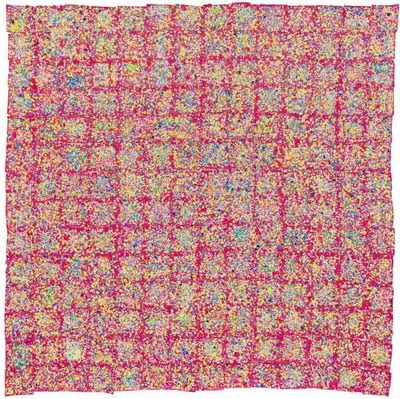
Untitled #7 (Carnival, Bahia, Brazil) (2022), like many of Howardena Pindell’s cut and sewn paintings of the last decade, is a celebration of color. Though the painting is unified by an expanse of fiery magenta, the saturated color of buried forms penetrates the monochromatic paint. Pindell’s iconic punched paper dots grace the surface with raw bursts of vivid color. The monumental work marks the artist’s return to the grid—a theme of particular interest to Howardena Pindell in the ’70s. The thick underlying surface occasionally ruptures, revealing the matrix of cut and sewn canvas below.

Howardena Pindell’s works produced during her recent paper making residency at Dieu Donné parallel the larger paintings—revisiting themes and techniques with renewed creativity and excitement that the artist first explored in the ’70s. Just as she deconstructs and reconstructs canvases through cutting and sewing, Pindell has embraced papermaking techniques as a way of circumventing the conventional treatment of the material as a two-dimensional surface, enabling an interplay of fore- and background, between subject and media. In Untitled #47 (2021), for example, Pindell meticulously places numbered chads into an embedded grid, layering translucent abaca paper on top, burying the chads into the surface as she often does in her dense painted surfaces.

Like her cut and sewn works, Howardena Pindell’s handmade papers take on new forms, suggesting new, idiosyncratic logical structures. In Untitled #21 (2021), the artist stencils layers of numerical symbols onto a loosely circular cotton paper. Each layer of numbers is, on its own, orderly, conforming to a uniform grid. But Pindell resets each layer with its own grid, scale, and color. Their legibility as number sets deteriorates, forming a mesmerizing dance of pattern and color.

Born in Philadelphia in 1943, Howardena Pindell studied painting at Boston University and Yale University School of Art and Architecture. After graduating, she accepted a position at the Museum of Modern Art, New York, where she worked for 12 years (1967–1979). She held the role of Exhibition Assistant in the Department of Circulating National and International Exhibitions, before transitioning to the Department of Prints and Illustrated Books, where she worked as a Curatorial Assistant, Assistant Curator, and finally as the Associate Curator and Acting Director. In 1979, she began teaching at the State University of New York, Stony Brook, where she is now a Distinguished Professor of Art.

Throughout her career, Pindell has exhibited extensively. Notable solo exhibitions include Spelman College (1971, 2015, Atlanta), A.I.R. Gallery (1973, 1983, New York), Just Above Midtown (1977, New York), Lerner-Heller Gallery (1980, 1981, New York), The Studio Museum in Harlem (1986, New York), Wadsworth Atheneum (1989, Hartford), Cyrus Gallery (1989, New York), G.R. N’Namdi Gallery (1992, 1995, 1996, 2000, 2002, 2006, Chicago, Detroit, and New York), Garth Greenan Gallery (2014, 2017, 2019, New York), and Victoria Miro (2019, London).

Her work has also featured in many landmark museum exhibitions, such as Contemporary Black Artists in America (1971, Whitney Museum of American Art, New York), Rooms (1976, P.S.1 Contemporary Art Center, New York), Another Generation (1979, The Studio Museum in Harlem, New York), Afro-American Abstraction (1980, P.S.1 Contemporary Art Center, New York), The Decade Show: Frameworks of Identity in the 1980s (1990, New Museum of Contemporary Art, New York), Bearing Witness: Contemporary Works by African-American Women Artists (1996, Spelman College Museum of Fine Art, Atlanta), Energy/Experimentation: Black Artists and Abstraction, 1964–1980 (2006, The Studio Museum in Harlem), High Times, Hard Times: New York Painting, 1967–1975 (2006, Weatherspoon Art Museum, University of North Carolina, Greensboro), WACK! Art and the Feminist Revolution (2007, Museum of Contemporary Art, Los Angeles), Target Practice: Painting Under Attack, 1949–1978 (2009, Seattle Art Museum, Seattle), Black in the Abstract: Part I, Epistrophy (2013, Contemporary Arts Museum, Houston), We Wanted a Revolution: Black Radical Women, 1965–1985 (2017– 2018, Brooklyn Museum, New York; California African American Museum, Los Angeles; Institute of Contemporary Art, Boston), Magnetic Fields: Expanding American Abstraction (2017–2018, Kemper Museum of Contemporary Art, Kansas City, Missouri; National Museum of Women in the Arts, Washington, D.C.; Museum of Fine Arts, St. Petersburg, Florida), Delirious: Art at the Limits of Reason, 1950–1980 (2017–2018, Metropolitan Museum of Art, New York), Soul of a Nation: Art in the Age of Black Power (2017–2019, Tate Modern, London; Crystal Bridges Museum of American Art, Bentonville, Arkansas; Brooklyn Museum, New York), and Outliers and American Vanguard Art (2018–2019, National Gallery of Art, Washington, D.C.; High Museum of Art, Atlanta; Los Angeles County Museum of Art, Los Angeles). In 2018, Pindell was the subject of a major retrospective, Howardena Pindell: What Remains To Be Seen, which originated at the Museum of Contemporary Art, Chicago, and traveled to the Virginia Museum of Fine Arts and the Rose Art Museum, Brandeis University, through 2019.

The major traveling exhibition Howardena Pindell: A New Language, which opened at Fruitmarket (November 13, 2021–May 2, 2022, Edinburgh, UK), is currently on view at Kettle’s Yard (July 2–October 30, 2022, Cambridge University, Cambridge, UK), and will travel to both Spike Island (February 3–May 7, 2023, Bristol, UK) and the Irish Museum of Modern Art (June 29–November 5, 2023, Dublin, Ireland).

Howardena Pindell is the recipient of numerous awards and honors. In 2019, she was awarded the Archives of American Art Medal by the Smithsonian Institution, the Artist Legacy Foundation 2019 Award, and the College Art Association 2019 Distinguished Artist Award for Lifetime Achievement.

Howardena Pindell’s work is in the permanent collections of major museums internationally, including the Fogg Museum, Harvard University; the Louisiana Museum of Modern Art, Copenhagen; the Metropolitan Museum of Art, New York; the Museum of Contemporary Art, Chicago; the Museum of Fine Arts, Boston; the Museum of Modern Art, New York; the National Gallery of Art, Washington, D.C.; the Philadelphia Museum of Art; the Princeton University Art Museum; the Rose Art Museum, Brandeis University; The Studio Museum in Harlem; the Virginia Museum of Fine Arts, Richmond; the Wadsworth Atheneum, Hartford; the Walker Art Center, Minneapolis; and the Whitney Museum of American Art, New York.

Garth Greenan Gallery represents Howardena Pindell.

GARTH GREENAN GALLERY
545 West 20th Street, New York, NY 10011 

14/10/22

52 Artists: A Feminist Milestone @ Aldrich Contemporary Art Museum, Ridgefield

52 Artists: A Feminist Milestone
Aldrich Contemporary Art Museum, Ridgefield
June 6, 2022 - January 8, 2023

Tourmaline
Tourmaline
Coral Hairstreak, 2020
Dye sublimation print, 29 ½” × 30”
Courtesy of the artist and Chapter NY, New York. 
Photo: Dario Lasagni. 

Erin M. Riley
Erin M. Riley 
Webcam 2, 2020
Wool, cotton, 72” x 100”
Courtesy of the artist and P·P·O·W, New York. 

Stella Zhong
Stella Zhong
Every Other Chopped, 2021
81” x 68” x 65”, Epoxy putty, air dry clay, wire, grout, aqua resin, 
tint, sand, epoxy, paint, plaster, foam, wood, ball bearing 
Courtesy of the artist and Chapter NY, New York.

The Aldrich Contemporary Art Museum presents 52 Artists: A Feminist Milestone. The exhibition celebrates the fifty-first anniversary of the historic exhibition Twenty Six Contemporary Women Artists, curated by Lucy R. Lippard and presented at The Aldrich Contemporary Art Museum in 1971. 52 Artists showcases work by the artists included in the original 1971 exhibition, alongside a new roster of twenty-six female identifying or nonbinary emerging artists that were born in or after 1980, tracking the evolution of feminist art practices over the past five decades. The new generation of artists included in the exhibition are:

Leilah Babirye (b. 1985)
Phoebe Berglund (b. 1980)
LaKela Brown (b. 1982)
Lea Cetera (b. 1983)
Susan Chen (b. 1992)
Pamela Council (b. 1986)
Lizania Cruz (b. 1983)
Florencia Escudero (b. 1987)
Alanna Fields (b. 1990)
Emilie L. Gossiaux (b. 1989)
Ilana Harris-Babou (b. 1991)
Loie Hollowell (b. 1983)
Maryam Hoseini (b. 1988)
Levy (b. 1991)
Amaryllis DeJesus Moleski (b. 1985)
Catalina Ouyang (b. 1993)
Anna Park (b. 1996)
Erin M. Riley (b. 1985)
LJ Roberts (b. 1980)
Aya Rodriguez-Izumi (b. 1986)
Aliza Shvarts (b. 1986)
Astrid Terrazas (b. 1996)
Tourmaline (b. 1983)
Rachel Eulena Williams (b. 1991)
Kiyan Williams (b. 1991)
Stella Zhong (b. 1993)

The new artists, who are all based in New York City, have not had a major solo museum exhibition in the United States as of March 1, 2022, aligning both with The Aldrich’s mission of representing the
work of emerging artists and with Lippard’s original mandate for the 1971 exhibition. 

“This group of 26 emerging artists reflect the revolutionary advancement of feminist art practices over half a century and exhibit a diversity of experiences and a multiplicity of sensibilities united by a twenty-first century feminist expression that is inclusive, expansive, elastic, and free,” said The Aldrich’s Senior Curator Amy Smith-Stewart, who curated the contemporary selection. 

52 Artists encompass the entirety of the Museum (approx. 8,000 sq. ft)—the first exhibition to do so since The Aldrich’s new building was inaugurated in 2004. The exhibition is organized by The Aldrich’s Senior Curator Amy Smith-Stewart and independent curator Alexandra Schwartz, with The Aldrich’s Curatorial Assistant Caitlin Monachino.

“52 Artists: A Feminist Milestone is one of our most ambitious exhibitions to date,” said Cybele Maylone, Executive Director of The Aldrich Contemporary Art Museum. “Th exhibition charts the Museum’s commitment to emerging and underrepresented artists over time and offers an unparalleled opportunity for vital scholarship about the historic legacy of the 1971 exhibition. We are delighted to bring together this exceptional roster of artists for this timely and important show.”

On view at The Aldrich from April 18 to June 13, 1971, Twenty Six Contemporary Women Artists was organized by writer, art critic, activist, and curator Lucy R. Lippard, who viewed curating this landmark exhibition as an activist gesture. In its catalogue, she states: “I took on this show because I knew there were many women artists whose work was as good or better than that currently being shown, but who, because of the prevailingly discriminatory policies of most galleries and museums, can rarely get anyone to visit their studios or take them as seriously as their male counterparts.” With this exhibition, Lucy R. Lippard arguably founded feminist curatorial practice in the USA.

52 Artists surveys this landmark exhibition, including works of art from the original exhibition and recreations of some of the more ephemeral pieces, and, if neither are available, related works from the same period. The exhibition also includes recent works by many of the original artists, examining how their practices have evolved over the past fifty years. By showing the original group alongside emerging artists of today, the exhibition testifies both to the historic impact of Lucy R. Lippard’s milestone exhibition and the influence of the original twenty-six artists she presented at The Aldrich on a new generation of artists.

Merrill Wagner
Merrill Wagner 
Untitled, 1969 
Courtesy of the artist and David Zwirner, New York 

Merrill Wagner
Merrill Wagner 
Inlet, 2010 
Courtesy of the artist and David Zwirner, New York 

Lucy Lippard’s original 1971 exhibition at The Aldrich was one of the first institutional responses to the issue of women artists’ invisibility in museums and galleries. More specifically, the show offered a rejoinder to the protests by the Ad Hoc Women Artists Committee (founded by Poppy Johnson, Brenda Miller, Faith Ringgold, and Lucy Lippard) over the absence of women in the Whitney Museum of American Art’s 1970 Sculpture Annual. Twenty Six Contemporary Women Artists opened the floodgates to a host of other feminist exhibitions throughout the 1970s, signaling Lucy Lippard’s emergence as a visionary feminist curator and critic and marking the debut of many groundbreaking artists. 52 Artists not only celebrates this radical exhibition but underscores its ongoing influence on future generations of artists.

Howardena Pindell
Howardena Pindell
Untitled, 1968–70 
Mott-Warsh Collection, Flint, Michigan
Photo credit: Robert Hensleigh and Tim Thayer 

Howardena Pindell
Howardena Pindell 
Carnival: Bahia, Brazil, 2017 
Courtesy of the artist and Garth Greenan Gallery, New York

The artists whose work was presented in the original 1971 exhibition are as follows. All but three of the original twenty-six artists have work included in 52 Artists (*Starred artists are not participating):

Cecile Abish (b. 1926)
Alice Aycock (b. 1946)
Cynthia Carlson (b. 1942)
Sue Ann Childress* (b. 1947)
Glorianna Davenport* (b. 1944)
Susan Hall (b. 1943)
Mary Heilmann (b. 1940)
Audrey Hemenway (1930-2008)
Laurace James (b. 1936)
Mablen Jones (1943-2021)
Carol Kinne (1942-2016)
Christine Kozlov (1945-2005)
Brenda Miller (b. 1941)
Mary Miss (b. 1944)
Dona Nelson (b. 1947)
Louise Parks* (b. 1944)
Shirley Pettibone (1936-2011)
Howardena Pindell (b. 1943)
Adrian Piper (b. 1948)
Sylvia Plimack Mangold (b. 1938)
Reeva Potoff (b. 1941)
Paula Tavins (1936-2019)
Merrill Wagner (b. 1935)
Grace Bakst Wapner (b. 1934)
Jackie Winsor (b. 1941)
Barbara Zucker (b. 1940)

The original 1971 catalogue was designed by architect and scholar Susana Torre. A new, 180-page hardcover book designed by Gretchen Kraus, The Aldrich’s Design Director, and co-published with Gregory R. Miller & Co., accompanies the exhibition. This significant catalogue includes new essays by Lippard, Smith-Stewart, and Schwartz, as well as rare historical documentation of the original exhibition, images, installation views, and checklists from both the 1971 and 2022 shows.

52 Artists: A Feminist Milestone
Published by The Aldrich Contemporary Art Museum
Essays by Lucy Lippard, Amy Smith-Stewart, and Alexandra Schwartz.
192 Pages, fully-illustrated, Hardcover

The exhibition is organized by The Aldrich’s Senior Curator Amy Smith-Stewart, who selected the emerging twenty-six artists, and independent curator Alexandra Schwartz, with The Aldrich’s Curatorial Assistant and Publications Manager Caitlin Monachino.

THE ALDRICH CONTEMPORARY ART MUSEUM
258 Main Street Ridgefield, CT 06877

27/09/15

Howardena Pindell @ Honor Fraser Gallery, Los Angeles, CA

Howardena Pindell 
Honor Fraser Gallery, Los Angeles 
Through October 31, 2015

Honor Fraser Gallery presents the first one-person exhibition of works by Howardena Pindell on the west coast of the US.

A significant figure in the discourse around abstract painting, conceptual art, and identity politics, Howardena Pindell has explored the potential for abstract painting and process-based practices to address social issues throughout her career. This exhibition looks at two facets of Pindell's practice that have remained consistent through five decades of artmaking: abstract paintings and constructions on canvas, paper, and board; and a body of work Pindell calls "video drawings", an ongoing series of photographic prints that arise from her unique hybridization of photography, video, and drawing. 

HOWARDENA PINDELL - BIOGRAPHY

Born in Philadelphia, PA in 1943 and based in New York City since 1968, Howardena Pindell earned her Bachelor of Fine Arts at Boston University in 1965 and her Master of Fine Arts at Yale University in 1967. She holds honorary doctorates from the Massachusetts College of Art and Design and Parsons The New School for Design. Between 1968 and 1978, she was on the curatorial staff at the Museum of Modern Art where she organized exhibitions for the Department of Drawings and Prints and the Department of Prints and Illustrated Books. Pindell's work as a curator led to travels to places around the world where her research and experiences impacted her curatorial, artistic, and personal growth. The burgeoning feminist art movement of the 1970s provided an influential though fraught context for her work. Pindell was a co-founder of the seminal A.I.R. Gallery in 1970, and while feminism was a crucial element in her developing worldview, she also encountered racism that worked at cross-purposes to the positive growth of a progressive feminist politics in the movement. 

Howardena Pindell's particular mode of abstraction continually insists on a confluence of geometric forms (circles and grids) and organic gestures. By pushing the grid beyond its capacity to contain and create order, Pindell challenges its authority both pictorially and culturally. Using small bits of paper cut with hole punches, she has been constructing textural, large scale paintings that pin directly to the wall since the late 1960s. Monochromatic from afar, these immersive works reveal themselves to be made up of countless tiny gestures and bits of varying color upon closer view. Unafraid of radical shifts in scale, Pindell also creates diminutive, vibrant collages that sing with moments of hand drawn arrows and numbers running through their constituent parts. Often starting with a drawing on paper that she folds up and cuts with a hole punch, Pindell fashions organic shapes that defy categorization from her accumulation of circular cut-outs. In a body of work from the 2000s, Pindell's ongoing exploration of two contrasting forms is explicit as numbered circles vie for space amid rigid grids in small assemblages on board. 

To make her video drawings, Howardena Pindell photographs televisual images, overlays the resulting photograph with drawn numbers and arrows, and then re-photographs the drawing. The works are finally realized as photographic prints. Deploying images from sporting events; documentary programs on nature, war, and history; and television shows aired in some of the many foreign countries Pindell has traveled to, the video drawings offer up a critique of media while also asserting Pindell's constant return to process as a means through which to generate form. These moments that have been extracted from a perpetual stream of moving images provide rich backgrounds to which Pindell can react. As she has described, "Formally, the lines and numbers represent areas of tension in the interface of the image and the lines, force and energy, real and imagined."

HOWARDENA PINDELL's work has been exhibited widely since 1971 including one-person exhibitions at Just Above Midtown, New York (1977); Birmingham Museum of Art, Birmingham, AL (1985); The Studio Museum in Harlem, New York (1986); Wadsworth Atheneum, Hartford, CT (1989); Georgia State University Art Gallery, Atlanta, GA (1993); and Heckscher Museum of Art, Huntington, NY (1999 and 2004). Thematic exhibitions featuring her work include Contemporary Black Artists in America, Whitney Museum of American Art, New York (1971); 1972 Annual Exhibition: Contemporary American Painting, Whitney Museum of American Art, New York (1972); Rooms: P.S.1, Queens, New York (1976); Thick Paint, Renaissance Society at the University of Chicago, Chicago, IL (1978); Afro-American Abstraction: An Exhibition of Painting and Sculpture by Nineteen Black American Artists, P.S. 1 Contemporary Art Center, Queens, NY (1980-1984; touring); Making Their Mark: Women Artists Move into the Mainstream 1970-1985, Cincinnati Art Museum, Cincinnati, OH (touring); Sexual Politics: Judy Chicago's Dinner Party in Feminist Art History, Hammer Museum, Los Angeles, CA (1996); Strange Days, Museum of Contemporary Art, Chicago, IL (2003); Double Consciousness: Black Conceptual Art since 1970, Contemporary Arts Museum, Houston, TX (2005); High Times, Hard Times: New York Painting, 1967-1975, Weatherspoon Art Museum, University of North Carolina, Greensboro, NC (2006-2007; touring); WACK! Art and the Feminist Revolution, Museum of Contemporary Art, Los Angeles, CA (2007-2009; touring); Lines, Grids, Stains, Words, Museum of Modern Art, New York (2007-2009; touring); and Variations: Conversations in and around Abstract Painting, Los Angeles County Museum of Art, Los Angeles, CA (2014-2015). Pindell's work is held in public collections such as the Metropolitan Museum of Art, New York; Museum of Contemporary Art, Chicago; Museum of Fine Arts, Houston; Museum of Modern Art, New York; National Gallery of Art, Washington, D.C.; Academy of Fine Arts, Philadelphia; Smithsonian Museum of American Art, Washington, D.C.; The Studio Museum in Harlem, New York; and the Whitney Museum of American Art, New York. She has been a professor at State University, New York at Stony Brook since 1979.

Honor Fraser Gallery, Los Angeles,California