
Dali. All of the poetic suggestions and all of the plastic possibilities
Museo Nacional Centro de Arte Reina Sofia, Madrid
Through September 2, 2013
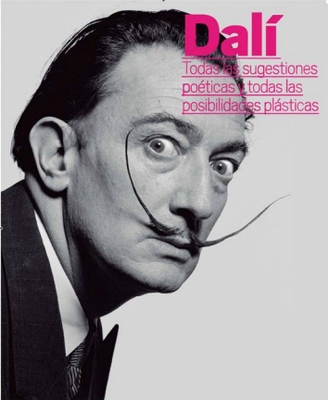
SALVADOR DALI, 1954
Photo by Philippe HALSMAN
(c) Philippe Halsman Archives / Magnum Photos / Contacto
The Museo Reina Sofía presents a major exhibition dedicated to Salvador Dalí, one of the most comprehensive shows yet held on the artist from Ampurdán. Gathered together on this unique occasion are more than 200 works from leading institutions, private collections, and the three principal repositories of Salvador Dalí’s work, the Fundació Gala-Salvador Dalí (Figueres), the Salvador Dalí Museum of St. Petersburg (Florida), and the Museo Reina Sofía (Madrid), which in this way are joining forces to show the public the best of their collections.
 |
| Salvador Dali |
The exhibition, a great success with the public when shown recently at the Centre Pompidou in Paris, aims to revalue Dalí as a thinker, writer and creator of a peculiar vision of the world. One exceptional feature is the presence of loans from leading institutions like the MoMA (New York), which is making available the significant work The Persistence of Memory (1931); the Philadelphia Museum of Art, which is lending Soft Construction with Boiled Beans (Premonition of Civil War) (1936); the Tate Modern, whose contribution is Metamorphosis of Narcissus (1937); and the Musées Royaux des Beaux-Arts, Belgium, the lender of The Temptation of Saint Anthony (1946).
Thirty works which have never before been seen in Spain are on view. Some of the most important are Partial Hallucination: Six Apparitions of Lenin on a Piano, 1931 (Centre Pompidou, Paris); The Angelus of Gala, 1935 (The Museum of Modern Art, New York); Bathers, c. 1928 (The Salvador Dalí Museum, St. Petersburg, Florida); Geopoliticus Child Watching the Birth of the New Man, 1943 (The Salvador Dalí Museum, St. Petersburg, Florida), and Symbole agnostique (Agnostic Symbol), 1932 (Philadelphia Museum of Art, Philadelphia).
 |
| Salvador Dali |
In the words of the curator Montse Aguer, this exhibition makes it possible for us to analyze Dalí’s artistic oeuvre and the different languages he employs, revealing his poetics to us. His finest work is not limited only to the invention of forms but also extends to poetic invention. In this respect, Dalí should be recognized as a leading renovator of the surrealist vocubulary, intensely committed to investigating the process of representing and interpreting what he observed and perceived.
 |
| Salvador Dali |
The exhibition is made up of eleven sections containing not only paintings and drawings but also documentary material, photographs, Salvador Dalí’s own manuscripts, magazines and films of enormous importance for an understanding of the artist’s complex universe. The surrealist period constitutes the nucleus of the show at the Museo Reina Sofía, with special emphasis on the paranoiac-critical method developed by the artist as a mechanism for the transformation and subversion of reality.
A catalogue of the exhibition has been edited and it includes texts of Pere Gimferrer, Thierry Dufrêne, Jean Michel Bouhours and Jean-Hubert Michel. The catalogue reproduces the works of the exhibition.
The exhibition Dali. All of the poetic suggestions and all of the plastic possibilities was organized by Museo Reina Sofía and Centre Pompidou, Paris, in collaboration with the Salvador Dalí Museum Saint Petersburg (Florida). With the special collaboration of the Fundacio Gala-Salvador Dali, Figueres.
Chief curator: Jean-Hubert Martin - Curators: Montse Aguer (exhibition at the Museo Reina Sofía, Madrid), Jean-Michel Bouhours and Thierry Dufrêne - Coordinator: Aurora Rabanal
The Museo Reina Sofia website: www.museoreinasofia.es

