Showing posts with label Salvador Dali. Show all posts

27/06/25

Dreamworld: Surrealism at 100 @ PMA - Philadelphia Museum of Art - A major exhibition celebrating the centenary of the Surrealist movement

Dreamworld: Surrealism at 100
Philadelphia Museum of Art
November 8, 2025 – February 16, 2026

Giorgio de Chirico
Giorgio de Chirico
(Italian, born Greece, 1888–1978) 
The Soothsayer's Recompense, 1913 
Oil on canvas, 53 3/8 × 70 7/8 inches (135.6 × 180 cm) 
Philadelphia Museum of Art: 
The Louise and Walter Arensberg Collection, 1950, 1950-134-38

André Masson
André Masson
(French, 1896–1987)
The Landscape of Wonders, 1935 
Oil on canvas, 30 1/8 × 25 3/4 inches (76.5 × 65.4 cm) 
Soloman R. Guggenheim Museum, New York 
Bequest, Richard S. Zeisler, 2007, 2007.44

Salvador Dali
Salvador Dalí
(Spanish, 1904–1989) 
Soft Construction with Boiled Beans, 
(Premonition of Civil War), 1936 
Oil on canvas, 39 5/16 x 39 3/8 inches (99.9 x 100 cm) 
Philadelphia Museum of Art: 
The Louise and Walter Arensberg Collection, 1950, 1950-134-41

Salvador Dali
Salvador Dalí
(Spanish, 1904–1989) 
Aphrodisiac Telephone, 1938 
Plastic and metal, 
8 1/4 × 12 1/4 × 6 1/2 inches (21 × 31.1 × 16.5 cm) 
Lent by the Minneapolis Institute of Art, 
The William Hood Dunwoody Fund, 96.2 

The Philadelphia Museum of Art (PMA) presents Dreamworld: Surrealism at 100, a major exhibition celebrating the centenary of the Surrealist movement. As the final stop in an ambitious  tour organized with the Centre Pompidou in Paris—and the sole venue in the United States—the PMA will tell the story of Surrealist art, spotlighting the makers who sought out new expressive forms to expand the reach of the creative imagination.

The five touring partners are: the Centre Pompidou (Paris), the Royal Museums of Fine Arts of Belgium (Brussels), the Fundación MAPFRE (Madrid), the Hamburger Kunsthalle (Hamburg), and the PMA. Each  venue was tasked with presenting a distinct story of Surrealism relevant to their own histories and collections. At the PMA, Dreamworld will provide a chronological installation arranged through six thematic sections, including one, unique to Philadelphia, that focuses on artists who fled from Europe to Mexico and the U.S. during World War II.

In his 1924 Manifesto of Surrealism, poet and artist André Breton addressed what he saw as a crisis of consciousness: at around twenty years of age, he said, humans discard their childlike imaginations to adopt adult sense, decorum, and judgement. Breton believed that the only legitimate aspiration is to obtain a state of freedom, achievable solely by reharnessing the imagination. Surrealism, the movement in literature and art that Breton codified with his manifesto, would continually seek new techniques for exploring the human capacity for astonishment.

The first self-described Surrealists working in Paris rejected the representation of objective reality in art as antithetical to a truer, higher beauty, and instead, sought to produce images with a dreamlike character. The first section of this exhibition, “Waking Dream,” traces the development of Surrealist imagery and experimental techniques across mediums in the 1920s, from the found-object constructions of Man Ray and the collages of Max Ernst to hallucinatory canvases by Giorgio de Chirico, René Magritte, and Salvador Dalí.

Jean Hans Arp
Jean (Hans) Arp
(French, born Germany [Alsace], 1886–1966) 
Growth, modeled 1938; cast by 1949 
Bronze, 31 1/4 × 12 1/2 × 7 3/8 inches (79.4 × 31.8 × 18.7 cm) 
Philadelphia Museum of Art: 
Gift of Curt Valentin, 1950, 1950-78-1

Roberto Matta
Roberto Matta
(Chilean, 1911–2002) 
Morphology (Fantasy Landscape), c. 1939 
Oil on canvas, 12 × 16 1/8 inches (30.5 × 41 cm)
Collection of Andrew S. Teufel

Dorothea Tanning
Dorothea Tanning
(American, 1910–2012) 
Birthday, 1942 
Oil on canvas, 40 1/4 × 25 1/2 inches (102.2 × 64.8 cm)
Philadelphia Museum of Art: 125th Anniversary Acquisition. 
Purchased with funds contributed 
by C. K. Williams, II, 1999, 1999-50-1

Dreamworld will then journey through sections exploring the themes of “Natural History” and “Desire.” Capturing a sense of wonder in nature was crucial for the development of Surrealist sensibility. Visitors will encounter enigmatic landscapes and fantastic creatures; torn-paper collages by Hans Arp will be displayed alongside Paul Klee’s vibrant painting Fish Magic (1925), the disorienting photographic landscapes by Lee Miller, and Joseph Cornell’s boxes containing found objects. Nearby, works by Hans Bellmer, Claude Cahun, André Kertész, and others will demonstrate the powerful ways in which photography served the Surrealist interest in eros, or desire, and the reinvention of the erotic body.

A through line of the exhibition is the use of mythology to convey the Surrealist world view. A section titled “Premonition of War” features images of monsters and creatures of strange and terrifying shape, which artists such as Dalí, Ernst, André Masson, Joan Miró, and Pablo Picasso used to respond to the devastating rise of totalitarianism and war in Europe in the 1930s.

With the outbreak of World War II, many Surrealists working in France left for North America, taking refuge in Caribbean ports, Mexico, and the United States. This is the focus of a section unique to the PMA, entitled “Exiles.” This section features treasured paintings in the PMA’s collection in addition to major loans such as Frida Kahlo's My Grandparents, My Parents, and I (Family Tree) (1936). In New York, Surrealism’s wartime capital, younger artists developed innovative forms of painting in tune with Surrealist methods. Highlights here will include Jackson Pollock’s Male and Female (1942–1943) and Mark Rothko’s Gyrations on Four Planes (1944).

The exhibition’s concluding section, “Magic Art,” focuses on a new type of esotericism that emerged within Surrealism in the aftermath of World War II. Filled with imagery of magical and alchemical beings, celestial figures, and symbols of the occult, this section will feature Leonora Carrington’s The Pleasures of Dagobert (1945), which materializes the magical, metamorphic imaginings of an early-medieval French monarch, and Remedios Varo’s Creation of the Birds (1957), in which an owl-headed painter uses starlight to bring a painted bird to life.

Remedios Varo
Remedios Varo
(Spanish, 1908–1963) 
Icon, 1945
Oil with mother-of-pearl and gold leaf inlays on wood 
Closed: 23 5/8 × 15 7/16 × 2 1/8 inches 
(60 × 39.2 × 5 .4 cm) 
Open: 23 5/8 × 27 9/16 × 2 1/8 inches 
(60 × 70 × 5.4 cm) 
Colección Malba, 
Museo de Arte Latinoamericano de Buenos Aires, 1997.02

Arshile Gorky
Illustrated by Arshile Gorky (American, born Van Province, 
Ottoman Empire [present-day Turkey], c. 1904–1948) 
Text by André Breton (French, 1896–1966), 
Dust jacket and cover designed by Marcel Duchamp 
(American, born France, 1887–1968), 
Cover of Young Cherry Trees Secured Against Hares, 1946 
Hardbound book with paper cover design by Marcel Duchamp
Book: 9 3/8 x 6 3/8 inches (23.8 x 16.2 cm)
Philadelphia Museum of Art: 
Gift of an anonymous donor, 1988, 1988-8-2

Victor Brauner
Victor Brauner
(Romanian, 1903–1966) 
The Lovers (Messengers of the Number), February, 1947 
Oil on canvas, 36 1/4 × 28 3/4 inches (92 × 73 cm) 
Centre Pompidou, Musée National d’Art Moderne, Paris: 
Bequest of Mme Jacqueline Victor Brauner, 1986, AM 1987-1204

Joseph Cornell
Joseph Cornell
(American, 1903–1972) 
Untitled (Constellation), c. 1958 
Box construction: wood, metal, cut paper, glass and found objects, 
13 × 19 3/8 × 4 1/4 inches (33 × 49.2 × 10.8 cm) 
Philadelphia Museum of Art: 
Gift of Josephine Albarelli, 2015, 2015-144-5
“Surrealist art has been a focus of our museum since receiving the generous gifts of the Louise and Walter Arensberg collection in 1950 and the bequest of the Albert E. Gallatin collection in 1952,” said Matthew Affron, the museum’s Muriel and Philip Berman Curator of Modern Art. “Today, our permanent collection features outstanding works by a range of artists associated with Surrealism, including Giorgio de Chirico, Joan Miró, René Magritte, Jean Arp, Salvador Dalí, and Dorothea Tanning. As the main repository of works by Marcel Duchamp, one of Surrealism’s most influential guiding spirits, the PMA is very proud to build on this monumental exhibition and present it to audiences in the U.S.”

“The PMA has an extraordinary collection of modern art, and through this exhibition, we can offer our visitors a new perspective on Surrealism and showcase the strength of our own collection,” said Sasha Suda, the George D. Widener Director and CEO. “I can’t think of a more perfect way to celebrate 100 years of Surrealism.”
In Philadelphia, Dreamworld: Surrealism at 100 is curated by Matthew Affron, the Muriel and Philip Berman Curator of Modern Art, with Danielle Cooke, Exhibition Assistant. It will be accompanied by an illustrated publication by Matthew Affron, detailing the the key motivations, principles, themes, and techniques of Surrealist art from the early 1920s to the late 1950s.

PMA - PHILADELPHIA MUSEUM OF ART
2600 Benjamin Franklin Parkway, Philadelphia, PA 19130

Related Posts on this blogzine:


The Hepworth Wakefield, 23 November 2024 – 27 April 2025

Keith de Lellis Gallery, New York, October 3 – November 15, 2024

Edwynn Houk Gallery, New York, 4 April - 25 May 2024

Tate Modern, London, 24 February 2022 – 29 August 2022

Museo Thyssen-Bornemisza, Madrid, 8 October 2013 - 12 January 2014

Museo Nacional Centro de Arte Reina Sofia, Madrid, April 27 - September 2, 2013

Zabriskie Gallery, New York, March 22 - May 5, 2001

Israel Museum, Jerusalem, December 22, 2000 - June 2001

Modern Art Museum of Fort Worth , January 14 - March 17, 1996 

01/03/15

Picasso/Dali, Dali/Picasso, Picasso Museum, Barcelona

Picasso/Dalí, Dalí/Picasso
Picasso Museum, Barcelona
20 March - 28 June 2015

The exhibition examines, for the first time, the relationship between two key figures of twentieth-century art. It challenges conventional historical views of the two artists as isolated, mythical and politically opposed figures, who developed their styles independently. The exhibition contains works by Pablo Picasso and Salvador Dalí (paintings, engravings and sculptures) from over 25 museums of art and private collections from around the world, many of which are only rarely lent out.

There was considerable contact between the two. Picasso supported Dalí during the young artist’s early career and in the 1930s helped organise his trip to America. After the Civil War, Dalí spoke and wrote about Picasso, describing his own works as a homage to him.

Dalí felt great admiration for Picasso but their relationship also involved an element of rivalry. There were a number of critical moments in its development. On his first trip to Paris in spring 1926, Dalí visited Picasso’s studio and viewed the works he was preparing for his next exhibition. On his return, Dalí began work on a major series of paintings that would reflect the impact this artistic encounter had on him.

In 1929 both Dalí and Picasso were exploring the creative and disturbing power of the dreamlike images of surrealism in their works. Between 1930 and 1934 their relationship was tied up with the surrealist movement.

The horrors of the Civil War moved both artists to produce powerful works reflecting theanguish of the human  condition. In the 1950s and afterwards the work of both artists began to look to the great art of the past, focusing on its most distinguished exponents, Velázquez in particular.

The consideration of these key points will follow a prologue based on Dalí’s perception of Picasso via his presence in art exhibitions and art criticism in Barcelona. The historical periods we have referred to will determine the structure of the exhibition, offering perspectives from which we can analyse various aspects of the work of these two twentieth-century masters.

Curated by: Juan José Lahuerta (until 2013) and William Jeffett

Organisation and production: Museu Picasso and Dalí Museum, Saint Petersburg, Florida
With the support of the Gala-Salvador Dalí Foundation, Figueres

PICASSO MUSEUM, BARCELONA
MUSEU PICASSO, BARCELONA
Montcada, 15-23 - 08003 Barcelona


05/09/13

Surrealism and the dream, Museo Thyssen-Bornemisza, Madrid

SURREALISM AND THE DREAM 
Museo Thyssen-Bornemisza, Madrid 
Curator: José Jiménez 
8 October 2013 - 12 January 2014 

SALVADOR DALI
Dream Caused by the Flight of a Bee around a Pomegranate a Second Before Awakening, 1944
51 x 41 cm
Museo Thyssen-Bornemisza, Madrid, Spain
       
The Museo Thyssen-Bornemisza presents the first monographic exhibition on Surrealism and the dream. Including a total of 163 artworks by the great Surrealist masters -André Breton, Salvador Dalí, Paul Delvaux, Yves Tanguy, Joan Miró, René Magritte, Max Ernst, André Masson, Jean Arp and Man Ray- the exhibition, curated by the art critic José Jiménez, will offer a thematic presentation of the Surrealists' visual interpretation of the world of dreams. 

Surrealism should not be considered just one more art movement: rather, it was an attitude to life essentially based on a vision of interior images accessed through the flow of desire. Its ideas have had a key influence on all subsequent art and on the contemporary mindset. The present exhibition aims to demonstrate that this influence has its most profound roots in the Surrealist connection between dream and image. 

In order to do so, the exhibition will include examples from the wide range of media in which this link is evident: painting, drawing, graphic work, collage, objects, sculptures, photography and film. The Surrealists’ creative horizon encompassed all art forms that could enrich and expand the mind, and its doors were equally open to painters, sculptors, photographers and filmmakers who were the first to adopt the fusion of expressive genres with a multimedia aesthetic during a period of major technological advances in the production and reproduction of images.

From this viewpoint, the role played by film was crucial. The darkness of the cinema brought about an encounter with the unexpected and the amazing of an unpremeditated and unconscious kind. Looking at the silver screen was the realm of waking dreams. According to André Breton, it was in cinemas that “the only totally modern mystery was celebrated”.

In the present exhibition the cinema is represented by seven video installations that will project excerpts from selected Surrealist films including Un chien d’Andalou (1929) by Louis Buñuel and Salvador Dalí, in which the idea of alienation or rootlessness – a key concept in the Surrealist aesthetic - is taken to its furthest limit. The film discards any narrative ordering in order to unfold a flow of images that is as open as a dream.

The significant presence of female artists in the exhibition is another important feature. For the first time, women artists encountered a key role within the context of Surrealism and one that gradually extended beyond their initial function as muses, objects of desire or companions. Many of them developed a creative personality that challenged or differed from those of their male colleagues. The large number (eleven) of women artists represented in the present exhibition, including Claude Cahun, Kay Sage, Nadja, Toyen, Dora Maar, Leonor Fini, Remedios Varo, Dorothea Tanning, Ángeles Santos, Meret Oppenheim and Leonora Carrington, offers proof of the unique nature of their contribution to the Surrealist representation of dreams. 

KAY SAGE
The upper side of the Sky, 1944
58,4 x 71,4 cm
The Israel Museum. 
The Vera and Arturo Schwartz Collection of Dada and Surrealist Art at the Israel Museum, Jerusalem, Israel

SURREALISM AND THE DREAM: The other half of life

The Surrealists’ most important contribution to the artistic concept of the dream lies in the way that they ceased to consider it a void or a hole in consciousness, rather seeing it as the other half of life and a conscious plane of experience. Knowledge and liberation of this plane was central to the enrichment and expansion of the interior world, which was the principal aim of these artists. In this sense, Goya, with his depiction of the dream as a realm of human reality devoid of the supernatural or mythical connotations that were present in earlier art, crucially embarked on a direction that would be pursued by the Surrealists a century later. 

HENRI ROUSSEAU 
Carnival Evening, 1886
117,3 x 89,5 cm
Philadelphia Museum of Art: The Louis E. Stern Collection, 1963

ODILON REDON
Closed Eyes, 1889
45 x 35 cm
Van Gogh Museum, Amsterdam

SURREALISM AND THE DREAM: From the dream to art

The liberation of the visual arts from a mimetic reproduction of exterior reality was one of the factors that brought about the transformation of modern art, particularly from the second half of the 19th century with the artistic avant-gardes. One of the most crucial aspects of the Surrealists’ contribution to this transformation was their championing of the representation of the dream world in art. In order to do so, they looked for a place in which dream and reality came together, moving to and from between the interior and exterior. Through their artistic endeavours the Surrealists thus transcribed the materials of the dream in visual form.

ROLAND PENROSE
Seeing is Believing (L'Ile invisible), 1937
100 x 75 cm
The Penrose Collection

The visual material in Surrealism and the Dream is divided into eight thematic sections: 

1. Those who opened up the paths (of dreams) 
2. I is another: variations and metamorphoses of identity
3. The infinite conversation: the dream is the overcoming of Babel: all languages communicate with each other, all languages are the same 
4. Landscapes of a different place: an alternative universe that nonetheless forms part of the existing one 
5. Irresistible perturbations: nightmare, anxiety 
6. Beyond good and evil: a world ruled by neither morality nor reason 
7. Where everything is possible: omnipotence, everything is possible in dreams 
8. The harsh light of desire: the sex drive without the restraints of conscious life 

The exhibition will be accompanied by a film cycle that includes the complete versions of the films of which excerpts will be shown on video installations in the galleries, as well as other titles. There will also be an international conference (8 and 9 October 2013) directed by the exhibition’s curator José Jiménez, which will focus on the different approaches and ideas regarding the representation of the dream in the visual arts.

Curator: José Jiménez, philosopher and professor of aesthetics and theory of the arts, Universidad Autónoma, Madrid
Coordinator: Laura Andrada, Curatorial Department, Museo Thyssen-Bornemisza

Publications: catalogue, English and Spanish versions

Museo Thyssen-Bornemisza
Paseo del Prado 8, 28014 Madrid
Opening times: Tuesdays to Sundays, 10am to 7pm. Saturdays, 10am to 9pm. Last admissions one hour before closing.
Museum's website: www.museothyssen.org

18/05/13

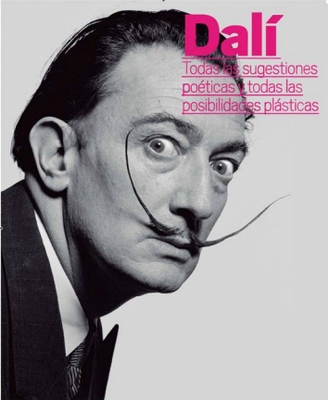
Dali. All of the poetic suggestions and all of the plastic possibilities, Madrid exhibition


Dali. All of the poetic suggestions and all of the plastic possibilities
Museo Nacional Centro de Arte Reina Sofia, Madrid
Through September 2, 2013

SALVADOR DALI, 1954
Photo by Philippe HALSMAN
(c) Philippe Halsman Archives / Magnum Photos / Contacto

The Museo Reina Sofía presents a major exhibition dedicated to Salvador Dalí, one of the most comprehensive shows yet held on the artist from Ampurdán. Gathered together on this unique occasion are more than 200 works from leading institutions, private collections, and the three principal repositories of Salvador Dalí’s work, the Fundació Gala-Salvador Dalí (Figueres), the Salvador Dalí Museum of St. Petersburg (Florida), and the Museo Reina Sofía (Madrid), which in this way are joining forces to show the public the best of their collections. 

Salvador Dali

The exhibition, a great success with the public when shown recently at the Centre Pompidou in Paris, aims to revalue Dalí as a thinker, writer and creator of a peculiar vision of the world. One exceptional feature is the presence of loans from leading institutions like the MoMA (New York), which is making available the significant work The Persistence of Memory (1931); the Philadelphia Museum of Art, which is lending Soft Construction with Boiled Beans (Premonition of Civil War) (1936); the Tate Modern, whose contribution is Metamorphosis of Narcissus (1937); and the Musées Royaux des Beaux-Arts, Belgium, the lender of The Temptation of Saint Anthony (1946). 

Thirty works which have never before been seen in Spain are on view. Some of the most important are Partial Hallucination: Six Apparitions of Lenin on a Piano, 1931 (Centre Pompidou, Paris); The Angelus of Gala, 1935 (The Museum of Modern Art, New York); Bathers, c. 1928 (The Salvador Dalí Museum, St. Petersburg, Florida); Geopoliticus Child Watching the Birth of the New Man, 1943 (The Salvador Dalí Museum, St. Petersburg, Florida), and Symbole agnostique (Agnostic Symbol), 1932 (Philadelphia Museum of Art, Philadelphia). 

Salvador Dali

In the words of the curator Montse Aguer, this exhibition makes it possible for us to analyze Dalí’s artistic oeuvre and the different languages he employs, revealing his poetics to us. His finest work is not limited only to the invention of forms but also extends to poetic invention. In this respect, Dalí should be recognized as a leading renovator of the surrealist vocubulary, intensely committed to investigating the process of representing and interpreting what he observed and perceived.


Salvador Dali

The exhibition is made up of eleven sections containing not only paintings and drawings but also documentary material, photographs, Salvador Dalí’s own manuscripts, magazines and films of enormous importance for an understanding of the artist’s complex universe. The surrealist period constitutes the nucleus of the show at the Museo Reina Sofía, with special emphasis on the paranoiac-critical method developed by the artist as a mechanism for the transformation and subversion of reality. 

A catalogue of the exhibition has been edited and it includes texts of Pere Gimferrer, Thierry Dufrêne, Jean Michel Bouhours and Jean-Hubert Michel. The catalogue reproduces the works of the exhibition. 

The exhibition Dali. All of the poetic suggestions and all of the plastic possibilities was organized by Museo Reina Sofía and Centre Pompidou, Paris, in collaboration with the Salvador Dalí Museum Saint Petersburg (Florida). With the special collaboration of the Fundacio Gala-Salvador Dali, Figueres.

Chief curator: Jean-Hubert Martin - Curators: Montse Aguer (exhibition at the Museo Reina Sofía, Madrid), Jean-Michel Bouhours and Thierry Dufrêne - Coordinator: Aurora Rabanal

The Museo Reina Sofia website: www.museoreinasofia.es

26/11/10

Andy Warhol: Motion Pictures - MoMA Exhibition, NYC

ANDY WARHOL, Lucinda Childs , 1964. Film still courtesy of The Andy Warhol Museum Andy Warhol: Motion Pictures
MoMA, Museum of Modern Art, NYC
December 19, 2010 - March 21, 2011

Among ANDY WARHOL’s cinematic oeuvre, the black and white silent films are the most daring and experimental in their selection of subject and theme, psychological acuity, rhythmic pacing, and sheer beauty of form. Although these films were originally shot at sound-film speed (24 frames per second), Warhol specified that prints be projected at a slower speed of 16 frames per second, a rate used in the projection of silent films from the 1890s through the 1920s.


Image: ANDY WARHOL. Screen Test: Lucinda Childs, 1964. 16mm film (black and white, silent). 4 min. at 16fps. ©2010 The Andy Warhol Museum, Pittsburgh, PA, a museum of Carnegie Institute. All rights reserved. Film still courtesy of The Andy Warhol Museum.


 andy_warhol_kiss_1963_film_stillANDY WARHOL. Kiss, 1963-1964. 16mm film (black and white, silent). 54 min. at 16fps. ©2010 The Andy Warhol Museum, Pittsburgh, PA, a museum of Carnegie Institute. All rights reserved.
Film still courtesy of The Andy Warhol Museum.


For this exhibition, a selection of Warhol’s films made in 1963-1966 has been transferred from 16mm film to DVD at the speed of 16 frames per second, and projected onto screens and monitors in a gallery setting. Thus it is again possible to see the works as Warhol intended, and to appreciate the ways in which he challenged and provoked both subject and viewer in his manipulation of moving images. 


ANDY WARHOL, Salvador Dali, 1966. Film still courtesy of The Andy Warhol Museum
ANDY WARHOL. Screen Test: Salvador Dalí, 1966 
16mm film (black and white, silent). 4 min. at 16fps. ©2010 The Andy Warhol Museum, Pittsburgh, PA, a museum of Carnegie Institute. All rights reserved. Film still courtesy of The Andy Warhol Museum. In the film the image is upside down.

ANDY WARHOL: MOTION PICTURES  AN EXHIBITION ON THE ROAD (2003-2011…)

This exhibition originated at MoMA as Andy Warhol: Screen Tests shown at MoMA QNS from May 1 to September 1, 2003. With the addition of Andy Warhol’s silent films, the show debuted as Andy Warhol: Motion Pictures at KW Institute for Contemporary Art in Berlin (May 8 - August 8, 2004), and was also presented at Museu de Arte Moderna, Rio de Janeiro (April 26 - June 26, 2005); Museu de Arte Moderna de São Paulo (June 16 - August 14, 2005); Malba-Colección Costantini, Museo de Arte Latinoamericano de Buenos Aires (September 23 - November 21, 2005); the Moscow Museum of Modern Art (December 18, 2008 - February 9, 2009); and the Galerie Rudolfinum in Prague (January 29 - April 5, 2009). It is organized by Klaus Biesenbach, Director of MoMA PS1 and MoMA’s Chief Curator at Large.

ANDY WARHOL, Lou Reed. Film still courtesy of The Andy Warhol Museum
ANDY WARHOL. Screen Test: Lou Reed, 1966
16mm film (black and white, silent). 4 min. at 16fps. ©2010 The Andy Warhol Museum, Pittsburgh, PA, a museum of Carnegie Institute. All rights reserved. Film still courtesy of The Andy Warhol Museum.

MoMA - The Museum of Modern Art – New York At The International Council of The Museum of Modern Art Exhibition Gallery, sixth floor
www.moma.org

28/08/10

Dali, Dance + Beyond Exhibition at Salvador Dali Museum, St. Petersburg, Florida


Dali, Dance + Beyond

Salvador Dali Museum St. Petersburg, Florida

Through December 31, 2010

Dali, Dance + Beyond at the Dali Museum of St. Petersburg, Florida, featuring never-before-displayed photographs, films, and objects documenting Salvador Dalí’s celebrated collaboration in the field of dance.

Salvador Dali worked with such luminaries of the dance as George Balanchine, Léonide Massine, and Maurice Béjart.  The focus of the exhibition is on the ballets Bacchanale (1939), Mad Tristan (1944), and Gala (1961-1962), and the opera La dama spagnola e il cavaliero romano that preceded the ballet Gala.

The exhibition includes more than 45 images from Italy, Belgium, and the United States, postcards, books, correspondence, and other printed materials. They reveal not only an insufficiently documented period of Dalí’s artistic production, but also shed new light on how Dalí’s ideas—and Surrealism—evolved during this period. The exhibition includes the publication of a fully illustrated catalogue.

Recently there has been a move to rehabilitate Dalí for his contribution to ‘low’ culture—his later work in fashion, jewelry, advertising, etc., and his role as a forerunner of the pop-art movement,” says curator Frédérique Joseph-Lowery. “We take a different approach. It is important to recognize his contribution to ‘high’ culture.” In his work on modern dance, Dalí created not only props, décor, and costumes, as is customary for visual artists, but also wrote the librettos, chose the music, and collaborated in the choreography of dancers’ movements.

Dalí, Dance + Beyond was organized by the Godwin-Ternbach Museum, Queens College, City University of New York.

The exhibition is curated by Frédérique Joseph-Lowery. The display at the Dalí Museum is arranged by William Jeffett, Chief Curator for Exhibitions. 

Funding for the exhibition was provided by Le Musoir, the New York City Department of Cultural Affairs, the Queens College’s Office of the President, and the Friends of the Godwin-Ternbach Museum.

Salvador Dali Museum St. Petersburg, Florida
July 9 - December 31, 2010

Museum web site at www. thedali.org.