Showing posts with label exposition Madrid. Show all posts

05/09/13

Surrealism and the dream, Museo Thyssen-Bornemisza, Madrid

SURREALISM AND THE DREAM 
Museo Thyssen-Bornemisza, Madrid 
Curator: José Jiménez 
8 October 2013 - 12 January 2014 

SALVADOR DALI
Dream Caused by the Flight of a Bee around a Pomegranate a Second Before Awakening, 1944
51 x 41 cm
Museo Thyssen-Bornemisza, Madrid, Spain
       
The Museo Thyssen-Bornemisza presents the first monographic exhibition on Surrealism and the dream. Including a total of 163 artworks by the great Surrealist masters -André Breton, Salvador Dalí, Paul Delvaux, Yves Tanguy, Joan Miró, René Magritte, Max Ernst, André Masson, Jean Arp and Man Ray- the exhibition, curated by the art critic José Jiménez, will offer a thematic presentation of the Surrealists' visual interpretation of the world of dreams. 

Surrealism should not be considered just one more art movement: rather, it was an attitude to life essentially based on a vision of interior images accessed through the flow of desire. Its ideas have had a key influence on all subsequent art and on the contemporary mindset. The present exhibition aims to demonstrate that this influence has its most profound roots in the Surrealist connection between dream and image. 

In order to do so, the exhibition will include examples from the wide range of media in which this link is evident: painting, drawing, graphic work, collage, objects, sculptures, photography and film. The Surrealists’ creative horizon encompassed all art forms that could enrich and expand the mind, and its doors were equally open to painters, sculptors, photographers and filmmakers who were the first to adopt the fusion of expressive genres with a multimedia aesthetic during a period of major technological advances in the production and reproduction of images.

From this viewpoint, the role played by film was crucial. The darkness of the cinema brought about an encounter with the unexpected and the amazing of an unpremeditated and unconscious kind. Looking at the silver screen was the realm of waking dreams. According to André Breton, it was in cinemas that “the only totally modern mystery was celebrated”.

In the present exhibition the cinema is represented by seven video installations that will project excerpts from selected Surrealist films including Un chien d’Andalou (1929) by Louis Buñuel and Salvador Dalí, in which the idea of alienation or rootlessness – a key concept in the Surrealist aesthetic - is taken to its furthest limit. The film discards any narrative ordering in order to unfold a flow of images that is as open as a dream.

The significant presence of female artists in the exhibition is another important feature. For the first time, women artists encountered a key role within the context of Surrealism and one that gradually extended beyond their initial function as muses, objects of desire or companions. Many of them developed a creative personality that challenged or differed from those of their male colleagues. The large number (eleven) of women artists represented in the present exhibition, including Claude Cahun, Kay Sage, Nadja, Toyen, Dora Maar, Leonor Fini, Remedios Varo, Dorothea Tanning, Ángeles Santos, Meret Oppenheim and Leonora Carrington, offers proof of the unique nature of their contribution to the Surrealist representation of dreams. 

KAY SAGE
The upper side of the Sky, 1944
58,4 x 71,4 cm
The Israel Museum. 
The Vera and Arturo Schwartz Collection of Dada and Surrealist Art at the Israel Museum, Jerusalem, Israel

SURREALISM AND THE DREAM: The other half of life

The Surrealists’ most important contribution to the artistic concept of the dream lies in the way that they ceased to consider it a void or a hole in consciousness, rather seeing it as the other half of life and a conscious plane of experience. Knowledge and liberation of this plane was central to the enrichment and expansion of the interior world, which was the principal aim of these artists. In this sense, Goya, with his depiction of the dream as a realm of human reality devoid of the supernatural or mythical connotations that were present in earlier art, crucially embarked on a direction that would be pursued by the Surrealists a century later. 

HENRI ROUSSEAU 
Carnival Evening, 1886
117,3 x 89,5 cm
Philadelphia Museum of Art: The Louis E. Stern Collection, 1963

ODILON REDON
Closed Eyes, 1889
45 x 35 cm
Van Gogh Museum, Amsterdam

SURREALISM AND THE DREAM: From the dream to art

The liberation of the visual arts from a mimetic reproduction of exterior reality was one of the factors that brought about the transformation of modern art, particularly from the second half of the 19th century with the artistic avant-gardes. One of the most crucial aspects of the Surrealists’ contribution to this transformation was their championing of the representation of the dream world in art. In order to do so, they looked for a place in which dream and reality came together, moving to and from between the interior and exterior. Through their artistic endeavours the Surrealists thus transcribed the materials of the dream in visual form.

ROLAND PENROSE
Seeing is Believing (L'Ile invisible), 1937
100 x 75 cm
The Penrose Collection

The visual material in Surrealism and the Dream is divided into eight thematic sections: 

1. Those who opened up the paths (of dreams) 
2. I is another: variations and metamorphoses of identity
3. The infinite conversation: the dream is the overcoming of Babel: all languages communicate with each other, all languages are the same 
4. Landscapes of a different place: an alternative universe that nonetheless forms part of the existing one 
5. Irresistible perturbations: nightmare, anxiety 
6. Beyond good and evil: a world ruled by neither morality nor reason 
7. Where everything is possible: omnipotence, everything is possible in dreams 
8. The harsh light of desire: the sex drive without the restraints of conscious life 

The exhibition will be accompanied by a film cycle that includes the complete versions of the films of which excerpts will be shown on video installations in the galleries, as well as other titles. There will also be an international conference (8 and 9 October 2013) directed by the exhibition’s curator José Jiménez, which will focus on the different approaches and ideas regarding the representation of the dream in the visual arts.

Curator: José Jiménez, philosopher and professor of aesthetics and theory of the arts, Universidad Autónoma, Madrid
Coordinator: Laura Andrada, Curatorial Department, Museo Thyssen-Bornemisza

Publications: catalogue, English and Spanish versions

Museo Thyssen-Bornemisza
Paseo del Prado 8, 28014 Madrid
Opening times: Tuesdays to Sundays, 10am to 7pm. Saturdays, 10am to 9pm. Last admissions one hour before closing.
Museum's website: www.museothyssen.org

18/05/13

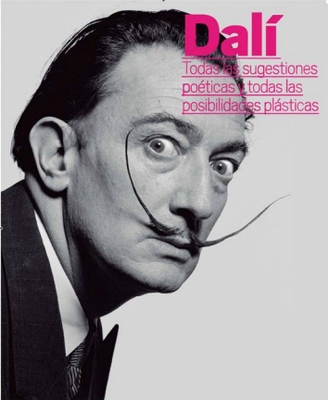
Dali. All of the poetic suggestions and all of the plastic possibilities, Madrid exhibition


Dali. All of the poetic suggestions and all of the plastic possibilities
Museo Nacional Centro de Arte Reina Sofia, Madrid
Through September 2, 2013

SALVADOR DALI, 1954
Photo by Philippe HALSMAN
(c) Philippe Halsman Archives / Magnum Photos / Contacto

The Museo Reina Sofía presents a major exhibition dedicated to Salvador Dalí, one of the most comprehensive shows yet held on the artist from Ampurdán. Gathered together on this unique occasion are more than 200 works from leading institutions, private collections, and the three principal repositories of Salvador Dalí’s work, the Fundació Gala-Salvador Dalí (Figueres), the Salvador Dalí Museum of St. Petersburg (Florida), and the Museo Reina Sofía (Madrid), which in this way are joining forces to show the public the best of their collections. 

Salvador Dali

The exhibition, a great success with the public when shown recently at the Centre Pompidou in Paris, aims to revalue Dalí as a thinker, writer and creator of a peculiar vision of the world. One exceptional feature is the presence of loans from leading institutions like the MoMA (New York), which is making available the significant work The Persistence of Memory (1931); the Philadelphia Museum of Art, which is lending Soft Construction with Boiled Beans (Premonition of Civil War) (1936); the Tate Modern, whose contribution is Metamorphosis of Narcissus (1937); and the Musées Royaux des Beaux-Arts, Belgium, the lender of The Temptation of Saint Anthony (1946). 

Thirty works which have never before been seen in Spain are on view. Some of the most important are Partial Hallucination: Six Apparitions of Lenin on a Piano, 1931 (Centre Pompidou, Paris); The Angelus of Gala, 1935 (The Museum of Modern Art, New York); Bathers, c. 1928 (The Salvador Dalí Museum, St. Petersburg, Florida); Geopoliticus Child Watching the Birth of the New Man, 1943 (The Salvador Dalí Museum, St. Petersburg, Florida), and Symbole agnostique (Agnostic Symbol), 1932 (Philadelphia Museum of Art, Philadelphia). 

Salvador Dali

In the words of the curator Montse Aguer, this exhibition makes it possible for us to analyze Dalí’s artistic oeuvre and the different languages he employs, revealing his poetics to us. His finest work is not limited only to the invention of forms but also extends to poetic invention. In this respect, Dalí should be recognized as a leading renovator of the surrealist vocubulary, intensely committed to investigating the process of representing and interpreting what he observed and perceived.


Salvador Dali

The exhibition is made up of eleven sections containing not only paintings and drawings but also documentary material, photographs, Salvador Dalí’s own manuscripts, magazines and films of enormous importance for an understanding of the artist’s complex universe. The surrealist period constitutes the nucleus of the show at the Museo Reina Sofía, with special emphasis on the paranoiac-critical method developed by the artist as a mechanism for the transformation and subversion of reality. 

A catalogue of the exhibition has been edited and it includes texts of Pere Gimferrer, Thierry Dufrêne, Jean Michel Bouhours and Jean-Hubert Michel. The catalogue reproduces the works of the exhibition. 

The exhibition Dali. All of the poetic suggestions and all of the plastic possibilities was organized by Museo Reina Sofía and Centre Pompidou, Paris, in collaboration with the Salvador Dalí Museum Saint Petersburg (Florida). With the special collaboration of the Fundacio Gala-Salvador Dali, Figueres.

Chief curator: Jean-Hubert Martin - Curators: Montse Aguer (exhibition at the Museo Reina Sofía, Madrid), Jean-Michel Bouhours and Thierry Dufrêne - Coordinator: Aurora Rabanal

The Museo Reina Sofia website: www.museoreinasofia.es

07/05/10

De Manet à l’impressionnisme : Une renaissance moderne

Exposition Art moderne > Impressionnistes
Exposition Art moderne > Espagne > Madrid
Exposition Art moderne > Etats-Unis > San Francisco
Exposition Art moderne > Etats-Unis > Nashville

De Manet à l’impressionnisme :
Une renaissance moderne
Exposition Hors les murs du Musée d'Orsay, Paris
De Madrid à San Francisco et Nashville

De Manet à l’impressionnisme : Une renaissance moderne est une exposition hors les murs du Musée d'Orsay. Elle ne comprend donc que des tableaux du musée choisis par les commissaires d'exposition en fonction de la problématique retenue.
De Manet à l’impressionnisme : Une renaissance moderne a déjà été exposé à la Fondation Mapfre à Madrid (11 janvier - 22 avril 2010). A partir de mai, elle sera aux Etats-Unis, à San Francisco, au Fine Arts Museums of San Francisco (22 mai - 6 septembre 2010), puis à Nashville au Frist Center for Visual Arts Nashville (14 octobre 2010 - 23 janvier 2011).

Un succès à Madrid
Avec 90 des grands chefs-d'oeuvre de Manet, Monet, Renoir, Sisley, Pissarro et Cézanne, la Fondation Mapfre souligne que c'est la première fois qu'un ensemble d'oeuvres impressionnistes de cette importance est présenté en Espagne. Le bilan de la fréquentation de l'exposition est des plus positif. Entre janvier et avril 2010, plus de 327.000 visiteurs ont pu admirer les oeuvres des plus grands peintres de l'impressionnismes du Musée d'Orsay. La Fondation Mapfre note que l'exposition "a été l'une des plus grandes réalisations culturelles de la saison d'hiver à Madrid et a battu tous les records de fréquentation".

Impresionismo
Couverture du catalogue de l'exposition à la Fondation Mapfre
Impresionismo. Un nuevo renacimiento

Textes de Stéphane Guégan et Alice Thomine, Conservateurs au Musée d'Orsay
Fundacion Mpfre, Madrid, 2010 - ISBN : 978-84-9844-203-8 - Langue: Espagnol - Prix: € 48

L’impressionnisme a-t-il encore quelque chose à nous apprendre sur ses sources, sa naissance, ses mutations et ses accointances avec l’époque de son premier épanouissement ? C’est le pari de cette exposition qui s’efforce de décloisonner le mouvement en le confrontant à la production des années 1870 dans son ensemble. L’exposition débute avec Manet et se referme sur lui : la période couverte, en somme, va du Fifre à l’Evasion de Rochefort, de la fin des années 1860 au début des années 1880. Elle vise avant tout à restituer l’unité d’une période et non à durcir l’opposition entre les mouvances qui la constituent. De salle en salle, le visiteur est amené à en évaluer les différentes composantes : l’influence hispanique sur des artistes aussi différents que Whistler et Carolus-Duran, l’“école des Batignolles” au sein de laquelle Bazille, Monet, Renoir font leurs premières armes après voir quitté l’atelier de Gleyre, l’héritage de Courbet et Millet sur le naturalisme de Salon (Breton, Bastien-Lepage, Falguières, etc.), l’aventure impressionniste et sa légende noire, la cordée Cézanne/Pissarro, la question du féminin à travers la figure de Berthe Morisot et l’évolution de l’art dit académique, loin des supposés diktats de l’école des Beaux-Arts.

Même au Salon, la peinture échappe pour partie aux catégories et aux canons traditionnels. A côté de l’expression baroque d’Henri Lévy ou des chairs satinées de William Bouguereau, la poésie de Gustave Moreau ou de Puvis de Chavannes ouvre la voie au symbolisme sans tourner le dos aux préoccupations actuelles. Bref, chacun affronte un monde de l’art aussi mobile que les lignes de partage esthétiques. “Notre but néanmoins se veut résolument étranger au révisionnisme qui a parfois accompagné la réhabilitation des “pompiers” “ précisent les commissaires de l’exposition du musée d’Orsay.

Tenir compte de la dimension collective d’une période donnée, aussi anarchique que soient les années 1870 en apparence, ne suppose pas qu’on ignore ce qui distingue les grands créateurs des moindres artistes. Rapprocher n’est pas confondre.

Le musée d’Orsay depuis vingt ans est partie liée à cette nouvelle appréciation des années 1870. Sa vocation reste de montrer la seconde moitié du XIXe siècle dans toute sa diversité artistique en rapprochant Manet de Couture et Moreau de Degas, puisque leurs chemins se sont croisés. A l’occasion des travaux que le musée connaîtra en 2010, cette exposition riche en chefs-d’oeuvre illustre parfaitement la position singulière qu’occupe Orsay dans le paysage international. Telle qu’elle est envisagée ici, soulignent les commissaires, la modernité ne ressemble plus au club fermé qu’a chéri le XXe siècle. Elle se signale plutôt par cet accord, variable mais authentique, qui rattache chacun des tableaux sélectionnés à son acte de naissance et à son entrée dans l’espace public. Manet, aux deux extrémités du parcours, rappelle que l’époque fut en effet hantée par la question du Salon et sa réforme perpétuelle, jusqu’au moment où Jules Ferry, en 1880, l’affranchit du contrôle de l’Etat. Le décès précoce de Manet coïncide avec ce tournant majeur de l’histoire de l’art moderne. Les années 1866-1883 voient donc simultanément la “mort du Salon” et l’essor d’un marché des images plus ouvert. 

Les années 1870 constituèrent à tous égards une période de renaissance. Profondément meurtri par la guerre, amputé de ses provinces de l’Est, traumatisé par la Commune et sa terrible répression, la France aspirait à un renouvellement. La municipalité parisienne venait de lancer la reconstruction de l’Hôtel de ville (1873), tandis que la France conservatrice se mobilisait autour du Sacré-Coeur (concours en 1874), chantier destiné à racheter les “fautes”. La République des ducs mit aussi un point d’honneur à décorer le Panthéon de peintures réparatrices ou réconfortantes.

Puvis de Chavannes, actif durant le siège et très présent au Salon, réalise son grand cycle décoratif dédié à sainte Geneviève. Alors que Courbet est condamné à l’exil, puis à mourir en Suisse, son exemple reste marquant. Manet n’est pas le seul à lui rendre hommage à distance, tout en restant libre du réalisme de son aîné. Il n’adhère pas davantage à l’esthétique de ses amis Monet et Degas. Certains des chefsd’oeuvre de l’exposition réveillent le souvenir du combat politique qui fut le sien avant 1879, et auquel s’associaient naturellement son obstination à forcer les portes de l’exposition officielle et son soutien à l’entreprise des peintres impressionnistes...

Sections de l'exposition
– Triomphe de Manet ?
– Hispanisme parisien
– L’Ecole des Batignolles
– L’année terrible (1870-1871)
– Réalismes : l’héritage de Millet et Courbet
– Le Salon : anciens et modernes
– Monet / Renoir / Sisley
– Pissarro / Cézanne
– Peintres femmes / Femmes peintes
– Degas : saisir la vie moderne
– Manet entre impressionnisme et retour au Salon

Commissaires de l'exposition Paris : Guy Cogeval, président du musée d’Orsay ; Stéphane Guégan et Alice Thomine, conservateurs au musée d’Orsay
Madrid : Pablo Jimenez Burillo, directeur général de l’Institut culturel de la Fondation Mapfre
San Francisco : John E.Buchanan, Directeur du Fine Arts Museums of San Francisco
Nashville : Susan Edwards, Directrice du Frist Center for Visual Arts.

De Manet à l’impressionnisme : Une renaissance moderne
Exposition hors les murs du Musée d’Orsay, Paris
Fondation Mapfre, Madrid : 11 janvier - 22 avril 2010
Fine Arts Museums of San Francisco, De Young, San Francisco : 22 mai - 6 septembre 2010
Frist Center for Visual Arts Nashville : 14 octobre 2010 - 23 janvier 2011