Showing posts with label Malick Sidibe. Show all posts

16/04/25

Malick Sidibé Exhibition @ Jack Shainman Gallery, NYC + A Monograph by Loose Joints

Malick Sidibé: Regardez-moi
Jack Shainman Gallery, New York
April 17 – May 31, 2025

Jack Shainman Gallery presents Regardez-moi, an exhibition of photographs by the Malian photographer Malick Sidibé (1935-2016). The exhibition, the title of which translates to “Look at Me”, marks the gallery’s latest celebration of Sidibé’s unparalleled ability to capture the heartbeat of Bamako, Mali following the country’s liberation from colonial rule in 1960.

Featuring a vibrant selection of photographs — some of which have never before been exhibited — this presentation invites viewers into the bustling parties, joyous gatherings, and tender moments that defined the transformative era of a young nation relishing to establish its own national identity. In today’s cultural climate, where visibility and representation hold immense weight, Sidibé’s work and legacy remain as significant as ever.

Malick Sidibe
Malick Sidibé, Painted Frames
Published by Loos Joints, 2025
Image © & Courtesy Loose Joints

Presented in conjunction with this exhibition is the publication of Painted Frames, a monograph by Loose Joints, and the first exploration of Sidibé’s synergistic painted frame photographs. In these works, Malick Sidibé collaborated with local Malian artists to blend his iconic photography with the traditional West African art of reverse-glass painting. Regardez-moi presents a selection of these painted frames; reaffirming the sanctity of African photography as a medium of memory and identity. The publication also features an essay by writer, independent researcher, and collector-archivist Amy Sall, in which she makes a case for the continued and ever-expanding importance of Sidibé’s oeuvre:

Malick Sidibé was witness to, and preserver of, a nascent, burgeoning postcolonial society in which a new modernity was being constructed by way of transcultural osmosis. From his studio to the soirées, and even to the banks of the Niger River, Malick Sidibé and his camera were at the center of it all. He was not only chronicling Malian history and culture, but making pivotal contributions to it…. The night clubs, living rooms, and courtyards he photographed were spaces of freedom and community. Sidibé’s oeuvre reflects dialectic expressions of being because he captured his subjects as their imagined and authentic selves. From his widely recognized Nuit de Noël (Christmas Eve, Happy Club) (1963) to his series Vues de dos, the framed images carry the same undercurrents of power and rebellion, tenderness and joy that flow throughout Sidibé’s entire archive.

Regardez-moi underscores Sidibé’s role as a pioneer who sculpted the visual identity of the African diaspora, offering a window into a Malian nation that boldly joined a global youth movement. His photographs transcend their historical context, speaking to contemporary dialogues about identity, agency, and the power of being seen. Sidibé’s photographs don’t just freeze time, they transform these scenes into vibrant stages where his subjects — young couples excited to be married, or older men or women reclaiming their freedom of expression — assert their presence and identity. In Dansez le Twist (1963-2010), Sidibé captures a young man and a woman in a state of joy while dancing the twist, an American rock ‘n’ roll dance that became a global cultural phenomenon from 1959 to the early 1960s, which was known for its simple yet lively steps that encouraged freedom of movement and expression. By providing his subjects with ways to be seen and celebrated, Sidibé’s lens offers a powerful counterpoint to our tech-filtered world, reminding viewers of the raw, unscripted joy of human connection. One of Malick Sidibé most celebrated series, Vues de Dos — with examples from the series held in the collections of numerous museums such as the Getty Museum, The National Gallery of Art, as well as the Metropolitan Museum of Art — provides viewers with a deeper understanding of the photographer’s curatorial eye, depicting women in his studio with their bare backs to the camera against a signature backdrop of striped walls. Sidibé’s photography serves as both a reflector and a loudspeaker, magnifying the vibrant, intimate essence of Bamako’s people in the wake of gaining independence from French colonial rule. The works capture a liberated people that resonates with a contemporary urgency now more than ever.

Malick Sidibé (b. 1935, Soloba, Mali; d. 2016, Bamako, Mali) was a photographer known for his black and white images chronicling the exuberant lives and culture—often of youth—in his native Bamako, Mali. Much of Sidibé’s work documented a transitional moment as Mali gained its independence, transforming from a French colony steeped in tradition to an independent country looking toward the West, and Sidibé played a pivotal role in sculpting the fresh, global appearance of the African diaspora.

This political expression often took shape through individual and collective presentation, such as fashion, music, and dance – something made palpable by Sidibé’s rhythmic compositions. Often capturing his subjects in the midst of ceremonial action or in joyous moments of nightlife, Malick Sidibé built the narrative of a specific time and space that empowered a culture to dictate their own stories. There is a distinct sense of chronicle felt in the movement of Sidibé’s subjects, who boldly occupy both the photograph’s frame and their recently decolonized nation’s public and leisure spaces. Beyond his candid shots, Malick Sidibé ran a formal portrait studio with a deliberately dramatic décor as a backdrop. In order to capture his sitters’ characters and lives, he orchestrated them into relaxed positions encouraging them to bring along beloved personal objects, like a new motorcycle or a James Brown record. It was through his portraiture that Malick Sidibé documented the changing fashions and aspirations of generations in Bamako.

JACK SHAINMAN, NEW YORK
513 West 20th Street, New York, NY 10011

LOOSE JOINTS PUBLISHING

05/08/12

Everything was moving: Photography from the sixties and seventies at Barbican Art Gallery, UK


Everything was moving: Photography from the 60s and 70s 
Barbican Art Gallery, London
13 September 2012 - 13 January 2013

I love all art medium but it is always a pleasure to share inforations about a major photography exhibition. This one is particulary interresting because it surveys the medium from an international perspective, and includes renowned photographers from across the globe, all working during two of the most memorable decades of the 20th Century. everything was moving: photography from the 60s and 70s tells a history of photography, through the photography of history. It brings together over 350 works, some rarely seen, others recently discovered and many shown in the UK for the first time.

It features key figures of modern photography including Bruce Davidson, William Eggleston, David Goldblatt, Graciela Iturbide, Boris Mikhailov and Shomei Tomatsu, as well as important practitioners whose lives were cut tragically short such as Ernest Cole and Raghubir Singh. Each contributor has, in different ways, advanced the aesthetic language of photography, as well as engaging with the world they inhabit in a profound and powerful way.

The exhibition is set in one of the defining periods of the modern age – a time that remains an inescapable reference point even today. The world changed dramatically in the 1960s and 1970s, shaped by the forces of post-colonialism, and Cold War neo-colonialism. This momentous epoch in history coincided with a golden age in photography: the moment when the medium flowered as a modern art form.

Great auteur photographers emerged around the ‘developed’ and the ‘developing’ world. Many, working increasingly independently from the illustrated press, and freed from the restraints of brief and commission, were able to approach the world on their own terms, and to introduce a new level of complexity to photographic imagery. Others, such as Li Zhensheng (China) and Ernest Cole (South Africa), found themselves living in situations of extreme repression, but devised inspiring strategies to create major works of photography in secrecy and at huge personal risk.

Back in the 1960s, many commentators viewed photography as inferior to painting or sculpture, because it simply recorded, mechanically, what could be seen, and was judged to be concerned primarily with reporting the facts (journalism) or campaigning for change (social documentary). Attitudes changed during this period, and the art museum slowly opened its doors to the medium. Less concerned to change the world, or to merely describe it, a new generation of photographers were driven to understand that world, as well as their place within it.

The exhibition presents a selection of works by the Chinese photographer, Li Zhensheng, some never before revealed in public. An aspiring artist and filmmaker, Li Zhensheng worked throughout the tumultuous decade of the Cultural Revolution (1966-1976) for the Heilongjiang Daily, the local newspaper of Harbin in the far North East of China, on the border with Russia. He, like everyone else in the country found himself caught up in the mad spiral of indoctrination and violence that was Mao’s ‘revolution’– at times as a participant, at others as a victim. At great personal risk, Li Zhensheng photographed in secret, and then buried those photographs, some 30,000 negatives, under his mud floor. The material only came fully to light in the West at the end of the 20th century. It is the most complete visual record known of this extraordinary period of human history.

In a very different response to totalitarianism, acclaimed conceptual photographer, Boris Mikhailov lived and worked in Kharkhov at the height of Soviet domination of the Ukraine. Boris Mikhailov developed a distinctive artistic approach, with which to evade the censors and to satirize Soviet occupation, as well as the tenets of socialist realism. The exhibition includes the first UK showing of his very first series, Yesterday’s Sandwich, 1968-1975, a collection of radical, often hilarious montages.

A pioneer of colour, Indian artist Raghubir Singh (1942-1999) was driven to create a photography that was emphatically modern and Indian. He broke abruptly with the colonial tradition of single-point perspective, picturesque, depopulated landscapes – to describe an India which was peopled, frenetic and luminous. His so-called theory of ‘Ganges modernism’ pitted colour and spirituality against the monochromatic angst and alienation of Western figures such as Robert Frank and Diane Arbus. The work of Raghubir Singh has never been thoroughly evaluated in the UK, and this selection includes rarely seen images from the extraordinary archives of the early part of his career.

In stark contrast to Raghubir Singh’s colourful exuberance, an unrelentingly black-and-white aesthetic emerged in Japan, exemplified by the work of Shomei Tomatsu who is widely considered the ‘godfather’ of modern Japenese photography and a major influence on Daido Moriyama. In Shomei Tomatsu’s first-ever British museum showing, life in 1960s and 1970s Japan is evoked in metaphoric, angry, uncompromisingly monochrome pictures. Shomei Tomatsu rails against continuing American military occupation at Okinawa (the base from which Vietnam was being bombed); the growing impact of American capitalism on Japenese culture; and the devastating psychological legacy of Nagasaki.

Where most of Africa was – in theory at least – liberated from colonial domination by the early 1960s, in South Africa, a government – inspired by Nazi Germany and ignored by the West – was starting to build its heinous apartheid regime. Across the Atlantic, in another society dominated by white racism and racial segregation, the Southern states of America saw the stirrings of change as the civil rights movement gathered pace. The struggle for civil rights –from Selma to Soweto, the Amazon to Londonderry – was to define the spirit of the times: as did an increasingly angry global opposition to the neo-colonial war that America was waging in Vietnam.

Johannesburg-based David Goldblatt, is, perhaps more than any other photographer since Eugène Atget, linked inextricably with the country of his birth. Over five decades, David Goldblatt has created arguably one of the most important bodies of documentary photography in the history of the medium. He has forged a complex, contradictory tableau of South Africa’s fractured society, during and after apartheid. For this exhibition, David Goldblatt has personally revisited his major series of the 1960s and 1970s, from On the Mines with Nadine Gordimer, to Some Afrikaners Photographed, and In Boksburg. The selection includes rarely exhibited works.

Long thought lost for ever, an incredible collection of vintage prints by the black South African Ernest Cole (1940-1990) was recently rediscovered and will be shown for the first time in Britain at Barbican Art Gallery. Ernest Cole somehow persuaded the Race Classification Board that he was not ‘black’ but ‘coloured’ (he changed his name from Kole to Cole) and was therefore able to practice as a photographer at a time when many black photographers were persecuted and imprisoned. Ernest Cole’s courage and determination were matched by his artistic talent. He escaped South Africa on 9 May 1966, and in exile in New York was to publish House of Bondage, 1967, an indelible record of what it was to be black under apartheid. Ernest Cole was never able to return home and he died in poverty, his negatives given away, it is believed, in lieu of an unpaid hotel bill.

South Africa ’s extraordinary tradition of realist photography during this period is contrasted with major American contemporaries. Bruce Davidson and William Eggleston are two of the giants of 20th century photography. In many ways, they are diametrically opposed in philosophy and approach, and yet at points in the 1960s they shared subject matter: both were photographing people and places in the contested landscape of the Southern states as the struggle for equality unfolded.

Time of Change, 1961-1965, one of Bruce Davidson’s most powerful series, has never been exhibited in the UK. On May 25, 1961 the 28-year old photographer joined a group of Freedom Riders making a terrifying journey by bus from Montgomery, Alabama to Jackson, Mississippi. It was the starting point of a four-year project for Bruce Davidson, in which he captures the mood and the events of the civil rights struggle, in a series of poignant and empathetic pictures. Where Bruce Davidson was interested in the human reality of the south, in contrast, William Eggleston, a native of Memphis, Tennessee, perplexed the critics with his seeming lack of subject matter, lack of composition - and lack of a photographic agenda. Now, he is widely viewed as a brilliant innovator who revolutionized photography with his ‘democratic’, non-hierarchical vision, his ‘shotgun’ aesthetic and his radical use of colour. William Eggleston’s classic pictures of the period – affectless, brooding images of the Deep South, saturated in vivid colour, and shot through with a sense of menace, equally conjure the mood of the time.

Also included: major contributions by Hasselblad-award winners Graciela Iturbide (Mexico) and Malick Sidibé (Mali); a little-seen allegorical work by Sigmar Polke (Germany) ; and a selection of Larry Burrows’ (UK) powerful Vietnam portraits.

Kate Bush, Head of Art Galleries, Barbican Centre, said:
I am delighted to bring together an amazing group of photographers whose striking and powerful images of the 1960s and 1970s make us look at the world again. everything was moving explores a spectrum of different photographic approaches, and asks if, in the early 21st century, we are finally prepared to erase the distinction between art photography and documentary photography.
This exhibition is supported by The Japan Foundation, Institut Français, The Great Britain Sasakawa Foundation and The Nehru Centre.

Art Gallery, Barbarican Centre's website: www.barbican.org.uk

04/11/10

La Photographie Africaine a la cote

Photographie Africaine
Vente du 23 novembre 2010 à Bruxelles
Par Pierre Bergé & Associés


Affiche de la vente Copyright Pierre Bergé et associés, Paris-Bruxelles, 2010


Le Mardi 23 Novembre 2010, Pierre Bergé & Associés,  fidèle à son esprit pionnier, organise la première vente uniquement consacrée à la photographie africaine : une vente exceptionnelle couvrant, du Maghreb à l’Afrique du Sud, plus d’un siècle et demi de photographie africaine (1850-2010).

Les expositions In/sight : African Photographers, 1940 to the present au Guggenheim Museum de New York (24 mai - 22 septembre, 1996), Africa Remix au Centre Pompidou (25 mai - 8 août, 2005), de même que Les magiciens de la Terre (Centre Pompidou, 18 mai - 14 août, 1989), organisée par Jean-Hubert Martin, avec le soutien privilégié d’André Magnin, ont révélé à l’Occident, la richesse et le dynamisme de l’art contemporain africain, et en particulier la photographie, jusque-là, ignorés des institutions culturelles, comme du marché de l’art. La reconnaissance est en cours et l’Afrique des artistes a désormais ses étoiles, convoitées par les musées et exposées dans les foires internationales.

L’oeil de VINCENT GODEAU, consultant chez Pierre Bergé & Associés, a su rassembler les œuvres de 59 photographes de cultures et de sensibilités différentes avec le souci de représenter la diversité des approches photographiques de tout un  continent, sans oublier la diaspora africaine en Europe. Vincent Godeau est l’auteur d’une thèse de Doctorat sur La photographie africaine contemporaine : vers une photographie panafricaine (1989-2009), Thèse de Doctorat soutenue sous la direction de Arnauld Pierre, Histoire de l’Art et Archéologie, Université Paris IV- Sorbonne, Paris, 24 Juin 2010, 2 vol. 677 pages.

Au total, 270 lots illustrent l’histoire de la photographie africaine, des années 1850 à nos jours, qui connut les révolutions de la couleur, puis du numérique, avec de ça, de là, ses poches de résistance.

Le cœur de la vente réserve un temps fort avec 21 portraits du Soudanais AL RASHID MAHDID (1923-2008), sans doute, le plus grand portraitiste d’Afrique orientale. Jeunes mariés, sportifs, policiers, artisans, pimpants diplômés, employés de chemin de fer ou militaires sont passés par son objectif, en format 18 x 24. Son portrait à la chambre de Jeune officier une étoile est l’un des plus troublant de la série, estimé 2300  / 2500 EUR. Avec un petit air d’Elvis dans son uniforme occidental, ses scarifications trahissent ses origines tribales. Al Rashid Mahdi est l’un des premiers portraitistes africain à penser le décor et la lumière de ses portraits, selon un protocole rigoureux de prise de vue. Il choisissait le diaphragme pour l’exposition en fonction du développement à venir  : une pratique élaborée avant même que ne paraisse la célèbre théorie d’Ansel Adams sur le « zone system ».


AL RASHID MAHDI

AL RASHID MAHDI (Soudan, 1923-2008)
Jeune officier une étoile portant scarification de la tribu chaïgir, 11 mars 1970. Tirage argentique en noir et blanc, deux exemplaires connus à ce jour, vintage. Cachets au verso : en arabe « Rashid Studio Atbara » et en anglais “Studio Al Rashid Atbara” ; © Al Rashid Mahdi /Elnour et tampon Elnour. H 13 x L 18 cm - Estimation : 2300 / 2500 EUR (Photo courtesy PBA)


Avec le Soudan, le Mali s’impose comme une nation pionnière de la photographie africaine représentée, ici, par le duo historique et de renommée internationale : SEYDOU KEITA (1921-2001), et Malick Sidibé. Le premier figure dans la vente avec 14 photos dont une dizaine provenant de la collection personnelle de Françoise Huguier, co-fondatrice des Rencontres de Bamako, Biennale africaine de la photographie. C’est le cas de ce Couple de jeune Wolofs, tirage argentique en noir et blanc par Jean-Pierre Leduc (Publimod), en 1993, estimé 1800 / 2200 EUR. Le second, et toujours actif, MALICK SIDIBE (né en 1936), séduira les amateurs avec ses portraits de la jeunesse débridée de Bamako, celle du quartier très vivant de Bagadadji, qui dans les années 70, se déhanchaient frénétiquement sur des airs Soul et Rock’n Roll made in U.S.A. Trois d’entre eux, « cigarette au bec », posent en noir et blanc pour la postérité dans une fourchette d’estimation comprise entre 1400 et 1600 EUR.


SEYDOU KEïTA

SEYDOU KEïTA (Mali, 1921-2001)
Couple de jeunes wolofs de Bamako. Tirage argentique en noir et blanc par Jean-Pierre Leduc (Publimod), marge blanche, circa 1993. H 30 x L 40 cm - Reproduit dans le livre Seydou Keïta, coll. Photo poche n° 63, Paris, photo n°17.  Provenance Françoise Huguier. Estimation : 1800 / 2200 EUR (Photo courtesy PBA)


MALICK SIDIBÉ

MALICK SIDIBÉ (Mali, né en 1936)
Portrait en studio de trois jeunes gens. Tirage argentique dentelé noir et blanc, semi mat, marges blanches. Date (14 mai 1976) et cachet au verso « STUDIO-MALICK... Bagadadji-BAMAKO » - H 8,5 x L 13,5 cm - Estimation 1400 / 1600 EUR
(Photo courtesy PBA)


Par ailleurs, KELETIGUI TOURE (1922-1998), honore également le Mali avec 18 portraits des années 1940, tirés à l’argentique en 1997 par FREDERIC VIDAL, estimés entre 1.200 et 1.300 EUR, dans un format moyen de 19 x 28 cm.


KÉLÉTIGUI TOURÉ

KÉLÉTIGUI TOURÉ (Mali, 1922-1998)
circa 1940
Tirage unique réalisé en 1997
H 22,7 x L 28,8 cm – Estimation : 1200 / 1300 EUR
(Photo courtesy PBA)


« La technique de la photographie est simple, mais ce qui faisait la différence, c’est que je savais trouver la bonne position, je ne me trompais jamais. Le visage à peine tourné, le regard vraiment important, l’emplacement des mains… j’étais capable d’embellir quelqu’un. A la fn, la photo était très belle. C’est à cause de ça que je dis que c’est de l’art » -- SEYDOU KEITA, Bamako, 1995/1996. 

De la même génération que les pères de la photographie malienne, DAVID GOLDBALTT, juif-allemand, né en Afrique du Sud, en 1930, observe l’évolution sociale et politique de son pays, explorant les relations entre les individus et les structures dans lesquelles ils vivent. Dans les photos qu’il publie en 1975 dans l’ouvrage Particulars, proposé dans la vente à 2.500  / 3000 EUR avec un tirage original en noir et blanc au format 24 x 24, il fixe des détails de corps, vêtements et accessoires qui sont évocateurs d’une origine sociale et temporelle, une manière détournée de rendre compte de la complexité de la société sud-africaine.


DAVID GOLDBLATT

DAVID GOLDBLATT (Afrique du Sud, né en 1930) Ouvrage Particulars, Goodman Gallery Editions, Johannesburg, 2003, numéroté 45/100. Ouvrage accompagné d’un tirage en noir et blanc au format H 24 x L 24 cm, « Woman collecting shellf sh, Port Saint Jihns, Transkei, 1975 », reproduit p. 5 de l’ouvrage – Estimation 2 500 / 3 000 EUR.

Autre militant anti-Apartheid, JURGEN SCHADEBERG, né à Berlin en 1931, est illustré dans la vente par 7 clichés argentiques en noir et blanc dont un célèbre portrait de Nelson Mandela pris pendant le procès Treason (Treason Trial), à Pretoria, en 1958 (photo ci-dessous).
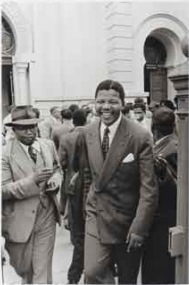
 

JÜRGEN SCHADEBERG JÜRGEN SCHADEBERG (Allemagne - Afrique du Sud, né en 1931)
Nelson Mandela during the Treason Trial-Pretoria, 1958. Tirage argentique en noir et blanc, marge blanche, signé au recto, daté (2008), numéroté (L.E. 9/18) – H 50 x L 60 cm – Au  verso : “Copyright c Jurgen Schadeberg”, et manuscrit : “Nelson Mandela during the Treason Trial-Pretoria, 1958. Jurgen Schadeberg. Handprinted by J.S. 2008, L.E. 9/18”. Reproduit dans l’ouvrage Jürgen Schadeberg Photographies, Hatje Cantz, p. 53 - Estimation : 2400 / 2600 EUR (Photo courtesy PBA)


Place à la couleur, avec deux portraits d’adolescents de Johannesburg par NONTSIKELELO “LOLO” VELEKO (Estimation, 800/ 1000 EUR), qui interrogent les identités communautaires,  à la suite de ses aînés Goldblatt et Schadeberg.


NONTSIKELELO “LOLO” VELEKO

NONTSIKELELO “LOLO” VELEKO (Afrique du Sud, née en 1977)
Série Beauty is in the eye of the beholder. Tirage couleur. H 29 x L 42 cm. Reproduit dans le catalogue de la biennale de Bamako de 2007, p. 111 – Estimation : 800 / 1000 EUR (Photo courtesy PBA)


De l’Afrique Australe, citons également les photos du Mozambicain RICARDO RANGEL, né en 1924, et celles, plus près de nous et en couleur, de la zimbabwéenne, BERRY BICKLE (née en 1959), dont les installations photographiques procèdent d’un travail de mémoire sur les identités interculturelles, tel ce collage de vêtements, lettres manuscrites et portraits photographiques  : photographie contrecollée sur un support en aluminium, estimée en 1000  et 1400 EUR. 

Les Indépendances africaines se sont accompagnées d’un engouement très fort pour la photographie qui a permis à de nombreux studios de perdurer et à d’autres de s’ouvrir, sur tout le continent africain, où se précipitait la jeunesse.

Celle de Bangui, par exemple, capitale de la République Centre-Afrique, se pressa au «  Studio National  », ouvert par le grand SAMUEL FOSSO (né en 1962), en 1975. Des photos qui ornaient la devanture, 15 ont été réunies dans un cadre par l’artiste lui-même. Elles constituent l’un des lots phare de la vente, estimé entre 15.000 et 20.000 EUR. Ces tirages argentiques montrent pour la première fois le travail de portraitiste accompli pendant la journée par le jeune photographe, avant que le soir, il ne se représente lui-même dans la solitude retrouvée de son studio.

L’Afrique équatoriale, est notamment représentée par JEAN DEPARA (1928-1997), avec 9 photos dont 8 portraits de la jeunesse de Léopoldville, future Kinshasa au Congo. Ces tirages argentiques en noir et blanc sont attendus autour de 1500 EUR.

Plus à l’Ouest, le Nigeria est présent à la vente avec trois tirages de la série de Hairstyles, réalisée entre 1968 et 1999, par J. D. OKKAI OJEIKERE. Les tirages argentiques en noir et blanc de cette série, exposée 2000 à la Fondation Cartier pour l’art contemporain, sont estimés entre 1800 et 2000 EUR.


J. D.‘OKHAI OJEIKEREJ. D.‘OKHAI OJEIKERE (Nigéria, né en 1930)
Oluweri Headdress, 1972. Tirage argentique. H 50 x L 60 cm - NB. Recto daté (05/02/2001), signé, référencé et daté HD-662A/72, tampon et timbre sec. Au verso : cachet “Tirage Philippe Salaün” -  Reproduit dans André Magnin, J. D. 'Okhai Ojeikere - Photographies, Fondation Cartier pour l’art contemporain et Actes Sud, 2000, p. 4.  1800 / 2000 EUR (Photo courtesy PBA)


Ce voyage à travers l’Afrique continentale se termine au Nord par le Maghreb avec des photos du marocain HICHAM BENOHOUD (né en 1968, à Marrakech), dont un tirage argentique issu de la série des Salles de Classes (Estimation, 800  / 1000 EUR), ensemble de photos réalisées entre 1994 et 2001. Pour ce projet, confie le photographe, « j’ai demandé à mes élèves de poser pour moi dans un espace réorganisé. J’ai finalement capté des images insolites dont la spécificité était d’être totalement inventées ».

En enjambant la mer méditerranée, la vente s’intéresse aux artistes franco-algériens qui, comme BRUNO BOUDJELAL (né en 1961), s’inspirent de leurs racines maghrébines pour nourrir leur travail photographique, comme il le fit en 2001 dans les Jours Intranquilles, série d’images à Bab el Oued, dans le village de son père (Estimation, 800 / 1000 EUR).

Au fil des pages du catalogue de la vente, il apparaît que les jeunes photographes africains partagent avec leurs aînés, les mêmes préoccupations  : les questions de l’identité, notion devenue complexe dans un monde métissé, la violence qui secoue l’Afrique, la globalisation des échanges, l’espoir et le désespoir de la jeunesse du continent.

Décomplexée de son grand frère occidental, la photographie africaine dans sa pluralité géographique et esthétique apparaît, plus que jamais, autonome, dynamique et engagée. Sa récente reconnaissance permettra encore à l’amateur de se positionner en dénicheur de talents. Cette vente en forme de rétrospective de la photographie africaine ancienne et contemporaine célèbre, à sa manière, le cinquantenaire des indépendances africaines (1960-2010).

VENTE : Mardi 23 novembre à 17 heures
BRUXELLES - SALLE DES BEAUX-ARTS
40 place du Grand Sablon 1000 Bruxelles
Grand Sablon 40 Grote Zavel B-1000 Brussel

EXPOSITION PUBLIQUE du samedi 20 au lundi 22 novembre de 11 heures à 18 heures et mardi 23 novembre de 11 heures à 14 heures

Consultant : Vincent Godeau

Catalogue consultable sur : www.pba-auctions.com

CATALOGUE DISPONIBLE chez Pierre Bergé & associés à Paris et Bruxelles : 10 EUR - Par Courrier : 12 EUR

#     #     #

La société de ventes volontaires Pierre Bergé & associés Belgique a réalisé pour la vente de Photographies africaines  du 23 novembre 2010  à Bruxelles, un montant de 57.860 EUR frais inclus.

TOP LOTS :

SEYDOU KEÏTA
L’enfant à la bicyclette
Tirage argentique
Adjugé frais inclus : 4960 EUR

YASMINA BOUZIANE
Untitled n°6 A.Y.A. The signature, 1993-1994
“Inhabited by imaginings we did not choose”
Tirage argentique
Adjugé frais inclus: 3100 EUR

Mise à jour Résultats