Showing posts with label Asian American. Show all posts

17/03/24

Xiaoze Xie @ Pi Artworks London - "Lost Tales and Recovered Histories" Exhibition

Xiaoze Xie
Lost Tales and Recovered Histories 
Pi Artworks London
14 March - 17 April 2024

Lost Tales and Recovered Histories at Pi Artworks London brings together two bodies of work: recent paintings from The Library Series and a new sculpture series titled Amber of History by Chinese American artist XIAOZE XIE. Through installation, sculpture, and painting, Xiaoze Xie explores the interrelatedness of books, libraries, and historical events, interrogating the vulnerability and deterioration of history and memory.

The Library Series is Xie’s largest body of work. Begun in 1993 when he was studying painting at The University of North Texas, the series has evolved as Xioze Xie has developed as an artist and teacher. When visiting libraries in the U.S. and around the world for research, Xiaoze Xie would photograph the arrangements of books left on the shelves by librarians, his one rule being that he could never reposition them in his paintings. It is the newest works from the series that are on display here: featuring books from the Guimet Museum in Paris, the Library of Congress in Washington D.C, and the Hubei Provincial Library in Wuhan, China, Xiaoze Xie uses a rich palette to give hints of the books’ content and emotional resonance, and to evoke the space and atmosphere of the institutions that house them. In Xie’s paintings, books, like the ideas within them, are subject to neglect and deterioration. Yet their preservation and continued existence, in however reduced forms, is a testament to their importance and the people who love, and care for them.

These themes of loss and absence are also present in Xie’s sculptural works, inspired by the discovery of Mogao Cave 17 at Dunhuang, China. Built during the late Tang Dynasty (851-862 A.D.), Cave 17 (also known as the Library Cave) was once the memorial hall of Dunhuang’s chief monk Hong Bian, and contained around 50,000 items including Buddhist sutras, literature, cultural relics, and artworks, before it was sealed. In 1900, the cave was rediscovered, and the majority of artefacts—nearly 40,000 documents, scriptures, and other cultural relics—were successively purchased by European expeditioners.

For Xioze Xie, the Library Cave and Dunhuang have been an important artistic influence for nearly a decade, and his series of resin sculptures, Amber of History, which includes Rain of Languages (2023) and Splendor of Colors (2023), takes the architectural form and physical dimension of the Library Cave as their starting point.The artist centres his imaginative explorations on the dialectical concepts of “plenitude/emptiness”or “gathering/absence”to make works here that figuratively restore the Library Cave’s voluminous holdings. In doing so, he analyses civilizational connections, notions of material abundance, and concretizes the idea of “a rain of language”

Ultimately, Xiaoze Xie’s project deals with the Library Cave’s complex and troubling history of dislocation and loss, as well as preservation and transformation of culture. His wider practice resonates with the ongoing discussions on ethical issues surrounding the acquisition of relics of other countries by Western institutions, and the controversy surrounding repatriation, and discarding of cultural artefacts.

XIOZE XIE (b. 1966, Guangdong Province, China)

Xie is an internationally recognized artist and the Paul L. & Phyllis Wattis Professor of Art at Stanford University. He received his MA in Fine art from the Central Academy of Arts & Design in Beijing and the University of North Texas, and has a BA in Engineering in Architecture from Tsinghua University. m, San Jose Museum of Art and Scottsdale Museum of Contemporary Art. Xioze Xie received the 2022 Asia Game Changer West Award from the Asia Society Northern California, the Academic Award in Painting in The Third Nanjing International Art Festival (2016), the Painters and Sculptors Grant from the Joan Mitchell Foundation (2013), the Pollock-Krasner Foundation Grant (2003), and artist awards from the Dallas Museum of Art and Phoenix Art Museum.

Permanent collections include: The Baltimore Museum of Art, Denver Art Museum, Museum of Fine Arts Houston, Oakland Museum of California, San Francisco Asian Art Museum, San Jose Museum of Art and Scottsdale Museum of Contemporary Art.

PI ARTWORKS LONDON
55 Eastcastle Street, London W1W 8EG

01/01/24

Glenn Kaino @ Pace Gallery, New York - "Walking with a Tiger" Exhibition

Glenn Kaino 
Walking with a Tiger 
Pace Gallery, New York 
January 12 – February 24, 2024 

Glenn Kaino
GLENN KAINO 
Daniel, 2023 
© Glenn Kaino, courtesy Pace Gallery

Pace presents an exhibition of new work by GLENN KAINO at its 540 West 25th Street gallery in New York. Tthe show, titled Walking with a Tiger, marks Glenn Kaino’s first major exhibition with Pace since he joined the gallery’s program in 2021. The presentation brings together 18 new artworks—including paintings, embroideries, and sculptures—created by the artist in 2023.

Known for his multidisciplinary, activist-minded practice and collaborative approach to art making, Kaino has explored a wide range of political, social, and environmental issues in his work across mediums. In his paintings, sculptures, installations, performances, films, and monumental public works, the artist examines the roles that empathy and subjectivity can play in dismantling oppressive power structures and effecting real change.

For his first full-scale exhibition with Pace, Glenn Kaino shows a selection of deeply personal works centering on his family history and identity as a Japanese-American. With new paintings, embroideries, and sculptures, the artist has, for the first time in his career, turned his gaze inward to his own history, memories, and experiences. Glenn Kaino’s decision to engage in this more intimate kind of storytelling—as opposed to the macro-scale social issues he has explored in much of his past work—evolved from Glenn Kaino: Aki’s Market, a multifaceted installation centering on his grandfather’s life in East LA, on view at the Japanese American National Museum in Los Angeles through January 28, 2024. Glenn Kaino’s show in New York addresses these personal concerns with the same rigor, inventiveness, and humor that has defined his approach to art making and scholarship.

Walking with a Tiger raises questions about the Asian-American diaspora, a subject that has been largely ignored in cultural production until very recently, as it relates to the past, present, and future alike. Based on original photography, Glenn Kaino’s portraits—including friends, musicians, and individuals he encountered on the streets of LA— are acts of visibility, bringing new representations of Asian-Americans into conversation with one another and foregrounding enactments of intergenerational communion within the exhibition. Through gestural processes of accumulation and erasure, Kaino uses his brushstrokes to partially obscure various features of the paintings’ subjects, suggesting a disruption or slippage in the fabric of time and a tension between the background and fore.

For the new embroidered works in the exhibition, the artist draws on the history of bunka shishu, Japanese punch embroidery that was popularized in the Japanese-American community during the postwar years as a kind of paint- by-numbers for fiber arts and served, for many, as a link to the past. Departing from the instructions within the kits as he has done in his previous 'Kitbash' works, Kaino has invented a new stitch that he utilizes alongside traditional methods. The threads in these works are long and loose, extending embroidered images of tigers, storks, and Kabuki figures well beyond the confines of the picture plane; in some cases, the artist sews images directly together. Japanese tigers are of particular interest to Kaino as symbolic meditations of a romanticized homeland, given that the creature has become part of Japanese iconography and mythology despite having never been indigenous to the country.

The exhibition also includes a selection of bronze sculptures based on kabuto, a type of helmet used by samurai. In Glenn Kaino’s hands, this traditional Japanese armor has been reinterpreted through a contemporary lens. Each of these works is an amalgamation of structures and styles—combining baseball caps or Kangols with futuristic, embellished forms that protrude into space, declaring their Asian-American history by incorporating distinctly American wares. Displayed atop wooden plinths, Kaino’s helmets will also feature decorated interiors composed of kimono fabrics and woven shoelaces from sneakers. These sculptures speak to the ways that the form and design of relics can endure through the ages, generating new meanings and connections by way of the artist's hand.

Glenn Kaino is the co-curator of the Hammer Museum’s forthcoming Pacific Standard Time exhibition Breath(e): Towards Climate and Social Justice, and his newly commissioned public works for LA’s 6th Street Park and MTA LAX Metro Connector will be unveiled in 2026 and 2024, respectively. Last year, he exhibited his large-scale installation Bridge (Raise Your Voice in Silence) (2021)—a work produced as part of his decade-long collaboration with Olympic track and field athlete Tommie Smith—at Pace’s gallery in New York. He also recently presented a long-term exhibition, In the Light of a Shadow, at MASS MoCA in North Adams, Massachusetts.

GLENN KAINO (b. 1972, Los Angeles, California) is known internationally for his expansive vision and activist-minded practice, which encompasses painting, sculpture, installation, performance, monumental public art, theatrical production, and feature film. Focusing on equity, social justice, and climate change, among other urgent topics, the artist’s work traces through lines among various art historical movements, including Arte Povera, Conceptualism, and performance art. A relentless optimist, Glenn Kaino creates work imbued with hope, revealing structures of power and domination and creating opportunities for direct action and progress, all rooted in the belief that cultural production can affect real change. Glenn Kaino often highlights the illusionistic and mesmeric effects of scientific and natural phenomena in his large-scale installations to explore notions of empathy and subjectivity and to bring legibility to the often-invisible forces that shape our world.

PACE GALLERY NEW YORK
540 West 25th Street, New York City

21/04/23

Shen Wei Exhibition @ Flowers Gallery, London - A Season Particular

Shen Wei: A Season Particular
Flowers Gallery, London
5 May - 3 June 2023

Shen Wei
SHEN WEI 
Untitled, 2020 
Chromogenic print 
© Shen Wei, courtesy of Flowers Gallery 

Shen Wei
SHEN WEI 
Celosie 9909, 2021 
Chromogenic print 
© Shen Wei, courtesy of Flowers Gallery 

Flowers Gallery presents A Season Particular, a solo exhibition by New York-based Chinese-American artist SHEN WEI. This exhibition of sensuous photographs explores notions of gender, form and desire, reflecting a practice which Shen Wei describes as “finding the spiritual and abstract similarities between our bodies and nature and emphasising the harmony, fragility, and interconnectedness of both.” In this exhibition, closely cropped figurative forms are interspersed with images of plants and blossoms, evoking a dreamlike sense of contemplation and calm.

According to Shen Wei: 
“The unique beauty and interplay between the human body and nature aim to elicit a sense of awe, wonder, and appreciation for the world around us, as well as a way to explore more profound spiritual and philosophical questions about the nature of existence and the purpose of life."
SHEN WEI

Born in 1977 and raised in Shanghai, Shen Wei is based in New York City. He is known for his intimate portraits of himself and others, as well as his poetic landscapes and still-life photography. His work has been exhibited internationally, with venues including the Museum of the City of New York, the Philadelphia Museum of Art, the Power Station of Art in Shanghai, China, the Hasselblad Foundation in Göteborg, Sweden, the North Carolina Museum of Art, and the Museum of Contemporary Photography in Chicago. His work has been featured in The New York Times, The Guardian, The New Yorker, CNN, Aperture, ARTnews, Paris Review, Financial Times, Le Figaro, and American Photo. Shen Wei’s work is included in the permanent collection of the Museum of Modern Art (MoMA), the Philadelphia Museum of Art, the J. Paul Getty Museum, the Museum of Contemporary Photography, the Library of Congress, the Carnegie Museum of Art, the Museum of Chinese in America, CAFA Art Museum, and the Ringling Museum of Art, among others. Shen Wei is a recipient of the Rockefeller Foundation Bellagio Center Arts Residency, the Asian Cultural Council Arts & Religion Fellowship, the New York Foundation for the Arts Fellowship, and the Lower Manhattan Cultural Council Arts Grant. He holds an MFA in photography, video, and related media from the School of Visual Arts, New York, and a BFA in photography from Minneapolis College of Art and Design.

Related post on Wanafoto: Shen Wei: Self @ Flowers Gallery, Hong Kong, 2021

FLOWERS GALLERY 
82 Kingsland Road, London E2 8DP 

30/03/23

Maia Ruth Lee @ Tina Kim Gallery, NYC - The skin of the earth is seamless

Maia Ruth Lee
The skin of the earth is seamless
Tina Kim Gallery, New York
April 6 – May 6, 2023

Tina Kim Gallery presents The skin of the earth is seamless, a solo exhibition of works by Busan-born (South-Korea), Colorado-based artist MAIA RUTH LEE (b. 1983). For her first exhibition with the gallery, Lee debuts a series of paintings, sculptures, and video, all developed over the course of the past year. These works expand on Lee’s Bondage Baggage series (2018-ongoing), born out of the artist’s longstanding concerns surrounding the physical, psychological, and emotional experiences of a diasporic migratory life. The works included in the exhibition speak to the potentiality of healing and transformation that could take place despite or rather, through mobility and rootlessness. Through abstraction, Lee’s work fluctuates between states of being settled and states of change.

All works presented in this exhibition stem from a material process that is at once tactile and painterly. The Bondage Baggage sculptures were originally developed in reference to the luggage seen on conveyor belts at the international airport in Kathmandu, where the artist spent her childhood. As objects that witness and endure limitations of physical borders, the parcels appear to the artist as containers of stories and ideas. Linen, clothing, and used materials are bunched together, covered with plastic, tarps, burlap or canvas, then meticulously fastened with rope-like cord in order to create the sculptures. The soft surfaces of these bundles often bulge and strain, evoking the fundamentals of containment and constraint, but also that of fortitude and resilience. Installed throughout the galleries, the physical qualities of these works evince notions of self-preservation, protection, and manifestation.

Some Bondage Baggage sculptures do not remain in these forms. The canvas layer of the sculptures is painted in ink and left to seep around and through the ropes. These ropes are then cut, allowing the “skin” of the sculptures to be unfurled, revealing Lee’s Bondage Baggage paintings. Summoning the appearance of leather or aging skin, each painting reveals track-like imprints that evidence the act of bondage performed on it previously. Although creases and traces are visible, they maintain an energetic, almost entropic charge. Often structured as burst-like compositions, the paintings seemingly radiate from an internal center outward. Describing these works as “vital embodiment of change, mutation, and growth,” the artist has conceptualized these paintings as visceral expressions of expansion and aliveness. These paintings stand in contrast to the second sculptural series on view: empty, shell-like “pods”  that are suspended and scattered within the gallery space. Made from the discarded ropes cut away from the body of the original Bondage Baggage sculptures, these works can be seen as the exoskeletal structure shed during the work’s metamorphosis. Remaining as fragile subjects, they bear only the vestiges of the items they once served to protect.

The exhibition’s title refers to a quote in writer Gloria Anzaldúa’s 1987 text “Borderlands/La Frontera”. Although Anzaldúa likens having a diasporic identity to having an open wound, she writes that “the skin of the earth is seamless, the sea cannot be fenced, el mar does not stop at borders.” In “The Letter”, a new video that Lee made for the exhibition, she stitches together footage of old family videos shot by her father in her rural hometown of Nepal. Subtitled with text from Lee’s personal letters written between 2020 through 2022, the seemingly mundane moments captured in the video provoke questions and concerns surrounding the home, family, spiritual inheritance, language, and translation. A tender and poignant portrait of one’s interior self, the exhibition centers migration as a generative, powerful force for creation.

MAIA RUTH LEE has held solo exhibitions at the Museum of Contemporary Art Denver (CO), Francois Ghebaly Gallery (LA), and Jack Hanley Gallery (NY). Lee has participated in numerous group exhibitions including the Aspen Art Museum (CO), 2019 Whitney Biennial, Whitney Museum of American Art, Helena Anrather Gallery, CANADA gallery, Studio Museum 127, Salon 94 in New York, and Overduin & Co. Gallery, and Roberts & Tilton Gallery in Los Angeles. Lee attended Hongik University in Seoul, and the Emily Carr Institute of Art and Design in Vancouver, Canada. Lee was the recipient of the Gold Art Prize in 2021 and the Rema Hort Mann grant in 2017. Her work is held in the public collection at the Whitney Museum of American Art.

TINA KIM GALLERY
525 West 21st Street, New York, NY 10011
_____________


21/03/23

Matsumi Kanemitsu @ Baltimore Museum of Art - Figure and Fantasy

Matsumi Kanemitsu: Figure and Fantasy 
Baltimore Museum of Art 
May 14 - October 8, 2023 

Matsumi Kanemitsu
Matsumi Kanemitsu 
Fish in a Pond. 1949 
The Baltimore Museum of Art: 
Bequest of J. Blankfard Martenet 2012.711.22

The Baltimore Museum of Art (BMA) will present Matsumi Kanemitsu: Figure and Fantasy, an exhibition of 60 works by the American artist created during and shortly after the artist’s residence in Baltimore, including rarely and never-before-seen paintings, drawings, and sculpture. Over the course of his life, Matsumi Kanemitsu (1922-1992) created a remarkable body of work that blended reflections on personal experience with imaginative fantasy. While he worked across media, he is most recognized for the evocative ink drawings and prints that he created after becoming associated with the Abstract Expressionist movement. The BMA’s exhibition emphasizes the depth and range of the early, largely figurative drawings created during a pivotal moment in the artist’s career when he was living in Baltimore in the late 1940s, before his association with the New York School. The BMA hosted the artist’s first museum exhibition in 1954, and seven decades later, it is introducing new audiences to the artist’s work in the Stanley Mazaroff and Nancy Dorman Center for the Study of Prints, Drawings and Photographs. 
“Matsumi Kanemitsu is an important second-generation Abstract Expressionist and one of the most talented draftsmen of the 20th century. While he was affiliated with both the New York and Los Angeles art communities, Figure and Fantasy provides an opportunity to explore the artist’s little known, but highly influential time in Baltimore, and reveals how his years in our city helped establish his artistic voice,” said Asma Naeem, the BMA’s Dorothy Wagner Wallis Director. “The exhibition also advances our knowledge beyond the small circle of well-recognized names to capture a deeper and truer history of Post-War American art.”
Figure and Fantasy is organized thematically to highlight the ways in which Matsumi Kanemitsu’s period of self-reflection in Baltimore following World War II established the trajectory of his career. The exhibition is drawn exclusively from gifts made by J. Blankfard Martenet (1898–1957), a Baltimore collector who befriended Matsumi Kanemitsu and was instrumental in launching his career. These rarely seen works capture the artist’s distinct synthesis of eastern and western aesthetics and poignant expressions of his lived experiences—his boyhood in Japan, his fascination with the humble aspects of daily life, his dual experience as both an enlisted U.S. soldier and a prisoner of the U.S. military, and portraits of those who formed his community in Baltimore. The exhibition also explores the significance of the relationship between artist and patron, and the ways in which Martenet’s commitment to the artist has led to the preservation of a critical part of his work and career.

Matsumi Kanemitsu - Short Biography

Matsumi Kanemitsu (b. Ogden, UT 1922; d. Los Angeles, CA 1992) was born to Japanese immigrants in Utah. At an early age, his parents sent him to live with his grandparents outside of Hiroshima. His childhood in Japan would later inspire his interest and engagement with emotive depictions of flora and fauna reminiscent of the country’s landscapes. He returned to the United States in 1940 and enlisted in the U.S. Army prior to the attack on Pearl Harbor in 1941. Despite his American citizenship, his Japanese heritage led to his detention and confinement. Matsumi Kanemitsu’s time in the Army intensified his experience of living between two worlds, an emotional and psychological toll that would influence his work as an artist. Yet, his service provided opportunities to live in Europe, where he became immersed in the arts, visiting museums and connecting with other artists, including Henri Matisse and Pablo Picasso.

After being discharged from the Army, Matsumi Kanemitsu moved to Baltimore, where he worked at the Bethlehem Steel shipyards and studied masonry and bricklaying. While he had begun creating oil portraits and pen and ink drawings during his service, his years in Baltimore were marked by a concentrated dedication to his artistic practice. During this time, he studied art informally with Karl Metzler and focused his attention on the study of the human body. While his work from the late 1940s and early 1950s retained strong elements of figuration, Kanemitsu often juxtaposed different styles into one work and experimented with painterly abstraction, developing a visual vocabulary entirely his own.

It was also during this period that he met J. Blankfard Martenet, an avid collector of the artist’s drawings who donated his collection to the BMA in 1957. Thanks in part to Martenet’s patronage, Kanemitsu’s first professional successes were achieved in Baltimore. He was featured in regional artist invitationals, winning a prize at the Peale Museum’s 1952 Life in Baltimore Twelfth Annual Painting Show, and receiving his first solo museum exhibition at the BMA in 1954. Matsumi Kanemitsu would later move to New York and then Los Angeles, becoming a prominent member of noted art world circles and taking on prestigious teaching roles. Starting in the mid-1950s, following his time in Baltimore, he fully embraced abstraction in his practice, and it is this that is most readily recognized.

This exhibition is curated by Leslie Cozzi, BMA Curator of Prints, Drawings, and Photographs.

Baltimore Museum of Art
10 Art Museum Drive, Baltimore, MD 21218

06/01/22

Jiha Moon @ Derek Eller Gallery, NYC - Stranger Yellow

Jiha Moon: Stranger Yellow
Derek Eller Gallery, New York
January 6 - February 5, 2022

Jiha Moon
JIHA MOON
Stranger face, yellow spirit, 2021
Ink, acrylic, ceramic, resin on Hanji mounted on panel
24 x 24 x 3 in. / 61 x 61 x 8 cm
© Jiha Moon, courtesy of Derek Eller Gallery

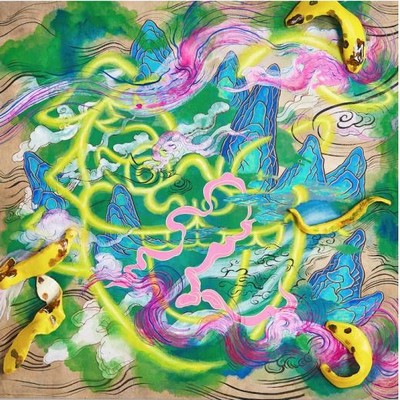
Derek Eller Gallery presents a solo exhibition of new paintings and ceramic sculptures by Atlanta-based artist JIHA MOON.  Working with a palette of super-saturated yellows, oranges, magentas and blues against contrasting dark Hanji (Korean mulberry paper) and brown stoneware, Jiha Moon mixes ingredients from Asian tradition and folklore, Western contemporary art, and global popular culture to create a vibrant and personal visual language in both two and three dimensions.

Throughout many of the works in this exhibition, Jiha Moon incorporates a particular shade of “Stranger Yellow” which she describes as a “mysterious, luscious, yet cautiously high-key color that stands out”.  Born in Korea in 1973, Jiha Moon has lived in the United States for over twenty years, and this color speaks to her notions of the visibility of the Asian community in America, as well as her own identity as an Asian American artist. The Stranger Yellow manifests itself in myriad ways: as an enlarged Pop brushstroke reminiscent of Lichtenstein, as a banana referencing the pejorative term for an assimilated Asian American, as the flowing blonde hair of a Western princess or Goldilocks, and as the contours of sun-dappled mountains and ocean waves evocative of Asian hanging scrolls.

The centerpiece of the exhibition, a ten-foot diptych entitled Yellowave (Stranger Yellow), contains many of these moves and more. Simultaneously chaotic and meditative, the painting pictures a large fluid landscape of swooping yellow in which twisted and patterned fortune cookies mingle with flowers and creatures from Korean folk art. A Blue Willow pattern motif (coopted from China by 18th Century Western design) occurs throughout. In a seamless cross-pollination of East and West, Jiha Moon incorporates additional invented and appropriated iconography in other paintings and sculpture, including Mexican Otomi dolls, Milagros, face jugs of the American South, emojis, tattoo design, and peaches (a symbol of immortality in Asian culture and a simultaneous nod to Jiha Moon’s hometown of Atlanta). She deftly utilizes this ever expanding vocabulary of imagery to explore relevant issues of identity, cultural displacement, and miscommunication.

JIHA MOON (born 1973, Daegu, South Korea) lives and works in Atlanta, GA. She had a recent solo exhibition at Abroms-Engel Institute for the Visual Arts at University of Alabama, Birmingham, AL and was included in “State of the Art 2020” at Crystal Bridges Museum of American Art, Bentonville, AK and “45 at 45” at L.A. Louver Gallery, Venice, CA. She has had solo  exhibitions at Museum of Contemporary Art Georgia, Atlanta; The Cheekwood Museum of Art, Nashville, TN; James Gallery of CUNY Graduate Center, NY, among others.  She has been included in group shows at Kemper Museum, Kansas City, MO; Fabric Workshop and Museum, Philadelphia; Asia Society, New York; and The Drawing Center, NY. Jiha Moon’s mid-career survey organized by the Halsey Institute of Contemporary Art and Taubman Museum toured more than 10 museum venues around the USA through 2018. This is her second solo exhibition at Derek Eller Gallery.

DEREK ELLER GALLERY
300 Broome Street New York, NY 10002

08/11/14

Miyoko Ito (1918 - 1983): Paintings, Adam Baumgold Gallery, New York

Miyoko Ito (1918 - 1983): Paintings
Adam Baumgold Gallery, New York
November 7 - December 19, 2014

Adam Baumgold Gallery presents an exhibition of paintings by MIYOKO ITO (1918-1983). This is Ito’s second New York solo exhibition since 1978. Miyoko Ito was born to Japanese parents in Berkeley, CA in 1918. She studied art at the University of California at Berkeley for a short time until she was imprisoned in a Japanese-American camp after the bombing of Pearl Harbor. Ito continued her education in prison and afterwards went to Smith College. After college, she was given a scholarship to attend the Art Institute of Chicago. It was in Chicago that Ito's career as an artist flourished; exploring cubism and latent abstraction in her works. Miyoko Ito stayed in Chicago until her death in 1983.

The exhibition focuses on Miyoko Ito’s paintings from the 1960’s to 1970’s. These paintings with their subtle mix of abstraction and figuration share the spirit of Matisse’s “Piano Lesson,” the linearity of Diebenkorn’s “Ocean Park” paintings and Paul Klee’s “ability to imbue his images with an inner life that is compelling and magical,” yet Ito’s paintings retain an obstinate independence and original vision that were an inspiration and bridge for generations of abstract and imagist artists in Chicago.
In his essay for the exhibition, Len Klekner says, “Ito’s paintings are in the main abstract, creating and maintaining an alternative universe as a whole distinctly set off from the world we inhabit. But many of her forms are allusive, suggestive of bits and pieces of bodies and the furnishings of our everyday lives. These elements are never resolved enough to overpower the imaginative arenas of her abstract fields. But they are suggestive enough, and perhaps even jarring enough, to lend another level of frisson to her works. Her forms are also often playful, quirky, and even goofy-to the point of contrasting markedly with the quiet authority of her sensitive backgrounds and resonant facture.”
Miyoko Ito’s work has been included in all major surveys of Chicago art including the exhibition “Art in Chicago 1945-1995.” A retrospective of her work was held at The Rennaisance Society at The University of Chicago in 1980. Ito was also included in the Whitney Biennial in 1975, and the Carnegie Insititute’s “International Exhibition of Contemporary Painting.” Her work is in the collections of The Art Institute of Chicago, The National Academy of Design, The Museum of Contemporary Art, Chicago, The Smart Museum of Art, Chicago, and The Whitney Museum of American Art, among others.

ADAM BAUMGOLD
60 East 66th Street, New York, NY 10065
www.adambaumgoldgallery.com

22/02/04

Shahzia Sikander, Tang Museum, Saratoga Springs, NY - Nemesis

Shahzia Sikander: Nemesis
Tang Museum, Saratoga Springs, NY
January 31 – April 11, 2004

The ancient art of miniature painting boldly enters the 21st century in the work of Pakistani-American artist Shahzia Sikander.  The Tang Teaching Museum and Art Gallery at Skidmore College presents her  innovative blend of Persian and contemporary themes, exquisitely rendered in small scale and opulent color in Shahzia Sikander: Nemesis.

Trained in miniature painting in Pakistan, Shahzia Sikander freely mingles Hindu and Muslim painting techniques with contemporary Western elements, from American painting and pop culture to war, supermodels, and fairy tales. Asian Art News described her work as “cultural weaving…fusing centuries-old techniques and images with provocative contemporary forms, without losing the rich possibilities of either approach.”

Sixth in the Tang’s series of “Openers” designed to introduce artists and new work to the region, Nemesis showcases the varied media and styles of Sikander’s most recent works. They range from jewel-like paintings as small as 6 by 8 inches to the large-scale wall installation Sikander makes in the Tang’s atrium. The exhibition also features two new works of animation, a medium whose elements of motion and time expand the narrative quality of Sikander’s works and invite the viewer to further engage her characters and environments. “The animations make more obvious the complex layering of imagery that the artist has always pursued in her paintings,” said exhibition co-curator Jessica Hough, associate curator of the Aldrich Contemporary Art Museum in Ridgefield, Conn.

The exhibition’s title comes from Sikander’s animation Nemesis, in which an elephant is composed, piece by piece, of smaller animals both gentle and fierce. Ridden by a devil character, the composite creature can be described as a nemesis—an unconquerable foe. Nemesis was also the name of the ancient Greek goddess of divine retribution, and “Greek gods, like Indian gods—even those thought of as ‘good’—are capable of imposing severe punishments on their subjects,” said exhibition co-curator Ian Berry, curator of the Tang Museum. “Sikander’s works often highlight this dark side of fate.”

Many of the works at first glance resemble ancient miniatures—but only at first glance. For instance, the 8-by-11-inch SpiNN (2003) depicts a spacious Mughal throne room rich with delicate architectural details (carvings, columns, geometric tiles) and crammed with nearly sixty gopis, female attendants of the Hindu god Krishna. Here, however, the exotic ladies dance attendance on a classically Western figure of Justice, seated on a throne and holding her scales aloft. Sikander’s work is “hardly about adhering to a closed heritage,” said the New York Times. “Instead, it seems to invite previously unrelated pictorial strains to mingle with humor, irony, and often eroticism.”

Born in the multicultural city of Lahore, Pakistan, Shahzia Sikander grew up equally conversant with international pop culture and her country’s heritage of miniature painting. Highly detailed and stylized, the art form originated as a courtly embellishment for royal manuscripts and reached its height during the Mughal empire (1526-1857), when Muslim rulers of Persia reigned over predominantly Hindu India. By Sikander’s day, cliché miniature images were “abundant as gift items everywhere, saturating the tourist market,” she recalls. “My initial feeling …was that it was kitsch, but I saw the potential of subversion.”

Shahzia Sikander studied miniature painting at the National College of Arts in Lahore, where classmates concentrating in contemporary Western art warned her that pursuing so highly stylized an art form would surely stifle her creativity. Inspired by the dedication of the school’s one instructor of miniature painting (his students were assigned to catch baby squirrels to acquire hairs fine enough for their handmade brushes), Sikander fully embraced “the rigors required of a miniaturist,” as Pakistan Newsline wrote. These included “the ritualized fabrication of brushes, the preparation of paper and of pigment from vegetable dyes as well as the meticulous brushwork required to achieve both the sharpness and softness of miniature painting techniques.” To Shahzia Sikander, the rigorous apprenticeship “never seemed restrictive. I wanted to learn the technique and skills,” and, she adds, “I liked that tension, remaining free of being prescribed while using a very prescribed art form.”

During graduate and post-graduate study at the Rhode Island School of Design and Houston’s Glassell School of Art, Shahzia Sikander discovered Southeast Asian painting styles that, given the highly charged political relationship between Pakistan and India, had previously been unavailable to her. Into her own Pakistani-based Mughal style, she began to incorporate the sensual designs and vibrant colors of the Indian Rajput school and the woman-centered format that first emerged in India’s Kangra valley in the 18th century. 

Sikander’s debut onto the New York art scene in 1997 quickly won attention and acclaim. Her work has appeared at the Drawing Center, the 1997 Whitney Biennial, Deitch Projects in SoHo, and the Museum of Modern Art’s important 2002 exhibition Drawing Now: Eight Propositions, among other venues. Her honors and awards include the honorary artist award from the Pakistan Ministry of Culture and National Council of the Arts. Shahzia Sikander lives and works in New York City.

The exhibition is organized by Tang curator Ian Berry and Aldrich associate curator Jessica Hough in collaboration with the artist.

The Tang Teaching Museum and Art Gallery at Skidmore College
815 North Broadway, Saratoga Springs, NY 12866