Showing posts with label PMA. Show all posts

22/10/25

Sebastian Errazuriz @ Philadelphia Art Museum - 'Double Take' Mid-career Survey Exhibition

Sebastian Errazuriz: Double Take
Philadelphia Art Museum
November 22, 2025 – August 16, 2026

Sebastian Errazuriz Design
SEBASTIAN ERRAZURIZ
Lightning Strike Lamp, 2025
Designed by Sebastian Errazuriz

Sebastian Errazuriz Design
SEBASTIAN ERRAZURIZ
Chicken Lamp III, 2014
Edition of 12 
Designed by Sebastian Errazuriz

Sebastian Errazuriz Design
SEBASTIAN ERRAZURIZ
The Represented Self, 2020 
Designed by Sebastian Errazuriz

Sebastian Errazuriz Design
SEBASTIAN ERRAZURIZ
The Represented Self, 2020 
Designed by Sebastian Errazuriz

The Philadelphia Art Museum presents Sebastian Errazuriz: Double Take, a mid-career survey by artist and designer Sebastian Errazuriz (b. 1977, Chile). The exhibition explores Errazuriz’s multi-hyphenate practice spanning art, craft, design, and technology, from antiquity-inspired furniture to multimedia work informed by artificial intelligence.  

Alongside the exhibition, Sebastian Errazuriz will be honored with the 39th Collab Design Excellence Award. Collab is the museum's affinity group for modern and contemporary design and has celebrated diverse international designers who have made important contributions that advance all disciplines of design. Collab was established in 1986 and presents the award annually. Previous awardees have included Florence Knoll Bassett, Naoto Fukasawa, Zaha Hadid, Ingo Maurer, George Nakashima, Gaetano Pesce, Patricia Urquiola, and Marcel Wanders, among others.  

Sebastian Errazuriz Design
SEBASTIAN ERRAZURIZ
Magistral Chest, 2014
Designed by Sebastian Errazuriz

Sebastian Errazuriz Design
SEBASTIAN ERRAZURIZ
Bust Shelf Green Marble, 2018
Designed by Sebastian Errazuriz

Sebastian Errazuriz Design
SEBASTIAN ERRAZURIZ
Bust Shelf Green Marble (Detail), 2018
Designed by Sebastian Errazuriz

Errazuriz’s creative imagination challenges upheld ideas of what design should be and, moreover, asks what it could be. Embracing humor and appropriation, his limited-edition and unique pieces often have a subtext that goes beyond form or function to include personal narratives, political messages, and cultural commentary. While many of Errazuriz’s pieces are functional, his work upends a number of conventions established within the design industry, including the notions that form should follow function, or that materials should be used where most appropriate.  

Sebastian Errazuriz: Double Take presents over 20 years of making, including early conceptual works that take nature and existing found objects as sources of inspiration. The exhibition features furniture, mirrors, and other products that the designer creates from appropriated and digitally manipulated Greco-Roman antiquities from museum collections. Also on display will be a range of the designer’s “kinetic” cabinets, defined by their moveable elements. Errazuriz is interested in disrupting the idea that cabinets must consist of a box with two front doors, regardless of their design. Instead, objects in Double Take propose a dynamic way of living with furniture that rotates, spins, and fans out in different directions.  

Sebastian Errazuriz Design
SEBASTIAN ERRAZURIZ
Piano Shelf, 2014
Designed by Sebastian Errazuriz

Sebastian Errazuriz Design
SEBASTIAN ERRAZURIZ
IMAGINE, 2025 
Designed by Sebastian Errazuriz

A final, monumental installation features a full-wall graphic made up of drawings that Sebastian Errazuriz has created through the use of artificial intelligence. Overlaid is a new work, which spells out the word “IMAGINE” in neon lights, the letters flashing in alternating patterns to alight only “AGI” at certain points. Unlike current AI models which are trained for specific tasks, the concept of AGI, or artificial general intelligence, involves systems possessing human-like cognitive abilities, allowing them to learn new skills, adapt to novel situations, and demonstrate common sense and creativity without explicit pre-programming. This focal point of the exhibition explores Errazuriz’s fascination with, and apprehension about, the potential impact of AI on artists, designers, and culture more broadly. 

Sebastian Errazuriz Design
SEBASTIAN ERRAZURIZ
Fan Cabinet, 2014
Designed by Sebastian Errazuriz

Sebastian Errazuriz Design
SEBASTIAN ERRAZURIZ
Narcissus Bowl, 2022
Designed by Sebastian Errazuriz
“The diverse body of work by Sebastian Errazuriz conveys imagination and cleverness, while also bewildering those who encounter it. The pieces are meant to be lived with, but, at the same time, are provocations. They have an air of mystery around their function and meaning,” said Tiffany Lambert, The Lisa Roberts and David Seltzer Curator of Modern and Contemporary Design. “This survey exemplifies one way to understand and challenge how design can impact our daily lives.” 
PHILADELPHIA ART MUSEUM
Alter Gallery (Gallery 276) 
2600 Benjamin Franklin Parkway, Philadelphia, PA 19130

15/07/25

A Nation of Artists @ Philadelphia Museum of Art & Pennsylvania Academy of the Fine Arts - A Landmark Exhibition of American Art Celebrating the United States’ 250th Anniversary

A Nation of Artists
Philadelphia Museum of Art
Pennsylvania Academy of the Fine Arts
April 12, 2026 - September 2027

The Philadelphia Museum of Art, Pennsylvania Academy of the Fine Arts, and The Middleton Family Present a Landmark Exhibition of American Art Celebrating the United States’s 250th Anniversary.

Jasper Johns, Flag
Jasper Johns 
Flag, 1960-66 
Encaustic and printed collage on paper laid down on canvas, 
17 1/2 x 26 3/4 (framed 34 3/4 x 44 inches) 
The Middleton Family Collection

Gilbert Stuart, George Washington
Gilbert Stuart  
George Washington (The Lansdowne Portrait), 1796 
Oil on canvas, 96 x 60 inches (243.84 x 152.4 cm)  
The Pennsylvania Academy of the Fine Arts, 
Bequest of William Bingham 

Jaune Quick-to-See Smith
Jaune Quick-to-See Smith 
 
What is an American?, 2001-2003   
Lithograph, chine collé, monotype, 
68 x 40 inches (172.72 x 101.6 cm)   
Gift of Ofelia Garcia

Barkley L. Hendricks
Barkley L. Hendricks 
J. S. B. III, 1968  
Oil on canvas, 48 x 34 3/8 inches (121.92 x 87.3125 cm)  
Gift of Mr. and Mrs. Richardson Dilworth

Two of America’s most esteemed cultural institutions—the Philadelphia Museum of Art (PMA) and the Pennsylvania Academy of the Fine Arts (PAFA)—announced A Nation of Artists, a historic collaboration with the private Middleton Family Collection that unites three extraordinary collections of American art. This unprecedented, once-in-a-lifetime exhibition will be presented exclusively at both PMA and PAFA to honor America’s 250th anniversary. It will open for public enjoyment from April 2026 to September 2027.

Featuring more than 1,000 works across the two museums, A Nation of Artists will be the most expansive presentation of American art ever mounted in Philadelphia. Though shaped by distinct curatorial visions at the PMA and PAFA, the exhibition is unified by shared themes exploring the richness of American art. Selections from The Middleton Family Collection—one of the country’s most significant private holdings—will be interwoven at both venues to offer fresh insight into the story of American art and experience.
“Our aspiration is that this exhibition is for everyone—no prior knowledge of art or history required,” noted John S. Middleton. “We believe in the power of storytelling to connect people and are thrilled to partner with these two storied institutions to share the works that have brought our family so much joy and inspiration. Like baseball, art has the power to bring people together and surprise us when we least expect it. With every viewing, there’s something new to discover. It’s an honor to help bring American art to life in a new way during this very special 250th commemoration of our country’s founding.
John Wallace
John Wallace
Untitled, 1939 
Oil on panel  36 x 19 ¾ inches (91.4 x 50.2 cm)  
A.E. Gllatin Collection, 1952 
Philadelphia Museum of Art

Horace Pippin
Horace Pippin 
John Brown Going to His Hanging, 1942 
Oil on canvas, 24 1/8 x 30 1/4 inches (61.2775 x 76.835 cm)   
John Lambert Fund 

Spanning three centuries of diverse mediums—from portraiture and sculpture to furniture, textiles, decorative arts, and photography—A Nation of Artists will trace the ever-evolving story of American creativity. Visitors will experience everything from the early realism of Charles Willson Peale to the shimmering brushwork of John Singer Sargent, the expressive intensity of Horace Pippin, and the impressionist elegance of Mary Cassatt—all shaped by the crosscurrents of cultural exchange, historic events, and imagination. The exhibition will further spotlight modern and contemporary artists whose work provides differing perspectives and interpretations of life in America today, including sculptural installations and multimedia works by Jaune Quick-to-See Smith, Rina Banerjee, and Mickalene Thomas.

Frederic Edwin Church
Frederic Edwin Church 
Pichincha, 1867 
Oil on canvas  31 × 48 3/16 inches (78.7 × 122.4 cm); 
Framed: 63 × 46 × 6 inches (160 × 116.8 × 15.2 cm)   
125th Anniversary Acquisition 
Gift of the McNeil Americana Collection, 2004 
Philadelphia Museum of Art.
“What makes American art so powerful is not only where it was created but also who made it—and why,” said Sasha Suda, the George D. Widener Director and CEO of the Philadelphia Museum of Art. “A Nation of Artists will present a broad and vibrant picture of artistic expression that was happening across the country through both familiar icons and voices that have historically been overlooked. We couldn’t be more excited and inspired to partner with PAFA and The Middleton Family on this extraordinary cultural milestone, and we look forward to welcoming everyone—from neighbors down the street to visitors from across the region, the country, and around the world—to be part of this celebration.”
As the birthplace of American democracy, Philadelphia will serve as a cultural and historic hub for the America 250 semiquincentennial celebrations, hosting global events including the 2026 FIFA World Cup, the PGA Championship, and the MLB All-Star Game, among many other exhibitions, sports events, and major conventions. A Nation of Artists will place the city at the heart of the nation’s creative legacy, reflecting both the historic depth and the city’s continued influence on American culture.
“This historic collaboration places Philadelphia’s artistic legacy on full display—offering the world a celebration of creativity, identity, and nationhood that can’t be experienced anywhere else,” said Angela Val, President and CEO of Visit Philadelphia. “Only in Philadelphia—where our independence was declared, our constitution debated and established, and our first states united—could an exhibition of this scale and significance come to life.”
Thomas Eakins
Thomas Eakins 
Portrait of Dr. Samuel D. Gross (The Gross Clinic), 1875 
Oil on canvas, 8 feet × 6 feet 6 inches (243.8 × 198.1 cm) 
Gift of the Alumni Association 
to Jefferson Medical College in 1878 
and purchased by the Pennsylvania Academy of the Fine Arts 
and the Philadelphia Museum of Art in 2007 with the generous 
support of more than 3,600 donors, 2007

Charles Willson Peale
Charles Willson Peale  
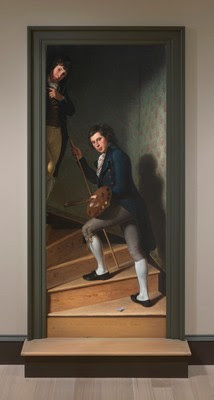
Staircase Group (Portrait of Raphaelle Peale 
and Titian Ramsay Peale I), 1795  
Oil on canvas,  7 feet 5 1/2 inches × 39 3/8 inches   
The George W. Elkins Collection, 1945   
Philadelphia Museum of Art

Wharton E. Esherick
Wharton E. Esherick  
Library Ladder Steps with Elephant 
and Donkey Shaped Finals, 1935  
Hickory, Oak  34 ¾ x 18 x 23 ¼ inches   
125th Anniversary Acquisition
Gift of Rachel Bok Goldman and Allen S. Goldman, M.D., 2001   
Philadelphia Museum of Art

Woman's Dress: Bodice, Skirt, and Belt
, 1866-1868 
Artist/maker unknown 
Magenta silk satin with black silk satin and black cotton lace   
Center Front Length (Skirt): 41 inches (104.1 cm), Waist (Bodice): 
23 inches (58.4 cm), Waist (Skirt): 22 inches (55.9 cm)   
Gift of Mr. and Mrs. W. W. Keen Butcher, 1997. 
Philadelphia Museum of Art

Bringing together two world-class institutions, A Nation of Artists will be a collaborative, two-venue exhibition with distinct perspectives, curated by the teams at the Philadelphia Museum of Art and the Pennsylvania Academy of the Fine Arts, in partnership with The Middleton Family. Highlighting the richness and diversity of American art, the exhibition spans generations and artistic traditions, featuring contributions from Indigenous, African American, immigrant, and historically underrepresented artists who have helped to shape the nation’s cultural story.

Celebrating its 150th anniversary in 2026, PMA’s installation will offer a sweeping panorama of American art from about 1700 to 1960. Through iconic masterworks and bold juxtapositions, visitors will trace the evolution of American identity and visual culture—exploring tensions between high and low, elite and common, abstraction and realism. Set within PMA’s Beaux-Arts building, the installation will affirm the museum’s civic role in shaping the future of art and culture.

This exhibition will also mark the reopening of PAFA’s fabled Historic Landmark Building, designed by Frank Furness and opened in 1876, unveiling a bold new installation of the museum’s permanent collection, enhanced by numerous works from The Middleton Family Collection. The reimagined installation will offer a contemporary lens on American art, grounded in PAFA’s legacy of inclusion and innovation. As the nation’s first art museum and school, founded by Charles Willson Peale in 1805, PAFA continues to shape how American artists evolve—through formal study, experimentation, community, and creative risk—supported by its exhibitions, certificate programs, and public initiatives.
“This is a transformative moment for PAFA and for Philadelphia,” said Harry Philbrick, Interim Director of the Pennsylvania Academy of the Fine Arts. “As we reopen our Historic Landmark Building, we invite audiences into a renewed experience—one that reflects both our storied legacy and our forward-looking vision. This exhibition, enriched by rarely seen works from The Middleton Family Collection, will offer a compelling and inclusive narrative of American art. It’s a powerful expression of PAFA’s ongoing commitment to education, artistic excellence, and public engagement—especially meaningful in a landmark year for our nation.”
Edward Hopper
Edward Hopper 
The Lee Shore, c. 1941 
Oil on canvas; 28 1/4 x 43 in. (71.8 x 109.2 cm) 
The Middleton Family Collection

Childe Hassam
Childe Hassam 
Up the Avenue from Thirty-Fourth Street, 1917  
Oil on canvas, 36 in × 29.93 in (~91.4 × 76.0 cm)   
The Middleton Family Collection

John Singer Sargent
John Singer Sargent 
Group with Parasols (A Siesta), c. 1904 
Oil on canvas; 26 1/8 × 34 1/4 in. (66.4 × 87 cm) 
The Middleton Family Collection

The Middleton Family Collection
Presented publicly for the first time, more than 120 works from The Middleton Family Collection, assembled over five decades, will bring added depth and dimension to A Nation of Artists. John S. Middleton, widely admired as the managing partner of the Philadelphia Phillies, and his wife Leigh Middleton, a champion in the fight to end homelessness, have been passionate art collectors throughout their nearly 50-year marriage. Masterworks not previously available for public exhibition will offer fresh perspectives on the story of American creativity and history.

A Nation of Artists is organized by the Philadelphia Museum of Art and the Pennsylvania Academy of the Fine Arts.

PHILADELPHIA MUSEUM OF ART
2600 Benjamin Franklin Parkway, Philadelphia, PA 19130

27/06/25

Dreamworld: Surrealism at 100 @ PMA - Philadelphia Museum of Art - A major exhibition celebrating the centenary of the Surrealist movement

Dreamworld: Surrealism at 100
Philadelphia Museum of Art
November 8, 2025 – February 16, 2026

Giorgio de Chirico
Giorgio de Chirico
(Italian, born Greece, 1888–1978) 
The Soothsayer's Recompense, 1913 
Oil on canvas, 53 3/8 × 70 7/8 inches (135.6 × 180 cm) 
Philadelphia Museum of Art: 
The Louise and Walter Arensberg Collection, 1950, 1950-134-38

André Masson
André Masson
(French, 1896–1987)
The Landscape of Wonders, 1935 
Oil on canvas, 30 1/8 × 25 3/4 inches (76.5 × 65.4 cm) 
Soloman R. Guggenheim Museum, New York 
Bequest, Richard S. Zeisler, 2007, 2007.44

Salvador Dali
Salvador Dalí
(Spanish, 1904–1989) 
Soft Construction with Boiled Beans, 
(Premonition of Civil War), 1936 
Oil on canvas, 39 5/16 x 39 3/8 inches (99.9 x 100 cm) 
Philadelphia Museum of Art: 
The Louise and Walter Arensberg Collection, 1950, 1950-134-41

Salvador Dali
Salvador Dalí
(Spanish, 1904–1989) 
Aphrodisiac Telephone, 1938 
Plastic and metal, 
8 1/4 × 12 1/4 × 6 1/2 inches (21 × 31.1 × 16.5 cm) 
Lent by the Minneapolis Institute of Art, 
The William Hood Dunwoody Fund, 96.2 

The Philadelphia Museum of Art (PMA) presents Dreamworld: Surrealism at 100, a major exhibition celebrating the centenary of the Surrealist movement. As the final stop in an ambitious  tour organized with the Centre Pompidou in Paris—and the sole venue in the United States—the PMA will tell the story of Surrealist art, spotlighting the makers who sought out new expressive forms to expand the reach of the creative imagination.

The five touring partners are: the Centre Pompidou (Paris), the Royal Museums of Fine Arts of Belgium (Brussels), the Fundación MAPFRE (Madrid), the Hamburger Kunsthalle (Hamburg), and the PMA. Each  venue was tasked with presenting a distinct story of Surrealism relevant to their own histories and collections. At the PMA, Dreamworld will provide a chronological installation arranged through six thematic sections, including one, unique to Philadelphia, that focuses on artists who fled from Europe to Mexico and the U.S. during World War II.

In his 1924 Manifesto of Surrealism, poet and artist André Breton addressed what he saw as a crisis of consciousness: at around twenty years of age, he said, humans discard their childlike imaginations to adopt adult sense, decorum, and judgement. Breton believed that the only legitimate aspiration is to obtain a state of freedom, achievable solely by reharnessing the imagination. Surrealism, the movement in literature and art that Breton codified with his manifesto, would continually seek new techniques for exploring the human capacity for astonishment.

The first self-described Surrealists working in Paris rejected the representation of objective reality in art as antithetical to a truer, higher beauty, and instead, sought to produce images with a dreamlike character. The first section of this exhibition, “Waking Dream,” traces the development of Surrealist imagery and experimental techniques across mediums in the 1920s, from the found-object constructions of Man Ray and the collages of Max Ernst to hallucinatory canvases by Giorgio de Chirico, René Magritte, and Salvador Dalí.

Jean Hans Arp
Jean (Hans) Arp
(French, born Germany [Alsace], 1886–1966) 
Growth, modeled 1938; cast by 1949 
Bronze, 31 1/4 × 12 1/2 × 7 3/8 inches (79.4 × 31.8 × 18.7 cm) 
Philadelphia Museum of Art: 
Gift of Curt Valentin, 1950, 1950-78-1

Roberto Matta
Roberto Matta
(Chilean, 1911–2002) 
Morphology (Fantasy Landscape), c. 1939 
Oil on canvas, 12 × 16 1/8 inches (30.5 × 41 cm)
Collection of Andrew S. Teufel

Dorothea Tanning
Dorothea Tanning
(American, 1910–2012) 
Birthday, 1942 
Oil on canvas, 40 1/4 × 25 1/2 inches (102.2 × 64.8 cm)
Philadelphia Museum of Art: 125th Anniversary Acquisition. 
Purchased with funds contributed 
by C. K. Williams, II, 1999, 1999-50-1

Dreamworld will then journey through sections exploring the themes of “Natural History” and “Desire.” Capturing a sense of wonder in nature was crucial for the development of Surrealist sensibility. Visitors will encounter enigmatic landscapes and fantastic creatures; torn-paper collages by Hans Arp will be displayed alongside Paul Klee’s vibrant painting Fish Magic (1925), the disorienting photographic landscapes by Lee Miller, and Joseph Cornell’s boxes containing found objects. Nearby, works by Hans Bellmer, Claude Cahun, André Kertész, and others will demonstrate the powerful ways in which photography served the Surrealist interest in eros, or desire, and the reinvention of the erotic body.

A through line of the exhibition is the use of mythology to convey the Surrealist world view. A section titled “Premonition of War” features images of monsters and creatures of strange and terrifying shape, which artists such as Dalí, Ernst, André Masson, Joan Miró, and Pablo Picasso used to respond to the devastating rise of totalitarianism and war in Europe in the 1930s.

With the outbreak of World War II, many Surrealists working in France left for North America, taking refuge in Caribbean ports, Mexico, and the United States. This is the focus of a section unique to the PMA, entitled “Exiles.” This section features treasured paintings in the PMA’s collection in addition to major loans such as Frida Kahlo's My Grandparents, My Parents, and I (Family Tree) (1936). In New York, Surrealism’s wartime capital, younger artists developed innovative forms of painting in tune with Surrealist methods. Highlights here will include Jackson Pollock’s Male and Female (1942–1943) and Mark Rothko’s Gyrations on Four Planes (1944).

The exhibition’s concluding section, “Magic Art,” focuses on a new type of esotericism that emerged within Surrealism in the aftermath of World War II. Filled with imagery of magical and alchemical beings, celestial figures, and symbols of the occult, this section will feature Leonora Carrington’s The Pleasures of Dagobert (1945), which materializes the magical, metamorphic imaginings of an early-medieval French monarch, and Remedios Varo’s Creation of the Birds (1957), in which an owl-headed painter uses starlight to bring a painted bird to life.

Remedios Varo
Remedios Varo
(Spanish, 1908–1963) 
Icon, 1945
Oil with mother-of-pearl and gold leaf inlays on wood 
Closed: 23 5/8 × 15 7/16 × 2 1/8 inches 
(60 × 39.2 × 5 .4 cm) 
Open: 23 5/8 × 27 9/16 × 2 1/8 inches 
(60 × 70 × 5.4 cm) 
Colección Malba, 
Museo de Arte Latinoamericano de Buenos Aires, 1997.02

Arshile Gorky
Illustrated by Arshile Gorky (American, born Van Province, 
Ottoman Empire [present-day Turkey], c. 1904–1948) 
Text by André Breton (French, 1896–1966), 
Dust jacket and cover designed by Marcel Duchamp 
(American, born France, 1887–1968), 
Cover of Young Cherry Trees Secured Against Hares, 1946 
Hardbound book with paper cover design by Marcel Duchamp
Book: 9 3/8 x 6 3/8 inches (23.8 x 16.2 cm)
Philadelphia Museum of Art: 
Gift of an anonymous donor, 1988, 1988-8-2

Victor Brauner
Victor Brauner
(Romanian, 1903–1966) 
The Lovers (Messengers of the Number), February, 1947 
Oil on canvas, 36 1/4 × 28 3/4 inches (92 × 73 cm) 
Centre Pompidou, Musée National d’Art Moderne, Paris: 
Bequest of Mme Jacqueline Victor Brauner, 1986, AM 1987-1204

Joseph Cornell
Joseph Cornell
(American, 1903–1972) 
Untitled (Constellation), c. 1958 
Box construction: wood, metal, cut paper, glass and found objects, 
13 × 19 3/8 × 4 1/4 inches (33 × 49.2 × 10.8 cm) 
Philadelphia Museum of Art: 
Gift of Josephine Albarelli, 2015, 2015-144-5
“Surrealist art has been a focus of our museum since receiving the generous gifts of the Louise and Walter Arensberg collection in 1950 and the bequest of the Albert E. Gallatin collection in 1952,” said Matthew Affron, the museum’s Muriel and Philip Berman Curator of Modern Art. “Today, our permanent collection features outstanding works by a range of artists associated with Surrealism, including Giorgio de Chirico, Joan Miró, René Magritte, Jean Arp, Salvador Dalí, and Dorothea Tanning. As the main repository of works by Marcel Duchamp, one of Surrealism’s most influential guiding spirits, the PMA is very proud to build on this monumental exhibition and present it to audiences in the U.S.”

“The PMA has an extraordinary collection of modern art, and through this exhibition, we can offer our visitors a new perspective on Surrealism and showcase the strength of our own collection,” said Sasha Suda, the George D. Widener Director and CEO. “I can’t think of a more perfect way to celebrate 100 years of Surrealism.”
In Philadelphia, Dreamworld: Surrealism at 100 is curated by Matthew Affron, the Muriel and Philip Berman Curator of Modern Art, with Danielle Cooke, Exhibition Assistant. It will be accompanied by an illustrated publication by Matthew Affron, detailing the the key motivations, principles, themes, and techniques of Surrealist art from the early 1920s to the late 1950s.

PMA - PHILADELPHIA MUSEUM OF ART
2600 Benjamin Franklin Parkway, Philadelphia, PA 19130

Related Posts on this blogzine:


The Hepworth Wakefield, 23 November 2024 – 27 April 2025

Keith de Lellis Gallery, New York, October 3 – November 15, 2024

Edwynn Houk Gallery, New York, 4 April - 25 May 2024

Tate Modern, London, 24 February 2022 – 29 August 2022

Museo Thyssen-Bornemisza, Madrid, 8 October 2013 - 12 January 2014

Museo Nacional Centro de Arte Reina Sofia, Madrid, April 27 - September 2, 2013

Zabriskie Gallery, New York, March 22 - May 5, 2001

Israel Museum, Jerusalem, December 22, 2000 - June 2001

Modern Art Museum of Fort Worth , January 14 - March 17, 1996 

12/02/24

Mary Cassatt at Work @ Philadelphia Museum of Art + FAMSF Legion of Honor, San Francisco. A large-scale exhibition

Mary Cassatt at Work
Philadelphia Museum of Art
May 18 – September 8, 2024

Mary Cassatt
MARY CASSATT 
Lydia Seated in the Garden with a Dog on Her Lap, 1878–79 
Oil on canvas, 10 3/4 × 16 in. (27.3 × 40.6 cm) 
Cathy Lasry, New York 

Mary Cassatt
MARY CASSATT 
A Goodnight Hug, 1880 
Pastel on brown paper laid down on board, 
16 9/16 x 24 3/4 in. (42 x 62.8 cm) 

Mary Cassatt
MARY CASSATT 
Driving, 1881 
Oil on canvas, 35 5/16 × 51 3/8 in. (89.7 × 130.5 cm) 
Philadelphia Museum of Art: 
Purchased with the W. P. Wilstach Fund, W1921-1-1 

Mary Cassatt
MARY CASSATT 
Woman at Her Toilette, c. 1891 
Oil on canvas, approx. 30 x 25 in. (76.2 x 63.5 cm) 
Private Collection 

The Philadelphia Museum of Art presents Mary Cassatt at Work, the first large-scale exhibition of the artist’s work in the U.S. in a quarter century. 

Pennsylvania-born and a celebrated member of the French Impressionists, Mary Cassatt built a groundbreaking career through hard work and artistic vision. For six decades, Cassatt was a committed, professional artist, making the social, intellectual, and working lives of modern women a core subject of her prints, paintings, and pastels.  She once wrote: “Oh the dignity of work, give me the chance of earning my own living, five francs a day and self-respect.”  

Mary Cassatt at Work presents over 130 of her works in various media to show her evolving practice as an artist and demonstrate her commitment to the “serious work” of artmaking. It presents new findings about her materials and working methods—which were advanced and radical for her era—based on detailed technical studies of the Philadelphia Museum of Art’s significant Cassatt holdings.  
“Art was Mary Cassatt’s life’s purpose and living,” said Sasha Suda, the George D. Widener Director and CEO of the Philadelphia Museum of Art. “This exhibition will focus on Cassatt’s professionalism, her biography, and the wider Parisian world she inhabited.  It’s my hope that this exhibition will reshape contemporary conversations about gender, work, and artistic agency.”  
Mary Cassatt at Work features works from the PMA’s extensive collection, including some of Cassatt’s most celebrated paintings and prints, as well as loans from the Metropolitan Museum of Art, the Art Institute of Chicago, the Cleveland Museum of Art, the Viginia Museum of Fine Arts, and private collections.
“We hope visitors come away with a sense of who Cassatt was and how carefully she constructed her identity as a working artist,” said curators Jennifer A. Thompson, The Gloria and Jack Drosdick Curator of European Painting and Sculpture and Curator of the John G. Johnson Collection, and Laurel Garber, The Park Family Assistant Curator of Prints and Drawings. “With this exhibition, we’ve sought to reexamine the full breadth of Cassatt’s art through the lens of her creative enterprise and draw attention to her commitment to ceaseless experimentation and bold techniques."
The exhibition will be accompanied by a fully illustrated catalogue.

Following its run at the PMA, this exhibition will travel to the Fine Arts Museums of San Francisco, Legion of Honor.

PHILADELPHIA MUSEUM OF ART - PMA
2600 Benjamin Franklin Parkway, Philadelphia, PA 19130

30/04/23

American Outsider Art @ Philadelphia Museum of Art - Of God and Country: American Art from the Jill and Sheldon Bonovitz Collection

Of God and Country: 
American Art from the Jill and Sheldon Bonovitz  Collection 
Philadelphia Museum of Art 
May 19, 2023 – January 1, 2024 

Josephus Farmer
Josephus Farmer
Cotton Kingdom,1987
Paint and enamel on carved wood
Collection of Jill and Sheldon Bonovitz

Jon Serl
Jon Serl
Between Two Worlds, 20th century
Oil on board, artist-made frame 
Collection of Jill and Sheldon Bonovitz

Elijah Pierce
Elijah Pierce
Untitled, 20th century
Paint, glitter, and varnish on carved wood 
Collection of Jill and Sheldon Bonovitz

The Philadelphia Museum of Art is presenting an exhibition devoted to an important group of works by artists historically marginalized or excluded from traditional narratives of art history and typically described as “Outsider artists.” Of God and Country: American Art from the Jill and Sheldon Bonovitz Collection explores their work through themes ranging from history to daily life, including the nation’s legacy of enslavement and racism, the landscape, and meditations on death and mortality. The exhibition features voices that variously critique and celebrate American life, often expressing ambivalence toward both the past and present while strong faith in the future, whether in this life or the next. Each work is drawn from the Jill and Sheldon Bonovitz Collection, including gifts, promised gifts, and loans to the museum. 
Sasha Suda, the George D. Widener Director and CEO, said: “Surrender your ideas of genre as you enter Of God and Country and allow yourself to let codified art hierarchies and categories melt away. That is the special pleasure of this collection of work often called Outsider Art.  We are immensely grateful to Jill Bonovitz, and to our longstanding museum Trustee Sheldon Bonovitz, for this remarkable array of works. Not only did they generously present the museum with a major promised gift of their collection in 2011, but the Bonovitzes have continued to collect with insight and passion and have generously contributed additional gifts during their shared adventure.”
Many of the artists represented in the exhibition ultimately achieved considerable reputations. Martín Ramírez and Bill Traylor are considered iconic figures. Sister Gertrude Morgan, Rev. Howard Finster, Joseph Yoakum, and Purvis Young are also widely known, while others remain less well recognized practitioners in the field of 20th century American art, including Jon Serl, Bruno del Favero, and S.L. Jones.

Purvis Young
Purvis Young
Untitled (Truck & Protesters), Late 20th century 
Mixed media, paint on wood construction 
Collection of Jill and Sheldon Bonovitz

Herbert Singleton
Herbert Singleton
The Enemies Within, Late 20th century
Enamel on carved found wood
Collection of Jill and Sheldon Bonovitz

The exhibition includes a broad range of media, sizes, and styles, and is organized in four sections, beginning with U.S. History & Life in America, which contains potent symbols of the US, including the flag, Uncle Sam, and portraits of figures ranging from Abraham Lincoln and Dwight D. Eisenhower to Rev. Martin Luther King, Jr. Some works highlight positive aspects of American life while others, such as Jail was Heat, by Purvis Young (1943-2010) and The Enemies Within, by Herbert Singleton (1945-2007), contain themes of discriminatory policing and incarceration policies that target Black communities.

Joseph Yoakum
Joseph Yoakum
Mt Willow in Ozark Range, Jefferson City Missouri
Early to mid-20th century
Watercolor, pen, and ink on paper 
Collection of Jill and Sheldon Bonovitz

A section called The American Landscape contains lively images of people and animals, agrarian life, and mountain ranges. Many of the artists represented here grew up in rural communities, often working on farms, while others traveled widely. Works by Martin Ramirez (1895-1963) include Horse and Rider, which evokes mineshafts and tunnels that the artist would have known working as a miner and railroad worker in California. Another drawing, by Joseph Yoakum (1891-1972), evokes dreamy mountains, rivers, gorges, and rocky outcroppings, suggesting an anthropomorphic vision infused by memory and imagination.

Sister Gertrude Morgan
The Lamb and his Bride, 20th century
Ink, acrylic, and crayon on repurposed Tide laundry detergent box 
Collection of Jill and Sheldon Bonovitz

Christianity and Spirituality reflects a history of American evangelicalism, as these artists often felt divinely inspired to make art and used their work to teach religious devotion. The section contains a focused grouping of works by street preacher Sister Gertrude Morgan (1900-1980), who established a gospel mission in the lower ninth ward of New Orleans. She represented herself as the bride of Christ there in New Jerusalem Highway, a painting also populated with images of angels.

Howard Finster
Howard Finster
People and Time Come Together . . ., #16,977, 1990 
Paint on wood cutout
Collection of Jill and Sheldon Bonovitz

Death and Mortality, the final section, reflects upon life’s fragility and Christian afterlife. In People and Time Come Together, Rev. Howard Finster (1916-2001) offers us a scaly dinosaur, painted on wood, surrounded by warnings of apocalypse; he dedicated himself to art at age 60, following a vision, and produced thousands of works, often evoking the urgency of end times. Another highlight is St. Helena First Black Embalmer John, painted on a corrugated iron sheet by Sam Doyle (1906-1985). He often rendered Black celebrities, such as Ray Charles or Joe Louis, but here focuses on a man practicing his craft as an embalmer, readying the deceased for the next journey.

The exhibition is organized by Louis Marchesano, Audrey and William H. Helfand Senior Curator of Prints, Drawings, and Photographs; Jessica Smith, Director of Curatorial Initiatives and Susan Gray Detweiler Curator of American Art; Jun P. Nakamura, former Suzanne Andree Curatorial Fellow; with contributions from Monique D'Almeida, Margaret R. Mainwaring Curatorial Fellow and Kendra Grimmett, former Carl Zigrosser Fellow.
“This exhibition is devoted to works created by people who operated far from the world of galleries, museums, and art schools, and yet they created astonishing works of art," said Louis Marchesano. “Of God and Country argues for a much wider, open-ended and more inclusive consideration of artistic vision in the United States of the 20th century and today.”
This exhibition is made possible by Jill and Sheldon Bonovitz.

About the Jill and Sheldon Bonovitz Collection

It is considered one of the finest private collections of works by American self-taught artists, and Jill and Sheldon Bonovitz assembled it over the course of several decades before making part of it a promised gift to the Philadelphia Museum of Art in 2011. Including 177 works of art, it contributed significantly to establishing the Museum as one of the primary centers for the study of artists who once rarely found a place in American museums, many having operated without academic training and outside traditional artistic discourse. The works in the Bonovitz collection were often produced in remote places using unconventional methods and materials such as reclaimed wood, sheet metal, house paint, and stove soot. These works draw upon the artists’ own experiences, immediate surroundings, and popular culture. In 2013, in association with Yale University Press, the Philadelphia Museum of Art published Great and Mighty Things: Outsider Art from the Jill and Sheldon Bonovitz Collection, on the occasion of a major exhibition of the same title.

PHILADELPHIA MUSEUM OF ART
2600 Benjamin Franklin Parkway, Philadelphia, PA 19130

13/01/22

Sean Scully @ Philadelphia Museum of Art - The Shape of Ideas

Sean Scully: The Shape of Ideas 
Philadelphia Museum of Art 
April 11 – July 31, 2022 

Sean Scully
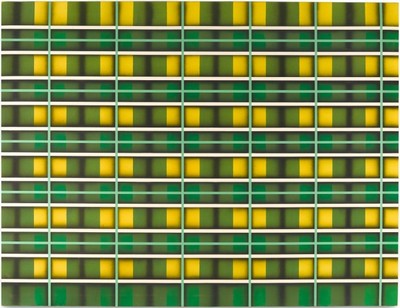
SEAN SCULLY
"Green Light," 1972–73, by Sean Scully. 
Acrylic on canvas, 8 feet 1/2 inches x 10 feet 6 3/4 inches. 
Private Collection. 
Image courtesy of Bonhams & Butterfields, New York, 2020. 
© Sean Scully.

The Philadelphia Museum of Art presents a major survey of Irish-born American artist SEAN SCULLY, featuring paintings and works on paper from the early 1970s to the present. Sean Scully: The Shape of Ideas charts the artist’s significant contributions to the American and European history of abstract painting as it has developed over the last half-century, while emphasizing the integral relationship between Sean Scully’s paintings, drawings, watercolors, and prints, which are rarely exhibited together. 
 “Sean Scully is one of the leading painters of our time,” said Timothy Rub, the George D. Widener Director and CEO of the Philadelphia Museum of Art and one of the exhibition curators. “Over the decades he has pursued a vision that has progressively opened new possibilities for abstraction, often working with deceptively simple compositional structures and on a variety of scales that range from the intimate to the monumental. He has also distinguished himself as a brilliant colorist, drawing inspiration from his immediate surroundings in places as various as Mexico, the remote islands of the Outer Hebrides, and the dense and dynamic urban fabric of New York, where he lived and worked for many years. We are pleased to share with our visitors this survey of Scully’s career, which illuminates his unique contributions to the history of Contemporary art.”
The exhibition, previously on view at the Modern Art Museum of Fort Worth, has been expanded for the Philadelphia Museum of Art presentation to include additional paintings and works on paper, bringing together over one hundred works that reflect the many phases of Sean Scully’s long and productive practice. Several galleries are devoted to the artist’s virtuosic prints, featuring color lithographs, woodcuts, etchings, and aquatints. Among the highlights of this section are a series of color aquatints from the museum’s collection, each accompanied by the verses of Spanish poet Federico García Lorca (1898–1936) along with a selection from the recently acquired portfolio Landlines and Robes (2018). The display of the artist’s prints both mirrors and offers an introduction to the galleries devoted largely to Sean Scully’s painting practice with pastels, drawings, and watercolors integrated throughout, further emphasizing the ongoing relationship between his paintings and works on paper.

The first paintings that the visitor encounters are important works that Sean Scully created during a fellowship year at Harvard University in 1972–73. This experience afforded him opportunities to travel from London to New York, a major center for Minimalism and abstract painting at the time. (He would move to New York permanently in 1975.) In these works, such as Green Light (1972–73), Sean Scully experimented with the grid, using tape and spray paint to layer the canvas and create an optically vibrant painting composed of vertical and horizontal stripes. On display nearby is Inset #2 (1973), an early example of the artist’s interest in creating a “painting within a painting,” or what Sean Scully terms an “inset,” which remains a hallmark motif within his practice.

An adjacent gallery is devoted to the complex multi-paneled works that Scully began to make in the early 1980s, a compositional format that would occupy the artist’s attention throughout the remainder of that decade. In these paintings, he combined panels of contrasting colors and formats into large and increasingly complex compositions, each structured by his signature “stripe.” Notable among these is Backs and Fronts (1981), an 8 x 20-foot work comprised of twelve attached canvases, which drew considerable notice when first exhibited at PS1 (now, MoMA PS1) in 1982.

Sean Scully
SEAN SCULLY
"The Fall, "1983, by Sean Scully. 
Oil on canvas, 9 feet 8 inches x 8 feet 5/8 inches. 
Gift of Jeffrey H. Loria, 2017. 
Image courtesy of Philadelphia Museum of Art, 2022. 
© Sean Scully.

The next large gallery features selections from a series of pivotal works produced during the artist’s residency at the Edward Albee Foundation in Montauk, New York, in 1982. These small paintings were made using scraps of wood that Scully found in Albee’s former barn, which doubled as Scully’s studio. He then pieced the scraps together to create sculptural compositions in relief, which are represented in the exhibition through works like Swan Island, Ridge, Bonin, and Elder all from 1982. Together, these paintings reflect a turning point in the artist’s use of scale as his work became increasingly architectural. This new direction was solidified by a group of monumental paintings, among them Heart of Darkness (1982), a colossal three-panel work in the collection of the Art Institute of Chicago, as well as The Fall (1983)—from the museum’s own collection. Around this same time, ean Scully also made the first of several trips to Mexico where he found inspiration in its architecture, its light, and its saturated colors. These travels spurred him to begin to explore watercolor as a medium, as seen in Mexico Azul 12.83 (1983).

Sean Scully
SEAN SCULLY
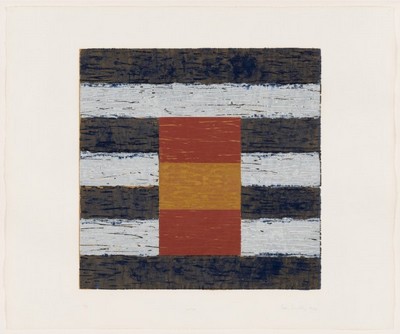
"With," 1988, by Sean Scully. 
Color woodcut, 29 7/8 x 30 inches. 
Purchased with the Edgar Viguers Seeler Fund, 2019. 
Image courtesy of Philadelphia Museum of Art, 2022. 
© Sean Scully.

In the late 1980s, Sean Scully extended his experimentation with the stripe, using it in combination with compositional structures such as the checkerboard and the inset. These ideas were given form in some of the artist’s most expressive paintings, among them Pale Fire (1988), A Bedroom in Venice (1988) and Union Yellow (1994). In them, and in many other works of this period, we can trace Scully’s development as a gifted colorist.

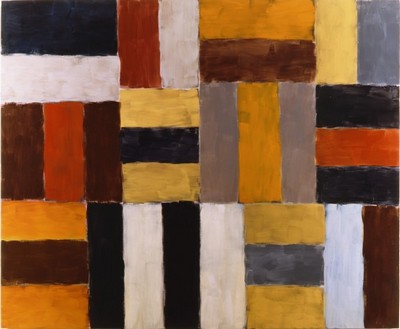
Sean Scully
SEAN SCULLY
"Wall of Light Orange Yellow," 2000, by Sean Scully. 
Oil on linen, 9 x 11 feet. 
Hugh Lane Gallery, Dublin: Donated by the artist, 2006. 
Collection & image courtesy of Hugh Lane Gallery, Dublin. 
© Sean Scully.

Another gallery features his best-known series, collectively titled Wall of Light, which Sean Scully began working on in earnest in 1998. Many of these works were made in response to a particular location, sensation, or memory. Their richly painted surfaces, composed in a quilted pattern of vertical and horizontal blocks (Sean Scully calls them “bricks”), are evocative of, as the title of the series suggests, walls of stone that are paradoxically, as Sean Scully has put it, “inhabited by light.” A selection of these paintings will be seen together with works on paper including pastels and watercolors from the same series, foregrounding the artist’s facility with working across different scales and mediums.

These Wall of Light paintings led to the development of Sean Scully’s other, closely related compositional formats, chief among them the paintings of the Doric series, which will occupy another spacious gallery. Sean Scully created this series as an homage to the heritage of ancient Greece, reflecting ideas of strength, resilience, and stability. Painted on aluminum, these works are more austere in their palette, which is predominantly grey and black, and more sonorous in their visual rhythms.

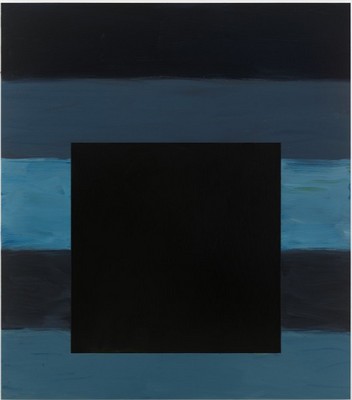
Sean Scully
SEAN SCULLY
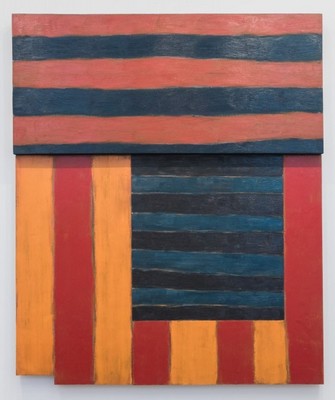
"Black Blue Window," 2021 by Sean Scully.
Oil on aluminum, 7 feet 1 inch x 6 feet 3 inches.
Collection of the artist. Image courtesy of the artist. 
Photographer: Elisabeth Bernstein; © Sean Scully.

A final gallery focuses on the work that Sean Scully has made during the past decade, most prominently a series titled Landlines. These large gestural paintings are made up of thick horizontal bands of color that harken back to the elegant and spare canvases that Scully produced after he came to New York in 1975. At the same time, the Landlines are among the most freely painted and unabashedly romantic works Sean Scully has ever created. Considered together, they reflect the artist’s continuing belief in the expressive potential of abstraction and his ability to register a precise tone or mood through color. The exhibition concludes with several recent works, among them Black Blue Window (2021), a work dominated by a gaping black square that reflects Sean Scully’s personal response to the COVID-19 pandemic.
Marla Price, Director of the Modern Art Museum of Fort Worth, and contributor to the exhibition’s catalogue, notes that the artist’s work, as it has evolved over the course of more than five decades, remains intimately connected: “Scully has spoken of his career as a ‘rolling cannibalization,’ in which he scavenges his own work and that of others to expand, develop, and move forward. The systematic elements in his early works have never really disappeared as he continues to explore different combinations of building units or motifs and then pair them with emotion and content.”

Exhibition co-curator Amanda Sroka, Associate Curator of Contemporary Art at the Philadelphia Museum of Art, adds: “In this exhibition, by integrating paintings and works on paper, we can understand and appreciate – in new and meaningful ways – Scully’s relationship to scale, materials, and color and the complementary roles that each have played in both the trajectory of his artistic development and in affirming his place within the Western art historical canon.”

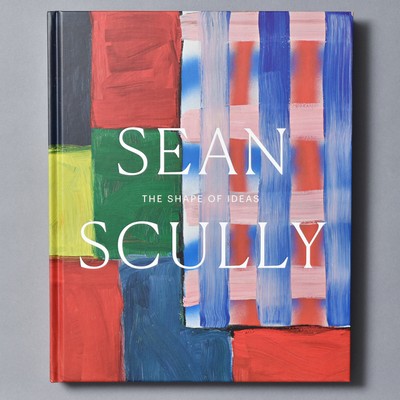
Sean Scully
SEAN SCULLY: THE SHAPE OF IDEAS
By Timothy Rub and Amanda Sroka
Philadelphia Museum of Art / Yale University Press
PUBLICATION - Sean Scully: The Shape of Ideas, is authored by Timothy Rub, the George D. Widener Director and CEO, with Amanda Sroka, Associate Curator of Contemporary Art. It is the first to thoroughly examine Sean Scully’s art within a biographical context. Co-published by the Philadelphia Museum of Art and Yale University Press, the catalogue presents an in-depth account of Scully’s work and his most significant bodies of work informed by extensive interviews with the artist and comprehensive art historical research. The book contains a preface by Marla Price, Director of the Modern Art Museum of Fort Worth and author of Scully’s multivolume catalogue raisonné; an extensive biographical, contextual and formal reading offered by Timothy Rub; and an essay by the poet and art critic Kelly Grovier on the unique contribution Scully has made to the history of abstraction, particularly as it has developed in North America and across Europe. Featured contributions include reprints of key essays by William Feaver, Deborah Solomon, Donald Kuspit, Arthur C. Danto, and Michael Auping, which contextualize Scully’s work over the decades. 256 pages. ISBN: 9780876332955. $45.00. Available now at https://store.philamuseum.org/sean-scully-the-shape-of-ideas/

SEAN SCULLY (b. Ireland, 1945) works in the mediums of painting, drawing, printmaking, sculpture, and photography. Coming of age in London in the 1950s and moving to the United States at 30 years old, the artist has tested the possibilities of abstract art to develop a style that is uniquely his own. He is the recipient of numerous awards, including the Peter Stuyvesant Foundation Prize, a National Endowment for the Arts Fellowship, a Guggenheim Fellowship, and the Harkness Fellowship, and stands as a two-time Turner Prize nominee. Scully’s works are found in numerous private and public collections, including the Philadelphia Museum of Art, the Modern Art Museum of Fort Worth, the Hirshhorn Museum and Sculpture Garden in Washington, DC, the Metropolitan Museum of Art, and the Wadsworth Athenaeum Museum of Art in Hartford, Connecticut. In 2015, Scully participated in the Venice Biennale with his solo exhibition Land Sea at the Palazzo Falier. For the 2019 Biennale, the artist presented Human, a solo exhibition at the historic Basilica of San Giorgio. The artist has held recent and significant exhibitions at institutions including the Museum of Fine Arts – Hungarian National Gallery, Hungary (2021); Skulpturenpark Waldfrieden, Germany (2020); and the Albertina, Vienna, Austria (2019). Sean Scully: The Shape of Ideas, which was seen previously at the Modern Art Museum of Fort Worth, is the artist’s first retrospective of this scale in the United States since Sean Scully: Twenty Years, 1976–1995, presented in 1995 at the Hirshhorn Museum and Sculpture Garden. He currently divides his time living and working in New York and the Bavarian countryside outside Munich.

Curators
Timothy Rub, The George D. Widener Director and Chief Executive Officer
Amanda Sroka, Associate Curator of Contemporary Art

TIMOTHY RUB has been the George D. Widener Director and Chief Executive Officer of the Philadelphia Museum of Art since 2009. Prior to that, he held director positions at the Cleveland Museum of Art, the Cincinnati Art Museum, and the Hood Museum of Art at Dartmouth College in Hanover, New Hampshire. A specialist in architectural history and modern and contemporary art, Rub began his curatorial career as a Ford Foundation Fellow and curator at Cooper Hewitt in New York.
 
AMANDA SROKA is the Associate Curator of Contemporary Art at the Philadelphia Museum of Art. She joined the museum in 2014 following the completion of her Masters in Art History at the Courtauld Institute of Art in London, where she focused on global conceptual art practices. Recent projects at the Philadelphia Museum of Art include Senga Nengudi: Topologies (2021), Marisa Merz (2019), Yael Bartana: And Europe Will Be Stunned (2018), Philadelphia Assembled (2017), Jitish Kallat: Covering Letter (2016), and “Plays of / for a Respirateur” An Installation by Joseph Kosuth (2015). Forthcoming projects include solo exhibitions at the museum dedicated to Martine Syms (2022) and Lawrence Abu Hamdan (2023) as part of the Future Fields Commission series.

In Philadelphia, Sean Scully: The Shape of Ideas is made possible by Robbi and Bruce Toll, and Constance and Sankey Williams, with support from the museum’s endowment through the Annenberg Foundation Fund for Major Exhibitions, the Robert Montgomery Scott Endowment for Exhibitions, the Kathleen C. and John J. F. Sherrerd Fund for Exhibitions, the Gloria and Jack Drosdick Fund for Special Exhibitions, the Jill and Sheldon Bonovitz Exhibition Fund, and the Lois G. and Julian A. Brodsky Installation and Exhibition Fund. The accompanying publication has been generously supported by Lisson Gallery, which also provided support for the exhibition.

PHILADELPHIA MUSEUM OF ART
2600 Benjamin Franklin Parkway, Philadelphia, PA 19130