Sean Scully: The Shape of Ideas
Philadelphia Museum of Art
April 11 – July 31, 2022
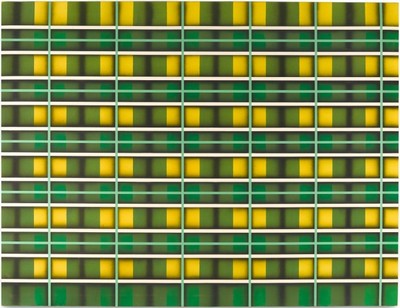
"Green Light," 1972–73, by Sean Scully.
Acrylic on canvas, 8 feet 1/2 inches x 10 feet 6 3/4 inches.
Private Collection.
Image courtesy of Bonhams & Butterfields, New York, 2020.
© Sean Scully.
The Philadelphia Museum of Art presents a major survey of Irish-born American artist SEAN SCULLY, featuring paintings and works on paper from the early 1970s to the present. Sean Scully: The Shape of Ideas charts the artist’s significant contributions to the American and European history of abstract painting as it has developed over the last half-century, while emphasizing the integral relationship between Sean Scully’s paintings, drawings, watercolors, and prints, which are rarely exhibited together.
“Sean Scully is one of the leading painters of our time,” said Timothy Rub, the George D. Widener Director and CEO of the Philadelphia Museum of Art and one of the exhibition curators. “Over the decades he has pursued a vision that has progressively opened new possibilities for abstraction, often working with deceptively simple compositional structures and on a variety of scales that range from the intimate to the monumental. He has also distinguished himself as a brilliant colorist, drawing inspiration from his immediate surroundings in places as various as Mexico, the remote islands of the Outer Hebrides, and the dense and dynamic urban fabric of New York, where he lived and worked for many years. We are pleased to share with our visitors this survey of Scully’s career, which illuminates his unique contributions to the history of Contemporary art.”
The exhibition, previously on view at the Modern Art Museum of Fort Worth, has been expanded for the Philadelphia Museum of Art presentation to include additional paintings and works on paper, bringing together over one hundred works that reflect the many phases of Sean Scully’s long and productive practice. Several galleries are devoted to the artist’s virtuosic prints, featuring color lithographs, woodcuts, etchings, and aquatints. Among the highlights of this section are a series of color aquatints from the museum’s collection, each accompanied by the verses of Spanish poet Federico García Lorca (1898–1936) along with a selection from the recently acquired portfolio Landlines and Robes (2018). The display of the artist’s prints both mirrors and offers an introduction to the galleries devoted largely to Sean Scully’s painting practice with pastels, drawings, and watercolors integrated throughout, further emphasizing the ongoing relationship between his paintings and works on paper.
The first paintings that the visitor encounters are important works that Sean Scully created during a fellowship year at Harvard University in 1972–73. This experience afforded him opportunities to travel from London to New York, a major center for Minimalism and abstract painting at the time. (He would move to New York permanently in 1975.) In these works, such as Green Light (1972–73), Sean Scully experimented with the grid, using tape and spray paint to layer the canvas and create an optically vibrant painting composed of vertical and horizontal stripes. On display nearby is Inset #2 (1973), an early example of the artist’s interest in creating a “painting within a painting,” or what Sean Scully terms an “inset,” which remains a hallmark motif within his practice.
An adjacent gallery is devoted to the complex multi-paneled works that Scully began to make in the early 1980s, a compositional format that would occupy the artist’s attention throughout the remainder of that decade. In these paintings, he combined panels of contrasting colors and formats into large and increasingly complex compositions, each structured by his signature “stripe.” Notable among these is Backs and Fronts (1981), an 8 x 20-foot work comprised of twelve attached canvases, which drew considerable notice when first exhibited at PS1 (now, MoMA PS1) in 1982.
"The Fall, "1983, by Sean Scully.
Oil on canvas, 9 feet 8 inches x 8 feet 5/8 inches.
Gift of Jeffrey H. Loria, 2017.
Image courtesy of Philadelphia Museum of Art, 2022.
© Sean Scully.
The next large gallery features selections from a series of pivotal works produced during the artist’s residency at the Edward Albee Foundation in Montauk, New York, in 1982. These small paintings were made using scraps of wood that Scully found in Albee’s former barn, which doubled as Scully’s studio. He then pieced the scraps together to create sculptural compositions in relief, which are represented in the exhibition through works like Swan Island, Ridge, Bonin, and Elder all from 1982. Together, these paintings reflect a turning point in the artist’s use of scale as his work became increasingly architectural. This new direction was solidified by a group of monumental paintings, among them Heart of Darkness (1982), a colossal three-panel work in the collection of the Art Institute of Chicago, as well as The Fall (1983)—from the museum’s own collection. Around this same time, ean Scully also made the first of several trips to Mexico where he found inspiration in its architecture, its light, and its saturated colors. These travels spurred him to begin to explore watercolor as a medium, as seen in Mexico Azul 12.83 (1983).
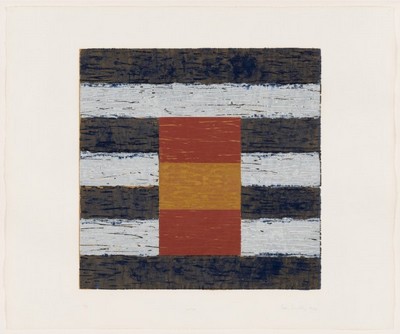
"With," 1988, by Sean Scully.
Color woodcut, 29 7/8 x 30 inches.
Purchased with the Edgar Viguers Seeler Fund, 2019.
Image courtesy of Philadelphia Museum of Art, 2022.
© Sean Scully.
In the late 1980s, Sean Scully extended his experimentation with the stripe, using it in combination with compositional structures such as the checkerboard and the inset. These ideas were given form in some of the artist’s most expressive paintings, among them Pale Fire (1988), A Bedroom in Venice (1988) and Union Yellow (1994). In them, and in many other works of this period, we can trace Scully’s development as a gifted colorist.
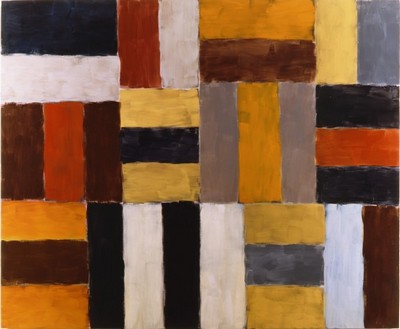
"Wall of Light Orange Yellow," 2000, by Sean Scully.
Oil on linen, 9 x 11 feet.
Hugh Lane Gallery, Dublin: Donated by the artist, 2006.
Collection & image courtesy of Hugh Lane Gallery, Dublin.
© Sean Scully.
Another gallery features his best-known series, collectively titled Wall of Light, which Sean Scully began working on in earnest in 1998. Many of these works were made in response to a particular location, sensation, or memory. Their richly painted surfaces, composed in a quilted pattern of vertical and horizontal blocks (Sean Scully calls them “bricks”), are evocative of, as the title of the series suggests, walls of stone that are paradoxically, as Sean Scully has put it, “inhabited by light.” A selection of these paintings will be seen together with works on paper including pastels and watercolors from the same series, foregrounding the artist’s facility with working across different scales and mediums.
These Wall of Light paintings led to the development of Sean Scully’s other, closely related compositional formats, chief among them the paintings of the Doric series, which will occupy another spacious gallery. Sean Scully created this series as an homage to the heritage of ancient Greece, reflecting ideas of strength, resilience, and stability. Painted on aluminum, these works are more austere in their palette, which is predominantly grey and black, and more sonorous in their visual rhythms.
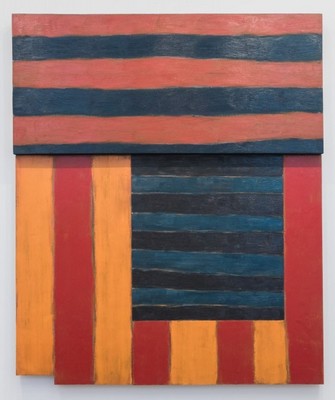
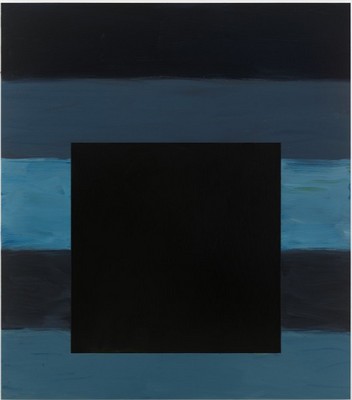
"Black Blue Window," 2021 by Sean Scully.
Oil on aluminum, 7 feet 1 inch x 6 feet 3 inches.
Collection of the artist. Image courtesy of the artist.
Photographer: Elisabeth Bernstein; © Sean Scully.
A final gallery focuses on the work that Sean Scully has made during the past decade, most prominently a series titled Landlines. These large gestural paintings are made up of thick horizontal bands of color that harken back to the elegant and spare canvases that Scully produced after he came to New York in 1975. At the same time, the Landlines are among the most freely painted and unabashedly romantic works Sean Scully has ever created. Considered together, they reflect the artist’s continuing belief in the expressive potential of abstraction and his ability to register a precise tone or mood through color. The exhibition concludes with several recent works, among them Black Blue Window (2021), a work dominated by a gaping black square that reflects Sean Scully’s personal response to the COVID-19 pandemic.
Marla Price, Director of the Modern Art Museum of Fort Worth, and contributor to the exhibition’s catalogue, notes that the artist’s work, as it has evolved over the course of more than five decades, remains intimately connected: “Scully has spoken of his career as a ‘rolling cannibalization,’ in which he scavenges his own work and that of others to expand, develop, and move forward. The systematic elements in his early works have never really disappeared as he continues to explore different combinations of building units or motifs and then pair them with emotion and content.”
Exhibition co-curator Amanda Sroka, Associate Curator of Contemporary Art at the Philadelphia Museum of Art, adds: “In this exhibition, by integrating paintings and works on paper, we can understand and appreciate – in new and meaningful ways – Scully’s relationship to scale, materials, and color and the complementary roles that each have played in both the trajectory of his artistic development and in affirming his place within the Western art historical canon.”
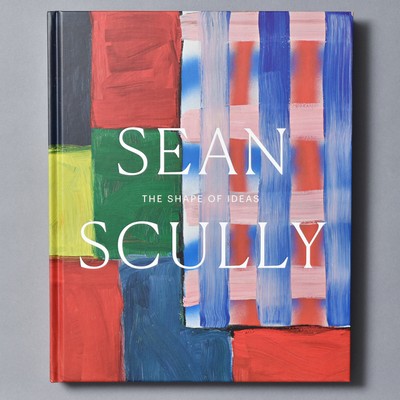
SEAN SCULLY: THE SHAPE OF IDEAS
By Timothy Rub and Amanda Sroka
Philadelphia Museum of Art / Yale University Press
PUBLICATION - Sean Scully: The Shape of Ideas, is authored by Timothy Rub, the George D. Widener Director and CEO, with Amanda Sroka, Associate Curator of Contemporary Art. It is the first to thoroughly examine Sean Scully’s art within a biographical context. Co-published by the Philadelphia Museum of Art and Yale University Press, the catalogue presents an in-depth account of Scully’s work and his most significant bodies of work informed by extensive interviews with the artist and comprehensive art historical research. The book contains a preface by Marla Price, Director of the Modern Art Museum of Fort Worth and author of Scully’s multivolume catalogue raisonné; an extensive biographical, contextual and formal reading offered by Timothy Rub; and an essay by the poet and art critic Kelly Grovier on the unique contribution Scully has made to the history of abstraction, particularly as it has developed in North America and across Europe. Featured contributions include reprints of key essays by William Feaver, Deborah Solomon, Donald Kuspit, Arthur C. Danto, and Michael Auping, which contextualize Scully’s work over the decades. 256 pages. ISBN: 9780876332955. $45.00. Available now at https://store.philamuseum.org/sean-scully-the-shape-of-ideas/
SEAN SCULLY (b. Ireland, 1945) works in the mediums of painting, drawing, printmaking, sculpture, and photography. Coming of age in London in the 1950s and moving to the United States at 30 years old, the artist has tested the possibilities of abstract art to develop a style that is uniquely his own. He is the recipient of numerous awards, including the Peter Stuyvesant Foundation Prize, a National Endowment for the Arts Fellowship, a Guggenheim Fellowship, and the Harkness Fellowship, and stands as a two-time Turner Prize nominee. Scully’s works are found in numerous private and public collections, including the Philadelphia Museum of Art, the Modern Art Museum of Fort Worth, the Hirshhorn Museum and Sculpture Garden in Washington, DC, the Metropolitan Museum of Art, and the Wadsworth Athenaeum Museum of Art in Hartford, Connecticut. In 2015, Scully participated in the Venice Biennale with his solo exhibition Land Sea at the Palazzo Falier. For the 2019 Biennale, the artist presented Human, a solo exhibition at the historic Basilica of San Giorgio. The artist has held recent and significant exhibitions at institutions including the Museum of Fine Arts – Hungarian National Gallery, Hungary (2021); Skulpturenpark Waldfrieden, Germany (2020); and the Albertina, Vienna, Austria (2019). Sean Scully: The Shape of Ideas, which was seen previously at the Modern Art Museum of Fort Worth, is the artist’s first retrospective of this scale in the United States since Sean Scully: Twenty Years, 1976–1995, presented in 1995 at the Hirshhorn Museum and Sculpture Garden. He currently divides his time living and working in New York and the Bavarian countryside outside Munich.
Curators
Timothy Rub, The George D. Widener Director and Chief Executive Officer
Amanda Sroka, Associate Curator of Contemporary Art
TIMOTHY RUB has been the George D. Widener Director and Chief Executive Officer of the Philadelphia Museum of Art since 2009. Prior to that, he held director positions at the Cleveland Museum of Art, the Cincinnati Art Museum, and the Hood Museum of Art at Dartmouth College in Hanover, New Hampshire. A specialist in architectural history and modern and contemporary art, Rub began his curatorial career as a Ford Foundation Fellow and curator at Cooper Hewitt in New York.
AMANDA SROKA is the Associate Curator of Contemporary Art at the Philadelphia Museum of Art. She joined the museum in 2014 following the completion of her Masters in Art History at the Courtauld Institute of Art in London, where she focused on global conceptual art practices. Recent projects at the Philadelphia Museum of Art include Senga Nengudi: Topologies (2021), Marisa Merz (2019), Yael Bartana: And Europe Will Be Stunned (2018), Philadelphia Assembled (2017), Jitish Kallat: Covering Letter (2016), and “Plays of / for a Respirateur” An Installation by Joseph Kosuth (2015). Forthcoming projects include solo exhibitions at the museum dedicated to Martine Syms (2022) and Lawrence Abu Hamdan (2023) as part of the Future Fields Commission series.
In Philadelphia, Sean Scully: The Shape of Ideas is made possible by Robbi and Bruce Toll, and Constance and Sankey Williams, with support from the museum’s endowment through the Annenberg Foundation Fund for Major Exhibitions, the Robert Montgomery Scott Endowment for Exhibitions, the Kathleen C. and John J. F. Sherrerd Fund for Exhibitions, the Gloria and Jack Drosdick Fund for Special Exhibitions, the Jill and Sheldon Bonovitz Exhibition Fund, and the Lois G. and Julian A. Brodsky Installation and Exhibition Fund. The accompanying publication has been generously supported by Lisson Gallery, which also provided support for the exhibition.
PHILADELPHIA MUSEUM OF ART
2600 Benjamin Franklin Parkway, Philadelphia, PA 19130