Showing posts with label Texas. Show all posts

10/10/25

Richard Prince: Posters Exhibition @ Galerie Max Hetzler, Marfa, Texas

Richard Prince: Posters
Galerie Max Hetzler, Marfa, Texas
Through 7 December 2025

Richard Prince Poster
Richard Prince 
Untitled, 2016 
Courtesy of Richard Prince Studio

Hetzler presents Posters, a solo exhibition of works by Richard Prince, for the gallery’s annual presentation in Marfa, Texas, through December 7, 2025.

One of the foremost representatives of appropriation art, Richard Prince has been recontextualising images and ideas from mass media, advertising and entertainment since the 1970s. Often based on products of everyday American culture, his practice is one of ‘post-production’, which reworks cultural phenomena and their attributes to rewrite received narratives and our understanding of history.

The present exhibition brings together a large body of Richard Prince’s Poster works on canvas and on paper, created between 2014 and 2024. The large canvases show reproductions of advertisements for mail-order posters, as were often found at the back of magazines in the second half of the 20th century. Hugely popular at the time, these printed images represent touchstones of early counter-cultural magazines, which are among Richard Prince’s long-term interests. The motifs of political slogans and far-out art in the form of cheap posters are singled out and chosen by the artist. They find their origins in the hippie head-shop culture of the late ’60s, which also encompassed magazines, music and comedy records. Taped-off and blocked-out from the pages where they were listed, the images have been blown up so that the resulting works are far larger than the original posters.

In their seemingly arbitrary selection, the poster images combine anti-war slogans, reproductions of Modern art, graphic-design interpretations of nude couples, and pictures of cats in sometimes humorously disparate compilations. The revolutionary attitude of the late ’60s student protests is juxtaposed against the self-indulgence of hippie culture in this side-by-side illustration of popular visual language.

If cultural attitudes are transported through everyday imagery, then  Richard Prince makes them transparent by applying the focus of his artistic practice to these source materials. Method and implication are translated into different contexts and, with his meticulous attention to detail, the artist decodes the communication of contemporary visual language and the ideas which are concealed within it.

Artist Richard Prince

Richard Prince (b. 1949, Panama Canal Zone) lives and works in Upstate New York. Prince’s work has been the subject of numerous solo exhibitions in international institutions, including Georgia Museum of Art, Athens (2024); Louisiana Museum of Art, Humblebaek; The Karpidas Collection (both 2022–2023); Museum for Modern Art, Weserburg (2021); Museum of Contemporary Art Detroit (2019–2020); Museo de Arte Latinoamericano de Buenos Aires Malba; Espace Louis Vuitton, Beijing; Astrup Fearnley Museet, Oslo (all 2018); Los Angeles County Museum of Art (2017–2018); Kunsthaus Bregenz (2014); Picasso Museum, Malaga (2012); Le Consortium, Dijon (2011); Serpentine Gallery, London; Walker Art Center, Minneapolis (both 2008); Guggenheim Museum, New York (2007–2008); Kunsthalle Zürich (2002); Museum für Gegenwartskunst, Basel (2001); and MAK, Vienna (2000), among others. The artist participated in the Venice Biennale in 2007 and 2003, as well as the Whitney Biennial in 2004, 1997, 1987 and 1985.

Works by Richard Prince are in the collections of international museums including the Art Institute of Chicago; Astrup Fearnley Museet, Oslo; The Broad, Los Angeles; Centre Pompidou, Paris; Fondation Louis Vuitton, Paris; Institute of Contemporary Arts, Boston; Kunstmuseum Basel; Los Angeles County Museum of Art; The Metropolitan Museum of Art, New York; Modern Art Museum of Fort Worth; Museum of Contemporary Art, Chicago; Museum of Contemporary Art, Los Angeles; The Museum of Modern Art, New York; Palazzo Grassi, Pinault Collection, Venice; San Francisco Museum of Modern Art; Solomon R. Guggenheim Museum, New York; Tate, London; Victoria and Albert Museum, London; and Whitney Museum of American Art, New York, among others.

GALERIE MAX HETZLER
1976 Antelope Hills Road, Marfa, Texas

Richard Prince: Posters
Galerie Max Hetzler, Marfa, Texas, 17 May – 7 December 2025

24/09/25

Myth and Marble: Ancient Roman Sculpture from the Torlonia Collection @ Kimbell Art Museum, Fort Worth

Myth and Marble: Ancient Roman Sculpture from the Torlonia Collection
Kimbell Art Museum, Fort Worth
September 14, 2025 – January 25, 2026

Statue of Cupid and Psyche
 
Roman, Imperial Period (second half of 2nd century AD)
Marble
Torlonia Collection, Rome
© Fondazione Torlonia. Photo by Lorenzo De Masi

Statue of Artemis Ephesia
Statue of Artemis Ephesia 
Roman, Imperial Period (2nd century AD) 
Marble
Torlonia Collection, Rome
© Fondazione Torlonia. Photo by Lorenzo De Masi

The Torlonia Nile, Formerly the Barberini-Albani Nile
The Torlonia Nile, Formerly the Barberini-Albani Nile 
Roman, Imperial Period, Flavian Era (late 1st century AD) 
Gray marble 
Torlonia Collection, Rome
© Fondazione Torlonia. Photo by Lorenzo De Masi

The Kimbell Art Museum presents the exhibition Myth and Marble: Ancient Roman Sculpture from the Torlonia Collection, in the Renzo Piano Pavilion. This exhibition brings to North America for the first time a selection of fifty-eight rarely seen masterpieces from the world’s most important private collection of Roman sculpture. 
“The opportunity to bring large-scale works of ancient Roman sculpture to the American public is extremely rare, and we at the Kimbell are grateful to Fondazione Torlonia for creating this once-in-a-lifetime experience,” said Eric Lee, director of the Kimbell Art Museum. “This is the first exhibition of ancient Roman sculpture in the Kimbell’s fifty-three-year history and is all the more exciting because the legendary Torlonia Collection has been largely unseen for the last seventy years.” 
Established during the course of the nineteenth century by the Franco-Italian banker Prince Giovanni Torlonia (1754–1829) and his son Prince Alessandro (1800–1886), the Torlonia Collection was handed down over generations, eventually growing into the largest private collection of ancient Roman sculptures. This veritable “collection of collections” was assembled through acquisitions from prominent collections of Roman patrician families and from excavations undertaken on the family’s own estates throughout Italy. By 1876, Prince Alessandro Torlonia created a museum to house and exhibit the family’s impressive holdings of ancient marbles. The Museo Torlonia was open to small groups until its closure at the onset of World War II. During this closure, Fondazione Torlonia was created at the behest of Prince Alessandro Torlonia (1925–2017) for the continued study and conservation of both the collection and the Villa Albani Torlonia, a monumental complex and one of the highest expressions of eighteenth-century taste. The sculptures remained largely unseen by the public until Fondazione Torlonia’s first exhibition, at the Musei Capitolini in Rome in 2020. Myth and Marble comes to North America after a recent exhibition of the Torlonia Collection drew unprecedented audiences at the Louvre in Paris.

The works on view at the Kimbell Art Museum were made between the late fifth century BC and the early fourth century AD, with most dating to the High Imperial period (first–second centuries AD). Visitors see examples of the most emblematic genres of ancient marble sculpture, including large-scale figures of gods, goddesses, and mythic heroes, vivid portraits of emperors and their families, and magnificent funerary monuments. Half of the sculptures have been newly cleaned, conserved, and studied specifically for this North American presentation.

Portrait of a Young Woman, known as the Maiden of Vulci
 
Roman, late Republican Period (mid-1st century BC)
Marble
Torlonia Collection, Rome
© Fondazione Torlonia. Photo by Lorenzo De Masi

The exhibition is organized thematically into six sections. Upon entering the Kimbell’s special exhibition galleries, visitors first encounter three Icons of the Torlonia Collection, including the mid-first-century BC Portrait of a Young Woman, known as the Maiden of Vulci. This is among the earlier and best-known works in the Torlonia Collection, providing a singular representation of Roman female portraiture from the early Augustan era. This and other portraits on view convey the striking naturalism that is a hallmark of ancient Roman sculpture and that viewers come to appreciate throughout the exhibition.  

Statue of a Goddess, known as the Hestia Giustiniani
 
Roman, Imperial Period, Hadrianic Era 
(first half of 2nd century AD) 
Marble 
Torlonia Collection, Rome.
© Fondazione Torlonia. Photo by Lorenzo De Masi

Next, Ideal Bodies and Model Behavior introduces visitors to depictions of myriad deities from the broader Roman world. This section illustrates how, as it expanded, the Roman Empire increasingly embraced aspects of Greek culture, both in its mythology and its visual language, cementing a shared Greco-Roman cultural heritage. The Statue of a Goddess, known as the Hestia Giustiniani, one of the most important works in the collection, is also one of the very few Roman versions of the classical Greek “severe” style in existence and is the largest and most intact sculpture of its type.

Statue of an Emperor on a Throne with Portrait of Augustus
Statue of an Emperor on a Throne with Portrait of Augustus 
Roman, Imperial Period (1st century AD) 
Marble 
Torlonia Collection, Rome.
© Fondazione Torlonia. Photo by Lorenzo De Masi

Portrait of Hadrian
Portrait of Hadrian
Roman, Imperial Period (c. 130 AD) 
Marble 
Torlonia Collection, Rome.
© Fondazione Torlonia. Photo by Lorenzo De Masi

Strategies of Succession displays second-century AD emperors and their imperial families, including a remarkable selection of female portraits. These stunningly realistic portrait sculptures, the likes of which would have permeated public and private spaces in the ancient world, functioned much as mass media does today. Visitors recognize the names of rulers such as Trajan, Hadrian, Marcus Aurelius, Commodus, and Septimius Severus, whose marble busts at once convey their likenesses, deliver overt political propaganda, and communicate subtle messages of power, authority, and identity.   

Statue of a Resting Goat - Head attributed to Gian Lorenzo Bernini
Statue of a Resting Goat 
Roman, Imperial Period, Trajanic Era (body: late 1st century 
head: attributed to Gian Lorenzo Bernini [1598–1680])
Marble 
Torlonia Collection, Rome 
© Fondazione Torlonia. Photo by Lorenzo De Masi 

Not a single work on view in Myth and Marble looks today as it did when it left the ancient artist’s workshop, whether through the wear and tear of time or by the hands of generations of art restorers. Restoration and Reconstruction spotlights sculptures that have been altered over the centuries—sometimes into nearly new works altogether—reflecting how collectors from the Renaissance through the nineteenth century preferred unfragmented objects to decorate their villas and estates. Intact portrait heads were regularly placed on newly carved busts in the past, and sometimes unrelated elements were assembled into wholly new works of art. The Rondanini-Type Medusa on a Trapezophoros (Table Leg) with a Griffin’s Head, for instance, was created through the assembly of two otherwise distinct, ancient sculptural fragments: a Medusa head joined to a Griffin-headed table leg. Sometimes great artists were engaged to update or perfect ancient fragments. For example, a mundane sculpture of a reclining ram was entirely transformed, made glorious with the addition of an exuberant head carved by the famed Baroque sculptor Gian Lorenzo Bernini around 1620. 

Portus Relief
Portus Relief 
Roman, Imperial Period (2nd–3rd century AD) 
Marble 
Torlonia Collection, Rome 
© Fondazione Torlonia. Photo by Lorenzo De Masi

As one of the largest landowners in nineteenth-century Rome, Prince Alessandro Torlonia hired archaeologists to excavate some of his own estates, notably a tract along the Via Appia Antica, which was a major ancient thoroughfare near Rome, and a property at Portus, once ancient Rome’s main harbor. Torlonia Excavations displays remarkable discoveries from these excavations, including an Attic Votive Relief from the fifth century BC, which is the only Greek sculpture in the exhibition and the earliest work in the entire Torlonia Collection. The Portus Relief offers a rare representation of the place where it was found, combining elements of the architectural and commercial landscape with symbolic motifs and deities.

Lid with Reclining Couple
Sarcophagus Depicting the Labors of Hercules 
and Lid with Reclining Couple 
Roman, Imperial Period (second half of 2nd century AD)  
Marble
Torlonia Collection, Rome. 
© Fondazione Torlonia. Photo by Lorenzo De Masi

Sarcophagus Depicting the Labors of Hercules
Sarcophagus Depicting the Labors of Hercules 
and Lid with Reclining Couple 
Roman, Imperial Period (second half of 2nd century AD) 
Marble
Torlonia Collection, Rome. 
© Fondazione Torlonia. Photo by Lorenzo De Masi

Myth and Marble closes with Death and Remembrance, reflecting a major strength of the Torlonia Collection: funerary monuments. These superb carvings underscore the longstanding Roman tradition of commemorating the dead and visually memorializing their likenesses and personal identities in marble, to be publicly displayed and visited by generations of descendants. Several extraordinary sarcophagi (stone coffins) such as the Sarcophagus Depicting the Labors of Hercules and Lid with Reclining Couple are among the largest sculpted works in marble to survive from ancient Rome.  
“Each of these exceptional sculptures has lived many lives over the centuries,” said Jennifer Casler Price, senior curator of Asian, African, and ancient American art at the Kimbell Art Museum and curator of the exhibition for the Kimbell. “Reaching across space and time, connecting the past with the present, these powerful works still resonate with us today. We are thrilled to be able to share their fascinating stories with our visitors and to bring these magnificent ambassadors from Rome to Texas.”

“Fondazione Torlonia is excited to be sharing the Torlonia Collection with audiences in North America for the first time. This exceptional group of ancient sculptures is a testament to the enduring cultural legacy of ancient Rome, as well as the vision and passion of multiple generations of the Torlonia family,” said Alessandro Poma Murialdo, president of Fondazione Torlonia.

“By sharing these rare masterpieces with the public, Fondazione Torlonia aims to deepen appreciation for and foster a renewed connection with the artistic achievements of the ancient world,” said Carlotta Loverini Botta, director of Fondazione Torlonia. “The universal spirit that has always informed classical art must continue to be nurtured for generations to come. It is a universal language that thrives on the ongoing reinvention of the classics through engagement with modern culture.” 
Portrait of a Man, known as the Old Man of Otricoli
Portrait of a Man, known as the Old Man of Otricoli 
Roman, late Republican Period (1st century BC) 
Marble 
Torlonia Collection, Rome 
© Fondazione Torlonia. Photo by Lorenzo De Masi

Portrait of Faustina the Younger
 
Roman, Imperial Period, Antonine Era (c. 160 AD) 
Marble 
Torlonia Collection, Rome 
© Fondazione Torlonia. Photo by Lorenzo De Masi

Myth and Marble: Ancient Roman Sculpture from the Torlonia Collection is co-organized by the Art Institute of Chicago and Fondazione Torlonia, in collaboration with the Kimbell Art Museum, the Montreal Museum of Fine Arts, and the Museum Box. 

The 160-page hardcover catalogue includes essays by Lisa Ayla Çakmak, the Mary and Michael Jaharis Chair and Curator, Arts of Greece, Rome, and Byzantium, The Art Institute of Chicago; Katharine A. Raff, the Elizabeth McIlvaine Curator, Arts of Greece, Rome, and Byzantium, The Art Institute of Chicago; Silvia Beltrametti, senior lecturer in the Department of Art History, Theory, and Criticism at the School of the Art Institute of Chicago; and Salvatore Settis, independent art historian. 

KIMBELL ART MUSEUM
3333 Camp Bowie Boulevard, Fort Worth, Texas 76107

31/03/25

Modern Art and Politics in Germany 1910–1945: Masterworks from the Neue Nationalgalerie, Berlin @ Kimbell Art Museum, Fort Worth

Modern Art and Politics in Germany 1910–1945: Masterworks from the Neue Nationalgalerie, Berlin 
Kimbell Art Museum, Fort Worth
March 30 – June 22, 2025

The Kimbell Art Museum presents the exhibition Modern Art and Politics in Germany 1910–1945: Masterworks from the Neue Nationalgalerie, Berlin. This exhibition brings together more than seventy paintings and sculptures from the collection of the Neue Nationalgalerie, Germany’s distinguished modern art museum. It traces the German experience in the visual arts from the last years of the German Empire, World War I and the liberal Weimar Republic that followed to the rise of National Socialism and Adolf Hitler, the Holocaust, and World War II. Paintings and sculptures by artists including Max Beckmann, Otto Dix, George Grosz, Hannah Höch, Wassily Kandinsky, Ernst Ludwig Kirchner, Paul Klee, Käthe Kollwitz, Gabriele Münter, and Christian Schad show how modern art played an important role in the discourse during these critical decades in twentieth-century political history and how politics, at the same time, influenced the visual arts. Most of the works on view in this exhibition have never before been shown in the United States. 
“This is the first special exhibition ever held at the Kimbell devoted to painting and sculpture in Germany during the fraught, tumultuous first half of the twentieth century,” said Eric Lee, director of the Kimbell Art Museum. “We are grateful to the Neue Nationalgalerie, Berlin for the opportunity to provide this experience in Texas.”
The exhibition leads visitors through the great shifts in art and politics that took place between 1910 and 1945 in six thematic sections, beginning with Expressionism. In the first decade of the twentieth century, artists challenged the status quo of German art, painting and sculpting roughly drawn and vividly colored works. The Expressionists’ works were political in their objection to the conservative taste of their times, and specifically that of Kaiser Wilhelm II. Many German Expressionist artists were given prominent places in German museums in the wake of the first World War but were later often banned under Hitler. This gallery includes Ernst Ludwig Kirchner’s Self Portrait with a Girl, 1914-15, and Emil Nolde’s 1909 Pentecost, among paintings by other influential artists.

The next section features the Neue Sachlichkeit (New Objectivity), a movement that typified the modern style of the 1920s. These artists rejected the seemingly crude brushwork and dissonant colors of Expressionism, seeking to adapt to a new post-war social order in the liberal climate of the so-called Weimar Republic, the democratic government that was ushered in at the end of World War I and lasted until Adolf Hitler seized power in 1933. Their paintings were often marked by careful draftsmanship, sober brushwork, and a kind of hyper-realism that gave a modern interpretation of the traditions of German Renaissance art. This section includes works by artists who may be less well-known to American audiences but who have long been celebrated in Germany and recognized by artists and historians worldwide. Among them are Kate Diehn-Bitt, Kurt Günther, Franz Radziwill, and Christian Schad, whose 1928 painting Sonja is among the most famous icons of the movement. 

From this rediscovery of realism, museum visitors move to galleries featuring the International Avant-Gardes that found favor in the 1910s and ‘20s, when modern art from across Europe was exhibited in Germany. At this time, more than ever before, art from abroad was featured in museums and commercial galleries. In this exhibition, portraits of three influential art dealers join works by the foreign artists they promoted: Afred Flechtheim by the painter Otto Dix; Herwarth Walden by the sculptor William Wauer; and Heinrich Thannhauser, in the painting by Lovis Corinth from the Kimbell’s own collection. This section of the exhibition includes works by such European artists as Pablo Picasso, Fernand Léger, Oskar Kokoschka, and Marianne von Werefkin

The exhibition next reveals ways that Modes of Abstraction entered and influenced German art in the years between the world wars. For example, the Cubism of Picasso, Georges Braque, and Léger exerted a strong influence in Germany, on painters such as Lyonel Feininger, Paul Klee, Gabriele Münter, and Georg Muche, whose works are displayed here. Feininger, Klee, and Muche were on the faculty of the Bauhaus, the famed art school, along with Wassily Kandinsky, and Oskar Schlemmer, also featured in this section of the exhibition. 

Politics and War demonstrates how artistic movements engaged directly with modern society and, by extension, with political issues. Some artists did so quite explicitly: George Grosz, in his famous 1926 Pillars of Society, blatantly ridiculed the establishment—political, military, and religious. The works in this gallery plot the course of events that led from Germany’s defeat in 1918 to the rise of militant nationalism in the 1930s, to a second world war, and to the Nazi atrocities that shocked nations worldwide. Examples include Wilhelm Lehmbruck’s mournful bronze sculpture Fallen Man, and Horst Strempel’s magnum opus, Night Over Germany, a denunciation of the Nazis’ barbarism in the form of a Christian altarpiece.

The exhibition concludes with an epilogue titled Before and After. This gallery includes works by some artists who had been exiled, who had been labeled as “degenerate,” or who were otherwise grappling with the political and humanitarian realities of post-war Germany, from the point of view of their art before the war and their history in the post-war era. Among the works seen in this concluding chapter of the exhibition are Max Beckmann’s melancholy 1942 Self Portrait in a Bar and Salvador Dalí’s Portrait of Mrs. Isabel Styler-Tas, painted in exile in Beverly Hills, California, in 1945. 
“The works in this exhibition are powerful, masterful,” said George T. M. Shackelford, deputy director of the Kimbell Art Museum. “And the stories that they tell about their turbulent times are gripping.” 
Modern Art and Politics in Germany 1910–1945: Masterworks from the Neue Nationalgalerie, Berlin has been organized by the Neue Nationalgalerie, Berlin, in cooperation with the Kimbell Art Museum. The curators of the exhibition are Dieter Scholz, George T. M. Shackelford, and Irina Hiebert Grun.

Moden Art and Politics in Germany 1910-1945
Modern Art and Politics in Germany 1910–1945 
Masterworks from the Neue Nationalgalerie, Berlin
The richly illustrated catalogue accompanying the exhibition is edited by George T. M. Shackelford, Irina Hiebert Grun, and Joachim Jäger, with major contributions by Dieter Scholz, Irina Hiebert Grun, and George T. M. Shackelford, and commentary on each work by a wide variety of German scholars. 
KIMBELL ART MUSEUM
3333 Camp Bowie Boulevard, Fort Worth, Texas 76107

Updated Post

08/03/25

Joe Overstreet: Taking Flight @ The Menil Collection, Houston

Joe Overstreet: Taking Flight
The Menil Collection, Houston 
Through July 13, 2025

Joe Overstreet Photograph
Joe Overstreet with his Flight Patterns, 1972
Courtesy of Menil Archives, The Menil Collection, Houston
Photo: Hickey-Robertson, Houston

Joe Overstreet
Joe Overstreet: Taking Flight
 
The Menil Collection, Houston 
January 24 - July 13, 2025
Installation view. Photo by Lauren Marek
Courtesy of The Menil Collection, Houston

Joe Overstreet
Joe Overstreet: Taking Flight
 
The Menil Collection, Houston 
January 24 - July 13, 2025
Installation view. Photo by Lauren Marek
Courtesy of The Menil Collection, Houston

The Menil Collection prsents Joe Overstreet: Taking Flight, an exhibition focused on the vibrant, politically charged abstract paintings created by pioneering artist JOE OVERSTREET (1933–2019). This presentation is organized chronologically and features Overstreet’s landmark Flight Pattern series of radially suspended paintings from the early 1970s, alongside crucial bodies of work that preceded and followed them. Taking Flight is the first major museum exhibition in nearly thirty years devoted to the work of this avant-garde artist.

Renowned for his innovative approach to nonrepresentational painting, Joe Overstreet stood at the forefront of artists who sought to intertwine abstraction and social politics. He made a significant contribution to postwar art, positioning abstraction as an expansive tool for exploring the idea of freedom and the Black experience in the United States.
“The Menil is proud to present Joe Overstreet: Taking Flight,” said Rebecca Rabinow, Director, The Menil Collection. “John and Dominique de Menil’s support of the artist began in the early 1970s when a painting was commissioned by him for an exhibition about the African American experience that the couple sponsored in Houston, Texas. Soon after, they purchased two of Overstreet’s Flight Pattern works and invited him back to Houston for a solo show. Now, some fifty years later, the Menil Collection looks forward to sharing his work with a new generation of visitors, both through this beautiful, thought-provoking exhibition, and the illustrated scholarly catalogue that provides fascinating insight and context for the appreciation of this artist’s work.”
In 1967, the artist began to build intricate, shaped canvas constructions, departing from the more representational style he had pursued in the early 1960s. In these works, Joe Overstreet combined new shapes and often matched the form of the underlying structure with geometric painted compositions. Justice, Faith, Hope, and Peace, 1968, is emblematic of this breakthrough, summoning references to current political events in a resolutely abstract language.

Joe Overstreet
Joe Overstreet: Taking Flight
 
The Menil Collection, Houston 
January 24 - July 13, 2025
Installation view. Photo by Lauren Marek
Courtesy of The Menil Collection, Houston

Joe Overstreet
Joe Overstreet: Taking Flight
 
The Menil Collection, Houston 
January 24 - July 13, 2025
Installation view. Photo by Sarah Hobson
Courtesy of The Menil Collection, Houston

Joe Overstreet’s best-known paintings, the Flight Patterns from 1970–1972, are central to the exhibition. To create these works, which the artist called “tent-like” and “nomadic,” he boldly applied brightly colored paint to unstretched canvases, which he suspended with taut ropes from the gallery’s floor, wall, and ceiling. The ropes were intended to evoke the brutal history of lynching in the United States, yet he also perceived these dynamic works as hopeful and redemptive. He described them as “birds in flight,” able to “take off, to lift up, rather than be held down.” In works like Free Direction, 1972, Joe Overstreet pushed the limits of the traditional medium of painting so that the piece appeared to leap off the wall, thus inaugurating a dynamic relationship between object, viewer, and architecture. This inventiveness was characteristic of his entire career.

Joe Overstreet
Joe Overstreet: Taking Flight
 
The Menil Collection, Houston 
January 24 - July 13, 2025
Installation view. Photo by Sarah Hobson
Courtesy of The Menil Collection, Houston

In the 1990s, following an inspiring trip to Senegal and the House of Slaves memorial on Gorée Island, Joe Overstreet created a series of monumental abstractions that address the African diaspora and explore questions of inheritance and memory. He described the Senegal paintings as “personal, emotional examinations of my past, present and future.” Works such as Gorée, 1993, display the artist’s material experimentation, which gave the paintings a weathered, luminous translucency, evoking the country’s “drifting opaque dust” and “searing white sunlight.”
“We have been honored to work closely with the estate of Joe Overstreet to create this significant presentation of his work,” said Natalie Dupêcher, Associate Curator of Modern Art, The Menil Collection. “Overstreet’s formally adventurous, culturally engaged, and politically responsive abstract work brilliantly expands the canon of 20th century art.”
Joe Overstreet: Taking Flight includes key loans from United States museums and private collections, as well as major paintings from the estate that have rarely been on view. Curated by Natalie Dupêcher, Associate Curator of Modern Art, The Menil Collection, the exhibition will be accompanied by a fully illustrated catalogue with new scholarly texts and installation images from the exhibition, available in late spring.

JOE OVERSTREET (1933–2019)

Born in rural Conehatta, Mississippi, Joe Overstreet began his career in the California Bay Area in the early 1950s, taking classes at several arts colleges, exhibiting in local galleries and jazz clubs, and participating in the Beat scene. In 1958, he moved to New York, where he joined a vibrant community of young artists exploring the possibilities of nonrepresentational abstraction. In the late 1960s, Joe Overstreet began working with shaped canvases. By 1970, with the Flight Pattern works, he had let his painting leap off the wall. After this series, he continued to experiment with new approaches to painting, investigating its spatial and textural possibilities. Committed to the intersection of social activism and artistic practice, Joe Overstreet cofounded Kenkeleba House, an arts organization and gallery, in 1974 with his wife, curator and historian Corrine Jennings, and writer Samuel Floyd. Working until his last years, Joe Overstreet died in New York City in 2019.

THE MENIL COLLECTION
1533 Sul Ross St., Houston, TX 77006

Joe Overstreet: Taking Flight @ The Menil Collection, Houston , January 24 - July 13, 2025

03/03/25

Sport and Spectator @ The McNay, San Antonio

Sport and Spectator
The McNay, San Antonio
March 1 — July 27, 2025

Hank Willis Thomas, Perseverance, 2017
Hank Willis Thomas
Perseverance, 2017 
Fiberglass, chameleon auto, paint finish
Courtesy of the artist and Jack Shainman Gallery, New York 
© Hank Willis Thomas

Brandon J. Donahue-Shipp, Basketball Bloom
Brandon J. Donahue-Shipp
Basketball Bloom (USA Outdoor), 2024 
Basketballs and shoestrings 
Courtesy of the artist and Pentimenti, Philadelphia 
© Brandon J. Donahue-Shipp

Brian Jungen, Nike Mask
Brian Jungen 
Horse Mask (Cher), 2016 
Nike Air Jordans 
Courtesy of the artist and Casey Kaplan, New York 
© Brian Jungen

Betsy Odom
Betsy Odom
Softball Glove, 2008
Tooled leather, and shearling
Courtesy of the artist
© Betsy Odom

Basketballs, footballs, tennis rackets, hockey sticks, jerseys, punching bags and other sports gear and paraphernalia become art in “Sport and Spectator,” on view at the McNay Art Museum. The exhibition celebrates American sports culture and confronts its complex intersection with race, gender and class. “Sport and Spectator” includes approximately 40 sculptures, textiles, screenprints and sports-themed installations by contemporary artists Brandon J. Donahue-Shipp, Jeffrey Gibson, Raul Rene Gonzalez, Sophie Inard, Brian Jungen, Justin Korver, Esmaa Mohamoud, Betsy Odom, Hank Willis Thomas, and Tyrrell Winston. Each work offers a recognizable element of sports while inviting viewers to consider athletics’ role in shaping society.

Brandon J. Donahue-Shipp, Basketball Bloom
Brandon J. Donahue-Shipp
Basketball Bloom (Breakaway Outdoor), 2024
Basketballs and shoestrings 
Courtesy of the artist and Pentimenti, Philadelphia. 
© Brandon J. Donahue-Shipp

Brandon Donahue-Shipp, who aspired to a career in professional basketball, uses his artistic practice to explore social and cultural realities in Black and Brown communities. Deflated basketballs and footballs become sculptural floral arrangements that symbolize the unfulfilled dreams of Black and Brown boys who also dreamed of careers in professional sports. “Coach’s Playbook,” is a screenprint that juxtaposes a basketball diagram with the floorplans of a courtroom. Strategic plays marked in red and blue cover the image and comment on the relationship between Black and Brown communities and the American legal system.

Hank Willis Thomas
Hank Willis Thomas
Changeup, 2019 
Mirrored stainless steel
Courtesy of the artist and Jack Shainman Gallery, New York 
© Hank Willis Thomas

Multiple works by Hank Willis Thomas highlight the potential for sports to both uplift Black communities and exploit the bodies of Black athletes. Resembling abstract modern sculpture, the metallic shapes in “Perseverance” depict an athlete’s bent limbs in dynamic motion. Presenting an anonymous player in the form of a public monument, Thomas’ sculpture acknowledges the power of sports to both unite and divide. The artist finishes the sculpture with shiny auto paint to comment on the sport’s reliance on international players, many who are of African descent.

Esmaa Mohamoud transforms jerseys to bodices to address gender in sports in her “One of the Boys” series. By pairing each jersey with a floor-length skirt made of silk and velvet, the artist presents a sports-themed ballgown that challenges the propensity for male athletes to be hyper-masculine while women remain underrepresented in sports. Growing up as the only girl with four brothers, she was a self-described tomboy. When her mom insisted that she wear a dress, she once wore a jersey over it.

Sophie Inard
Sophie Inard 
First base en rose, 2023 
Vintage hockey helmet with cotton yarn
Courtesy of the artist 
© Sophie Inard

Sophie Inard blankets common sports equipment with intricate patterns, bringing together the fast-paced, harsh sports world and the slower, delicate, calculated practice of crochet. She uses the “granny square” pattern reminiscent of a time that preceded modern-day technology to cover golf clubs, baseball bats, motorcycle helmets, rugby balls, boxing gloves, skateboards and other equipment. Wrapping sports equipment in soft yarn communicates the idea that opposites can coexist.

Jeffrey Gibson adorns Everlast punching bags with glass beads to pay homage to traditional Native American craft traditions while offering social and political commentary. His works also include references to artists and musicians through titles and words that appear on the works such as “The Love You Give Is the Love You Get,” inspired by lyrics from The Beatles’ “The End.” “Sharecropper” honors his grandparents, who persevered through poverty. Each work also celebrates boxing’s power to release tension and stress.
“‘Sport and Spectator’ explores the artistic alchemy of manipulating the materiality and meaning of sports paraphernalia,” said exhibition co-curator René Paul Barilleaux. “The contemporary artists featured are committed to incorporating sports equipment into their artistic practice, and this exhibition is unique in that numerous exhibitions have been organized around the theme of sports culture, but seemingly not specific to sports equipment and gear,” added co-curator Lauren Thompson.
“Sport and Spectator” is organized for the McNay Art Museum by René Paul Barilleaux, head of curatorial affairs, and Lauren Thompson, curator of exhibitions. 

McNay Art Museum
Tobin Exhibition Galleries
6000 N New Braunfels Avenue, San Antonio, TX 78209

01/03/25

Michael Tracy @ The McNay, San Antonio - Survey Exhibition "Michael Tracy: The Elegy of Distance"

Michael Tracy: The Elegy of Distance 
The McNay, San Antonio 
March 1 — July 27, 2025 

Michael Tracy, Flower Sacrifice, 1988
Michael Tracy 
Flower Sacrifice, 1988 
Gilded wood, swords, brass milagros, silk, and fresh flowers
Courtesy of Michael Tracy Foundation

Many never-before-seen paintings, sculptures and mixed-media objects anchor an exhibition that does what artist MICHAEL TRACY did for his six-decade career: challenge us to think deeply about those things we hold dear.

More than 50 objects welcome visitors in Michael Tracy: The Elegy of Distance. The works promote critical thinking, empathy, thoughtful exchange and healing as viewers consider faith, ritual, immigration and the environment. An original soundscape by musical composer Omar Zubair will complement the presentation.
“Although the artist withdrew from the museum and gallery ecosystem for years, the issues his work addresses have become increasingly urgent,” said René Paul Barilleaux, the McNay’s head of curatorial affairs. “The McNay’s exhibition will bring attention to this significant American artist’s work, introducing a new generation to him.”
Spanning nearly floor to ceiling, large canvases coated in thick paint, discarded supplies, sand and other materials evoke the desert landscape around Tracy’s studios in San Ygnacio, a small Texas border town along the Rio Grande. Seven paintings from his series “Speaking with the Dead” (2013-2015) ooze with varying shades of charcoal and black acrylic that are thickly layered on the canvas to communicate the relationship between decay and preservation. The heavy texturing suggests the works want to escape the canvases that hold them as they implore the viewer to commune.

Michael Tracy’s works blur the lines between international and metaphysical borders. “Cruz de la Paz Sagrada VII” (1980), a bracketed cross that stands more than 70 inches tall, is composed of heart-shaped Milagros, hair, swords, rosaries, spikes and scissors. The sculpture is a poignant juxtaposition of sacred and secular. Viewers can also see studies for the “Golmuhar” series (2005-2010) and finished acrylic paintings that reflect the yellow, orange and chartreuse blooms on the trees native to India. Michael Tracy routinely made semi-annual trips there to make jewelry.

“Para los olvidados (For the forgotten ones, 1989),” reportedly induced gasps from the audience when the pyramid-shaped work, stuffed with fragrant white flowers and covered with human hair, was first exhibited in Mexico City. The work is believed to pay homage to the unnamed heroes in the Aztec wars.
“In the decades since his last significant solo exhibitions, which garnered national attention, society has evolved its thoughts around issues like climate change, religion and traditional beauty standards. Michael Tracy’s exhibition at the McNay will allow visitors to revisit his work with fresh perspectives framed by societal evolution that reflects an increased awareness of the urgency of the issues addressed in his work,” said René Paul Barilleaux.
Programming for scholars and community members draws parallels between Tracy’s work and modern-day concerns about the environment, religion, border policy, immigration and societal definitions of beauty. A free poster-size publication includes images of artworks in the exhibition and a reflection on the artist by Christopher Rincón, president of the Michael Tracy Foundation and director of the River Pierce Foundation.
“Given San Antonio’s diversity and its proximity to the U.S./Mexico border, the McNay has the opportunity to present an impactful exhibition to a large audience acutely affected by issues represented within it,” said Matthew McLendon, Ph.D., the McNay’s director and CEO. “An exhibition of Michael Tracy’s work at this precise moment, so close to his passing, is especially poignant as it will serve to honor his lifelong dedication to his artistic practice and reinforce his critical contributions to social justice and the visual arts, squarely placing him as one of the leading American artists known to grapple with these issues and help us, the viewers, understand, process and confront them in an informed and thoughtful way.”
Michael Tracy, an Ohio native, earned a bachelor’s degree in literature and art at St. Edward’s University (Austin, Texas), studied at the Cleveland Institute of Art and earned a master’s degree in studio art from The University of Texas at Austin. In 1978, he established his studio in San Ygnacio and turned more of his attention to the Texas town as his national and international fame waned. Despite his creative success, San Ygnacio’s population of less than 1,000 people did not fully embrace the artist. Many of the residents were descendants of the area’s original settlers and were off-put by some of Tracy’s gestures, including “The River Pierce: Sacrifice II,” a 1990 Good Friday ritual burning of Tracy’s “Cruz: La Pasión” (1982-87), a cross-like object. Approximately 200 people joined Michael Tracy for the processional inspired by the city’s annual Via Dolorosa.
“The McNay has a long tradition of elevating lesser-known, marginalized artists working outside of the mainstream art world,” René Paul Barilleaux said. “In Michael Tracy’s case, the McNay recognized him both at the beginning of his career and, perhaps more importantly, now at the end of his career when the mercurial winds of the art world have shifted away from the once lauded artist.”
Fifty-three years ago, McNay Art Museum mounted Michael Tracy’s first-ever museum exhibition, “Seven Gold Paintings,” at what was then the Marion Koogler McNay Art Institute.

Surveying approximately two decades of Tracy’s career, “The Elegy of Distance” debuts many objects from the artist’s personal holdings alongside artworks on loan from other collections. The exhibition is organized by René Paul Barilleaux in collaboration with Christopher Rincón.

McNay Art Museum
6000 N New Braunfels Avenue, San Antonio, TX 78209

18/08/24

Meiji Modern: Fifty Years of New Japan @ MFAH, Houston

Meiji Modern 
Fifty Years of New Japan 
Museum of Fine Arts, Houston
July 7 – September 15, 2024

Japan’s Meiji era (1868–1912) was a period of unprecedented cultural and technological transition. Over these remarkable decades, the country experienced radical social and political shifts, which propelled the historically inward-facing society into a new modern, global era. The Museum of Fine Arts, Houston, presents a fresh look at the art of this transformative era with the landmark exhibition Meiji Modern: Fifty Years of New Japan.

Following over two centuries of near-total isolation, the archipelago of Japan was thrown into chaos with the arrival of the American Commodore Perry in 1853; following a series of international trade agreements, the feudal fiefdoms of Japan were transformed into a modern nation-state, with the Emperor “restored” to the throne. Through more than 150 extraordinary objects borrowed from over 70 public and private collections, the exhibition reveals the profound cross-cultural impact of the country’s developing relationships with the wider world.

Paintings, prints, photographs, sculpture, and fine examples of enamel, lacquer, embroidery, and textiles all evidence a blending of cultures and techniques and the innovative interchange of old and new. Uniquely, the exhibition features a diverse selection of both export wares and items made for display in Japan, reflecting the diversity of tastes and aesthetic discourse in the Meiji period. The exhibition also features several recently discovered masterpieces of Japanese art, many of which have never been shown publicly.

Meiji Modern: Fifty Years of New Japan is organized into five thematic sections that reveal the varied cross-cultural influences on Japanese history and identity over the course of the Meiji period.

Crafting a Modern State highlights the emergence of a country opening up to the outside world through prints, and other objects depicting Western scenes and motifs. Depictions of Meiji rulers in Western clothing and portrayals of American dignitaries in Japanese clothing underscore these new international connections. This also illustrates the importance of art and artwork both as industry and as a tool of diplomacy to the fledgling Meiji state.

Navigating Changing Seas demonstrates the continued cultural importance of the sea in Japanese art, conveying its role in bringing the outside world to Japan, and bringing Japan to the outside world. A massive bronze masterpiece, nearly life size, of the Dragon King of Sea presenting a warrior with a magical tide-controlling jewel, the most significant piece of Meiji Period metalwork in the United States, is one of the highlights of this section.

Fashioning the Self assesses the emergence of a new Japanese identity as a non-white, modern nation-state, and considers the changing gender roles of the period, the end of samurai status, the creation of a Meiji bureaucracy, and the growing embrace of modern conveniences as seen in clothing items and prints such as Telephone Call: A Merchant’s Wife. This section also highlights the unprecedented new social freedom enjoyed by women, using a series of woodblock printed illustrations from women’s magazines, a new genre that emerged during the period as women in Japan achieved widespread literacy for the first time. Another highlight of this section is a bowler hat by Hayakawa Shōkōsai I, woven entirely out bamboo reeds.

Making History, Enshrining Myth examines the importance of a national religion, traditions, and myths to the formation of a modern nation-state, and considers how a self-conscious reinterpretation and re-articulation of the past helped inform a contemporary nation and its global future through unique new expressions. Crucially, this section also considers the role of China and the appreciation of Chinese art and culture during the Meiji Period and includes a rare and important two-sided painted screen by Noguchi Shōhin, one of the few female painters of the Meiji Period.

Cultivating a Modern Aesthetic shows the traditional themes of plants and animals as the motifs and subject matter most eagerly embraced by foreigners, and therefore commonly made for export. Such artistic production translated to diplomatic soft power as well as a lucrative way to fund industry. It also fueled Western expectations for and definitions of “Asian tradition,” setting precedents for cultural and geopolitical relations and tensions that continue to unfold in the global arena today. This section features several important painted screens that have not been shown publicly for over 100 years and an imposing but beautiful ceramic painted made by Itaya Hazan, the father of Japanese studio ceramics. This vessel, the only known work by the artist in North America and one of only a handful outside of Japan, was acquired directly from the artist by Henry Walters in 1915, and is one of many such works in the exhibition that were purchased during the Meiji Period as contemporary art, highlighting Japan’s importance and might on the world stage by the end of these tumultuous five decades of new Japan.

Meiji Modern: Fifty Years of New Japan has been organized by the Japanese Art Society of America. The exhibition is co-curated by Bradley Bailey, the Ting Tsung and Wei Fong Chao Curator of Asian Art, Museum of Fine Arts, Houston; and Chelsea Foxwell, Associate Professor of Art History, University of Chicago. 

The exhibition is accompanied by a fully illustrated scholarly catalogue with essays and entries, published by Yale University Press.

Meiji Modern
Fifty Years of New Japan
by Chelsea Foxwell and Bradley M. Bailey
Published by Yale University Press, 2023
272 Pages, 11.30 x 9.25 in, 275 color illustrations
Gary Tinterow, Director and Margaret Alkek Williams Chair at the Museum of Fine Arts, Houston, noted, “Meiji Modern: Fifty Years of New Japan provides a fascinating window onto this transformative era, a collision of culture and identity that forged newly modern approaches to esthetics, trade and statehood in Japan. It also shows to great effect the unprecedented achievements of Japanese artisans and artists, culminating centuries of technical perfection. We are pleased to partner with Japanese Art Society of America, on their 50th anniversary, to bring this unprecedented exhibition to the MFAH.”

“Late-19th-century Japan represents an early and compelling chapter in the history of global modern art, as Japan became one of the first non-Western nations seeking to repel colonization by making the case for the integrity of its art and culture,” commented Bradley Bailey. “While seemingly opposed, these two ambitions intertwined to produce a distinct form of expression that helped to define Japan’s classical past as well as its global future.” 
Previous Venues:
Asia Society, New York, October 3, 2023 – January 7, 2024
Smart Museum of Art, University of Chicago, March 21 – June 9, 2024

MFAH - MUSEUM OF FINE ARTS / HOUSTON
1001 Bissonnet, Houston, Texas 77005

19/05/24

Zoe Leonard @ Chinati Foundation, Marfa, Texas - "Al río / To the River" Exhibition

Zoe Leonard: Al río / To the River
Chinati Foundation, Marfa, Texas
October 12, 2024 - June 2025

Roe Leonard
ZOE LEONARD
Al río / To the River (detail), 2016–2022 
Gelatin silver prints, C-prints and inkjet prints 
© Zoe Leonard. 
Courtesy the artist, Galerie Gisela Capitain, and Hauser & Wirth.

The Chinati Foundation/La Fundación Chinati presents an exhibition of ZOE LEONARD’s Al río / To the River. The photographic work follows the course of the Rio Grande/Río Bravo where the river is used to define the boundary between the United States and Mexico. Zoe Leonard’s work contemplates the intricate cultural, social, political, ecological, and economic landscapes that comprise the 1,200 mile stretch of river from Ciudad Juárez and El Paso to the Gulf of Mexico and poses the question: what does it mean to ask a body of water to perform a political task? “The shifting nature of a river—which floods periodically, changes course, and carves new channels—is at odds with the political task it is asked to perform,” says Zoe Leonard.

Known for her work across photography, sculpture, and installation, Zoe Leonard has long explored the physical and bodily act of looking, often underscoring tensions between the natural world and human-built environments. Her work You see I am here after all (2008), made on-site at Dia Beacon and exhibited from 2008 to 2011, is composed of thousands of postcards of Niagara Falls from the early 1900s through the 1970s. It considers the role of photography in constructing American historical narratives and myths. In her large-scale installation 100 North Nevill Street, on view at the Chinati Foundation from 2013 to 2015, the artist transformed a former ice plant building into a camera obscura that projected the ever-changing state of the external environment in Marfa. As with all of her camera obscura works, the piece was made on-site in response to the existing architecture, history, and land

In late 2016, Zoe Leonard began to photograph the Rio Grande/Río Bravo—and the ways in which humans live in relation to it—from various perspectives in the United States and Mexico. The artist crossed back and forth from one side of the river to the other (and from one country to another), creating layered and thought-provoking compositions that draw attention to the complexity of the river as a porous channel, a source of life, and a politicized site. The work depicts the water, the land that surrounds it, and the infrastructures built along, across, and through it, offering viewers a variety of frames through which to think about the movement of people, animals, cars, boats, information, and goods.

Al río is comprised of several hundred photographs, structured in groupings, or ‘passages,’ and in this exhibition, a selection will be installed across three buildings on the grounds of Chinati. By arranging the photographs in passages, Zoe Leonard uses seriality to show actions unfolding; quotidian scenes of rest and play contrast with acts of policing and government control. The images are deeply specific and rooted in place, but they also relate to our shared world—one in which daily life is disrupted by fences, checkpoints, and surveillance. The project engages with histories of image-making from abstraction to documentary to digital surveillance, and, in doing so, reconsiders representational tropes, mythologies about the American West and Mexico, and the role of photography in shaping our perceptions of borders and rivers.

The opening of Al río / To the River at the Chinati Foundation—its first institutional presentation in the Americas—follows its debut at Mudam Luxembourg – Musée d’Art Moderne Grand-Duc Jean (2022), and subsequent exhibitions at Musée d’Art Moderne de Paris (2022) and the Museum of Contemporary Art Australia, Sydney (2023). Hauser & Wirth presented a related gallery exhibition of excerpts from Al río in New York in 2022, as did Capitain Petzel in Berlin (2022) and Galleria Raffaella Cortese in Milan (2023/2024). At Chinati, where artworks are permanently installed throughout the former military spaces of Fort D.A. Russell, Zoe Leonard’s photographs will respond to—and sometimes mirror—the surrounding environment. When traveling between exhibition spaces, visitors may notice familiar subjects, like the mountains in the distance or a passing border patrol vehicle.

The exhibition is accompanied by a two-volume publication, also entitled Al río / To the River. Edited by poet Tim Johnson, designed by Joseph Logan, and published by Hatje Cantz, the book features a selection of Zoe Leonard’s photographs and a compilation of writings by artists, poets, historians, musicians, and scholars with an interest in the politics, ecology, and cultures that intersect at the river. Both Johnson and his partner Caitlin Murray, Director of the Chinati Foundation, are longtime friends of the artist, who first came to Marfa in 2006. When Donald Judd established the foundation in 1986, he invited his friends to install work there; Leonard’s exhibition expands upon this history of long-term collaboration and conversation among friends.

ZOE LEONARD (born 1961 in Liberty, New York; lives and works in New York, New York and Marfa, Texas) balances rigorous conceptualism with a distinctly personal vision in her work with photography, sculpture, and installation. Employing seriality and shifting perspectives, and with an attention to the materiality of photography, Zoe Leonard’s practice probes the politics of representation and display. Zoe Leonard explores themes such as gender and sexuality, loss and mourning, migration, displacement, and the urban landscape. Her photography invites us to contemplate the role that the medium plays in constructing histories and shaping our perceptions of the world around us. More than its focus on any particular subject, Zoe Leonard’s work encourages the viewer to consider the act of looking itself, as a complex and conditional process. 

CHINATI FOUNDATION
Marfa, Texas 79843


05/05/24

Artist Charis Ammon @ Inman Gallery, Houston - "Meanwhile" Exhibition

Charis Ammon: Meanwhile 
Inman Gallery, Houston 
May 3 - July 6, 2024 

Charis Ammon
CHARIS AMMON
Fresh Flowers, 2024
Oil on canvas on board 
6 x 8 inches (15.2 x 20.3 cm)
© Charis Ammon, courtesy of Inman Gallery

Inman Gallery presents Meanwhile, a solo exhibition of new work by Charis Ammon. This is the artist third solo show with the gallery.

Charis Ammon paints quotidian images to document her encounters with urban landscapes and everyday environments. She captures the city both as a site of flux: construction zones, urban development, and concrete, and as a setting of connection. The resulting compositions ask us to consider places and moments we often overlook or disregard, to (re)orient our attention towards the present moment.

Meanwhile presents a new suite of paintings exploring quiet intimacies: buckets of flowers in bodega entryways, dewy raindrops on plastic sheaths for bouquets, HEB greeting cards waiting to be purchased, and closeups of socks, implying a private moment at home. The exhibition marks a transition from the artist’s previous grittier cityscapes and construction sites towards softer subject matter. The imagery is still "in the city” – grocery stores, bodegas, flower shop storefronts – but the gaze has shifted to capturing public places that speak to private expressions.

However, the circumstances that prompt these private expressions remain outside the scope of the paintings, fortifying the works’ emotional depth. Charis Ammon’s subject matter – cards and flowers waiting to be purchased – piques our curiosity as to what is happening, or did happen, or could happen to necessitate these gifts. Is this gesture joyous or mournful? With the absence of people to indicate the celebratory or commemoratory nature of an event, we as the viewer are left wondering. Read in this light, the works take on a melancholic tone, reflecting both the unease of an unknown outcome and the warmth of the thoughtful gesture itself.

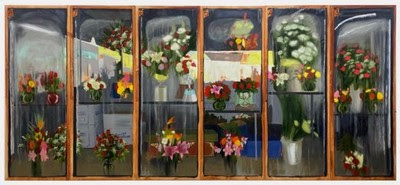
Charis Ammon
CHARIS AMMON
Meanwhile, 2024
Oil on canvas, eight panels 
Each 70 x 26 inches (15.2 x 20.3 cm)
© Charis Ammon, courtesy of Inman Gallery

The titular work, a monumental, multi-panel painting depicting a flower shop refrigerator, responds to this very notion of thick stillness amid anticipation. Painted to-scale, the surface reveals frosted glass and foggy windows partitioning receding space. While life-shaking events divide our sense of time into ‘befores’ and ‘afters,’ Ammon calls attention to how we navigate the ‘meanwhile.’ Other titles, like“Sharing a Bag of Chips” (sock painting) or “You, Me, and Everybody Else” (valentine card display kiosk), point to the material markers of quality time in these moments. The card paintings have a more humorous tone, siphoning through several templates that don’t “fit” until something rings true. The sock paintings capture a more tender moment at home, just talking or snacking with a friend or a love, reminding us that being present is a gift too.

By painting gifts and rituals that form around the in-between moments of life events Ammon expresses the physical ways we communicate care. In their depiction of gesture, the works capture the joys, humor, and tenderness of sharing a life with others. Charis Ammon’s canvases occupy the same space as the bouquets and cards they depict—when words are unavailable or feel inadequate, a painting gestures towards the feelings we carry.

CHARIS AMMON (born 1992, Dallas, TX) holds a BFA in Painting from Texas State University and an MFA in Painting from The University of Houston. Charis Ammon's solo exhibitions include Where Do You Go When You Are On Your Way?, Alexander DiJulio Gallery, New York, NY (2023), Palm Trees and City Debris, Texas State University Gallery, San Marcos, TX (2022), Inheritance at The Old Jail Art Center, Albany, TX (2020), and Maintenance at Art League Houston (2019), as well as two solo exhibitions at Inman Gallery (2021, 2018). Her work was recently included in Night Work, Alexander DiJulio Gallery, New York, NY (2024), In Being Double: The Pace Staff Show, Pace Gallery, New York, NY (2023), Book Arts of Houston, The Printing Museum, Houston TX (2023), Urban Impressions: Experiencing the Global Contemporary Metropolis, Moody Center for the Arts, Rice University, Houston, TX (2022) and The Big Show, Lawndale Art Center, Houston (2022). She lives and works in Brooklyn, NYC

INMAN GALLERY
3901 Main Street, Houston, TX 77002