Showing posts with label Houston. Show all posts

08/03/25

Joe Overstreet: Taking Flight @ The Menil Collection, Houston

Joe Overstreet: Taking Flight
The Menil Collection, Houston 
Through July 13, 2025

Joe Overstreet Photograph
Joe Overstreet with his Flight Patterns, 1972
Courtesy of Menil Archives, The Menil Collection, Houston
Photo: Hickey-Robertson, Houston

Joe Overstreet
Joe Overstreet: Taking Flight
 
The Menil Collection, Houston 
January 24 - July 13, 2025
Installation view. Photo by Lauren Marek
Courtesy of The Menil Collection, Houston

Joe Overstreet
Joe Overstreet: Taking Flight
 
The Menil Collection, Houston 
January 24 - July 13, 2025
Installation view. Photo by Lauren Marek
Courtesy of The Menil Collection, Houston

The Menil Collection prsents Joe Overstreet: Taking Flight, an exhibition focused on the vibrant, politically charged abstract paintings created by pioneering artist JOE OVERSTREET (1933–2019). This presentation is organized chronologically and features Overstreet’s landmark Flight Pattern series of radially suspended paintings from the early 1970s, alongside crucial bodies of work that preceded and followed them. Taking Flight is the first major museum exhibition in nearly thirty years devoted to the work of this avant-garde artist.

Renowned for his innovative approach to nonrepresentational painting, Joe Overstreet stood at the forefront of artists who sought to intertwine abstraction and social politics. He made a significant contribution to postwar art, positioning abstraction as an expansive tool for exploring the idea of freedom and the Black experience in the United States.
“The Menil is proud to present Joe Overstreet: Taking Flight,” said Rebecca Rabinow, Director, The Menil Collection. “John and Dominique de Menil’s support of the artist began in the early 1970s when a painting was commissioned by him for an exhibition about the African American experience that the couple sponsored in Houston, Texas. Soon after, they purchased two of Overstreet’s Flight Pattern works and invited him back to Houston for a solo show. Now, some fifty years later, the Menil Collection looks forward to sharing his work with a new generation of visitors, both through this beautiful, thought-provoking exhibition, and the illustrated scholarly catalogue that provides fascinating insight and context for the appreciation of this artist’s work.”
In 1967, the artist began to build intricate, shaped canvas constructions, departing from the more representational style he had pursued in the early 1960s. In these works, Joe Overstreet combined new shapes and often matched the form of the underlying structure with geometric painted compositions. Justice, Faith, Hope, and Peace, 1968, is emblematic of this breakthrough, summoning references to current political events in a resolutely abstract language.

Joe Overstreet
Joe Overstreet: Taking Flight
 
The Menil Collection, Houston 
January 24 - July 13, 2025
Installation view. Photo by Lauren Marek
Courtesy of The Menil Collection, Houston

Joe Overstreet
Joe Overstreet: Taking Flight
 
The Menil Collection, Houston 
January 24 - July 13, 2025
Installation view. Photo by Sarah Hobson
Courtesy of The Menil Collection, Houston

Joe Overstreet’s best-known paintings, the Flight Patterns from 1970–1972, are central to the exhibition. To create these works, which the artist called “tent-like” and “nomadic,” he boldly applied brightly colored paint to unstretched canvases, which he suspended with taut ropes from the gallery’s floor, wall, and ceiling. The ropes were intended to evoke the brutal history of lynching in the United States, yet he also perceived these dynamic works as hopeful and redemptive. He described them as “birds in flight,” able to “take off, to lift up, rather than be held down.” In works like Free Direction, 1972, Joe Overstreet pushed the limits of the traditional medium of painting so that the piece appeared to leap off the wall, thus inaugurating a dynamic relationship between object, viewer, and architecture. This inventiveness was characteristic of his entire career.

Joe Overstreet
Joe Overstreet: Taking Flight
 
The Menil Collection, Houston 
January 24 - July 13, 2025
Installation view. Photo by Sarah Hobson
Courtesy of The Menil Collection, Houston

In the 1990s, following an inspiring trip to Senegal and the House of Slaves memorial on Gorée Island, Joe Overstreet created a series of monumental abstractions that address the African diaspora and explore questions of inheritance and memory. He described the Senegal paintings as “personal, emotional examinations of my past, present and future.” Works such as Gorée, 1993, display the artist’s material experimentation, which gave the paintings a weathered, luminous translucency, evoking the country’s “drifting opaque dust” and “searing white sunlight.”
“We have been honored to work closely with the estate of Joe Overstreet to create this significant presentation of his work,” said Natalie Dupêcher, Associate Curator of Modern Art, The Menil Collection. “Overstreet’s formally adventurous, culturally engaged, and politically responsive abstract work brilliantly expands the canon of 20th century art.”
Joe Overstreet: Taking Flight includes key loans from United States museums and private collections, as well as major paintings from the estate that have rarely been on view. Curated by Natalie Dupêcher, Associate Curator of Modern Art, The Menil Collection, the exhibition will be accompanied by a fully illustrated catalogue with new scholarly texts and installation images from the exhibition, available in late spring.

JOE OVERSTREET (1933–2019)

Born in rural Conehatta, Mississippi, Joe Overstreet began his career in the California Bay Area in the early 1950s, taking classes at several arts colleges, exhibiting in local galleries and jazz clubs, and participating in the Beat scene. In 1958, he moved to New York, where he joined a vibrant community of young artists exploring the possibilities of nonrepresentational abstraction. In the late 1960s, Joe Overstreet began working with shaped canvases. By 1970, with the Flight Pattern works, he had let his painting leap off the wall. After this series, he continued to experiment with new approaches to painting, investigating its spatial and textural possibilities. Committed to the intersection of social activism and artistic practice, Joe Overstreet cofounded Kenkeleba House, an arts organization and gallery, in 1974 with his wife, curator and historian Corrine Jennings, and writer Samuel Floyd. Working until his last years, Joe Overstreet died in New York City in 2019.

THE MENIL COLLECTION
1533 Sul Ross St., Houston, TX 77006

Joe Overstreet: Taking Flight @ The Menil Collection, Houston , January 24 - July 13, 2025

22/10/24

The Art Show 2024 - Exhibitions & Exhibitors

The Art Show 2024 
Exhibitions & Exhibitors
October 30 - November 2, 2024

Entrance to The Art Show 2023 at the Park Avenue Armory 
Photo by Jason Wyche. 
On scrims: Georges Sand, Waterfall with Mountain in Distance, 1875, 
Courtesy Jill Newhouse Gallery 
Lighting by Zumtobel

For over 60 years, the  Art Dealers Association of America (ADAA) has supported the US' leading fine art galleries, allowing them to focus on the economic and cultural contributions they offer their communities and the world at large. Today, the organization includes over 200 diverse member galleries from nearly 40 U.S. cities. These galleries represent hundreds of established and emerging artists internationally. As the only fair with a rigorous peer review process where all booth proposals are vetted by the ADAA member galleries that have applied, the resulting standard of connoisseurship has become synonymous with The Art Show.

THE ART SHOW 2024 SOLO EXHIBITIONS

This year, 43 solo presentations at the fair promote in-depth study and focused critical attention on a wide array of artists, spanning iconic art historical figures and an intergenerational range of voices in contemporary art, with a particular focus on women artists. They include:

• A new suite of carefully rendered oil on canvas paintings depicting imagined interiors by Quentin James McCaffrey, in a focused presentation by Nicelle Beauchene Gallery.

• Never-before-seen works by Alison Elizabeth Taylor that transform the historic technique of wood inlay into marquetry hybrid and collage pieces, presented by James Cohan.

• Derek Eller Gallery’s presentation of new paintings by Clare Grill, who allows natural occurrences like daylight and shadow to dictate the forms of her emotive abstractions

• Works by Croatian conceptual artist Mladen Stilinović (1947-2016) exploring money and its relationship to labor, the body, and art, presented by Peter Freeman, Inc.

Lucy Mackenzie’s timeless still life oil paintings of everyday objects isolated in space, presented by Nancy Hoffman Gallery.

• A showcase by Hosfelt Gallery of Tim Hawkinson’s turn to painting via twelve tiny, hyperreal oils painted from family photos that explore the body, aging, and our shared humanity.

• Susan Inglett Gallery’s presentation of a series of large-scale abstract paintings by Martha Jackson Jarvis that depict her family member’s journey as a free Black soldier during the American Revolution.

• Kasmin’s presentation of rarely and never-before-exhibited photographic works by Tina Barney that span five decades of the artist’s investigation of the theme of family.

• New works by Suchitra Mattai that combine bas-relief sculpture with traditionally feminine practices such as weaving, embroidery, and adornment, presented by Roberts Projects.

• Tina Kim Gallery’s showcase of works by the renowned fiber and textile artist Lee ShinJa, highlighting the beginning of the artist’s experiments with metal elements in her abstracted natural landscapes.

• New silk collages by Billie Zangewa that weave personal narratives and broader social critique in Lehmann Maupin’s booth.

• Anthony Meier’s presentation of Jessie Henson’s “Monument” series: cast-bronze and gilded sculptures of found embroideries.

• New ink on cotton paper monoprints created by Chase Hall with the use of a newly developed pigment incorporating coffee grounds, presented by Pace Prints.

• A presentation by Petzel of 93-year old artist Isabella Ducrot’s newly created “Flowerpot” textile works that combine sensuality, repetition, and the everyday to create compositions of flowers and plants situated within decorative borders and framing devices.

• Sicardi | Ayers | Bacino’s presentation of eight works from “Mnemosyne’s Whisper,” Cuban artist Reynier Leyva Novo’s ongoing series investigating memory and protest.

• New paintings by Seth Becker alongside a suite of “Real Photo Postcards” from the artist’s collection at Venus Over Manhattan’s booth.

THE ART SHOW 2024 TWO-PERSON & GROUP EXHIBITIONS

The two-person and group presentations at The Art Show 2024 examine a diverse range of art historical moments and themes, with a preponderance of exhibitors emphasizing cross-cultural dialogues, mentorship and legacy, intergenerational dialogue among women artists, and artists’ social relationships. Highlights from these multiartist booths include:

• Castelli Gallery’s presentation which examines the connections and cross-cultural dialogue between Japanese conceptual artist Arakawa (1936-2010) and American sculptor Robert Morris (1931-2018), who met in the early 1960s during their overlapping time residing in artist Yoko Ono’s downtown New York City loft.

• A presentation by Luxembourg + Co. exploring the work of Isamu Noguchi (1904-1988) and Katsumi Nakai (1927-2013), two innovators in the field of sculpture who shared an aspiration to translate Japanese craft traditions into a new geographic context.

• George Adams Gallery’s presents a survey of two expansive and idiosyncratic artists newly represented by the gallery, featuring the expressive figurative artwork of M. Louise Stanley and sculptural works by Elisa D’Arrigo.

• Reassessing notions of identity, society, and culture, a two-person presentation by Peter Blum Gallery featuring new semi-figurative paintings by Luisa Rabbia and recent glass and bead sculptures by Joyce J. Scott.

• A presentation by Altman Siegel highlighting Adaline Kent (1900-1957) and Ruth Laskey, two female artists from different generations living and working in the Bay Area.

• Nazarian / Curcio’s presentation of paintings by Annie Lapin and sculptures by Fay Ray, two artists who draw from art history and the natural world to explore our sense of mystery, grandeur, and the sublime.

• A presentation by Sapar Contemporary titled Mathematics, Particle Physics and Gravity in the Works of Pioneering Women Artists of 1970s, featuring works on paper, folded paper constructions, and knotted monofilament sculptures made by Bilge Friedlaender (1934-2000), Benigna Chilla, and Yvonne Pacanovsky Bobrowicz (1928-2022).

• A group exhibition by Paulson Fontaine Press featuring a new print series by Charles Gaines, alongside editions by the artist and educator’s former students: Edgar Arceneaux, Gary Simmons, and Henry Taylor.

• A two-person showcase by Hales Gallery that presents paintings by two generations of Indigenous artists—Kay WalkingStick and Jordan Ann Craig—who engage with their ancestral culture.

• McClain Gallery’s presentation of artists hailing from Houston, Texas, featuring paintings by Dorothy Hood and Delita Martin’s print-focused collages.

• A dual artist presentation by Michael Werner Gallery of figurative cast stone sculptures by German artist Wilhelm Lehmbruck (1881-1919) and abstract paintings by French artist Eugène Leroy (1910-2000).

THE ART SHOW 2024 COMMITTEE

• Mary Ryan, Mary Ryan Gallery, Chair
• Seth Curcio, Nazarian/Curcio
• Katherine Degn, Kraushaar Galleries
• Trey Hollis, P·P·O·W
• Jessica Kreps, Lehmann Maupin
• Alana Ricca, Schoelkopf Gallery
• Mary Skarbek, Roberts Projects
• Andrea Teschke, Petzel
• Anthony Meier, Anthony Meier, ADAA President
Mary Ryan, Chair of The Art Show 2024 Committee says: “Stepping into my new role as Chair of The Art Show Committee this year has been a true pleasure, allowing me to lend even greater support to an organization and community that I’ve been a part of for over 20 years. The Art Show’s commitment to supporting ADAA members uniquely positions it to reflect the vibrancy and complexity of the art market, cementing its status as a not-to-be-missed event each season.”
THE ART SHOW 2024 EXHIBITORS

• ACA Galleries (New York, NY)
• George Adams Gallery (New York, NY)
• Peg Alston Fine Arts (New York, NY)
• Altman Siegel (San Francisco, CA)
• Nicelle Beauchene Gallery (New York, NY)
• Berggruen Gallery (San Francisco, CA)
• Berry Campbell (New York, NY)
• Peter Blum Gallery (New York, NY)
• Jonathan Boos (New York, NY)
• CANADA (New York, NY)
• Castelli Gallery (New York, NY)
• James Cohan (New York, NY)
• Crown Point Press (San Francisco, CA)
• DC Moore Gallery (New York, NY)
• Tibor de Nagy (New York, NY)
• Andrew Edlin Gallery (New York, NY)
• Derek Eller Gallery (New York, NY)
• Eric Firestone Gallery (New York, NY & East Hampton, NY)
• Debra Force Fine Art, Inc. (New York, NY)
• Forum Gallery (New York, NY)
• Peter Freeman, Inc. (New York, NY)
• James Fuentes (New York, NY & Los Angeles, CA)
• GAVLAK (Los Angeles, CA & Palm Beach, FL)
• Hales Gallery (New York, NY)
• Hirschl & Adler Modern (New York, NY)
• Nancy Hoffman Gallery (New York, NY)
• Hosfelt Gallery (San Francisco, CA)
• Susan Inglett Gallery (New York, NY)
• Inman Gallery (Houston, TX)
• Kasmin (New York, NY)
• June Kelly Gallery (New York, NY)
• Anton Kern Gallery (New York, NY)
• Tina Kim Gallery (New York, NY)
• Krakow Witkin Gallery (Boston, MA)
• Kraushaar Galleries (New York, NY)
• Greg Kucera Gallery (Seattle, WA)
• Lehmann Maupin (New York, NY)
• Galerie Lelong & Co. (New York, NY)
• Locks Gallery (Philadelphia, PA)
• Luxembourg + Co. (New York, NY)
• Barbara Mathes Gallery (New York, NY
• McClain Gallery (Houston, TX)
• Miles McEnery Gallery (New York, NY)
• Anthony Meier (Mill Valley, CA)
• Charles Moffett (New York, NY)
• Nazarian / Curcio (Los Angeles, CA)
• Jill Newhouse Gallery (New York, NY)
• Ortuzar Projects (New York, NY)
• P·P·O·W (New York, NY)
• Pace Prints (New York, NY)
• Paulson Fontaine Press (Berkeley, CA)
• Josh Pazda Hiram Butler (Houston, TX)
• Perrotin (New York, NY & Los Angeles, CA)
• Petzel (New York, NY)
• Almine Rech (New York, NY)
• Ricco/Maresca Gallery (New York, NY)
• Roberts Projects (Los Angeles, CA)
• Michael Rosenfeld Gallery (New York, NY)
• Mary Ryan Gallery (New York, NY)
• Sapar Contemporary (New York, NY)
• Schoelkopf Gallery (New York, NY)
• Marc Selwyn Fine Art (Beverly Hills, CA)
• William Shearburn Gallery (St. Louis, MO)
• Susan Sheehan Gallery (New York, NY)
• Sicardi | Ayers | Bacino (Houston, TX)
• Sperone Westwater (New York, NY)
• Louis Stern Fine Arts (West Hollywood, CA)
• Timothy Taylor (New York, NY)
• Leslie Tonkonow Artworks + Projects (New York, NY)
• TOTAH (New York, NY)
• Two Palms (New York, NY)
• Van Doren Waxter (New York, NY)
• Venus Over Manhattan (New York, NY)
• Michael Werner (New York, NY & Los Angeles, CA)
• Yares Art (New York, NY & Santa Fe, NM & Beverly Hills, CA)

DELITA MARTIN 
Star Twin I (Roman numeral 1), 2024 
Courtesy the artist and McClain Gallery

THE ART SHOW 2024 "SPOTLIGHT ON... HOUSTON"

Launching this year, a new annual initiative titled “Spotlight On…” will feature a different city every year with a robust cohort of ADAA member galleries. This year’s focus will be the vibrant arts community of Houston, Texas. “Spotlight On…Houston” serves as a platform for an in-depth exploration of the city’s distinctive art scene, bringing its foremost artists, curators, museum directors, dealers, cultural advocates, and collectors together to highlight the innovative work taking place in its institutions, alternative art spaces, and galleries.

The “Spotlight On… Houston” panel discussion series offers insightful examinations of the city’s visionary arts programs and their impact on the surrounding community, and includes a conversation with Houston institutional leaders, John Guess, Jr. (Chief Executive Officer, Houston Museum of African American Culture), Hesse McGraw (Executive Director, Contemporary Arts Museum Houston), Alison Weaver (Founding Executive Director, Moody Center for the Arts at Rice University), and Michelle White (Senior Curator, The Menil Collection) on creating sustainable futures within an evolving art world landscape, moderated by Julia Halperin (Co-Founder, Burns Halperin Report); a roundtable exploration on the importance of supporting artists directly via alternative art spaces with Paola Creixell (Founder, PAC Art Residency), Xandra Eden (Executive Director, DiverseWorks), Pete Gershon (Curator of Programs, Orange Show Center for Visionary Art), and Danielle Burns Wilson (Executive Director/Art Director, Project Row Houses), facilitated by Ali RosaSalas (Vice President of Visual and Performing Arts, Abrons Arts Center/Henry Street Settlement); and a convening of storied Houston collectors Leah Bennett, Judy Nyquist, and Leigh Smith in a discussion on the evolution of fine arts philanthropy in the region, led by Sarah Douglas (Editor-in-Chief, ARTnews).

ADAA worked with Texas-based filmmakers, Walley Films, to create a short documentary that will premiere at the fair. It will feature Houston ADAA members—Inman Gallery, McClain Gallery, Josh Pazda Hiram Butler, Sicardi | Ayers | Bacino, and Texas Gallery—and further enrich the initiative’s exploration of Houston and its environs.
Kinsey Robb, Executive Director of the ADAA, comments: “The establishment of ‘Spotlight On…’ creates a powerful new platform to explore the vibrant artistic communities that define the strength and national scope of the ADAA. We are thrilled to launch this initiative with ‘Spotlight On…Houston’ which provides us the opportunity to deepen our understanding of the city’s dynamic arts community while attracting new audiences and fostering new relationships at the fair.”
THE ART SHOW
The Park Avenue Armory
Park Avenue and 67th Street, New York

18/08/24

Meiji Modern: Fifty Years of New Japan @ MFAH, Houston

Meiji Modern 
Fifty Years of New Japan 
Museum of Fine Arts, Houston
July 7 – September 15, 2024

Japan’s Meiji era (1868–1912) was a period of unprecedented cultural and technological transition. Over these remarkable decades, the country experienced radical social and political shifts, which propelled the historically inward-facing society into a new modern, global era. The Museum of Fine Arts, Houston, presents a fresh look at the art of this transformative era with the landmark exhibition Meiji Modern: Fifty Years of New Japan.

Following over two centuries of near-total isolation, the archipelago of Japan was thrown into chaos with the arrival of the American Commodore Perry in 1853; following a series of international trade agreements, the feudal fiefdoms of Japan were transformed into a modern nation-state, with the Emperor “restored” to the throne. Through more than 150 extraordinary objects borrowed from over 70 public and private collections, the exhibition reveals the profound cross-cultural impact of the country’s developing relationships with the wider world.

Paintings, prints, photographs, sculpture, and fine examples of enamel, lacquer, embroidery, and textiles all evidence a blending of cultures and techniques and the innovative interchange of old and new. Uniquely, the exhibition features a diverse selection of both export wares and items made for display in Japan, reflecting the diversity of tastes and aesthetic discourse in the Meiji period. The exhibition also features several recently discovered masterpieces of Japanese art, many of which have never been shown publicly.

Meiji Modern: Fifty Years of New Japan is organized into five thematic sections that reveal the varied cross-cultural influences on Japanese history and identity over the course of the Meiji period.

Crafting a Modern State highlights the emergence of a country opening up to the outside world through prints, and other objects depicting Western scenes and motifs. Depictions of Meiji rulers in Western clothing and portrayals of American dignitaries in Japanese clothing underscore these new international connections. This also illustrates the importance of art and artwork both as industry and as a tool of diplomacy to the fledgling Meiji state.

Navigating Changing Seas demonstrates the continued cultural importance of the sea in Japanese art, conveying its role in bringing the outside world to Japan, and bringing Japan to the outside world. A massive bronze masterpiece, nearly life size, of the Dragon King of Sea presenting a warrior with a magical tide-controlling jewel, the most significant piece of Meiji Period metalwork in the United States, is one of the highlights of this section.

Fashioning the Self assesses the emergence of a new Japanese identity as a non-white, modern nation-state, and considers the changing gender roles of the period, the end of samurai status, the creation of a Meiji bureaucracy, and the growing embrace of modern conveniences as seen in clothing items and prints such as Telephone Call: A Merchant’s Wife. This section also highlights the unprecedented new social freedom enjoyed by women, using a series of woodblock printed illustrations from women’s magazines, a new genre that emerged during the period as women in Japan achieved widespread literacy for the first time. Another highlight of this section is a bowler hat by Hayakawa Shōkōsai I, woven entirely out bamboo reeds.

Making History, Enshrining Myth examines the importance of a national religion, traditions, and myths to the formation of a modern nation-state, and considers how a self-conscious reinterpretation and re-articulation of the past helped inform a contemporary nation and its global future through unique new expressions. Crucially, this section also considers the role of China and the appreciation of Chinese art and culture during the Meiji Period and includes a rare and important two-sided painted screen by Noguchi Shōhin, one of the few female painters of the Meiji Period.

Cultivating a Modern Aesthetic shows the traditional themes of plants and animals as the motifs and subject matter most eagerly embraced by foreigners, and therefore commonly made for export. Such artistic production translated to diplomatic soft power as well as a lucrative way to fund industry. It also fueled Western expectations for and definitions of “Asian tradition,” setting precedents for cultural and geopolitical relations and tensions that continue to unfold in the global arena today. This section features several important painted screens that have not been shown publicly for over 100 years and an imposing but beautiful ceramic painted made by Itaya Hazan, the father of Japanese studio ceramics. This vessel, the only known work by the artist in North America and one of only a handful outside of Japan, was acquired directly from the artist by Henry Walters in 1915, and is one of many such works in the exhibition that were purchased during the Meiji Period as contemporary art, highlighting Japan’s importance and might on the world stage by the end of these tumultuous five decades of new Japan.

Meiji Modern: Fifty Years of New Japan has been organized by the Japanese Art Society of America. The exhibition is co-curated by Bradley Bailey, the Ting Tsung and Wei Fong Chao Curator of Asian Art, Museum of Fine Arts, Houston; and Chelsea Foxwell, Associate Professor of Art History, University of Chicago. 

The exhibition is accompanied by a fully illustrated scholarly catalogue with essays and entries, published by Yale University Press.

Meiji Modern
Fifty Years of New Japan
by Chelsea Foxwell and Bradley M. Bailey
Published by Yale University Press, 2023
272 Pages, 11.30 x 9.25 in, 275 color illustrations
Gary Tinterow, Director and Margaret Alkek Williams Chair at the Museum of Fine Arts, Houston, noted, “Meiji Modern: Fifty Years of New Japan provides a fascinating window onto this transformative era, a collision of culture and identity that forged newly modern approaches to esthetics, trade and statehood in Japan. It also shows to great effect the unprecedented achievements of Japanese artisans and artists, culminating centuries of technical perfection. We are pleased to partner with Japanese Art Society of America, on their 50th anniversary, to bring this unprecedented exhibition to the MFAH.”

“Late-19th-century Japan represents an early and compelling chapter in the history of global modern art, as Japan became one of the first non-Western nations seeking to repel colonization by making the case for the integrity of its art and culture,” commented Bradley Bailey. “While seemingly opposed, these two ambitions intertwined to produce a distinct form of expression that helped to define Japan’s classical past as well as its global future.” 
Previous Venues:
Asia Society, New York, October 3, 2023 – January 7, 2024
Smart Museum of Art, University of Chicago, March 21 – June 9, 2024

MFAH - MUSEUM OF FINE ARTS / HOUSTON
1001 Bissonnet, Houston, Texas 77005

05/05/24

Artist Charis Ammon @ Inman Gallery, Houston - "Meanwhile" Exhibition

Charis Ammon: Meanwhile 
Inman Gallery, Houston 
May 3 - July 6, 2024 

Charis Ammon
CHARIS AMMON
Fresh Flowers, 2024
Oil on canvas on board 
6 x 8 inches (15.2 x 20.3 cm)
© Charis Ammon, courtesy of Inman Gallery

Inman Gallery presents Meanwhile, a solo exhibition of new work by Charis Ammon. This is the artist third solo show with the gallery.

Charis Ammon paints quotidian images to document her encounters with urban landscapes and everyday environments. She captures the city both as a site of flux: construction zones, urban development, and concrete, and as a setting of connection. The resulting compositions ask us to consider places and moments we often overlook or disregard, to (re)orient our attention towards the present moment.

Meanwhile presents a new suite of paintings exploring quiet intimacies: buckets of flowers in bodega entryways, dewy raindrops on plastic sheaths for bouquets, HEB greeting cards waiting to be purchased, and closeups of socks, implying a private moment at home. The exhibition marks a transition from the artist’s previous grittier cityscapes and construction sites towards softer subject matter. The imagery is still "in the city” – grocery stores, bodegas, flower shop storefronts – but the gaze has shifted to capturing public places that speak to private expressions.

However, the circumstances that prompt these private expressions remain outside the scope of the paintings, fortifying the works’ emotional depth. Charis Ammon’s subject matter – cards and flowers waiting to be purchased – piques our curiosity as to what is happening, or did happen, or could happen to necessitate these gifts. Is this gesture joyous or mournful? With the absence of people to indicate the celebratory or commemoratory nature of an event, we as the viewer are left wondering. Read in this light, the works take on a melancholic tone, reflecting both the unease of an unknown outcome and the warmth of the thoughtful gesture itself.

Charis Ammon
CHARIS AMMON
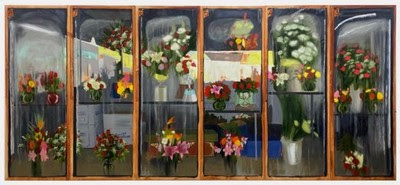
Meanwhile, 2024
Oil on canvas, eight panels 
Each 70 x 26 inches (15.2 x 20.3 cm)
© Charis Ammon, courtesy of Inman Gallery

The titular work, a monumental, multi-panel painting depicting a flower shop refrigerator, responds to this very notion of thick stillness amid anticipation. Painted to-scale, the surface reveals frosted glass and foggy windows partitioning receding space. While life-shaking events divide our sense of time into ‘befores’ and ‘afters,’ Ammon calls attention to how we navigate the ‘meanwhile.’ Other titles, like“Sharing a Bag of Chips” (sock painting) or “You, Me, and Everybody Else” (valentine card display kiosk), point to the material markers of quality time in these moments. The card paintings have a more humorous tone, siphoning through several templates that don’t “fit” until something rings true. The sock paintings capture a more tender moment at home, just talking or snacking with a friend or a love, reminding us that being present is a gift too.

By painting gifts and rituals that form around the in-between moments of life events Ammon expresses the physical ways we communicate care. In their depiction of gesture, the works capture the joys, humor, and tenderness of sharing a life with others. Charis Ammon’s canvases occupy the same space as the bouquets and cards they depict—when words are unavailable or feel inadequate, a painting gestures towards the feelings we carry.

CHARIS AMMON (born 1992, Dallas, TX) holds a BFA in Painting from Texas State University and an MFA in Painting from The University of Houston. Charis Ammon's solo exhibitions include Where Do You Go When You Are On Your Way?, Alexander DiJulio Gallery, New York, NY (2023), Palm Trees and City Debris, Texas State University Gallery, San Marcos, TX (2022), Inheritance at The Old Jail Art Center, Albany, TX (2020), and Maintenance at Art League Houston (2019), as well as two solo exhibitions at Inman Gallery (2021, 2018). Her work was recently included in Night Work, Alexander DiJulio Gallery, New York, NY (2024), In Being Double: The Pace Staff Show, Pace Gallery, New York, NY (2023), Book Arts of Houston, The Printing Museum, Houston TX (2023), Urban Impressions: Experiencing the Global Contemporary Metropolis, Moody Center for the Arts, Rice University, Houston, TX (2022) and The Big Show, Lawndale Art Center, Houston (2022). She lives and works in Brooklyn, NYC

INMAN GALLERY
3901 Main Street, Houston, TX 77002

01/11/23

Ken Price @ McClain Gallery, Houston - A Focus Exhibition

Ken Price: A Focus Exhibition
McClain Gallery, Houston
November 1 – December 30, 2023

Ken Price (1935 – 2012) is best known for his innovative ceramic sculpture and is recognized as one of the most important sculptors to have emerged in Los Angeles in the 20th century. Throughout his 50+ year career, Price also made extraordinary drawings with watercolor of varied subjects from sculpture studies and still lifes to landscapes and erotic drawings. Ken Price rose to prominence in the early 1960s and was a key player in the explosion of the Los Angeles Contemporary art scene in the 60s.

Born in Los Angeles in 1935, Ken Price grew up near the beach and spent his youth surfing nearly every day. Price began studying art at Santa Monica Collage at the age of 18. He went on to earn a BFA in 1956 from the University of Southern California and took ceramics classes at the Chouinard Art Institute and Otis College of Art and Design, where he studied under Peter Voulkos. Ken Price earned an MFA in 1959 from the New York State College of Ceramics at Alfred University and had his gallery debut at the legendary Ferus Gallery in Los Angeles just a year later, at the age of 25. He quickly established himself with several successful solo exhibitions, including at the Whitney Museum of American Art in New York in 1969.

Ken Price exhibited extensively until his death in 2012, at his home in Arroyo Hondo, New Mexico, just outside of Taos. That same year a major retrospective of his work, on which he collaborated with friend and architect Frank Gehry, was staged at the Los Angeles County Museum of Art; Metropolitan Museum of Art in New York; and Nasher Sculpture Center in Dallas, Texas. Works by Price are held in numerous museum collections, among them The Los Angeles County Museum of Art; Metropolitan Museum of Art, New York; Museum of Modern Art, New York; and the National Gallery of Art, Smithsonian Institution, Washington, D.C.

McCLAIN GALLERY
2242 Richmond Avenue, Houston, TX 77098

06/10/23

Vertigo of Color: Matisse, Derain, and the Origins of Fauvism @ The Met Fifth Avenue, New York + Museum of Fine Arts, Houston

Vertigo of Color: Matisse, Derain, and the Origins of Fauvism 
The Met Fifth Avenue, New York 
October 13, 2023 – January 21, 2024 
Museum of Fine Arts, Houston 
February 25 – May 27, 2024 

Henri Matisse (1869–1954) and André Derain (1880–1954) embarked on a creative partnership in the summer of 1905 that would change the course of French and European painting. The two painters daringly experimented with energetic bursts of color, form, and structure, the outcome of which led to a bold, new artistic language known as Fauvism (from the French fauve, or “wild beast”). Vertigo of Color: Matisse, Derain, and the Origins of Fauvism presents, for the first time in the United States, the legacy of that legendary summer through 65 paintings, drawings, and watercolors by Henri Matisse and André Derain on loan from national and international museums and private collections.
"This captivating exhibition not only speaks to the transformative partnership of Matisse and Derain, but it also provides a highly focused and engaging view of their groundbreaking artistic practices," said Max Hollein, The Met's Marina Kellen French Director and CEO. "Vertigo of Color is remarkable in that the works are largely experimental, giving us the opportunity to understand their process and look back at a singular moment that has so powerfully resonated with generations of artists and audiences."
It was the partnership between the two artists—along with their intense investigations of color and light and their will to experiment outside the canon—that led to Fauvism in the early years of the last century. While staying in the modest fishing village of Collioure, Henri Matisse and André Derain worked toward a new aesthetic of color and light, drawing inspiration from local surroundings and their experience of the bustling life of the port, quiet beaches, and landscapes. Their evolving visual language grew from the sensory experience of a moment in time, rather than from observable reality—a sweep of sand brushed in saturated red, a cork oak tree delineated in pink, shadows of reflected light in dazzling hues. Matisse wrote, “My choice of colors does not rest on any scientific theory; it is based on observation, on feeling, on the experience of my sensibility.” 
"As the story of a rewarding partnership, this exhibition is the first to focus intently on the paintings, drawings, and watercolors that laid the groundwork for Fauvism," said Dita Amory, Robert Lehman Curator in Charge of the Robert Lehman Collection. "In just nine weeks, Matisse and Derain revolutionized color and liberated brushwork, paving the way for modernism."
Exhibiting several paintings at the Salon d’Automne in Paris in November 1905, Henri Matisse and André Derain were both derided and praised. They puzzled audiences and stirred controversy—and soon galvanized a group of contemporary artists to follow in their path, a new path in European art that radically contradicted conventional norms. Responding to the now-legendary Salon exhibition, a prominent French journalist labeled them and their fellow artists “les Fauves,” literally “wild beasts.” Though Fauvism was short-lived, it gave rise to a ravishing palette in an evolving modernist dialogue, and the Salon d’Automne played a key role in disseminating its inventions.

Vertigo of Color: Matisse, Derain, and the Origins of Fauvism, which is co-organized by The Metropolitan Museum of Art and the Museum of Fine Arts, Houston, features many of the most celebrated works of Fauvism. The works on view include loans from Musée National d’Art Moderne, Centre Pompidou; National Galleries of Scotland; National Gallery of Art, Washington, D.C.; San Francisco Museum of Modern Art; and the Museum of Modern Art, New York; as well as private collections.

The exhibition begins with galleries dedicated to André Derain and Henri Matisse and feature several paintings not shown in the United States in over half a century, including Derain’s portrait of Matisse, Henri Matisse (Tate), and Matisse’s portrait of Derain, André Derain (Tate). That summer, while Derain and Matisse shared many of the same geographic vantage points and subjects, their work diverged in structure, composition, treatment of space, and color palette. Matisse preferred to paint in watercolor while Derain worked in oil. There is a gallery devoted to Amélie Matisse, who joined her husband in Collioure along with their two sons. Amélie posed tirelessly for both her husband and for Derain in works of vibrant oil and watercolor, such as Derain’s dazzling Woman with a Shawl: Madame Matisse in a Kimono (private collection). Amélie Matisse  was an indispensable model whose presence advanced the figure painting of both artists immeasurably.

Vertigo of Color also presents significant works on paper, sketches, portraits, and intimate drawings, and features the original catalogue for the Salon d’Automne of 1905. While landscapes, seascapes, and portraits feature prominently, still lifes by Matisse detailing fresh local produce provide another platform for investigations of color and form.

While the exhibition foregrounds the marvelous partnership of the two artists, it also traces how their approaches to painting and drawing differed: André Derain was determined to finish his canvases in Collioure, while Henri Matisse chose to gather inspiration and source material and then work in his Paris studio. Vertigo of Color demonstrates Henri Matisse’s immense influence on modernism in the early years of the 20th century. The exhibition closes with a selection of paintings dating to 1906.  It was in the following years that Henri Matisse and André Derain realized some of their most important paintings of the period, paintings that owe a debt to the experiments of Collioure.

Vertigo of Color: Matisse, Derain, and the Origins of Fauvism is curated at The Met by Dita Amory, Robert Lehman Curator in Charge, Robert Lehman Collection, and at the Museum of Fine Arts, Houston, by Ann Dumas, Consulting Curator of European Art.

The exhibition is organized by The Metropolitan Museum of Art and the Museum of Fine Arts, Houston. It will be on view at the Museum of Fine Arts, Houston, from February 25 to May 27, 2024.

A fully illustrated catalogue accompanies the exhibition. It is published by The Metropolitan Museum of Art and distributed by Yale University Press. Authors include curators Dita Amory and Ann Dumas; Met conservator Isabel Duvernois; and Isabelle Monod-Fontaine, Curator Emerita, Centre Pompidou, Paris. ISBN: 9781588397652
THE MET FIFTH AVENUE
THE METROPOLITAN MUSEUM OF ART
1000 Fifth Avenue, New York, NY 10028

24/09/23

Ruth Asawa @ Whitney Museum of American Art, NYC + Menil Drawing Institute, Houston - Ruth Asawa Through Line

Ruth Asawa Through Line
Whitney Museum of American Art, New York
September 16, 2023 - January 15, 2024

Ruth Asawa Through Line is the first exhibition to examine Ruth Asawa’s oeuvre through the lens of her lifelong drawing practice. Co-organized by the Whitney Museum of American Art and the Menil Collection, this presentation reveals the complexity and richness of the materials and processes she experimented with, emphasizing the foundational role that drawing played in developing her distinct visual language. While now widely recognized as a sculptor, Ruth Asawa (1926–2013) practiced drawing daily, referring to the act as her “greatest pleasure and the most difficult.” Through drawing, Ruth Asawa explored the world around her and the boundaries of the medium itself, turning everyday encounters into moments of profound beauty and endowing ordinary objects with new aesthetic possibilities.

Positioning drawings, collages, and watercolors alongside stamped prints, copper foil works, and sketchbooks, the exhibition exposes the breadth of Ruth Asawa’s innovative practice through over one hundred works from public and private collections, many of which have not been previously exhibited. Organized thematically, the presentation begins with foundational lessons the artist absorbed and built upon at Black Mountain College in the late 1940s. Subsequent galleries examine the function of repetition and the development of specific motifs and approaches—from the Greek meander to the paper fold—and how they recur throughout her work. The exhibition shows how drawing emerged as a cornerstone of Ruth Asawa’s practice in San Francisco, later becoming a key component of her role as an educator and community leader in the Bay Area. Surveying the artist’s impressive range and expansive approach, Ruth Asawa Through Line offers an unparalleled window into Ruth Asawa’s exploratory and resourceful approach to materials, line, surface, and space.

This exhibition is co-organized by Kim Conaty, Steven and Ann Ames Curator of Drawings and Prints at the Whitney Museum of American Art, and Edouard Kopp, John R. Eckel, Jr. Foundation Chief Curator of the Menil Drawing Institute, with Scout Hutchinson, Curatorial Fellow at the Whitney Museum, and Kirsten Marples, Curatorial Associate at the Menil Drawing Institute. 

After the exhibition closes at the Whitney, it will travel to the Menil Drawing Institute in Houston.

WHITNEY MUSEUM OF AMERICAN ART
99 Gansevoort Street, New York, NY 10014

25/03/23

Erika Blumenfeld: Tracing Luminaries @ Inman Gallery, Houston

Erika Blumenfeld: Tracing Luminaries
Inman Gallery, Houston
March 9 – April 29, 2023

Erika Blumenfeld
Erika Blumenfeld
Plate no. I6914 (Small Magellanic Cloud), 2022
From the portfolio Tracing Luminaries
A portfolio of six intaglio prints with cyanotype, chine collé, and
24k gold leaf on Hahnemuhle Copperplate
Portfolio size: 17 ¼ x 15 in

Erika Blumenfeld inspects one of the engraved acrylic plates - Photograph by Jake Eshelman
Erika Blumenfeld
inspects one of the engraved acrylic plates
Photograph by Jake Eshelman

Inman Gallery presenst Erika Blumenfeld: Tracing Luminaries, a solo presentation of her Tracing Luminaries potrfolio of six cyanotypes, accompanied by a singe print from a stand-alone edition. 

Tracing Luminaries is a new print edition by Houston-based artist Erika Blumenfeld created in close collaboration with Island Press in St. Louis, MO. The project centers on the Women Computers who, beginning in the late 1800s, worked at the Harvard College Observatory with the institution's growing Astronomical Photographic Glass Plate Collection. These women brought their keen attention and passion for discovery to the task of examining and cataloguing hundreds of thousands of stars and deep space objects, revolutionizing astronomy and astrophysics in the process. In their careful examination of the glass plates, the women hand-inked their research directly onto the glassy surface of countless photographic plates, literally drawing connections across the night sky in lyrical gestures .

In an effort to digitize this collection of 500,000 glass plates to benefit time-duration astronomy research efforts, the Harvard-Smithsonian Center for Astrophysics initiated what is known as the DASCH project, which, in the process of creating clean scans of the collection, permanently removed the women's marks from the plates. While a group of the Women Computer's marked plates were set aside for posterity, and those markings were documented photographically before being wiped off, the majority of the women's original marks no longer exist. Upon learning of this history, Blumenfeld was moved to artistically intervene. Combing photography, printmaking, and experimental conservation, Blumenfeld worked with Island Press to return the women's marks to the stars through the language of materials. Using theelement of pure gold-which is forged by the stars-and direct sun-exposed cyanotype "lightrecordings," the Tracing Luminaries prints reveal the women's drawn notations as a poetic starfieldamidst a deep blue expanse.

Erika Blumenfeld writes:
“The rich historic data of the stars captured on the photographic emulsion and the collection’s continued import in contemporary astronomical research are inseparable from the historical inked ephemera illustrating human exploration and knowledge seeking, our longing to learn the stars, and the people who carried that vision to us.”
She continues:
“The entanglement of these star-made materials alongside interwoven ideas of latency and presence, of human and cosmic timescales, and of elemental reciprocity has coalesced as a kind of alchemy throughout the making of this work. In this way, their marks—these interstellar drawings—once again become embodied fluid topographies, embedded by the gravity force of the press as it orbited the intaglio plate and paper, finally revealing the women’s marks as elevated. Then, the elemental form of pure gold coalesces with the embossed ink layer forming a material bond that renders the text as star matter—and raised, as it would be, above the print’s own horizon line; their marks become, once again, star-bound.”
ERIKA BLUMENFELD holds a BFA in Photography from Parsons School for Design and an MSc in Conservation Studies from University College London. Both a Guggenheim and Smithsonian Fellow, Blumenfeld’s studios include laboratories, observatories, and extreme environments, and she has collaborated with scientists and research institutions, including NASA, Scripps Institution of Oceanography, McDonald Observatory, and the South African National Antarctic Program. Her works are in the permanent collections of the Albright-Knox Art Gallery, Lannan Foundation, Museum of Fine Arts, Houston; New Mexico Museum of Fine Arts; The Polaroid Collection; Scottsdale Museum of Contemporary Art; University College London and the University of Texas. Her work has been featured in National Geographic, Art in America, Nature, ARTnews, New Scientist, and The New York Times, among others. In 2022, the artist was elected as Full Member of the Sigma Xi Scientific Research Society for her artistic practice’s contributions to science.

INMAN GALLERY
3901 Main Street, Houston, TX 77002

12/03/23

Jackie Gendel @ Inman Gallery, Houston - Sidelong Glances

Jackie Gendel: Sidelong Glances 
Inman Gallery, Houston 
March 9 – April 29, 2023

Jackie Gendel
JACKIE GENDEL 
 
Study for tbt, 2019 
Ink, gouache, flashe, watercolor, faux gold leaf on paper
9 3/4 x 8 1/8 in (24.8 x 20.6 cm)

Jackie Gendel
JACKIE GENDEL
 
tbt, 2023
Watercolor and gouache on handmade paper
10 3/8 x 11 3/8 in (26.4 x 28.9 cm)
14 3/8 x 15 3/8 x 1 1/4 in (36.5 x 39.1 x 3.2 cm) framed

Inman Gallery presents Sidelong Glances, a solo exhibition of works on paper made by JACKIE GENDEL across the span of the last decade, from 2014 to 2023.

Jackie Gendel paints colorful, narrative compositions that blur the distinction between figuration and abstraction in their rendering of people and cinematic spaces. Figures – women in particular – take center stage in Jackie Gendel’s work, unfolding within dynamic scenes with moving bodies in changing spaces. Embracing a fluid approach to her work, Jackie Gendel has commented how she develops “scenes, characters and situations through deliberate figuration, intuitive mark making, color and chance procedures,” often painting over works, or creating the same image in different colors and sizes to subvert the singular image. This procedural evolution mirrors the evolving identities of the characters she paints, allowing a narrative to continue without a predetermined or fixed destination. In doing so, Jackie Gendel’s practice quite literally creates a moving image, which skillfully parallels the theatrical, even cinematic, nature of the paintings themselves.

Included in the show are a series of works on paper across nearly a decade of making, from 2014-2023. Within this selection we see Jackie Gendel working in a range of styles and scales, with color and shape varying widely. Yet this also gives us a unique opportunity to see the cyclical nature of her work, the ways she moves in and out of motifs, circling back to compositional strategies with renewed vigor and sustained curiosity. Such display pushes back on reductive understandings of stylistic evolution as linear progress, instead showing a nuanced, playful, expansive understanding of experimentation and generative creation with an eye for sequence and seriality.

Jackie Gendel’s compositions, like her painterly process, are highly attuned to the slippery relationship between space, time, and motion. Embracing experimentation and loss of control, her works show the ways marks can subtly and dramatically shift unfolding narratives and morph into expressive characters. “In this way,” Jackie Gendel writes, “painting and drawing introduce me to my subject.”

Not only do we have a sense of Jackie Gendel introducing herself – and by extension, the viewer – to her subjects, but so too do we feel the figures introducing themselves to one another. Rarely alone, these figures exist alongside others, their relationships captured in varying gestures and glimpses, alluding to dynamics we are not wholly privy to. Sidelong glances between the women are scattered throughout the exhibition, both within paintings and across tableaux. The women rarely look back at us, choosing instead to concern themselves with their own narratives, their own worlds, and each other. In this way, the paintings have a life of their own; the sidelong glance quietly subverts the gaze and honors the figures’ own agency.

JACKIE GENDEL (b. 1973, Houston, TX) received a BA from Washington University in St. Louis (St. Louis, MO) and an MFA from Yale University (New Haven, CT). She has been the subject of numerous solo and group exhibitions, both nationally and internationally, and her work has been featured in publications such as Artforum, The New York Times, The New Yorker, Art in America, Hyperallergic, Modern Painter, and Art Papers. The American Academy of Arts and Letters awarded Jackie Gendel an Academy Award in 2007. She is currently an Associate Professor of Painting at the Rhode Island School of Design. Jackie Gendel lives and works in Providence, Rhode Island.

INMAN GALLERY
3901 Main Street, Houston, TX 77002

17/02/23

Richard Brown Lethem @ Inman Gallery, Houston - Roots, Stones and Baggage

Richard Brown Lethem 
Roots, Stones and Baggage 
Inman Gallery, Houston 
January 14 – February 25, 2023

Richard Brown Lethem
RICHARD BROWN LETHEM
 
Russets, One Stone, 2022
Acrylic and charcoal on canvas
24 x 24 x 1 3/8 in (61 x 61 x 3.5 cm)
© Richard Brown Lethem, courtesy of Inman Gallery

RICHARD BROWN LETHEM (b. 1932) has been living and thinking in paint on canvas since the 1950’s, with results that have been categorized, more or less aptly, as abstraction, expressionism, figuration, social realism, surrealism, and allegory. Now in his ‘90’s, Richard Brown Lethem’s imagery has become unified and direct, often consisting of a central form derived from nature, yet distilled, by the visionary pressure of his attention, into symbols seemingly directly drawn from his psychic landscape, and beamed into that of the viewer. If this is an example of “late style,” it is one defiantly uninterested in a modest contemplation of mortality; instead, the painter’s wisdom exalts an embrace of color and sensuality, and traces the joyous mystery of our consistent presence as neighboring bodies in a shared field of space.

All but one painting in this exhibition were created in Richard Brown Lethem’s new studio in Claremont, CA. where he moved at the beginning of the pandemic to be closer to family. It was in Claremont where Lethem met artist Emily Joyce (b. 1976), who's solo exhibition Under the Garden is on view concurrently in the main gallery. Upon seeing Richard Brown Lethem’s first show in Claremont, Emily Joyce knew she had found a kindred spirit. They quickly became “art family,” with a mutual affinity for getting deep into seemingly simple things, everyday objects, basic shapes, flat color–painting at its most elemental.

INMAN GALLERY
3901 Main Street, Houston, TX 77002

13/02/23

Emily Joyce @ Inman Gallery, Houston - Under The Garden

Emily Joyce: Under The Garden 
Inman Gallery, Houston 
January 14 – February 25, 2023 

Emily Joyce
EMILY JOYCE
Blue Nile, 2022
Flashe vinyl paint, acrylic, and metal leaf on canvas over panel
16 x 16 in (40.6 x 40.6 cm)
© Emily Joyce, courtesy of Inman Gallery

Former Core Artist in Residence EMILY JOYCE (b. 1976) returns to Houston for her seventh solo exhibition with the Inman Gallery. 

In Emily Joyce’s recent symmetrical paintings, she explores hidden systems of nature, the built world, and the cosmos. The paintings are composed of modular and interlocking hexagons, triangles, and concentric circles with special surprise guest appearances by the occasional lily or a bit of gilded text. 

While in her twenties and fresh out of art school, Emily Joyce worked as a decorative painter, embellishing the walls of mansions and vacation homes. Now, a few decades later, that early training has seeped into her new paintings. 

In this recent body of work, there are combinations of faux-bois, gold leafing, spatter painting, stenciling, rag-rolling, marbelizing etc.–sometimes all in one composition. By assigning each technique to its own specific shape on the canvas, Emily Joyce creates an unfolding pattern and off-beat rhythm. The decorative finishes function as sophisticated painting solutions, rather than tromp-l’oeil trickery. 

Emily Joyce’s presentation includes a site-specific painting onto which other works are hung, a self-referential work that cleverly–and playfully–exemplifies these conceptual underpinnings.

INMAN GALLERY
3901 Main Street, Houston, TX 77002

10/12/22

Jamal Cyrus @ Inman Gallery, Houston - Long to Go

Jamal Cyrus: Long to Go 
Inman Gallery, Houston
November 12, 2022 - January 7, 2023

Jamal Cyrus
Jamal Cyrus 
Sstrum, 2022
Helmet conch shell, wood, carpet, speaker stand, 
tambourine jingles, corn grits, India ink
75 x 18 x 15 in (190.5 x 45.7 x 38.1 cm)
© Jamal Cyrus, courtesy of Inman Gallery

Inman Gallery presents Long to Go, a solo exhibition of new work by Jamal Cyrus. Utilizing both exhibition spaces of the gallery, the exhibition features new, cross-disciplinary work by Cyrus, including denim and papyrus-based two-dimensional works, as well as sculpture and installation showcasing Cyrus’ rich material practice. Included in the exhibition are collaborative drawings by Jamal Cyrus and Dawolu Jabari Anderson, a fellow former member of Otabenga Jones & Associates. This is Jamal Cyrus' fourth solo show at Inman Gallery.

As Cyrus says, Long to Go explores the “two-mindedness” of Black America, which possesses a dual African and American past. The show’s title signifies a longing to return to or connect with ancestral Africa, as well as signaling a long road that still lies ahead toward freedom, equality and justice for Black Americans in the U.S. Cyrus’ practice has always centered around the notion of reviewing and re-viewing Afro-diasporic history through a nuanced lens. He aims to look again and bring to light the cultural narratives and figures who have been overlooked, ignored, or censored by the establishment.

In the spring of 2018, Jamal Cyrus was awarded a travel grant sponsored by BMW (the BMW Art Journey), which presents awarded artists with the opportunity to create a journey designed to transform their approach to art-making. During his travels in the summer of 2018, Cyrus sought to learn about the influence that migration and displacement have had on the expressive practices within the African Diaspora. This 45-day trip took him to four continents, seven countries, twelve cities and left him with a set of experiences and a repository of information that has proved to be pivotal in Cyrus’ career. Cyrus’ artistic practice has afforded him a form of self-education, as well as an education for the viewer, as he continues to explore the themes of Black Atlantic migration and the function of music in Black culture.

The works in Cyrus’ 2019 Inman Gallery exhibition Currents and Currencies offered the first evidence of the research and insights afforded him by his Art Prize journey. This show also debuted Cyrus’ use of denim as a signature material in his artistic practice. In the artist’s words, he is attempting with denim “to use the materials and format of the quilt to document aspects of Black political history.” Three years later, we see the continued development and mining of these rich travel experiences in the works on view in the current show.

Long to Go is accompanied by a thoughtful essay written by Houstonia magazine writer Amarie Gipson. Below is an excerpt from her writing for the exhibition brochure:
“Chants, moans, and cries for deliverance” are what Civil Rights leader Wyatt T. Walker considers to be the bedrock of Black music traditions. From the fields and churches of the plantation South to the bars and clubs of the nation's urban hotspots and beyond, a longing for freedom is at the heart of our culture.

In Long to Go, Cyrus continues his investigation of Black spirituality and resistance, asking questions about history without the expressed need for solutions or answers. The exhibition’s title is a double entendre that points to the tension between the presence of freedom in Black life and the continued pursuit of it. It’s a phrase that can either taunt or motivate you. At all once, it conjures a deep sense of longing alongside a reminder of the distance from liberation. Black American culture is created at the crux of this tension. The struggle for equity and equality has lived alongside our Afrofuturist desire to dwell beyond the constructs of global oppression. It is the liminal space where political resistance, spirituality and aesthetics converge.”
JAMAL CYRUS (b. 1973, Houston, TX) received his BFA from the University of Houston in 2004 and his MFA from the University of Pennsylvania in 2008. He has won several prestigious awards, most recently the Driskell Prize, awarded by the High Museum of Art, Atlanta, GA (2020). Cyrus was also a member of the artist collective Otabenga Jones and Associates, active from 2002 to 2017. He lives and works in Houston, TX. In September, Jamal Cyrus: The End of My Beginning opened at the Mississippi Museum of Art in Jackson. This marks the third installment of Cyrus’ museum survey, which originated at The Blaffer Art Museum, University of Houston in 2021 and continued on to the Institute of Contemporary Art, Los Angeles in 2022. The exhibition was organized for MMA by Ryan N. Dennis, Chief Curator and Artistic Director of the Center for Art & Public Exchange (CAPE).

INMAN GALLERY
3901 Main Street, Houston, TX 77002

09/12/21

Shane Tolbert @ McClain Gallery, Houston - Blood Harmony

Shane Tolbert: Blood Harmony
McClain Gallery, Houston
Through January 8, 2022

McClain Gallery presents Shane Tolbert: Blood Harmony. In his second solo exhibition at the gallery, Shane Tolbert navigates a vibrant intersection of modernist aesthetics, experimental paint handling, and a palette that relates to the high desert landscape of New Mexico, his home since 2017. For these new paintings and collages, Shane Tolbert draws inspiration from his interactions and relationships with Santa Fe and the neighboring mountain towns, creating visual passages by way of movement and marks on the canvas.

In a distinct shift from his last body of work, Shane Tolbert points his observation of time from a geological and cosmic scale to a more human realm, partially guided by the isolation and contraction of time and space during the pandemic. There is a focus on time as directly related to his body: the new construction of a flower garden at his home, the course of meteorological time and its unpredictability, the difficulty of watching a parent pass from afar, to the joys of life’s milestones. 

As Shane Tolbert elaborates: “This current practice of painting and collage touches on recent life events -- from the  monumental to the prosaic -- interpreting memories into abstract compositions. My paintings at times are fussy and meticulous, but also seemingly unlabored, as they grasp at a visual equivalence to process collective moments of our dispassionate and chaotic world, a record.”

While Shane Tolbert’s compositions remain formally driven, he plays with and pulls at his medium to create hotly abstract paintings. He employs a paint application technique he has been utilizing and developing for over a decade: one that combines traditional modes of painting with pliable acrylic paint pours, an expansion of the materiality of the medium that allows him to manipulate paint in its solid form. Meandering multicolored passages ribbon throughout many of these paintings, sometimes invoking textiles and traditional weaving, and, perhaps, a look back to Tolbert’s previous work with deadstock textiles and redaction techniques. The artist also picks the brush back up and makes use of apparent masking techniques: blue painter’s tape is applied to the canvas, painted over and then removed. The space unveiled below is painted in the same distinctive blue as the original tape, a referential move that subtly nods to the tradition and practices of painting at large. 

This sense of tension between visual elements, layering of patterns, and the choice of titles hint at more personal references.  “Blood Harmony,” the exhibition’s namesake, is painted in vertical stripes of green, brown, purple, and red to allow the primed canvas to peek through. The titular phrase refers to the auditory phenomenon when siblings or other relations harmonize in song together, an effect that can be profoundly moving as the singers’ similar vocal cords produce a unique sonic unison. The distinctly independent paintings in the exhibition make a robust stand together– a harmonious record of the artist’s research and practice. 

SHANE TOLBERT (b. 1985, Corsicana, TX) currently lives and works in Santa Fe, New Mexico. Tolbert received his BFA in Painting from the University of Houston in 2008 and his MFA in Painting from the University of California, Santa Barbara in 2010. Tolbert’s work has been exhibited twice at the Contemporary Arts Museum, Houston and was included in the McClain Gallery exhibition Summertime Blues in 2014, with a subsequent solo show in 2018. McClain Gallery exhibited Tolbert’s work in its two-artist booth at Untitled Art Fair, Miami in 2019 and in a solo online exhibition in 2020. In New York, Tolbert participated in the Edward Albee Foundation Residency, Montauk, and has shown with David Richard Gallery and in the group show UnderErasure at Pierogi Gallery. Recent projects include an large scale installation at Northpark Mall in Dallas, an outdoor installation at the Blaffer Art Museum’s downtown Houston satellite space, and commissions for United Airlines. His work has been reviewed in Art in America, Glasstire, and Visual Art Source, among others; and his writings have been published in Southwest Contemporary (previously THE Magazine). 

McCLAIN GALLERY
2242 Richmond Avenue, Houston, TX 77098
_____________