Showing posts with label art auction. Show all posts

08/04/24

Jean-Michel Basquiat Paintings @ Phillips' Auctions, New York & Hong Kong - "Basquiat’s World: Works Formerly from the Collection of Francesco Pellizzi"

Basquiat’s World: Works Formerly from the Collection of Francesco Pellizzi
Phillips, New York & Hong Kong
14 & 31 May, 2024

Jean-Michel Basquiat
Untitled (ELMAR), 1982
68 x 93 1/8 in. (172.7 x 236.5 cm)
Estimate: $40-60 million
To be Offered on 14 May in New York
Image courtesy of Phillips

A testament to the auction house’s unwavering commitment to the legacy of Jean-Michel Basquiat, Phillips will offer three magnificent paintings by the artist this Spring, all formerly from the original collection of Francesco Pellizzi and the Pellizzi Family. Professor Pellizzi was the co-founder and editor of the journal Res, Anthropology and Aesthetics, published by the Peabody at Harvard and Chicago University Press. Each of the works was acquired by Pellizzi from Annina Nosei in the early 1980s, a pivotal point in the artist’s career, and remained in his collection for decades. Phillips’ Evening Sales in New York and Hong Kong mark the first time that these important works will be offered publicly. Untitled (ELMAR), 1982, and Untitled (Portrait of a Famous Ballplayer), 1981, will be sold in New York on 14 May, with Native Carrying Some Guns, Bibles, Amorites on Safari, 1982, being offered two weeks later in Hong Kong on 31 May. Prior to the sales, the three works are unveiled in New York for an exhibition open from 8-14 April, followed by a tour to Los Angeles from 23-25 April, marking the last time that they will be on view together.
Robert Manley, Deputy Chairman and Worldwide Co-Head of Department, said, “Phillips is proud to have become the house of Basquiat over the past decade. From the sale of Flexible for $45 million from the artist’s estate, to the $85 million sale of Untitled, 1982, from the Maezawa Collection, to our role as a lead sponsor of the Basquiat family’s King Pleasure exhibition, Phillips’ celebration of the artist’s genius extends beyond the saleroom. We are now honored to announce this incredible group of works, boasting some of Basquiat’s most iconic imagery with equally impressive provenance and exhibition history. An inspired collector, Francesco Pellizzi acquired timeless works that underscore Basquiat's enduring significance and artistic vision, as they continue to inspire and provoke thought forty years later.”
A classicist and an anthropologist by training, who had studied with Claude Lévi-Strauss in Paris, Professor Pellizzi wrote in one of his many essays on art*, “A ‘good eye,’—I’ve always had trouble understanding what that expression meant—is, if anything, the capacity to connect with what is truly unprecedented (hence “disturbing” if only for a little while).”
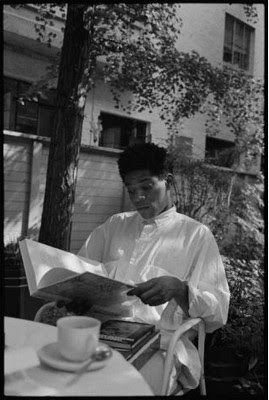
Jean-Michel Basquiat at the
Pellizzi residence in New York, NY, 1984
Photo by Francesco Pellizzi
© Francesco Pellizzi

Francesco Clemente, Andy Warhol, and Jean-Michel Basquiat 
at the Pellizzi residence in New York, NY, 1984
Photo by Francesco Pellizzi
© Francesco Pellizzi

Leading the group of works being offered is Untitled (ELMAR), created in 1982 and acquired by the Pellizzi Family just two years later [illustrated page one]. At nearly eight feet wide, the monumental work is a cornerstone of el Jean-MicBasquiat's golden year, during which he transitioned from street art to gallery success. Emblematic of Basquiat’s best works, Untitled (ELMAR) is rich in iconography and self-referential imagery. On the left, a “fallen angel” figure, birdlike and adorned with the recurring crown-of-thorns motif—which doubles as a halo—hovers above a luminous blue sea of scribbled waves and the text “ELMAR”, suggesting a modern-day Icarus on the verge of descent. To the right, a radiant archer, also crowned, releases two arrows in his direction. Untitled (ELMAR) ultimately reflects Jean-Michel Basquiat's exploration of duality within his own identity and encapsulates the essence of the artist at the peak of his creative powers.

Untitled (ELMAR) has a significant history; it was included in an exhibition dedicated to the Collection of Francesco Pellizzi at the Hofstra Museum in New York in 1989, and later presented at Gagosian Los Angeles as part of a memorial exhibition in 1998, marking the 10-year anniversary of Basquiat’s death. It was notably featured on the cover of the accompanying catalogue. More recently, the work was prominently exhibited in the artist’s historical 2018 retrospective at the Fondation Louis Vuitton in Paris.

Jean-Michel Basquiat
Untitled (Portrait of a Famous Ballplayer), 1981
50 1/8 x 43 1/2 in. (127.3 x 110.5 cm)
Estimate: $6.5-8.5 Million
To be offered on 14 May in New York
Image courtesy of Phillips

Jean-Michel Basquiat's groundbreaking transition from street art to canvas reached a pivotal moment in 1981 as seen in Untitled (Portrait of a Famous Ballplayer). This seminal piece, executed during a transformative period in Basquiat's career, stands as a testament to his exploration of race, identity, and American culture, which would endure throughout the rest of his career. It was exhibited at historic shows such as Nosei’s Jean-Michel Basquiat Memorial Exhibition, which opened in December 1988, just a few months after his passing and coinciding with what would have been the artist’s 28th birthday.

In Untitled (Portrait of a Famous Ballplayer), Jean-Michel Basquiat juxtaposes symbols of the "all-American" sport with his depiction of a Black central figure donning a baseball uniform, as well as his signature text and crown motifs. Basquiat challenges societal norms and confronts stereotypes, inviting viewers into a complex dialogue on inclusion and exclusion within American culture. Basquiat's use of the phrase “FAMOUS NEGRO ATHLETES” (with “NEGRO ATHLETES” notably crossed out) serves as a potent commentary on race, identity, and representation. It also reflects Basquiat's own experiences as a Black artist living and working in a predominantly white art world.

Jean-Michel Basquiat
Native Carrying Some Guns, Bibles, Amorites on Safari, 1982
72 1/8 x 71 3/4 in. (183.2 x 182.2 cm)
Estimate: $12-18 Million / HK$90-120 Million
To be offered on 31 May in Hong Kong
Image courtesy of Phillips

Since Phillips became a key operator in Asia in 2015, the company has been dedicated to presenting the best Western artworks to collectors and enthusiasts in the region. The company’s significant growth in Asia underscores the activity of Asian collectors acquiring works by the most important international artists. Jean-Michel Basquiat is a perfect example of this, with collectors in Asia being drawn to the artist’s oeuvre, which resonates deeply with the region's rich artistic traditions. In 2022, Phillips sold Untitled, 1982, from the collection of Japanese entrepreneur Yusaku Maezawa, with the buyer also being a private collector in Asia. Given Basquiat’s enduring appeal and resonance in Asia, Phillips offers Native Carrying Some Guns, Bibles, Amorites on Safari, 1982, at Phillips Hong Kong on 31 May.

In this work, a Black figure dominates the canvas with its arms raised, confronting a colonial poacher. The artwork merges intricate draftsmanship with street art gestures and takes on such significant subjects such as slavery and empire. Through a direct portrayal and the incorporation of text, Jean-Michel Basquiat critiques colonial commerce, encapsulating his broader themes of colonization, commercialization, and African American history. Reduced to caricatures, the figures symbolize “native” and “colonizer”, evoking explicit critiques of white imperialism. Native Carrying Some Guns, Bibles, Amorites on Safari reflects Jean-Michel Basquiat’s acute awareness of societal issues and stands as an emblematic representation of his oeuvre, capturing the intensity of his artistic vision.

* Francesco Pellizzi, in 1979-1989 AMERICAN, ITALIAN, MEXICAN ART, from the Collection of Francesco Pellizzi

AUCTION DATES:
New York | 14 May | Untitled (ELMAR), 1982, and Untitled (Portrait of a Famous Ballplayer), 1981
Hong Kong | 31 May | Native Carrying Some Guns, Bibles, Amorites on Safari, 1982

EXHIBITION DATES:
New York | 8-14 April | All Three Works
Los Angeles | 23-25 April | All Three Works
Taipei | 4-5 May | Native Carrying Some Guns, Bibles, Amorites on Safari, 1982
New York | 4-14 May | Untitled (ELMAR), 1982, and Untitled (Portrait of a Famous Ballplayer), 1981
Hong Kong | 22 May – 31 May | Native Carrying Some Guns, Bibles, Amorites on Safari, 1982

PHILLIPS NEW YORK – 432 Park Avenue, New York, NY 10022
PHILLIPS HONG KONG – G/F, WKCDA Tower, West Kowloon Cultural District, No. 8 Austin Road, West Kowloon

25/06/20

I.M.A.gination @ Christie’s Paris & Online - Charity Sale to Benefit the Claude and France Lemand I.M.A. Fund

I.M.A.gination 
Charity Sale to Benefit the Claude and France Lemand I.M.A. Fund
Christie’s Paris & Online
24 June - 16 July 2020

Dia Al-Azzawi
DIA AL-AZZAWI
Search for a symbol, 2006
Claude and France Lemand Collection
Estimate: €20,000-30,000

Claude and France Lemand, Parisian collectors and gallery owners, who presented Middle Eastern Art in the capital as early as 1988, have decided to donate 44 works by Middle Eastern, Japanese and French artists from their personal collection to be sold by Christie’s Paris to help young artists who are in great need due to the Covid 19 crisis and to benefit the Claude & France Lemand-IMA Fund at the Institut du Monde Arabe. The fund aims to secure future acquisitions, organise exhibitions, undertake research work, publish exhibition catalogues.

The format of the sale will be an online auction, starting on 24 June and closing on 16 July. Some selected highlights will be on view at Christie’s Paris from 26 and to 30 June, during the Post-War and Contemporary Art Paris sales, then from 4 to 10 July again, during the exhibition of Christie’s new concept Evening sale ‘ONE’ taking place in 4 cities. Estimates range from €1,000 to €40,000 and works by each artist are already present in the collections of the Institut du Monde Arabe and many of the 26 artists are also represented in permanent collections of other international institutions.

In October 2018, Claude and France Lemand have generously donated more than 1300 works by Middle Eastern artists to the Institut du Monde Arabe museum, the largest donation in the history of the institution, founded in 1980 by 18 Arab countries in Paris. One year later, the number of works donated reached 1500.

The 44 works are spanning 60 years of artistic development throughout the Middle East, starting with the top lot of the sale Shafic Abboud’s 1959 work entitled Saison, and estimated at €40,000-60,000 and finishes with a series of 9 works produced in 2019-2020 as tributes to the Notre-Dame fire in April 2019. Claude Lemand initiated this project as the Institut du Monde Arabe directly oversees Notre-Dame and hence was a first-hand witness on the destruction of the historical monument.

Jack Lang, Former French Minister of Culture and President of the Institut du Monde Arabe comments: “Claude and France Lemand were among the first to believe in the creativity of contemporary artists in the Arab world. They are also known for their generosity. A donation is always a human adventure. It continues and grows, since the benefactors of the IMA Museum are now also becoming benefactors of artists from the Arab world. I am pleased to bring my patronage to this charity sale”.

Valérie Didier, Christie’s Impressionist and Modern Art Specialist: “What a pleasure and honour to organize a sale in Paris to benefit the Claude and France Lemand - IMA Fund. I personally have immense admiration for the couple, in particular for their unprecedented generosity, as Claude and France have devoted their whole life to defend these artists. I am convinced collectors will be present to support their latest great cause and to reinvigorate the Institut du Monde Arabe’s activity.”


Shafic Abboud
SHAFIC ABBOUD
Saison, 1959
Estimate: €40,000-60,000 
Shafic Abboud
SHAFIC ABBOUD
Composition, 1960
Estimate: €5,000-7,000

SHAFIC ABBOUD (1926-2004) is one of the foremost Arab artists of the 20th century. His paintings are a manifesto for freedom, colour, light and joy, as well as being a permanent bridge between the art scenes of France and Lebanon and that of Europe and the Middle East. Both Lebanese and Parisian, he was very attached to Lebanon, to its landscapes, its light and his own childhood memories. The stories of his grandmother, who was the village’s story-teller, left an indelible mark on him, at a very early age. Shafic Abboud arrived in 1947 in Paris. He is represented with two works: Saison 1959, estimate €40,000-60,000, and a nice Composition done the following year, estimate €5,000-7,000.


Dia Al-Azzawi
DIA AL-AZZAWI
Arabic Letter, 2008
Estimate: €15,000-20,000

DIA AL-AZZAWI (born 1939, Baghdad), started his artistic career in 1964, after graduating from the Institute of Fine Arts and Archaeology in Baghdad. His studies of ancient civilizations and Iraqi heritage had a profound impact on his art, and a key objective in the early formation of his artistic style was to link the visual culture of the past to the present. He is internationally recognised as one of the pioneers of modern Arab art. Defined by its powerful visual impact and brilliant colour, Al-Azzawi’s art covers a range of subjects executed in a variety of media, including painting, sculpture, drawing, prints and art books. He lives and works in London since 1976, but continues to derive inspiration from his homeland, Iraq. With exhibitions of his work held worldwide, his art features in numerous private and public collections. Dia Al-Azzawi in his own words about his art: "My work is part of the Renaissance of Arab Art trend, yet it is universal in its dimension and interlocked within contemporary history and culture." Dia Al-Azzawi is represented with three works in this auction: Search for a Symbol, 2006, estimate €20,000-30,000, Arabic Letter, 1984-2005, estimate €15,000-20,000 and was also part of the group of artists creating tributes to the fire of Notre-Dame My tribute to Notre Dame, 2019, estimate: €20,000-30,000.


Najia Mehadji
NAJIA MEHADJI
La Vierge à l’enfant, 2019
Estimate : €15,000-20,000 

Another artist who paid tribute to the fire of Notre-Dame is French-Moroccan female artist NAJIA MEHADJI (b. 1950), who created a vibrant and unusually large 180 x 110 cm painting of La Vierge à l’Enfant, 2019, estimate: €15,000-20.000. "This is the painting I made as a tribute to Our Lady, based on the sculpture of the Madonna and Child at the entrance to the choir near the left transept (at Notre Dame) and the many blue drapes that feature the mantle of the Virgin in Bellini's or Fra Angelico's paintings. Its dimensions, 180 x 110 cm, are those of the sculpture of Our Lady, and the red background refers both to the fire and to the colours of the stained-glass windows in the cathedral's rosettes. ", commented Najia Mehadj on, 27 May 2019 about her work.

All artists represented in the auction are: Shafic Abboud - Youssef Abdelke - Etel Adnan - Nasser Al-Aswadi - Boutros Al-Maari - Dia Al-Azzawi - Assadour - Abdallah Benanteur - Mahjoub Ben Bella - Halida Boughriet - Chaouki Choukini - Dahmane - Khaled Dawwa - Fatima El-Hajj - Abdelkader Guermaz - Mohamed Kacimi - Mohammed Khadda - Mohammad Omar Khalil - Manabu Kochi - Mohamed Lekleti - Hussein Madi - Najia Mehadji - François Sargologo - Hussein Taï - Khaled Takreti - Hani Zurob

Online Auction: 24 June to 16 July 2020
Exhibition: From 26 and to 30 June, then from 4 to 10 July, each time from 10 am to 6pm
Venue: Christie’s: 9 avenue Matignon, 75008 Paris

*Estimates do not include buyer’s premium. Sales totals are hammer price plus buyer’s premium and are reported net of applicable fees. 

CHRISTIE'S
www.christies.com

10/03/17

Andy Warhol's Soup Can With Can Opener (Vegetable) To Star New York's Post-War and Contemporary art Auctions, Christie's, New York

Andy Warhol's Soup Can With Can Opener (Vegetable) To Star New York's Post-War and Contemporary art Auctions
Christie's, New York
17 May 2017

Andy Warhol’s Big Campbell’s Soup Can with Can Opener (Vegetable), 1962 (estimate on request) will star in Christie’s Post-War and Contemporary Art Evening Sale on 17 May. One of the 20th-century’s most iconic images, Warhol’s ‘Campbell’s Soup Cans’ quite literally changed the course of art in the post-war period. The property of the Cingillioglu Family Collection, the present work was originally part of the legendary collection of Pop Art assembled by Emily and Burton Tremaine, who acquired the painting after a visit to Warhol’s studio in the year of its execution.  It was last sold as part of the renowned collection of Barney A. Ebsworth at Christie’s New York in 2010. The work will be on view at Christie’s King Street in London from 4 March to 8 March. 
Francis Outred, Chairman and Head of Post-War and Contemporary Art EMERI, “Warhol’s Soup Cans changed art history by recognizing the rise of mass consumption in society, and predicting the world we live in today. This painting was made at the very moment of recognition and thereby created the foundation for the for the Pop Art phenomenon which continues to inspire many aspects of contemporary society. The Cingillioglu Family Collection has been established over the past 40 years, collecting the very best across many categories and periods and is particularly known for its strong constellation of Pop art. Bought at Christie’s in 2010 for over 23 million dollars, Big Campbell’s Soup Can with Can Opener (Vegetable) is now set for a triumphant return to the auction room and presents a real opportunity to acquire one of the most historically relevant and instantly recognizable canvases of the 20th century.”
Conceived and executed in Warhol’s New York factory, Big Campbell's Soup Can with Can Opener (Vegetable) is the first in Warhol’s series of large-scale hand painted ‘Campbell's Soup Cans’. In July 1962 it was exhibited at the Wadsworth Athenaeum, Hartford, becoming the first picture by Andy Warhol to ever be shown in a museum. Of the ten large-scale Campbell soup cans painted by Warhol, six are in museum collections, including the Menil Collection, Houston; the Kunsthaus, Zurich; the Kunstsammlung Nordrhein-Westfalen, Düsseldorf; and two in The Andy Warhol Museum, Pittsburgh.

Big Campbell’s Soup Can with Can Opener (Vegetable) directly predates the birth of the silkscreen, prefiguring the means of painting that came to define Warhol’s practice. Looking at the lack of shadow and the treatment of the reflected light on the metal of the tin and of the opener, it becomes clear that Warhol is considering a way to bridge the handmade with the mechanical. The evidence, on close inspection, of traces of pencil on the surface and the rather lush red brushstrokes on the label shows Warhol working through the ideas that would become the focus of his entire career.

When Andy Warhol was asked, in a 1977 interview by Glenn O'Brien, what his favorite work was, he said, 'I guess the soup can'.* Warhol’s ‘Campbell Soup Can’ paintings draw attention to the world of mass production that had become a fundamental part of modern existence in the 1960s. By co-opting the visual tropes of commercial art, in which he had been trained, Andy Warhol was able to speak to a contemporary audience that was fully conversant in the same language. Recalling the tactics of Marcel Duchamp’s readymade Andy Warhol was able to capture the attention of the media and public like no other artist of our time.   

* (Glenn O'Brien, 'Interview: Andy Warhol", High Times, August 1977, in K. Goldsmith, ed., I'll Be Your Mirror: The Selected Andy Warhol Interviews: 1962-1987, New York, 2004, p. 242).

Auction:
Post-War and Contemporary Art Evening Sale
New York, 17 May 2017
7pm

CHRISTIE'S

08/02/14

Jean-Michel Basquiat at Christie's, New York. Works from the collection of Alexis Adler

JEAN-MICHEL BASQUIAT 
WORKS FROM THE COLLECTION OF ALEXIS ADLER 
Christies's, Exhibition at Rockefeller Center, New York
1-28 March 2014 

Jean-Michel Basquiat
JEAN-MICHEL BASQUIAT
© Alexis Adler

Before Jean-Michel became Basquiat, and could afford studios and canvases, he painted all over his apartments — on walls, doors, refrigerators, clothes and any other bare surface he could find. In 1979, the artist began transforming the East Village apartment he was sharing with Alexis Adler, just such a living installation. Christie’s is honored today to announce a blockbuster month-long curated exhibition featuring a grouping of approximately 50 works coming from the Lower East Side apartment, where she lived with Jean-Michel Basquiat from 1979 to 1980. The three major works, a glyph-like work on plaster that reads Olive Oyl, a door titled within as Famous Negro Athletes and Milk painted on a radiator will highlight the First-Open sale of Post-War and Contemporary on March 6th, and a selection of 41 works and items will be sold through a dedicated Online-Only sale to be held March 3-17. To be comprehensive, the exhibition will also present works and archive photographs on loan from Alexis Adler’s collection.

The exceptional month long exhibition will take place on the 20th floor of 1230 Avenue of the Americas, at Rockefeller Center in March 2014. The show will be accompanied by a fully-illustrated catalogue, featuring never before published images of the artist and several unique photographs of Basquiat taken by Alexis Adler.

“Jean was just a young and wonderful person that had a lot to say. Everything around us was about art at that time, everything was about creativity, and whatever he could find became art. He was only 19 and just absorbing and creating. It’s been really wonderful living with these pieces for almost 35 years, and I hope that the next owners get as much joy as I did. Living with it is a responsibility. There are beautiful pieces, and they mean a lot to me because I was there, have remembrances.  But I know that Jean gave them to me as a gift, and I enjoyed them as such, I have just the memories. I’ve always been interested in sharing and I have realize that today young people are willing to learn more about Jean and are really interested in his art.  I'm really excited to be able to have the show at Christie’s, as well as pass on, and share the artwork with other people so they can enjoy it. I’ve been enjoying it for a long time,” declared Alexis Adler.

Jean-Michel Basquiat and Alexis Adler cohabited from 1979 to 1980, when Basquiat was nineteen, and creating punk-influenced photocopied collages and painted clothing for sale on the street. Alexis Adler’s collection includes never before exhibited items including paintings, drawings and postcards as well as painted clothing kept private since the 80’s when the artist and Alexis shared the Lower East Side apartment.

“It's a pleasure to be able to present to the public this wonderful grouping of material from the collection of Alexis Adler. The sum total of these works provide an intimate view of Basquiat before his fame and while he was practicing graffiti in the streets and getting by on his own wits and the good will of others who recognized his tremendous creative spark. His name was SAMO and it was written everywhere, he was infamous before becoming famous. This body of work exhibits the artist’s early grasp of his ability and potential, many of the words and forms represented here carry over into his canvases which will be created just a few months later. We are indebted to Alexis Adler for having the foresight to preserve these early pieces and present them to the public now for the very first time,” stated Jonathan Laib, Christie’s, Senior Specialist, Post-War & Contemporary Art.

Adler has just graduated from college when they met. She became part of the downtown scene along with Basquiat, Michael Holman, Al Diaz and Shannon Dawson – young friends with an alternative style who became regulars at the Mudd Club and other downtown fixtures.  When they first started going together neither Basquiat or Adler had a home, and they sometimes stayed together with some friends. In 1979, they both moved in an apartment on East 12th Street near Avenue B. It was his first permanent address after leaving his father's home in Brooklyn. He had a room in the back of the railroad apartment filled with papers where he made his drawings and poetic phrases. Adler had studied art history at Barnard, and majored in Biology in college; she is today a successful embryologist in New York. Jean-Michel Basquiat was fascinated by her Biology textbooks, and copied many of the Biology and Chemistry symbols into his drawing.

The collection also includes writings and early drawings, as well as his postcards and painted clothes. In these early years, Basquiat painted on walls and objects in other apartments he stayed at, or left drawings on paper as gifts. But many of those were thrown away and painted over, and other objects sold when prices for his work first started rising.

BASQUIAT'S WORKS TO BE OFFERD IN THE FIRST OPEN OF POST WAR AND CONTEMPORARY ART, 6 March 2014

Jean-Michel Basquiat
JEAN-MICHEL BASQUIAT (1960-1988) 
Olive Oyl 
paint on wall, 48 x 30 in. 
Estimate: $400,000-600,000 
Image courtesy Christie's, New York 

Jean-Michel Basquiat
JEAN-MICHEL BASQUIAT (1960-1988)
Untitled (Famous Negro Athletes)
paint on door (Detail), 80 x 24 in.
Executed in 1980-1981
Estimate: $800,000-1,200,000
Image courtesy Christie's, New York

Jean-Michel Basquiat
JEAN-MICHEL BASQUIAT (1960-1988)
Milk
paint on radiator, 24 x 16 x 6 in.
Estimate: $300,000-500,000 
Image courtesy Christie's, New York 

“I met Jean (which is what everybody called him, I think, until he got famous—I never called him that while he was alive), toward the beginning of 1979 when he was 18.  (I was at the self-dramatic Jesus’s crucifixion age.)  But we treasured the same information and we spoke the same language and that put us on the level.  I never thought of him as a kid, but as a wise guy/wise man.  He was a rebel.  What are you rebelling against?  What have you got?  Hey, I found him by tracking down the words he wrote on walls on the street, and that was the beginning of a permanent friendship.  I was always glad to see him show up.  He was always up for perpetrating some fun.  He would tell you something interesting, ask you a question you couldn’t answer, give you a gift you didn’t expect, play your records, look through your books and in the refrigerator, and leave you a drawing. Thanks!
Alexis’s collection is the pure pro-bono production of an artist on fire with ideas.  These are the roots and the seeds of thing to come. Already in 1979 he was developing his own vocabulary of words, characters (Popeye and Olive Oyl) and signs.  Here’s the crown and the wheel, the dotted line, the spilled ink.  He’s trying things out.  With the postcards he’s doing Warhol and Rauschenberg, pop art, and with the clothes he’s doing Franz Kline and Pollock.” Glenn O’Brien, writer and friend of Jean-Michel Basquiat. Extract from the text written for the Christie’s dedicated exhibition catalogue. 

BASQIAT'S WORKS TO BE OFFERD ON THE ONLINE-ONLY SALE, 3 - 17 March 2014

Jean-Michel Basquiat
JEAN-MICHEL BASQUIAT (1960-1988)
Untitled (Typical Cancer)
ink and collage on paper, 11 x 8 1/4 in.
Executed in 1979-1980
Estimate: $20,000-30,000
Image courtesy Christie's, New York 

Jean-Michel Basquiat
JEAN-MICHEL BASQUIAT (1960-1988)
Untitled
collage and mixed media on paper
7 1/4 x 5 1/2 in.
Executed in 1979-1980
Estimate: $8,000-12,000
Image courtesy Christie's, New York 

Jean-Michel Basquiat
JEAN-MICHEL BASQUIAT (1960-1988)
Untitled (Rock Hudson)
collage and ink on paper
6 3/4 x 6 3/4 in.
Executed in 1979-1980
Estimate: $20,000-30,000
Image courtesy Christie's, New York 

Jean-Michel Basquiat
JEAN-MICHEL BASQUIAT (1960-1988)
Untitled (Flag)
watercolor and typewriter type on paper
2 3/8 x 5 in.; 11 7/8 x 12 1/4 in. (framed)
Executed in 1979-1980
$50,000-70,000
Image courtesy Christie's, New York 

Jean-Michel Basquiat
JEAN-MICHEL BASQUIAT (1960-1988)
Mead Sketch Diary
spiral notebook with red ink inscriptions
11 x 8 1/2 in.
Executed in 1979-1980
$80,000-120,000
Image courtesy Christie's, New York

Jean-Michel Basquiat
JEAN-MICHEL BASQUIAT (1960-1988)
Blue paint on sweatshirt
Executed in 1979-1980
Estimate: $10,000-15,000
Image courtesy Christie's, New York 

Exhibition
Rockefeller Center, 20th Floor on 1230 Avenue of the Americas, March 1 - 28, 2014
Monday to Saturday 10am – 5pm
Sunday March 2, 1pm – 5pm
Closed on Sunday March 9, 16 and 23

First open sale: March 6, 2014
Christie’s 20 Rockefeller Plaza

Online-only sale, March 3 – 17, 2014
Christies.com/pwconline

Christie’s Website: www.christies.com

11/11/12

Villa Grisebach, Berlin: 200th auction celebrated with seven artworks auctions


Masterpieces of German Expressionism and Twentieth Century Art 
Exceptional Offerings at Grisebach’s Fall Auctions - Inaugural Auction ORANGERIE - Selected Objects From Two Millennia  
At Villa Grisebach Auction House in Berlin, Germany

Villa Grisebach invites to Fasanenstrasse in Berlin to celebrate her 200th auction. From November 28 to December 1, 2012, in seven auctions, each accompanied by a separate catalogue, a total of more than 1,200 works of art with a pre-sale estimate of 17 to 23 million euros will be offered.  


OTTO MUELLER, Zwei Mädchen (Zwei Mädchenakte in Dreiviertelfigur), Circa 1924  
Distemper on burlap. Relined. 120 x 89,5 cm 
Photo Courtesy Grisebach, Berlin

Masterpieces of German Expressionism take the lead with the large-format painting “Zwei Mädchen” by Otto Mueller of 1924 (€ 800,000/1,200,000), Schmidt-Rottluff’s important 1919 double portrait “Frauen am Meer” (€ 400,000/600,000), Max Pechstein’s powerful “Sonnenuntergang am Meer” of 1921 (€ 400,000/600,000), Erich Heckel’s “Blick aufs Meer” at the Flensburg Förde of 1920 (€ 300,000/400,000) and a watercolor, saturated in intensely glowing hues, by Emil Nolde, “Zwei bärtige Männer (Apostel)” (€ 300,000/400,000). 

OTTO DIX, Sonnenaufgang, 1913 
Oil on paper on cardboard. 50,5 x 66 cm
Photo Courtesy Grisebach, Berlin

Another piece of museum quality is “Sonnenaufgang” by Otto Dix (€ 300,000/400,000), created in 1913 it can be seen as an apocalyptic vision of the First World War. Originally in the collection of the Dresden Stadtmuseum, the painting was displayed in the 1937 propaganda show “Degenerate Art.“ Since the 1960s, due to its significance, it has been included in many exhibitions in Germany and abroad. 


WILLI BAUMEISTER, Kessaua statuarisch, 1954 
Oil with resin on masonite. 65 x 81 cm 
Photo Courtesy Grisebach, Berlin

German post-war art is represented by superb works by Willi Baumeister (“Kessaua statuarisch,” 1954,  € 250,000/300,000), Ernst Wilhelm Nay (“Motion,” 1962, € 300,000/400,000), and Emil Schumacher (“Hephatos,” 1959, € 220,000/280,000) leading over to the contemporary art section. 

Here, Andy Warhol’s  large-format “Friedrich der Grosse,” entrusted to Grisebach by the Daimler AG (€ 700,000/1,000,000), and Anselm Kiefer’s “Odin and the World-Ash” (€ 400,000/600,000) take first positions.  

ANDY WARHOL, Friedrich der Grosse, 1986 
Acrylic and screenprint on canvas, 213 x 184 cm
Photo Courtesy Grisebach, Berlin

ANSELM KIEFER, Odin and the World-Ash, 1981 
Oil over woodcut over wove paper on burlap, 170,5 x 190,2 cm 
Photo Courtesy Grisebach, Berlin

On the occasion of Villa Grisebach’s 200th auction the renowed german auction house's program expanded once again: The new department “ORANGERIE” offers selected objects from an Attic stamnos from  the 6th century B.C. (€ 80,000/100,000) to four of Mies van der Rohe’s “MR10” tubular steel chairs of 1927 (€ 10,000/15,000). The 2012 celebrations of Prussian King Frederick the Great’s 300th birthday are reflected in this auction by the rediscovered first marble bust of his descendant, Queen Luise, created by Christian Daniel Rauch in 1804 and believed to be lost until recently (€ 100,000/150,000).

Bernd Schultz: “We are pleased to offer in our 200th auction museum-quality examples of German Expressionism that, in many cases, have not surfaced the market for several decades. The strong offerings in our post-war art section is a sign for the  growing importance of the activities in our contemporary art department. For me, a  personal pleasure is our new department, ORANGERIE, which we designed to entice our clients to collect exceptional objects from ancient times through today.” 

Villa Grisebach's Auction dates 

- 19th Century Art: Wednesday, 28 November 2012, 2:30 pm
- Modern and Contemporary Photographs (read previous post): Wednesday, 28 November 2012, 5 pm
- ORANGERIE - Selected Objects: Thursday, 29 November 2012, 11 am
- Selected Works: Thursday, 29 November 2012, 5 pm
- Modern Art: Friday, 30 November 2012, 11 am
- Post-War and Contemporary Art: Friday, 30 November 2012, 2:30 pm
- Benefit Auction for the Max Beckmann Distinguished Visitorship of the American Academy in Berlin: Friday, 30 November 2012, 7 pm
- Third Floor - Estimate up to € 3,000: Saturday, 1 December 2012, 11 AM (Part I) and 2:30 PM (Part II)

All auction catalogues are available at www.villa-grisebach.com. Preview exhibitions will be held in Berlin from November 23 to 27 at three venues at Fasanenstrasse.

Text by Micaela Kapitzky

Villa Grisebach Auktionen GmbH  
Fasanenstrasse 25 • D-10719 Berlin

09/06/11

19th Century Paintings Sales Results - Sotheby's Amsterdam, June 2011


19th Century European Paintings Auction
Sotheby's Amsterdam, 7 June 2011 
Totals EUR 1,5 / USD 2,3 million   

Next 19th Century European Paintings sale on 12 December 2011

7 June 2011's sale of 19th Century European Painting at Sotheby’s Amsterdam brought EUR 1,586,925 (USD 2,312,848), within pre-sale expectations (est. EUR 1.5 - 2 million). The auction achieved sellthrough rates of 46.9% by lot and 69.2% by value, and set three new artist records.

The highest price achieved was for Winter in the Streets of a Dutch Town painted by WILLEM KOEKKOEK (1839-1895), one of the most distinguished painters of townscapes, which realised €228,750 ($333,389) against a pre-sale estimate of €100,000 – 150,000. Willem Koekkoek’s works were greatly admired all over Europe for their nostalgic mood and uniquely refined and detailed style of painting. This painting is an impressive example, not only because of its size, but also because of its ability to capture Holland's Age of Romanticism. 

Speaking after the sale, Mrs. Eveline van Oirschot, Chairman of Sotheby’s Amsterdam, said: ‘This very successful total result shows us again the strong demand nowadays for paintings of good quality coming from private collections.’

In church considered as one of the finest paintings by the American artist GARI MELCHERS fetched €88,350 ($128,765), above the pre-sale high estimate (est. €50,000 - 70,000), and is bought by the American Telfair Museum of Art. The painting was once part of the collection of Walther Rathenau, the Berlin industrialist and founder of the German Democratic Party, who was murdered in 1922 by officers of the extreme right wing party because of his Jewish background and political ideas. 

Holly McCullough of the Telfair Museum of Art comments :’Gari Melchers served as the Telfair’s fine arts advisor between 1906-1916 and was responsible for acquiring some of the very finest works in our collection. We are absolutely delighted to attain this very fine example of Melchers’ early work as a tribute to his ongoing legacy at the Telfair.’ 

A beautiful city view, Figures at the fishmarket in Delft, by CORNELIS SPRINGER realised €162,750 ($237,198), against a pre-sale estimate of €150,000 - 200,000. 

Another high price is realised for A girl in kimono a magnificent watercolour by FLORIS ARNTZENIUS, which sold for €78,750 ($114,773), well above pre-sale expectations (est. €20,000 - 30,000).  

NEW ARTIST RECORDS 

Another high price and new artist record for JAN HENDRIK VERHEYEN with A Lively Townscene, Utrecht, which sold for €96,750/ $141,007, against a pre-sale estimate of €12,000 - 18,000.

New artist record also for MARIE BELOUX-HODIEUX with A flower still life with peonies, hydrangea in a copper kettle, which sold for for €6,250/ $9,109 (est. €4,000 - 6,000).

Another new artist record for SALOMON LEONARDUS VERVEER, The ferry on the maas near Dordrecht, which sold for €102,750/ $149,752 against a pre-sale estimate of €50,000 - 80,000.

Pre-sale estimates do not include buyer’s premium.
Sale prices include buyer's premium. Sale session totals are net aggregate figures plus premiums. Sotheby's buyer's premium is 25% of the hammer price on the first €15.000, 20% of the hammer price up to and including €800.000, and 12% thereafter on each lot. 

Sotheby’s Amsterdam holds 19th Century Paintings auctions twice a year. The next sale will take place on 12 December 2011. 

SOTHEBY'S AMSTERDAM - NETHERLANDS 

14/02/11

Post-War & Contemporary Art - Christie’s London Auctions lead by Andy Warhol and Jeff Koons works

Post-War & Contemporary Art Auctions 
Christie’s London
16 - 17 February 2011

CHRISTIE’S AUCTIONS OF POST-WAR AND CONTEMPORARY ART will take place on 16 and 17 February 2011 in London and are expected to realise a combined total of £46,246,000 to £66,447,000 (corresponding auctions in February 2010 - £34.9 million to £50.5 million). Highlights from the Evening auction were on public exhibition at Christie’s New York from 24 to 26 January. The full auctions is on public exhibition in London from 12 to 16 February.

ANDY WARHOL AND JEFF KOONS LEAD CONTEMPORARY MASTERWORKS

Francis Outred, Head of Post-War and Contemporary Art, Christie’s Europe: “I am very excited by the upcoming auction which is probably the strongest and most diverse we have had in London since I joined Christie’s in January 2009. Showing some of the most important art from Europe and America of the last fifty years, it also showcases the best art which has emerged across the globe over the last decade. Anchored by the re-discovery of the outstanding monumental self-portrait by Andy Warhol, it is also great to offer Jeff Koons’ seminal ‘Winter Bears’. An incredible life-like representation in wood which is child-size, this re-fashioning of the Adam and Eve story as cutesy Alpine bears clutching a heart shaped bag, where all seems too perfect to be true, represents one of Koons' greatest musings on the nature of modern relationships. It seems very apt to be offering this work in Valentine's week.”

REDISCOVERED SEMINAL LARGE SELF-PORTRAIT BY ANDY WARHOL (1928-1987)

Executed in 1967 and an addition to an historically important series of 10 self-portraits, the picture has been in a private collection since 1974 when it was acquired from Leo Castelli, Warhol’s primary dealer. It will be offered at the Post-War and Contemporary Art Evening Auction on Wednesday 16 February 2011 in London and is expected to realise £3 million to £5 million. The picture was exhibited in public for the first time at Christie’s New York from 22 to 26 January 2011.

The present work is one of an historic series of 11 large-scale self-portraits executed in 1967, five of which are in museums (Tate, London; The Staatsgalerie Moderne Kunst, Munich; the San Francisco Museum of Modern Art; and two at the Detroit Institute for Arts). Such is the importance of the series that eight of the known works were included in the artist’s landmark retrospective at MOMA two years after his death in 1989. The present work is completely unpublished and has been in the same private collection since 1974.

Francis Outred, Head of Post-War and Contemporary Art, Christie’s Europe: “I’m incredibly excited at the prospect of offering this rediscovered masterpiece by Andy Warhol. At the time of its execution Warhol was at the peak of his creative powers and this very rare series of works were the largest self-portraits he had made. This work shows a classic image of the artist in an imposing, larger than life scale, with an extraordinary presence of thick, red paint. That 5 of the works from this series are in museums is a testament to their importance.”

The image of Warhol with his hand to his mouth is one of the most representative and iconic images of the artist. Warhol first used the image for a group of works in 1966 painted in a much smaller, life-size scale. The following year he used the same image in producing 11 monumental works in a large-scale format of six foot square, of which the present example is one. Six works from this series were exhibited in the American Pavilion at the 1967 International and Universal Exposition in Montreal which was visited by tens of millions of people, and which saw the portraits dominate an exhibition including works by Jasper Johns, Roy Lichtenstein, Barnett Newman and Robert Rauschenberg.

By 1967 Warhol had reached a point in his career when he was internationally recognized as the most important and controversial figure in American Pop Art. The present series of self-portraits represent the high point of his career when he has achieved great wealth and fame, and when as a celebrity he brashly and confidently presented his own image in a truly monumental fashion to a global audience of millions.

SEMINAL WORK FROM JEFF KOONS

Another leading highlight is Winter Bears, 1988, a seminal work from Jeff Koons (b. 1955) highly acclaimed Banality series which launched him as an international art star in the late 1980s. At over 120 cm in height, the pair of child-sized sculptures, with their wide eyes, matching ‘his and hers’ clothing and cartoonish faces, wave to us and welcome us into the distinct world of Jeff Koons. If the Banality series was Koons’ idealised human civilisation or ‘Garden of Eden’, the Winter Bears represented Adam and Eve, the perfect depiction of human unity, as an Alpine European couple. Painstakingly carved out of wood which has then been polychromed in the traditional manner redolent of the great Medieval church sculpture in Germany, Koons has here lent a human and spiritual air to a cartoon-like creation. Their size and physicality lends them a thoroughly human quality which begins to jar the lines between cartoon and reality, and high and low art. Offered at auction for the first time having been in the present collection since 1994, it is expected to realise £2.5 million to £3.5 million. Another version of Winter Bears resides in the collection of the Tate Modern in London.

OTHER HIGHLIGHTS OF POST-WAR AND CONTEMPORARY ART EVENING AUCTION

Dina Amin, Director and Head of Evening Auction: “The global personality of the sale is reflected in works from China, Brazil, India and Iraq as well as major works from America and Europe. We are particularly pleased to have strong representations of Eduardo Chillida, Gerhard Richter and Lucio Fontana, alongside an extremely rare pioneering portrait by Martial Raysse.”

Italy

The dawn of conceptual art is represented at the auction through two Italian pioneers of the movement; Lucio Fontana (1899-1968) and Piero Manzoni (1933-1963). In the late 1950s and early 1960s, these two artists transformed the landscape of contemporary art with works that went on to inspire, among others, Warhol, Koons, Hirst and Gursky.

Concetto spaziale, 1961, by Lucio Fontana (1899-1968) is a sumptuous symphony of gold which explores the ideas and concepts of space and the immaterial in the same year that Yuri Gagarin would become the first man in space. From the artist’s breakthrough series Olii, which includes the celebrated Venice series of the same year, the present work relates very closely to Concetto spaziale, Venezia era tutta d’oro, now in the Museo Thyssen-Bornemisza, Madrid. It is expected to realise £2 million to £3 million. Also by the artist, Concetto spaziale, Attesa was executed in 1964 and is a beautiful, crisp minimalist work in white which emphasizes the purity of the slash against a background reminiscent of Manzoni, whom he had strongly influenced and who had died the previous year. It is expected to realise £1 million to £1.5 million.

Achrome by Piero Manzoni (1933-1963) is an early, majestic example of the artist’s most celebrated series of works. Executed in 1958-59, it is of a relatively large scale of 60cm by 80cm and is offered at auction for the first time. Created through the marriage of soaked kaolin and canvas, the work has been allowed to develop autonomously to mesmerizing effect. It is expected to realise £1.8 million to £2.5 million.

United States

Untitled by Jean-Michel Basquiat (1960-1988) is an important, early work executed in 1981, the year in which the artist moved from the street to the studio. Acquired by the current Italian owner circa 1982, the year after it was painted, this important, early and rarely seen work captures the raw energy and power of the artist before his star rose in the art world. It is expected to realise £1 million to £1.5 million. ‘While I was there looking at the painting [the present work], the owner came closer to me and said: ‘When Basquiat knew that the painting was here, he came back to see it again. As soon as he saw the painting, he started crying. He said that he would never be able to do paintings like this again’ (T. Lo Porto, quoted in Phoebe Hoban, ‘Vita Lucente e Breve di un Genio dell’arte’, Rome, 2006).

France

L'année dernière à Capri (titre exotique) by Martial Raysse (b. 1936) is one of the artist’s most important works. Painted in 1962, it captures the point at which Nouveau Réalisme the movement that he pioneered, met with Pop Art in striking fashion. An exceptionally early milestone from the early history of Pop Art, this vibrant, larger than life work measures 184cm x 134.6cm and is offered at auction for the first time having been in the same private collection since circa 1975. It is expected to realise £1 million to 1.5 million with proceeds to benefit a charitable Foundation.

UK

Branded by Jenny Saville (b. 1970) is an epic, early portrait measuring 7 foot in height and 6 feet in width. Painted in 1992, it was one of the first works by the artist acquired by Charles Saatchi as he began to champion her work and it was subsequently exhibited in 2000 at the National Portrait Gallery’s Painting the Century: 101 Portrait Masterpieces 1900-2000. It was acquired at auction by the present owner in 2000 for a then world record price for the artist and is expected to realise £700,000 to £1,000,000. 

Arginine Decarboxylase by Damien Hirst (b. 1965) was executed in 1994, the year that he was nominated for the Turner Prize, and is one of the largest of the artist’s early, celebrated spot paintings. It is expected to realise £400,000 to £600,000.

Germany

Athanor by Anselm Kiefer (b. 1945) is a haunting and provocative presentation of a Reichstag-like building as a vast, ruined and burnt-out brick oven painted in 1991, the period soon after German reunification. A monumental and highly important work that represented both a warning and an image of hope and possibility to the German people, it is expected to realise £800,000 to £1,200,000.

Gerhard Richter (b. 1932) is widely regarded as the father of post-modern painting and the auction will offer 4 of his works each from different, influential periods in his career:
o Stadtbild, is an almost abstract townscape painted in 1969 as the artist moved away from the photo-realist style that had dominated his output during that decade (estimate: £400,000 to £600,000).
o Gilbert & George, 1975, is one of a series of six portraits of the celebrated British artists, two of which are in museums (Tate Modern, London and National Gallery, Canberra) (estimate: £600,000 to £800,000).
o Abstraktes Bild, 1990, is a mesmerizing work that represents the pinnacle of the artist’s move into abstraction (estimate: £1 million to £1.5 million)
o Ausschnitt (Kreutz), 1971, is a masterly painting, a photo-realist depiction of a brushstroke (estimate: £1.2 million to £1.8 million).

Untitled V, 1997, by Andreas Gursky (b. 1955) is one of the most important and recognisable of the artist’s works, showing 6 rows of sport shoes – a symbol representing consumerism and popular culture in the 1990s. Executed in 1997 and measuring 4 metres in length, the present work is one of an edition of only six, another of which established a then world auction record price for the artist in 2002. Offered from an important private European collection, it is expected to realise £800,000 to £1,200,000.

Spain

The auction will offer three outstanding works by Eduardo Chillida (1924-2002), each a powerful example of the artist’s command of form and space executed in three vastly differing materials. Lo profundo es el Aire XX (How Profound is the Air XX), 1998, is carved from a vast block of translucent alabaster in such a way that it mpoetically explores and demonstrates the conceptual penetration of solid material by light and space (estimate: £600,000 to £800,000); Elogio del Vacío V (Eulogy of the Void V), 1984, is made from cor-ten steel and expected to realise £350,000 to £450,000; and Mural G-46, a large and comparatively rare clay work from 1984 carries an estimate of £300,000 to £400,000.

Tres equis, 1990, by Miquel Barceló (b. 1957) belongs to one of the most celebrated series of paintings by the artist in which he portrays images and interpretations of Bullfights. Offered from an important European collection, it is expected to realise £400,000 to £600,000.

21st century global artists

A strong group of global artists from the 21st century will be presented at the auction including works by Charti Kher from India, Yan Pei Ming from China and Adriana Vãrejao from Brazil. Parede com Incisões a la Fontana II (Wall with Incisions a la Fontana II), 2001, is an important masterpiece by Adriana Vãrejao (b. 1964), one of Brazil’s most prominent contemporary artists. The work shows a vast representation of a tiled wall which has been dramatically punctuated with slashes which recall the work of Lucio Fontana. However, these slashes allow a glimpse through to an apparently fleshy background, giving the illusion of an existence beneath the surface. One of the most important works of South American contemporary art to be offered on a global auction platform, it is expected to realise £200,000 to £300,000.
The Post-War and Contemporary Art Day Auction will take place on Thursday 17 February 2011 and will offer 215 lots with a combined pre-sale estimate of £10,246,000 to £14,507,000, with individual estimates from £10,000.

*Estimates do not include buyer's premium

Sale 7955: Post-War & Contemporary Art Evening Auction, 16 February 2011
Sale 7956: Post-War & Contemporary Art Day Auction, 17 February 2011

CHRISTIE'S LONDON
www.christies.com


03/12/10

Sotheby’s Turkish Contemporary Art Sale 2011

Sotheby’s Next Annual Turkish Contemporary Art Sale to take place on 7 April, 2011


MUBIN ORHON, Untitled, oil on canvas, 1977, 130 x 97cm. Courtesy of Sotheby's

MUBIN ORHON, Untitled, oil on canvas, 1977, 130 x 97cm.
Estimate: £50,000 - 70,000
Image courtesy of Sotheby's


Following the huge successes achieved by Sotheby’s in the field of Turkish Contemporary Art since pioneering international auctions in this collecting category in 2009, Sotheby’s confirm that its next sale of Turkish Contemporary Art will take place in London on 7 April, 2011.

Among the modern and contemporary highlights already consigned for sale is Mubin Orhon’s 1977 oil on canvas Untitled which is estimated at £50,000-70,000.

ELIF BAYOGLU Appointed Head of Sale

Sotheby’s also announce that Elif Bayoglu, who joined the company in 2008 and has played an instrumental role in each of Sotheby’s auctions  in this increasingly important field, has been appointed Head of Sale. Elif Bayoglu will continue to be supported by Dalya Islam, Sotheby’s Consultant in Modern and Contemporary Turkish, Arab and Iranian Art, Oya Delahaye, Head of Sotheby’s Turkish Office, and Edward Gibbs, Senior Director and Head of Sotheby’s Middle East, India and Turkey Department.

Commenting on Elf Bayoglu’s appointment, Edward Gibbs said:  “We are delighted that Elif has taken on responsibility as Head of Sale for our auctions of Turkish Contemporary Art. Sotheby’s auctions in this field are an extremely important part of the company’s business and we are very pleased that Elif will now play an even more central role in developing this collecting field at Sotheby’s.”

15/09/10

Ordination by Nicolas Poussin (1594-1665) for sale at Christie's London

On 7 December 2010 in London, Christie’s will offer a masterpiece from one of the most celebrated groups of paintings in European history. Ordination by Nicolas Poussin (1594-1665) will highlight the Old Masters and 19th Century Art Evening Sale where it will be presented for sale for the first time in over 225 years by the Trustees of the Belvoir Estate. It is expected to realise £15 million to £20 million.

Richard Knight, International Co-Head of Old Masters and 19th Century Art at Christie's, said: “We are honoured to have been entrusted with the sale of Nicolas Poussin's 'Ordination'. One of the Sacraments, 'Ordination' formed part of the set of seven, a commission to Poussin by one of Rome's most celebrated collectors. The pictures, for which there was no iconographical precedent, became a prize coveted by Popes and Kings. Poussin is without question one of the greatest of all French painters whose influence on the development of European Art from the 17th Century onwards cannot be overstated. Like Titian before him and his contemporaries Caravaggio and Velazquez, he developed a personal, innovative and highly rigorous style of outstanding originality.  His work has been deeply influential on generations of artists up to the present day.

The market for the finest Old Masters continues to show great strength. In the past year we have offered masterpieces by such towering figures as Raphael, Rubens and Rembrandt. It is works by such artists as these that have attracted new collectors from around the world, eager to acquire great art of historical importance. We expect wide international interest and excitement from museums, collectors and the art market generally, when Poussin's remarkable 'Ordination' appears in our next sale in London on 7th December.”

A spokesman for the Trustees said: “After careful consideration the Trustees have made the extremely difficult decision to offer at Christie’s one of the 5 remaining works from the Rutland Sacraments. The original group of 7 pictures was acquired by the 4th Duke of Rutland in 1785 but was divided when ‘Penance’ was lost in a fire, and when ‘Baptism’ went to the National Gallery in Washington in 1946. The proceeds released from the sale of the painting will enable us to realise our core aims of securing the restoration and long-term preservation of Belvoir Castle and Estate. The paintings have been on public display at Belvoir for many years and we have been very happy to lend them to the National Gallery for the last 7 years for the public’s greater enjoyment. Following the successful sale of ‘Ordination’, it is our hope that the 4 remaining paintings will go back on public display at the National Gallery in London.”

ORDINATION by NICOLAS POUSSIN (1594-1665) 

This master piece of art is one of five remaining works which once formed the renowned group of Seven Sacraments acquired by the 4th Duke of Rutland in 1785. One of the most celebrated groups of paintings in the entire history of European art it was executed in the 1630s for Cassiano dal Pozzo, a celebrated antiquary and collector in Rome. The group has since been divided; Penance perished in a fire and Baptism went to the National Gallery of Art in Washington D.C.

Cassiano dal Pozzo was one of Poussin’s first and most important patrons. His commission of the Sacraments saw Poussin painting a series of works showing how the earliest Christians lived and worshipped in ancient times, connecting the everyday present of papal Rome with the epoch of the Caesars. Such a thing had never been done before. Although earlier artists had often made a conscious attempt to show Christ and the Apostles in the dress of their time, none had done it with such an exhaustive attention to detail, and commitment to accuracy. The originality of the series was such that its fame quickly spread far and wide.

When Nicolas Poussin was summoned to France by Cardinal Richelieu to serve as First Painter to King Louis XIII, he acquired an important new patron in Paul Fréart de Chantelou, a Parisian diplomat who was determined to secure for himself and for France another version of the pictures that had brought such glory to Cassiano, to Rome and to Poussin. This second set is that which is now in the collection of the Dukes of Sutherland, and on loan to The National Gallery of Scotland.

The family collection of Cassiano dal Pozzo’s descendants quickly became a ‘must-see’ landmark of the Grand Tour, and when Sir Robert Walpole attempted to acquire the first group of Sacraments for his collection at Houghton Hall – where he assembled one of the greatest collections in European history - they became the subject of one of the first formal export blocks in history; the export license was denied by the Pope himself, resulting in the cancellation of the Walpole sale. The dealer and agent James Byres could only manage to arrange the sale of the pictures to Charles Manners, 4th Duke of Rutland (1754-1787), by having copies painted (allegedly in the space of a single day) and substituted for the originals, so that they could be smuggled out of Italy.

The 4th Duke was forming a collection to rival Sir Robert Walpole’s, with the advice of none other than Sir Joshua Reynolds, who undoubtedly supported the Duke’s interest in the first group of Sacraments. Reynolds would have known them well from his travels in Italy. When the original seven Rutland Sacraments arrived in London in 1786, they created a stir. King George III expressed a desire to see the 4th Duke’s triumphant new acquisition, and it was Sir Joshua Reynolds who had the privilege and the pleasure of showing the Rutland Poussins to the King, at the Royal Academy in 1787.

The Seven Sacraments took pride of place in the collection at Belvoir Castle not long after their acquisition by the 4th Duke, and hung there almost without break well into the 21st century. One of them, Penance, perished in a fire; another, Baptism, was acquired by The National Gallery of Art, Washington, D.C., in 1946. The remaining five were lent to the landmark exhibitions, Poussin: Sacraments and Bacchanals at The National Gallery of Scotland in 1981, and Nicolas Poussin, 1594-1665, at the Grand Palais in Paris and the Royal Academy in London, 1994-1995, and have been on loan to The National Gallery, London, since 2003.

Nicolas Poussin (1594-1665) is recognised as one of the greatest and most influential artists in European art history. Born in France, he moved to Italy in the 1620s where he spent most of his life championing a renaissance in Classical painting at a time when Baroque was the most common style. Having moved to Rome, Poussin soon found wealthy patrons and established an impressive reputation. In 1640 he was summoned by Louis XIII and returned to France as First Painter in Ordinary to the King. He executed a number of prestigious works but quickly grew tired of the jealousy inferred on him by competing artists, returning to Rome in 1643 where he remained until his death.

Christie's London
Old Masters & 19th Century Art Evening Sale
7th December 2010
London, King Street

Art Collection of Max Palevsky Christie's Auctions

Highlights from The Collection of Max Palevsky tour started today at Christie's Paris where it is exhibited through September 21, followed by Christie’s Hong Kong from October 2-6, then to Christie’s London from October 9-14 and finally in Christie’s New York from October 21-27, 2010. 

The Collection of Max Palevsky is a superb group of over 250 works ranging  from Antiquities to those by the most significant artists from the Impressionist and Modern and Post-War and Contemporary periods.  The collection will be offered throughout multiple auctions starting in October 2010 at Christie’s New York and is expected to realize from $53 million to $78 million. 

Short biography of Max PALEVSKY (1924-2010) - Born in Chicago, he was an innovator and forerunner in computers and systems technology. His work continues to influence computing technology today. After serving in World War II, he traveled to New York and became fascinated with an exhibition on modern architecture at the Museum of Modern Art.  It was then that he began to envision what a modern utopia could be.  Palevsky was trained in mathematics and engineering and had a love for the literature of Balzac and Proust. In 1951 Palevsky leapt from a job as a philosophy professor at the University of California, Los Angeles to pursue computers technology, a fledgling field.

“We saw a class of problems that should be solved by computers, but for which no computers were being built.” — Max Palevsky, 1967

He worked early on at firms including Bendix Corporation and Packard Bell Computer Corporation.  In the early 1960s he  was a  proponent of small and medium-size business computers — a market he intuited was neglected by IBM and other leading firms at the time —  and co-founded Scientific Data Systems, which he eventually sold to Xerox in 1969 for close to $1 billion. He helped found Intel Corp. and then exited the corporate world for other endeavors such as film production, then politics supporting Democrats George McGovern, Robert F. Kennedy, Jimmy Carter and Gray Davis. He also invested in a passion of his, Rolling Stone magazine. Palevsky began collecting art later in life, which enriched his homes in Beverly Hills, Malibu and Palm Springs, Calif.

“Max Palevsky’s keen intellect, passion for mathematics, computer systems and philosophy is acutely reflected in the works he collected,” said Marc Porter, chairman of Christie’s America.  “From Fernand Léger, whose obsession with the machine age echoed Palevsky’s own, to Richard Lindner’s robotic women and Alexander Calder’s riveted steel sculptures, there is a sense of order and symmetry to the collection.  Palevsky’s art collection offers insight to his genius.”

The Collection of Max Palevsky comprises Antiquities, Impressionist and Modern Art, Post-War and Contemporary Art, 20th Century Decorative Arts and Design, Prints and Multiples, Japanese Art, Latin American Art, American Sculpture and  Modern British Art.

Highlights from The Collection of Max Palevsky within Christie’s Impressionist and Modern Art Evening Sale to be held on November 3, 2010 in New York, include five works by the French artist Fernand Léger (1881-1955). Most notable is Léger’s La Tasse de Thé 1921 (estimate: $8,000,000-12,000,000), a depiction of a voluptuous curvilinear woman against a geometric background of contrasting forms in primary colors. It belongs to Léger’s pivotal series of the early 1920s, which culminated in his seminal masterpiece Le Grand Déjeuner, on display at the Museum of Modern Art in New York. It is the top lot in the Palevsky collection.  Femme sur fond rouge, femme assise, painted in the 1920s (estimate: $5,000,000-7,000,000) shows Léger in his most daring and reductive style, placing a woman in tones of steely gray and black against a flat crimson background. 

Max Palevsky’s love of Balzac inspired him to collect a series of Auguste Rodin bronzes related to the sculptor's commission for a monument to the author. Balzac étude finale (estimate: $500,000-700,000), depicting the imperious Balzac in costume, is the highlight of the group. Other exciting versions of the Balzac subject will be offered in the following Day Sale on November 4. 

Also a part of the Impressionist and Modern Art Evening Sale is Giorgio Morandi’s poetic Natura Morta (estimate: $700,000-1,000,000), a still life of a carafe and two canisters in muted tones and an Egon Schiele work from 1911, named Liegender Akt mit schwarzen Strumpfen (estimate: $1,000,000- 1,500,000), depicting a nude woman lounging.

For the Post-War and Contemporary Art Evening sale to be held on November 10, 2010, at Christie’s Rockefeller Center flagship, the highlights from The Collection of Max Palevsky include: Tableau Noire, a painted steel stabile sculpture completed by Alexander Calder in 1970 (estimate: $2,500,000-3,500,000), four works by Donald Judd including Untitled, 1980, a signature Judd stack comprised of 10 units of stainless steel and red anodized aluminum (estimate: $2,000,000-3,000,000) and Roy Lichtenstein’s Girl in Mirror, 1964 (estimate: $3,000,000-4,000,000) depicting a flaxen-haired woman smiling at her reflection in a hand mirror in porcelain enamel on steel.

Frank Stella’s Telluride, 1960-1961 (estimate: $4,000,000-6,000,000) is a rare and important example from his copper painting series, the majority are in museums and institutions. The T-shaped painting with striations in copper oil paint is a testament to Palevsky’s fondness for symmetry. Four lots by Richard Lindner are also slated to be sold in the Post-War and Contemporary Evening Sale. Most notable is West 48th Street, 1964 (estimate: $600,000- 800,000) which shows a woman with breasts exposed wearing a fantastically-harsh metal corset juxtaposed with a ladylike handbag and opera-length gloves.

The standouts in the Antiquities auction on December 10, 2010 include: A Roman Marble Athena, circa 1st-2nd Century A.D. (estimate: $200,000-300,000), A Roman Marble Head of Aphrodite, circa 1st-2nd Century A.D. (estimate: $150,000- 250,000) and A Roman Marble Herm of a Draped Female, circa 1st-2nd century A.D. (estimate: $250,000-350,000).

Palevsky’s collection of Decorative Arts was international, but also focused on the richness of American decorative art in the early 20th century.  Christie’s 20th Century Decorative Arts & Design department will offer several pieces from The Collection of Max Palevsky on December 15th, 2010, including a group of leaded glass windows by the likes of Frank Lloyd Wright, Morris & Co. and Louis Sullivan; works by Tiffany Studios and an enameled silver vase by Archibald Knox for Liberty & Co. (estimate: $70,000-90,000).

On October 26, 2010, Christie’s will offer several works from The Collection of Max Palevsky in the Prints and Multiples Sale in New York.  The key features in that sale are Pablo Picasso, Buste de Femme au Chapeau, 1962 (estimate: $220,000-280,000) as well as several works by Roy Lichtenstein and Richard Lindner.