Showing posts with label Danish. Show all posts

27/12/24

Ursula Reuter Christiansen @ ARKEN Museum of Contemporary Art, Ishoj - "I Am Fire and Water" Exhibition

Ursula Reuter Christiansen
I Am Fire and Water
ARKEN Museum of Contemporary Art, Ishoj
22 August 2024 - 5 january 2025

Ursula Reuter Christiansen 
Jeg er ild og vand, Installation photo
ARKEN Museum of Contemporary Art 
Photo Anders Sune Berg

Jeg er ild og vand Ursula Reuter Christiansen 
Photo Kavian Borhani

Jeg er ild og vand Ursula Reuter Christiansen 
Photo Kavian Borhani

Ursula Reuter Christiansen 
Vred brud (angry bride), 1971
Museum Jorn

The exhibition I Am Fire and Water offers a unique opportunity to explore new works by Ursula Reuter Christiansen and reflect on how we humans navigate a world filled with both hope and despair.

How can we retain our essential humanity in a world where hope and courage are constantly beset by cruelty and despair? What do we do when children are robbed of their lives in war? And how do we say goodbye to this world, poised between love and the abyss?

These are some of the weighty and highly topical questions raised by Ursula Reuter Christiansen – one of Denmark’s most significant living artists – in her installations and paintings in the exhibition I Am Fire and Water.
Says curator Dorthe Juul Rugaard: ‘Ursula Reuter Christiansen is one of Denmark’s greatest contemporary artists. She is a keen observer of the times in which we live, and she uses her art to say important and poignantly relevant things about the world we share while world history is being written before our eyes.’
Over the course of more than six decades, Ursula Reuter Christiansen (b.1943 in Trier, Germany) has enriched the art world with works in which beauty wrestles with the demonic and light meets darkness. Her narrative, expressive, and poetic works reflect the human condition while also speaking directly to the political and climatic crises unfolding in the world right now.
‘Ursula Reuter Christiansen is in a league of her own, and the rest of Europe is beginning to see that too. Her prominence as an artist is matched by her feminist credentials; for example, she was a leading activist of the Redstockings movement in Denmark. As an artist, she has upheld a feminist point of view in her criticism and her outlook on the world,’ continues Dorthe Juul Rugaard.

‘Having said that, Ursula Reuter Christiansen has also expanded her scope and reach beyond the gender debate and is now more concerned with humanity as such: in her art, she embraces our existential conditions on this globe, a world in a state of crisis – not only as regards the climate, but also in relation to atrocities such as the war in Gaza, where the children are the main victims.’
Ursula Reuter Christiansen 
Flüchte, Flige, Entrinne, 2024
Installation photo. 
ARKEN Museum of Contemporary Art
Photo Anders Sune Berg

Ursula Reuter Christiansen
Courage, 2023
ARKEN Museum of Contemporary Art
Photo Anders Sune Berg 

The exhibition I am Fire and Water is an impressive feat on the part of Ursula Reuter Christiansen, a tour de force that presents installations and paintings from the earliest years of her career in the 1960s to the present day. Brand new works were created especially for the exhibition at ARKEN.

Ursula Reuter Christiansen invites audiences on a journey through seven installations that reflect various facets of life. The exhibition ranges from the colossal installation Rotten Eggs Against Bombs to Washed Out Faces, the latter consisting of white sheets with faces painted onto them: here, trauma and pain have been scrubbed and washed out and the demons hung out to dry. Among the new installations is Es Ist Zu Spät (It Is Too Late), which invites visitors along on the artist’s personal journey through the fog – perhaps ending in a farewell to the world.

ARKEN MUSEUM OF CONTEMPORARY ART
Skovvej 100, 2635 Ishøj

01/06/24

Vilhelm Hammershoi: Silence @ Hauser & Wirth Basel - Inaugural Exhibition

Vilhelm Hammershøi: Silence 
Hauser & Wirth Basel 
1 June - 13 July 2024

Vilhelm Hammershøi
Double Portrait of the Artist and His Wife, Seen
through a Mirror. The Cottage Spurveskjul, 1911
Oil on canvas, 55 x 76 cm / 21 5/8 x 29 7/8 in
© Vilhelm Hammershøi, courtesy Hauser & Wirth

Vilhelm Hammershøi
Interior in London, Brunswick Square, 1912
Oil on canvas, 53 x 76 cm / 20 7/8 x 29 7/8 in
Photo: Annik Wetter Photographie
© Vilhelm Hammershøi, courtesy Hauser & Wirth

Hauser & Wirth inaugurates its new gallery in Basel at Luftgässlein 4 with the exhibition ‘Vilhelm Hammershøi. Silence’. Curated by art historian Felix Krämer, a leading expert on Vilhelm Hammershøi, it is the first ever solo exhibition of the celebrated 19th- and early 20th-century Danish artist in Switzerland, bringing together 16 works from private collections dating between 1883 and 1914, some of which have rarely been exhibited before. Characterized by their mesmerizing composure and omnipresent minimal color palette, ‘Vilhelm Hammershøi. Silence’ devotes its attention to these genre paintings without narratives and is accompanied by a catalog by Hauser & Wirth Publishers, featuring essays from the curator Felix Krämer and art historian and writer Florian Illies (author of ‘Love in a Time of Hate’ and ‘1913: The Year Before the Storm’).

Alongside the interior paintings for which Vilhelm Hammershøi is highly renowned, including nine works featuring a figure, the exhibition features several of the artist’s early farmstead paintings and cityscapes of Copenhagen and London, as well as a rare self-portrait of the artist with his wife. The quiet but radical originality that emanates from these works situates Hammershøi as a precursor to the modern masters who were to follow, including Giorgio Morandi, Edward Hopper and Andrew Wyeth. Highlighting Hammershøi’s powerfully prescient vision, Florian Illies writes, ‘The future already spoke through him. More than a hundred years in advance, he intuited the spaces in which our souls now wish to reside.’

Vilhelm Hammershøi’s timeless paintings defy categorization, visually bridging the art of the Old Masters with that of the modern era. Drawing from both the past and his present, Hammershøi created a highly individual artistic language that has captured the imaginations of contemporary audiences from beyond his native Denmark. Major international retrospectives and exhibitions of his work over the last 20 years have been held at The Royal Academy of Arts, London, UK (2008), Kunsthalle München, Germany (2012) and Tokyo Metropolitan Museum of Art, Japan (2020), among others.

Vilhelm Hammershøi
Interior with the Artist’s Wife, Seen from Behind, 1901
Oil on canvas, 45 x 39 cm / 17 3/4 x 15 3/8 in
Photo: Annik Wetter Photographie
© Vilhelm Hammershøi, courtesy Hauser & Wirth

Vilhelm Hammershøi
Morning Toilette, 1914
Oil on canvas, 87 x 73 cm / 34 1/4 x 28 3/4 in
© Vilhelm Hammershøi, courtesy Hauser & Wirth

Born in Copenhagen in 1864, the son of a merchant, Vilhelm Hammershøi remained loyal to his hometown of Copenhagen where he lived until his death in 1916. Through early travels to the European centers of Paris and London with his wife, Ida Hammershøi, née Ilsted, whom he married in 1891, he familiarized himself with the rapidly evolving international art of his time. Yet, it was Dutch 17th-century genre painting, particularly the enigmatic domestic interiors of Johannes Vermeer, and the early 19th-century Danish Golden Age, that became a wellspring of inspiration for the artist. Following their travels, the couple settled in their 17th-century apartment, Strandgade 30, in the Christianshavn district of Copenhagen, where they would reside from 1898 to 1909. Described by his contemporaries as a recluse, the artist preferred to paint at home rather than in a studio, resisting the influences and distractions of the outside world. Hammershøi’s interior paintings, each depiction imbued with a contemplative stillness, were to remain the artist’s enduring fascination and most renowned motif.

Among the works in the exhibition are major paintings of interiors with a singular female figure, most noticeably depicting Vilhelm Hammershøi’s wife, Ida. Within the interiors that Hammershøi created, Ida repeatedly appears as an isolated figure with her back turned towards the viewer, giving these paintings a timeless quality by denying any sort of emotional or narrative reading. Certain motifs reappear in different configurations alongside his wife, often in an artificial and dream-like manner, creating an inherent tension between the figure and its environment. The uncanny placement of household objects, such as candlesticks, chairs, desks and mirrors, can be seen as evocative of the still life compositions that Giorgio Morandi painted decades later. In the painting ‘Interior with the Artist’s Wife, Seen from Behind’ (1901), Ida stands ambivalently next to a pianoforte; however, there is no interaction between two. The presence of a musical instrument emphasizes the absence of sound, adding to the profound feeling of stillness. These ephemeral interior paintings conjure a voyeuristic intimacy which anticipates the atmosphere of works by 20th-century artists such as Edward Hopper or René Magritte.

Vilhelm Hammershøi
Interior with a Standing Woman, 1898
Oil on canvas, 48.5 x 42.4 cm / 19 1/8 x 16 3/4 in
© Vilhelm Hammershøi, courtesy Hauser & Wirth

Vilhelm Hammershøi
Woman before a Mirror, 1906
Oil on canvas, 46 x 38.5 cm / 18 1/8 x 15 1/8 in
© Vilhelm Hammershøi, courtesy Hauser & Wirth

Vilhelm Hammershøi’s reductive color palette and masterful use of diffused light give the interiors a contemplative, melancholic quality and stand in stark contrast to the bold expressionists and fauvists of his time. In one of the earliest interiors on view, ‘Interior with a Standing Woman’ (1898), the artist experiments with brown and ochre tones seen in his early farmstead paintings. In later paintings, Vilhelm Hammershøi began to employ the grey toned color palette that would come to define his minimal aesthetic, as seen in the work ‘Woman Before a Mirror’ (1906). Although evocative of black and white or sepia photography, his palette was radical since it ultimately alienated his images from realism. Asked about his color use in 1907, the artist replied: ‘Why do I use so few and muted colors? Frankly, I don’t know. It’s quite impossible for me to say anything on the matter. It feels natural to me. In purely coloristic terms I absolutely believe that a painting works best the fewer colors are used in it.’ The seriality of the isolated figure, setting and disconnection from verisimilitude are traits that arguably characterize Hammershøi’s works as precursors to conceptual and modernist approaches.

Many of Vilhelm Hammershøi’s later paintings utilize an experimental approach to perspective, with several works reminiscent of photographic compositions and viewpoints. A rare example of a self-portrait of the artist with his wife, ‘Double Portrait of the Artist and His Wife, Seen through a Mirror. The Cottage Spurveskjul’ (1911) features the artist’s own reflection within the confines of an elliptical shaped mirror, allowing the viewer’s gaze to merge with the artist’s, whilst Ida is distanced from the viewer in the background. ‘Morning Toilette’ (1914) is one of the latest paintings on view featuring the artist’s wife and is in stark contrast to earlier examples; here, Vilhelm Hammershøi crops the figure from the waist upwards. These angular compositions and perspectives imbue the artist’s work with a striking contemporary relevance which, alongside Hammershøi’s use of the figure and color, reveal a remarkably modernist sensibility that continues to garner new generations of followers who join those steeped in the history of art of the 19th and early 20th Centuries. 

HAUSER & WIRTH BASEL
Luftgässlein 4, 4051 Basel

17/04/24

Sculptor Kai Nielsen @ Glyptotek, Copenhagen + Faaborg Museum – "Born of Everyday Life" Exhibition

Kai Nielsen – Born of Everyday Life
Glyptotek, Copenhagen
30 May 2024 - 5 January 2025

Kai Nielsen
Portrait of Kai Nielsen
Undated 
Glyptotek's archive © Ida & Gustav Krog

Kai Nielsen
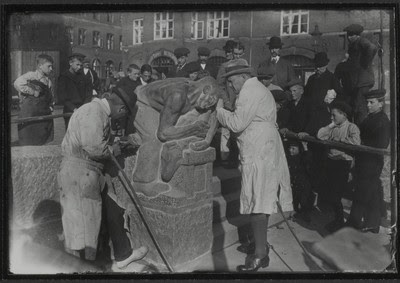
Kai Nielsen during the work on the decoration of Blågårds Plads
Undated 
© Holger Damgaard

Kai Nielsen
Kai Nielsen 
The Water Mother. Designed 1918-20. Chopped 2003-04 
The Glyptoteket © Anders Sune Berg

The Glyptotek presents Kai Nielsen – Born of Everyday Life. The exhibition has been devised in close collaboration with Faaborg Museum, which presents a parallel exhibition with the same title at the same time*.

If you have visited the Glyptotek in Copenhagen, you have probably already met "The Water Mother", who welcomes visitors to the Glyptotek from her pool in the Winter Garden. Maybe you have also seen Kai Nielsen’s sculptures of working people on Blågårds Square in Copenhagen, but without knowing they were by him.

Many people in Denmark even own their own little Kai Nielsen statuette. Kai Nielsen called his statuettes “hand-sized”. Designed for Bing & Grøndahl, Kähler and Dansk Kunsthandel, they ended up in countless Danish homes. Under #migogkai, owners of Kai Nielsen statuettes can share a photo and their story about the statuette, thereby becoming part of the exhibition.

Kai Nielsen - Muscle men, mythology and motherhood
Kai Nielsen (1882 – 1924) was fascinated by the human body. His themes included both strong male bodies with the ideal physique of antiquity as a role model – for example, in the monumental sculpture First Generation – and female figures inspired by ancient mythology like Aphrodite – for example in the sculpture "Aarhus Girl" or "Venus with the Apple". But he was also dedicated to everyday motifs: for example, "Girl Fiddling with Her Toes", statuettes of children, and busts of his family and of famous athletes, artists and art collectors of his day.

The Glyptotek and Kai Nielsen
Kai Nielsen’s endeavour to depict ‘what is natural’ and make his works accessible invests his art with a down-to-earth, popular quality. At the same time, his sculptures feature references to mythological and ancient stories. One of his most iconic works, "The Water Mother" (1921) – the landmark of the Glyptotek – was originally carved at the museum. Her story features in the exhibition, which will also introduce visitors to some of Kai Nielsen’s most well-known works.

Kai Nielsen attended the academy in Copenhagen and found inspiration at the Glyptotek, where he studied 19th-century French and Danish sculpture, and ancient Greek and Roman art. At an early stage in his career, he got in touch with the brewer Carl Jacobsen: maybe to inspire the patron of art to invest in his works. The Glyptotek has an extensive collection of Kai Nielsen’s sculptures and sketches, which are presented in the exhibition alongside loans from museums and private collections in Denmark and Norway.

Kai Nielsen
Kai Nielsen during work on a statuette
Undated 
The archive of the Glyptothek

Kai Nielsen
Kai Nielsen during work with Zeus and Io, 1916 
© Peter Elfelt

Kai Nielsen
Kai Nielsen
First generation, 1906
Plaster 
The Glyptoteket © Anders Sune Berg

Kai Nielsen
Kai Nielsen
Morning Toilet, 1918 
Faaborg Museum  © Andreas Bastiansen

Kai Nielsen - Studying the body
Kai Nielsen was born and raised in Svendborg. There was something both down-to-earth and lofty about Kai Nielsen. This was reflected in the quasi-mythological story of Kai the sculptor and human being, to which his family, friends and acquaintances all contributed. He possessed a sparkling sense of humour, great charisma, superhuman willpower and manic industriousness, despite his rather frail constitution and poor health.

“It takes a healthy body to make healthy art,” was one of the mottos of the artist from Funen. This was a conviction he took literally. Persistently, he modelled the human body, while training his own. He rowed, swam, boxed, rode, fenced and wrestled, and hiked in the mountains of Norway, the home country of his wife, the painter Yanna Lange Kielland Holm (1880-1932). He fought an eternal battle between health and illness and, after several years of illness and operations, died in 1924 at the early age of 41.

* In Faaborg Museum, the exhibition runs from 9 June 2024 to 5 January 2025.

Ny Carlsberg Glyptotek
Dantes Plads 7 • 1556 Copenhagen

Faaborg Museum
Gronnegade 75 • 5600 Faaborg

29/03/23

Jeppe Hein @ SMK - National Gallery of Denmark, Copenhagen - Under the Surface

Jeppe Hein: Under the Surface 
SMK - National Gallery of Denmark, Copenhagen
1 April – 22 October 2023

Jeppe Hein
Jeppe Hein painting his breath onto a wall 
Photo by Hendrik Hähner / Studio Jeppe Hein
Courtesy: Jeppe Hein

Jeppe Hein
Jeppe Hein
Breathe with Me at Moderna Museet, 2022 
Courtesy: KÖNIG GALERIE, Berlin, 303 GALLERY, New York, 
and Galleri Nicolai Wallner, Copenhagen 
Photo: Åsa Lundén

Jeppe Hein
Jeppe Hein
Breathe with Me at Moderna Museet, 2022 
Courtesy: KÖNIG GALERIE, Berlin, 303 GALLERY, New York, 
and Galleri Nicolai Wallner, Copenhagen 
Photo: Åsa Lundén

How are you today? How do you feel about the world around you? Can you let go of your thoughts and just be in the moment?

SMK Thy launches its new season presenting an exhibition created by the internationally renowned artist Jeppe Hein (b. 1974) who encourages the museum’s visitors to pause, open their minds, take a deep breath and notice how they feel.

Mingling humour and serious reflection, he invites you to enter a world with plenty of room for play, dialogue, creativity and contemplation. Here, visitors have the opportunity to put their personal stamp on the exhibition’s four interactive works, all of which rely on the guests’ participation to fully unfold.

“This is an invitation to activate your senses, to be inspired, to share your perspective, to open up your heart, to do something you are maybe not used to do, to step out of your comfort zone and to find out something about yourself that you were not aware of. What is under your surface? The answer is within you!” says Jeppe Hein.

Jeppe Hein
Jeppe Hein
Today I feel like … Right Here Right Now, 2022 
Courtesy KÖNIG GALERIE, Berlin, 303 GALLERY, New York, 
and Galleri Nicolai Wallner, Copenhagen 
Photo: WebStyleStory

Jeppe Hein
Jeppe Hein
Today I feel like … Right Here Right Now, 2022 
Courtesy KÖNIG GALERIE, Berlin, 303 GALLERY, New York, 
and Galleri Nicolai Wallner, Copenhagen 
Photo: WebStyleStory

On display in ‘Pakhuset’ at Doverodde Købmandsgård, the participatory works include Breathe with Me, which has been shown all over the world in places such as New York, Beijing and Stockholm.

Here, Jeppe Hein asks the guests to take a brush, dip it in blue paint and paint vertical brushstrokes on the wall in time with their exhale. During the exhibition period, a growing number of lines will appear, reflecting how we are all connected through our breathing and how we breathe the same air, regardless of where in the world we live.

In Today I feel like… visitors can pick up a piece of chalk from a local limestone quarry and use it to draw their current mood in one of the many circles marked out on the walls.

The museum also presents an all-new work created specifically for the exhibition in Thy. Here, Jeppe Hein collaborates with the photographer and local Thy resident Fredrik Clement, who has photographed the west coast of Thy with its crashing waves, surfers and sand. Under the Surface features five of these photographs, displayed on a grand scale. Using brush and paint, Jeppe Hein has added new details and layers to the scenes, and visitors are invited to do the same on smaller posters.

Jeppe Hein
Jeppe Hein, 2022. 
Photo: Jan Strempel Photography

JEPPE HEIN (b. 1974) is a graduate from the Royal Danish Academy of Fine Arts and the Städelschule – Staatliche Hochschule für Bildende Künste in Frankfurt. He is particularly known for his interactive works, where he makes use of surprising and captivating elements that place the audience at the centre of events and focus on their perception of the surrounding space.

Jeppe Hein has exhibited all over the world, including at the Moderna Museet, Stockholm, Rockefeller Center, New York City, 21st Century Museum of Contemporary Art, Kanazawa and Centre Georges Pompidou, Paris. Permanent installations by Jeppe Hein can be found at ARKEN, Ishøj, La Guardia Airport, New York, and the Rijksmuseum, Amsterdam, among others.

SMK - STATENS MUSEUM FOR KUNST
NATIONAL GALLERY OF DENMARK
Sølvgade 48-50 - 1307 Copenhagen

27/11/22

Anton Funck, Ellen Siebers, Muzae Sesay @ pt. 2 Gallery, Oakland

Anton Funck, Ellen Siebers, Muzae Sesay
pt. 2 Gallery, Oakland
November 12 - December 16, 2022

pt. 2 Gallery presents a group exhibition featuring work by Anton Funck, Ellen Siebers and Muzae Sesay. Though disparate in technique and resulting outcome, the trio of artists each create works that touch on themes of landscape, our built environment and a fascination with the natural world, all the while sharing in the pleasures of materiality and the act of painting itself.

Based in Copenhagen, Danish artist ANTON FUNCK builds dense compositions of hatched lines, dots and negative space to create metaphysical otherworldly landscapes. Through the humble means of watercolor on heavyweight paper, Anton Funck creates undulating fields of color that upon closer inspection reveal densely repeated strokes of slight variations on a given hue. The minute scale and intricacy of Anton Funck’s mark making lends the compositions a sense of vastness, as if we the viewer are looking upon an unfolding landscape, horizons, seas and celestial bodies all intimated through subtle shifts in color and line direction. With titles such as Hiding and A Shimmering Moment of Sorrow, the artist’s suggested landscapes are never overtly defined, the paintings instead reveling in their own complex ambiguity.

Hudson, New York based painter ELLEN SIEBERS creates intimately scaled paintings that encase a series of worlds within. Presenting a range of square paintings on panel, each piece no longer than a foot on either side, Ellen Siebers weaves dreamlike brushy compositions that oscillate between landscape and abstraction, each interspersed with a hovering crop of a contrasting image. Within Lemons in September, deep fields of rich black are interspersed by scuttling brushstrokes in red, viridian and umber earth tones, all immediately cut through by a small rectangular crop of a bowl of lemons painted in heavily contrasting warm ochres and yellows–a break of light hovering above the dark background. The effect is one of visual and conceptual intrigue as our eyes bounce back and forth, questioning the relation of the layered images. The paintings feel equally reverent to a history of painting and our digital contemporary and the prevalence of the screen within a screen experience. 

Oakland-based painter MUZAE SESAY’s latest works continue the artist’s exploration of how we negotiate space and architecture through a unique hybrid of drawing and painting, simultaneously touching on the oddities within our built environment and the joy of art making in all its inherent materiality. Within House of Flags, a moody composition realized with a pared-down palette of mustard yellow, black and white, Sesay creates a spindly structure composed of thin black verticals, bisecting diagonals and sagging connections, each carrying a series of small triangular flags. The tent-like structure, contrasted by a brushy yellow background painted directly over the dark black creates an elegant push pull of foreground and background, a thin white crescent moon and a white rectangle break up the space. Yet the structure sits eerily vacant, suggesting a circus tent completely devoid of the accompanying jovial atmosphere one might assume. Muzae Sesay’s other work, Two 5G Radio Towers, sees a pair of vertical structures verging on naturalistic, tapering trunks and palm like leaves, each broadcasting a radiating waveform realized in a dark colored pencil over a dirty tan background, a vertical bar of deep mahogany running up the left of the canvas. Sesay extracts a poetic beauty from utilitarian structures while also hinting at the uncanny strangeness in the convergence of natural and technological worlds. 

Written by Nick Makanna

pt. 2 Gallery
1523b Webster Street, Oakland, CA 94612
______________


24/05/21

Elisabeth Jerichau-Baumann @ ARoS Aarhus Kunstmuseum - Between Worlds

Elisabeth Jerichau-Baumann 
Between Worlds 
ARoS Aarhus Kunstmuseum 
Through 12 september 2021 

Elisabeth Jerichau-Baumann
ELISABETH JERICHAU-BAUMAN
En såret dansk kriger, 1865
Statens Museum for Kunst

Elisabeth Jerichau-Baumann
ELISABETH JERICHAU-BAUMAN
En egyptisk fellahkvinde med sit barn, 1872
Statens Museum for Kunst

The exhibition showcases about 100 paintings by the Danish-Polish artist ELISABETH JERICHAU-BAUMAN (1818–1881), representing a different and lesser-known side of the 19th-century Danish art scene.
- It has long been a desire of ours to set up an exhibition devoted to Elisabeth Jerichau-Baumann at ARoS, and we are now proud to announce the most extensive presentation of her works to date. She was a unique voice in 19th-century Denmark and a forceful woman who, throughout her career, fought for her own personal emancipation – both as an artist and as an individual. Now we are giving her the place she deserves, says Erlend G. Høyersten, museum director, ARoS.
A NEW LOOK AT THE DANISH GOLDEN AGE

In the middle of the 19th century it was artists such as C.W. Eckersberg and a number of leading art historians who wrote the history of the Danish Golden Age. The period after the First Schleswig War was marked by strong national feeling, and the Danish art scene was dominated by subject matter dealing with the Danish people, the Danish landscape and the national past. This was the reality that Elisabeth Jerichau-Baumann experienced when she came to Denmark in 1849. Because of her background at the art academy in Düsseldorf, she was mistaken for a German on her arrival, which in those years, from a pro-Danish point of view, was practically the worst kind of category to be placed in.
– Jerichau-Baumann is a cosmopolitan when compared to Danish artistic life in general. In Jerichau-Baumann's paintings we see drama and emotion, which runs contrary to the work of contemporary Danish Golden Age painters. The same is true of her use of colour. Jerichau-Baumann works within a range of brownish shades that are characteristic of the contemporary Central European trend, as opposed to the Danish use of colour, which is light and blond. She arrives in a Denmark strongly marked by nationalism, and here, because of her international style, she hits a brick wall, says Jakob Vengberg Sevel, curator, ARoS.
ELISABETH JERICHAU-BAUMAN

Elisabeth Jerichau-Baumann was born in 1818 in Warsaw to a Polish mother and a German father. She trained at the Academy of Fine Arts in Düsseldorf (1838 to 1844) after which she travelled to Rome where she met the Danish artist Jens Adolf Jerichau. They married and subsequently moved to Denmark, where they had nine children. In the period 1858 to 1871 Jerichau-Baumann travelled back and forth between Copenhagen and London where, for example, she did work for the British royal family. From 1869 to 1870 she made her first long voyage to the Orient (the Middle East and North Africa), and her travels became a way of discovering the world and promoting herself. Thanks to her foreign contacts and European perspective, Jerichau-Baumann was one of the very few Danish painters to portray the Orient and, as a woman, she was given exceptional access to harems which she could thus reproduce from her own observations. In addition, she was a very successful portrait painter of the aristocracy. Stylistically, she was oriented towards Europe and represented the European trends which, at the time, were thin on the ground in the Danish art world.

Curator-in-charge: Jakob Vengberg Sevel, curator, ARoS.

ARoS AARHUS KUNSTMUSEUM
Aros Allé 2, 8000 Aarhus C

06/05/06

Peter Land, Galleri Nicolai Wallner, Copenhagen - The First Day at School

Peter Land: The First Day at School
Galleri Nicolai Wallner, Copenhagen
May 5 - June 17 2006

Galleri Nicolai Wallner presents the exhibition "The First Day at School" with new drawings by the Danish artist PETER LAND.

Peter Land, internationally recognized for his important video works from the early the nineties, has recently worked with large scale sculptures, drawings and watercolors. Artistically Land takes as starting point the artist's body and mind, revealing a vulnerable reflexion of the self and alienation. In his works he centers on fundamental feeling of being different and alone, using humor to draw attention to these serious problems of the modern human existence.

The exhibition "The First Day at School" consists of a series of ten drawings with awkward and gawky children. The drawings present well-known figures; a boy with braces on his teeth, a child with snotty nose and a nervous squint-eyed girl. The works evoke memories of traumatic experiences from the schoolyard. Most people recognize the feeling of sometimes being insecure and maladjusted, but for these children it's a more or less a permanent state of mind.

Though on the surface grotesque or humorous, Peter Land's work contain a melancholic pondering over basic existence. Rather than functioning as caricatures the drawings invoke a great deal of empathy for the children.

"At the Lake" is a large-scale black and white watercolour, which presents a boy sitting at the shore of a small forest lake. At the other shore a strange human figure, with almost dissolved outlines, is situated. The two are spatially divided by the lake, but might also represent different stages in life. The work explores the forming of identity and consciousness in adolescence. The lake acts both as a reflection pool and a metaphor for the unknown.

Last year Peter Land was one of the five artists who were chosen to represent Denmark at the Venice Biennale. Land has exhibited widely at galleries and museums in Europe. He has had solo shows at various prestigious institutions including Fundación Miró (Barcelona), Musée d'art moderne et contemporain (Genève) and The National Gallery of Denmark (Copenhagen). In June he will present a new installation project at Art Unlimited, Art Basel.

GALLERI NICOLAI WALLNER
Ny Carlsberg Vej 68, 1760 Copenhagen

25/03/00

Joachim Koester, Galeri Nicolai Wallner, Copenhagen - Row Housing

Joachim Koester: Row Housing
Galeri Nicolai Wallner, Copenhagen
March 24 - May 6, 2000

Galeri Nicolai Wallner presents an exhibition with new works of Joachim Koester.

In the main gallery: The 30 photographs that makes up Row Housing is an attempt to narrate a specific space and it's history while at the same time pointing to the boundary of the photographic image. The location is Resolute on Cornwallis Island in the far north of Arctic Canada. An area made famous through Sir John Franklin's disastrous attempt to find the Northwest Passage in 1843. With images of Franklin's winter camp, abandoned military stations from the cold war, and the only building completed as part of the Swedish architect Ralph Erskine's model town, the photographs from Row Housing aim at capturing the ghost frames resonating in and around the town of Resolute. The images depict the area suspended between visible and invisible traces of history, and the newly gained independence as part of the Inuit state Nunavut in 1999.

In the back gallery: Four photographs from Greenland as a part of the larger work Nordenskiold and the ice cap. An installation about the explorer Nordenskiold's and his expedition to the Greenlandic ice cap in 1870.

GALERI NICOLAI WALLNER
Njalsgade 21, Building 15, 2300 Copenhagen