Showing posts with label portrait photography. Show all posts

17/04/24

Sculptor Kai Nielsen @ Glyptotek, Copenhagen + Faaborg Museum – "Born of Everyday Life" Exhibition

Kai NielsenBorn of Everyday Life
Glyptotek, Copenhagen
30 May 2024 - 5 January 2025

Kai Nielsen
Portrait of Kai Nielsen
Undated 
Glyptotek's archive © Ida & Gustav Krog
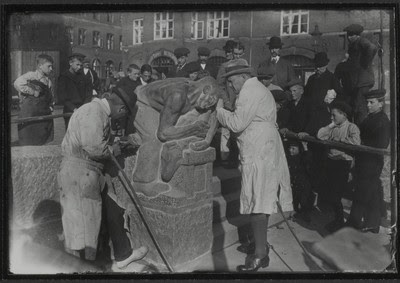
Kai Nielsen
Kai Nielsen during the work on the decoration of Blågårds Plads
Undated 
© Holger Damgaard

Kai Nielsen
Kai Nielsen 
The Water Mother. Designed 1918-20. Chopped 2003-04 
The Glyptoteket © Anders Sune Berg

The Glyptotek presents Kai Nielsen – Born of Everyday Life. The exhibition has been devised in close collaboration with Faaborg Museum, which presents a parallel exhibition with the same title at the same time*.

If you have visited the Glyptotek in Copenhagen, you have probably already met "The Water Mother", who welcomes visitors to the Glyptotek from her pool in the Winter Garden. Maybe you have also seen Kai Nielsen’s sculptures of working people on Blågårds Square in Copenhagen, but without knowing they were by him.

Many people in Denmark even own their own little Kai Nielsen statuette. Kai Nielsen called his statuettes “hand-sized”. Designed for Bing & Grøndahl, Kähler and Dansk Kunsthandel, they ended up in countless Danish homes. Under #migogkai, owners of Kai Nielsen statuettes can share a photo and their story about the statuette, thereby becoming part of the exhibition.

Kai Nielsen - Muscle men, mythology and motherhood
Kai Nielsen (1882 – 1924) was fascinated by the human body. His themes included both strong male bodies with the ideal physique of antiquity as a role model – for example, in the monumental sculpture First Generation – and female figures inspired by ancient mythology like Aphrodite – for example in the sculpture "Aarhus Girl" or "Venus with the Apple". But he was also dedicated to everyday motifs: for example, "Girl Fiddling with Her Toes", statuettes of children, and busts of his family and of famous athletes, artists and art collectors of his day.

The Glyptotek and Kai Nielsen
Kai Nielsen’s endeavour to depict ‘what is natural’ and make his works accessible invests his art with a down-to-earth, popular quality. At the same time, his sculptures feature references to mythological and ancient stories. One of his most iconic works, "The Water Mother" (1921) – the landmark of the Glyptotek – was originally carved at the museum. Her story features in the exhibition, which will also introduce visitors to some of Kai Nielsen’s most well-known works.

Kai Nielsen attended the academy in Copenhagen and found inspiration at the Glyptotek, where he studied 19th-century French and Danish sculpture, and ancient Greek and Roman art. At an early stage in his career, he got in touch with the brewer Carl Jacobsen: maybe to inspire the patron of art to invest in his works. The Glyptotek has an extensive collection of Kai Nielsen’s sculptures and sketches, which are presented in the exhibition alongside loans from museums and private collections in Denmark and Norway.

Kai Nielsen
Kai Nielsen during work on a statuette
Undated 
The archive of the Glyptothek

Kai Nielsen
Kai Nielsen during work with Zeus and Io, 1916 
© Peter Elfelt

Kai Nielsen
Kai Nielsen
First generation, 1906
Plaster 
The Glyptoteket © Anders Sune Berg

Kai Nielsen
Kai Nielsen
Morning Toilet, 1918 
Faaborg Museum  © Andreas Bastiansen

Kai Nielsen - Studying the body
Kai Nielsen was born and raised in Svendborg. There was something both down-to-earth and lofty about Kai Nielsen. This was reflected in the quasi-mythological story of Kai the sculptor and human being, to which his family, friends and acquaintances all contributed. He possessed a sparkling sense of humour, great charisma, superhuman willpower and manic industriousness, despite his rather frail constitution and poor health.

“It takes a healthy body to make healthy art,” was one of the mottos of the artist from Funen. This was a conviction he took literally. Persistently, he modelled the human body, while training his own. He rowed, swam, boxed, rode, fenced and wrestled, and hiked in the mountains of Norway, the home country of his wife, the painter Yanna Lange Kielland Holm (1880-1932). He fought an eternal battle between health and illness and, after several years of illness and operations, died in 1924 at the early age of 41.

* In Faaborg Museum, the exhibition runs from 9 June 2024 to 5 January 2025.

Ny Carlsberg Glyptotek
Dantes Plads 7 • 1556 Copenhagen

Faaborg Museum
Gronnegade 75 • 5600 Faaborg

11/11/22

Markus Copper Retrospective @ Kiasma, Helsinki - The Taste of Metal

Markus Copper The Taste of Metal
Museum of Contemporary Art Kiasma, Helsinki
11 November 2022 – 26 February 2023

Markus Copper
Markus Copper
Juggernaut, 1992-95
Photo: Finnish National Gallery / Petri Virtanen

Markus Copper
Markus Copper
Archangel of Seven Seas, sketch, 1996
Photo: Finnish National Gallery / Petri Virtanen

Markus Copper
Markus Copper 2009
Photo: Finnish National Gallery / Petri Virtanen

The visual artist MARKUS COPPER (1968–2019) is known for his sculptures that take over the surrounding space. The sounds, mechanical movements and lights reverberating in viewers’ bodies spark their attention. The retrospective at Museum of Contemporary Art Kiasma showcases Markus Copper’s exceptional art and his worldview with a selection of work of unprecedented variety and depth. Diving into the culture of collective trauma and the human tragedies of our time, the exhibition comprises works that were completed between 1991 and 2018.

MARKUS COPPER: METAPHORS AND SENS OF DANGER

The Taste of Metal exhibition takes a deep dive into the collective trauma culture and human tragedies of our time. The large­scale Estonia (2006) and Kursk (2004) capture the communal fear and anxiety induced by the sinking of the car ferry Estonia and the submarine Kursk. Whaling Station (2009), constructed from external ribs sown together out of leather jackets and a rowing boat, is in turn doomed to repeat a ritual portrayal of the flensing of a whale. 

Markus Copper
Markus Copper
Kursk, drawing
Photo: Finnish National Gallery / Hannu Karjalainen

Markus Copper
Markus Copper
Kursk, 2004
Photo: Finnish National Gallery / Petri Virtanen

Markus Copper
Markus Copper
Kursk, 2004
Photo: Finnish National Gallery / Petri Virtanen

Markus Copper
Markus Copper
Estonia, 2006
Finnish National Gallery / Kiasma
Photo: Finnish National Gallery / Petri Virtanen

Markus Copper
Markus Copper
Whaling Station, 2009
Photo: Finnish National Gallery / Petri Virtanen
“Markus Copper wanted his dramatic sculptures to highlight the forces that govern life, the constant tension between destruction and creativity, the fact that art can explore the darkest aspects of life and society on a symbolic level. The sense of threat in his works evokes turning points, the fragility of life, fractures and transience. The power of the works lies in their ability to open themselves up, through the mythical figures that the artist has created, to the sore points of our own time. They create room to think and to experience the meaning dimensions of human existence,” says Leevi Haapala
Especially in the early stages of his career, Markus Copper sought to impart a sense of threat to his work, and some of his early pieces even involved a dimension of actual danger. A case in point is Sixpack of Instant Death (1995), which consisted of six sculptural objects that Markus Copper gave to his friends. The objects were designed to explode when linked together. In 2020, the police tracked down the work’s missing components, which have since been rendered harmless. 

Markus Copper
Markus Copper
Sixpack of Instant Death, 1995
Photo: Finnish National Gallery / Petri Virtanen

MARKUS COPPER: ICONIC PIECES AND UNKNOWN WORKS

The exhibition also includes Markus Copper’s best-known work, a whale sculpture entitled Archangel of Seven Seas (1998). Part of the Kiasma collection today, the iconic piece is one of the museum’s most cherished artworks. A key component of the work is a set of organ pipes from the church of Kotka that play a low, rumbling “whale song”. 

Markus Copper
Markus Copper
Archangel of Seven Seas, 1998
Photo: Finnish National Gallery / Petri Virtanen

Markus Copper
Markus Copper
Archangel of Seven Seas, 1998
Photo: Finnish National Gallery / Petri Virtanen

Markus Copper
Markus Copper
Archangel of Seven Seas, 1998
Photo: Finnish National Gallery / Petri Virtanen

Many of Markus Copper’s works have been dismantled or lost. They are presented in the exhibition in the form of drawings, sketches and documentary material. With the help of the artist’s family and friends, Kiasma has succeeded in recovering and partly conserving several works, including the sculptures Whaling Station (2009), South Pacific Execution (2007) and The Khyber Pass (2014). These are all now accessioned to the collection of the Finnish National Gallery.

Markus Copper
Markus Copper
Iron Maiden, Bourgeois Door, 2006
Photo: Finnish National Gallery / Petri Virtanen

Markus Copper
Markus Copper
Khyber Pass, 2014
Photo: Finnish National Gallery / Petri Virtanen

Markus Copper was also a prolific and skilful draughtsman. The show includes several of his drawings from various museum collections, including his last suite, Roadside Picnic (2018), which is part of the Kiasma collection. Also included in the show are rarely screened video documentaries about the artist from the 1990s.

The exhibition is curated by museum director Leevi Haapala and curator Jari-Pekka Vanhala from Kiasma. The exhibition is accompanied by the publication of a lavishly illustrated book on Markus Copper’s art, produced in collaboration with Parvs Publishing Company. The book offers fresh perspectives on the artist’s work by several authors. 

Museum of Contemporary Art KIASMA
Mannerheiminaukio 2, 00100 Helsinki

22/05/11

Ancienne Photo : Portrait, Argentine, 1911

Anciennes photographies : Portrait, Argentine, circa 1911 
Vintage photograph from Argentina, c. 1911


La photographie montée sur carton dont les photos ci-dessous présentent les détails 

Comme j'ai déjà eu l'occasion de le faire sur ce blog, je vous présente ici une ancienne photographie de ma collection. Il s'agit du portrait d'un homme dont le nom est inscrit en manuscrit au dos de la photo mais que je ne parviens pas à "déchiffrée". Cet homme l'a envoyé à un ami en 1911 (manuscrit au verso - la photo peut être antérieure). Cette photo n'a pas vraiment de valeur en soi mais c'est une belle photo réalisée en studio par un photographe P. Ferrari (ou Jerrari ?), de Vera, ville située dans la province de Santa Fe, en Argentine. Etant donné que pas mal de photos anciennes sont aujourd'hui mises en ligne sur internet, j'ai tenté de trouver des infos sur le photographe ou d'autres photos prises par lui. Mais je n'ai rien trouvé (j'ai bien sûr regardé sur les sites argentins). Il faut dire que le nom ne facilite pas les recherches ;) La photographie est montée sur carton avec un ornement en relief couleur argenté.

Détail du portrait

Signature du photographe

Adresse du photographe

Blason de Vera (à vérifier)

Ornement en relief. Treifle à quatre feuilles ?

Détail du col de la chemise avec le noeud que porte l'homme
Je sais qu'il s'agit d'un noeud courant mais je n'en connais pas le nom : merci de laisser l'info en commentaire pour compléter :)

(c) 2011 Wanafoto Blogzine

02/04/09

Hollywood Portraits by Alan Wallace

Photo © Alan Wallace, All rights reserved
Alan Wallace capturing portraits inspired by Hollywood actors. Very nice B&W pictures!
Publish Date: April 1, 2009
Dimensions: Standard Landscape - 40 pgs Softcover: $19.95 Hardcover, Dust Jacket: $29.95 Hardcover, ImageWrap: $31.95
http://www.blurb.com/

06/01/09

Lighting Techniques for Middle Key Portrait Photography

(c) Norman Phillips/Amherst Media - All rights reserved
Learn To Avoid Common Problems And Create Portraits With Greater Visual Impact
Norman Phillips, author of Lighting Techniques for High Key Portrait Photography and Lighting Techniques for Low Key Portrait Photography, examines a much over-looked area of photography: the middle key. As Phillips shows, the fact that many photographers ignore middle key as a way of structuring their images results in portraits that may be cluttered or be visually confusing because elements of the scene, subject, clothing, props, and lighting are actually at odds with each other. By approaching these images with the concept of middle key in mind, it becomes much easier to avoid common errors and produce images with greater impact. While photographers are generally familiar with high-key images (photographs with primarily very light tones paired with soft lighting) and low-key images (photographs with primarily dark tones paired with dramatic lighting), the concept of middle key (everything in between) is one that is often overlooked. This is surprising, since this is the key in which the vast majority of images are produced. Lighting Techniques for Middle Key Portrait Photography is now available.
As Norman Phillips shows, by approaching these images with the concept of middle key in mind, it becomes much easier to avoid common lighting errors and produce images with greater impact. These errors occur because photographers often decide to create a portrait that is not high key and not low key. This approach fails to provide sufficient structure because it does not precisely define the objectives of the shoot. As a result, the portraits produced may look cluttered or be visually confusing because elements of the scene, subject, clothing, props, and lighting are actually at odds with each other. By consciously deciding to create a middle key portrait, on the other hand, photographers can help to avoid arbitrary decisions and begin more precisely selecting the kinds of colors and tones that will produce visual harmony and an overall more pleasing appearance in their portraits. They also have a starting point for devising a lighting setup that will harmonize well with all of the other elements in the image, drawing the viewer to just those areas of the scene or subject that the photographer intends to emphasize. Finally, they can implement all of these techniques that communicate the emotional impact they envision.
"Packed with images and diagrams from over a dozen acclaimed photographers", this book shows exactly how effective such a studied approach can be and provides the step-by-step explanations that enable readers to achieve similar results in their own work.
About the author
Norman Phillips is a master photographer who is the recipient of more than 150 awards, including the Accolade of Outstanding Photographic Excellence in Recognition of Contribution to the Industry. He has hosted many seminars, sponsored by corporations like Pentax Corporation, Eastman Kodak and Burrell Colour, Inc. Phillips is also a regular contributor to industry publications including Rangefinder magazine and the Wedding and Portrait Photographers International monthly newsletter.
http://www.amherstmedia.com/
Click Here To Look Inside This Book With Google Book Search Photo of Norman Philipps - Copyrighted - All rights reserved

21/08/04

Maternity Photography by LauryL

(c) LaurieL - All rights reserved
LaurieL Fine Art Photography is making pregnant women realize how incredibly beautiful they really are... and her photographs prove it
Take a glance through her on line gallery, and you will see just how beautifully her photography deplicts the splendor of a woman with child. The images range from sensous to serene... from fun to fantastic... to ultimately... treasured pieces of fine art.
"I love the glow that comes from a woman who is happily expecting a child. I want to capture her beauty...the curves of her body, created by the new life it carries. I want to capture that time... I want her to remember how beautiful she was. It's like the weeks before Christmas for a young child... the anticipation, the excitement... the love for what is about to happen. That's what I strive to capture..that's what I love... that's what I do."
In addition to maternity photography, LaurieL also captures tender moments of children and families. She has created a line of custom birth announcements that carry over her photographic style of clean line, black & white photography. Custom Holiday cards and Graphic Design services are also available.
Featuring all digital equipment, including a digital darkroom, final photographs are enhanced for flawless beauty.
Each portrait is a piece of fine art, carefully worked to create stunning, heirloom images. For maternity, and upon request, unwanted stretch marks or veins are removed. Hips, thighs and arms are contoured, so that any unflattering weight gain that may have occurred during pregnancy is minimized. The final images are stunning, and have awarded Laurie top recognition amongst her peers and the photographic world.
You can visit her gallery at http://www.laurielphotography.com/

15/02/03

Ingar Krauss, Marvelli Gallery, New York - The Cat's Eye

Ingar Krauss: The Cat's Eye
Marvelli Gallery, New York
February 13 - March 22, 2003

Marvelli Gallery presents The Cat's Eye, the first New York exhibition of German photographer Ingar Krauss. In this show, he presents a series of b&w photographs portraying peculiar girls and boys moving in the fragile space between reality and dream, childhood and adulthood, the inner and the outer world.

With sensitivity and intuition, Ingar Krauss creates portraits of children suspended between sadness and sensuality, vulnerability and mystery. The images of these uncanny children are charged with psychological intensity. Choosing children who grew up in marginal areas, far from homogenizing metropolitan contexts, Ingar Krauss focuses on their psychological features: absorbed in themselves, melancholically dreaming, tentatively sensual, naturally serious and sad. These children's psychological poignancy is almost a challenge to the viewer. The carefully chosen backgrounds enhance the complexity of these portraits: from floral wallpaper to dry institutional settings, from mysterious rooms to moody outdoor environments. In these formally striking pictures, Ingar Krauss carefully modulates light and composition in order to achieve a balance between subject and surroundings.

A self-taught photographer, Ingar Krauss has only recently started to exhibit his photographs, gaining immediate recognition. His work has been exhibited in Berlin, at the National Portrait Gallery in London and at Kunsthalles in Erfurt and Speyer, Germany.

MARVELLI GALLERY
526 West 26th Street, New York, NY 10001
www.marvelligallery.com 

31/03/98

Portraits of 110 Gay and Lesbian Writers Photographs from Robert Giard' s Particular Voices on View at The New York Public Library

Since the mid-1980s, photographer Robert Giard has traveled the United States photographing contemporary American gay and lesbian literary figures for his ongoing portrait series, Particular Voices. Beginning April 18, The New York Public Library - the largest institutional collector of Mr. Giard's photographs - will exhibit 110 portraits from this series in "Particular Voices": Robert Giard's Portraits of Gay and Lesbian Writers. The Library holds more than 150 of Giard's exquisite black-and-white prints in its Miriam and Ira D. Wallach Division of Art, Prints and Photographs.
The exhibition also features pioneering published works and selected manuscript materials from the Library's extensive and growing archival holdings representing gay and lesbian American literary figures.
Since Robert Giard's first portrait for Particular Voices, a 1985 photograph of playwright William Hoffman on display in the exhibition, the project has blossomed to include more than 500 works. Mr. Giard conceived of Particular Voices as a personal testament to the role that writing by gay men and lesbians, and by extension, its purveyors, archivists, and historians, has played in his life. He said, "I am delighted to have this first big exhibition at the Library because I haunted public libraries as a child. I worked my way through college and graduate school as a library assistant. Furthermore, my work is about books, authors, and keepers of Culture and history."
In 1997, MIT Press published Giard's book, Particular Voices: Portraits of Gay and Lesbian Writers, an anthology of his portraits coupled with sample writings by the people pictured, as well as essays by Joan Nestle, Christopher Bram, and the photographer. The forward is by Julia VanHaaften, curator of the Photography Collection at The New York Public Library's Center for the Humanities, who also curated the exhibition.
Robert Giard's Work
Giard's work takes him into his subjects' homes or workspaces and displays a gamut of backgrounds, poses, and aesthetics. Luis Alarcon is shown with his Frieda Kahlo collection. Allen Ginsberg is pictured holding his own portrait of William Burroughs. Maria Irene Fornes is holding a stage set model. Tony Kushner is reclining on silk souvenir pillow, portraying Karl Marx. May Sarton is pictured in her charming New England sitting room aflood with sunlight. Joan Nestle, co-founder of the Lesbian Herstory Archives, is pictured holding a plaster sculpture of two faces nestling. Some of the other writers featured in the exhibition include Edward Albee, Dorothy Allison, Rafael Campo, Blanche Wiesen Cook, Samuel R. Delany, Kenward Elmslie, Lillian Faderman, Allan Gurganus, Doris Grumbach, Essex Hemphill, Audre Lord, Tim Miller, Kate Millett, Adrienne Rich, Barbara Smith, Edmund White, and Jonathan Williams.
Robert Giard's photographs have been previously displayed in several exhibitions, including those at the San Francisco Public Library, the Lesbian & Gay Community Center in New York City, the East Hampton Center for Contemporary Art, and in galleries at State University of New York campuses at Albany, Oswego, and Stony Brook.
Julia VanHaaften said, "Bob's work is particularly significant because he is continuing a grand tradition of photographing authors. His work complements the Library's collection of cultural portraits by Carl Van Vechten from the 1930s and 1940s."
"Particular Voices": Robert Giard's Portraits of Gay and Lesbian Writers opens April 18 and continues through June 27, 1998, in the Third Floor Print and Stokes Galleries of the Center for the Humanties at Fifth Avenue and 42nd Street.
Companion Volume for Sale in The Library Shops Robert Giard's Particular Voices: Portraits of Gay and Lesbian Writers (MIT Press, 1997) is available in The Library Shops for $45 ($40.50 for Friends of the Library). The Library Shop at the Center for the Humanities (Fifth Avenue and 42nd Street) is open Monday­ Saturday, 11 a.m. ­6 p.m. The Library Shop in the Mid-Manhattan Library (Fifth Avenue and 40th Street) is open Monday­ Friday, 10 a.m.­ 7 p.m.; Saturday, 10 a.m.­ 6 p.m.; and Sunday, noon­ 5 p.m.
Exhibition hours are Monday, Thursday­, Saturday, 10 a.m.­ 6 p.m. Tuesday and Wednesday, 11 a.m.­ 7:30 p.m. Closed Sundays and, in observance of Memorial Day, Saturday, May 23 and Monday, May 25.
For information on current and upcoming exhibitions, programs, and services at The New York Public Library, visit the Library's website at www.nypl.org
Funding - This exhibition has been made possible by the continuing generosity of Miriam and Ira D. Wallach. Acquisition of "Particular Voices" has been made possible by gifts from the Daniele Agostino Foundation, Louis F. Arce, David P. Becker, William F. Burns, Dr. Herbert I. Cohen and Danny Cook, Dr. Nanette K. Gartrell, the Horace W. Goldsmith Foundation, Michael Hampton and George Stambolian, Deborah Ann Light, Joyce and Robert Menschel, Dr. Diane Mosbacher, Michael Piore, the Posner-Wallace Foundation, the Miriam & Ira D. Wallach Fund, and an anonymous donor.