Showing posts with label Copenhagen. Show all posts

07/06/25

Michelangelo Imperfect @ National Gallery of Denmark, SMK, Copenhagen

Michelangelo Imperfect
National Gallery of Denmark, SMK, Copenhagen
Through 31 August, 2025

Michelangelo Sculpture
Facsimile after Michelangelo Buonarroti
Active Life (Leah). Original 1542–44,
facsimile 2024–25
The Royal Cast Collection, SMK – 
National Gallery of Denmark. Photo: SMK

Michelangelo Sculpture
Facsimile after Michelangelo Buonarroti 
Genius of Victory Original c. 1519-26, 
facsimile 2024-25
The Royal Cast Collection, SMK –
National Gallery of Denmark. Photo: SMK

Michelangelo Sculpture
Plaster cast after Michelangelo Buonarroti
Bacchus. Original c. 1496-97, cast c. 1874-79
The Royal Cast Collection, SMK – 
National Gallery of Denmark. Photo: SMK

He painted the ceiling of the Sistine Chapel, designed the dome of St. Peter’s Basilica in Rome, and his sculptures are known worldwide. SMK presents the most comprehensive display of Michelangelo Buonarroti’s sculptural work seen in 150 years.

If one were to point to a single artist who has contributed fundamentally to the modern perception of art as self-expression in Western culture, it would be the Italian artist Michelangelo Buonarroti (1475–1564). His iconic statue David shows us why.

Viewed from the left, the almost five-metre-tall figure is a classically idealised, alert young man ready for battle – but when seen from the other side he changes expression, revealing doubt and hesitation. Michelangelo insisted on reflecting the often conflicted and contradictory inner lives of his figures. He was not the first to do so, but he did it with such consistency that it changed the course of art.

A bronze David and thirty-nine other sculptures reproduced after Michelangelo can be seen at the National Gallery of Denmark (SMK) in Copenhagen in the exhibition Michelangelo Imperfect. Not since the celebration of the 400th anniversary of Michelangelo’s birth in Florence in 1875 has so comprehensive a selection of the artist’s sculptural production been gathered in one place.

Michelangelo Sculpture
Plaster cast after Michelangelo Buonarroti 
Brutus. Original 1540 or 1548, cast 1897 
The Royal Cast Collection, SMK – 
National Gallery of Denmark. Photo: SMK

Michelangelo Sculpture
Plaster cast after Michelangelo Buonarroti
Day (Giorno). Original c. 1525-26, cast 1897
The Royal Cast Collection, SMK – 
National Gallery of Denmark Photo: SMK

Michelangelo David Sculpture
Plaster cast after Michelangelo Buonarroti 
Head of David. Original 1501-1504, cast 1890
The Royal Cast Collection, SMK – 
National Gallery of Denmark. Photo: SMK

Michelangelo’s focus was almost exclusively on the human body, especially the male form, in which he found endless scope for expressing thoughts, emotions and tensions. He invariably strove for greatness, reaching for the impossible. Already in his lifetime, he was described as ‘il divino’ – the divine. But his art also revolves around the imperfect, the unfinished and the fragile; around being in a state of becoming, anxious, wavering and hesitating. This is apparent in his biblical, mythological and allegorical subjects alike.

‘This is the impossible exhibition: You would never be able to gather Michelangelo’s original sculptures in one place. But with SMK’s collection of historical reproductions in plaster and newly produced facsimiles of the highest quality, we are able to present a perhaps imperfect, yet strikingly complete, overall account of a body of work that changed art forever and remains remarkably poignant today,’ says the exhibition’s curator, Matthias Wivel.

The basis for SMK’s exhibition is its exquisite collection of historical casts after Michelangelo sculptures in the Royal Cast Collection. Most of these were commissioned and cast in 1895–98 for the then-new National Gallery of Denmark (today SMK). Some were added in the twentieth- and early twenty-first century. The collection encompasses the majority of Michelangelo’s most famous sculptures.

Michelangelo Head of David Sculpture
Cast after Michelangelo Buonarroti
Head of David. Original c. 1501-04, cast 1890
Photo from the Royal Cast Collection, SMK – 
National Gallery of Denmark

Michelangelo Sculpture
Cast after Michelangelo Buonarroti
The Dying Prisoner. Original c. 1513-14, cast c. 1852–70
Photo from the Royal Cast Collection, SMK – 
National Gallery of Denmark

In order to get as close as possible to a complete presentation of the Renaissance master’s sculptures, SMK complements these historical plaster casts with newly commissioned and -produced 3D-modelled and cast sculptures – so-called facsimiles – produced in Madrid by Factum Foundation, world leaders in the production of facsimiles, reconstructions and rematerialisations of artworks.

This enables SMK to bring together under one roof reproductions of masterpieces that in the original are located in many different places and with only a few exceptions are never moved, either because they are too fragile to travel, too difficult to move, or, quite simply, too culturally significant. The exhibition also includes original sculptural models (maquettes), drawings, and letters from Michelangelo’s own hand.
‘This [is] a unique opportunity to experience Michelangelo’s sculptural art as a whole. At the same time, it offers a chance to reflect on the role played by reproduction and copying in art and in our understanding of art. Reproductions have always been part of the way we create and perceive art, but have been somewhat neglected in a museum context in recent times. We see great potential here,’ says the exhibition’s curator, Matthias Wivel.
In connection with the exhibition, SMK is publishing a comprehensive and richly illustrated catalogue that presents new research and unfolds themes from the exhibition – including an exploration of the relationship between original and copy, as well as a challenge to the distinction between the finished and the unfinished, the perfect and the imperfect.

NATIONAL GALLERY OF DENMARK
SMK - STATENS MUSEUM FOR KUNST
Sølvgade 48-50, 1307 Copenhagen

Related Posts:

Teylers Museum, Haarlem
15 October 2025 - 25 January 2026

ALBERTINA Museum, Vienna
15 September 2023 - 14 January 2024

13/03/25

Gauguin & Kihara @ Glyptotek, Copenhagen - "Gauguin & Kihara – First Impressions" Exhibition

Gauguin & Kihara – First Impressions
Ny Carlsberg Glyptotek, Copenhagen
8 May, 2025 - 6 December 2026

Paul Gauguin Painting
Paul Gauguin
Vahine no te Tiare. Woman with the Flower, 1891
MIN 1828 © Glyptoteket

Paul Gauguin Painting
Paul Gauguin
Arearea no Varua ino. The Amusement of the Evil Spirit, 1894
MIN 1832 © Glyptoteket

Throughout his career, Paul Gauguin pursued the ideal conditions for life as an artist. Yet wherever he went, reality seldom lived up to his expectations. When reality fell short, however, imagination was given free rein in his artistic worlds. This is the starting point for the Glyptotek’s upcoming collection presentation, Gauguin & Kihara – First Impressions, which also features an important new acquisition grappling explicitly with Gauguin’s work.
 
The Glyptotek holds one of the world’s finest collections of works by the French artist Paul Gauguin (1848–1903). In recent years, many of the museum’s 58 Gauguin pieces—including paintings, woodcarvings, drawings and ceramics—have been on loan to renowned museums across the globe. Now, they return home to be shown together in a presentation, opening on 8 May, offering new perspectives on Gauguin’s well-known works.
 
This spring, the Gauguin collection is joined by the Japanese-Sāmoan contemporary artist Yuki Kihara (b. 1975) and her video work First Impressions: Paul Gauguin, recently acquired by the museum. Together, their works open a dialogue across time, cultural divides and vast oceanic distances.

Paul Gauguin Painting of Brittany
Paul Gauguin
Landscape from Brittany with Breton Women, 1888 
MIN 1826 © Glyptoteket

Paul Gauguin Painting of Brittany
Paul Gauguin
Shepherdess from Brittany, 1889
MIN 1827 © Glyptoteket
 
Paul Gauguin: The eternal pursuit

Gauguin’s futile search for the ideal conditions for an artist’s life took him from Paris to Copenhagen, through Normandy, Brittany and Arles, and onwards to the then-French colonies of Martinique, Tahiti and the Marquesas Islands. When reality proved disappointing, he let his imagination run free, creating artistic worlds on his own terms. ‘Who cares about accuracy!!’ he declared. The Glyptotek delves not only into this artistic journey but also into the physical, political and historical contexts that shaped it, examining how Gauguin depicted the places and cultures he encountered along the way.

Paul Gauguin Painting
Paul Gauguin
Skaters in Frederiksberg Garden, 1884 
MIN 3213 © Glyptoteket
“Gauguin moved through the world in a way not unlike today’s tourists. Like the traveller who crops out souvenir stalls from their holiday photos and seeks out restaurants touted as “hidden gems” in various guidebooks, Gauguin pursued the idea of authenticity, often viewing his destinations through the lens of existing narratives and images. Having spent nearly a decade in the South Pacific, Gauguin may have lived too long in the region to be called a tourist, but this comparison opens a conversation in which Gauguin’s works are not solely a matter of his distinctive colours, uniform surfaces and bold contours. They also offer insight into the cultural, political and social contexts in which they were created, challenging us still today to reflect on our own time. Through what lens do we, as modern-day tourists and cultural consumers, view the world?” says Anna Kærsgaard Gregersen, curator of the French collection at the Glyptotek.
The collection presentation will be shown in the Henning Larsen building, which will, in coming years, house an extensive selection of the Glyptotek’s French collections. This initiative is part of the museum’s commitment to strengthening the presentation of French art and culture, its collection being among the most significant in the Nordic region.

Yuki Kihara: Striking new acquisition

Yuki Kihara
Yuki Kihara (b. 1975)
First Impressions Paul Gauguin, 2018 
© Courtesy of Yuki Kihara, 
the Fine Arts Museums of San Francisco,
the Ny Carlsberg Glyptotek, Copenhagen and Milford Galle

The Glyptotek has acquired a contemporary artwork that offers a modern interpretation of one of Western art history’s most iconic—and most controversial—artists. The new acquisition, and the museum’s first video work, First Impressions: Paul Gauguin (2018), is by the Japanese-Sāmoan contemporary artist Yuki Kihara.

The video work was co-commissioned by the Glyptotek and the Fine Arts Museums of San Francisco. It was previously shown as part of the Glyptotek’s special exhibition Paul Gauguin – Why Are You Angry? (2020), which later toured to Alte Nationalgalerie (2022). That same year, the work was included in the 59th Venice Biennale, where Kihara represented Aotearoa New Zealand. Now, the work returns to the Glyptotek as a newly conceived installation and permanent part of the museum’s collection.
“I remember thinking how strange it was to be in front of [Paul Gauguin’s] paintings, as if time and space had collapsed. Here we were as artists from two different parts of the world having a dialogue in two different moments in history,” says Yuki Kihara, reflecting on her first real encounter with Gauguin’s works.
Presented in the format of a talk show, the video work features a host and panel who are shown reproductions of Gauguin paintings from Tahiti (including two from the museum’s own collection), after which they share their first impressions. As the conversation unfolds, Gauguin fades into the background, giving way to the participants’ own perspectives and speculative stories about the paintings’ models.
 
Both Yuki Kihara and the talk show participants belong to the Fa’afafine and Fa’atama communities, the Sāmoan counterparts to Māhū, a Tahitian term referring to individuals endowed with spiritual gifts from more than one gender. In colonial times, the Māhū were banned by missionaries, but researchers believe that several of Gauguin’s figures may depict Māhū—a theory also discussed among the panel.
“With humour and gravity, Kihara directs the colonial gaze back towards the West, reclaiming her community’s power to shape their own narrative. This acquisition initiates vital conversations across time and place, holding the museum and Western art history accountable, and challenging us to acknowledge historical nuance and the contemporary voices traditionally excluded from discussions surrounding Gauguin’s complex oeuvre,” explains Anna Kærsgaard Gregersen.
YUKI KIHARA (b. 1975) is a Japanese-Sāmoan interdisciplinary artist based in Sāmoa. Her practice seeks to challenge one-sided historical narratives through performance, sculpture, video, photography and curatorial practice. With a particular focus on postcolonial narratives and representation in Oceania, she explores issues of race, gender, power and cultural appropriation. Yuki Kihara represented Aotearoa New Zealand at the 59th Venice Biennale (2022) with Paradise Camp, and she has been the subject of solo exhibitions worldwide, including at The Metropolitan Museum of Art, the Fine Arts Museums of San Francisco, Powerhouse Museum and the Sainsbury Centre. Her works are found in the collections of museums including the Museum of Modern Art, The Metropolitan Museum of Art, Los Angeles County Museum of Art, Kaohsiung Museum of Fine Arts, National Gallery of Australia and Te Papa Tongarewa Museum of New Zealand.

Ny Carlsberg Glyptotek
Dantes Plads 7 • 1556 Copenhagen

30/04/24

After the Sun—Forecasts from the North @ Buffalo AKG Art Museum + Gammel Strand, Copenhagen

After the Sun—Forecasts from the North
Buffalo AKG Art Museum
April 26 - August 19, 2024

The Buffalo AKG Art Museum presents After the Sun—Forecasts from the North, a new exhibition that surveys a generational response to the precarious state of our natural environment. Organized by Helga Christoffersen, Curator-at-Large and Curator of the Nordic Art & Culture Initiative at the Buffalo AKG, After the Sun is on view in the new Jeffrey E. Gundlach Building, after which it will travel to Gammel Strand in Copenhagen, Denmark.

Featuring the work of twenty artists with strong ties to Denmark, Finland, Iceland, Norway, and Sweden, After the Sun considers how emergencies at a Northern latitude reverberate globally. The exhibition presents new artistic engagements that build on the Nordic region’s tradition of depicting the natural world, and asks what art is generated in response to the intensifying global climate crisis.
“As the inaugural exhibition of the Nordic Art & Culture Initiative at the Buffalo AKG, After the Sun is a fitting example of the prescient, global projects that define the Buffalo AKG,” said Janne Sirén, Peggy Pierce Elvin Director. “The Nordic Art & Culture Initiative creates an unprecedented international platform for new art and pressing subject matter. We are honored to present After the Sun and to partner with Gammel Strand in Copenhagen to extend the exhibition’s reach across the Atlantic.”

Cathleen Chaffee, Charles Balbach Chief Curator, observed, “This remarkable exhibition envisions the scope of our vulnerability as a species, as we navigate an existence that is increasingly, consistently in extremis. Encompassing artists who approach the pressing subject of climate change from vastly different perspectives, it is a case study for the ways artists can help us see otherwise opaque aspects of life in a time of natural and manmade crises.”
The exhibition’s title is drawn from Danish writer Jonas Eika’s collection of short stories Efter Solen (After the Sun), winner of the Nordic Literature Prize in 2019. Eike has said that the book emerged from a sense of personal and political exhaustion, a feeling that he believes is shared by many: “That the way we imagine the future is mostly just a continuation of what there is today. The future, as a potential for change and a source of political energy, seems to be missing.” 

As Eika’s book addresses the profound challenge of responding to forces that pull us apart, the artists included in After the Sun grapple with how artistic practice may or may not succeed at meaningfully shaping the future world.

Occupying the entire first floor of the Buffalo AKG’s new Jeffrey E. Gundlach Building’s special exhibition galleries along with outdoor space on the museum campus, After the Sun presents artistic responses to the climate crisis that range from the analytical to the speculative, the poetic to the political. Some artists consider the repercussions of temporary solutions to climate change, among them Lea Porsager (born Frederikssund, Denmark, 1981, lives in Copenhagen, Denmark), in whose hands a sequence of massive disused windmill blade fragments become poignant ruins. Amitai Romm’s (born Jerusalem, 1985, lives in Copenhagen, Denmark) slight but throbbing sculptures and sound work are among several in the exhibition to approach science and data related to the environment from a visceral, embodied position. Olof Marsja’s (born Gällivare, Lapland, Sweden, 1986, lives in Gothenburg, Sweden) plant-human hybrid sculptures are contemporary guardian figures, related to indigenous knowledge and the artist’s own Sámi tradition. These, and all the artists in After the Sun explore what a meaningful engagement with nature might mean today and how we might forge practical, theoretical, and metaphysical paths forward.

Participating Artists

Sigurður Ámundason (b. 1986, Reykjavik, lives in Reykjavik, Iceland),  
Felipe de Ávila Franco (b. 1982, Belo Horizonte, Brazil, lives in Helsinki, Finland), 
Á. Birna Björnsdóttir (b. 1990, Reykjavik, lives in Amsterdam, The Netherlands), 
Ragna Bley (b. 1986, Uppsala, Sweden, lives in Oslo, Norway), 
Sara-Vide Ericson (b. 1983, Bollnäs, Sweden, lives in Älvkarhed, Sweden),  
Carola Grahn (b. 1982, Jåhkåmåhkke, Lapland, Sweden, lives in Malmö, Sweden), 
Alma Heikkilä (b. 1984, Pälkäne, Finland, lives in Helsinki, Finland),  
Jane Jin Kaisen (b. 1980, Jeju Island, South Korea, lives in Copenhagen, Denmark),  
Juha Pekka Matias Laakkonen (b. 1982, Helsinki, lives in Helsinki, Finland),  
Linda Lamignan (b. 1988, Stavanger, Norway, lives in Copenhagen, Denmark), 
Timimie Märak (b. 1988, Stockholm, lives in Stockholm, Sweden),  
Olof Marsja (b. 1986, Gällivare, Lapland, Sweden, lives in Gothenburg, Sweden), 
Santiago Mostyn (b. 1981, San Francisco, lives in Stockholm, Sweden),  
Lea Porsager (b. 1981, Frederikssund, Denmark, lives in Copenhagen, Denmark), 
Amitai Romm (b. 1985, Jerusalem, lives in Copenhagen, Denmark),  
Vidha Saumya (b. 1984, Patna, India, lives in Helsinki, Finland),  
Inuuteq Storch (b. 1989, Sisimiut, lives in Sisimiut, Greenland),  
Jenna Sutela (b. 1983, Turku, Finland, lives in Berlin),  
Apichaya [Piya] Wanthiang (b. 1987, Bangkok, lives in Oslo, Norway),  
Simon Daniel Tegnander Wenzel (b. 1988, Hamburg, lives in Oslo, Norway)  

After the Sun—Forecasts from the North is the inaugural exhibition of the Buffalo AKG Nordic Art & Culture Initiative. It is co-organized by the Buffalo AKG Art Museum and Gammel Strand, Copenhagen, Denmark.

The Buffalo AKG Nordic Art & Culture Initiative is a unique platform in North America for art of the Nordic region in a broad sense, encompassing artists whose practices are tied to a landmass that includes Denmark, Finland, Iceland, Norway, Sweden, the Faroe Islands, Greenland, and the Åland Islands. The Initiative is dedicated to organizing programs and exhibitions at the Buffalo AKG and in the Buffalo community with artists and cultural producers across disciplines who are substantively associated with the Nordic region. As part of the Initiative, over the next sixty years the Buffalo AKG will develop North America’s leading collection of contemporary art from the Nordic region.

BUFFALO AKG ART MUSEUM
1285 Elmwood Avenue, Buffalo, New York 14222

17/04/24

Sculptor Kai Nielsen @ Glyptotek, Copenhagen + Faaborg Museum – "Born of Everyday Life" Exhibition

Kai Nielsen – Born of Everyday Life
Glyptotek, Copenhagen
30 May 2024 - 5 January 2025

Kai Nielsen
Portrait of Kai Nielsen
Undated 
Glyptotek's archive © Ida & Gustav Krog

Kai Nielsen
Kai Nielsen during the work on the decoration of Blågårds Plads
Undated 
© Holger Damgaard

Kai Nielsen
Kai Nielsen 
The Water Mother. Designed 1918-20. Chopped 2003-04 
The Glyptoteket © Anders Sune Berg

The Glyptotek presents Kai Nielsen – Born of Everyday Life. The exhibition has been devised in close collaboration with Faaborg Museum, which presents a parallel exhibition with the same title at the same time*.

If you have visited the Glyptotek in Copenhagen, you have probably already met "The Water Mother", who welcomes visitors to the Glyptotek from her pool in the Winter Garden. Maybe you have also seen Kai Nielsen’s sculptures of working people on Blågårds Square in Copenhagen, but without knowing they were by him.

Many people in Denmark even own their own little Kai Nielsen statuette. Kai Nielsen called his statuettes “hand-sized”. Designed for Bing & Grøndahl, Kähler and Dansk Kunsthandel, they ended up in countless Danish homes. Under #migogkai, owners of Kai Nielsen statuettes can share a photo and their story about the statuette, thereby becoming part of the exhibition.

Kai Nielsen - Muscle men, mythology and motherhood
Kai Nielsen (1882 – 1924) was fascinated by the human body. His themes included both strong male bodies with the ideal physique of antiquity as a role model – for example, in the monumental sculpture First Generation – and female figures inspired by ancient mythology like Aphrodite – for example in the sculpture "Aarhus Girl" or "Venus with the Apple". But he was also dedicated to everyday motifs: for example, "Girl Fiddling with Her Toes", statuettes of children, and busts of his family and of famous athletes, artists and art collectors of his day.

The Glyptotek and Kai Nielsen
Kai Nielsen’s endeavour to depict ‘what is natural’ and make his works accessible invests his art with a down-to-earth, popular quality. At the same time, his sculptures feature references to mythological and ancient stories. One of his most iconic works, "The Water Mother" (1921) – the landmark of the Glyptotek – was originally carved at the museum. Her story features in the exhibition, which will also introduce visitors to some of Kai Nielsen’s most well-known works.

Kai Nielsen attended the academy in Copenhagen and found inspiration at the Glyptotek, where he studied 19th-century French and Danish sculpture, and ancient Greek and Roman art. At an early stage in his career, he got in touch with the brewer Carl Jacobsen: maybe to inspire the patron of art to invest in his works. The Glyptotek has an extensive collection of Kai Nielsen’s sculptures and sketches, which are presented in the exhibition alongside loans from museums and private collections in Denmark and Norway.

Kai Nielsen
Kai Nielsen during work on a statuette
Undated 
The archive of the Glyptothek

Kai Nielsen
Kai Nielsen during work with Zeus and Io, 1916 
© Peter Elfelt

Kai Nielsen
Kai Nielsen
First generation, 1906
Plaster 
The Glyptoteket © Anders Sune Berg

Kai Nielsen
Kai Nielsen
Morning Toilet, 1918 
Faaborg Museum  © Andreas Bastiansen

Kai Nielsen - Studying the body
Kai Nielsen was born and raised in Svendborg. There was something both down-to-earth and lofty about Kai Nielsen. This was reflected in the quasi-mythological story of Kai the sculptor and human being, to which his family, friends and acquaintances all contributed. He possessed a sparkling sense of humour, great charisma, superhuman willpower and manic industriousness, despite his rather frail constitution and poor health.

“It takes a healthy body to make healthy art,” was one of the mottos of the artist from Funen. This was a conviction he took literally. Persistently, he modelled the human body, while training his own. He rowed, swam, boxed, rode, fenced and wrestled, and hiked in the mountains of Norway, the home country of his wife, the painter Yanna Lange Kielland Holm (1880-1932). He fought an eternal battle between health and illness and, after several years of illness and operations, died in 1924 at the early age of 41.

* In Faaborg Museum, the exhibition runs from 9 June 2024 to 5 January 2025.

Ny Carlsberg Glyptotek
Dantes Plads 7 • 1556 Copenhagen

Faaborg Museum
Gronnegade 75 • 5600 Faaborg

08/04/24

Yvette Brackman Installation @ SMK, Copenhagen - National Gallery of Denmark - "Salon des Refusés" Exhibition

Yvette Brackman: Salon des Refusés
SMK, Copenhagen
11 April – 8 September 2024

Ville Jais-Nielsen
Ville Jais-Nielsen 
Figure Composition, 1949
Courtesy of the SMK

Juliette Meyer Willumsen
Juliette Meyer Willumsen 
Inkwell with Four Female Figures, 1896
Courtesy of the SMK

Since 2000, American-born Yvette Brackman (b. 1967, New York City) has worked as an artist in Denmark. Her mother and father came to the United States as Jewish dissidents from the Soviet Union. And her own family’s transnational history is often the subject of her art, processed and conveyed through sculpture, performance, video and text.

In the new installation Salon des Refusés, which is part of Yvette Brackman’s postdoctoral research project at SMK, she has taken her own history as the starting point for unearthing new stories in the museum’s vast collection encompassing 700 years of visual art. Stories about escape, women’s art history, belonging, transnational artistic culture and cultural assimilation.
‘In this installation I reflect on my relationship with Danish art history and look for an artistic lineage. The SMK collection has a strong national focus, and the history of Jewish artists in Denmark is not represented as such. In my work, I have looked for gaps in the collection, which I have tried to fill by unfolding new stories and by adding relevant works,’ explains Yvette Brackman.
The Salon of the Refused

Yvette Brackman’s installation comprises a total of 27 works and is named after the French ‘Salon des Refusés’ of 1863: an exhibition for those artists who had been refused by the juried official Salon. She has selected works ranging from the years 1100 to 1949, all of which somehow represent Jewish history – or the lack thereof – in the SMK collection. Four of the artists featured in the installation are Juliette Meyer Willumsen (1863-1949), Ville Jais-Nielsen (1886-1949), Marie Henriques (1866-1944) and Chana Orloff (1888-1968). For Yvette Brackman, these four historical female artists each personify a specific destiny: the defeated, the refugee, the assimilated and the rebel.

Yvette Brackman’s installation of works from the collection has been underway since 2020. With the conflict between Hamas and Israel, a number of the exhibition's themes have taken on new topicality. Brackman’s project is rooted in historical events and circumstances, but the current situation illustrates, on several levels, how history and the present are always connected.

YVETTE BRACKMAN

Yvette Brackman (b. 1967) holds an MA in art history, an MA in fine art and a certificate in gender studies from the University of Illinois at Chicago. She was born in New York City, has lived in Denmark since 1999 and became a Danish citizen in 2017. Since 2020, she has been a Mads Øvlisen Postdoctoral Fellow at SMK, working with practice-based research.

Yvette Brackman has presented solo and group shows in Denmark and internationally at venues such as O – Overgaden Institute for Contemporary Art, Nikolaj Kunsthal, the Liverpool Biennial and Freies Museum. She was professor and head of the School for Walls and Space at the Royal Danish Academy of Fine Arts and has been a visiting professor at the Oslo Academy of Fine Art.

In 2016, SMK acquired a collection of her works entitled AGIT MEM, a series which draws on references to the Russian historical avant-garde and her family’s history as immigrants. In 2022, she was awarded the Danish Arts Foundation’s lifelong grant.

SMK - Statens Museum for Kunst
National Gallery of Denmark
Sølvgade 48-50, 1307 Copenhagen

13/11/23

Joaquín Sorolla @ Glyptotek, Copenhagen – "Light in Motion" Exhibition

Joaquín Sorolla – Light in Motion
Glyptotek, Copenhagen
8 November 2023 – 3 March 2024

Joaquín Sorolla
Joaquín Sorolla 
Clotilde bajo el toldo, Biarritz (Clotilde beneath the awning, Biarritz), 1906 
© Madrid, Museo Sorolla [Inv. 00774]

Joaquín Sorolla
Joaquín Sorolla 
La alberca, Alcázar de Sevilla (The reservoir, Alcázar, Seville), 1910
© Madrid, Museo Sorolla  [Inv. 00854]

Joaquín Sorolla
Joaquín Sorolla
 
Clotilde en el jardín (Clotilde in the garden), 1919-1920 
© Madrid, Museo Sorolla  [Inv. 01270]

Joaquín Sorolla – Light in Motion is the first-ever solo exhibition in the Nordic region devoted to the work of the Spanish artist Joaquín Sorolla. Featuring one of Spain’s most important painters, it marks both the 100th anniversary of the artist’s death and the state visit of the Spanish royal family to Denmark.

In November, for the first time in 42 years, the Spanish royal family pays a state visit to Denmark. In the light of this visit, and the fact that this year marks the 100th anniversary of the death of the painter Joaquín Sorolla, in collaboration with Museo Sorolla, the Spanish Agency for International Development Cooperation is presenting an exhibition devoted to the artist.  

Joaquín Sorolla (1863-1923) was one of Spain’s greatest artists. Although up there with the likes of painters such as Diego Velázquez, Francisco de Goya and Pablo Picasso, internationally speaking his oeuvre is probably not as famous as that of those other Spanish masters.

Joaquín Sorolla was born in Valencia in 1863. He started studying art in 1876 at the Escuela de Bellas Artes in Valencia. He then travelled to Madrid, Paris and several Italian cities before finally settling in Madrid in 1899. He regularly took part in international exhibitions in major cities such as Paris, Munich, Vienna, London and Chicago, receiving several awards and meeting international colleagues. In 1909, Joaquín Sorolla had a major exhibition in New York, and in 1911 he received a large-scale commission from Archer Milton Huntington, who requested a decorative mural consisting of 14 monumental paintings featuring motifs from the regions of Spain. Joaquín Sorolla died in Cercedilla, Madrid in 1923.

Joaquín Sorolla
Joaquín Sorolla
Sierra Nevada en invierno (Sierra Nevada in Winter), 1910 
© Madrid, Museo Sorolla [Inv. 00867]

Joaquín Sorolla
Joaquín Sorolla
Rompeolas, San Sebastián (Breakwater, San Sebastián), 1917-1918 
© Madrid, Museo Sorolla [Inv. 01246]

This is the first-ever solo exhibition in Denmark of the work of Joaquín Sorolla. The Museo Sorolla has loaned 17 of the artist’s distinctive works to the Glyptotek. Actually, the work of Joaquín Sorolla was exhibited at the Glyptotek on one previous occasion: a single work featured in Den Internationale Kunstudstilling (The International Art Exhibition) (1897), when the museum was inaugurated. Carl Jacobsen’s objective was to introduce major international art to the Nordic region and to show the outside world that Denmark was a potentially new artistic centre in Europe.

Joaquín Sorolla is famous as ‘the master of light’. His paintings are full of light in motion, as observed by the artist in various landscapes and natural phenomena, and from season to season. He is famous for his depictions of the sea and beach scenes, landscapes and portraits, all of which motifs are featured in this exhibition. Given his interest in light, Sorolla is often associated with Impressionism. However, on account of his attempt to render his environment as accurately as possibly, he can also be called a Naturalist.

In the context of Denmark, Joaquín Sorolla’s work has much in common with the work of the Skagen Painters: in particularly, that of Peder Severin Krøyer. Joaquín Sorolla and Krøyer were contemporaries, and Sorolla is often referred to colloquially as ‘the Spanish Krøyer’. This is not only due to their common interest in plein air painting, but also because they both created atmospheric, lucent paintings, capturing nature, people’s lives and scenes of everyday life: working fishermen, young women walking on the beach, shaded gardens and the constant changes of the sea.

The work of the two artists featured in many of the same exhibitions – for example, in the 1895 Exposition Nationale des Beaux-Arts in Paris – and it is very likely that they knew and saw each other’s works.

Joaquín Sorolla – Light in Motion features key works from the collection of the Museo Sorolla in Madrid. The exhibition was the initiative of the Spanish Agency for International Development Cooperation in collaboration with the Museo Sorolla. The exhibition is curated by Enrique Juncosa.

Joaquín Sorolla’s paintings are presented in dialogue with five works by five Spanish contemporary artists from different generations. All the works relate to Joaquín Sorolla’s oeuvre. The five Spanish contemporary artists are: Soledad Sevilla, Miquel Barceló, Juan Uslé, Miki Leal and Belén Rodríguez.

Ny Carlsberg Glyptotek, Copenhagen
Dantes Plads 7, Copenhagen 1556

29/03/23

Jeppe Hein @ SMK - National Gallery of Denmark, Copenhagen - Under the Surface

Jeppe Hein: Under the Surface 
SMK - National Gallery of Denmark, Copenhagen
1 April – 22 October 2023

Jeppe Hein
Jeppe Hein painting his breath onto a wall 
Photo by Hendrik Hähner / Studio Jeppe Hein
Courtesy: Jeppe Hein

Jeppe Hein
Jeppe Hein
Breathe with Me at Moderna Museet, 2022 
Courtesy: KÖNIG GALERIE, Berlin, 303 GALLERY, New York, 
and Galleri Nicolai Wallner, Copenhagen 
Photo: Åsa Lundén

Jeppe Hein
Jeppe Hein
Breathe with Me at Moderna Museet, 2022 
Courtesy: KÖNIG GALERIE, Berlin, 303 GALLERY, New York, 
and Galleri Nicolai Wallner, Copenhagen 
Photo: Åsa Lundén

How are you today? How do you feel about the world around you? Can you let go of your thoughts and just be in the moment?

SMK Thy launches its new season presenting an exhibition created by the internationally renowned artist Jeppe Hein (b. 1974) who encourages the museum’s visitors to pause, open their minds, take a deep breath and notice how they feel.

Mingling humour and serious reflection, he invites you to enter a world with plenty of room for play, dialogue, creativity and contemplation. Here, visitors have the opportunity to put their personal stamp on the exhibition’s four interactive works, all of which rely on the guests’ participation to fully unfold.

“This is an invitation to activate your senses, to be inspired, to share your perspective, to open up your heart, to do something you are maybe not used to do, to step out of your comfort zone and to find out something about yourself that you were not aware of. What is under your surface? The answer is within you!” says Jeppe Hein.

Jeppe Hein
Jeppe Hein
Today I feel like … Right Here Right Now, 2022 
Courtesy KÖNIG GALERIE, Berlin, 303 GALLERY, New York, 
and Galleri Nicolai Wallner, Copenhagen 
Photo: WebStyleStory

Jeppe Hein
Jeppe Hein
Today I feel like … Right Here Right Now, 2022 
Courtesy KÖNIG GALERIE, Berlin, 303 GALLERY, New York, 
and Galleri Nicolai Wallner, Copenhagen 
Photo: WebStyleStory

On display in ‘Pakhuset’ at Doverodde Købmandsgård, the participatory works include Breathe with Me, which has been shown all over the world in places such as New York, Beijing and Stockholm.

Here, Jeppe Hein asks the guests to take a brush, dip it in blue paint and paint vertical brushstrokes on the wall in time with their exhale. During the exhibition period, a growing number of lines will appear, reflecting how we are all connected through our breathing and how we breathe the same air, regardless of where in the world we live.

In Today I feel like… visitors can pick up a piece of chalk from a local limestone quarry and use it to draw their current mood in one of the many circles marked out on the walls.

The museum also presents an all-new work created specifically for the exhibition in Thy. Here, Jeppe Hein collaborates with the photographer and local Thy resident Fredrik Clement, who has photographed the west coast of Thy with its crashing waves, surfers and sand. Under the Surface features five of these photographs, displayed on a grand scale. Using brush and paint, Jeppe Hein has added new details and layers to the scenes, and visitors are invited to do the same on smaller posters.

Jeppe Hein
Jeppe Hein, 2022. 
Photo: Jan Strempel Photography

JEPPE HEIN (b. 1974) is a graduate from the Royal Danish Academy of Fine Arts and the Städelschule – Staatliche Hochschule für Bildende Künste in Frankfurt. He is particularly known for his interactive works, where he makes use of surprising and captivating elements that place the audience at the centre of events and focus on their perception of the surrounding space.

Jeppe Hein has exhibited all over the world, including at the Moderna Museet, Stockholm, Rockefeller Center, New York City, 21st Century Museum of Contemporary Art, Kanazawa and Centre Georges Pompidou, Paris. Permanent installations by Jeppe Hein can be found at ARKEN, Ishøj, La Guardia Airport, New York, and the Rijksmuseum, Amsterdam, among others.

SMK - STATENS MUSEUM FOR KUNST
NATIONAL GALLERY OF DENMARK
Sølvgade 48-50 - 1307 Copenhagen

16/12/21

Suzanne Valadon @ Ny Carlsberg Glyptotek, Copenhagen - Model, Painter, Rebel

Suzanne Valadon 
Model, Painter, Rebel
Ny Carlsberg Glyptotek, Copenhagen
24 February – 31 July 2022

Suzanne Valadon
Suzanne Valadon 
Nude in the Mirror, 1916-17
Oil on canvas 
The Weisman & Michel Collection

Suzanne Valadon
Suzanne Valadon 
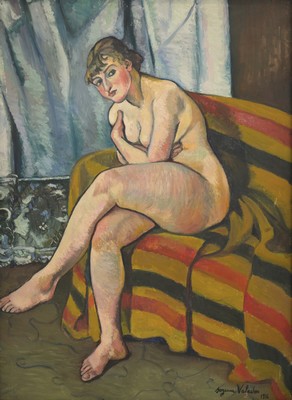
Nude Sitting on a Sofa, 1916
Oil on canvas 
The Weisman & Michel Collection

Suzanne Valadon
Suzanne Valadon
Woman in an Armchair, (Portrait of Madame G.), 1919
Oil on canvas 
The Weisman & Michel Collection

The Glyptotek is presenting the first-ever exhibition in the Nordic region about the French painter and model, Suzanne Valadon. Despite her poor upbringing, Valadon forged a successful career as an artist, based on her work as a model, her independent studies and her talent. 

Suzanne Valadon modelled for Renoir, Puvis de Chavannes and Toulouse-Lautrec, she was a friend of Degas and van Gogh, and she was a great admirer of Gauguin. Prior to becoming part of their artistic circle, Suzanne Valadon (1865 – 1938) was a favourite model for the painters of Montmartre. Inspired by her role models, she taught herself to paint and, in the early 20th century, she was the very first self-taught woman to exhibit at the Salon de la Société Nationale des Beaux Arts.

If her name rings a bell, it is perhaps because she already hangs on the walls of the Glyptotek portrayed in paintings by Henri Toulouse-Lautrec. His 1885 portrait of Valadon is an important testimony to the network, which she influenced and to which she belonged. But the portrait also testifies to the fate she and so many other great female artists of the time met: hugely successful in their day, yet forgotten by posterity. The permanent collections of the Glyptotek are no exception. Valadon is represented not by her own work, but only as a model for Toulouse-Lautrec.

Since 1949, the Glyptotek has never mounted a major, historical solo exhibition of works by a French female painter. Now, once again, the museum is making its galleries available to a rebel painter who, by asserting her independence, challenged the conventions of the age, as both an artist and a woman.

Though Marie-Clémentine Valadon (pseudonym: Suzanne Valadon) grew up in poverty, by the time she was a teenager she had forged a brilliant career as an artist’s model. From her work as a model she learned artistic techniques and social codes, and was to become part of an impressive network of artists.

With her uncompromising portraits and nude studies, rooted in her gender and her class, Valadon paved new ways for art. She defied the social norms of the time and carved her own unique path into the Parisian art world. Her unusual history, her business connections, strategies and contribution to 20th century art will be the subjects of the Glyptotek’s special exhibition 'Susanne Valadon – Model, Painter, Rebel'.
“It is more than a hundred years since Valadon painted her audacious portraits of confident women with strong bodies, sinuous shapes and pubic hair. Easily recognisable by their fiery dark contours and bright colours, Valadon’s works tackle a number of issues that, even to this day, challenge social codes related to femininity, marriage, motherhood, desire and the female body. Valadon was not a feminist in the traditional sense of the word, but her works make a huge impact, despite all the gossip that has so often overshadowed her work. The upcoming exhibition will not only feature her extraordinary works, but will also tell the story of an exceptional woman who succeeded in transforming her working-class background from a disadvantage into a unique entrée into the world of art. Valadon definitely deserves to be acknowledged as one of our many inspiring, female forebears in the history of art,” says Anna Kærsgaard Gregersen, Curator, Danish and French Art of the 19th Century at the Glyptotek.
 
The exhibition, 'Suzanne Valadon - Model, Painter, Rebel' is a collaboration between the Ny Carlsberg Glyptotek and the Barnes Foundation, Philadelphia.

The exhibition was originally devised by the Barnes Foundation. At the Barnes Foundation - 'Suzanne Valadon: Model, Painter, Rebel' was supported by the Pew Center for Arts & Heritage, Philadelphia.

The exhibition is accompanied by the publication of a richly illustrated catalogue.

The exhibition opened at the Barnes Foundation in Philadelphia on 26 September 2021 and runs until 9 January 2022. At the Glyptotek it will run from 24 February to 31 July 2022.

SUZANNE VALADON

Born to a single mother in Bessines-sur-Gartempe, Suzanne Valadon (née Marie-Clémentine Valadon, 1865-1938) grew up in poverty in Paris. Valadon spent little time in school and, though she began drawing at the age of 9, she never received any formal art education.

As a teenager, Valadon modelled for some of the most famous artists of the time, including Renoir, Puvis de Chavannes and Toulouse-Lautrec. The modelling work kindled her own ambition. Encouraged by Degas, the artist’s friend and mentor, she began working on drawings and prints. At the age of 18, she gave birth to her son, Maurice Utrillo who, with his mother’s help, went on to enjoy a successful career as an artist.

In 1882, Suzanne Valadon started to experiment in the use of oil as a medium. Her drawings and paintings were exhibited, capturing the attention of collectors, gallery owners and art critics. By 1910, Valadon was a confident painter. She had divorced her first husband and was about to get married a second time: to her son’s friend, André Utter, who was a mere 20 years old.

In the 1920s, Suzanne Valadon enjoyed great commercial success and, prior to her death in 1938, the French state purchased several of her works. In her lifetime, Suzanne Valadon exhibited both nationally and internationally. However, today she is chiefly known in her home country.

NY CARLSBERG GLYPTOTEK
Dantes Plads 7, Copenhagen 1556

31/10/16

Liu Xiaodong @ Faurschou Foundation Copenhagen

Liu Xiaodong: Painting As Shooting
Curated by Jérôme Sans

Faurschou Foundation Copenhagen

Through December 16,  2016


Liu Xiaodong
Photo of artwork ‘Xuzi at Home’.
© Xiaodong Studio
Liu Xiaodong
2010
Oil on canvas, 140 x 150 cm.
Collection of the artist


Photo of artwork ‘The Nude Black Maya’.
© Xiaodong Studio
Liu Xiaodong
The Nude Black Maya, 2009,
Oil on canvas, 200 x 250 cm.
Private Collection

Faurschou Foundation presents the third and final Liu Xiaodong exhibition in its Copenhagen space.

Painting as Shooting is conceived as an exhibition in three chapters, curated by Jérôme Sans and produced by Faurschou Foundation, in Venice, Beijing and Copenhagen. The first step, which took place at the Cini Foundation for the 56th Venice Biennale, was the first major European institutional exhibition to fully explore Liu Xiaodong’s unique practice, as one of China’s most influential painters of the last two decades. The second, presented by Faurschou Foundation in its Beijing space, presented the most recent series of works created by the artist during his stay in Ordos in Inner Mongolia. The last chapter, mixing the first two shows, represents the most updated survey on Liu Xiaodong’s work.

The exhibition, Painting as Shooting, focuses on a unique selection of some of the artist’s most important projects from the last decade. They deal with major global, sociological, cultural, economic, ecological and environmental issues from the past ten years. It is not meant as a retrospective exhibition, but rather as a journey through images of the various worlds and situations he has witnessed all over the world, in locations such as China, Asia, Cuba, Europe, Israel, etc.


Liu Xiaodong
Photo of artwork ‘Jincheng Airport’.
© Xiaodong Studio
Liu Xiaodong
Jincheng Airport, 2010,
Oil on canvas,
300 x 400 cm.
Collection of the artist

Most recently Liu Xiaodong reactivated the issue on human migration, which appeared in his earlier "Hot Bed" series. Previously he portrayed migrants within Asia, both in his homeland China and in Thailand. Today Liu focuses on the largest migration and humanitarian problem since World War II: communities taking the most dangerous trip across the Mediterranean Sea and the most hazardous routes into Europe to escape the wars in the Middle East and Africa, hoping to find a better future in Europe. This issue will not only impact Europe, but the rest of the world.

Liu Xiaodong's projects will also be presented in an extended book, containing large graphical illustrations, sketches, diary notes and texts by Jérôme Sans. In addition to the exhibition there will be shown ten documentaries each following the different projects.

Painting as shooting

Liu Xiaodong is a painter of everyday life. His images are of family and friends set against modest scenery capturing ordinary moments, such as eating, laughing or playing games. However, in-depth exploration of what is hidden behind the small stories that populate the surface of his work reveals a much bigger picture. Xiaodong’s paintings are pointing with simple gestures to the reality of the periphery, the margins and the paradoxes of our contemporary society. It is the reality that no one dares to speak about; the tough reality of daily existence that reaches out to us from displaced communities—from migrant workers, victims of ecological and natural disasters and sex workers to the new homeless—all sharing the dream of a better life.

Liu Xiaodong approaches his work with the eyes and the storyboard practice of a filmmaker. Each of the artist’s major works begins with a simple idea from one of his daily diary entries, describing the events he has witnessed, photos he has taken or people he has met, and then transforms them into live characters on his canvas. In a way the artist’s paintings resemble a production set where he acts as a director who collaborates with actors to play, record or recreate a situation, various impressions or the effects thereof. It is hereby that Liu Xioadong embodies the concept of "painting as shooting."

Biographies


Liu Xiaodong
Photo of the artist Liu Xioadong
Photo by © Jiang Jia

Liu Xiaodong (1963) lives and works in Beijing. He holds a BFA and an MFA in painting from the Central Academy of Fine Arts, Beijing (1988–95). The artist gained recognition in the 1990s and represents the Chinese Neo-Realism style. His solo exhibitions include Kunsthaus Graz, Austria (2012) and Ullens Centre for Contemporary Art, Beijing (2010), while his work was also shown in various group exhibitions such as the Shanghai Biennale (2000, 2010), the 15th Biennale of Sydney (2006) and the 47th Venice Biennale (1997).


Jerome Sans & Liu Xiadong
The artist Liu Xiaodong with the curator Jèrôme Sans, Venice, 2015.
Photo by Yu Hong, © Faurschou Foundation & Liu Xiaodong Studio

Jérôme Sans is an internationally renowned curator, art critic, artistic director who has curated numerous major exhibitions around the world. He was the former director of the ground-breaking Ullens Centre for Contemporary Art in Beijing and co-founder of the acclaimed Palais de Tokyo in Paris. He is currently artistic director of one of the most important urban development projects in Europe, the Lyon Rives de Saône-River Movie, and co-founder of Perfect Crossovers ltd, a Beijing based cultural consultancy group.

FAURSCHOU FOUNDATION
www.faurschou.com