Showing posts with label Ny Carlsberg Glyptotek. Show all posts

13/03/25

Gauguin & Kihara @ Glyptotek, Copenhagen - "Gauguin & Kihara – First Impressions" Exhibition

Gauguin & Kihara First Impressions
Ny Carlsberg Glyptotek, Copenhagen
8 May, 2025 - 6 December 2026

Paul Gauguin Painting
Paul Gauguin
Vahine no te Tiare. Woman with the Flower, 1891
MIN 1828 © Glyptoteket

Paul Gauguin Painting
Paul Gauguin
Arearea no Varua ino. The Amusement of the Evil Spirit, 1894
MIN 1832 © Glyptoteket

Throughout his career, Paul Gauguin pursued the ideal conditions for life as an artist. Yet wherever he went, reality seldom lived up to his expectations. When reality fell short, however, imagination was given free rein in his artistic worlds. This is the starting point for the Glyptotek’s upcoming collection presentation, Gauguin & Kihara – First Impressions, which also features an important new acquisition grappling explicitly with Gauguin’s work.
 
The Glyptotek holds one of the world’s finest collections of works by the French artist Paul Gauguin (1848–1903). In recent years, many of the museum’s 58 Gauguin pieces—including paintings, woodcarvings, drawings and ceramics—have been on loan to renowned museums across the globe. Now, they return home to be shown together in a presentation, opening on 8 May, offering new perspectives on Gauguin’s well-known works.
 
This spring, the Gauguin collection is joined by the Japanese-Sāmoan contemporary artist Yuki Kihara (b. 1975) and her video work First Impressions: Paul Gauguin, recently acquired by the museum. Together, their works open a dialogue across time, cultural divides and vast oceanic distances.

Paul Gauguin Painting of Brittany
Paul Gauguin
Landscape from Brittany with Breton Women, 1888 
MIN 1826 © Glyptoteket

Paul Gauguin Painting of Brittany
Paul Gauguin
Shepherdess from Brittany, 1889
MIN 1827 © Glyptoteket
 
Paul Gauguin: The eternal pursuit

Gauguin’s futile search for the ideal conditions for an artist’s life took him from Paris to Copenhagen, through Normandy, Brittany and Arles, and onwards to the then-French colonies of Martinique, Tahiti and the Marquesas Islands. When reality proved disappointing, he let his imagination run free, creating artistic worlds on his own terms. ‘Who cares about accuracy!!’ he declared. The Glyptotek delves not only into this artistic journey but also into the physical, political and historical contexts that shaped it, examining how Gauguin depicted the places and cultures he encountered along the way.

Paul Gauguin Painting
Paul Gauguin
Skaters in Frederiksberg Garden, 1884 
MIN 3213 © Glyptoteket
“Gauguin moved through the world in a way not unlike today’s tourists. Like the traveller who crops out souvenir stalls from their holiday photos and seeks out restaurants touted as “hidden gems” in various guidebooks, Gauguin pursued the idea of authenticity, often viewing his destinations through the lens of existing narratives and images. Having spent nearly a decade in the South Pacific, Gauguin may have lived too long in the region to be called a tourist, but this comparison opens a conversation in which Gauguin’s works are not solely a matter of his distinctive colours, uniform surfaces and bold contours. They also offer insight into the cultural, political and social contexts in which they were created, challenging us still today to reflect on our own time. Through what lens do we, as modern-day tourists and cultural consumers, view the world?” says Anna Kærsgaard Gregersen, curator of the French collection at the Glyptotek.
The collection presentation will be shown in the Henning Larsen building, which will, in coming years, house an extensive selection of the Glyptotek’s French collections. This initiative is part of the museum’s commitment to strengthening the presentation of French art and culture, its collection being among the most significant in the Nordic region.

Yuki Kihara: Striking new acquisition

Yuki Kihara
Yuki Kihara (b. 1975)
First Impressions Paul Gauguin, 2018 
© Courtesy of Yuki Kihara, 
the Fine Arts Museums of San Francisco,
the Ny Carlsberg Glyptotek, Copenhagen and Milford Galle

The Glyptotek has acquired a contemporary artwork that offers a modern interpretation of one of Western art history’s most iconic—and most controversial—artists. The new acquisition, and the museum’s first video work, First Impressions: Paul Gauguin (2018), is by the Japanese-Sāmoan contemporary artist Yuki Kihara.

The video work was co-commissioned by the Glyptotek and the Fine Arts Museums of San Francisco. It was previously shown as part of the Glyptotek’s special exhibition Paul Gauguin – Why Are You Angry? (2020), which later toured to Alte Nationalgalerie (2022). That same year, the work was included in the 59th Venice Biennale, where Kihara represented Aotearoa New Zealand. Now, the work returns to the Glyptotek as a newly conceived installation and permanent part of the museum’s collection.
“I remember thinking how strange it was to be in front of [Paul Gauguin’s] paintings, as if time and space had collapsed. Here we were as artists from two different parts of the world having a dialogue in two different moments in history,” says Yuki Kihara, reflecting on her first real encounter with Gauguin’s works.
Presented in the format of a talk show, the video work features a host and panel who are shown reproductions of Gauguin paintings from Tahiti (including two from the museum’s own collection), after which they share their first impressions. As the conversation unfolds, Gauguin fades into the background, giving way to the participants’ own perspectives and speculative stories about the paintings’ models.
 
Both Yuki Kihara and the talk show participants belong to the Fa’afafine and Fa’atama communities, the Sāmoan counterparts to Māhū, a Tahitian term referring to individuals endowed with spiritual gifts from more than one gender. In colonial times, the Māhū were banned by missionaries, but researchers believe that several of Gauguin’s figures may depict Māhū—a theory also discussed among the panel.
“With humour and gravity, Kihara directs the colonial gaze back towards the West, reclaiming her community’s power to shape their own narrative. This acquisition initiates vital conversations across time and place, holding the museum and Western art history accountable, and challenging us to acknowledge historical nuance and the contemporary voices traditionally excluded from discussions surrounding Gauguin’s complex oeuvre,” explains Anna Kærsgaard Gregersen.
YUKI KIHARA (b. 1975) is a Japanese-Sāmoan interdisciplinary artist based in Sāmoa. Her practice seeks to challenge one-sided historical narratives through performance, sculpture, video, photography and curatorial practice. With a particular focus on postcolonial narratives and representation in Oceania, she explores issues of race, gender, power and cultural appropriation. Yuki Kihara represented Aotearoa New Zealand at the 59th Venice Biennale (2022) with Paradise Camp, and she has been the subject of solo exhibitions worldwide, including at The Metropolitan Museum of Art, the Fine Arts Museums of San Francisco, Powerhouse Museum and the Sainsbury Centre. Her works are found in the collections of museums including the Museum of Modern Art, The Metropolitan Museum of Art, Los Angeles County Museum of Art, Kaohsiung Museum of Fine Arts, National Gallery of Australia and Te Papa Tongarewa Museum of New Zealand.

Ny Carlsberg Glyptotek
Dantes Plads 7 • 1556 Copenhagen

17/04/24

Sculptor Kai Nielsen @ Glyptotek, Copenhagen + Faaborg Museum – "Born of Everyday Life" Exhibition

Kai NielsenBorn of Everyday Life
Glyptotek, Copenhagen
30 May 2024 - 5 January 2025

Kai Nielsen
Portrait of Kai Nielsen
Undated 
Glyptotek's archive © Ida & Gustav Krog

Kai Nielsen
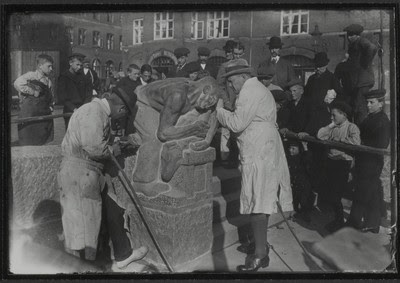
Kai Nielsen during the work on the decoration of Blågårds Plads
Undated 
© Holger Damgaard

Kai Nielsen
Kai Nielsen 
The Water Mother. Designed 1918-20. Chopped 2003-04 
The Glyptoteket © Anders Sune Berg

The Glyptotek presents Kai Nielsen – Born of Everyday Life. The exhibition has been devised in close collaboration with Faaborg Museum, which presents a parallel exhibition with the same title at the same time*.

If you have visited the Glyptotek in Copenhagen, you have probably already met "The Water Mother", who welcomes visitors to the Glyptotek from her pool in the Winter Garden. Maybe you have also seen Kai Nielsen’s sculptures of working people on Blågårds Square in Copenhagen, but without knowing they were by him.

Many people in Denmark even own their own little Kai Nielsen statuette. Kai Nielsen called his statuettes “hand-sized”. Designed for Bing & Grøndahl, Kähler and Dansk Kunsthandel, they ended up in countless Danish homes. Under #migogkai, owners of Kai Nielsen statuettes can share a photo and their story about the statuette, thereby becoming part of the exhibition.

Kai Nielsen - Muscle men, mythology and motherhood
Kai Nielsen (1882 – 1924) was fascinated by the human body. His themes included both strong male bodies with the ideal physique of antiquity as a role model – for example, in the monumental sculpture First Generation – and female figures inspired by ancient mythology like Aphrodite – for example in the sculpture "Aarhus Girl" or "Venus with the Apple". But he was also dedicated to everyday motifs: for example, "Girl Fiddling with Her Toes", statuettes of children, and busts of his family and of famous athletes, artists and art collectors of his day.

The Glyptotek and Kai Nielsen
Kai Nielsen’s endeavour to depict ‘what is natural’ and make his works accessible invests his art with a down-to-earth, popular quality. At the same time, his sculptures feature references to mythological and ancient stories. One of his most iconic works, "The Water Mother" (1921) – the landmark of the Glyptotek – was originally carved at the museum. Her story features in the exhibition, which will also introduce visitors to some of Kai Nielsen’s most well-known works.

Kai Nielsen attended the academy in Copenhagen and found inspiration at the Glyptotek, where he studied 19th-century French and Danish sculpture, and ancient Greek and Roman art. At an early stage in his career, he got in touch with the brewer Carl Jacobsen: maybe to inspire the patron of art to invest in his works. The Glyptotek has an extensive collection of Kai Nielsen’s sculptures and sketches, which are presented in the exhibition alongside loans from museums and private collections in Denmark and Norway.

Kai Nielsen
Kai Nielsen during work on a statuette
Undated 
The archive of the Glyptothek

Kai Nielsen
Kai Nielsen during work with Zeus and Io, 1916 
© Peter Elfelt

Kai Nielsen
Kai Nielsen
First generation, 1906
Plaster 
The Glyptoteket © Anders Sune Berg

Kai Nielsen
Kai Nielsen
Morning Toilet, 1918 
Faaborg Museum  © Andreas Bastiansen

Kai Nielsen - Studying the body
Kai Nielsen was born and raised in Svendborg. There was something both down-to-earth and lofty about Kai Nielsen. This was reflected in the quasi-mythological story of Kai the sculptor and human being, to which his family, friends and acquaintances all contributed. He possessed a sparkling sense of humour, great charisma, superhuman willpower and manic industriousness, despite his rather frail constitution and poor health.

“It takes a healthy body to make healthy art,” was one of the mottos of the artist from Funen. This was a conviction he took literally. Persistently, he modelled the human body, while training his own. He rowed, swam, boxed, rode, fenced and wrestled, and hiked in the mountains of Norway, the home country of his wife, the painter Yanna Lange Kielland Holm (1880-1932). He fought an eternal battle between health and illness and, after several years of illness and operations, died in 1924 at the early age of 41.

* In Faaborg Museum, the exhibition runs from 9 June 2024 to 5 January 2025.

Ny Carlsberg Glyptotek
Dantes Plads 7 • 1556 Copenhagen

Faaborg Museum
Gronnegade 75 • 5600 Faaborg

13/11/23

Joaquín Sorolla @ Glyptotek, Copenhagen – "Light in Motion" Exhibition

Joaquín Sorolla Light in Motion
Glyptotek, Copenhagen
8 November 2023 – 3 March 2024

Joaquín Sorolla
Joaquín Sorolla 
Clotilde bajo el toldo, Biarritz (Clotilde beneath the awning, Biarritz), 1906 
© Madrid, Museo Sorolla [Inv. 00774]

Joaquín Sorolla
Joaquín Sorolla 
La alberca, Alcázar de Sevilla (The reservoir, Alcázar, Seville), 1910
© Madrid, Museo Sorolla  [Inv. 00854]

Joaquín Sorolla
Joaquín Sorolla
 
Clotilde en el jardín (Clotilde in the garden), 1919-1920 
© Madrid, Museo Sorolla  [Inv. 01270]

Joaquín Sorolla – Light in Motion is the first-ever solo exhibition in the Nordic region devoted to the work of the Spanish artist Joaquín Sorolla. Featuring one of Spain’s most important painters, it marks both the 100th anniversary of the artist’s death and the state visit of the Spanish royal family to Denmark.

In November, for the first time in 42 years, the Spanish royal family pays a state visit to Denmark. In the light of this visit, and the fact that this year marks the 100th anniversary of the death of the painter Joaquín Sorolla, in collaboration with Museo Sorolla, the Spanish Agency for International Development Cooperation is presenting an exhibition devoted to the artist.  

Joaquín Sorolla (1863-1923) was one of Spain’s greatest artists. Although up there with the likes of painters such as Diego Velázquez, Francisco de Goya and Pablo Picasso, internationally speaking his oeuvre is probably not as famous as that of those other Spanish masters.

Joaquín Sorolla was born in Valencia in 1863. He started studying art in 1876 at the Escuela de Bellas Artes in Valencia. He then travelled to Madrid, Paris and several Italian cities before finally settling in Madrid in 1899. He regularly took part in international exhibitions in major cities such as Paris, Munich, Vienna, London and Chicago, receiving several awards and meeting international colleagues. In 1909, Joaquín Sorolla had a major exhibition in New York, and in 1911 he received a large-scale commission from Archer Milton Huntington, who requested a decorative mural consisting of 14 monumental paintings featuring motifs from the regions of Spain. Joaquín Sorolla died in Cercedilla, Madrid in 1923.

Joaquín Sorolla
Joaquín Sorolla
Sierra Nevada en invierno (Sierra Nevada in Winter), 1910 
© Madrid, Museo Sorolla [Inv. 00867]

Joaquín Sorolla
Joaquín Sorolla
Rompeolas, San Sebastián (Breakwater, San Sebastián), 1917-1918 
© Madrid, Museo Sorolla [Inv. 01246]

This is the first-ever solo exhibition in Denmark of the work of Joaquín Sorolla. The Museo Sorolla has loaned 17 of the artist’s distinctive works to the Glyptotek. Actually, the work of Joaquín Sorolla was exhibited at the Glyptotek on one previous occasion: a single work featured in Den Internationale Kunstudstilling (The International Art Exhibition) (1897), when the museum was inaugurated. Carl Jacobsen’s objective was to introduce major international art to the Nordic region and to show the outside world that Denmark was a potentially new artistic centre in Europe.

Joaquín Sorolla is famous as ‘the master of light’. His paintings are full of light in motion, as observed by the artist in various landscapes and natural phenomena, and from season to season. He is famous for his depictions of the sea and beach scenes, landscapes and portraits, all of which motifs are featured in this exhibition. Given his interest in light, Sorolla is often associated with Impressionism. However, on account of his attempt to render his environment as accurately as possibly, he can also be called a Naturalist.

In the context of Denmark, Joaquín Sorolla’s work has much in common with the work of the Skagen Painters: in particularly, that of Peder Severin Krøyer. Joaquín Sorolla and Krøyer were contemporaries, and Sorolla is often referred to colloquially as ‘the Spanish Krøyer’. This is not only due to their common interest in plein air painting, but also because they both created atmospheric, lucent paintings, capturing nature, people’s lives and scenes of everyday life: working fishermen, young women walking on the beach, shaded gardens and the constant changes of the sea.

The work of the two artists featured in many of the same exhibitions – for example, in the 1895 Exposition Nationale des Beaux-Arts in Paris – and it is very likely that they knew and saw each other’s works.

Joaquín Sorolla – Light in Motion features key works from the collection of the Museo Sorolla in Madrid. The exhibition was the initiative of the Spanish Agency for International Development Cooperation in collaboration with the Museo Sorolla. The exhibition is curated by Enrique Juncosa.

Joaquín Sorolla’s paintings are presented in dialogue with five works by five Spanish contemporary artists from different generations. All the works relate to Joaquín Sorolla’s oeuvre. The five Spanish contemporary artists are: Soledad Sevilla, Miquel Barceló, Juan Uslé, Miki Leal and Belén Rodríguez.

Ny Carlsberg Glyptotek, Copenhagen
Dantes Plads 7, Copenhagen 1556

16/12/21

Suzanne Valadon @ Ny Carlsberg Glyptotek, Copenhagen - Model, Painter, Rebel

Suzanne Valadon 
Model, Painter, Rebel
Ny Carlsberg Glyptotek, Copenhagen
24 February – 31 July 2022

Suzanne Valadon
Suzanne Valadon 
Nude in the Mirror, 1916-17
Oil on canvas 
The Weisman & Michel Collection

Suzanne Valadon
Suzanne Valadon 
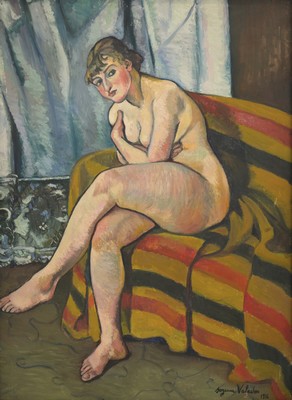
Nude Sitting on a Sofa, 1916
Oil on canvas 
The Weisman & Michel Collection

Suzanne Valadon
Suzanne Valadon
Woman in an Armchair, (Portrait of Madame G.), 1919
Oil on canvas 
The Weisman & Michel Collection

The Glyptotek is presenting the first-ever exhibition in the Nordic region about the French painter and model, Suzanne Valadon. Despite her poor upbringing, Valadon forged a successful career as an artist, based on her work as a model, her independent studies and her talent. 

Suzanne Valadon modelled for Renoir, Puvis de Chavannes and Toulouse-Lautrec, she was a friend of Degas and van Gogh, and she was a great admirer of Gauguin. Prior to becoming part of their artistic circle, Suzanne Valadon (1865 – 1938) was a favourite model for the painters of Montmartre. Inspired by her role models, she taught herself to paint and, in the early 20th century, she was the very first self-taught woman to exhibit at the Salon de la Société Nationale des Beaux Arts.

If her name rings a bell, it is perhaps because she already hangs on the walls of the Glyptotek portrayed in paintings by Henri Toulouse-Lautrec. His 1885 portrait of Valadon is an important testimony to the network, which she influenced and to which she belonged. But the portrait also testifies to the fate she and so many other great female artists of the time met: hugely successful in their day, yet forgotten by posterity. The permanent collections of the Glyptotek are no exception. Valadon is represented not by her own work, but only as a model for Toulouse-Lautrec.

Since 1949, the Glyptotek has never mounted a major, historical solo exhibition of works by a French female painter. Now, once again, the museum is making its galleries available to a rebel painter who, by asserting her independence, challenged the conventions of the age, as both an artist and a woman.

Though Marie-Clémentine Valadon (pseudonym: Suzanne Valadon) grew up in poverty, by the time she was a teenager she had forged a brilliant career as an artist’s model. From her work as a model she learned artistic techniques and social codes, and was to become part of an impressive network of artists.

With her uncompromising portraits and nude studies, rooted in her gender and her class, Valadon paved new ways for art. She defied the social norms of the time and carved her own unique path into the Parisian art world. Her unusual history, her business connections, strategies and contribution to 20th century art will be the subjects of the Glyptotek’s special exhibition 'Susanne Valadon – Model, Painter, Rebel'.
“It is more than a hundred years since Valadon painted her audacious portraits of confident women with strong bodies, sinuous shapes and pubic hair. Easily recognisable by their fiery dark contours and bright colours, Valadon’s works tackle a number of issues that, even to this day, challenge social codes related to femininity, marriage, motherhood, desire and the female body. Valadon was not a feminist in the traditional sense of the word, but her works make a huge impact, despite all the gossip that has so often overshadowed her work. The upcoming exhibition will not only feature her extraordinary works, but will also tell the story of an exceptional woman who succeeded in transforming her working-class background from a disadvantage into a unique entrée into the world of art. Valadon definitely deserves to be acknowledged as one of our many inspiring, female forebears in the history of art,” says Anna Kærsgaard Gregersen, Curator, Danish and French Art of the 19th Century at the Glyptotek.
 
The exhibition, 'Suzanne Valadon - Model, Painter, Rebel' is a collaboration between the Ny Carlsberg Glyptotek and the Barnes Foundation, Philadelphia.

The exhibition was originally devised by the Barnes Foundation. At the Barnes Foundation - 'Suzanne Valadon: Model, Painter, Rebel' was supported by the Pew Center for Arts & Heritage, Philadelphia.

The exhibition is accompanied by the publication of a richly illustrated catalogue.

The exhibition opened at the Barnes Foundation in Philadelphia on 26 September 2021 and runs until 9 January 2022. At the Glyptotek it will run from 24 February to 31 July 2022.

SUZANNE VALADON

Born to a single mother in Bessines-sur-Gartempe, Suzanne Valadon (née Marie-Clémentine Valadon, 1865-1938) grew up in poverty in Paris. Valadon spent little time in school and, though she began drawing at the age of 9, she never received any formal art education.

As a teenager, Valadon modelled for some of the most famous artists of the time, including Renoir, Puvis de Chavannes and Toulouse-Lautrec. The modelling work kindled her own ambition. Encouraged by Degas, the artist’s friend and mentor, she began working on drawings and prints. At the age of 18, she gave birth to her son, Maurice Utrillo who, with his mother’s help, went on to enjoy a successful career as an artist.

In 1882, Suzanne Valadon started to experiment in the use of oil as a medium. Her drawings and paintings were exhibited, capturing the attention of collectors, gallery owners and art critics. By 1910, Valadon was a confident painter. She had divorced her first husband and was about to get married a second time: to her son’s friend, André Utter, who was a mere 20 years old.

In the 1920s, Suzanne Valadon enjoyed great commercial success and, prior to her death in 1938, the French state purchased several of her works. In her lifetime, Suzanne Valadon exhibited both nationally and internationally. However, today she is chiefly known in her home country.

NY CARLSBERG GLYPTOTEK
Dantes Plads 7, Copenhagen 1556

29/10/16

Théodore Rousseau @ Ny Carlsberg Glyptotek, Copenhagen

Théodore Rousseau. Unruly Nature
Ny Carlsberg Glyptotek, Copenhagen

Through 8 January 2017


Théodore Rousseau, French, 1812 - 1867
Mont Blanc Seen from La Faucille, Storm Effect, begun 1834
Oil on canvas, 143 × 240 cm
Ny Carlsberg Glyptotek, Copenhagen, MIN1783


Théodore Rousseau, French, 1812 - 1867
View of Mont Blanc, Seen from La Faucille, c. 1863-67
Oil on canvas, 91.4 × 118.4 cm
Minneapolis Institute of Art, The Putnam Dana McMillan Fund
Photo: Minneapolis Institute of Art

THEODORE ROUSSEAU (1812 - 1867) stands among the great figures of mid-19th century French painting. This autumn’s major special exhibition at the Glyptotek showcases Théodore Rousseau’s richly varied life’s work, where landscape painting became fertile soil for wild innovation. Featuring 56 paintings and drawings from 29 museums and private collections and from the Glyptotek’s own collection, this exhibition is the first large-scale presentation of Rousseau ever in Scandinavia, and the first of its kind in Europe since 1967.

Théodore Rousseau: Out of the shadows
Despite his considerable significance, Théodore Rousseau has long stood in the shadows of the subsequent generations of French painters – particularly the Impressionists, whom he can be said to have anticipated with his dawning abstraction and daring brushstrokes. Similarly, his role as standard bearer for the so-called Barbizon school has dimmed later generations’ appreciation of the full importance of Rousseau’s groundbreaking painting. Flemming Friborg, director of the Glyptotek, says: “Rousseau is much more than a warm-up act for Monet & associates. He is very much his own artist. This exhibition specifically aims to set him free from the constraints of preconceived categories, presenting him as what he is: one of the great innovators of landscape painting.”


Théodore Rousseau, French, 1812 - 1867
Evening (The Parish Priest), 1842-43
Oil on panel, 42.3 × 64.4 cm
Toledo Museum of Art, Gift of Arthur J. Secor, 1933.37
Photo: Chris Ridgway


Théodore Rousseau, French, 1812 - 1867
Sunset near Arbonne, c. 1860–65
Oil on wood, 64.1 x 99.1 cm
The Metropolitan Museum of Art, New York (Bequest of Collis P. Huntington, 1900)

Théodore Rousseau: Unruly landscapes
Théodore Rousseau entered the art scene at a time when landscape painting became recognised as one of the most popular and experimental genres around. Up until this point, landscapes had led rather quiet lives on the outskirts of the art of painting, serving mainly as the backdrop of scenes from literature and history. But now a new generation of artists began working with pure landscapes. Landscapes offered infinite painterly potential with their array of natural phenomena, capricious weather and changing light. Rousseau soon proved himself to be an artist of great scope and range. But to him landscapes were more than just nature. Painting became a prism through which he could merge sober observations of nature with his own feisty artistic temperament. Clear-headed renditions of details are combined with voluptuous brushstrokes to great effect in scenes from nature where the Romantic credo about the sublime is given unbridled visual expression.


Théodore Rousseau, French, 1812 - 1867
Forest of Fontainebleau, Cluster of Tall Trees Overlooking the Plain of Clair-Bois at the Edge of Bas-Bréau, c. 1849-52
Oil on canvas, 90.8 × 116.8 cm
The J. Paul Getty Museum, Los Angeles, 2007.13


Théodore Rousseau, French, 1812 - 1867
Farm in Les Landes, c. 1852-67
Oil on canvas, 64.8 × 99.1 cm
Sterling and Francine Clark Art Institute, Willamstown, Massachusetts, USA
© Sterling and Francine Clark Art Institute, Williamstown, Massachusetts. Photo: Michael Agee

Covering two floors, the exhibition demonstrates the sheer range of Théodore Rousseau’s oeuvre. Arranged in chronological order, the works on display demonstrate how Rousseau’s experiments cut across different techniques and formats, and especially how he utilized the synergy between drawing and painting. Open, receptive and explorative, Rousseau’s life’s work emerges as an extremely fruitful combination of fascination with nature and technical skill that helped formulate an entirely new vocabulary of expression within the landscape genre.

Théodore Rousseau: An unruly artist
The story of Théodore Rousseau’s career is of such stuff as myths are made on. Having been repeatedly met by chilly reception and rejections from the Paris Salon, Rousseau chose, in 1841, to entirely boycott this uppermost tier of the official art scene in France. A daring move that would usually have tripped up any artistic career. Yet things turned out differently for Rousseau. His absence became synonymous with the growing dissatisfaction with the Salon, and he was soon celebrated as “le Grand Refusé”. With political winds blowing in his favour, Rousseau was able to make a carefully staged comeback, casting him as a heroic martyr who not only conquered the art scene, but also won a seat on the Salon jury. Demand for his art rose rapidly soon afterwards – and did so at a time when the commercial art market began emerging in earnest. Soon his works were sold at dizzying prices, and far into the 20th century his artworks were among the most highly sought-after among museums and private collectors.

”Théodore Rousseau. Unruly Nature” has been co-organized with the J. Paul Getty Museum in Los Angeles, which showed the exhibition from 21 June to 11 September 2016.

Catalogue
The exhibition is accompanied by a comprehensive catalogue (in English) that offers an overview of and insights into Théodore Rousseau’s rich and varied landscape painting. Featuring articles by the exhibition curators: Scott Allan (J. Paul Getty Museum), Édouard Kopp (Harvard Art Museums) and Line Clausen Pedersen (Ny Carlsberg Glyptotek).
Unruly Nature: The Landscapes of Théodore Rousseau. Publisher: J. Paul Getty Museum
209 pages, lavishly illustrated.

Ny Carlsberg Glyptotek, Copenhagen
Dantes Plads 7, Copenhagen 1556
www.glyptoteket.com

11/11/15

Paint, Ny Carlsberg Glyptotek, Copenhagen

PAINT
Ny Carlsberg Glyptotek, Copenhagen
26 November 2015 - 3 March 2016

Vincent van Gogh
Landscape from Saint-Rémy, 1889
Oil on canvas, 70,5 x 88,5 cm
Ny Carlsberg Glyptotek, Copenhagen

This winter’s exhibition at the Ny Carlsberg Glyptotek celebrates painting as an art form – directly, openly and stripped of any framing devices and narratives. Quite literally, too: a special range of selected French masterpieces are exhibited without their lovely, heavy golden frames in settings that focus attention on the art itself and on its key quality: its ability to invite contemplation.

Traditionally, frames have served as dividers that set up a boundary between the pictorial space and the space occupied by the spectator. PAINT rips van Gogh, Cézanne, Degas, Courbet, Rousseau, Manet, Sisley and Monet out of their frames. Freed from the clear-cut boundaries provided by the frame, the masterpieces presented in this exhibition take on new and unexpected qualities. A simple, but effective device – and the exhibition makes the most of it by not only giving the paintings plenty of space to breathe, but the visitors, too.

Behind the frame
Without the frames the canvases and their subjects appear exactly as they were when the artists stopped working on them. Their brushstrokes, hatchings and layers of pigment are revealed to us in new ways, unveiling more of the creative process behind the painting. PAINT delves under the skin of nine selected masterpieces, offering rare insights into their hidden aspects; insights of the kind usually reserved for conservators and art historians.

Théodore Rousseau
Thuderstorm over Mont Blanc 1834. 1863-67
Oil on canvas, 143 x 240 cm
Ny Carlsberg Glyptotek, Copenhagen

Undisturbed
PAINT prompts contemplation by offering plenty of space, time and quiet calm for the works and visitors alike – thereby allowing the sensuous qualities of each painting to emerge with even greater clarity. Our focus is shifted away from traditional concerns such as chronology, theme and narrative to home in on the basic forms of each work’s appearance and inception. PAINT not only challenges the visitors, but also the Glyptotek institution itself as it asks what is most important in an exhibition context: the perceptions held by art, history, the museum or the visitor?

With the Salon next door
PAINT extends across no less than two floors of the Glyptotek. Things look very different on the third floor, where the Glyptotek’s collection of French art is on display in an all-new temporary rehang. Here you will find pictures still in their frames, densely hung from floor to ceiling, interspersed by small sculptures: just as you would find art presented at the Salons of nineteenth-century France.

Ny Carlsberg Glyptotek, Copenhagen, Denmark
www.glyptoteket.com

07/03/12

Exhibition Flinders Petrie Shadow Pyramids at Ny Carlsberg Glyptotek, Copenhagen

In the Shadow of the Pyramids: 
Excavating with Flinders Petrie, the Father of Archaeology
Ny Carlsberg Glyptotek, Copenhagen
Through March 25, 2012

 flinders-petrie_photo_in_abydos Flinders Petrie at 69, in Abydos 1922
© Petrie Museum,  University College, London

FLINDERS PETRIES: THE FATHER OF ARCHAEOLOGY
The exhibition In the Shadow of the Pyramids tells the story of the English archaeologist and Egyptologist Flinders Petrie’s excavations in Egypt in the years before and after the First World War. Petrie, who lived from 1853 to1942, was the first to illustrate and write down details of his discoveries of everything from pottery and rusty nails to mummies and complete statues. His methods were imitated by other archaeologists and thus Petrie is called the “Father of Archaeology”.

egyptologyst_tine_bagh The Egyptologist Tine Bagh with a canopic jar belonging to a man named Iunefer from c. 1800 BC. The jar was found by Flinders Petrie in Hawara in Egypt 1911  Photo © Kim Nilsson

IN THE SHADOW OF THE PYRAMIDS: PIECES IN A JIGSAW PUZZLE
The exhibition “In the Shadow of the Pyramids” displays a number of tomb finds, fragments of statues and tomb and temple walls, which, through Flinders Petrie, came to the Glyptotek. Fresh knowledge and new links with other Petrie finds from, for instance, the British Museum and the Museum of Fine Arts Boston, are presented. Visitors have the opportunity to get close to Petrie and his discoveries. One hundred years on, Petrie’s finds have achieved new significance such as when a crown with feathers and horns proves to belong to an impressive statue of the crocodile god Sobek.

pyramid_hawara_egypt_ Pyramid and ruins of the temple called the Labyrinth in Hawara, Egypt. Photo: Janne Klerk, May 2011. Petrie excavated the Labyrinth in 1911 and found the canopic jar of Iunefer and the relief with at crocodile snout, c. 1800 BC. Photos: Kim Nilsson

 tomb_nefermaat_egypt The tomb of Nefermaat and his wife Atet in Meydum, Egypt. Photo: Janne Klerk, May 2011. Flinders Petrie excavated here in 1910 and found the relief with fowling etc. and the wall painting with Nefermaat with a leopard dress in Atet’s chapel, c. 2550 BC. Photos: Ole Haupt.

THE NY CARLSBERG FOUNDATION
Petrie’s excavations were supported by various foundations and museums, particularly in Europe and the USA. For many years the Ny Carlsberg Foundation was one of Petrie’s most generous sponsors. After each excavation campaign Petrie distributed his finds according to clear agreements with the Egyptian state. First the Egyptian Museum in Cairo was allotted the unique finds; thereafter Petrie was permitted to divide up what remained among the various sponsors, according to the extent of their contributions. The Ny Carlsberg Foundation handed over its share of the finds to the Glyptotek. As a result, today, the museum holds over 200 of Petrie’s finest discoveries, some of which come from the ancient sites of Memphis, Meydum and Hawara.

meri-re-ha-ishtef Statuette of Meri-re-ha-ishtef. Excavations of Flinders Petrie 1921 in Sedment, Egypt. AEIN 1560, wood, H 65.5 cm. © Photo Ole Haupt, Ny Carlsberg Glyptotek.

cosmetic_spoon_egypt Cosmetic spoon. From the excavations of Flinders Petrie in Sedment, Egypt, 1921. AEIN 1559, wood, L 27 cm. © Photo Ole Haupt, Ny Carlsberg Glyptotek.

The exhibition is supported by Queen Margrethe’s and Prince Henrik’s Foundation, Oticon Foundation and Atlantis Rejser.

NY CARLSBERG GLYPTOTEK
Dantes Plads 7, 1556 Copenhagen