Showing posts with label Eeva-Riitta Eerola. Show all posts

29/03/25

Eeva-Riitta Eerola @ Helsinki Contemporary Gallery - "C" Exhibition

Eeva-Riitta Eerola: C
Helsinki Contemporary
11 April - 4 May 2025

Eeva-Riitta Eerola
Eeva-Riitta Eerola
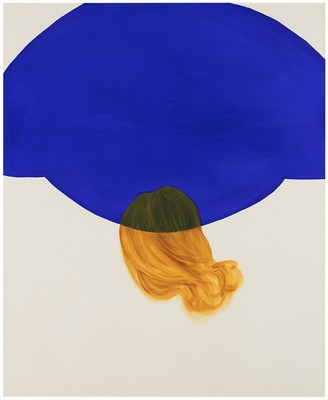
Vessel (Garden) IV, 2025
Acrylic on canvas, 90 cm x 90 cm
Photo: Erno Enkenberg
Courtesy of Helsinki Contemporary

Eeva-Riitta Eerola
Eeva-Riitta Eerola
Vessel (Garden) III, 2025
Oil on acrylic on canvas, 46 cm x 50 cm
Photo: Erno Enkenberg
Courtesy of Helsinki Contemporary

EEVA-RIITTA EEROLAs paintings seem to materialize like apparitions, exuding effortless simplicity, but also a sense of potency. Echoing her desire to simplify, Eeva-Riitta Eerola has named her new exhibition after a single letter of the alphabet: C. This emblem can be read in many ways: as a visual symbol, as a phoneme, or even as a word. Visually, its shape both encloses and opens outwards, recalling the phase of the lunar cycle when the Moon is visible only as a narrow crescent. In ancient carvings, the map of the Garden of Eden is inscribed as a fertile crescent at the confluence of four rivers, or as a rounded vessel containing paradise.

Eeva-Riitta Eerola
Eeva-Riitta Eerola
Observer (Garden) III, 2025
Oil on acrylic on canvas, 42 cm x 33 cm
Photo: Erno Enkenberg
Courtesy of Helsinki Contemporary

Eeva-Riitta Eerola
Eeva-Riitta Eerola
Act (Garden) IV, 2025
Oil on acrylic on canvas, 50 cm x 80 cm
Photo: Erno Enkenberg
Courtesy of Helsinki Contemporary

Abstracted maps, streams and paths are among the prominent recurring elements in Eerola’s paintings, as are hands and eyes. The eye motif is significant in that the letter ‘C’ can represent the English verb ‘to see’, or its imperative form. Eerola’s paintings invite our gaze to roam and for us to immerse ourselves experientially. The eye and the hand can be interpreted as symbolizing the painting process: when painting is reduced to its basic essentials, the gaze and the manual gesture are the painter’s most important tools.

Eeva-Riitta Eerola’s paintings engage in close study of the way we humans experience images. She is interested in exploring painting’s ability to convey an experience of spatiality and presence. In her new exhibition, spatial experiences are conveyed through images of gardens. Eerola’s gardens are semi-abstract, however, representing more of a conceptual and symbolic space than a physical one.

Eeva-Riitta Eerola
Eeva-Riitta Eerola
Courtesy of Helsinki Contemporary

Eerola’s practice also reflects her interest in the history of painting. In the exhibition C, Eeva-Riitta Eerola has drawn inspiration from symbolism, an historic art movement that used symbolic images to suggest emotions and universal human experiences. She first became interested in symbolism after experiencing a death in her family as a teenager. What especially drew her to symbolism was its compelling manner of invoking death, life, continuity, finality and infinity. While preparing for this exhibition, Eeva-Riitta Eerola took inspiration from a beloved painting of her youth, The Garden of Death (1896) by Hugo Simberg, a small-scale depiction of skeletons tenderly caring for uncanny flowers in a garden situated somewhere between the living and the dead.

HELSINKI CONTEMPORARY
Bulevardi 10 - 00120 Helsinki

11/01/22

Eeva-Riitta Eerola @ Helsinki Contemporary Gallery - Locus

Eeva-Riitta Eerola: Locus
Helsinki Contemporary, Helsinki
7 - 30 January 2022

Eeva-Riitta Eerola
EEVA-RIITTA EEROLA
Passage I, 2021
Oil and acrylic on canvas, 140 x 115
© Eeva-Riitta Eerola / Photo: Jussi Tiainen
Courtesy of Helsinki Contemporary

Eeva-Riitta Eerola
EEVA-RIITTA EEROLA
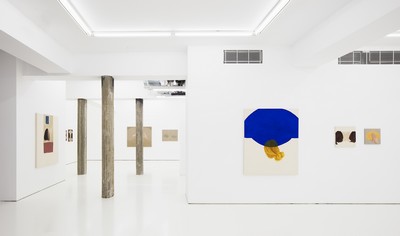
Exhibition view: Locus
© Eeva-Riitta Eerola / Photo: Jussi Tiainen
Courtesy of Helsinki Contemporary

Helsinki Contemporary presents EEVA-RIITTA EEROLA’s solo exhibition Locus. This suite of paintings has been built around themes of experientiality, the body and the sensory perception of space. These themes derive from the artist’s visit to the Museo Nazionale di San Marco, set in an old Dominican convent in Florence, and on her multisensory, analytical experience of Fra Angelico’s frescos. Continuing on from Eeva-Riitta Eerola’s earlier production, the exhibition challenges those who experience it to look and to sense the works holistically – viewing them from the outside or merging to become part of them.

The title of the exhibition, Locus, refers to the experience of a space, to the place where something is happening or to where something is situated. It underscores the holistic nature of the sensory perception of space and the significances of the mutual relationship between human being and space. The physical experience of Fra Angelico’s convent frescos encapsulates something fundamental about painting and the experiencing of space, both on an emotional level and via conscious perception. 
“My own viewing experience when faced with Fra Angelico’s frescos is one example of the ability of painting to be simultaneously fixed in time and place and totally outside of them. The frescos were painted almost 600 years ago, and yet, as I looked at them, in a way, the time separating them from me vanished. The works are, of course, rooted in their context and their time, but also in Fra Angelico and his assistants’ concrete labours, in their presence in the space, in the choices they made, and in the touch of their hands. When I was looking at the paintings, all of those levels were present for me in my own time as both a cognitive and a sensory experience,” Eeva-Riitta Eerola says.
Eeva-Riitta Eerola deals with delicate shifts between image and place in three series of works, Act, Observer and Passage. The symbols that appear in the paintings give rise to multiple layers in this suite of paintings. The Actseries refers to authorship, action and perception. The hands in the paintings are simultaneously like the author’s or viewer’s hands at this moment, while also referring to details in Fra Angelico’s frescos. The Observer painting series is based on a powerful, multifarious symbol, an eye shape reminiscent of that of an almond or shell. In these reductive paintings it refers to the main mode of sensory perception – looking. In the Passage series the accent is on the relationship between human and space – the experience of place. The fragmentary figures in the new paintings exist more in relation to the space than in Eeva-Riitta Eerola’s earlier works. When working on the paintings in the Locus exhibition, the artist has drawn on the concepts of stratification, transparency, repetition and disintegration.

The choices of material in the works are closely linked to their contents. The unprimed canvas speaks of making the process visible and thematically of a study of the fresco technique. On the bare canvas, as in the frescos, the paint, and with it the image, becomes in some special way a part of the space.

EEVA-RIITTA EEROLA (b. 1980, Siilinjärvi) graduated from the Finnish Academy of Fine Arts in 2010 and also studied at the École nationale supérieure des Beaux-arts de Paris. She has exhibited in several group and solo exhibitions in Finland and abroad, e.g. at Galleri Bo Bjerggaard, Copenhagen, in 2015 and Gallery Jaus, Los Angeles, in 2014. Eeva-Riitta Eerola's latest solo show, The Shape of Thing to Come, was seen at Helsinki Contemporary in autumn 2019. Her work is represented in a number of Finnish public collections, including Museum of Contemporary Art Kiasma, Saastamoinen Foundation, Sara Hildén Art Museum, and the Wihuri Foundation. In 2016, Eeva-Riitta Eerola worked on the internationally prestigious ISCP (International Studio & Curatorial Program) residence program in New York. Besides that, she has collaborated with the video artist Jenni Toikka, their latest joint project being a site-specific exhibition at Maison Louis Carré, France, in autumn 2019. In 2021, Eeva-Riitta Eerola’s works were shown in Art Center Purnu’s PINTA (surface) summer exhibition and as part of the hanging in Artek Helsinki’s shop. Thanks go to Arts Promotion Centre Finland (Taike), the Finnish Institute in Rome, and Jenny and Antti Wihuri Foundation for supporting Eeva-Riitta Eerola’s work.

HELSINKI CONTEMPORARY
Bulevardi 10, 00120 Helsinki