Showing posts with label Marlborough Gallery. Show all posts

12/01/24

Lapsus Calami @ Marlborough Gallery, London - Curated by Eddie Peake - Artistic direction by Will Davis

Lapsus Calami
Curated by Eddie Peake
Artistic direction by Will Davis
Marlborough Gallery, London
8 December 2023 - 27 January 2024

Eddie Peake
© Courtesy of Eddie Peake

Lapsus Calami is a group exhibition curated by Eddie Peake featuring works by Actress (Darren Cunningham), Bolade Banjo, Jennifer Bornstein, Woodsy Bransfield, Megan Broadmeadow, Saskia Colwell, Enej Gala, K8 Hardy, Claire Hooper, Motoko Ishibashi, Leigh Ledare, Jocelyn McGregor, Tian Mu, Harriet O’Ryan, Robert Overby, Fabian Peake, Proscenium Arch, Christina Ramberg, Jemima Stehli and Ajamu X.

Literally translated to ‘slip of the pen’, Lapsus Calami relates in this instance to artworks that are a result of laterally connected and associative modes of thinking and making, instead of predetermined or diagrammatic approaches. The selected works consider the notion of masculinity in the broadest possible sense – its permutations, fragility, falsehoods, antitheses, the areas where it collapses and may manifest as qualities that are not typically male, or arguably as definitively not male at all. It looks at representations that ostensibly compound normative ideas of what masculinity might be, as well as purposely complicating and undermining them.

Lapsus Calami acknowledges the impossibility of the term masculinity in its singular form, and instead approaches it as a vast, diverse and highly subjective spectrum which is shaped by circumstance, societal context and lived experience. It argues that the manifestation of self and identity is an arbitrary and intuitive combination of design and accident and that masculinity in itself is a mistake, a haphazard ‘slip of the pen’.

While the self-portrait by musician and artist Actress can be seen as a confident re-appropriation of stereotypes commonly associated with the image of male black musicians, it simultaneously highlights the issues that come with the self-perpetuation of such standardised readings. Similarly, the chunky jewellery that adorns Woodsy Bransfield’s silhouettes signals the association with a certain social status, the evident cheap quality of the diamanté material, however, confronts masculine bravado with the harsh reality of circumstance and means.

Leigh Ledare’s video works examine gendered power dynamics in family relationships versus their normative portrayal in the context of sexuality, while Harriet O’Ryan’s piece considers themes of masculinity and violence.

A very personal, private inquiry into different facets of masculinity is offered in the quiet portraits by Claire Hooper, Fabian Peake’s tender depiction of his sleeping son, Proscenium Arch’s associative written account of his own coming-of-age, and Ajamu X’s photographic explorations of queer black desire and visibility.

Bolade Banjo’s photographic resin sculptures expand the medium of photography and consider the theme within a social context, while in Enej Gala’s installation bone-like elements combine to create fragile, intertwined anthropomorphic shapes, spreading around the space like a viral fungus.

The notion of the male gaze constitutes another key theme of the exhibition. Christina Ramberg’s quasimorphological studies of women’s clothing address the objectification of the female body, stylising the human form into interchangeable fragments that can be manipulated at will. The works of Robert Overby and Saskia Colwell expose the voyeuristic nature of traditional art historical topoi, while Motoko Ishibashi and Tian Mu consider the fetishisation of the body in contemporary popular culture.

Jennifer Bornstein’s film and Megan Broadmeadow’s performance explore themes of female togetherness outside of the male gaze, which is continued in Jemima Stehli’s ‘Tit-Works’, Jocelyn McGregor’s Vaginaramas’ and K8 Hardy’s monumental, pigmentsoaked menstrual pad, playfully reclaiming agency over stereotypical narratives around the female body.

MARLBOROUGH
6 Albemarle Street, London W1S 4BY

16/05/23

Joe Tilson @ Marlborough Gallery, London - Modest Materials & A-Z Box of Friends & Family + Monograph by Marco Livingstone

Joe Tilson 
Modest Materials 
A-Z Box of Friends & Family 
Marlborough Gallery, London 
28 April – 3 June 2023 

Joe Tilson
JOE TILSON
Geometry 3, 1964
Oil and acrylic on wood relief
74 x 74 in./ 188 x 188 cm
Courtesy of Joe Tilson and Marlborough London

Marlborough London presents two complimentary exhibitions to mark the 95th birthday of the British artist Joe Tilson RA.

Modest Materials on the ground floor and first floor galleries is an overview of Joe Tilson’s career, spanning seven decades and ranging from bold Pop Art pieces to political works and elaborate wood reliefs, through to Joe Tilson’s most recent body of work honouring his love for Venice and Tuscany. The exhibition title plays on Joe Tilson’s early training as a carpenter and joiner, and his unorthodox approach to art practice that led him to work with ‘modest materials’. 

Born in London to working-class parents in 1928, Joe Tilson joined the Royal Air Force before going to study at St Martin’s School of Art (1949-52), where he became friends with Frank Auerbach and Leon Kossoff amongst others, and the Royal College of Art (1952-55). After graduating, he was awarded the Rome Prize for a year in Italy, introducing him to classical history and culture which would become important to his art and philosophy in later decades.

Joe Tilson went on to become one of the foremost pioneers of Pop Art in Britain presenting his mixed media works in the British Pavilion at the Venice Biennale in 1964 and moving in a circle of artists that included Richard Hamilton, Eduardo Paolozzi and Allen Jones. 

David Hockney was a neighbour in Notting Hill for a time, and Joe Tilson is credited as having introduced Peter Blake to The Beatles.

At the end of the 1960s, tired of the London art scene, Joe Tilson moved to the country where he began developing a new body of work inspired by nature and myth. In the decades since he has continued to work in a wide variety of media and styles, dividing his time between Wiltshire, London and Venice. Joe Tilson has taught at St Martin’s, the Slade School of Fine Art, the School of Visual Arts, New York and the Hochschule für bildende Künste in Hamburg.

A-Z Box of Friends and Family on the second floor gallery is inspired by Joe Tilson’s 1963 work of the same title, and features original artworks by friends including Auerbach, Paolozzi and Hamilton, as well as some of his artist family members including his wife Jos Tilson and children Sophy, Jake and Anna. The exhibition, which also includes portraits of Joe Tilson by fellow artists Blake and Hockney, is an eclectic celebration of an extraordinary life.

JOE TILSON by MARCO LIVINGSTONE
Lund Humphries, May 2023
The Marlborough London exhibitions coincide with the publication of a major monograph by Lund Humphries. Written by Marco Livingstone and designed by Tilson’s son Jake, the book provides a definitive overview of the artist’s oeuvre. 
MARLBOROUGH
6 Albemarle Street, London W1S 4BY

27/08/22

Juan Genovés @ Marlborough Gallery, London - Reconsidered

Juan Genovés: Reconsidered
Marlborough Gallery, London
September 9 - October 29, 2022

Juan Genovés
Juan Genovés 
El avion, 1968
Acrylic on canvas, 195 x 130.5 cm
Courtesy of Marlborough, London

The Directors of Marlborough present Juan Genovés: Reconsidered, an exhibition of early paintings by the Spanish figurative painter, created during the height of his political engagement. This presentation offers visitors an opportunity to revisit the work of an exceptional, and in many ways unique artist through a selection of works chronologically bound between 1965 and 1975, paying homage to his landmark exhibition held at Marlborough Fine Art London in 1967.

Juan Genovés was born in Valencia, Spain, in 1930, in the midst of an era of political turmoil during the Spanish Civil War, witnessing the rise of the Franco dictatorship at a young age. This environment catalysed him to emerge as a distinct artistic and activist voice in opposition to fascism and political injustice, informing his visual language and signature motif of the crowd. Developed in the early 1960s, the crowd paintings, which were typically executed from an aerial view, depict groups of people fleeing, hiding, or being harmed by agents of the state, thus creating a landscape of bodies in motion. Juan Genovés’s work was viewed as highly controversial in Spain at the time and banned from being exhibited nationwide. 

Accompanying the exhibition will be a new publication contextualizing Juan Genovés’s unique approach to the political context in which he lived. In this book Bartomeu Marí, formerly of The Institut Valencià d’Art Modern (IVAM) and Barcelona Museum of Contemporary Art (MACBA), explores the topic of political engagement. For Juan Genovés, being an artist was a form of rebellion in support of the silent side. We discover before us an unusual member of a community of creators, who expanded the frontiers of what we understand as art today. Juan Genovés broadened the thematic vocabulary of post-war painting from a stage that was not very favourable to the arts and artistic experimentation and with his civic action laid the foundation for Spanish avant-garde art in the later twentieth century. 

Juan Genovés’s work is found in many significant public collections, including: The Art Institute of Chicago, Chicago, USA; Centre National d’Art Contemporain, Centre Pompidou, Paris, France; Collezione Thyssen-Bornemisza, Lugano, Switzerland; Galeria Nazionale d’Arte Moderna, Rome, Italy; Hirshhorn Museum and Sculpture Garden, Washington D.C., USA; Instituto Valencià de Art Modern, Valencia, Spain; The Israel Museum, Jerusalem, Israel; Minneapolis Institute of Art, Minneapolis, USA; Montreal Museum of Fine Arts, Montreal, Quebec; Musées Royaux des Beaux-Arts de Belgique, Brussels, Belgium; The Museum of Modern Art, New York, USA; Museo de Bellas Artes, Caracas, Venezuela; Museo Nacional Centro de Arte Reina Sofía, Madrid, Spain; Museum fur Moderne Kunst, Vienna, Austria; Nagasaki Prefectural Art Museum, Nagasaki, Japan; Nationalgalerie, Berlin, Germany; The Solomon R. Guggenheim Museum, New York, USA; Museo Rufino Tamayo, Mexico City, Mexico.

MARLBOROUGH GALLERY
6 Albemarle Street, London W1S 4BY
05/01/22

Hughie O’Donoghue @ Marlborough Gallery, London - Deep Water and the Architecture of Memory

Hughie O’Donoghue
Deep Water and the Architecture of Memory
Marlborough, London
Through 15 January 2022

Hughie O’Donoghue
HUGHIE O'DONOGHUE
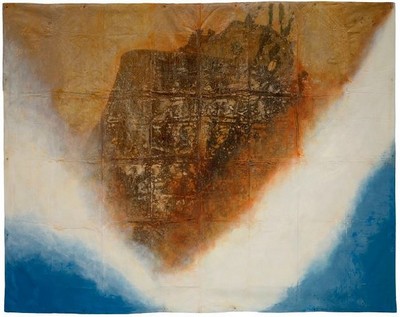
Blue Water, 2018
Mixed media on prepared tarpaulin, 237 x 302 cm
© Hughie O'Donoghue, courtesy Marlborough, London

Marlborough London presents Hughie O’Donoghue: Deep Water and the Architecture of Memory, an exhibition of large-scale works by Hughie O’Donoghue RA (born 1953).

At the core of this new body of work is the artist’s deep-rooted interest in interrogating the way memory is forged through generations. Drawing on his own memories as a child, the substantial works on tarpaulin exhibited in the show depict the MV Plassy which was wrecked in a storm off the coast of Inisheer in 1960. The shipwreck, which has been a recurring motif in O’Donoghue’s practice for over twenty years, has an imposingly theatrical, almost sculptural presence. Glowing with phosphorescent shades of rusty reds and yellows, the ship seems to witness its own slow demise whilst the sea around it remains a continuously moving yet immutable force.

Materiality is a focal aspect of this striking body of work. Primarily using repurposed materials such as sackcloth and sandbags, Hughie O’Donoghue creates an idiosyncratic tension between the realism of his imagery and the physicality of the works. This contrast is achieved through a complex superposition of photographic images with layers of resin, acrylic and oil paint whilst also embracing the irregularities of the materials. The subtly nuanced hues of his compositions are testament to Hughie O’Donoghue’s interest in the tradition of oil painting and were inspired by the lavish colours of Old Master painters such as Titian, whose works he studied as an artist-in-residence at the National Gallery in 1984.

Deep Water and the Architecture of Memory celebrates the artist’s unique ability to excavate history in an almost archaeological manner in order to investigate contemporary questions of memory and identity. Charged with metaphorical, though never fully formulated subject matters, the works in this exhibition invite the viewer to immerse themselves in the artist’s thought and working process, ultimately challenging them to confront their own relationship with identity.

Born in Manchester in 1953, Hughie O’Donoghue lives and works in London and County Mayo, Ireland. He obtained an MA in Fine Art at the Goldsmiths College, London, and was an artist-in-residence at the National Gallery, London, in 1984 and at St John’s College, Oxford, in 2000. Hughie O’Donoghue was elected a member of the Royal Academy of Arts, London, in 2009. His work has been widely exhibited in Britain and Europe. An exhibition of his work will open at the National Gallery of Ireland in March 2022.

The exhibition is accompanied by a fully illustrated catalogue featuring an introduction by Thomas Marks and an essay by Hughie O’Donoghue.

MARLBOROUGH GALLERY
6 Albemarle Street, London W1S 4BY


19/04/21

Victor Pasmore @ Marlborough Gallery, London - Line & Space

Victor Pasmore: Line & Space 
Marlborough Gallery, London 
12 April - 6 June 2021 

Victor Pasmore
VICTOR PASMORE 
Untitled, 1996
Oil, spray paint and pencil on board
121.9 x 121.9 cm
© The Estate of Victor Pasmore, courtesy Marlborough Gallery

VICTOR PASMORE (1908-1998) was one of the greatest British artists of his generation. His pioneering development of abstract art is considered to be one of the most significant achievements in 20th century British art.

Following the success of Victor Pasmore’s exhibition at Hastings Contemporary, this retrospective provides a unique chance to take stock of a major figure in the international abstract movement. His incredibly versatile output was described by former Tate Director Alan Bowness as ‘a succession of metamorphoses that have at various times dismayed, astonished and delighted his admirers … surely one of the outstanding and most original contributions that anyone has made to the art of our time.’ Victor Pasmore holds a unique place in the canon of British art. His work reflects and anticipates the changes that occurred in art and art practice throughout the twentieth century. A career that evolved from the lyrical landscapes of the young artist through the development of a new, pure abstraction to experiments with constructivist sculpture, spray painting, collage and Perspex, and involvement with the planning of Peterlee New Town, made Victor Pasmore one of the foremost exponents and theorists of abstract art. His work, in all its diversity, remains challenging and relevant today.

VICTOR PASMORE was educated at Harrow School, where his interest in painting began. From 1927 he studied under A.S. Hartrick at the Central School of Arts and Crafts, during which time he discovered the School of Paris. In 1933 he was elected as a member of the London Artists’ Association, headed by Roger Fry and Duncan Grant. Robert Pasmore, William Coldstream and Claude Rogers formed an independent private art school, the Euston Road School, in 1937. In 1954 Pasmore was appointed Consulting Director of Urban Design for the South West Area, Peterlee New Town, in Country Durham.

Victor Pasmore held positions as Director of Painting at Camberwell School of Art and Head of the Department of Painting at King’s College, Durham University, as well as lecturing at Harvard University. He was awarded Honorary degrees from the Royal College of Art and the University of Warwick and was appointed CBE in 1959. He became a Trustee of the Tate Gallery in 1963-4 and was elected a Royal Academician in 1983. Victor Pasmore’s work can be found in major museums and public collections worldwide, including Tate Britain (UK), Royal Academy of Arts (UK), Museum of Modern Art (USA), The British Council (UK) and Yale Center for British Art (USA), amongst others.

The exhibition is accompanied by a fully illustrated catalogue with forward by Elizabeth Gilmore, Director Hastings Contemporary, and text by Chris Stephens, Director Holburne Museum, Bath. 

MARLBOROUGH GALLERY
6 Albemarle Street, London W1S 4BY

06/04/19

Joe Tilson @ Marlborough, London - New Paintings

Joe Tilson: New Paintings
Marlborough, London
10 April - 18 May 2019

Joe Tilson
JOE TILSON
The Stones of Venice Sant Alipio (2018)
Courtesy Joe Tilson and Marlborough London

Continuing a year of celebration for his 90th birthday, Marlborough London presents an exhibition of new paintings by Joe Tilson. Following on from his 2016 exhibition, Stones of Venice, this collection continues to draw upon Joe Tilson’s love and knowledge of the city he has visited for over 60 years, bringing together some 18 works on canvas, painted in acrylic with his characteristic use of bright colour and expressively layered texture. This exhibition straddles the unveiling of two exciting public installations by the artist in Venice.

Since the 50’s, Joe Tilson has nurtured a love of Venice, and is celebrated in both his native country and Italy, dividing his time between London, Tuscany and Venice. Since 2002, he and his wife have spent months of each year in their small house in the sestiere of Dorsoduro. In 2018 he was commissioned by the Grand Hotel Hungaria on the Lido to produce some 3,000 glass panels to adorn the façade of the hotel as part of their major renovation. Considering his deep-rooted connections to the city, it is little wonder that Joe Tilson will be recognised at this year’s Biennale with a special commission to be unveiled in May.

Joe Tilson
JOE TILSON
The Stones of Venice Ca' Foscari 2 (2017)
Courtesy Joe Tilson and Marlborough London

As Ruskin’s 200th anniversary is marked in 2019, this continuation on the theme of Stones of Venice is a timely nod to the influence the great art historian and critic has had on Tilson. Ruskin’s 1851-53 examination of Venetian art and architecture of the same title sits applicably in line with Joe Tilson’s latest series of works, depicting façades of his favourite Venetian churches. Paired with bold geometric patterns of the city’s stone flooring, Joe Tilson’s large-format paintings are carefully titled to reveal which particular archway or façade is detailed. The exhibition includes a number of new works from Joe Tilson’s postcard series: images of ecclesiastical buildings embedded in giant sized replicas of The Stones of Venice Sant Alipio (2018) envelopes. A fully illustrated catalogue will accompany the show, with essay by Waldemar Januszczak, critic and broadcaster.

Joe Tilson was born in London in 1928. Following his time in the RAF and training as a carpenter, Tilson studied at St. Martin’s School of Art and at the Royal College of Art in the 1950s alongside Peter Blake, Allen Jones, Patrick Caulfield and David Hockney. His teaching career included spells at St. Martin’s, the Slade and The School of Visual Arts in New York. He was elected a Royal Academician in 2001, becoming a Senior Academician in 2003 when the RA presented a retrospective of his work. In 2018, he marked his 90th birthday with over 100 flags hanging down the length of Regent’s Street as part of the RA’s 250th anniversary celebrations.

MARLBOROUGH LONDON
6 Albemarle Street, London W1S 4BY
www.marlboroughlondon.com

15/02/18

Hughie O’Donoghue @ Marlborough Fine Art, London - Scorched Earth

Hughie O’Donoghue: Scorched Earth
Marlborough Fine Art, London 
15 March - 14 April 2018

Hughie O’Donoghue 
Lavender Field’, 2017-18 
Oil on prepared tarpaulin, 179 x 238 cm. 
Courtesy of the artist and Marlborough Fine Art

Marlborough Fine Art presents Scorched Earth, a solo exhibition of new works by acclaimed British artist HUGHIE O'DONOGHUE.

Hughie O’Donoghue often uses historic events and figures from art history as a point of departure in his work. In this exhibition, the artist questions the legacy of Vincent Van Gogh in our collective cultural memory, particularly focusing on the paintings Van Gogh made during the last two years of his life in Arles and St. Remy in the south of France.

Hughie O’Donoghue 
When the Last Fires Have Burned Out’, 2017-18 
Oil on linen canvas, 125 x 158 cm. 
Courtesy of the artist and Marlborough Fine Art

Technically inventive and on a human scale, Hughie O’Donoghue’s richly worked new paintings revisit and reimagine the imagery observed and invented by Van Gogh as he struggled to make a lucid vision manifest while his health deteriorated in demoralising circumstances. Although personally familiar with Arles, St. Remy and the setting of the Saint-Paul asylum where Van Gogh was a patient, having first visited the area in 1973, Hughie O’Donoghue has chosen to situate these paintings in his own immediate environment: the enclosed fields beside his studio. The subject therefore is brought into Hughie O’Donoghue’s own territory and field of vision.

On show are new large scale paintings which reimagine some of the seminal late works of Van Gogh, in particular the lost painting The Painter on the Road to Tarascon but also The Wheatfield with a Reaper and Enclosed Field with a Peasant, both shown in London as part of The Real Van Gogh at The Royal Academy 2010. The encounter with these two paintings sowed the imaginative seeds in Hughie O’Donoghue that have led to this new body of works.

Hughie O’Donoghue 
Photography by Anthony Hobbs 
Courtesy of the artist and Marlborough Fine Art

HUGHIE O'DONOGHUE 

Born in Manchester in 1953, Hughie O'Donoghue lives and works in London and County Mayo, Ireland. He was elected member of the Royal Academy of Arts in 2009 and to Aosdána (an Irish association of artists) in 2013. He has been an artist-in-residence at the National Gallery, London and St John’s College, Oxford. He received an Honorary Doctorate from the National University of Ireland in 2005. Since 2011 the artist’s work has been represented by Marlborough. His work has been exhibited widely in Britain (including solo exhibitions at: Leighton House Museum, London, 2016; University Gallery, Newcastle, 2013; Abbot Hall Art Gallery, Kendal, 2012; Leeds City Art Gallery, 2009; Imperial War Museum, 2003; Fitzwilliam Museum, Cambridge and touring, 2001-03; and Whitworth Art Gallery, Manchester, 1999), as well as in Ireland, Germany, France, Holland and the Czech Republic.

A fully illustrated catalogue with an introduction by Martin Gayford accompanies the exhibition.

MARLBOROUGH FINE ART  
6 Albemarle Street, London W1S 4BY
www.marlboroughlondon.com

26/01/18

Magdalena Abakanowicz @ Marlborough Gallery, New York

Magdalena Abakanowicz: Embodied Forms
Marlborough Gallery, New York
February 7 - March 10, 2018

Magdalena Abakanowicz
Abakan Rouge III, 1971
Sisal weaving
127 x 78 3/4 in., 322.6 x 200 cm 
© the Estate of Magdalena Abakanowicz and Marlborough Gallery, New York

Marlborough Gallery presents Embodied Forms, the first exhibition dedicated to the work of Magdalena Abakanowicz since her recent death at the age of 86. Opening on Wednesday, Februrary 7, the exhibition will feature a broad selection of the artist’s work ranging from 1971 to 2009, including key works from four of her series: Abakans, Crowds, War Games and Coexistence.

Magdalena Abakanowicz is recognized as one of the most unique and potent voices in contemporary art. Her installations and sculptures, at once beautiful and unsettling, are a reminder of the fragile nature of the human condition. As a child, the artist endured the trauma of living in occupied Poland during WWII. This experience prompted a lifelong awareness of existential concerns and a unique sculptural vocabulary. She said of that time, “When I was 12 in 1942, one could only escape from human cruelty inside oneself (into a world of dreams, imaginings)”. This kind of mental departure – self-defense against omnipresent propaganda and destruction – informed her artistic output for decades to come.

In the early 1960s, when fiber objects were considered “craft” as opposed to “art,” Magdalena Abakanowicz taught herself how to dye and weave discarded rope to create the immense, suspended, anatomical forms within her small living space in Warsaw. The works defied easy classification and stood against any established definitions. Marlborough is delighted to exhibit a selection of these woven sisal works, known as the Abakans. “Monumental, strong, soft and erotic,” Abakanowicz writes, “these objects became the image of my reality.”

Beginning in the 1980s, Magdalena Abakanowicz channeled her deeply personal feelings about loss, isolation, displacement and regeneration into sculptures of crowds—figures in burlap and later, bronze, that articulate both the harmony and rupture within multitudes. Shown in the exhibition will be the artist’s Coexistence, a group of 13 burlap figures from 2002, and concurrently showing at Marlborough Contemporary, at 545 W. 25th Street, 2nd Floor, will be Crowd IV, a group of 24 figures realized between 1989 and 1990. Addressing the theme of multitudes, the artist writes:
I feel overawed by quantity where counting no longer makes sense. By unrepeatability within such a quantity. By creatures of nature gathered in herds, droves, species, in which each individual, while subservient to the mass, retains some distinguishing features… A riddle of nature’s abhorrence of exact repetition or inability to produce it. Just as the human hand cannot repeat its own gesture. I invoke this disturbing law, switching my own immobile herds into that rhythm. 

Magdalena Abakanowicz
Coexistence (13), 2002
Burlap, each unique
Dimensions variable
© the Estate of Magdalena Abakanowicz and Marlborough Gallery, New York

In addition, the exhibition will include three major works from the artist’s War Games series: Marrow Bone, Errant and Kos. This series was first presented in the United States in 1993 in a solo exhibition curated by Michael Brenson at MoMA PS1. Both broken and indestructible, each work articulates a different personality imbued with its own tragedy and capacity for violence.

During her lifetime, Magdalena Abakanowicz had over 150 solo exhibitions in Europe, North and South America, Japan, South Korea, and Australia. In 1999, the Metropolitan Museum of Art, New York, held an exhibition entitled Abakanowicz on the Roof, a solo presentation of the artist on the museum’s rooftop. That same year, the Jardins du Palais Royal in Paris held an exhibition for the artist. Among numerous prizes and distinctions, Magdalena Abakanowicz received seven honorary doctorates from universities in Europe and the United States as well as the Commandeur de l’Ordre des Arts et des Lettres from France and Cavaliere dell’Ordine al Merito della Repubblica Italiana. She was also awarded the prestigious International Sculpture Center’s Lifetime Achievement award in 2005 as well as the Grand Cross of Merit (Großes Verdienstkreuz mit Stern) from the Federal Republic of Germany in 2010.

In the past thirty years Magdalena Abakanowicz developed a number of site-specific sculpture installations that incorporate multiple figures or elements of increased scale. Among these are Negev at the Israel Museum, Jerusalem, 1987; Space of Dragon, Olympic Park, Seoul, South Korea, 1985; Becalmed Beings, Hiroshima City Museum of Contemporary Art, Hiroshima, Japan, 1993; Space of Unknown Growth, Europos Parkas, Vilnius, Lithuania, 1997-98; Unrecognized, Citadel Park, Poznan, Poland, 2002; Space of Stone, Grounds for Sculpture, Hamilton, New Jersey, 2003; and her last major public work, Agora, a sculptural group comprised of 106 unique cast-iron figures measuring over nine-feet tall permanently installed in Chicago’s Grant Park in 2006.

Magdalena Abakanowicz’s work can be found in numerous public collections including the Israel Museum, Jerusalem, Israel; Ludwig Museum, Cologne, Germany; Musée National d’Art Moderne, Centre Georges Pompidou, Paris, France; Stedelijk Museum, Amsterdam, the Netherlands; Museum of Contemporary Art, Chicago, Illinois; Museum of Modern Art and The Metropolitan Museum of Art in New York, New York; Nasher Sculpture Center, Dallas, Texas; National Gallery of Art, Washington, D.C. and the Sezon Museum of Modern Art, Karuizawa, Japan, among others.

Magdalena Abakanowicz joined Marlborough Gallery in 1989, where she presented over twenty solo exhibitions. Marlborough Gallery is grateful to Professor Mary Jane Jacob for her help in the realization of this exhibition. An illustrated catalogue will be available at the time of the exhibition. 

MARLBOROUGH GALLERY 
40 West 57th Street, New York, NY 10019
www.marlboroughgallery.com

01/05/04

Red Grooms at Marlborough Gallery, New York - New Works in Wood

Red Grooms, New Works in Wood 
Marlborough Gallery, New York
May 6 – June 5, 2004

Since 1976 when Red Grooms had his first exhibition at Marlborough of Ruckus Manhattan he has staked his claim as one of America’s most original, inventive, and popular artists. His work combines the sophistication of high art with the naiveté of folk art and the caricature of the cartoonist. The current exhibition includes one large oil on canvas and approximately twenty-five of the artist’s hallmark dimensional constructions which meld painting and sculpture. The painting entitled Manet at the Met (78 1/4 x 120 1/2”) is bound to be one of the show’s highlights. It portrays a large room at The Metropolitan Museum where Red Grooms has painted the various Manet works on view. The gallery is “ruckused” with a veritable comédie humaine of art goers while Red Grooms shows off his anecdotal ability to make characters believable. 

The medium for all the dimensional works in this show is acrylic on wood and among the several stand out pieces the largest is based on a gangster funeral. Measuring approximately seven by ten feet the scene of Death in the Family is set in the 1930s and we see FBI agents in the process of surveillance, peering through Venetian blinds as the gangsters load the coffin into a hearse. Another eye-catching work entitled Joseph’s Bridge has for its genesis the famous painting by Joseph Stella of the Brooklyn Bridge set against the New York skyline. In Red Grooms’ adaptation we see the bridge from the same vantage point as in Joseph Stella’s painting but the bridge is now projected into space and the footbridge is peopled by joggers, bicyclists and tourists while their general bustle is echoed by the repeating forms of the suspension cables and in the movement of car traffic on the ramps below and by the motoring of boats in the East River. The bright colors of the painting enhance the scene’s boisterous activity and overall radiant joyfulness.

It could be said that Red Grooms’ work is theatrical in nature, that it conveys through his special, resonant colors the buoyant feeling of a circus atmosphere, and that it is entertaining. “He is living proof that art can be fun,” and as another critic has pointed out, “the vibrant hues and dynamic motion of his work capture the energy of the circus in a way which immediately calls to mind the renderings of the very same subject in late 19th century art of Seurat and Signac.” Grooms himself once stated, “As a kid I was mad about the theater, absolutely mad about it. Circuses, carnivals, movies, it didn’t matter what they were. All of them are theater to me.” While the spirit of the theater indeed informs much of his work, one must remember, however, as Clare Henry rightly pointed out in Sculpture Magazine that Red Grooms’ large scale figurative tableaux are more than mere entertainment: “A superb draftsman with a keen, unforgiving eye yet easy going, light touch, he translates a lifetime’s acute observation (laced with strong satire) into bright Pop Americana with universal appeal. Caricature is often vicious and Grooms can offer a no-holds-barred message with bite. But he stops short of the malicious in favor of the benign commentary on human frailties with which we can all identify. Such humanity and honesty imbues his stereotypes with conviction.”

RED GROOMS was born in Nashville, Tennessee in 1937. He studied at the School of the Art Institute of Chicago, the New School for Social Research in New York City and at the Hans Hoffman School of Fine Arts in Provincetown, MA. Along with developing the painted relief as both a painting and sculpture, Grooms invented the three dimensional form called sculpto-pictorama that allows the viewer to walk through and interact with an environment created by the artist’s vision. He has had three retrospective shows: in 1985 at the Pennsylvania Academy of Fine Arts, in 1987 at the Whitney Museum, and in 2001 at the National Academy of Design of his graphic work. This last exhibition traveled to eight other venues through 2004. He has also been honored with several important survey exhibitions, of which two recent ones were at Grounds for Sculpture in Hamilton, NJ in 2000 and at the Katonah Museum, NY in 2003. The Frist Center for Visual Arts, Nashville, TN, will present an exhibition of Red Grooms’ work from May 7 - October 10, 2004.

He has received numerous awards and commissions throughout his career. His most recent award is the Lifetime Achievement Award given by the National Academy of Design in 2003. His most recent major commissions are a large (132 x 188 x 88”) painted aluminum and plastic sculpture entitled Piragüas de Frambuesa (Raspberry Shaved Ice Cone) for Coamo, Puerto Rico to be completed in 2004; a monumental cyclerama and accompanying canvases for Shelly’s Restaurant, in New York in 2000; the permanent outdoor installation entitled Tennessee Fox Trot Carousel in Nashville in 1998; and a permanent outdoor sculpture commissioned by the City of Nagoya, Japan in 1996. Grooms’ additional artistic activities include happenings, filmmaking and theater designs. The artist lives and works in New York City.

Red Grooms’ work can be found in thirty-nine museums throughout the world. Among them are the following: American Museum of the Moving Image, Astoria, NY; The Art Institute of Chicago, IL; The Brooklyn Museum of Art, NY; The Butler Institute of American Art, Youngstown, OH; Carnegie Museum of Art, Pittsburgh, PA; The Chrysler Museum, Norfolk, VA; The Cleveland Museum of Art, OH; Delaware Art Museum, Wilmington, DE; Des Moines Art Center, IA; The Denver Art Museum, CO; Fort Worth Art Museum, TX; Solomon R. Guggenheim Museum, New York, NY; Hirshhorn Museum and Sculpture Garden, Washington, DC; Nagoya City Art Museum, Japan; The Metropolitan Museum of Art, New York, NY; Moderna Museet, Stockholm, Sweden; Museum of Contemporary Art, Chicago, IL; Museum of Modern Art, New York, NY; The Pennsylvania Academy of Fine Arts, Philadelphia, PA; Philadelphia Museum of Art, PA; Whitney Museum of American Art, New York, NY.

In June 2004 Rizzoli will publish a new monograph on Red Grooms entitled Red Grooms with essays by Arthur Danto and Marco Livingstone and an interview with the artist by Timothy Hyman.

In collaboration with Marlborough’s exhibition will be a show of the artist’s watercolors and prints at the Tibor de Nagy Gallery. Entitled The Private World of Red Grooms the exhibition will run from April 29 to May 28, 2004.

MARLBOROUGH GALLERY 
www.marlboroughgallery.com

01/11/98

Fernando Botero at Marlborough Gallery, NYC - Drawings and Watercolors on Canvas

FERNANDO BOTERO
Drawings and Watercolors on Canvas
Marlborough Gallery, New York
November 4 - December 5, 1998

Marlborough Gallery presents an exhibition by the world renowned Colombian artist, Fernando Botero. Botero was born in Medellin, Colombia in 1932. He moved to Bogota in 1951 where he had his first one-man show at the age of nineteen. He presently lives and works in Paris, France and Pietrasanta, Italy.

The exhibition is comprised of approximately thirty large-scale drawings on canvas and includes portraits, still lifes, and scenes of family and city life. The drawings are executed in the mediums of charcoal, sanguine and watercolor and range in size from an average of about 50 by 40 inches to a monumental triptych measuring 7 by 14 feet entitled The Street. In this “tour de force” sanguine drawing, certainly one of the largest ever done by an artist, there are three arenas of action bound together and unified structurally by a giant slabbed sidewalk and an extended row of houses that form a contiguous frieze-like background in each panel. In the left panel a man wearing a suit and tie and bowler hat is having his shoes shined by a tiny figure in tattered striped pants and a baseball cap, while a beautiful woman passes by nonchalantly holding a parasol and each character seeming to be oblivious to one another. In the center panel, another woman whose voluptuous curves are shown off in her white polka dot dress and elegant necklace walks her little dog and is greeted by a gallant gentleman tipping his hat to her. In the right panel, a grand, aproned nanny is taking an enormous child out for a daily stroll in a baby carriage while in the lower corner a plump dog squats facing forward, alone in his awareness of the viewer, and in the upper corner a man’s small head appears looking out a window intrigued by all the goings on in The Street. In another drawing of striking fascination, Portrait of Velasquez, Fernando Botero carries on his long established tradition of creating in his inimitable style portraits of artists he admires. In this full length portrait Velasquez is seen as a courtly gentleman holding a brush in his right hand and a palette in his left. The drawing rendered in rich, deep charcoal conveys the elegance of the artist’s clothes and with touches of sanguine in the sashes of the artist’s pantaloons and in the cross emblazoned on the front of his waist coat, charm and delicacy are added to Fernando Botero’s monumental interpretation. All the drawings in this exhibition bear witness to an inventive imagination and a phenomenal draftsmanship both in the artist’s facility to draw any subject he chooses and in the wide range and variations of effects that his drawing skills can achieve. Fernando Botero’s drawings can be dramatic and monumental as in the case of many of the works in this show and also as in other drawings, graceful and expressive of the most refined lyricism. There is no question that, generally speaking, behind every great artist lies a great draftsman. This drawing exhibition demonstrates beyond any doubt the accomplished mastery of a great artist.

Fernando Botero’s work is distinctly his own and highly original. His art strikes a universal human chord that goes beyond regional tastes and temporal values and reaches a fundamental feeling in people all over the world. There is, perhaps, no other living artist who has so many admirers and collectors. His work is sought-after as much in the United States, South America, and Europe as it is in South Africa, Asia, and Australia. Asia Pacific Sculpture News attributed this phenomenon to “a vision of humanity that transcends the boundaries of cultural specificity, a vision of humanity that pulsates to the ancient universal rhythms of life.”

Fernando Botero has had innumerable one-man exhibitions. In the last five years alone he has had over thirty exhibitions worldwide devoted solely to his work. Among the most prominent museum exhibitions are the following: Forte de Belvedere, Florence, Italy (1991); Kunst Haus, Vienna, Austria (1992); Grand Palais, Paris, France (1992); Palais des Papes, Avignon, France; Pushkin Museum, Moscow, Russia; Hermitage Museum, St. Petersburg, Russia (1992-93); Helsinki City Art Museum, Finland (1994); The Chicago Cultural Center, Illinois (1994); Museo Nacional de Bellas Artes, Buenos Aires, Argentina (1994); Shinjuku Mitsukoshi Museum of Art, Tokyo, Japan (1995); The Israel Museum, Jerusalem (1996). He has had highly successful outdoor exhibitions of his monumental sculptures in Monaco, Paris, New York, Chicago, Fort Lauderdale, Los Angeles and Washington, D.C.

Fernando Botero’s work can be found in forty-six museums. Among the most prominent are: The Baltimore Museum of Art, Maryland; Israel Museum, Jerusalem; The Metropolitan Museum of Art, New York; Hirshhorn Museum and Sculpture Garden, Washington, D.C.; Museo de Arte Contemporaneo de Caracas, Venezuela; Museo de Arte Moderno, Bogota, Colombia; Museo Nacional de Bellas Artes, Santiago, Chile; The Museum of Modern Art, New York; Neue Pinakothek, Munich, Germany; Pushkin Museum, Moscow, Russia; The Solomon R. Guggenheim Museum, New York; Wallraf-Richartz Museum, Cologne, Germany; and The State Hermitage Museum, St. Petersburg, Russia. Many books have been published on Botero’s work in English, Spanish, French, German, Italian, Chinese and Japanese.

A fully illustrated catalog of the Fernando Botero show is available.

MARLBOROUGH GALLERY
40 West 57th Street, New York, NY 10019
www.marlboroughgallery.com

05/12/97

Vincent Desiderio, Marlborough Gallery, New York - Recent Paintings Exhibition

Vincent Desiderio: Recent Paintings 
Marlborough Gallery, New York 
December 2, 1997 - January 3, 1998

Marlborough New York presents en exhibition of recent paintings by VINCENT DESIDERIO (b. 1955). The exhibition consists of fifteen oil paintings, including nine in triptych form, painted during the past four years.

For Vincent Desiderio, the importance of painting to the life of the imagination is absolute. The act of painting makes available to the artist realms of understanding which are unforseeable outside of its processes. It is through the narrative, the fictional reconstruction of events, both personal and public, that Desiderio attempts to chart the vague and often elusive character of man at the end of the 20th century.

The works are composed in rich tonalities with optical layerings of cool and warm color. Viewing them, the visitor is conscious of a strong connection with pre-modernist painting. Yet, it is with an informed and discerning eye that Vincent Desiderio aligns himself with his historical antecedents. The process of creating the works takes a central place serving as a metaphor for being. What is most intriguing to him is the strong connection between his process and how one thinks through an image to its final resolution. Vincent Desiderio's technique, in fact, allegorizes the artist's quest for a replenished imaginative space.

Though Vincent Desiderio is undisputedly a painter of reality, that description alone only begins to describe what he accomplishes in his work. His intense blend of autobiography and dislocation, reveal him as influenced by existential thought and experience as well. The results are the portrayal of seemingly real situations through a dreamlike veil of trance and trauma.

In the painting entitled The Interpretation Of Color, the levels of meaning begin to reveal themselves from the choice of its title onward. Vincent Desiderio pays homage to his modernist past choosing a title which refers to Joseph Albers' life-long work (The Interaction Of Color). The painting's subject is a figure who, overfed on culture, has collapsed on the floor in a post-prandial stupor. Around him, one sees the emblems of his history. Art texts strewn about evoke a spiral of centrifugal movement. The nuanced paint handling contributes to the effect of slow movement as one descends into the vortex of this vertiginous space. He is a man of the land of Cockaigne, the mythical realm of human excess, conjuring in his slumber a narrative regarding the whole future of painting.

In the triptych entitled Mimetic Composition, three images present contrasting visions recording grief. In the center, a haunting image of a man's face appears as if staring into a mirror. Thus, the image of the sick man symbolizes passage through life. To the right, a wedding banquet or birthday celebration is set up for video-taping. But at the same time, it is abandoned and frozen in time, becoming a metaphor for the desire to record the celebration of events as if to eulogize them. Finally to the left, the most receding of the panels presents a life cast of a woman's face grimacing. It represents the inability of the signifier and the signified to meet, or the failure of words or images to touch the object itself. Vincent Desiderio's work continues to explore life's deeply rooted mysteries, hopes, and fears in a taught balance of change and stasis.

Born in Philadelphia in 1955, VINCENT DESIDERIO joined Marlborough Gallery in 1991, and had his first one man show in 1993. He has exhibited extensively in galleries and museums worldwide and his works are included in numerous private and public collections including The Metropolitan Museum of Art, New York; the Denver Art Museum; the Everson Museum of Art, Syracuse, NY; Galerie Sammlung Ludwig, Aachen, Germany; the Greenville County Museum of Art, Greenville, SC; and the Indiana University Museum of Art, Indiana, PA; among others.

In 1996, Vincent Desiderio became the first American artist to receive the prestigious International Prize of Contemporary Art presented by the Monaco-based Prince Pierre Foundation.

Beginning January 7th., three exhibitions, Motherwell: Works On Paper, Juan Genovès: Works On Paper and Still Lifes: Prints & Photographs will be on view continuing through the month of January, 1998.

MARLBOROUGH GALLERY
40 West 57th Street, New York, NY 10019
www.marlboroughgallery.com

08/11/97

Icon / Iconoclast at Marlborough Chelsea, NYC - An Exhibition of Works by: Francis Bacon, Francesco Clemente, David Hockney, Robin Kahn, Alex Katz, R.B. Kitaj, Ouattara, Ad Reinhardt, Philip Taaffe, Fred Tomaselli, Terry Winters, Curated by Raymond Foye

Icon / Iconoclast
Marlborough Chelsea, New York
November 8 - December 27, 1997

An Exhibition of Works by:

Francis Bacon
Francesco Clemente
David Hockney
Robin Kahn
Alex Katz
R.B. Kitaj
Ouattara
Ad Reinhardt
Philip Taaffe
Fred Tomaselli
Terry Winters

Curated by Raymond Foye

Marlborough Chelsea presents an exhibition of paintings, Icon/Iconoclast. The exhibition, consisting of one work each by eleven artists, is about the persistent power of images in modern life. Even though creative strategies in the arts have varied widely in the past three decades, challenges to pictorialism seem only to strengthen the hold that certain images possess over us. Attempting to break or destroy imagery, artists have, in fact, created entirely new pictorial conceptions expanding our definition of what constitutes a picture. This paradox is expressed by the title of the exhibition.

Beginning with Ad Reinhardt's black painting as an ultimate statement of both the iconic and the iconoclastic impulses in art, the exhibition explores the many ways in which contemporary painters have sought to re-define the image within the formal traditions of Western art. 

Like Ad Reinhardt, Francis Bacon has served as a touchstone for subsequent generations of artists: in this case, painters who have sought to pursue aspects of figuration, portraiture, and the passions of the flesh. Yet, the attempt to instill in modern painting the secular equivalence of the experience of ecstasis - so integral to the art of the Renaissance - was a lifelong preoccupation with both these artists, each in their own way.

The iconic image stands as an object of mediation and contemplation and embodies a system of belief which may be communicated through narrative, metaphor, or allegory. The painters chosen in this exhibition may all be characterized by their commitment to expanding conceptions of picture-making by means of investigating the image itself. The mistrust for iconoclastic images, which persists to this day, springs from similar origins: that artists are conjurers of illusions, and may propagate false beliefs. Recently, similar criticism has been most sharply directed at artists employing figuration and representation such as David Hockney, R.B. Kitaj, Alex Katz, and Francesco Clemente.

In the work of Philip Taaffe and Fred Tomaselli, figurative elements are deployed in the service of abstraction while preserving the flatness and frontality of the icon. Both artists explore a diagrammatic language akin to the mandala or symbolon: ritual configurations that speak to the inner working of an image and its correspondence to archaic forms. The wider perspective of the primacy of the aesthetic experience itself is the basis of the work of Terry Winters whose imagery finds its analogy in the complex nexus of biology and cognitive science.

Conceptualizations of the female body and aspects of women's roles in society have been the subject of recent work by Robin Kahn who draws on sources as diverse as history, alchemy and anthropology. The legacy of symbols which is the inheritance of iconography from Medieval and Renaissance times have functioned as source material for many of her works. In the work of Ouattara, an African artist from the Ivory Coast, the icon comes closest to its animist origins as mediator between the worlds of the human and the divine.

All of the living artists in Icon/Iconoclast are represented by new work. A centerpiece of the exhibition is a major ensemble of paintings and drawings by R.B. Kitaj constituting a single work, The Killer Critic Assassinated by his Widower, Even, (1997). The subject of a controversial exhibition earlier this year at London's Royal Academy, the work is a visual rebuttal to the critical malign following Kitaj's retrospective and the subsequent death of his wife, Sandra, events which the artist relates in the work itself. It is Kitaj's farewell address to London, a final salvo launched at the same philistine cultural establishment that Ezra Pound once lampooned in his famous suite of poems, Hugh Selwyn Mauberley.

Icon/Iconoclast has been organized by Raymond Foye. Along with Francesco Clemente he is co-publisher of Hanuman Books, a press devoted to poetry, Hinduism, and writings by artists (a list that include William Burroughs, Rene Ricard, Francis Picabia, Willem deKooning, Cookie Mueller, René Daumal, Jack Kerouac, Robert Frank, Max Beckmann, Patti Smith and others). He has curated (with Ann Percy) a full scale retrospective of the works of Francesco Clemente, Three Worlds (Philadelphia Museum of Art), and over the past twenty years has edited books, catalogues and livres d'artiste by numerous artists in the exhibition, including David Hockney, R.B. Kitaj, Philip Taaffe, Terry Winters and Francesco Clemente. His published works on poets and poetry include James Schuyler (Farrar, Strauss & Giroux), John Wieners (Black Sparrow Press), Bob Kaufman (New Directions) and Edgar Allan Poe (City Lights Books). He presently lives and works in New York City.

MARLBOROUGH CHELSEA
211 West 19th Street, New York, NY 10011
www.malgoroughgallery.com

29/10/97

Larry Rivers, Marlborough Gallery, New York - Fashion and The Birds

Larry Rivers: Fashion and The Birds
Marlborough Gallery, New York
October 29 - November 29, 1997

Marlborough Gallery presents an exciting exhibition of new work by the inimitable American painter, Larry Rivers. This is Larry Rivers' twelfth one-man show at Marlborough since his joining the gallery in 1964. Larry Rivers was born Yitzroch Loiza Grossberg, in the Bronx, New York in 1923 to Russian Jewish immigrants. He began his career in music as a jazz saxophonist. In 1947, at the suggestion of a friend, he began to paint at Hans Hoffman's school in Provincetown, Mass. His success was such that two years later he was given his first New York show. In 1950, Clement Greenberg and Meyer Schapiro selected him to be part of a New Talent show, and since that time he has become one of America's most important and innovative painters.

Larry Rivers' exhibition is comprised of approximately twenty-five paintings and ten drawings. Larry Rivers likes to work in a series using a central subject such as in his previous show called Art and the Artist. In this show, many of the works are based on a series derived from his recent interest in James Audubon and The Birds of America. (His first painting based on this subject was painted in 1985/86, entitled Twenty-five Birds of the Northeast, taken from a place mat at his table at his favorite diner). Among the new works are two brilliant portraits of Audubon as well as several works devoted to single bird studies such as a striking Great Blue Heron (50 x 48 inches), Black Neck Stilt (30 x 34 inches) and Comorant (48 x 40 inches). In other works, Larry Rivers has taken female models from the world of fashion and mixed them with bird images creating an intriguing visual Gestalt from separate elements of experience and emotion. This eclectic mixture is at once provocative, surprising, and enjoyably fresh. The medium for these works is based in some cases on the relief technique which Larry Rivers has developed into his own personal style. In some of these, he has deepened their relief increasing thereby the work's tactile exuberance. In other works, Larry Rivers has continued to use the flat canvas to magnificent expressive effect.

What stands out in all Larry Rivers' work is the superiority of his draughtsmanship, the lightness of his touch, the presence of his hand, and a unique color palette. It has been said that "Rivers' stubborn individualism has become his signature." He has been called a "maverick and innovative artist," "enterprising and mercurial," "a reactionary." Art International called him "contrariness incarnate." Rivers himself has said, "I have my own agenda," reflecting Arthur Jones' statement that "Rivers has constantly challenged the status quo." Rivers was painting figurative works when the tide was high on Abstract Expressionism. He was the first American artist to use commercial images in fine art which led the London Sunday Telegraph later to call him "the grand old man of Pop Art." In the same article, the Telegraph said Larry Rivers "has always stayed true to his talent as a figurative draughtsman and interested in relating the contemporary image to the tradition of western painting." In his brilliant new work, Rivers once again adds to the lexicon of stimulating contemporary images that one hasn't seen before. Rivers' style has always been hard to pin down. John Ashberry, who described Rivers' work as "handsome and dazzling original," summarized that "Rivers has always been out of sync" and Roberta Smith of the New York Times called him "a consummate synthesizer who seems to have considered any artist or art work fair game." But perhaps the wellspring for the strength, sensitivity and enormous individuality by which his work can be measured has been best sounded by John Gruen who wrote the following:
"Early on, Rivers had developed a painting style he could call his own. It might be categorized as being semi-abstract, semi-realistic, pop-artist, post-romantic, or neo-classic. But whatever the label, it reflected (and still does) an untrammeled imagination, an extraordinary draughtsmanship, a color sense that has no truck with garishness or vulgarity, and an innate vitality that springs from Rivers' own restlessness and reflects itself with charged-up spontaneity, into whatever he paints."
Larry Rivers is represented in numerous public collections in the United States. Among them are the following: The Baltimore Museum of Art; The Art Institute of Chicago; Dallas Museum of Art; De Menil Foundation, Houston; The Nelson-Atkins Museum of Art, Kansas City; Los Angeles County Museum of Art; The Minneapolis Institute of Art. In New York City, he is represented in the Solomon R. Guggenheim Museum, The Jewish Museum, the Metropolitan Museum of Art, the Museum of Modern Art and the Whitney Museum of American Art. In Washington, D.C., he is represented at the Corcoran Gallery of Art, the Hirshhorn Museum & Sculpture Garden and the National Gallery of Art. He is also represented by the Tate Gallery, London, the Museo Rufino Tamayo, Mexico City and the Museo de Arte Contemporaneo, Caracas.

An illustrated color catalogue of the Rivers Fashion and The Birds is available.

This exhibition is accompanied in the small gallery by a show of small sculptures by Arnaldo Pomodoro.

Following Larry Rivers' exhibition in December will be an exhibition of paintings by Vincent Desiderio.

MARLBOROUGH GALLERY
40 West 57th Street, New York, NY 10019
www.marlboroughgallery.com

05/10/97

Landscape Painter Tomas Sanchez joins Marlborough Gallery

LANDSCAPE PAINTER TOMAS SANCHEZ 
JOINS MARLBOROUGH GALLERY

Marlborough Gallery announces that the esteemed landscape painter, TOMAS SANCHEZ, has joined its stable of artists.

Tomas Sanchez was born in 1948 in Cuba. He graduated in 1971 from the National School of Art in Havana. In 1980, he won first place in the 19th International Juan Miro Prize of drawing in Barcelona and in 1981 had his first one-man show of drawings at the Miro Foundation in the same city. In 1984, he won the Amelia Palaez National award for painting in the first Biennial of Havana and the following year he was honored by his first retrospective exhibition at the National Museum of Fine Arts in Havana. In 1988, Tomas Sanchez, received Cuba's National Culture Merit Award given by the State Council. He has had several successful exhibitions in South America, Mexico and Florida where the artist now lives and works. His most recent exhibition (1996) was a one-man show at the Museum of Art in Fort Lauderdale, Florida.

There are currently two books published on Tomas Sanchez's work: Tomas Sanchez and His Pictorial Universe (Palette Publications, 1996) and Tomas Sanchez, Paisaje Interior (Petroleos Mexicanos, 1994). Writing in the text to the former work, Roberto J. Cayuso says that Tomas Sanchez can be associated with Spanish realist painters who understand their art not from a photographic vision, but born from meditation and...prompted by life and authentic visual perceptions. Continuing, he states:

When we admire one of his landscapes, whether it deals with junkyards or interpretations of nature, the first thing that impresses us is the surprising magnificence of the theme and then, the treatment of it. Here, we can almost count the leaves of the trees and the waves of the waters. His clouds seem to be pieces of cotton torn and tossed by the wind that create an exquisite symphony of lights and colors without neglecting the smallest detail, however small it may be. He delivers us with a work of lyricism and unsuspected yearnings.

MARLBOROUGH GALLERY
www.marlboroughgallery.com

07/09/97

Marlborough new gallery in Chelsea, Manhattan's newest art district

MARLBOROUGH GALLERY, NEW YORK, 
TO OPEN A NEW GALLERY IN CHELSEA

Pierre Levai, Director of Marlborough Gallery, New York, has announced that Marlborough will open a gallery in Chelsea, Manhattan's newest art district, on September 18, 1997. The addition of Marlborough Chelsea marks the ninth venue for Marlborough, which, in addition to its 57th Street location in Manhattan, has galleries in London, Madrid, and Santiago, Chile, and offices in Buenos Aires, Hong Kong, Tokyo and Zurich.

Marlborough Gallery's program in Chelsea will include exhibitions of work by artists represented by Marlborough as well as exhibitions organized by independent curators that will feature artists represented by Marlborough in addition to other artists. Furthermore, Marlborough Chelsea will house the offices of International Public Art, Ltd. the independent corporation of Marlborough Gallery Inc. formed last fall, which-under the direction of Dale M. Lanzone, formerly Director of the United States Federal Government's public art program-is committed to the development of international public art projects, with an emphasis on the integration of art, architecture, and the urban and natural environments.
"Marlborough Chelsea provides an excellent opportunity for us to continue our commitment to an expanded international presence on behalf of our artists. Moreover, the new gallery will give us an alternate forum to mount exhibitions that are unique and separate from Marlborough Gallery's 57th Street program," stated Pierre Levai.
Located at 211 West 19th Street, Marlborough Chelsea is comprised of architectural elements characteristic of downtown exhibition spaces. The 4,000 square-foot, glass storefront-which has been designed by Mr. Lanzone in collaboration with architect Eli King-features 14 foot ceilings, a concrete floor and a central row of columns.

The Marlborough Chelsea inaugural exhibition, which will be on view September 18 through October 25, will feature large-scale sculpture by gallery artists Magdalena Abakanowicz and Sir Anthony Caro, as well as Louise Bourgeois. This is Anthony Caro's first exhibition with Marlborough since joining the gallery this month. Marlborough Chelsea, 211 West 19th Street, opens to the public Thursday, September 18th. 1997. Gallery hours are Tuesday to Saturday from 10:00 a.m. to 5:30 p.m. 

MARLBOROUGH GALLERY
www.marlboroughgallery.com

03/09/97

British sculptor Anthony Caro - Marlborough Gallery - The artist is represented by the gallery in the USA

BRITISH SCULPTOR SIR ANTHONY CARO 
REPRESENTED BY MARLBOROUGH GALLERY 
IN THE USA

Marlborough Gallery, New York, announces that renowned British sculptor Sir Anthony Caro has joined the gallery and will be represented by Marlborough throughout the United States.

Sir Anthony Caro was born in Surrey, England in 1924. He attended the Royal Academy in London and, during that time, served as assistant to sculptor Henry Moore. Throughout his career Sir Anthony has been a dedicated educator, holding teaching positions at St. Martin's School of Art in London and Bennington College in Vermont. In 1982, he founded the Triangle Artists' Workshop, an annual gathering of sculptors and painters in Pine Plains, New York. In 1987, he was knighted for his contribution to art. Sir Anthony Caro lives and works in London.

One of the most accomplished and respected sculptors working today, Sir Anthony's work is among the most innovative of the 20th century. He has been a driving force in contemporary sculpture, and as a teacher has inspired an entire generation of younger British sculptors including Barry Flannagan, Richard Long, William Tucker, Bruce McLean and Gilbert & George. His sculptural language has evolved over the years to include works in various materials ranging from steel in different forms such as I-beams and ship's buoys, to ceramic, bronze, silver, lead and wood. Sir Anthony is continuously reinventing his art by challenging his own perceptions of scale and exploring new means with which to express his artistic vision.

Sir Anthony Caro first came to the forefront of the British contemporary art scene in the early 1960s, when he began to produce abstract, welded steel sculpture, painted in bright colors. In 1966, Sir Anthony turned his attention toward small-scale steel forms. His best-known work of this period is a series called Table Pieces. Unlike his large-scale steel sculptures which were set directly on the ground, these smaller-scale sculptures rested on table tops, making the table itself an integral part of the work. In the 1970s, he began to examine sculpture on a monumental scale and abandoned his use of painted steel for materials such as raw, unfinished steel, iron, bronze and wood. In May 1970, while a critic for The New York Times, Hilton Kramer wrote of Sir Anthony: "He is unquestionably the most important sculptor to come out of England since Henry Moore...One has the impression of an artist who, having totally mastered a new and difficult area of sculptural syntax, is now permitting himself a freer margin of lyric improvisation".

Since 1980, Sir Anthony has been predominantly interested in architecturally related sculpture. He was profoundly moved by a trip he made to Greece in 1985, in which he marveled at the relationship between the sculpture and architecture at such sites as the Parthenon, Delphi, Mycenae and Olympia. In 1987, he executed a series of works inspired by Greek pedimental sculpture, including After Olympia, a monumental work inspired by the west pediment of the Temple of Zeus. In the 1980s, Sir Anthony's interest shifted toward what he calls "sculpitecture", or works that examine the relationship and create a dialogue between architecture and sculpture. In more recent years, he has collaborated with numerous architects such as: Frank Gehry, with whom he realized the 1978 Architectural Village, a network of freely constructed wooden forms and linking walkways; and Sir Norman Foster, with whom he helped produce a winning entry for the 1996 Millennium Bridge Design competition for the first footbridge to be built over the river Thames in more than a century.

In a 1995 interview with Robert Hopper, Sir Anthony stated: "One thing that I like about the nineties is that possibilities are broader for me than they have been. I can tackle things in a fresh way. And the way forward is not clear."

Among Sir Anthony Caro's innumerable one-man exhibitions in galleries and museums worldwide are a 1992 exhibition organized by The British Council and installed amid the ruins of the Trajan Markets in the ancient Roman Forum, and the largest retrospective of his work to date organized in 1995 by the Museum of Contemporary Art in Tokyo. His sculpture is represented in more than one hundred public collections worldwide including: Boston Museum of Fine Arts; Hirshhorn Museum and Sculpture Garden, Smithsonian Institution, Washington, DC; Museum of Modern Art, New York; National Museum of Art, Osaka; Tate Gallery, London; and the Tel Aviv Museum, Israel.

Large-scale sculpture by Sir Anthony Caro will be included in the inaugural exhibition opening September 18 at Marlborough's new gallery in Chelsea at 211 West 19th Street, New York City. His work will also be featured in a solo exhibition at Marlborough Chelsea in the spring of 1998.

MARLBOROUGH GALLERY
www.marlboroughgallery.com

02/09/97

Abakanowicz, Bourgeois, Caro - Marlborough Chelsea, New York - Inaugural Exhibition

Abakanowicz, Bourgeois, Caro
Marlborough Chelsea, New York
September 18 - October 25, 1997

For its inaugural exhibition, Marlborough Chelsea, New York, presents sculptures by Magdalena Abakanowicz, Louise Bourgeois and Sir Anthony Caro. 

The gallery's inaugural exhibition presents one work each by Abakanowicz, Bourgeois and Caro. Each of these works through their physical and conceptual presence, commands and defines the gallery's architectural spaces, creating three interrelated but markedly different environments. These sculptures are of such independent and forceful character that they dominate their environments through the drama of a physical discourse that captures the viewer as if he or she had stumbled into a theater and onto a stage occupied by giants.

Magdalena Abakanowicz channels her deeply personal feelings about loss, isolation, displacement and regeneration as experienced throughout her childhood in Poland into her sculpture. Gouged and smooth bronze surfaces display the marks of the artist's fingers and nails; her work becomes an expressionist rendering in three-dimensional form of angst, aggression and strength. Rather than representing a single historical moment, group or tragedy, Magdalena Abakanowicz says that her work "is about the human condition in general". Backward Seated Figures (1992-93), comprised of 20 bronze forms, suggests a crowd of people seated on the floor, hunched over slightly. The air between each sculpture is heavy and fraught with tension; the installation creates a mood which fills the gallery and pushes at the walls, enveloping the viewer. The installation at Marlborough Chelsea will be the first showing of this piece in the United States.

A native of France, American sculptor Louise Bourgeois' work developed initially in the 1940s through her exposure to the Surrealists. Her later works reflect a continuing interest in feminism and forms related to the body. While many of her recent projects have explored and represented personal recollections of childhood memories and experiences through seemingly fragile and delicate forms, Eyes (1995), included in this exhibition, is monumentally forceful in both its physical and conceptual presence. The pair of massive granite spherical eyes with hemispherical irises captures everything that falls within their gaze. At the direction of  Louise Bourgeois, the eyes have been positioned at a distance apart to reflect the proportions of a monolithic face. The eyes are positioned to create a field of vision and depth of focus that extends beyond the walls of the gallery into the city - the sculpture is both a corporeal anchor and conceptual window.

British sculptor Sir Anthony Caro, who recently joined Marlborough for his North American representation, shapes mass and the spaces which his forms inhabit in a powerful yet carefully constructed way. His new work created specifically for this exhibition, Wareham Ziggurat (1997), rises over 12 feet high with its towering stepped shape. Ascending from floor to ceiling, the work forces one's attention upwards into the spaces that most sculpture does not reach. Because of the internal architectural "rooms" within the sculpture, the spectator is drawn inside and therefore deals with both external and internal notions of architectural form and space. The giant railroad sleepers from which the sculpture is made are stacked high like a vast pyramid, giving the work a physicality that is primal, ancient and mysteriously ritualistic in character.

Abakanowicz, Bourgeois, Caro will be followed by a group show curated by Raymond Foye, on view from November 1 through November 29, 1997. An exhibition of work by Spanish sculptor Francisco Leiro opens December 3, and will remain on view through January 3, 1998.

Marlborough Chelsea
211 West 19th Street, New York, NY
www.malgoroughgallery.com