Showing posts with label Nigerian. Show all posts

03/07/25

Nigerian Modernism @ Tate Modern, London - This Major Exhibition traces the development of modern art in Nigeria with 50 artists and 250 artworks across 50 years

Nigerian Modernism 
Tate Modern, London
9 October 2025 - 11 May 2026

Uzo Egonu
Uzo Egonu 
Stateless People an artist with beret, 1981
© The estate of Uzo Egonu. Private Collection

Ben Enwonwu
Ben Enwonwu
The Durbar of Eid-ul-Fitr, Kano, Nigeria, 1955
© Ben Enwonwu Foundation. Private Collection

Bruce Onobrakpeya
Bruce Onobrakpeya
,
The Last Supper, 1981
© Reserved. Tate Collection

Tate Modern presents the first UK exhibition to trace the development of modern art in Nigeria. Spanning a period from indirect colonial rule to national independence and beyond, Nigerian Modernism will celebrate an international network of artists who combined African and European traditions, creating a vibrant artistic legacy. The exhibition presents the work of over 50 artists across 50 years, from Ben Enwonwu to El Anatsui. They each responded to Nigeria’s evolving political and social landscape by challenging assumptions and imagining new futures, reclaiming Indigenous traditions to create a new African vision of Modernism. Featuring more than 250 works, including painting, sculpture, textile, ceramics and works on paper from institutions and private collections across Africa, Europe and the US, it offers a rare opportunity to encounter the creative forces who revolutionised modern art in Nigeria.

Nigerian Modernism - List of artistsJonathan Adagogo Green, Tayo Adenaike, Jacob Afolabi, Adebisi Akanji, Justus D. Akeredolu, Jimo Akolo, El Anatsui, Chike C. Aniakor, Abayomi Barber, Georgina Beier, Alexander “Skunder” Boghossian, Jimoh Buraimoh, Avinash Chandra, Nike Davies-Okundaye, Ndidi Dike, Uzo Egonu, Ibrahim El-Salahi, Afi Ekong, Erhabor Emokpae, Ben Enwonwu, Sir Jacob Epstein, Clara Etso Ugbodaga-Ngu, Okpu Eze, Adebisi Fabunmi, Agboola Folarin, Buraimoh Gbadamosi, Sàngódáre Gbádégesin Àjàlá, Yusuf Grillo, Felix Idubor, Solomon Irein Wangboje, Ladi Kwali, Akinola Lasekan, Jacob Lawrence, Valente Malangatana, Naoko Matsubara, Demas Nwoko, Olu Oguibe, Rufus Ogundele, J.D Ojeikere, Emmanuel Okechukwu Odita, Simon Okeke, Uche Okeke, Olowe of Ise, Asiru Olatunde, Lamidi Olonade Fakeye, Oseloka Okwudili Osadebe, Aina Onabolu, Bruce Onobrakpeya, Ben Osawe, Muraina Oyelami, Ru van Rossem, Karl Schmidt-Rottluff, Gerard Sekoto, Twins Seven Seven, Ahmad Shibrain, F.N. Souza, Ada Udechukwu, Obiora Udechukwu, Etso Clara Ugbodaga-Ngu, Susanne Wenger.

Ben Enwonwu
Ben Enwonwu 
The Dancer (Agbogho Mmuo - Maiden Spirit Mask) 1962 
© Ben Enwonwu Foundation, 
courtesy Ben Uri Gallery & Museum

The exhibition begins in the 1940s amid calls for decolonisation across Africa and its diaspora. With the Nigerian education system under British governance, many artists trained in Britain, adopting European artistic techniques and witnessing Western modernism’s fixation on African art. The balance between Nigeria’s Indigenous traditions, colonial realities and calls for independence was evident in the practices of artists, many of whom became involved in arts education and reform. Aina Onabolu pioneered new figurative portraits of Lagos society figures, whilst Akinola Lasekan depicted scenes from Yoruba legends and history. Globally celebrated artists of the period, Ben Enwonwu and Ladi Kwali, combined their Western training with Nigerian visual art traditions. Drawing upon his knowledge of Igbo sculpture, Ben Enwonwu adapted his Slade School education to celebrate the beauty of Black and African culture. Meanwhile, Ladi Kwali who trained under British potter Michael Cardew at Pottery Training Centre in Abuja, developed a new style of ceramic art that synthesised traditional Gwarri techniques and European studio pottery.

Jimo Akolo
Jimo Akolo
 
Fulani Horsemen, 1962
© Reserved. Courtesy Bristol Museum and Art Gallery

Clara Etso Ugbodaga-Ngu
Elemu Yoruba Palm Wine Seller, 1963
© Clara Etso Ugbodaga-Ngu. Hampton University Museum

National independence on 1 October 1960 inspired a sense of optimism throughout the country, with artistic groups creating art for a new nation. The exhibition will look at the legacy of The Zaria Arts Society whose members included Uche Okeke, Demas Nwoko, Yusuf Grillo, Bruce Onobrakpeya and Jimo Akolo. Encouraged by teachers like Clara Etso Ugbodaga-Ngu, they developed independent creative styles centred around a concept of ‘Natural Synthesis’, merging Indigenous forms with modern expression. In the 1960s amid an economic boom, Lagos became a dynamic cultural hub, inspiring tropical modernist architecture, public art commissions and nightclubs filled with Highlife music. Meanwhile in Ibadan, The Mbari Artists’ and Writers’ Club founded by German publisher Ulli Beier, offered a discursive space run by an international group of artists, writers and dramatists including Chinua Achebe, Wole Soyinka, and Malangatana Ngwenya. The Mbari Club was closely associated with the influential Pan-African modernist journal Black Orpheus, which will be displayed at Tate Modern.

During this period, many artists reflected on Nigeria’s rich cultural and religious heritage as home to more than 250 ethnic groups. The late 1950s saw the emergence of the New Sacred Art Movement, founded by Austrian born artist Susanne Wenger who drew on Yoruba deities and beliefs to explore the ritual power of art. The group led the restoration of the Osun-Osogbo Sacred Grove where ancient shrines were adorned with cement sculptures and carvings. In parallel, The Oshogbo Art School emerged out of series of influential workshops at Duro Ladipo’s Popular Bar providing a space for experimentation among untrained artists and performers including Nike Davies-Okundaye, Jacob Afolabi and Twins Seven Seven who explored Yoruba cultural identity and personal mythologies in their work.

Obiora-Udechukwu
Obiora Udechukwu 
Our Journey, 1993 
© Obiora Udechukwu. Hood Museum of Art

The outbreak of the Nigerian Civil War in 1967 caused a cultural and political crisis for many artists. The post-independence feeling of optimism and unity were replaced with division, and later a desire to reconnect across Nigeria’s diverse ethnic groups. The exhibition looks to the revival of ‘uli’ - linear Igbo designs which can be decorative or represent natural elements and everyday objects. Historically passed down between women, artists like Uche Okeke who had inherited this knowledge from his mother, and those from the Nsukka Art School including Obiora Udechukwu, Tayo Adenaike and Ndidi Dike, adapted this visual language as a modernist art form, reclaiming an element of ancestral culture and reflecting on the struggles of conflict during the war.

Uzo Egonu
Uzo Egonu
Northern Nigerian Landscape, 1964
© The estate of Uzo Egonu. Tate

Uzo Egonu
Uzo Egonu 
Women in Grief, 1968 
© The estate of Uzo Egonu. Tate

The exhibition ends with a spotlight on Uzo Egonu, exploring how artists towards the end of the 20th century began to respond to global Nigerian identities. Living in Britain since the 1940s, Uzo Egonu’s work was informed by his perspective as an expatriate, creating works imbued by his childhood memories and feelings of nostalgia, as well as his response to current events, observed from overseas. The exhibition brings together Uzo Egonu’s Stateless People paintings, the first time these works have been reunited in 40 years. Begun in 1980, the series reflects on questions of nationhood and cultural identity. Depicting a single figure in each painting - a musician, artist and writer - Uzo Egonu represents the growing visibility of Nigeria’s diaspora around the world. The series sums up the tension between national identity and artistic independence which shaped Nigeria’s story of modern art.

Nigerian Modernism is curated by Osei Bonsu, Curator, International Art, Tate Modern and Bilal Akkouche, Assistant Curator, International Art, Tate Modern.

TATE MODERN
Bankside, London SE1 9TG

25/02/25

Pap Souleye Fall @ Stellarhighway, Brooklyn - HIDDENINPLAINSIGHT Exhibition Organized by Peter Kelly

Pap Souleye Fall 
HIDDENINPLAINSIGHT
Organized by Peter Kelly
Stellarhighway, Brooklyn
January 18 - March 15, 2025

Pap Souleye Fall
 
GRIGRIGREENSCREEN, 2025
Web around expandable screen, 2012 to 2024 
gri gri, pearls, Kirby eyes, 52 x 52 inches

Pap Souleye Fall
GRIGRIGREENSCREEN, 2025 (detail)

Pap Souleye Fall 
GRIGRIGREENSCREEN, 2025 (detail)

In her essay Gender Dynamics of the Japanese Media Mix, cultural anthropologist Mizuko Ito describes the phenomenon of “media mixing” in the following terms: “Japan has a more integrated and synergistic relationship among media types than one tends to see in US children’s culture. Popular series make their way to all different platforms of media and each plays off the strengths of the other. Weekly or monthly manga magazines provide the serialized narrative foundation for series, as well as a venue for disseminating information about new game and toy releases, strategy, and tournaments.”

Media mixing, as defined by Ito, plays a central role in Pap Souleye Fall’s studio. To properly contextualize this relationship one must first contextualize “Dead Pixel,” a personification of the conceptual underpinning of Fall’s work. Created as a central figure of Fall’s eponymous comic series, Dead Pixel began as an amorphous figure who digests and processes digital sediment, and has become a trickster spirit embodied in the multimedia artist’s entire practice.

Even in a nominal sense, Dead Pixel calls attention to some central tenets: a pixel is a physical object, directing light to comprise a digital image–simultaneously a physical and digital object. Colloquially, when an individual pixel’s light stops working, it is pronounced dead. A common theme in which Fall engages is the tension and balance between the physical and digital. In KEYEDUPKEYEDOUT, Dead Pixel is made corporeal, with human extremities protruding from quilted found fabrics, signifying the hue of green screen. Rather than conventional tracking points used in motion capture technology, Pap Souleye Fall utilizes pearls, cowrie shells, and peanuts–a nod to the history of Senegalese peanut farming and traditional West African decorative motifs. The green screen is referenced again through PIXEL OF “GUTTED VORTEX,” covered in monochrome green paper—Dead Pixel’s digestive process as detailed in the DEAD PIXEL comics–in which a group of objects are flattened, broken down, and ultimately processed. The green screens reference the vast expanse of the digital void–an empty space designed to be filled. Notably, “chroma keying” is a process that is teetering into obsolescence as CGI technology advances.

Each aluminum wall-based sculpture quotes a panel from Fall’s DEAD PIXEL manga series–segmented and cast into aluminum sculpture. This process highlights his interest in both media mixing and the embodied histories of physical objects. Recycled aluminum, quilting, beading, and assemblage are all notable in their incorporation of existing objects into a new distinct form.

PAP SOULEYE FALL (b. 1994) received a MFA in Sculpture at Yale School of the Arts in 2022 and a BFA in Fine Arts (concentration in Sculpture) from Philadelphia’s University of the Arts in 2017.Pap Souleye Fall is a Senegalese-American artist who explores the transmedia potential of sculpture, installation, performance, cosplay, digital media, and comics. Pap Souleye Fall has received the Daedalus Foundation Fund for Past Fellows & Awardees in 2023, the Black Rock Fellowship in 2023, the Ilab Fellowship in 2023, the Dedalus Foundation Emerging Artist Grant in 2022, the Alice Kimball Travel Grant in 2021, and the Florence Whistler Fish Award for Student Excellence in 2017. Much of Fall’s work reflects his growing up within the African Diaspora. Being of two worlds, he realized that through art Fall had the ability to construct his own worlds. As such, Pap Souleye Fall became fascinated with the ways art could be embedded in everyday life, activating common materials to explore themes such as utopia, identity, notions of masculinity, Africanisms, and Afro-Futurism.

STELLARHIGHWAY
Brooklyn, NY 11233

24/02/25

Ritual Expressions: African Adornment from the Permanent Collection @ LACMA - Los Angeles County Museum of Art

Ritual Expressions: African Adornment from the Permanent Collection
Los Angeles County Museum of Art - LACMA
February 23 – July 6, 2025

Man’s Royal Ceremonial Robe, Africa, Nigeria, Yoruba people,
early 20th century 
Los Angeles County Museum of Art, 
Marcel and Zaira Mis Collection, 
purchased with funds from the LACMA 50th Anniversary Gala
Photo © Museum Associates/LACMA

Detail of Man’s Royal Ceremonial Robe, Africa, Nigeria, 
Yoruba people, early 20th century 
Los Angeles County Museum of Art, 
Marcel and Zaira Mis Collection, 
purchased with funds from the LACMA 50th Anniversary Gala
Photo © Museum Associates/LACMA

Man’s Headdress
, Gishu or Acholi people, mid-20th century
Los Angeles County Museum of Art, 
Marcel and Zaira Mis Collection, 
purchased with funds from the LACMA 50th Anniversary Gala
Photo © Museum Associates/LACMA

Robe
, Africa, Cameroon, Grasslands Bamum people, 
mid-20th century 
Los Angeles County Museum of Art, 
Marcel and Zaira Mis Collection, 
purchased with funds from the LACMA 50th Anniversary Gala
Photo © Museum Associates/LACMA

The Los Angeles County Museum of Art (LACMA) presents Ritual Expressions: African Adornment from the Permanent Collection. Bodily adornments, such as ritual textiles, clothing, and headwear, are created by the many cultures throughout the African continent. The exhibition explores how adornments are constructed to express societal conventions, and reveals their critical role in establishing and transmitting the wearer’s identity and rank. Ritual Expressions is a focused presentation that brings together more than 30 examples of a rich diversity of textiles, clothing, and headwear representing more than 20 cultures from Africa, all drawn from LACMA’s permanent collection.

The exhibition explores how adornments are constructed to express societal conventions, and reveals their critical role in establishing and transmitting the wearer’s identity and rank. For example, a striking 28-foot-long raffia palmfiber textile is wrapped around the body to transform into a dimensional ceremonial skirt, enlarging the wearer’s figure while indicating status and wealth within the community. Dramatic headdresses sculpted with diverse natural materials, such as gourds, raffia palms, bast fibers, and cotton, are embellished with distinctive elements, such as pigments, feathers, fur, shells, or glass beads. A person’s individuality, intelligence, and spirit are acknowledged by crowning the head with structures imbued with cultural traditions, which encircle and rise above the head, magnifying the subject’s stature and status. African adornments such as these are testaments to the meticulous craftsmanship of their creators, physically and symbolically linking the present with past legacies.

LACMA has developed and presented a number of exhibitions of African Art, including Shaping Power: Luba Masterworks from the Royal Museum for Central Africa (2013), African Cosmos (2014), and The Inner Eye: Vision and Transcendence in African Arts (2017), all curated by the late Dr. Mary (Polly) Nooter Roberts, consulting curator of African Art. Many of these exhibitions featured significant works from the permanent collection. Additionally, LACMA will be working with artists and creative leaders in West Africa on future collaborations and programs that will augment the museum’s exhibition programming.

This exhibition was organized by the Los Angeles County Museum of Art

Ritual Expressions is curated by Sharon S. Takeda, Senior Curator and Department Head of Costume and Textiles.

LOS ANGELES COUNTY MUSEUM OF ART - LACMA
5905 Wilshire Boulevard, Los Angeles, CA, 90036 

23/02/25

Monilola Olayemi Ilupeju @ Kestner Gesellschaft, Hanover - "BloodLetter" Exhibition

Monilola Olayemi Ilupeju
BloodLetter 
Kestner Gesellschaft, Hanover
December 7, 2024 - March 2, 2025

Monilola Olayemi Ilupeju 
V. & Blue Tree, 2024
Courtesy of the artist, PSM, Berlin and private collection

Monilola Olayemi Ilupeju 
Grandpa’s Balcony, 2024 
Courtesy the artist

Monilola Olayemi Ilupeju
„(No) Fear”, 2024
Courtesy the artist, PSM, Berlin, 
and The Yelmani Collection

“breeze blocks, bare toes, dripping water,
peeling turquoise, eyelet lace dancing on concrete.

morning prayers on the roof,
after-school tutoring on the balcony,
movie nights in the parlor.
oh man.

grandma buried in the backyard, next to the other wives,
drying clothes spread out across the lawn like a fleet of warm shadows.

to know you is to love you.”

Monilola Olayemi Ilupeju, 2024

BloodLetter is the first institutional solo exhibition by the Nigerian-American artist Monilola Olayemi Ilupeju. At its heart is the artist’s book of the same name, a handcrafted leather-bound work made specifically for the show at the Kestner Gesellschaft. This book forms the conceptual core of the exhibition and embodies key motifs that shape the artist’s practice: ancestry, memory, grief, healing, and the complex connection between individual and collective narratives.

Serving as much more than a collection of texts, BloodLetter functions as a personal archive. Poems, essays, letters, and journal entries address questions of identity, belonging, and migration: autobiographical reflections intertwine with universal themes including intergenerational trauma, resilience, familial ties, and cultural transformation. The book is presented in the exhibition within a specially designed installation made of clay elements called “breeze blocks,” inspired by the cement blocks used by her grandfather in the construction of his home. This pavilion creates an intimate space within the exhibition itself, both protective and porous, while also highlighting the artist’s book as both a physical and conceptual center of the exhibition.

The exhibition focuses on Monilola Olayemi Ilupeju’s large-scale paintings on leather and small sculptures made of birch, whose symbols and personal motifs expand the thematic range of the exhibition. Ilupeju combines painting, installations, and text in her practice, making visible the fractures and overlays of memory through unconventional media and surfaces modified with scratch marks and pyrographic techniques. Her works link personal and collective narratives, questioning traditional archiving while opening spaces where stories can be told in depth. In particular, the relationships with her family and thoughts on homeland and diaspora are a common thread throughout her works.

The title BloodLetter refers on one hand to the central role of blood as a metaphor in Ilupeju’s work. For the artist, blood signifies life, connection, trauma, and the transmission of stories. On the other hand, “Letter” points to recorded written and spoken language, asemic writing, the documentation and reshaping of narratives. Together, the interplay of these ideas creates an artistic concept that explores the relationship between body, language, and history.

Monilola Olayemi Ilupeju (b. 1996) is a multimedia artist and writer. In her paintings, texts, performances, and installations, she balances her own experiences of connection, violence, and healing with broader considerations of cultural distortions and identity. Monilola Olayemi Ilupeju lives and works in Berlin.

Curator: Alexander Wilmschen

KESTNER GASELLSCHAFT
Goseriede 11, 30159 Hannover

14/06/23

Collins Obijiaku @ Luce Gallery, Turin - Traces of Me

Collins Obijiaku: Traces of Me 
Luce Gallery, Turin 
May 4 - June 30, 2023 

Luce Gallery presents Traces of Me, the first solo exhibition for COLLINS OBIJIAKU with the gallery. On view are series of new portrait paintings - all with his signature meandering charcoal line-work.

Collins Obijiaku is a Nigerian-based painter who uses the tradition of portraiture to examine the depths, truths, and complexities of humanity. In each work, the artist paints quiet, composed figures, with expressive gazes, to directly engage the viewer. To further strengthen the allure and intimacy, Collins Obijiaku draws a winding line—with no detectable beginning or end—that weaves throughout the sitter’s face and skin reminiscent of ‘mapping’ each person’s life journey. Together, the paintings in Traces of Me encourage viewers to contemplate the individuality of each person, as well as their distinct contribution to the diversity and complexity of the human experience.

This exhibition brings together a collection of portraits of people the artist has known since childhood. As the title Traces of Me hints, the paintings conceal a small element of the artist’s connection between him and each kindred spirit on view, a sentiment Collins Obijiaku felt after working on the series. In every elegant composition, he observes an old friend, memorializing their likeness, and thoughtfully records their inner conviction of strength, hope, positivity, and intelligence. Although usually indifferent to incorporating symbolism into his work, his use of ochre yellow, in many of the paintings, references the artist’s nostalgic connection to the hue from childhood. He recalled that all the brightest students were selected for the yellow group — a color he still associates with intelligence to this day. While aesthetically pleasing, the true strength of Collins Obijiaku’s work is how he marries observations of each sitter’s distinct mannerisms and expressions, with his meditative charcoal line work, to gently guide the viewer to see more deeply and encourage profound empathy.

In Portrait of Gladys (woman in blue dress) we see an elegant, young Nigerian woman donning a periwinkle blue dress. In a pale yellow room, she sits with her arms pressing downward, shifting her weight slightly left while leaning ever-so-slightly forward toward us, meeting our gaze directly. There’s a brief pause in her expression — her eyes slightly squinting— as if she’s examining us, rather than the other way around.

Her demeanor is calm and poised, while simultaneously exuding an inner confidence. For Collins Obijiaku this confidence is particularly important to emphasize with his female sitters, as he seeks to change common misconceptions of women, and instead emphasize their power. Meandering throughout her face, across her chest, and cascading down each arm, Collins Obijiaku’s signature charcoal lines create visual pathways for the viewer to explore. Working much like fingerprints or wrinkles, the lines identify her, as well as all the twists and turns of life. She knows who she is, where she’s been, and where she aspires to be.

COLLINS OBIJIAKU (b.1995) is a Nigerian-based visual artist working in portraiture. A self-taught painting and drawing artist, Collins Obijiaku creates alluring portraits of individuals from his home country. In each work captivating gazes and skin permeated with charcoal line work resembling topographic maps, foster a deeper understanding of both the individual, and ultimately humanity as a whole. In 2019, Collins Obijiaku was an artist-in-residence at Black Rock Senegal, the multidisciplinary residency program founded by artist Kehinde Wiley in Dakar, Senegal. Collins Obijiaku’s works have been also exhibited at the Museum of African Diaspora in San Francisco and the National Gallery of Arts in Enugu in Nigeria. His international exhibitions throughout Africa, Europe, and the United States include a solo show with Roberts Projects in Los Angeles, California. Additionally, his work has been acquired by numerous private collections and public institutions, including the Dallas Museum of Art in Dallas, Texas.

LUCE GALLERY
Largo Montebello, 40, 10124 Torino

01/10/22

Chidinma Nnoli @ Marianne Boesky Gallery, NYC - When will my feet catch fire?

Chidinma Nnoli
When will my feet catch fire?
Marianne Boesky Gallery, New York
September 8 – October 8, 2022

Chidinma Nnoli
CHINDINMA NNOLI
The pains of growing, 2022
Oil and acrylic on canvas, 62 x 54 inches
© Chidinma Nnoli, courtesy Marianne Boesky Gallery

Marianne Boesky Gallery presents When will my feet catch fire?, a solo presentation of five new paintings and a sculptural work by Lagos, Nigeria-based artist CHINDINMA NNOLI. The works on view explore various modes of processing trauma and healing, and delve into the ways in which stigma, dissociation, and dominant societal narratives limit  discourses around traumatic events. For Chidinma Nnoli, the works pose the question: “When will the things I am going through be ‘big’ enough for me to speak about?”
 
Chidinma Nnoli situates seemingly silent feminine  figures within  otherworldly, sparsely populated terrains. Deploying a thick, pastel-hued impasto, Chidinma Nnoli creates landscapes that are as fleshy and tangible as they are ethereal and mysterious. The balance between the earthly and the celestial continues in Chidinma Nnoli’s debut sculptural work Is there a God beyond the sky? in which a pair of hands reach upwards from a brick-like, earthy base.
 
The exhibition’s title is derived from Lavender, lavender, when will my feet catch fire? a poem Chidinma Nnoli wrote in 2017. Since 2020, Chidinma Nnoli’s work has referenced her poetry, much of it written in late adolescence, with each series in her oeuvre referencing a separate poem.
 
This latest body of work marks a transition in Chidinma Nnoli’s compositions, away from interior spaces, familial subjects, and Romanesque architecture, and towards obliquely evocative landscapes centered on iterations of a feminine figure. In this way, the new paintings insist on the importance––the human value––of a single subject’s embodied experience and spiritual existence. Philosophically and spiritually, When will my feet catch fire? explores the emotions––liberating as well as daunting––born of claiming one’s independence.

CHINDINMA NNOLI (b. 1998, Nigeria) is a visual artist with a Bachelor of Arts from the University of Benin. In 2020, she was selected for the Rele Arts Foundation Young Contemporaries exhibition. Select group exhibitions include: The Invincible Hands (2021), Shyllon Museum, Lagos, Orita Meta (2021), Rele Gallery, Los Angeles, and In Situ (2021), Marianne Boesky Gallery, New York. Nnoli held her debut solo exhibition To Wander Untamed in 2020 at Rele Gallery, Lagos and had a solo presentation at the Armory Show in 2021. Her works have been featured in Vogue, The New York Times, Hyperallergic, and ColossalChidinma Nnoli currently lives and works in Lagos.

MARIANNE BOESKY GALLERY
509 West 24th Street, New York, NY 10011

12/02/22

Samuel Olayombo @ ADA \ contemporary art gallery, Accra, Ghana - Unchained: The Cotton Candy Cowboys

Samuel Olayombo
Unchained: The Cotton Candy Cowboys
ADA \ contemporary art gallery, Accra, Ghana
February 10 – 20 March 2022

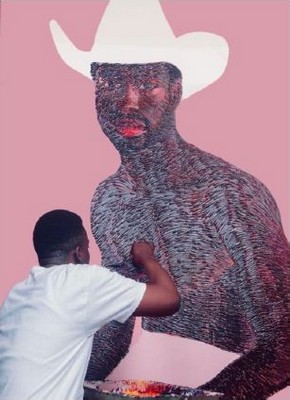
Samuel Olayombo
Samuel Olayombo in his studio 
Image courtesy Samuel Olayombo and ADA \ contemporary art gallery

Samuel Olayombo
Samuel Olayombo
Cherry Sheriff Django, 2022
84 x 60 inches
Image courtesy Samuel Olayombo and ADA \ contemporary art gallery

In Samuel Olayombo’s inaugural exhibition at ADA \ contemporary art gallery titled Unchained: The Cotton Candy Cowboys, Black figures are clothed in an array of rose-coloured clothing and Stetsons, which the artist presents to discuss masculinity and societal gender assertions and associations. The pink clothing and background serve as an emblem of softness, kindness, nurturance, and compassion; qualities that are often thought of as feminine.

The works throughout the show build on crossing the boundaries of traditional masculinity. In sharp contrast to the dark skin, the pink colour scheme accentuates the figures and imagines the notion of men in pink from a fresh perspective. The Black male figures affirm the stoic strength of the Western cowboy archetype and yet unveils the sweet, delicate, and dynamic nature of masculinity. Even though the artist’s figures appear to be posing and rigid, they seem carefree and light-hearted. Samuel Olayombo envisions his striking portraits as an effort to change representations of masculinity and shift ideas on what it means to be a man.

The dark palette-painted skin of Samuel Olayombo’s cowboys pays homage to the body scarification culture of the Ife, a Yoruba tribe of Nigeria. In an attempt to reaffirm and replicate a controversial cultural ritual of diverse root explanations and spiritual significance.

Unchained: The Cotton Candy Cowboys positions the Black cowboy in our visual purview and assert visibility, grounded in the significant history that has gone underrepresented. The rich legacy of Black cowboys in the American West, according to historical literature, accounted for up to an estimated 25 percent of workers in the range-cattle industry from the 1860s to 1880s. The exhibition focuses on the cowboy hero as a Black gallant figure and subverts the early image of the American cowboy into one that is dynamically intersectional. Samuel Olayombo’s robust manly subjects submerged in pink, foster freedom of expression, and translate into a staple of strength and confidence.

SAMUEL OLAYOMBO (born 1991) is a Nigerian artist who studied fine and applied arts at the University of Benin. A lover of texture, Samuel Olayombo works with oils, acrylics, charcoal, and pastels to create vibrant, dramatic, large-scale canvases of predominately male, non-gender normative portraits. Using a palette knife to convey intricate, 3-dimensional skin textures, Samuel Olayombo pays homage to classic artists such as Vincent Van Gough and Arja Valimaki in his work. His fascination with ’scarring’ prevalent in certain Yoruba cultures as well as toxic masculinity, macho male culture and constructs of sexuality, gender roles and gender equality are the key narratives Samuel Olayombo explores within his compositions.

ADA \ contemporary art gallery
Villaggio Vista, North Airport Road
Airport Residential Area, Accra, Ghana

09/06/02

Double Dress: Yinka Shonibare, a Nigerian-British Artist at The Israel Museum, Jerusalem

Double Dress: Yinka Shonibare, a Nigerian-British Artist
Israel Museum, Jerusalem
May 31 - October 29, 2002 

The first mid-career retrospective of Nigerian-British artist Yinka Shonibare premieres at The Israel Museum, Jerusalem.

Organized by the Israel Museum, Double Dress: Yinka Shonibare, a Nigerian/British Artist features over 20 works, including large-scale installations, paintings and photographs. By interweaving African and traditional English motifs and imagery, Shonibare addresses critical issues of inter-culturalism with both sensitivity and humor. The exhibition is accompanied by a fully illustrated catalogue published by the Israel Museum.

Drawing upon his own life experiences, Yinka Shonibare creates works that examine notions of identity and affiliation while challenging aesthetic and social structures and conventions. Born in London in 1962, Yinka Shonibare moved to Lagos, Nigeria with his family when he was a young boy. At seventeen he returned to England where he studied art at Goldsmiths College. His works are filled with both cultural collisions and confluences and often combine elements of "high" and "low" art.

A number of Yinka Shonibare's life-size installations recreate scenes from classical European paintings using mannequins dressed in Victorian costumes made of fabrics with African motifs. Mr. and Mrs. Andrews without Their Heads (1998), for example, was inspired by Thomas Gainsborough's famous portrait of the British gentry, Mr. and Mrs. Andrews (1748-49), and explores the relationship between British aristocracy and colonialism, suggesting that the wealth of the upper classes was often a result of the colonization of Africa.

One of the artist's central themes is the "dandy," and Yinka Shonibare often portrays himself as this aristocratic, witty, and decadent character. In many of his photographs, Shonibare also places himself in carefully staged scenes featuring iconic images of English high society. In his twelve-part photographic work Dorian Gray (2001), Yinka Shonibare assumes the role the namesake of Oscar Wilde's novel, The Portrait of Dorian Gray, inspired by scenes from the 1945 film version of the novel.
"Shonibare's exploration of identity and affiliation in diverse societies could not be more timely," stated James Snyder, director of the Israel Museum. "The issues he addresses are affecting the social fabric of nations throughout the world, but are especially relevant to Jerusalem, whose history has been shaped by the confluence of so many cultures. The Israel Museum is a perfect venue for presenting the work of this important artist."
Yinka Shonibare's work is in numerous private and public collections, including the permanent collections of The Museum of Modern Art, New York; The Museum of Contemporary Art, Chicago; The National Gallery of Modern Art, Rome; The National Gallery of Canada, Ottawa; The Scottish National Gallery, Edinburgh; and the Israel Museum, Jerusalem.
"Shonibare's work is extremely powerful, intelligent and witty," noted Suzanne Landau, curator of the exhibition and Chief Curator of the Arts at the Israel Museum. "He captures the essence of our time by juxtaposing and combining disparate cultures and traditions, which makes his work so significant and meaningful today."
Yinka Shonibare was born in London in 1962. He grew up in Nigeria, his family's country of origin, and returned to England at the age of seventeen. This bicultural artist has created a significant body of critically acclaimed paintings, photographs, and installations that address issues of identity, class, and race. Using wit and humor, he uncovers the many layers of contemporary culture and its historical baggage.

In the early 1990s Yinka Shonibare began using faux-African cotton prints, fabrics that had become an expression of African identity, but were in fact products of colonial commerce and industry that originated elsewhere. At first he stretched the fabric across square frames, arranging them in a grid on the gallery wall; later he began to play with the fabrics in elaborate, nineteenth-century Victorian dresses and corsets. By the late 1990s his subject matter had expanded to include aliens and astronauts, along with spoofs of classic European high culture from Hogarth and Fragonard to Jane Austen and Oscar Wilde. New themes, such as the nuclear family, were introduced, and familiar themes were explored in new contexts, for example, the colonial aspects of space travel.

As his work evolved, Yinka Shonibare also began experimenting with a wider variety of media, including photography and digital imaging. This increased range of methods has allowed the artist to make pointed critiques across a spectrum of political, social, and cultural concerns, and it has given him the opportunity to situate the "African" prints in novel contexts, keeping the ironic incongruities fresh and sophisticated.
Although often linked to colonialism and identity, Yinka Shonibare's works are not defined by this connection. "I hate conclusive things," he insists. "I think once a piece is conclusive, it's dead. The mind should be allowed to travel and have fantasy and imagination. People's minds need to wander."
The exhibition is on view in the Nathan Cummings 20th Century Art Building. 

A catalogue accompanies this exhibition.

ISRAEL MUSEUM, JERUSALEM