Showing posts with label Saatchi Gallery. Show all posts

06/08/25

RPS International Photography Exhibition 2025 @ Saatchi Gallery, London

RPS International Photography Exhibition 2025
Saatchi Gallery, London
5 August - 18 September 2025

Lydia Goldblatt
Lydia Goldblatt
Lick
© Lydia Goldblatt
Courtesy of The Royal Photographic Society

Kunnath Keerthana
Kunnath Keerthana 
Boomika 1
© Kunnath Keerthana 
Courtesy of The Royal Photographic Society

Timon Benson
Timon Benson 
About to Leave
© Timon Benson
Courtesy of The Royal Photographic Society

Ville Niiranen
Ville Niiranen
Family Portrait
© Ville Niiranen
Courtesy of The Royal Photographic Society

The exhibiting artists for the 166th edition of the Royal Photographic Society's International Photography Exhibition (IPE), the world's longest-running photography exhibition, have been announced. Renowned for showcasing the diversity of contemporary photography from around the world, the works are on display at London's Saatchi Gallery.

More than 4,000 photographers, both amateur and professional, submitted work for consideration in the 166th IPE open call. 113 prints from 51 photographers were selected by a guest panel for inclusion in the exhibition.

Selected Photographers: Mark Aitken, Jocelyn Allen, Debe Arlook, Murray Ballard, Timon Benson, John Boaz, Sean Cham, Raeann Kit-Yee Cheung, Alex Currie, Megan K Eagles, Thomas Dryden-Kelsey, Andy Fell, Stefano Ferrarin, Austin Fischer, Margarita Galandina, Lydia Goldblatt, Francisco Gonzalez Camacho, Mat Hay, Ronya Hirsma, Peter Holliday, Lawrence W. Ivy, Ayesha Jones, Keerthana Kunnath, Jacopo Locarno, Deacon Lui, Mehdi Moghimnejad, Aidan Murgatroyd, Albert Ng, Ville Niiranen, Ryan O'Toole Collett, Ana Paganini, Andy Pilsbury, Tine Poppe, Matthew  Renew, Emilie Rondal Nielsen, Hyunmin Ryu, Aindreas Scholz, Kate Schultze, Nirvana Seepersaud, Aria Shahrokhshahi, Xu Shengzhe, Gokhan Tannover, Valentin Valette, lnes Ventura, Katie Waite, Alastair Philip Wiper, Hanna Wolf, Naoto Yoshida, Zeng Fengyang, ChengLong  Zhang, Danilo Zocatelli Cesco.

Francisco Gonzalez Camacho
Do(I)ce
© Francisco Gonzalez Camacho
Courtesy of The Royal Photographic Society

John Boaz
John Boaz 
Fabian , Equestrian Eventer
© John Boaz
Courtesy of The Royal Photographic Society

Aidan Murgatroyd
Aidan Murgatroyd
The Tangential
© Aidan Murgatroyd
Courtesy of The Royal Photographic Society

Tine Poppe
Tine Poppe 
Chrysanthemum Morifolium 
© Tine Poppe
Courtesy of The Royal Photographic Society

The IPE has always reflected the times and this year's submissions are no exception with many photographers focussing on themes that include environmental issues, identity, community, family, and culture, showing how contemporary photographers engage with and capture aspects of the world that are not only visually compelling but also socially and culturally significant.

With this edition showing at Saatchi Gallery, London, more people than ever can view the work and appreciate the broad range of photography and themes captured in the final selection.
Victoria Humphries, CEO of the RPS comments: "This is another edition of the RPS International Photography Exhibition that pushes the boundaries of creative expression and celebrates the diversity and evolution of photography. When you view this exhibition and see the same themes evolving from every corner of the world you can't underestimate the importance of the RPS International Photography  Exhibition in bringing  these works together."

Mat Hay
Mat Hay 
Felipe Barrera Aguirre, traditional Chinampero farmer 
and agroecology teacher
© Mat Hay
Courtesy of The Royal Photographic Society

Murray Ballard
Murray Ballard
Men Playing Cards, Muro Leccese Salento, [2022]
© Murray Ballard 
Courtesy of The Royal Photographic Society 

Peter Holliday
Peter Holliday 
Kalle 
© Peter Holiday 
Courtesy of The Royal Photographic Society

Ana Paganini
Ana Paganini
Our Lady of Fatima
© Ana Paganini 
Courtesy of The Royal Photographic Society

The selection panel of experts consisted of Yuxing Chen, a Chinese artist and researcher based in the UK and previous recipient of the IPE 165 award; Kalpesh Lathigra,a British Indian artist occupying documentary and art practise and senior lecturer at London College of Communication/ University of the Arts London; Anne Nwakalor, a British Nigerian Photo Editor and Communications Officer and founding editor of No! Wahala Magazine; Nicola Shipley, Curator, Producer, Mentor and co-founder and Director of GRAIN projects; and photography consultant and long-term member of the IPE selection panel,Dr Michael Pritchard.

The two award recipients for the 166th edition of the International Photography Exhibition have been announced, with Lydia Goldblatt, and Keerthana Kunnath receiving the honours. Lydia Goldblatt  received the IPE Award for her series Fugue, which explores motherhood as a central theme, considering love and grief, mothering and losing a mother, as well as intimacy and distance.The Under 30s Award was presented to Keerthana Kunnath for her series Not What You Saw, which centres on South Indian female bodybuilders who challenge entrenched gender and beauty norms by embracing physical strength, a trait often considered as masculine.

On receiving the IPE award Lydia Goldblatt said:"It is a huge honour to have my work selected for the RPS IPE 166. I am deeply humbled and very grateful  to receive the IPE Award, and so excited to exhibit Fugue in the company of wonderful photographers. I am profoundly moved to know that this project, which began so quietly and privately, has resonated with the esteemed jury, and that it will have the opportunity to be seen by others who might a/so connect to its themes. To have my work recognised and seen within the rich context and history of the RPS is a very great privilege."

On receiving the Under 30s IPE Award Keerthana Kunnath said:" I am honoured to be named one of the two award winners at this year's RPS International Photography Exhibition. This recognition from such a prestigious institution marks a significant milestone in my photographic journey. It's a joy to see the series being appreciated and celebrated. Thanks to all the judges."

Simon Hill HonFRPS, RPS President,comments:"The RPS is proud to champion a dynamic and inclusive international photographic community. The International Photography Exhibition, with its unique legacy and global reputation, continues to be a vital platform for celebrating the richness and significance of contemporary photography. This 166th edition showcases an extraordinary collection of work from some of the most innovative and talented photographers worldwide. It is a testament to the power of photography to inspire, challenge, and connect us, and we are confident that this carefully curated exhibition will captivate and resonate with audiences through its diverse subjects, themes, techniques, and aesthetics."

RPS - ROYAL PHOTOGRAPHIC SOCIETY

SAATCHI GALLERY, LONDON

06/07/25

HIP HOP – Living a Dream @ Saatchi Gallery, London - An exhibition of photographs by Jamel Shabazz, Joseph Rodriguez, Gregory Bojorquez

HIP HOP – Living a Dream
Jamel Shabazz, Joseph Rodriguez, Gregory Bojorquez
Saatchi Gallery, London
31 July – 11 September 2025

Jamel Shabazz
JAMEL SHABAZZ 
THE DOWNTOWN BROOKLYN CREW, 
DOWNTOWN BROOKLYN, NYC, 1985
Courtesy of Saatchi Gallery and Galerie Bene Taschen

Joseph Rodriguez
JOSEPH RODRIGUEZ 
PUBLIC ENEMY CONCERT, 
STOCKHOLM, SWEDEN, 1990
Courtesy of Saatchi Gallery and Galerie Bene Taschen

Gregory Bojorquez
GREGORY BOJORQUEZ 
CHELSEA - 4TH STREET BRIDGE, 
LOS ANGELES, CA, 1998
Courtesy of Saatchi Gallery and Galerie Bene Taschen

Saatchi Gallery presents HIP HOP – Living a Dream, an exhibition showcasing the work of renowned photographers JAMEL SHABAZZ  (b. 1960), GREGORY BOJORQUEZ (b. 1951), and GREGORY BOJORQUEZ (b. 1972). From the early 1980s on, each of these three American chroniclers provides distinct insights into the rise and global impact of American Hip Hop culture. HIP HOP – Living a Dream delves into the lifestyle that, in combination with music, graffiti, breakdancing, and fashion, evolved into a worldwide phenomenon – from the streets of 1980s New York to Los Angeles, the Southern United States, Europe, and beyond, persisting into the present day.

Jamel Shabazz
JAMEL SHABAZZ 
REPRESENTING, BROOKLYN, NYC, 1988
Courtesy of Saatchi Gallery and Galerie Bene Taschen

Jamel Shabazz Photography
JAMEL SHABAZZ 
THE DISCO ENFORCERS, NY
Courtesy of Saatchi Gallery and Galerie Bene Taschen

Jamel Shabazz’s work from the 1980s serves as both a personal visual diary and a historical document, capturing the birth of the Hip Hop movement in the vibrant metropolis of New York City. Shabazz’s portraits embody the zeitgeist of New York, illustrating a pivotal era of music, fashion, and art. Jamel was stationed in the US Army in Germany when he heard one of the first major Hip Hop groups, Positive Force, debut their 1979 hit song “We Got the Funk”. His love for the genre is manifested in the images he would produce over the decades. The first of many Hip Hop artists he photographed were LL Cool J, and Public Enemy. Today, his portraits are synonymous with the movement itself.

Joseph Rodriguez
JOSEPH RODRIGUEZ
 
MASTER P IN HIS OFFICE ON THE PHONE MAKING MOVES, 
NEW ORLEANS, LA, 1997
Courtesy of Saatchi Gallery and Galerie Bene Taschen

In his series East Side Stories – Gang Life in East L.A., Brooklyn-born photographer Joseph Rodriguez provides a documentary-style look at gang culture during the 1990s. His work portrays the lived experiences, nuances, and harsh realities of gang life. According to Joseph Rodriguez, “My interest in going to L.A. began in early 1992. I was strongly influenced by the Hip Hop coming out of the streets of Los Angeles and other cities across the country. These youth were rapping about the very important issues in their communities. Their music were like the newspapers of the streets.” In addition to his documentation of American Hip Hop on both the West and East Coast, Rodriguez’s portraits of groups in Sweden point to the many facets of international forms of Hip Hop and its prevalence in cities beyond New York, such as Los Angeles and New Orleans, where Joseph Rodriguez documented notable figures Master P and the No Limit Crew.

Gregory Bojorquez

GREGORY BOJORQUEZ 
ANDRE 3000 AND BIG BOI, ATLANTA, GA, 2002
Courtesy of Saatchi Gallery and Galerie Bene Taschen

Gregory Bojorquez
GREGORY BOJORQUEZ 
MISSY ELLIOTT, ADVENTURA, FL, 2003
Courtesy of Saatchi Gallery and Galerie Bene Taschen

Los Angeles native Gregory Bojorquez has been documenting the Hip Hop scene since the 1990s: “Before I started photographing it, I was a fan of L.A. Hip Hop. The first things I photographed in Hip Hop were underground Hip Hop shows. Some were promoted by Orlando and Bigga B. Those shows were called Unity. Some artists they featured were Wu Tang affiliated artists, Goodie Mob, Big Pun. Sway & Tech had the Wake up Shows reunions. Some acts were OutKast, Gang Star, Pharoahe Monch and the legendary freestyle battle between Supernatural & Juice.” His works also feature Snoop Dogg & Tha Dogg Pound (DPG), 50 Cent, Eminem, DMX, Lil Wayne, Jay-Z, Missy Elliott, Mos Def, Swizz Beatz, and Ice Cube.

Like Hip Hop itself, the three photographers Shabazz, Rodriguez, and Bojorquez have garnered international acclaim, reaching audiences far beyond the United States. Jamel Shabazz’s photographs are part of esteemed collections worldwide, including the National Gallery of Art (Washington, DC); the Whitney Museum of American Art (New York), the Deutsche Börse Photography Foundation (Frankfurt am Main), the J. Paul Getty Museum (Los  Angeles),  and  the   Gordon  Parks Foundation in New York. Gregory Bojorquez’s works have been exhibited at the Vincent Price Art Museum in Los Angeles and internationally in Cologne, Berlin, and other locations. Joseph Rodriguez’s photographs are housed in institutions such as the Los Angeles County Museum, the International Center of Photography in New York, the Smithsonian American Art Museum and the National Gallery of Art in Washington DC, Museum Ludwig in Cologne, and the Albertina in Vienna.

This exhibition is produced with Galerie Bene Taschen, Cologne

SAATCHI GALLERY 
Duke of York's HQ, King's Road, London SW3 4RY
Location in the gallery: Galleries 3 & 4
Admission: Free entry, pre-booking not required

You may be interested by:

Schirn Kunsthalle Frankfurt, February 29 - May 26, 2024

05/04/25

Maro Gorky @ Saatchi Gallery, London - "Maro Gorky: The Thread of Colour" Exhibition

Maro Gorky
The Thread of Colour 
Saatchi Gallery, London
28 March - 12 May 2025

Maro Gorki - Painting
Maro Gorky
Nesting Peacocks, 2008
© Maro Gorky, courtesy of Saatchi Gallery

Maro Gorki - Painting
Maro Gorky
Flowering Cypress, 2012
© Maro Gorky, courtesy of Saatchi Gallery
Maro Gorky's landscapes are very satisfying to look at. Her stained-glass colour, crisp shapes and compositional majesty instil her syntheses of previous art with the force of an individual intently focused personality. You can't ask much more of art - Roberta Smith, New York Times
Maro Gorky - Painting
Maro Gorky
Connecticut Wedding, 1991
© Maro Gorky, courtesy of Saatchi Gallery

Maro Gorki - Painting
Maro Gorky
The Etruscans, 1991
© Maro Gorky, courtesy of Saatchi Gallery

In the 80s and 90s Maro Gorky’s personal view of the world was expressed in portraits of people she knew and loved. These works strike a deep note when they reflect upon personal memories, such as Connecticut Wedding (1991) which depicts the marriage of her great-grandmother. In The Etruscans (1991) painted in earthy colours, Maro Gorky emphasises her and her husband’s commitment to their home in Tuscany and the local inhabitants, who have become their lasting friends. 

Maro Gorki - Painting
Maro Gorky
Valerio, 2003
© Maro Gorky, courtesy of Saatchi Gallery

Maro Gorki - Painting
Maro Gorky
Cosima Pregnant, 2004
© Maro Gorky, courtesy of Saatchi Gallery

Maro Gorki - Painting
Maro Gorky
Saskia Pregnant, 2005
© Maro Gorky, courtesy of Saatchi Gallery

Maro Gorki - Painting
Maro Gorky
The Last Act, 1980
© Maro Gorky, courtesy of Saatchi Gallery

The Last Act (1980), exhibited in Maro Gorky's first London exhibition in 1983 at the Wraxall Gallery with Sarah Long, depicts a young girl with her lover. Amidst the Tuscan landscape, she stands in lovingly painted fronds and petals of wildflowers, and the couple gaze outward in an idealised, romantic pose. Maro Gorky has consistently painted her daughters, Saskia and Cosima, along with their friends and families. Over time, the portraits have become more simplified, and a sense of medieval maternity is often referred to in the portraits of her daughters.

Maro Gorki - Painting
Maro Gorky
Beirut is Burning, 1982
© Maro Gorky, courtesy of Saatchi Gallery

Maro Gorki - Painting
Maro Gorky
Adolescence, 1987
© Maro Gorky, courtesy of Saatchi Gallery

Both Maro Gorky's landscapes and portraits suggest a newfound reverence for the sacred, expressed through simplified shapes while maintaining a focus on the Tuscan landscape's formal structure. Discerning influences and derivations in Gorky's work is complex, as her canvases exude powerful emotions and energy. While Gorky references Byzantine icons, Botticelli, and medieval religious art, her art transcends simple categorisation.

A short film made by Gorky’s daughter Cosima Spender, an award-winning film director, producer and writer, is premiered alongside the Saatchi exhibition. The film explores her mother’s artistic practice and style, delving into her perception of the world and how it translates into her landscapes and portraits. Through Maro Gorky’s own words, the film reveals the artist’s intentions and aspirations behind her life’s work.

Maro Gorki - Painting
Maro Gorky
Olimpic, 1991
© Maro Gorky, courtesy of Saatchi Gallery

Maro Gorki - Painting
Maro Gorky
The New Wing, 2002
© Maro Gorky, courtesy of Saatchi Gallery

Maro Gorki - Painting
Maro Gorky
Autumn Vines, 2025
© Maro Gorky, courtesy of Saatchi Gallery

MARO GORKY 
Gorky's work continues a tradition of an academic training fleshed out by modernism that includes André Derain, Leland Bell and Louisa Matthiasdottir - Roberta SmithNew York Times
Maro Gorky was born in New York in 1943, the eldest daughter of the Armenian / American painter Arshile Gorky, one of the originators of Abstract Expressionism. Growing up surrounded by the heroes of Modernism, her first art tutors – before she had properly learnt to walk – were Andre Breton and Roberto Matta. Her father’s suicide when she was five years old, and the subsequent recognition of his epic legacy for American Art, set Maro Gorky on an artistic voyage that seemed both inborn and eternally restless.

Maro Gorky studied at the Slade School of Art, under Frank Auerbach, where she met her husband Matthew Spender, the sculptor and writer. Over the last 60 years, Gorky and Spender have rebuilt and resided in what was once an old ruin of a farmhouse, in the Tuscan village of San Sano in Avane. This house and the surrounding garden have become as much a creative endeavour as Gorky’s painting. One can distinctly see the impression that Gorky and Spender have left on the landscape. Upon approach to the farmhouse, peacocks wander through a profusion of plants, morning glory clambers over the terraces, and the life-size marble and terracotta sculptures by Spender populate the olive groves. Inside the house, Gorky has frescoed the walls, wardrobe panels and even bathroom tiles with animals, plants and patterns as a lasting imprint of her brush.
 
Describing the setting of the Tuscan landscape as the inspiration for many of Gorky’s paintings would not accurately convey the deep-seated impact that the landscape has had on her artwork. Rather, it is apparent that Gorky, Spender, the farmhouse and the natural surroundings, through maintaining a constant retrospective dialogue with one another over the years, have grown to become inextricably linked; a feeling that is evocatively manifested in Gorky’s landscapes included this exhibition. From the early-romanticised landscapes of undulating Tuscan hills, they move towards an abstracted discourse on colour and pattern, whilst retaining the vibrancy and warmth of the rural Italian environment.
In Maro Gorky’s own words…

Speaking about how living in Tuscany has inspired her work, Gorky says: “You have to be a city slicker to feel romantic about the countryside, but I am not urban. When I think of the word “home,” I see a lit fire – the hearth. And rats in the granary, peacocks, tortoises and turtledoves, hoopoes, swallows and screaming swifts. The “Tusk” of Tuscany, the hunters yelling “qua, qua, qua”, the dogs out of control and the cars called Cherokee. The secret camera in my wood spying on nocturnal animals, counting those breeders in the dark. Terra di Siena being chomped by mechanical dinosaurs reshaping the hills for vines, the sound of rocks grinding as the landscape is de-boned.” 

"It has nothing to do with painting and yet it has everything to do with painting. There is intention, there is composition. Green is a usual colour, so you don’t want it, except for peacocks. Green must be split into its fractions, the components of yellow and blue – and we’re back to Agent Orange. The quiet of the country does not exist. There is no such thing as silence. I feel as if we are as we were a hundred years ago, on the verge of revolution.
 
“Landscape painting used to signify for me a narrative without a beginning or an end, a visual echo of my thoughts. Then I discovered the desert. Near Mount Ouinat, on the frontier of Libya, Egypt and the Sudan, 500 miles from the nearest Egyptian outpost, I observed that the landscape has been ferociously simplified under the irresistible erosion of wind and sand. Crystals cut like jewels were methodically distributed from under my feet, right up to the horizon. This world without human beings was incredibly peaceful.
 
“Since that moment I have been trying to simplify my landscapes down to their essential underlying structure. The line becomes a path. Colours are what I perceive when I walk along that path. Shapes, as containers in which to place my emotions. Every now and again, like a crystal in the desert, one touch of absolute precision, that last sharp point of white on the pupil of the eye of a Byzantine hermit, painted with a brush made from a special feather found only in a kingfisher’s thumb.” - Maro Gorky
The exhibition is presented in collaboration with Long & Ryle (4 John Islip Street, London, SW1P 4PX) which presents Maro Gorky: Maps of Feeling through 2 May 2025.

SAATCHI GALLERY
Duke of York's HQ, King's Rd, London SW3 4RY

04/01/24

Christo and Jeanne-Claude @ Saatchi Gallery, London - 'Boundless' Exhibition

Christo and Jeanne-Claude: Boundless
Saatchi Gallery, London
15 November 2023 – 22 January 2024

Saatchi Gallery presents the largest retrospective of the renowned artist duo Christo and Jeanne-Claude ever in the UK. Titled Christo and Jeanne-Claude: Boundless the exhibition traces their artistic journey, from experimental beginnings in Paris across six decades of collaboration. The exhibition showcases rarely-seen works and offers a glimpse into future projects to be undertaken by the estate of the artists.

Christo and Jeanne-Claude: Boundless introduces visitors to the couple’s seminal projects, ranging from their early collaborations to monumental masterpieces, among them Wrapped Coast in Australia (1969), Surrounded Islands (1983) in Miami/Florida, The Pont Neuf Wrapped in Paris (1985), The Umbrellas (1991), installed simultaneously in Japan and the USA, The Gates in Central Park, New York City (2005) and The Floating Piers at Lake Iseo in Italy (2016). It also includes the perspective The Mastaba, a project for Abu Dhabi. This exhibition is the last to ever be signed off by Christo before his death and is divided into ten thematic chapters.

The exhibition reveals a story of love and artistic collaboration between Christo and Jeanne-Claude, celebrating their artistic synergy and profound connection, contextualised alongside their artistic contemporaries, including Jean Dubuffet, Yves Klein, and Lucio Fontana. Boundless unveils a vivid narrative of passionate determination, highlighting the couple’s refusal to be confined by traditional norms and how this distinctive approach, fuelled their creative vision and shaped their artistic journey.

Jeanne-Claude’s gift for communication and her tenacity became the driving force in realising projects, often over the course of decades. It was essential to their artistic ethos that their ambitious installations were funded independently. The exhibition showcases how drawings, sketches, prints, and collages were transformed into valuable currency, providing the foundation for realising their larger-than-life visions.

A climactic juncture in their journey is showcased through the breathtaking wrapping of the Berlin Reichstag in 1995 and the Arc de Triomphe in Paris in 2021. These monumental achievements embody their daring and creative prowess, demonstrating their ability to transform public spaces into artistic canvases.

Journey through the unrealised dreams that shaped their legacy, with insight into The Mastaba (project for Abu Dhabi), which will be an enduring monument to the couple’s boundless creativity. Larger than the Great Pyramid of Giza, this visionary concept stands as a testament to the enduring impact of Christo and Jeanne-Claude’s expression and drive.

The exhibition was conceived and curated by Kay Heymer, together with co-curator Sophie-Marie Sümmermann and was first shown at Kunstpalast, Düsseldorf. Alongside Christo and Jeanne-Claude, the following artists are represented in the exhibition: Arman, Alberto Burri, César, Jean Dubuffet, Lucio Fontana, Raymond Hains, Yves Klein, Jacques Mahé de la Villeglé, Piero Manzoni, Arnulf Rainer, Niki de Saint Phalle, Daniel Spoerri, Antoni Tàpies, Jean Tinguely and Wolf Vostell.
Lorenza Giovanelli, representative of the artists’ estate: “Christo and Jeanne-Claude have a long history with the city of London. Their first project in London dates back to 1963 when they wrapped a female model in the studio of photographer and filmmaker Charles Wilp. Over the years, they returned many times and became close friends with art dealers Annely and David Ju-da, who, since 1971, organized more than a dozen exhibitions with Christo and Jeanne-Claude.

In 2018, Christo realized The London Mastaba on Hyde Park’s Serpentine Lake, his first major public out-door work in the UK. Now thanks to Ingrid and Thomas Jochheim, who shared a long friendship with the artists and have made their collection available to the public, the exhibition at Saatchi Gallery offers a unique opportunity to revisit Christo and Jeanne-Claude’s work on a large scale.”
SAATCHI GALLERY
Duke of York’s HQ, King’s Road, London, SW3 4RY

CHRISTO AND JEANNE-CLAUDE
 
BY JACOB BAAL-TESHUVA
Published by Taschen
26 x 21 cm, 96 pages
@Taschen - www.taschen.com

A short but very interesting book.

08/04/23

Photography Exhibition: Civilization @ Saatchi Gallery, London - Civilization: The Way We Live Now

Civilization: The Way We Live Now 
Saatchi Gallery, London 
2 June - 17 September 2023 

Sheng-Wen Lo
Sheng-Wen Lo
Diergaarde Blijdorp Rotterdam, The Netherlands 
from the series White Bear, 2016 
© Sheng-Wen Lo

Alejandro Cartagena
Alejandro Cartagena
Mother at the Mexico – USA border wall, 
from the series Without Walls, 2017 
© Alejandro Cartagena

Lauren Greenfield
Lauren Greenfield
High school seniors (from left) 
Lili, 17, Nicole, 18, Lauren, 18, Luna, 18, and Sam, 17, 
put on their makeup in front of a two-way mirror for Lauren Greenfield's 
Beauty CULTure documentary, Los Angeles, 2011, 
from the "GENERATION WEALTH" project 
© Lauren Greenfield

Saatchi Gallery presents Civilization: The Way We Live Now, an international exhibition offering an unprecedented look at 150 contemporary photographers tracking the visual threads of humankind’s ever-changing, extraordinarily complex life across the globe.

Featuring many previously unseen images, this landmark exhibition acknowledges the diverse material and spiritual cultures that make up global “civilization” today. Exploring a wide range of subjects, from our great collective achievements to our ruinous collective failings, Civilization: The Way We Live Now highlights the complexity and contradictions of contemporary civilization.

Participating photographers practising across all five continents; from Reiner Riedler’s families cavorting at leisure parks, through Raimond Wouda’s high school subculture, Wang Qingsong’s parody of insane work habits, to Lauren Greenfield’s displays of ostentatious wealth, Edward Burtynsky’s study of fragile water resources, Pablo Lopez Luz’s views on a sprawling contemporary megapolis, Thomas Struth’s vision of past civilizational glories and Xing Danwen’s electronic wastelands, Civilization draws together powerful imagery into a new, unique and challenging discourse.

A collaboration between Saatchi Gallery and the Foundation for the Exhibition of Photography, with curators William A. Ewing and Holly Roussell, the highly-anticipated exhibition has toured in major museums across Korea, China, Australia, New Zealand, France and Italy and includes a new selection of works curated especially for this London edition at Saatchi Gallery. In addition to the photographers with decades of experience, Civilization features the work of many in mid-career, as well as emerging talents.

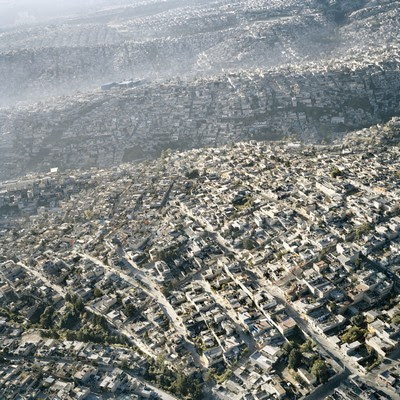
Pablo López Luz
Pablo López Luz 
Vista Aerea de la Ciudad de Mexico, XIII, 
from the series Terrazo, 2006 
© Pablo López Luz

Cyril Porchet
Cyril Porchet
Untitled from the series Crowd, 2014 
© Cyril Porchet

Jeffrey Milstein
Jeffrey Milstein
Newark 8 Terminal B, Newark, NJ, 
from the series Airports, 2016 
© Jeffrey Milstein

As curator William A. Ewing explains:
“Photographers are at work everywhere, photographing everything, using their eyes and their minds to seize telling moments in the rapid flux with sharp, vivid images. Photographers are our civilization’s eyes... Ironically, it may be that many of these photographs will last longer than the monuments and artefacts that they depict. London has always been a great centre for the celebration of photography from all corners of the globe, filled with collections, archives, museums and galleries deeply committed to the promotion of this vital art form. We curators have been privileged to benefit from many loans from these sources, and welcome Saatchi Gallery’s invitation to share the fruits of our research with a London audience.”
The exhibition is conceived as a journey through key aspects of civilization, via eight thematic chapters: HIVE, which features photographs dealing with the concept of the urban environment, a prerequisite of all civilizations; ALONE TOGETHER which looks at social relationships; FLOW, which takes its subject to the movement of peoples, good and ideas; PERSUASION, which looks at the strategies that politicians and merchandisers employ to influence our behaviour; CONTROL, which has to do with authority and power; RUPTURE, which looks at societal breakdown and conflict; ESCAPE, which shows people searching for release from the mundane; and NEXT? which hints at the new world taking shape in the 21st Century.

Wang Qingsong
Wang Qingsong 
Work, Work, Work, 2012 
© Wang Qingsong

Reiner Riedler
Reiner Riedler
Wild River, Florida, 
from the series Fake Holidays, 2005 
© Reiner Riedler

Olaf Otto Becker
Olaf Otto Becker
Point 660, 2, 08/2008 67°09’04’’N, 50°01’58’’W, Altitude 360M, 
from the series Above Zero, 2008 
© Olaf Otto Becker

The Concept in Detail

Civilization: The Way We Live Now focuses on our emerging global civilization, as it has taken shape over the early years of the 21st Century, and focuses specifically on collective behaviour and achievement, so often disguised in our time by the celebration of individuality. Civilization neither denies individualism, nor the reality of distinct cultures, rich in their own right and which may even oppose homogenizing global forces. However, our focus remains on what is shared collectively by large numbers of people, either directly as participants, or indirectly as consumers or passive observers.

This fast-emerging global civilization has made use of and absorbed the discoveries and inventions of many previous civilizations while adding a profusion of its own innovations. Our burgeoning sciences and new technologies have given us the capacity to extend human life (and destroy countless other forms) and engineer new life forms (and create huge risks, even to the possible destruction of our own species). It has the capacity to create utopias and dystopias—even, paradoxically, simultaneously. It is now projecting itself into deep space with the idea of eventually finding another home for our species.

A Portrait through Photography

Photography may also be seen in the light of a collective civilizational endeavour. Together, photographers are creating a multifaceted portrait of our time. They are busy everywhere on the surface of the globe, in every country and in every city, observing, recording, interpreting, questioning—not to mention fixing for posterity—the way we live now: where we live and how we live; how we work and how we play; how we move our bodies, our goods, and our ideas; how we collaborate and how we compete; how we make love and how we make war. We find photographers at work in banks, chambers of government, prisons, schools, and places of work of every description, each capturing some thread which goes to weave the rich texture of our civilization. The exhibition can therefore be seen as a show about civilization—or about photography—and ideally through these two lenses simultaneously.

Vincent Fournier
Vincent Fournier 
Ergol #1, S1B clean room, Arianespace, 
Guiana Space Center [CGS], Kourou, French Guiana, 2011 
© Vincent Fournier

Michael Najjar
Michael Najjar 
orbital ascent, 2016 
from the series outer space 
© Michael Najjar

Exhibiting Photographers

Max Aguilera-Hellweg, Andreia Alves de Oliveira, Evan Baden, Murray Ballard, Olivo Barbieri, Mandy Barker, Lisa Barnard, Olaf Otto Becker, Valérie Belin, Daniel Berehulak, Mathieu Bernard-Reymond, Peter Bialobrzeski, Florian Böhm, Michele Borzoni, Priscilla Briggs, Paul Bulteel, Edward Burtynsky, Alejandro Cartagena, Philippe Chancel, Che Onejoon, Olivier Christinat, Lynne Cohen, Lois Conner, Raphaël Dallaporta, Sian Davey, Susan Derges, Gerco de Ruijter, Richard de Tscharner, Sergey Dolzhenko, Natan Dvir, Roger Eberhard, Mitch Epstein, Andrew Esiebo, Adam Ferguson, Vincent Fournier, Andy Freeberg, Matthieu Gafsou, Andreas Gefeller, George Georgiou, Christoph Gielen, Ashley Gilbertson, Katy Grannan, Samuel Gratacap, Lauren Greenfield, Han Sungpil, Nick Hannes, Sean Hemmerle, Mishka Henner, South Ho Siu Nam, Candida Höfer, Dan Holdsworth, Hong Hao, Aimée Hoving, Pieter Hugo, Leila Jeffreys, Jo Choonman, Chris Jordan, Yeondoo Jung, Nadav Kander, KDK, Mike Kelley, Kim Taedong, Alfred Ko, Irene Kung, Benny Lam, Sonia Lenzi, Gjorgji Lichovski, Michael Light, Mauricio Lima, Sheng-Wen Lo, Pablo López Luz, Christian Lünig, Alex MacLean, David Maisel, Ann Mandelbaum, Edgar Martins, Jeffrey Milstein, Mintio, Richard Misrach, Andrew Moore, David Moore, Richard Mosse, Michael Najjar, Walter Niedermayr, Jason Sangik Noh, Noh Suntag, Simon Norfolk, Trent Parke, Cara Phillips, Robert Polidori, Sergey Ponomarev, Cyril Porchet, Mark Power, Giles Price, Yan Wang Preston, Reiner Riedler, Simon Roberts, Andrew Rowat, Victoria Sambunaris, Sato Shintaro, Dona Schwartz, Paul Shambroom, Chen Shaoxiong, Toshio Shibata, Corinne Silva, Alec Soth, Henrik Spohler, Will Steacy, Thomas Struth, Larry Sultan, Shigeru Takato, Eric Thayer, Danila Tkachenko, Eason Tsang Ka Wai, Andreas Tschersich, Amalia Ulman, Brian Ulrich, Penelope Umbrico, Johanna Urschel, Carlo Valsecchi, Reginald Van de Velde, Cássio Vasconcellos, Massimo Vitali, Robert Walker, Dougie Wallace, Richard Wallbank, Wang Qingsong, Patrick Weidmann, Thomas Weinberger, Damon Winter, Michael Wolf, Paolo Woods and Gabriele Galimberti, Raimond Wouda, Xing Danwen, Ahmad Zamroni, Luca Zanier, Zhang Xiao, Robert Zhao Renhui, Francesco Zizola.

CIVILIZATION: The Way We Live Now has been co-produced by the Foundation for the Exhibition of Photography, Minneapolis/Paris/Lausanne, and the National Museum of Modern and Contemporary Art of Korea, in collaboration with the Saatchi Gallery, London. Previous venues of the exhibition include the National Museum of Modern and Contemporary Art in Seoul, South Korea; UCCA Centre for Contemporary Art, Beijing, China; the National Gallery of Victoria, Melbourne, Australia; the Auckland Art Gallery, Auckland, New Zealand; the Museum of Civilisation (Mucem), Marseille, France and the Museo San Domenico, Forlì, Italy.

The exhibition is curated by William A. Ewing and Holly Roussell, assisted by Justine Chapalay. William A. Ewing is an author, lecturer, and curator of photography, and former director of the Musée de l’Elysée in Lausanne. Over the years his exhibitions have been seen in London at the Serpentine, Whitechapel, and Barbican Galleries, the Photographer’s Gallery, the Welcome Institute and Somerset House. Holly Roussell is a curator and museologist specialising in photography and contemporary art from East Asia. Currently, she is curator for the UCCA Center for Contemporary Art, Beijing. The project is directed by Todd Brandow, Executive Director, Foundation for the Exhibition of Photography, Minneapolis / Lausanne and Bartomeu Mari, Director, Museum of Modern and Contemporary Art, Seoul, Korea.

Exhibition Catalogue - The official Civilization book is published by Thames & Hudson and FEP Editions. In parallel with the exhibition, a major publication has been produced in a number of editions: British, American, Italian, French, German, Korean and Chinese. Hardbound and 500+ images.

SAATCHI GALLERY
Duke of York's HQ, King's Road, London, SW3 4RY

10/10/22

The New Black Vanguard: Photography between Art and Fashion @ Saatchi Gallery, London - Curated by Antwaun Sargent

The New Black Vanguard: 
Photography between Art and Fashion
Curated by Antwaun Sargent
Saatchi Gallery, London
28 October 2022 – 22 January 2023

Tyler Mitchell
TYLER MITCHELL
Untitled (Hijab Couture), New York, 2019
From The New Black Vanguard (Aperture, 2019)
© Tyler Mitchell

Dana Scruggs
DANA SCRUGGS
Fire on the Beach, 2019
From The New Black Vanguard (Aperture, 2019)
© Dana Scruggs

Jamal Nxedlana
JAMAL NXEDLANA
Johannesburg, 2019
From The New Black Vanguard (Aperture, 2019)
© Jamal Nxedlana

Saatchi Gallery presents The New Black Vanguard: Photography between Art and Fashion, a ground breaking exhibition featuring 15 international Black photographers contributing to a new vision of the Black figure and reframing representation in art and fashion. This exhibition is a celebration of Black creativity both in-front of and behind the camera. Featured works include Black stylists, models, make-up artists and creative directors who are bringing a radical new set of references and experiences to image making. This exhibition is organized by Aperture.

The New Black Vanguard is curated by American writer and critic Antwaun Sargent who explores a new aesthetic of Black portraiture while examining the cross-pollination between art, fashion, and culture in the making of images.
Antwaun Sargent adds, "This exhibition is an exploration of this generation's Black image makers who are bringing fresh perspective to photography. Image by image, they have created a loose global network around their art that powerfully centres identity, community and desire. The artists in this show profoundly reanimate the possibilities of contemporary photography."
Featured Photographers: Campbell Addy, Quil Lemons, Daniel Obasi, Arielle Bobb-Willis, Namsa Leuba, Ruth Ossai, Micaiah Carter, Renell Medrano, Adrienne Raquel, Awol Erizku, Tyler Mitchell, Dana Scruggs, Nadine Ijewere, Jamal Nxedlana, Stephen Tayo.

Nadine Ijewere
NADINE IJEWERE
Untitled, 2018
From The New Black Vanguard (Aperture, 2019)
© Nadine Ijewere, for Garage magazine
The New Black Vanguard means a lot to me. It’s an important milestone in history where the work of young black artists have been curated beautifully and published in a book. It’s a dream for this show to be exhibited at the Saatchi Gallery in London. This represents progress and more boundaries being removed. London is my home, I still remember school trips to the Saatchi! Now we are here, together, telling our stories!”– Nadine Ijewere, Photographer
Campbell Addy
CAMPBELL ADDY
Adut Akech, 2019
From The New Black Vanguard (Aperture, 2019)
© Campbell Addy
“Many moons ago, as a newly graduated student, Antwaun Sargent came to me to talk about the experiences in the industry and what's needed. Speaking about the book he hopes to create - I implored him and said "if only I had seen a book like that when I was younger, a project of profound joy and happiness, that showcased Blackness in its variety in visual media. Maybe then it wouldn't have been such a struggle for me to just imagine myself as one of those artists." Now seeing what The New Black Vanguard has done, and it's evolution through many cities, brings me so much happiness. As I know there is a young creative from a similar background to that of the exhibiting artists that is going to feel seen and feel acknowledged. Who may also feel challenged to create work! So it brings me profound joy and immense pride, that it is also going to be in London – in the same city that Antwaun and I met to talk about said book – many, many years ago. This moment in itself feels incredibly full circle.” – Campbell Addy, Photographer
The New Black Vanguard presents artists whose vibrant portraits and conceptual images fuse the genres of art and fashion photography in ways that break down long-established boundaries. Their work has been widely presented in traditional lifestyle magazines, ad campaigns, and museums, as well as on thier individual social media channels; infusing the contemporary visual vocabulary around beauty and the body with new vitality and substance.

The images open up conversations around the representation of the Black body and Black lives as subject matter. Collectively, the works celebrate Black creativity. Seeking to challenge the idea that Blackness is homogenous, the works serve as a form of visual activism delivered by emerging talents who are creating photography in vastly different contexts — be it in New York or Johannesburg, Lagos or London. The results — often made in collaboration with Black stylists and fashion designers — present new perspectives on the medium of photography and the notions of race, beauty, gender and power.

This exhibition includes selected works from these ground breaking contemporary photographers, as well as a salon wall presentation of images created by other young Black photographers contributing to this movement. Vitrines of publications, past and present, contextualise these images and chart the history of inclusion, and exclusion, in the creation of the Black commercial image. The exhibition proposes a brilliantly re-envisioned future.

SAATCHI GALLERY
Duke of York's HQ, King's Rd, Chelsea, London SW3 4RY