Showing posts with label art exhibition. Show all posts

02/07/16

Michael Joo: Installation at the Sackler Gallery, Washington, D.C.

Perspectives: Michael Joo
The Sackler Gallery, Washington, D.C.
 
July 2, 2016 - July 9, 2017

 Michael Joo at EVA International 2016
(c) Photo Sean Curtin

An installation by Korean American artist Michael Joo (b. 1966, Ithaca, N.Y.) is exhibited in the Smithsonian’s Arthur M. Sackler Gallery Pavilion this year as part of the museum’s “Perspectives” contemporary art series. “Perspectives: Michael Joo,” on view July 2, 2016–July 9, 2017, explore the migration patterns of Korean red-crowned cranes. The monumental installation consists of a canvas—nearly 13 feet tall and 10 feet wide—and a hanging sculpture.

The subject of these two new artworks, created specifically for the Sackler, are endangered red-crowned cranes, which are significant in Korean culture. The cranes freely migrate through the Korean Demilitarized Zone (DMZ)—a pristine ecosystem of 160 miles of unoccupied territory between North and South Korea. Joo employs a combination of painting, sculpture, photography, digital scanning, printmaking and crane specimens in his investigation of the birds’ movements.
“As a sculptor I have been preoccupied with spaces and the time it takes for us to move through them, how the things we bring to them—from ourselves, to our objects, to our intentions and perceptions of them—can expand, how we locate ourselves in the present,” Joo said.

In the large canvas installation, Joo uses a silver-nitrate method common in his work. The piece is silvered using a chemical process derived from early photographic techniques. He uses three-dimensional ornithological scans from the Smithsonian’s National Museum of Natural History, where he participated in a Smithsonian Artist Research Fellowship residency in 2012. The abstraction is a mirrored image of two collected crane carcasses, representing both their organic form and the geometric form of their storage container.

The sculpture portion of the installation consists of brass rods suspended from the Sackler Pavilion ceiling. The sculpture’s linear patterns outline the satellite-tracked migration patterns of the red-crowned cranes across Korea and the DMZ. Each rod is dependent on the other for balance, and their lines represent freedom and the inescapability of instinct.

During the year that this installation is on view, the natural light from the windows will interact with the silvered canvas and the sculpture’s lines. As natural light hits them, their appearance will change depending on the time of day and time of year.

A website and video documenting the artist’s process will be available for both on-site and off-site visitors.

About “Perspectives”

The Sackler Gallery’s “Perspectives” series presents large-scale works by internationally renowned contemporary artists. Previous exhibitions have featured the works of Lara Baladi, Cai Guo-Qiang, Y.Z. Kami, Anish Kapoor, Chiharu Shiota, Hiroshi Sugimoto, Do-Ho Suh, Hale Tenger and Ai Weiwei, among others.

“Perspectives: Michael Joo” is organized by the Sackler Gallery and sponsored by Altria Group. Additional funding is provided by the Sackler’s Endowment for Contemporary Asian Art.

About the Artist Michael Joo

Michael Joo is a Korean American artist with a Bachelor of Fine Arts from Washington University in St. Louis and a Master of Fine Arts from Yale University. He has had numerous solo and group exhibitions in the United States and abroad. Joo represented South Korea at the 49th Venice Biennale in 2001 and was awarded the grand prize at the sixth Gwangju Biennale in 2006. In 2012, Joo was a Smithsonian Artist Research Fellow, studying 3-D scanning and the relationship between art and technology.

About the Freer and Sackler Galleries

The Smithsonian’s Freer Gallery of Art and the adjacent Arthur M. Sackler Gallery, located on the National Mall in Washington, D.C., together comprise the nation’s museum of Asian art. It contains one of the most important collections of Asian art in the world, featuring more than 40,000 objects ranging in time from the Neolithic to the present day, with especially fine groupings of Islamic art, Chinese jades, bronzes and paintings and the art of the ancient Near East. The galleries also contain important masterworks from Japan, ancient Egypt, South and Southeast Asia and Korea, as well as the Freer’s noted collection of works by American artist James McNeill Whistler. The Freer, which will be closed during the exhibition, is scheduled to reopen in spring 2017 with modernized technology and infrastructure, refreshed gallery spaces and an enhanced Eugene and Agnes E. Meyer Auditorium.

www.asia.si.edu

02/01/16

Daubigny, Monet, Van Gogh: Impressions of Landscape

Daubigny, Monet, Van Gogh: Impressions of Landscape
Taft Museum of Art, Cincinnati, Ohio
February 20 - May 29, 2016
Scottish National Gallery, Edinburgh
Van Gogh Museum, Amsterdam

Pushing the boundaries of traditional landscape painting, Charles François Daubigny (1817-1878) was a vital touchstone and mentor for the subsequent generation of avantgarde artists now widely celebrated as the Impressionists. In the 1850s and 1860s, Daubigny routinely painted outdoors to directly capture qualities of light and atmosphere, launched a floating studio boat on French waterways that fundamentally changed the way artists could frame their compositions, employed radical painterly techniques and exhibited sketch-like works that critics assailed as “mere impressions.” Though an inspiration to artists such as Claude Monet, Camille Pissarro and Vincent Van Gogh, Daubigny is now relatively unknown. Until this year he has never been the subject of a major international exhibition, and no exhibition has previously examined Daubigny’s profound influence upon the Impressionists and in turn their influence on his late style.

Co-organized by the Taft Museum of Art, the Scottish National Gallery and the Van Gogh Museum, Daubigny, Monet, Van Gogh: Impressions of Landscape revises our understanding of the origins of Impressionism by reconsidering Charles François Daubigny as a central figure in the development of 19th-century French landscape painting, including Impressionism. The groundbreaking exhibition will be on view at the Taft Museum of Art in Cincinnati, Ohio, the sole U.S. venue, from Feb. 20 through May 29, 2016. It will travel to the Scottish National Gallery in Edinburgh and the Van Gogh Museum in Amsterdam later in 2016 and in early 2017.

In addition to one of the Taft’s Daubigny paintings, which prompted the exhibition, Daubigny, Monet, Van Gogh: Impressions of Landscape will also feature spectacular loans from numerous North American and European museums—including the Art Institute of Chicago; Montreal Museum of Fine Arts; National Gallery, London; Museum of Fine Arts, Bordeaux; Scottish National Gallery, Edinburgh; Van Gogh Museum, Amsterdam—and private collections.

“Conceived at the Taft, this very special exhibition reflects the museum’s strength in European art and its strong relationships with a host of distinguished international institutions,” said Taft Director and CEO Deborah Emont Scott. “We are thrilled to bring this stellar group of European works of art to our greater Cincinnati, regional and national audiences.”

Of the 55 paintings in the exhibition, approximately 40 masterpieces by Daubigny will showcase the full range of the artist’s achievements over four decades, including both small easel paintings created outdoors and grand-scale paintings completed in the studio for exhibition. The remainder of the works on view will offer fascinating and often surprising comparisons with Impressionist and Post-Impressionist paintings by Claude Monet, Camille Pissarro and Vincent Van Gogh, revealing Daubigny’s impact on and importance for two subsequent generations of artists, the Impressionists and the Post-Impressionist Van Gogh.

“This exhibition stakes a claim for Daubigny’s inadequately recognized achievements as a powerful innovator and precursor to one of the most original art historical movements of all time,” said Lynne Ambrosini, Director of Collections and Exhibitions and Curator of European Art at the Taft Museum of Art. Ambrosini is the initiating curator (and one of five curators) of the exhibition.

In the vanguard of artists who privileged and embraced the immediacy of open-air painting, Charles François Daubigny invented the studio boat and was the first to paint views surrounded by water instead of from the riverbanks. This pioneering compositional technique of stripping away conventional foregrounds to more directly observe nature and capture the effects of light, as well as his radically unfinished painting style and brighter palette, had a powerful influence on the young Impressionists.

Highlights of the exhibition include Daubigny’s images of silvery light and reflections along the Seine and Oise rivers, stormy atmospheric effects at the Normandy coast, dramatic moonlit landscapes, views of lush fields and scenes of blossoming orchards in the countryside outside Paris—the last another subject he invented. These subjects were soon taken up by Monet and Pissarro, whose similarly themed works will also be featured, for example Pissarro’s The Banks of the Oise near Pontoise (1873, Indianapolis Museum of Art), which echoes Charles François Daubigny’s compositions, and Monet’s Autumn on the Seine, Argenteuil, (1873, High Museum of Art, Atlanta, Georgia), which was painted from Monet’s emulative studio boat. Daubigny’s panoramic views of the sunny grain-fields near Auvers were admired by Van Gogh, who adopted Daubigny’s then famous double-wide canvas formats for his own pictures of the plains near Auvers. The final section of the exhibition presents five masterpieces by Van Gogh that reveal his debt to Daubigny, including Daubigny’s Garden (1890, R. Staechelin Collection, Basel, Switzerland), which exhibits Van Gogh’s signature swirling intensity.

Taft Museum of Art, Cincinnati, Ohio

08/02/15

Monir Shahroudy Farmanfarmaian: Infinite Possibility. Mirror Works and Drawings 1974–2014 at Solomon R. Guggenheim Museum, NYC

Monir Shahroudy Farmanfarmaian: Infinite Possibility. Mirror Works and Drawings 1974-2014 
Solomon R. Guggenheim Museum, NYC 
March 13 - June 3, 2015

The Solomon R. Guggenheim Museum will present the first comprehensive exhibition in the United States of the celebrated Iranian artist Monir Shahroudy Farmanfarmaian (b. 1924). In recognition of a lengthy career, Monir Shahroudy Farmanfarmaian: Infinite Possibility. Mirror Works and Drawings 1974–2014 focuses on the faceted mirror sculptures and corresponding geometric drawings Monir has produced over the past forty years. The majority of the selected works in this exhibition are from the artist’s own collection, and many have never been shown to the public.

MONIR SHAROUDY FARMANFARMAIAN 
Untitled, 2012. 
Felt-tip pen on paper, 70 x 100 cm. 
Collection of the artist, courtesy The Third Line, Dubai 
© Monir Shahroudy Farmanfarmaian. 
Photo: Courtesy of the artist and The Third Line, Dubai

Monir’s rich body of work references Persian architectural and decorative tradition, the mathematical basis of geometric forms in Islamic pattern, and Sufi cosmology. When considered along with the Guggenheim’s historical commitment to abstraction and internationalism, the exhibition offers a timely opportunity to examine Monir’s rich body of work in its own right and as part of an increasingly transnational perspective on artistic production and its reception.

Monir Shahroudy Farmanfarmaian: Infinite Possibility. Mirror Works and Drawings 1974–2014 is organized by the Serralves Museum of Contemporary Art, Porto, Portugal, where it was on view in fall 2014 before traveling to New York. The exhibition is curated by Suzanne Cotter, Director, Serralves Museum of Contemporary Art, Porto, and former Curator, Abu Dhabi Project, Solomon R. Guggenheim Foundation, with assistance from Karole Vail, Associate Curator, Solomon R. Guggenheim Museum, for its New York presentation.

The Leadership Committee for Infinite Possibility is gratefully acknowledged for its support, with special thanks to Simin N. Allison, Maryam Eisler, The Soudavar Memorial Foundation, Mohammed Afkhami, Patricia and Alexander Farman-Farmaian, Haines Gallery, Yasmine Nainzadeh and Sara Nainzadeh, Nazgol and Kambiz Shahbazi, and The Third Line.

MONIR SHAROUDY FARMANFARMAIAN
Mirror Ball, 1973
Mirror on plaster ball, 19 x 19 x 19 cm
Collection of Nima Isham, Montana
© Monir Shahroudy Farmanfarmaian
Photo: Filipe Braga 
© Fundação de Serralves–Museu de Arte Contemporânea, Porto, Portugal

Monir Shahroudy Farmanfarmaian: Infinite Possibility. Mirror Works and Drawings 1974–2014 includes early wood, plaster, and mirror reliefs, a series of large-scale geometric mirror sculptures, and an impressive body of works on paper, focusing on a sculptural and graphic oeuvre developed over a period of more than forty years. The presentation reveals how the compositional principles used by the artist during this period were translated into large-scale commissions, including a series of etched glass doors created for a New York townhouse in the early 1980s. A selection of previously unseen abstract works on paper produced between 1974 and 2014 reveals the central role of drawing as a conceptual foundation for Monir’s sculptural practice. The artist’s ambitious mirror sculptures, known as “geometric families,” which she produced in the last decade since reinstating her studio in Tehran, will also be on view. Monir’s prolific body of work is characterized by the merging of visual and spatial experience and a distinctive approach to abstraction, coupled with the aesthetic tradition of Islamic architecture and decoration, allowing for, in the artist’s own words, “infinite possibility.”

MONIR SHAROUDY FARMANFARMAIAN 
Untitled, 1980
Felt-tip pen and colored pencil on paper, 63 x 44.5 cm
Collection of the artist
© Monir Shahroudy Farmanfarmaian
Photo: Courtesy of the artist

Born in Qazvin, Iran, in 1924, MONIR SHAROUDY FARMANFARMAIAN attended the Fine Arts College of Tehran before moving to New York in 1945, where she studied at Cornell University and at Parsons School of Design and worked as a freelance illustrator for Vogue and as a graphic designer. These formative years in New York served as a sort of apprenticeship for Monir, who spent time alongside fellow artists Milton Avery, Willem de Kooning, Joan Mitchell, Louise Nevelson, Barnett Newman, and later Andy Warhol, among others. Notably, during her time in New York, Monir visited the Guggenheim in its founding locations and was present at the 1956 groundbreaking for the Frank Lloyd Wright–designed museum building on Fifth Avenue. She returned to Iran in 1957 and journeyed across the country, further developing her artistic sensibility through encounters with traditional craftsmanship. Indigenous art forms such as Turkoman jewelry and clothing, coffee house paintings (a popular form of Iranian narrative paintings), and the technique of reverse-glass painting influenced her work, resulting in a productive period of artistic discovery and breakthrough that culminated in a series of commissions in Iran and exhibitions in Europe and the United States, including presentations at Galerie Denise René in Paris and New York. The Islamic Revolution in 1979 marked the beginning of Monir’s twenty-six-year exile in New York, during which she focused on drawing, collage, and a few commissions, and also returned to carpet and textile design. In 2004, when she finally returned to Iran, she reestablished her studio there and resumed working with some of the same craftsmen she had collaborated with in the 1970s.

Monir Shahroudy Farmanfarmaian in her studio working on Heptagon Star, Tehran, 1975
Photo: Courtesy of the artist and The Third Line, Dubai

Monir Shahroudy Farmanfarmaian has been the subject of solo exhibitions at the Italian Institute, Tehran (1968); Jack Kaplan Gallery, New York (1975); the Kennedy Center, Washington, D.C. (1976); the Iran American Society, Tehran (1976); Galerie Denise René, New York and Paris (1977); the Victoria and Albert Museum, London (2007); and Leighton House Museum, London (2008). Her work has also been featured in a number of group exhibitions, including the first Tehran Biennial (1958); the Venice Biennale (1958, 1964, 1966, and 2009); Gold, The Museum of Modern Art, New York (1978–79); Living Traditions: Contemporary Art from Afghanistan, Iran, and Pakistan, Queen’s Palace, Bagh-e Babur, Kabul (2008); The Power of Ornament, Lower Belvedere, Orangery, Vienna (2009); Asia Pacific Triennial of Contemporary Art, Brisbane (2009–10); There is always a cup of sea to sail in, São Paulo Biennial (2010); and Jef Guys/Monir Shahroudy Farmanfarmaian: The world as seen through a Pelican in Plexi, Wiels, Brussels (2013).

Monir Shahroudy Farmanfarmaian’s works are found in numerous public collections, including the Metropolitan Museum of Art, New York; Queensland Art Gallery, Brisbane; Tate, London; and the Victoria and Albert Museum, London. Several of the artist’s extant works from the 1970s are in the collection of the Tehran Museum of Contemporary Art. Major commissions include installations at King Abdulaziz International Airport in Jeddah, Saudi Arabia, Dag Hammarskjöld Tower in New York, and the Niavaran Cultural Center in Tehran

Solomon R. Guggenheim Museum, NY

24/12/13

Cyprien Gaillard, Gladstone Gallery, New York

Cyprien Gaillard: Today Diggers, Tomorrow Dickens 
Gladstone Gallery, New York 
Through January 30, 2014 


Gladstone Gallery presents their first exhibition with CYPRIEN GAILLARD, “Today Diggers, Tomorrow Dickens.” For this ambitious and complex presentation, Gaillard has created two complementary bodies of sculptural works that explore notions of regeneration, ruination, and decay, turning his eye to the relationship between evolution and erosion – a thread that weaves through much of his work. Navigating the concept of the altered readymade through an anthropological lens, Gaillard has incorporated processed natural and industrial materials to achieve an equilibrium that reflects the way in which our society simultaneously progresses and reverts in the realm of the bleak.

Inspiration for the exhibition title came from a series of mural slogans used to conceal a raw building site, home of the future performing arts center in Beverly Hills. Intended as a playful tag suggesting the inconvenience caused by ongoing construction as being an experience worth enduring, the slogan struck Cyprien Gaillard as ironic. As a Dickensian universe connotes poverty, hardship, and ruin, Gaillard thought that the message, rather than suggesting progression and growth, hinted at a reversion to darker times. The works that Gaillard has created for the exhibition evoke this contradiction, inviting viewers to consider the ways in which our vision of progress simultaneously leads us back toward a more dismal landscape and unyielding reality.

On the first floor of the exhibition, visitors encounter a series of sculptures ranging from small-scale to monumental. Entering the gallery as if in reverse, viewers are presented with an opposing perspective of the sculptural works – a series of excavator machine parts, removed from their conventional setting. Placed directly on the floor, with the teeth once used for digging now acting as a sculptural anchor, the excavator heads are set with deftly carved pieces of onyx, inserted where the buckets once attached to the machines. Sourced from a variety of locations, the excavator heads have been washed and waxed, their resilience to the outdoors rendered defunct by the process necessary to preserve them as sculptural works. Once part of a machine used as a means for destruction, to encourage rejuvenation through building, these pieces, now preserved, begin a fossilization process of their own. Though the diggers have caused destruction in their lifetime, in their arrested manner Cyprien Gaillard has preserved them, imbuing them with new purpose.

Bringing together a diverse range of material, Cyprien Gaillard suggests a certain geographical mapping within the works. The white and yellow minerals have been sourced from Iran and Utah, respectively, and together with the machinery, found in California and made by Esco, Caterpillar, Bobcat etc. – American companies with international reach – they evoke the global nature of a tendency towards endless progress and the necessary ruination implicit in that process.

The notion of conceptual mapping, as well as more formal decisions, act as points of connection between the two series of works on view.  The color yellow persists as paint residue on the excavator heads and is reflected again in the yellow-hued banded calcite, which, though mined by similar machinery through a process of destruction, now rests in perfect equilibrium in the grip of the sculpture – an essential part of the work.  The color yellow is present in the body of work on view on the gallery's second floor as well, which features a series of sculptural works made out of back issues of National Geographic magazine, whose covers are outlined in yellow. These works are composed of pages from the magazine, cut with one single artistic gesture, and then folded together to hold them in place. Though they evoke a collage-like appearance, the works are held together simply by the tension incurred on the paper during the cutting and folding process – a tension that is echoed in the stress caused to the onyx held in the grip of the excavator heads.

Cyprien Gaillard sifted through copies of the magazine from the past fifty years, selecting individual pages from various issues, and bringing these disparate pages together to create a geographical map within the confines of each folding on view. Each work is created out of five different pages, whose full nature is concealed by virtue of the folding process. Selecting pages of issues from different decades, Gaillard has brought together fragments from distinct historical periods, distilling a particular moment in time. By putting these pages side by side with one another, Gaillard has created a dialogue within each piece, navigating time and space to create one unified present vision. Placed like scientific specimens beneath vitrines, the works are presented as small portals into history – one that is both real and contained on the pages, and one that is fabricated by virtue of the disparate pairings of the pages.

Taken together, these two series of works reflect Cyprien Gaillard's longstanding interest in artifact and preservation. Though the excavator heads and the magazines were both once lively tools used by people for creation and learning, they now stand as objects frozen in time – still relics that reflect a dystopian vision of our society.

Cyprien Gaillard was born in Paris and lives and works in Berlin and New York. He has been the subject of solo exhibitions at a number of major institutions, including: MoMA PS1, New York; Hammer Museum, Los Angeles; Schinkel Pavillon, Berlin; Fondazione Nicola Trussardi, Milan, Italy; Kunst-Werke Institute for Contemporary Art, Berlin; Centre Georges Pompidou, Paris; and Kunsthalle Basel, Basel, Switzerland. 

Gladstone Gallery 
21st Street, New York
www.gladstonegallery.com

07/10/13

Léger: Modern Art and the Metropolis, Philadelphia Museum of Art

Léger: Modern Art and the Metropolis
Philadelphia Museum of Art 
October 14, 2013 - January 5, 2014 

FERNAND LEGER, French, 1881 - 1955 
Composition à la main et aux chapeaux, 1927 
Oil on canvas, 97 3/4 x 73 inches (248.3 x 185.4 cm) 

Centre Pompidou, Paris Musée national d'art moderne/Centre de création industrielle 

Comprising approximately 160 works, including loans from public and private collections in Europe and the United States, this multimedia exhibition will unite The City with other important paintings from this period by the French painter FERNAND LEGER (1881-1955), and with key works in film, theater design, graphic and advertising design, and architecture by the artist and his avant-garde colleagues, including Piet Mondrian, Theo van Doesburg, Cassandre, Amédée Ozenfant, Le Corbusier, Francis Picabia, Alexandra Exter, Gerald Murphy, and others. 

Returning to Paris after military service in World War I, Fernand Léger encountered a changed city, infused with a new boisterous energy that would inspire him to create one of his landmark achievements, the monumental painting The City (1919). The creation of this work signaled the beginning of the most experimental period in Léger’s work, lasting through the 1920s, when the artist challenged and redefined the practice of painting by bringing it into active engagement with the urban popular and commercial arts. Léger: Modern Art and the Metropolis will examine the centrality of this masterpiece in Léger’s career and the European avant-garde in the years immediately after World War I.

FERNAND LEGER, French, 1881 - 1955 
Les Disques, 1918 
Oil on canvas, 105 1/2 × 81 7/8 × 1 9/16 inches (268 × 208 × 3.9 cm) 
Musée d'art moderne de la ville de Paris 

Timothy Rub, the George D. Widener Director and Chief Executive Officer of the Philadelphia Museum of Art, said: “Léger’s The City, donated to the Museum by the artist and collector A.E. Gallatin, is one of the greatest works in our collection and a landmark in the history of modern art. This exhibition examines the painting in context and marks the first time that the culture of the modern metropolis is explored as a catalyst for Léger’s pursuits in a variety of media.”

In the United States, the exhibition will be seen only in Philadelphia. Following its presentation at the Museum, it will travel to Venice where it will be on view at the Correr Museum, Piazza San Marco (a Fondazione Musei Civici di Venezia institution).

A monumental painting in a post-Cubist style, The City was intended by the artist to convey viscerally the density and spatial complexity of the urban environment. Fernand Léger considered The City a “mural” painting both because of its grand scale and because he believed it spoke to a mass audience. With its composition characterized by montage-like cross-cuts from one scene to the next and dramatic “close-ups,” The City emulated the most popular of modern urban entertainments, the cinema. With his enthusiasm for modernity and urban culture continuing to grow, Léger considered abandoning painting for filmmaking. In 1922-1924 he designed, produced, and directed for the cinema and theater. During this time, in collaboration with Amédée Ozenfant, Fernand Léger established a free school where he taught with Alexandra Exter (photo) and Marie Laurencin. In 1924, influenced by the work and theories of Theo van Doesburg and Le Corbusier, Fernand Léger produced the first of his entirely abstract "mural paintings.”

ALEXANDRA EXTER, Russian (born Ukraine), 1882 - 1949 
Design from Décors de Théâtre, 1930 
Pochoir print, 20 1/2 x 13 inches (52.1 x 33 cm), Framed: 29 1/2 × 23 1/2 × 1 1/4 inches (74.9 × 59.7 × 3.2 cm) 
Jerome Robbins Dance Division, The New York Public Library for the Performing Arts, Astor, Lenox and Tilden Foundations

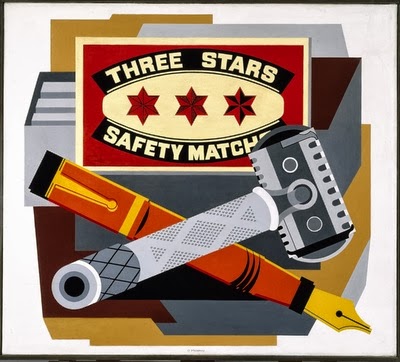
The exhibition will be organized thematically to reflect the fertile relationships between painting and urban culture during this period. The first section of the exhibition will examine the notion of “publicity” and the excitement Léger felt for the evolving visual language of mass communication in the city: the bustle of billboards, traffic signs, and shop window displays. Léger’s paintings, his designs for advertising posters, and his print illustrations will be seen alongside work by other artists and designers, such as Gerald Murphy (photo), Cassandre, and Jean Carlu.

GERALD MURPHY, American, 1888 - 1964 
Razor, 1924 
Oil on canvas, 32 1/16 × 36 1/2 inches (81.4 × 92.7 cm), Framed: 34 × 38 inches (86.4 × 96.5 cm) 
Dallas Museum of Art, Foundatino for the Arts Collection, gift of the artist

The exhibition will also explore Léger’s interest in public entertainment and staged performance, mainly the theater and cinema, highlighting the set and costume designs produced by Léger for film and ballet. This part of the exhibition will survey avant-garde activities around cinema and the stage and include works by Picabia, Alexandra Exter, Georgii Yakoulov, and others. The exhibition’s final section will address the theme of “space” by presenting the artist’s abstract mural compositions of the mid-1920s, intended as decorative architectural panels, in the context of the avant-garde’s exploration of integrating architectural and pictorial space. This section of the exhibition will include works by artists, architects, and designers such as Piet Mondrian (photo), van Doesburg, Robert Mallet-Stevens, Alexander Archipenko and Le Corbusier.

PIET MONDRIAN, Dutch, 1872 - 1944 
No. VI / Composition No. II, 1920 
Oil on canvas, 39 3/16 × 39 3/8 inches (99.5 × 100 cm) 
Tate: Purchased 1967

“For many artists, the metropolis imposed a new way of seeing and demanded new practices of artmaking,”comments exhibition curator Anna Vallye, the Museum’s Andrew W. Mellon Postdoctoral Curatorial Fellow in Modern and Contemporary Art. “It inspired Léger to probe the boundaries between the arts, and between fine art and common culture.”

The exhibition is accompanied by a catalogue published by the Philadelphia Museum of Art in collaboration with Yale University Press. Featuring essays by scholars of art, architecture, and film history, a selection of historical texts by Léger and other avant-garde figures not previously published in English, and more than 250 full-color illustrations, the catalogue conveys the experimental spirit of the 1920s.

PHILADELPHIA MUSEUM OF ART
Museum's website: www.philamuseum.org

24/09/13

Balthus: The last studies, Gagosian Gallery, New York

Balthus: The last studies
Gagosian Gallery, New York
September 26, 2013 - extended through January 18, 2014

Gagosian gallery, New-York, presents a special exhibition “Balthus: The Last Studies.” This is the gallery's first exhibition with the Estate of Balthus to announce the representation and it has been prepared in close association with the artist's family. The exhibition inaugurates Gagosian's new ground-floor gallery at 976 Madison Avenue.

“Balthus: The Last Studies” presents for the very first time selections from an extensive but little-known body of preparatory photographic work by the painter, giving fresh insight into the working processes that he adopted late in life. This intimate exhibition also brings to light key continuities and correspondences between images throughout Balthus's oeuvre, providing a resonant counterpoint to “Balthus: Cats and Girls: Paintings and Provocations,” the thematic survey of early paintings at The Metropolitan Museum of Art, New York that opens to the public on September 25.

Balthus is commonly known as the reclusive painter of charged and disquieting narrative scenes, whose inspirative sources and embrace of exquisitely rigorous technique reach back to the early Renaissance, though with a subversive modern twist. In the last decade of his life, when physical frailty made it all but impossible for him to draw, he discovered the Polaroid camera—a surprising turn for one who had remained so defiantly aloof from many of the radical innovations of his own time. With it he began making extensive instant preparatory "sketches" for his paintings, which were often many years in the making. 

During this time, his artistic energies and attention were reserved largely for his last model, a girl named Anna who posed for him every Wednesday for eight years in the same room, with the same curtain, the same chaise longue, the same window in changing light conditions, the same bucolic mountain scenery looming beyond. What these compelling, jewel-like photographic images reveal—from the dramatic affect of classical gesture to the seeming nonchalance of studied repose—is the extraordinary level of nuance and inventiveness that Balthus was able to evince repeatedly from a simple scene and an approximate photographic method.

In some instances, spontaneous interaction is captured in a single shot; in the first image of the exhibition, Anna presents herself to Balthus's lens for the first time, a guileless child already possessed of La Gioconda's mysterious smile. In others, sequences of images reveal fleeting passages of barely perceptible evolution while Balthus intently searches the situation before him to meticulously define each element. And thus Anna is transformed into the stuff of allegory. Each of the 155 Polaroids presented here, which span the years of collaboration between the artist and his last model, is a record of a masterly command of subject and circumstance and of formal obsession pursued to the end.

The exhibition is accompanied by a magnificent two-volume book in a limited release of 1,000 copies, in which the entire corpus of Polaroids is reproduced. It is edited by Nicolas Pages and Benoit Peverelli and published by Steidl.

Balthus (Balthasar Klossowski de Rola) was born in Paris in 1908 and died in Rossinière, Switzerland in 2001.  At the age of 13, he published Mitsou, a book of 40 ink drawings with a text by Rainer Maria Rilke, a close family friend. A self-taught artist, he held his first exhibition at Galerie Pierre, Paris in 1934. Following the ensuing scandal, he showed with Pierre Matisse Gallery, New York from 1938–77, although he never visited the U.S.  His paintings and drawings are in the collections of key museum and private collections worldwide.

In 1961, Balthus became director of the French Academy in Rome. Over the next 16 years he restored the interior of the Villa Medici and its gardens to their former elegance. During his lifetime, he was also a noted stage designer for Shakespeare's As You Like It, Shelley's Cenci (as adapted by Antonin Artaud), Camus's État de siège and Mozart's Così fan tutte.

Balthus's first major museum exhibition was at The Museum of Modern Art in 1956. Other museum exhibitions of note include Musée des Arts Decoratifs, Paris (1966); Tate Gallery, London (1968); La Biennale di Venezia (1980); The Museum of Contemporary Art, Chicago (1980); Musée cantonal des beaux-arts de Lausanne (1993); Musée national d'art moderne de la ville de Paris (1984, traveled to Metropolitan Museum, Kyoto); The Metropolitan Museum of Art, New York (1984); and Palazzo Grassi, Venice (2001). "Balthus: Cats and Girls: Paintings and Provocations," opening at The Metropolitan Museum of Art, New York on September 25, will be the first U.S. museum survey of the artist's work in 30 years.

Gagosian Gallery
976 Madison Avenue
New York, NY 10075

05/09/13

Surrealism and the dream, Museo Thyssen-Bornemisza, Madrid

SURREALISM AND THE DREAM 
Museo Thyssen-Bornemisza, Madrid 
Curator: José Jiménez 
8 October 2013 - 12 January 2014 

SALVADOR DALI
Dream Caused by the Flight of a Bee around a Pomegranate a Second Before Awakening, 1944
51 x 41 cm
Museo Thyssen-Bornemisza, Madrid, Spain
       
The Museo Thyssen-Bornemisza presents the first monographic exhibition on Surrealism and the dream. Including a total of 163 artworks by the great Surrealist masters -André Breton, Salvador Dalí, Paul Delvaux, Yves Tanguy, Joan Miró, René Magritte, Max Ernst, André Masson, Jean Arp and Man Ray- the exhibition, curated by the art critic José Jiménez, will offer a thematic presentation of the Surrealists' visual interpretation of the world of dreams. 

Surrealism should not be considered just one more art movement: rather, it was an attitude to life essentially based on a vision of interior images accessed through the flow of desire. Its ideas have had a key influence on all subsequent art and on the contemporary mindset. The present exhibition aims to demonstrate that this influence has its most profound roots in the Surrealist connection between dream and image. 

In order to do so, the exhibition will include examples from the wide range of media in which this link is evident: painting, drawing, graphic work, collage, objects, sculptures, photography and film. The Surrealists’ creative horizon encompassed all art forms that could enrich and expand the mind, and its doors were equally open to painters, sculptors, photographers and filmmakers who were the first to adopt the fusion of expressive genres with a multimedia aesthetic during a period of major technological advances in the production and reproduction of images.

From this viewpoint, the role played by film was crucial. The darkness of the cinema brought about an encounter with the unexpected and the amazing of an unpremeditated and unconscious kind. Looking at the silver screen was the realm of waking dreams. According to André Breton, it was in cinemas that “the only totally modern mystery was celebrated”.

In the present exhibition the cinema is represented by seven video installations that will project excerpts from selected Surrealist films including Un chien d’Andalou (1929) by Louis Buñuel and Salvador Dalí, in which the idea of alienation or rootlessness – a key concept in the Surrealist aesthetic - is taken to its furthest limit. The film discards any narrative ordering in order to unfold a flow of images that is as open as a dream.

The significant presence of female artists in the exhibition is another important feature. For the first time, women artists encountered a key role within the context of Surrealism and one that gradually extended beyond their initial function as muses, objects of desire or companions. Many of them developed a creative personality that challenged or differed from those of their male colleagues. The large number (eleven) of women artists represented in the present exhibition, including Claude Cahun, Kay Sage, Nadja, Toyen, Dora Maar, Leonor Fini, Remedios Varo, Dorothea Tanning, Ángeles Santos, Meret Oppenheim and Leonora Carrington, offers proof of the unique nature of their contribution to the Surrealist representation of dreams. 

KAY SAGE
The upper side of the Sky, 1944
58,4 x 71,4 cm
The Israel Museum. 
The Vera and Arturo Schwartz Collection of Dada and Surrealist Art at the Israel Museum, Jerusalem, Israel

SURREALISM AND THE DREAM: The other half of life

The Surrealists’ most important contribution to the artistic concept of the dream lies in the way that they ceased to consider it a void or a hole in consciousness, rather seeing it as the other half of life and a conscious plane of experience. Knowledge and liberation of this plane was central to the enrichment and expansion of the interior world, which was the principal aim of these artists. In this sense, Goya, with his depiction of the dream as a realm of human reality devoid of the supernatural or mythical connotations that were present in earlier art, crucially embarked on a direction that would be pursued by the Surrealists a century later. 

HENRI ROUSSEAU 
Carnival Evening, 1886
117,3 x 89,5 cm
Philadelphia Museum of Art: The Louis E. Stern Collection, 1963

ODILON REDON
Closed Eyes, 1889
45 x 35 cm
Van Gogh Museum, Amsterdam

SURREALISM AND THE DREAM: From the dream to art

The liberation of the visual arts from a mimetic reproduction of exterior reality was one of the factors that brought about the transformation of modern art, particularly from the second half of the 19th century with the artistic avant-gardes. One of the most crucial aspects of the Surrealists’ contribution to this transformation was their championing of the representation of the dream world in art. In order to do so, they looked for a place in which dream and reality came together, moving to and from between the interior and exterior. Through their artistic endeavours the Surrealists thus transcribed the materials of the dream in visual form.

ROLAND PENROSE
Seeing is Believing (L'Ile invisible), 1937
100 x 75 cm
The Penrose Collection

The visual material in Surrealism and the Dream is divided into eight thematic sections: 

1. Those who opened up the paths (of dreams) 
2. I is another: variations and metamorphoses of identity
3. The infinite conversation: the dream is the overcoming of Babel: all languages communicate with each other, all languages are the same 
4. Landscapes of a different place: an alternative universe that nonetheless forms part of the existing one 
5. Irresistible perturbations: nightmare, anxiety 
6. Beyond good and evil: a world ruled by neither morality nor reason 
7. Where everything is possible: omnipotence, everything is possible in dreams 
8. The harsh light of desire: the sex drive without the restraints of conscious life 

The exhibition will be accompanied by a film cycle that includes the complete versions of the films of which excerpts will be shown on video installations in the galleries, as well as other titles. There will also be an international conference (8 and 9 October 2013) directed by the exhibition’s curator José Jiménez, which will focus on the different approaches and ideas regarding the representation of the dream in the visual arts.

Curator: José Jiménez, philosopher and professor of aesthetics and theory of the arts, Universidad Autónoma, Madrid
Coordinator: Laura Andrada, Curatorial Department, Museo Thyssen-Bornemisza

Publications: catalogue, English and Spanish versions

Museo Thyssen-Bornemisza
Paseo del Prado 8, 28014 Madrid
Opening times: Tuesdays to Sundays, 10am to 7pm. Saturdays, 10am to 9pm. Last admissions one hour before closing.
Museum's website: www.museothyssen.org

22/05/13

Romare Bearden: A Black Odyssey, Exhibition at the Amon Carter Museum, Texas

Romare Bearden: A Black Odyssey
The Amon Carter Museum of American Art, Fort Worth, Texas, USA
Through August 11, 2013

On May 18, the Amon Carter Museum of American Art opened Romare Bearden: A Black Odyssey, an exhibition of nearly 50 artworks by ROMARE BEARDEN (1911-1988), one of the most powerful and original artists of the 20th century. The collages, watercolors and prints in the exhibition are based on Homer’s epic poem “The Odyssey,” the ancient story of the Greek hero Odysseus’s journey home to Ithaca after fighting in the Trojan War. The exhibition is the first full-scale presentation of these works outside of New York City and is organized by the Smithsonian Institution Traveling Exhibition Service (SITES). Romare Bearden: A Black Odyssey is on view at the Amon Carter through August 11, and admission is free.

In the Black Odyssey series, Romare Bearden establishes an artistic bridge between Homer’s poem—arguably the definitive work of classical mythology—and African-American culture by depicting Homeric characters as black players on the timeless stage of antiquity. As Bearden once said, “All of us are on a kind of odyssey. And I think this is what makes the story so lasting, so classic, and applicable to everyone.”

Robert G. O’Meally, the Zora Neale Hurston Professor of English and Comparative Literature at Columbia University and curator of the exhibition, suggests a still broader context to Bearden’s series, which assures us that the search for home, family and a sense of belonging is central to self-discovery for all modern-day Americans regardless of race. “In creating the Black Odyssey series,” O’Meally says, “Bearden not only staked a claim to the tales of ancient Greece as having modern relevance, he also made the claim of global cultural collage—that as humans, we are all collages of our unique experiences. Indeed, Bearden does not merely illustrate Homer—he is Homer’s true collaborator, and he invites us as viewers to inherit Homer’s tale and interpret it as our own.”

Amon Carter director Andrew J. Walker concurs. “Bearden’s reinterpretation of ‘The Odyssey’ has a universal appeal that will perhaps allow us all to reflect on our own personal journeys,” he says. “The artworks are beautiful and filled with vivid, saturated colors and geometric images that captivate the imagination. Because Bearden’s work is not in our collection, the exhibition offers an introduction of this important American artist to our visitors.”

The exhibition provides visitors with many ways to learn about Bearden’s life and work. A multimedia tour is available as a free app on web-compatible devices, including smartphones and tablets, and works with Android and Apple operating systems. Visitors may also access the tour on one of the museum’s handheld devices, available for free check out during their visit. Visitors can create works of art by remixing Bearden’s collages in a free iPad app titled “Romare Bearden: Black Odyssey Remixes.” With this app, visitors can layer shapes and forms, and add written words and sound to a variety of Bearden backdrops. (This app is only accessible on visitors’ iPads; devices are not available at the museum.)

Within the exhibition visitors can discover Bearden’s influences, inspiration and techniques through a 15-minute film. It features rarely seen interviews and footage of Bearden at work in his studio; poignant insight and analysis from O’Meally and Diedra Harris-Kelley, the artist’s niece; and commentary from his close friend and personal photographer, Frank Stewart.

In conjunction with the exhibition, the museum will display the work of local artist Sedrick Huckaby (b. 1975), who credits Bearden as an important influence. Huckaby’s 18-by-14-foot oil painting Hidden in Plain Site (2011) will be displayed in the museum’s atrium through October.

Romare Bearden: A Black Odyssey is organized by the Smithsonian Institution Traveling Exhibition Service in cooperation with the Romare Bearden Foundation and Estate and DC Moore Gallery. The exhibition and its related educational resources are supported by a grant from the Stavros Niarchos Foundation. The Fort Worth presentation is supported in part by Bates Container, the Garvey Texas Foundation and AZZ incorporated.

A fully illustrated companion book of the same name (DC Moore Gallery, 2008), written by O’Meally, complements the exhibition. The hardcover book features full-color images of Bearden’s work and an essay by O’Meally, and retails for $45 in the Amon Carter’s Museum Store + Café.

After the exhibition closes in Fort Worth, it continues on its seven-city national tour through 2014 with stops in Madison, Wis., Atlanta, Manchester, N.H. and New York.

Amon Carter Museum, Fort Worth, TX
Museum's website: www.cartermuseum.org

14/06/12

Barbara Kruger: Belief+Doubt, Hirshhorn Museum, Washington DC


Barbara Kruger: Belief+Doubt 
Hirshhorn Museum, Washington DC 
August 20, 2012+2013+2014

The Smithsonian’s Hirshhorn Museum and Sculpture Garden, Washington, DC, has commissioned internationally renowned artist BARBARA KRUGER to create a site-specific installation for one of the museum’s most-visited public spaces. Belief+Doubt (2012) will fill the lower-level lobby and extend into the newly relocated museum bookstore. Approximately 6,700 square feet of surface—including walls, floor and escalator sides—will be covered in text-printed vinyl, surrounding viewers with lettering up to 12 feet high in a high-contrast color scheme of red, white and black.

Belief+Doubt speaks to the social relations and networks of power that define daily life. At a time when the value of certitude is taken for granted, Kruger says she is “interested in introducing doubt.” Large swaths of the floor are covered in open-ended questions WHO IS BEYOND THE LAW? WHO IS FREE TO CHOOSE? WHO SPEAKS? WHO IS SILENT?, while the area facing the bookstore explores desire and consumption YOU WANT IT. YOU BUY IT. YOU FORGET IT.

“It’s a tremendous opportunity,” said Barbara Kruger, noting the particular resonance these themes have in Washington, a city preoccupied with power.

Belief+Doubt will remain on view through 2014, the year the Hirshhorn celebrates its 40th anniversary. Like the recent presentation of Doug Aitken’s “Song 1” on the façade of the museum, Kruger’s installation is part of an initiative to activate new sites in and around the Hirshhorn. “Throughout the museum, we are emphasizing the artist’s voice,” said Richard Koshalek, director of the museum. “In addition, we are committed to curating all of the Hirshhorn’s public areas, not only those already thought of as exhibition spaces. Barbara Kruger’s work interrogates the way power and money flow in contemporary society. Having her intervene in a part of the building that is at once a social site and a place of commerce amplifies both her concerns and those of the Hirshhorn.”

Assistant Curator Melissa Ho, coordinator of the project, said, “Kruger’s command of architectural space and her ability to engage an audience amidst busy, lived experience make her the ideal artist to work with this site. ‘Belief+Doubt’ takes advantage of the constant movement through the lobby. As visitors descend the escalators, they are surrounded by language that beckons from all sides but only fully reveals itself as they pace and circulate through the entire space.”

In the 1980s, Barbara Kruger’s work helped bring photographic illustration and the techniques of mass media into the mainstream of contemporary art. Her signature photomontages, in which images from old books and magazines are emblazoned with banners of text designed to complicate the original meaning of the pictures, are some of the decade’s defining artworks. Kruger built on her early experience as a magazine photo editor and designer and book jacket designer to reconceive conceptual art as a vibrant public discourse by endowing it with a provocative visual identity and graphic punch. A profound influence not only on the development of visual art but also on movements in graphic design and street art, her work has moved fluidly between white-cube galleries and urban spaces, being equally at home printed on matchbooks, T-shirts, billboards, shopping bags, magazine covers and the sides of buses.

Since the 1990s, Barbara Kruger has focused increasingly on creating environments that encompass the viewer in language, either through sound and video projection or, as at the Hirshhorn, the enclosure of a space with text. In recent years, her site-specific vinyl installations have been mounted at the Schirn Kunsthalle in Frankfurt, the Stedelijk Museum in Amsterdam and the Los Angeles County Museum of Art. Her room-sized multichannel video work The Globe Shrinks (2010) has been shown in Berlin, New York, London and Los Angeles. In 2005, Barbara Kruger was awarded the Golden Lion for Lifetime Achievement at the 51st Venice Biennale.

The materials for this project have been donated by 3M. Additional funding was provided by L&M Arts and the Barbara Lee Family Foundation.

The Hirshhorn Museum and Sculpture Garden's website: www.hirshhorn.si.edu

25/02/12

On Horizons, Photo Museum Winterthur - Set 8 from the Collection of the Fotomuseum Winterthur

On Horizons - Set 8 from the Collection of the Fotomuseum Winterthur
Fotomuseum Winterthur, Switzerland
Curator: Thomas Seelig
Through May 20, 2012
 

The photographic gaze into the horizon is a mirror for internal and external states and produces artistic interpretations and commentaries. As in other artistic genres, landscape in photography is interpreted through political and private gazes and the results go far beyond purely aesthetic experiences. Assembled from the collection of the Fotomuseum Winterthur, this exhibition shows how photographers since the mid-1960s have approached their imagery from a range of analytical and emotional standpoints.  


Garry Winogrand Garry Winogrand
Albuquerque, New Mexico, 1958
Silbergelatine-Abzug, 21,5 x 32 cm
Collection Fotomuseum Winterthur
© Estate of Garry Winogrand / Courtesy Fraenkel Gallery, San Francisco

Albuquerque, New Mexico, 1958. This amazing photograph by Garry Winogrand is part of the exhibition organized by the Swiss museum dedicaced to the photography in Winterthur, near Zurich.

Also on view, 1970s B&W and color photographs by renowed photographers Luigi Ghirri, Shomei Tomatsu, Guido Guidi and Robert Häusser.

Luigi Ghirri Luigi Ghirri
Salisburgo (Salzburg), 1977
C-Print, 23,8 x 35,5 cm
Collection Fotomuseum Winterthur
© Estate of Luigi Ghirri

This photograph by Luigi Ghirri is from “Diaframma 11, 1/125 luce naturale” Aperture 11, 1/125 second shutter speed with natural day light. The exhibition also features Luigi Ghirri’s pictures from “Kodakrome” (1973).

Shomei Tomatsu Shomei Tomatsu
Japan World Exposition, Osaka, 1970
C-Print, 20,5 x 29,7 cm
Collection Fotomuseum Winterthur
Acquired with funds from Canon (Schweiz) AG
© Shomei Tomatsu

Guido Guidi Guido Guidi
Fosso Ghiaia, 1972
Silbergelatine-Abzug, 17,3 x 17,3 cm
Collection Fotomuseum Winterthur, Schenkung Thomas Koerfer
© Guido Guidi

Robert Hausser Robert Häusser
Relative Orientierungen, Relative orientations, 1972
Gelatin-silver print, 41 x 57 cm
Collection Fotomuseum Winterthur, Gift of Robert Häusser
© Robert Häusser / FIP / Reiss-Engelhorn-Museum

Exploring unknown locations provides the creative impulse for works by three Swiss photographers Balthasar Burkhard, Reto Camenisch, and Jan Jedlicka, who express their visions in monumental individual images or in series of small-scale works.

Balthasar Burkhard Balthasar Burkhard
Chlönthal, 2002
Triptych Gelatin-silver prints, 244 x 306 cm
Collection Fotomuseum Winterthur, Gift of Volkart Foundation
© Estate of Balthasar Burkhard

Lewis Baltz is a participant of the famous exhibition New Topographics: Photographs of a Man-Altered Landscape, which in 1975 first addressed the man-created interface between civilization and nature.

Lewis Baltz Lewis Baltz
Aus: Continuous Fire Polar Circle, 1986
Gelatin-silver print, 20,2 x 25,4 cm
Collection Fotomuseum Winterthur, Dauerleihgabe Lewis Baltz
© Lewis Baltz


Time for looking and contemplation is the central element of Himmel [Heaven], an eighty-one image slide show by weather phenomenologist Andreas Züst. Accordingly, it shares a close bond with the hi-gloss digital video Highlights II by Dominik Hodel as well as the publication LA AIR by Bruce Nauman, which presents sunsets over Los Angeles juxtaposed with minimalist color studies.

Andreas Zust Andreas Züst
From: Sky, 1990-2000
Slide show in 81 parts
Collection Fotomuseum Winterthur
© Estate of Andreas Züst

Dominik Hodel Dominik Hodel
Headlights II, 2010
Full-HD Videoloop 2.45 min.
Collection Fotomuseum Winterthur
© Dominik Hodel

When Christian Schwager photographs almost innocent-looking meadows and forests in Bosnia some ten years after the civil war, the unhealed wounds, the hidden signs of violence, disturb us. Pictures of landscapes are never neutral, the exacting gaze of the photographs anchor them in a particular zeitgeist and open up additional levels of meaning.

When Robert Frank seeks visual answers to elementary questions of life in the sparse surroundings of his house in Nova Scotia (Canada), circling about his direct environment again and again, landscape becomes a projection screen for yearnings and remembrances.

Robert Frank Robert Frank
For Andrea 1954-1974, Mabou, 1975
Gelatin-silver print, 49,6 x 39,8 cm
Collection Fotomuseum Winterthur, Gift of George Reinhart
© Robert Frank

Also on view a triptych by the landscape photographer Axel Hütte. His last book, Towards the Woods, was published in september 2010 by Schirmer/Mosel (in english).

Axel Hutte Axel Hütte
Furka, Schweiz, 1995
2 C-Prints, each 205 x 162 cm
Collection Fotomuseum Winterthur
© Axel Hütte


With works by the following artists : Caroline Bachmann / Stefan Banz, Lewis Baltz, Balthasar Burkhard, Reto Camenisch, Gintaras Didziapetris, Dick Duyves, Hans-Peter Feldmann, Peter Fischli/David Weiss, Thomas Flechtner, Robert Frank, Dunja Evers, Luigi Ghirri, John Gossage, Guido Guidi, Robert Häusser, Dominik Hodel, Roni Horn, Axel Hütte, Jan Jedlicka, Claudio Moser, Bruce Nauman, Igor Savchenko, Christian Schwager, Yoshiko Seino, Shomei Tomatsu, Garry Winogrand, and Andreas Züst.

The exhibition is organized by THOMAS SEELIG, curator of the collection at Fotomuseum Winterthur.

On Horizons - Set 8 from the Collection of the Fotomuseum Winterthur

Accompanying the exhibition is, as part of the series of publications on the collection of the Photography Museum Winterthur, a collection brochure with works of the exhibition: On Horizons – Set 8 from the Collection of the Fotomuseum Winterthur, THOMAS SEELIG (ed.), Fotomuseum Winterthur, Winterthur, 2011, 32 pages, numerous color and b/w illustrations, softbound, 24,6 x 20 cm, German / English. With an essay by CHRISTOPH RIBBAT, and texts to the artists. On the cover of the brochure is a detail of the photogaph by Luigi Ghirri taken in Salzburg in 1977.

Alpi – a Film by Armin Linke
Film screening on September 28, 2011 with an introduction by Armin Linke, in conjunction with the exhibition On Horizons. The film Alpi is the result of seven years of research into how the landscapes of the Alps—spanning the borders of eight nations and four languages—are perceived and used. In the film the Alps are portrayed as an island that is subjected to numerous global transformations. The complexity of social, economic, and political relationships within the context of landscape are easily visualized by this centralized and fragile region. The screening has been concluded by a public discussion with Thomas Seelig and Armin Linke. ARMIN LINKE (b. 1966) is an artist who works with photography and film. He lives in Milan and Berlin.

Fotomuseum Winterthur, Switzerland / Suisse
Photography Museum - Musée de la photographie

CH-8400 Winterthur (Zurich)
www.fotomuseum.ch

19/02/12

Adel Abdessemed: Who’s afraid of the big bad wolf at David Zwirner, New York

Adel Abdessemed: Who’s afraid of the big bad wolf 
David Zwirner, New York

February 17 - March 17, 2012


ADEL ABDESSEMED
Décor, 2011-2012 (detail). Razor wire.
Four elements, each: 86 x 70 x 24 inches (218.4 x 177.8 x 61 cm)

David Zwirner presents an exhibition of new works by ADEL ABDESSEMED. Spanning both of the gallery's 525 and 533 West 19th Street spaces, Who's afraid of the big bad wolf is Abdessemed's second solo exhibition since he joined the gallery in 2008.

Across a wide range of media, Adel Abdessemed transforms well-known materials and imagery into charged artistic declarations. The artist pulls freely from myriad sources–personal, historical, social, and political–to create a visual language that is simultaneously rich and economical, sensitive and controversial, radical and mundane.

The exhibition brings together recent works that revolve around the themes of war, violence, and spectatorship. The 525 gallery space presents works grouped by Adel Abdessemed as primarily concerned with the dichotomy between meaning and matter: they include Décor, which presents four life-size sculptures of the crucified Jesus made entirely from razor wire. Modeled after German Renaissance painter Matthias Grünewald's Crucifixion (a part of his Isenheim Altarpiece from 1506-1515), the contorted, twisted figures hang against an otherwise naked wall without the structure of the cross itself. Creating a formal juxtaposition between the hazardous qualities of the razor wire and its abstract appearance, Décor enhances the connotations of physical suffering implicit in the subject matter, while the repetitive appearance of the sculptures creates a distinctively decorative effect.

Occupying the floor in front of Décor is a group of over thirty larger-than-life-sized microphones made from hand-blown glass. Perhaps an allegory for the ideal of transparent communication and open dialogue, the title of the work, L'avenir est aux fantômes (The future belongs to ghosts), is a reference to the late French philosopher Jacques Derrida, whose characterization of a variety of phenomena as "ghosts" was highlighted in Ken McMullen's film Ghost Dance, 1983, featuring Jacques Derrida himself. Also on view nearby is La Grande Parade, a large installation of Abdessemed's drawings of porcupines, weasels, tortoises, and other reptiles. Executed in the artist's loose style, the animals have sticks of dynamite strapped to them as if presenting an allusion to modernday kamikazes.

In the 533 gallery space, which brings together works Adel Abdessemed has characterized as primarily concerned with substantive themes of hope, death, memory, and compulsion, viewers first encounter Hope, an installation of a boat found abandoned on a beach in the Florida Keys. Used illegally to transport immigrants in pursuit of a new life to the United States, often compromising their safety in the process, the boat is presented as it was discovered, but has been filled to the brim with black bags cast in polyurethane resin from actual, stuffed garbage sacks. While a crude and provocative analogy between the trash and the boat’s former passengers appears explicit, Hope presents an art historical reference to Romantic artist Caspar David Friedrich's apocalyptic painting from 1823-1824, The Wreck of the Hope, featuring a capsized vessel in a sea of icebergs.

Also on view in the 533 gallery space: Who's afraid of the big bad wolf, a wall installation of taxidermy animals, including wolves, which takes its title from the famous soundtrack to Disney's 1933 cartoon The Three Little Pigs as well as from Barnett Newman's version of the phrase for his series of paintings from the late 1960s, Adel Abdessemed's previous work with preserved animals, the installation juxtaposes the age-old practice of taxidermy, used for scientific as well as for decorative purposes, with a reference to meaningless slaughter and war–the animals in the installation have subsequently been burnt and are a monotonous black while the overall dimensions correspond to Pablo Picasso's Guernica, 1937, a now classic representation of the effects of war on civilians. Near the installation, Mémoire presents a video showing a baboon spelling out the words "Tutsi" and "Hutu" on a white wall, which refer to the names of the opposing ethnic groups involved in the 1994 Rwandan civil war and the ensuing devastating genocide.

Coup de tête depicts the moment French footballer Zinedine Zidane headbutted Italian Marco Materazzi in the 2006 World Cup final in Germany in a heated response to a verbal insult by the latter. While it presents a realistic rendition of the event, Abdessemed's slightly larger-thanlife, resin sculpture is not so much a commemoration of the incident itself as it is a testament to the emotions and underlying narratives which often accompany major sports events. By distilling the moment of Zidane's much scrutinized violent impulse, Adel Abdessemed's work draws attention to the verbal insults and provocations that often flourish in the sport without any visible manifestation, and further emphasizes the obsessive interest in drama that lies beyond the game itself. As such, it reverberates with the underlying theme of the exhibition, which is concerned with familiar manifestations of aggression and violence. Drawing on a multitude of seemingly converse and often visually spectacular references and symbols, Abdessemed highlights the interconnectedness of innate aspects of human behavior, while at the same time challenging passive modes of spectatorship.


ADEL ABDESSEMED: Short biography

Born in Constantine, Algeria, Adel Abdessemed attended the École des Beaux-Arts d'Alger, Algiers, and the École nationale des Beaux-Arts de Lyon, France. He had his first American gallery exhibition, RIO, at David Zwirner in 2009.

A major survey of the artist's work is planned for October 2012 at the Centre Georges Pompidou in Paris, and will be accompanied by an exhibition catalogue. Abdessemed’s work was recently the subject of solo exhibitions at Parasol unit foundation for contemporary art, London, and the Ontario College of Art & Design, Toronto (both 2010). Other notable solo exhibitions include the Fondazione Sandretto Re Rebaudengo, Turin (2009); MIT List Visual Arts Center, Cambridge, Massachusetts; Le MagasinCentre National d'Art Contemporain de Grenoble, France (both 2008); and P.S.1 Contemporary Art Center, Long Island City, New York (2007).

The artist has participated in a number of significant group exhibitions, including the 3rd Thessaloniki Biennale; In Praise of Doubt, Punta della Dogana, Venice (both 2011); Aichi Triennale 2010, Nagoya, Japan (2010); Mapping the Studio: Artists from the François Pinault Collection, Palazzo Grassi and Punta della Dogana, Venice; 10th Lyon Biennale, France; 10th Istanbul Biennial; 10th Havana Biennial (all 2009); 7th Gwangju Biennial, Gwangju, South Korea (2008); and the 52nd Venice Biennale (2007).

His work is represented in prominent collections internationally, including the Centre Georges Pompidou, Paris; The Israel Museum, Jerusalem; Musée d'art moderne et contemporain, Geneva; Musée d'Art Moderne de la Ville de Paris; and the François Pinault Foundation, Venice. He lives and works in Paris.

A comprehensive monograph of Adel Abdessemed's work as been prepared by David Zwirner in collaboration with Pier Luigi Tazzi and Steidl.

DAVID ZWIRNER, NEW YORK
525 and 533 West 19th Street New York, NY
www.davidzwirner.com