Showing posts with label Santa Fe. Show all posts

15/09/24

Unskilled Worker @ Daniel Cooney Fine Art, Santa Fe - "When You're a Boy" Exhibition

Unskilled Worker
When You're a Boy
Daniel Cooney Fine Art, Santa Fe
September 12 – October 26, 2024

Daniel Cooney Fine Art presents the debut US exhibition by Unskilled Worker titled When You’re a Boy. The exhibition consists of 20 intimate portraits of young men, all painted in 2024 and never before seen. The exhibition marks a transition back to single figures, renewing the stillness and loose line of the artist’s early work.

Unskilled Worker has received great renown for her densely narrative, large-scale work that has garnered fans across the globe. Since the early days of her practice, she has created the “boys” between larger projects as “a washing away, a deep breath”, a place to center herself and create renewed energy. Over the years they have become a vital part of her creative process and until now have never been exhibited as a group.

The portraits are sometimes a direct reference to an individual that inspires the artist and sometimes an amalgam of various people, both real and imagined. The artist states, “The common denominator is surely me. I’m not certain it’s possible to paint a face and leave myself behind. In a way they connect to my story.”, while we see a portrait of a young man, we are looking deeply at the artist herself. The portraits are undeniably highly emotional and intensely felt by the artist and the viewer alike.

Unskilled Worker is the moniker assumed by Helen Downie, a London based artist, best known for her idiosyncratic and expressive style of painting. Her paintings have appeared in many publications, including The New York Times, Vanity Fair, Vogue, Dazed, Forbes, Creative Review and i-D. Her work is collected internationally and have been exhibited at galleries across the world including London, Hong Kong, Seoul, Milan, Madrid, Tokyo and Shanghai.

Unskilled Workers paintings have been exhibited at the Minsheng Art Museum in Shanghai. In 2016, a specially commissioned portrait by the artist was featured as a limited-edition cover of Bazaar Art with six leading contemporary female artists. Unskilled Worker collaborated with Gucci in 2017 by launching a 40-piece collection featuring her artwork.

DANIEL COONEY FINE ART
1600 Lena Street, Santa Fe, NM 87505

21/01/24

Ways of Seeing: Four Photography Collections @ New Mexico Museum of Art, Santa Fe

Ways of Seeing 
Four Photography Collections 
New Mexico Museum of Art, Santa Fe
January 20 - June 16, 2024

Jeff Brouws
Jeff Brouws 
Mobil/Trailer, Inyokern, Calif., 1991
Chromogenic print, 18 × 18 in. 
Collection of the New Mexico Museum of Art 
Gift of Jamie Brunson and Dr. Mark Levy, 2021 (2022.15.2) 
Photo Courtesy of Jeff Brouws / Robert Koch Gallery, San Francisco 

Showcasing three groups of recent donations and one promised gift to the New Mexico Museum of Art collection and highlighting individual approaches to collecting art, Ways of Seeing includes nearly forty photographs ranging from a 1903 photogravure by Gertrude Käsebier to a 2013 pigment print by local artist Anthony O’Brien. 

“Ways of Seeing is an interesting study of taste and the profound reasons why collectors select objects for their personal collections,” said the museum’s Executive Director Mark A. White. “In addition, the exhibition is an important reminder of how collectors have shaped and grown the photography collection of the New Mexico Museum of Art.” 

Photographer and photo dealer Donald B. Moritz began collecting photographs in the mid-1980s, working directly with the artists he admired to amass a holding of primarily black-and-white prints. He met one of them, longtime New Mexico photographer David Michael Kennedy, when taking a class at the Santa Fe Workshops. Struck by the beauty of Kennedy’s work, Moritz quickly became one of the El Rito artist’s major collectors. In 2022, Moritz donated Kennedy’s portfolio of cloud studies and four additional photographs, all on view. 

New Yorker W.M. Hunt chose a thematic approach to acquiring photographs. “Photography changed my life; it gave me one,” Hunt says in The Unseen Eye. The 2011 publication documents Hunt’s extensive collection of images from across the history of photography in which the eyes of the subject are hidden or obscured. Eight photographs from Hunt’s donation are on view, by artists Adam Fuss, Debbie Fleming Caffery, Inge Morath and Saul Steinberg, Ruth Thorne Thomsen, Arthur Tress, Gerald Slota, Minor White, and Joel-Peter Witkin. 

Painter Jamie Brunson donated seven photographs to the museum from a collection she assembled with her former husband, the late art historian and teacher Mark Levy, while living in Berkeley, California. The two were drawn to large-scale, contemporary photographs of the 1980s and 1990s, particularly those alluding to human interactions with the environment and those that reflected their interests in meditation and the concept of the void. The group is comprised of work by Tom Baril, Jeff Brouws, Kevin Bubriski, Edward Burtynsky, William Claxton, Richard Misrach, and John Pfahl.  

Another couple, Caroline Burnett and her late husband William, also shared the adventure of collecting photographs. In 1992, Bill gave Caroline a print of an Arnold Newman’s photograph of Georgia O’Keeffe at Ghost Ranch, as a reminder of their hike to the summit of Pedernal. The two moved to Santa Fe in 2001, and continued collecting photographs that touched their hearts and often feature a sense of serenity. After Bill’s death, Caroline continued to shape the collection and established it as a promised gift to the museum. On loan for this exhibition are gems by Ruth Bernhard, Manuel Álvarez Bravo, Harry Callahan, Kenro Izu, Gertrude Käsebier, local photographer Anthony O’Brien, Sebastião Salgado, Alfred Stieglitz, and Todd Webb. 

NEW MEXICO MUSEUM OF ART
Santa Fe, New Mexico

23/12/09

Georgia O’Keeffe: Abstraction – US Landmark Exhibition


Georgia O'Keeffe, Series I © Georgia O’Keeffe Museum/Artist Rights Society (ARS), New York              Georgia O'Keeffe, Series I © Milwaukee Art Museum, Photography by Larry Sanders                Georgia O'Keeffe, Series I © Städtische Galerie im Lenbachhaus

  Georgia O'Keeffe, Series I—No. 1, No. 3 and No. 4, 1918

Georgia O’Keeffe: Abstraction is a US landmark exhibition debuting at the Whitney Museum of American Art. Following its New York debut, the show travels to

The Phillips Collection, Washington D.C., February 6– May 9, 2010, and to

the Georgia O'Keeffe Museum, Santa Fe, May 28 – September 12, 2010.


While Georgia O’Keeffe (1887–1986) has long been recognized as one of the central figures in 20th-century art, the radical abstract work she created throughout her long career has remained less well-known than her representational art. By surveying her abstractions, Georgia O’Keeffe: Abstraction repositions O’Keeffe as one of America's first and most daring abstract artists. The exhibition is one of the largest of Georgia O'Keeffe's work ever assembled.

Including more than 125 paintings, drawings, watercolors, and sculptures by Georgia O'Keeffe as well as selected examples of Alfred Stieglitz’s famous photographic portrait series of Georgia O’Keeffe, the exhibition has been many years in the making.


While it is true that Georgia O’Keeffe has entered the public imagination as a painter of sensual, feminine subjects, she is nevertheless viewed first and foremost as a painter of places and things. When one thinks of her work it is usually of her magnified images of open flowers and her iconic depictions of animal bones, her Lake George landscapes, her images of stark New Mexican cliffs, and her still lifes of fruit, leaves, shells, rocks, and bones. Even O’Keeffe’s canvasses of architecture, from the skyscrapers of Manhattan to the adobe structures of Abiquiu, come to mind more readily than the numerous works—made throughout her career—that she termed abstract.

This exhibition is the first to examine Georgia O'Keeffe's achievement as an abstract artist. In 1915, O'Keeffe leaped into the forefront of American modernism with a group of abstract charcoal drawings that were among the most radical creations produced in the United States at that time. A year later, she added color to her repertoire; by 1918, she was expressing the union of abstract form and color in paint. First exhibited in 1923, Georgia O’Keeffe’s psychologically charged, brilliantly colored abstract oils garnered immediate critical and public acclaim. For the next decade, abstraction would dominate her attention. Even after 1930, when Georgia O’Keeffe’s focus turned increasingly to representational subjects, she never abandoned abstraction, which remained the guiding principle of her art. She returned to abstraction in the mid-1940s with a new, planar vocabulary that provided a precedent for a younger generation of abstractionists.

Abstraction and representation for Georgia O’Keeffe were neither binary nor oppositional. She moved freely from one to the other, cognizant that all art is rooted in an underlying abstract formal invention. For O’Keeffe, abstraction offered a way to communicate ineffable thoughts and sensations.

As she said in 1976, “The abstraction is often the most definite form for the intangible thing in myself that I can only clarify in paint.”

Through her personal language of abstraction, she sought to give visual form (as she confided in a 1916 letter to Alfred Stieglitz) to “things I feel and want to say - [but] havent [sic] words for.” Abstraction allowed her to express intangible experience—be it a quality of light, color, sound, or response to a person or place.

As Georgia O’Keeffe defined it in 1923, her goal as a painter was to “make the unknown—known. By unknown I mean the thing that means so much to the person that he wants to put it down—clarify something he feels but does not clearly understand.”

This exhibition and catalogue chronicle the trajectory of Georgia O'Keeffe's career as an abstract artist and examine the forces impacting the changes in her subject matter and style. From the beginning of her career, she was, as critic Henry McBride remarked, “a newspaper personality.” Interpretations of her art were shaped almost exclusively by Alfred Stieglitz, artist, charismatic impresario, dealer, editor, and O’Keeffe’s eventual husband, who presented her work from 1916 to 1946 at the groundbreaking galleries “291”, the Anderson Galleries, the Intimate Gallery, and An American Place. Alfred Stieglitz’s public and private statements about O’Keeffe’s early abstractions and the photographs he took of her, partially clothed or nude, led critics to interpret her work—to her great dismay—as Freudian-tinged, psychological expressions of her sexuality.

Cognizant of the public’s lack of sympathy for abstraction and seeking to direct the critics away from sexualized readings of her work, Georgia O’Keeffe self-consciously began to introduce more recognizable images into her repertoire in the mid-1920s. As she wrote to the writer Sherwood Anderson in 1924, “I suppose the reason I got down to an effort to be objective is that I didn’t like the interpretations of my other things [abstractions].” Georgia O’Keeffe’s increasing shift to representational subjects, coupled with Alfred Stieglitz’s penchant for favoring the exhibition of new, previously unseen work, meant that Georgia O’Keeffe’s abstractions rarely figured in the exhibitions Alfred Stieglitz mounted of her work after 1930, with the result that her first forays into abstraction virtually disappeared from public view.

Georgia O’Keeffe: Abstraction was organized by the Whitney Museum of American Art, New York; The Phillips Collection, Washington, DC; and the Georgia O’Keeffe Museum, Santa Fe, NM. The curatorial team, led by Whitney curator Barbara Haskell, includes Barbara Buhler Lynes, the curator of the Georgia O’Keeffe Museum and the Emily Fisher Landau Director of the Georgia O'Keeffe Museum Research Center; Bruce Robertson, professor of the history of art and architecture at the University of California, Santa Barbara; Elizabeth Hutton Turner, professor and vice provost for the arts at the University of Virginia and guest curator at The Phillips Collection; and Sasha Nicholas, Whitney senior curatorial assistant.


The exhibition is accompanied by a fully illustrated catalogue with essays by the organizers. In addition to rethinking Georgia O'Keeffe's place in American modernism, the book reappraises the origin and singular character of her abstract vocabulary and the stylistic shifts which her art underwent over the span of her long career. It adds significant new insight into her art and life, publishing for the first time excerpts of recently unsealed letters written by Georgia O’Keeffe to photographer and gallerist Alfred Stieglitz, whom she married in 1924. These letters, along with a contextual chronology and other primary documents referenced by the authors, offer an intimate glimpse into her creative method and intentions as an artist.


Whitney Museum of American Art
September 17, 2009-January 17, 2010


Image Credits, from left to right:

Georgia O'Keeffe, Series I—No. I, 1918
Oil on composition board, 19 3/4 x 16 in. (50.2 x 40.6 cm)
Amon Carter Museum, Fort Worth, Texas
Purchase with assistance from the Anne Burnett Tandy Accessions Fund, 1995.8
© Georgia O’Keeffe Museum/Artist Rights Society (ARS), New York

Georgia O’Keeffe, Series I—No. 3, 1918
Oil on board, 20 x 16 in. (50.8 x 40.6 cm)
Milwaukee Art Museum
Gift of Jane Bradley Pettit Foundation and The Georgia O’Keeffe Foundation
M1997.192, © Milwaukee Art Museum
Photography by Larry Sanders

Georgia O'Keeffe, Series I, No. 4, 1918
Oil on canvas, 20 x 16 in. (50.8 x 40.6 cm)
Städtische Galerie im Lenbachhaus, Munich
Gift of The Georgia O'Keeffe Foundation
© Städtische Galerie im Lenbachhaus

19/11/09

Radius Books Hosts 2009 Annual Book Party


Friday, December 4, 2009, 5–8 pm

519 Cerrillos Road, Santa Fe, New Mexico (across from Hotel Santa Fe, in the old Luna bldg)


“Incredibly beautiful books . . . Radius and its mission are welcome forces in a world increasingly inundated by digital dogma . . . [with] a commitment to emerging artists as well as cultural giants . . . “ — Zane Fischer, The Santa Fe Reporter


RADIUS BOOKS  launched in 2007 as a new PUBLISHER OF FINE ART AND PHOTOGRAPHY BOOKS based in Santa Fe, New Mexico. With national and international distribution by Distributed Art Publishers (D.A.P.), Radius Books has already worked with many notable artists and gained an international reputation.

The explicit mission of the company is “to promote an ongoing dialogue among writers, thinkers, artists, photographers and all members of society by producing worthwhile bodies of work in book form.” In this spirit, Radius Books has been organized as a 501©(3) not-for-profit corporation, and donates 200-300 copies of every title published to libraries and schools in order to reach and inspire audiences––particularly young people––who otherwise might not have the opportunity to experience books of this kind.

With print runs ranging from 1000–3000 copies for most of its trade editions—and affordable pricing––limited editions for most titles, and distribution to the standard bookstore trade, Radius Books aims for a targeted, yet broad market. Sharon Gallagher, president and CEO of D.A.P. says, “We had been looking for a long time for the American counterpart to the small, European art publishers, and we found it in Radius Books.”

Titles on the 2009 list include books by legendary California-based painter ED MOSES, Magnum photographer ALEX WEBB and REBECCA NORIS WEBB, Bay-area photographer MICHAEL LIGHT, and the Turner Prize-winning artist CHRIS OFILI.

Their annual Book Party is a chance to see new titles, interact with the artists, and support a local non-profit. Radius Books will show their appreciation to the local Santa Fe community by offering 30% off all trade editions of books. “Radius pushes the edges . . . they are expanding the parameters of what an art book can be.” ––George Thompson, Director, Center for American Places, in PDN Magazine.


RADIUS BOOKS

1012 Marquez Place 109B
Santa Fe, New Mexico 87505

www.radiusbooks.org

06/09/09

Gerry Snyder and Marco Rosichelli: The Surreal Life, New Mexico Museum of Art, Santa Fe

The Surreal Life: Gerry Snyder and Marco Rosichelli
New Mexico Museum of Art, Santa Fe
September 25, 2009 - January 31, 2010

The Surreal Life sets up a dialogue between the work of two artists, Gerry Snyder and Marco Rosichelli, who share a desire to create alternative universes both familiar and strange. 

Gerry Snyder and Marco Rosichelli present in their art extremely well known elements – Snyder’s beautifully crafted paintings with their Renaissance inspired backdrops and Rosichelli’s finely crafted playground toys. However, they juxtapose these artistic elements with surreal content, Snyder with amorphous balloon-like cartoon shapes and Rosichelli with fetus-like forms. 

Marco Rosichelli’s sculptures evoke common objects reminiscent of childhood icons and toys. He says, “…the viewers are enticed to interact with the work.”  

The figures in Gerry Snyder’s paintings have an unruly organic quality that suggest Darwinian principles run amok; they can’t stop growing extra breasts yet lack basic necessities like arms or mouths. 

We are asked to consider the anthropomorphic forms represented in both artists’ work, either through our subconscious dream-fueled mind or as literal symbols. Is the Rosichelli sculpture in the exhibition, “Spring Fetus 2,” the realization of some dream gone bad or more literally a hobby horse common to children’s playgrounds? Is Snyder asking us to look at the forms in his paintings as if through a window or is the canvas a mirror?

Exhibition curator Tim Rodgers, Ph.D., said that he hopes the viewer will, “…find such art inspiring in that it opens up new possibilities and alternative worlds.”

Gerry Snyder earned his BFA from the University of Oregon and his MA in Art and Media, at New York University. Gerry Snyder lives in New Mexico. His work has been exhibited internationally and is in the Whitney and DeYoung Museums’ permanent collections. Marco Rosichelli received his BFA in sculpture and design from Southern Oregon University in Ashland, Oregon. He recently earned an MFA in sculpture from Arizona State University, in Tempe, Arizona. He was recently the recipient of a public art commission through the Scottsdale Public Arts Commission, in Scottsdale, Arizona. Rosichelli currently lives in Arizona. Marco Rosichelli has mostly shown in Arizona and Oregon and The Surreal Life is a good opportunity to see emerging and more established artists’ take on this topic.

NEW MEXICO MUSEUM OF ART
Santa Fe’s Plaza at 107 West Palace Avenue
www.nmartmuseum.org 

30/09/08

Lee Friedlander - New Mexico at Andrew Smith Gallery, Santa Fe

Lee Friedlander: New Mexico
Andrew Smith Gallery, Santa Fe
October 31, 2008 - January 15, 2009

Lee Friedlander was born in Aberdeen, Washington, in 1934. Beginning in 1963 with an acclaimed one-man show at George Eastman House, he has had exhibitions at the Museum of Modern Art, New York; Corcoran Gallery, Washington D.C.; National Gallery of Victoria, Melbourne; Center for Creative Photography, Tucson; and the San Francisco Museum of Modern Art. He is the recipient of numerous awards and fellowships including a MacArthur Grant (1990) and the MacDowell Colony Award (1986). Friedlander's photographs have been widely exhibited and published. They have also been the subject of over two dozen books including Self-Portrait, Like A One-Eyed Cat, American Musicians, Sticks and Stones: Architectural America and Friedlander: The Museum of Modern Art.
Andrew Smith Gallery at 203 W. San Francisco St., Santa Fe, NM 87501 opens an exhibition of approximately fifty photographs taken in New Mexico by the American Master of Photography, Lee Friedlander on Oct. 31, 2008. Mr. Friedlander will be in the gallery for the opening reception on Friday, Oct. 31, 2008 from 5 to 7 p.m. to meet the public and sign copies of his newest publication, Lee Friedlander New Mexico, published by Radius Books, Santa Fe, NM (2008). The exhibit continues through January 15, 2009.
Lee Friedlander ranks as possibly America's greatest photographer. For over fifty years he has prodigiously photographed what he calls the "American social landscape" with an unflinching eye for realism. Transcending mere documents, his photographs are the result of his artistic genius to structure scenes through the camera lens playing what chief photography curator at the Museum of Modern Art, Peter Galassi, calls, "a double game of light and shadow, near and far, which Friedlander wins by knitting the opposing terms together in a riotous and irregular but articulate pattern, making a whole that pulsates with life."
The exhibit features photographs taken in Santa Fe, Albuquerque, Gallup, Chimayo, and Diablo Canyon between 1995 and 2005. Friedlander's fondness for urban and wilderness areas in disarray is evident in this plethora of scenes that will be familiar to any New Mexico resident. Scraggly back yards, sun baked streets studded with poles and signs, makeshift hovels and historic buildings, juniper dotted hillsides, and ubiquitous pickup trucks are all packed together in a befuddling mixture of order and chaos, warmth and alienation, freedom and restraint, nature and commercialism. "The same nosy, curious eye is at work, poking through thickets and chain link fences, playing its usual Cubist game of figure and ground."
The western landscape is an old subject in the annals of photography, but for Friedlander, used to shooting in urban and rural areas, this was new territory. By the 1970s the classically beautiful western landscape as exemplified by Ansel Adams had become questionable as a serious theme in contemporary photography. Photographers like Robert Adams have demonstrated that in our era Nature has been beaten back and relegated to the rarified confines of parks and wilderness areas. From coast to coast most of the U.S. is a maze of telephone wires, highways, billboards, strip malls, suburbs and gas stations. But that is exactly the sort of thing that appeals to Friedlander for whom "decorous enthrallment with beauty dissolves into uncharted fascination with fact."
Friedlander began photographing in New Mexico in the late 1960s. Today this work is part of an ongoing series of landscapes he has been working on for more than a decade. Some of his best loved images were taken in New Mexico, including "105-34 - Albuquerque, New Mexico," 1972, in which a black dog with its tongue lolling out is the sole occupant at a corner of 12th Street and Central. This photograph reflects the core of Friedlander's work; his love of the vernacular, and his penchant for photographing the indigenous and commonplace ratherthan the exotic and sophisticated.
Years ago Friedlander shot with a Leica, but since the early 90s his principal camera has been a medium-format Hasselblad Superwide that produces a square picture, with a negative nearly four times as large as the Leica's. The prints from these negatives have a special clarity and brightness that matches the pellucid atmosphere of the high desert.
"1499-3: New Mexico," 2001
Telephone poles, signs, and street lights are scattered throughout a bland, sun drenched industrial district. Sky and pavement mirror each other's brilliant values and contrast with the dark horizon line of buildings. The vertical dimension is emphasized by telephone poles doubled in size by their dark shadows cast on the pavement. In this cross shaped composition of elongated forms a squat fire hydrant and a stop sign take on the appearance of whimsical side kicks.

© Lee Friedlander - All rigths reserved

"1185-7: Santa Fe, NM," 1995

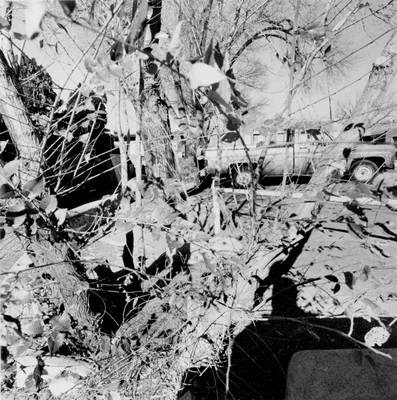
Friedlander snuck his camera into someone's yard like an intruder peering through a confusion of trees at something in the distance. In a jarring collusion of foreground and background, leafy branches brushing the lens are mashed up against a pickup truck and houses in the distance. Fantastic distortions occur. The leaves are the same size as truck tires. Patchy shadows have more substance than houses. Poles, wires, houses and foliage all seem made of the same substance in this collage-like composition. According to Peter Galassi, "These photographs have a patchwork vitality reminiscent of modernist collage from Kurt Schwitters to Robert Rauschenberg, but with a crucial different: the unity of Friedlander's pictures depends upon the finely adjusted logic of their interior arrangements, but it is also the unity of the camera vision."

© Lee Friedlander - All rigths reserved

"1184-03 - Santa Fe, NM" 1995

With so many subjects to photograph on the streets of Santa Fe one wonders why Friedlander chose a featureless adobe wall. Is the subject of this photograph the traffic meter near the center of the composition, the peeling Chevy jutting into the right side of the picture, the adobe wall splashed with sunlight and shadow, or two feathery pine trees behind the wall? Maybe Friedlander's intention is describe what all see, but few would have noticed, the bizarre way tree mirrors tree, and how the shapes of car and meter are doubled by their shadows on the wall.

© Lee Friedlander - All rigths reserved

"1185-09: Santa Fe, NM" 1995

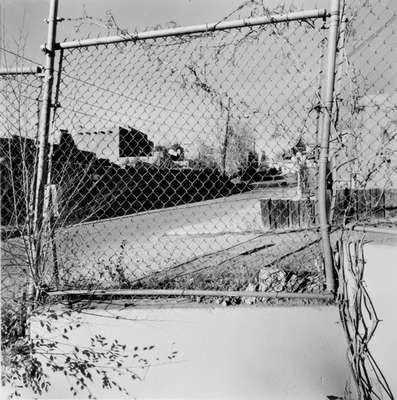
The square metal frame of a hurricane fence entwined with vines fills the photograph, creating a whimsical duplicate of the square picture plane. Diagonal spaces within the weave of the fence create a moiré pattern through which can be seen the remarkably abstract shapes of flat roofed buildings and street, bisected by sunlight and shadow.

© Lee Friedlander - All rigths reserved

"1725-27: New Mexico" 2006

This photograph of a nondescript street in some small town is primarily a study in geometric shapes. Dominating the picture is a stop sign topped by another sign containing the street number. Facing the camera is a corrugated metal building whose false front is shaped like stair steps. In between them the road forms a graceful crescent. This photograph conveys Friedlander's typically cool nonchalance toward his subjects, along with his distanced, yet playful, witty and ironic inquisitiveness.

© Lee Friedlander - All rigths reserved

"1725-24: New Mexico" 2006
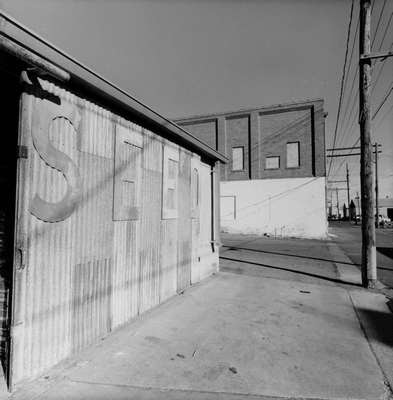
It has been said of Friedlander's photographs "the camera's mindless objectivity can jolt us into seeing things anew." In this image a metal building with the word SEED nailed to its side is one of several structures on a quiet industrial street. Despite the word "seed" there is nothing growing in the scene, not even a blade of grass. The camera lens describes the lackluster architecture according to the laws of one-point perspective. Buildings, sidewalks, telephone poles and wires recede toward a vanishing point somewhere beyond the picture plane. But something about Friedlander's deadpan handling of the scene loosens it from its literalness. The otherwise characterless street suddenly becomes an interesting sequence of rectangles and squares resembling box flaps that could be folded up at a moment's notice.
© Lee Friedlander - All rigths reserved

"1724-13: New Mexico," 2006

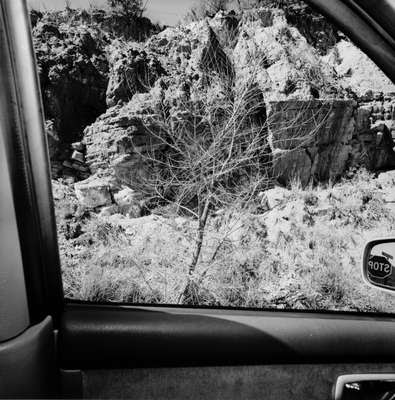
Since the beginning of his career Friedlander has taken photographs from inside his car, using the windows, paneling and mirrors as multiple viewfinders for whatever happens to be outside. In this instance, he stopped to photograph a small, leafless tree growing in prickly grasses below a rock escarpment. The steep, crumbly slope rising nearly to the top of the picture does not invite exploration, nor does it convey anything remotely sublime or pastoral. Though probably a natural geological formation it might just as easily have been thrown up by a bulldozer. In any case, it would be tough to traverse. Even its view is hindered by the scrubby tree in the foreground. Wryly reiterating that everything has come to a dead standstill, Friedlander included the car's rear view mirror with its reflection of a sign containing the single command: " STOP."

© Lee Friedlander - All rigths reserved

"1726-16: New Mexico," 2006

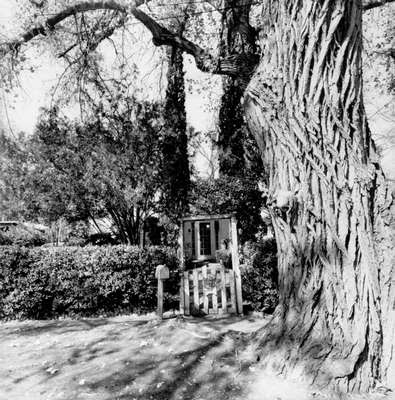
In a neighborhood bypassed by time and developers Friedlander photographed at close range a massive cottonwood tree with bark resembling thick slabs of clay. Nearby is a dense hedge, an old fashioned mailbox, and a rickety wooden gate leading to a house nearly hidden in the overgrowth of vines and trees. Only the front door is visible and it appears strangely diminutive next to the luxuriant plant life. What makes this photograph interesting is that within Friedlander's enormous body of highly complex images this is a perfectly ordinary shot, almost like a moment of repose. The fact that every so often Friedlander shoots a charmingly picturesque scene merely adds to the breadth of his work and the paradox of his vision.

© Lee Friedlander - All rigths reserved

Gallery hours at 203 W. San Francisco St. location are 10 - 5 Mon. - Sat. Gallery hours at 122 Grant Ave. gallery are 10 - 5 Tues.- Sat.

Andrew Smith Gallery: www.andrewsmithgallery.com/

Liz Kay

Reference:

Peter Galassi, Friedlander: Museum of Modern Art, New York, 2005.

20/12/06

James Koskinas & Julie Schumer, Farrell Fischoff Gallery, Santa Fe - Without Hesitation

James Koskinas & Julie Schumer: Without Hesitation
Farrell Fischoff Gallery, Santa Fe
June 23 - July 24 2006

Farrell Fischoff Gallery presents an exhibition of new paintings by New Mexico artists James Koskinas and Julie Schumer. 

This is the second two-person show Farrell Fischoff has given James Koskinas and Julie Schumer, and their work has grown stronger and more compositionally sophisticated in the intervening two years.

James Koskinas describes himself as an Expressionist painter: "I do not own my talent. The paintings come from somewhere. All I have to do is hold on to the brush."

In his current series of paintings, Portraits of Women, James Koskinas explores his subconscious archetypes of woman and femininity with boldly colored studies of women's faces. These striking paintings portray a wide range of expression and emotion, demonstrating James Koskinas' skill with the brush, and his fascination with the human form.

Julie Schumer’s geometric abstractions are drawn from her acute observation and sensitivity to the world around her. They distill the southwestern landscape using color, light and form. Painted over time, layer by layer, each canvas or work on paper has developed a compelling depth and warmth.

Originally from Arizona and California, respectively, James Koskinas and Julie Schumer now reside in Lamy, New Mexico where they have lived and worked together for the past 6 years.

FARREL FISCHOFF GALLERY
1807 Second Street, #29, Santa Fe, NM 87505-3801
www.farrellfischoff.com

31/03/01

Erika Wanenmacher at SITE Santa Fe - Grimoire

Erika Wanenmacher: Grimoire
SITE Santa Fe
March 31 - May 27, 2001

SITE Santa Fe presents ERIKA WANENMACHER: GRIMOIRE, a large-scale installation designed especially for SITE Santa Fe. The exhibition is organized by SITE Santa Fe.

For GRIMOIRE, Erika Wanenmacher presents an exhibition of personal spell-making; a journey of gathering and storing magic. In a preliminary exhibition description, Erika Wanenmacher writes:
"Although the term grimoire usually denotes a traditional encyclopedia of western magic, this show really describes my own personal territory of art-making. Several years ago I realized that what I was constructing -- physically and mentally -- were spells. My favorite definition of magic comes from Dion Fortune who declares it "the art of changing consciousness at will." In considering my work as spells, the most important aspect is the intent. It is imperative to be clear. What do I want this spell to do? The intent is out in front of any action. As a storyteller, if I can get my story (intent) across, then I have acted upon the consciousness of the viewer. Magic."
In her exhibition, Erika Wanenmacher shows both early two- and three-dimensional pieces and newer installation work made especially for SITE Santa Fe. She will present a large installation featuring her car -- a 1972 Volvo station wagon with a Chevy 350 engine that runs on propane -- in the middle of a 16 foot pentacle sand painting, covered with a net held by 5 large cast aluminum heads. The heads, (a recurring image in her work and based on the likeness of Erika and the Aztec goddess Teoloztatl), will hold the ends of the net clamped in their teeth. The car will be loaded with pieces of art packed in found boxes. On the walls will be 4 videos, each one representing a different element (earth, air, fire, water).

The exhibition also features light boxes, showing x-rays of the box pieces in the car and individual sculptures that are magical tools; including a trickster box containing raven and coyote arms; a post-apocalyptic travelling magic tool set; and a giant necklace of the Hindu goddess Kali.

Erika Wanenmacher is a Santa Fe, New Mexico-based artist who works in multi-media. She has attended the Feminist Studio Workshop, The Woman's Building in Los Angeles, California and the Kansas City Art Institute, Kansas City, Missouri. Erika Wanenmacher has been involved in many one-person exhibitions including Terrible Beauty, Tangibles, Storyteller, Grace, and Buzz at Linda Durham Contemporary Art, Galisteo, New Mexico; and Devotionals at Braunstein/Quay Gallery, San Francisco, California. She has also participated in numerous group exhibitions around the world including Contemporary Botanica, Tweed Museum, Duluth, Minnesota; Ship from the Desert, The Moorings Project, Schiffbauergasse, Potsdam, Germany; El Mundo Del Arte De Nuevo Mexico, Guadalajara, Mexico; and Edgy: Five Contemporary Northern New Mexico Artists, Coconino Art Center, Flagstaff, Arizona.

SITE Santa Fe
1606 Paseo de Peralta, Santa Fe, New Mexico

06/08/00

Georgia O'Keeffe: Works on Paper at Georgia O'Keeffe Museum, Santa Fe - "O'Keeffe on Paper" Exhibition

O'Keeffe on Paper
Georgia O'Keeffe Museum, Santa Fe
July 29 - October 29, 2000

Drawing on new scholarship and including many rarely seen works from private collections, O'Keeffe on Paper presents 55 stunning watercolors, pastels and charcoals by Georgia O'Keeffe (1887-1986). The exhibition offers fresh insights into this distinctive and little-known aspect of the artist's oeuvre. 

Georgia O'Keeffe created works on paper throughout her long career and did some of her most innovative work in watercolor, pastel and charcoal. By including sheets produced over a half-century period, starting in 1915, the exhibition illuminates the artist's technical virtuosity, while tracing the development of her personal artistic language. In a broader sense, O'Keeffe's work reflects the dialogue in 20th-century American art between representation and abstraction.

In the 1910s, Georgia O'Keeffe created some of the most innovative images of early American modernism, starting with charcoal drawings such as No. 2 - Special (1915). The following year her work was introduced to photographer and gallery owner Alfred Stieglitz, whom she married in 1924.

Georgia O'Keeffe's watercolors from the teens range from the spare and highly abstract, such as Black Lines (1916), to broad fields of clear, bold color as in Blue No.II (1916) and Evening Star V (1917), to more representational images, Roof with Snow (1916) and Train at Night in the Desert (1916). Of particular interest are three fluid watercolors Ð all known as Untitled (Abstraction/Portrait of Paul Strand) Ð from private collections. Created in 1917, they refer to the photographer and friend of the artist and reflect O'Keeffe's experimentation with different forms of imagery.

Georgia O'Keeffe settled in New York in 1918 where she became part of the circle of modernists gathered around Stieglitz, many of whom, like Stieglitz himself, embraced the city as one of their subjects over several decades. Georgia O'Keeffe employed pastel to record buildings silhouetted against the East River and charcoal to depict the skyline of Manhattan and the Brooklyn Bridge. Blue Flower (1918), a delicate early pastel, presages the large-format oil paintings of flowers close-up for which O'Keeffe is famous, while A White Camellia (1938) is a late pastel on a similar theme. After her permanent move to New Mexico in 1949 she again chose to work in charcoal. Among those late works is the highly abstract From a River Trip (1965), the latest drawing in the exhibition.

Co-curators of O'Keeffe on Paper are Barbara Buhler Lynes, curator of the Georgia O'Keeffe Museum, author of the catalogue raisonné, and Emily Fisher Landau Director of the Georgia O'Keeffe Museum Research Center, and Ruth E. Fine, the National Gallery's curator of modern prints and drawings and co-director of the catalogue raisonné project. Selections were made by Fine and Lynes with Judith Walsh, the National Gallery's senior paper conservator, who participated in the catalogue raisonné project, and Elizabeth Glassman, president emerita of The Georgia O'Keeffe Foundation and co-director of the catalogue raisonné project.

The exhibition is organized by the Georgia O'Keeffe Museum, Santa Fe, and the National Gallery of Art, Washington DC. It is made possible by the Henry Luce Foundation, The Georgia O'Keeffe Foundation and the National Advisory Council of the Georgia O'Keeffe Museum.

The exhibition celebrates the publication of the two-volume O'Keeffe catalogue raisonné, a major scholarly project of the National Gallery of Art in partnership with The Georgia O'Keeffe Foundation. "We are delighted to collaborate with the National Gallery in presenting this exceptional exhibition, honoring the publication of the catalogue raisonné and bringing before the public works of such significance," said George G. King, director, Georgia O'Keeffe Museum. He noted that the O'Keeffe Museum celebrates its third anniversary in July as well.

The fully illustrated exhibition catalogue demonstrates the depth of work conducted by the catalogue raisonné project and how the research has facilitated greater understanding of O'Keeffe's art. Essays by Fine, Glassman, Lynes, and Walsh place O'Keeffe's works on paper in the context of her American contemporaries and in relation to her oil paintings, and examine the importance of the artist's choice of materials in the development of her aesthetic. The catalogue is available for $25 (softcover) and $35 (hardcover, distributed by Harry N. Abrams, Inc., publishers) in the Museum Shop and on the Museum web site at www.okeeffemuseum.org. 

Also available in the Museum Shop, on the Museum web site, is Georgia O'Keeffe: Catalogue Raisonné by Barbara Buhler Lynes, published by Yale Press, the National Gallery of Art and The Georgia O'Keeffe Foundation. A two-volume set in a slipcase, it presents more than 2,000 paintings, drawings, watercolors, and sculptures by Georgia O'Keeffe, many of which have not previously been reproduced, along with factual entries for each. There is a full bibliography, exhibitions listing and chronology of the artist's life. With 2,050 illustrations in color and 100 in black-and-white, it is available for $195.

GEORGIA O'KEEFFE MUSEUM
217 Johnson Street, Santa Fe, NM 87501