Showing posts with label Lee Friedlander. Show all posts

22/11/25

Lee Friedlander: Christmas @ Deborah Bell Photographs, New York - Exhibition + Book published by the Eakins Press Foundation

Lee Friedlander: Christmas
Deborah Bell Photographs, New York
November 6, 2025 - January 10, 2026

Deborah Bell Photographs presents Lee Friedlander: Christmas, an exhibition of photographs by Lee Friedlander dating from 1958 to 2015, in collaboration with Fraenkel Gallery, San Francisco and Luhring Augustine, New York. 

This exhibition also celebrates the release of Friedlander's most recent book, LEE FRIEDLANDER: CHRISTMAS, published by the Eakins Press Foundation, New York. Although many of the photographs on view are well known from their inclusion in Friedlander's previous books and numerous exhibition catalogues, and have appeared on the walls of museum and gallery exhibitions internationally, this publication features Friedlander's personal edit of photographs related to the theme of Christmas. As indicated by the Eakins Press Foundation, the book presents 106 beautifully reproduced photographs that span the artist's life, cover most of the United States, and give us a sweeping view of American culture by this renowned photographer of the social landscape. The exhibition features some 30 photographs selected from the book.

Lee Friedlander: Christmas
Afterword by Peter Kayafas
Eakins Press Foundation, 2025
Clth, 11.75 x 12.5 in. / 112 pgs / 106 b&w / 106 tritone
ISBN 9780871301055
Cover Photograph: Lee Friedlander (American, b. 1934)  
San Angelo, Texas, 1997  
Gelatin silver print  sheet 20 x 16'“ (50.8 x 40.6 cm)  
© Lee Friedlander, Courtesy Fraenkel Gallery, San Francisco 
and Luhring Augustine, New York

Peter Kayafas, Director and President of Eakins Press Foundation, writes in the Afterword to the sumptuously illustrated book:
Whether or not you've celebrated Christmas at any point over the past seventy years--roughly the period covered by these photographs--you have no doubt encountered some of the things Friedlander shows us here....Is Christmas in America a religious holiday? A commercial precept? An ironic commentary? A misunderstanding? An indulgent blasphemy? All or none of the above? In these pictures, the only thing certain is that Christmas has provided an opportunity for the people's photographer to hold up a mirror--and make no mistake, it is Friedlander's mirror--to a diverse, flawed, inventive, preoccupied, and spectacular society.
DEBORAH BELL PHOTOGRAPHS
526 West 26th Street, New York, NY 10001

Related Post:

Deborah Bell Photographs, New York , November 1, 2018 – January 19, 2019 

25/07/25

Lee Friedlander, Joseph Rodríguez, Garry Winogrand @ Museum Ludwig, Cologne - "Street Photography" Exhibition Curated by Barbara Engelbach

Street Photography
Lee Friedlander, Joseph Rodríguez, Garry Winogrand
Museum Ludwig, Cologne
Through October 12, 2025

Lee Friedlander - NYC
Lee Friedlander
New York City, 1963
Gelatin silver paper, print after 1963, 22 x 32,9 cm
Museum Ludwig, Cologne
© Lee Friedlander, courtesy Fraenkel Gallery, San Francisco 
and Luhring Augustine, New York 
Repro: Historisches Archiv mit Rheinischem Bildarchiv

Garry Winogrand - NYC
Garry Winogrand
New York City, 1969
Gelatin silver paper, print after 1978, 22,9 x 34,2 cm 
© The Estate of Garry Winogrand / Courtesy
Fraenkel Gallery, San Francisco
Repro: Historisches Archiv mit Rheinischem Bildarchiv 

Joseph Rodriguez - Taxi
Joseph Rodriguez
220 West Houston Street, NY 1984,
Gelatin silver paper, print after 1988, 25,2 x 37,2 cm 
© Joseph Rodriguez, Courtesy Galerie Bene Taschen 
Repro: Historisches Archiv mit Rheinischem Bildarchiv

The street life of cities has always been a fascinating subject for photographers, who have approached it in a variety of ways, from candid images documenting urban unrest to portraits that shine a spotlight on individuals. Since the nineteenth century, cities and photography have been directly linked through the idea of modernity. With the introduction of compact cameras such as the Leica, street photography developed into its own genre in the mid-twentieth century. Small-format cameras gave photographers greater flexibility and enabled them to respond quickly while remaining discrete. They explored public space without obtruding and, in contrast to staged photography, captured candid and spontaneous moments that had previously been considered unworthy photographic subjects. Influenced by Henri Cartier-Bresson’s concept of the “decisive moment,” these photographers sought to capture the fleeting instant when light, composition, and subject aligned to convey the significance of an event. 

Lee Friedlander NYC
Lee Friedlander
New York City, 1965
Gelatin silver paper, print after 1965, 22 x 32,9 cm
Museum Ludwig, Cologne
© Lee Friedlander, courtesy Fraenkel Gallery, San Francisco 
and Luhring Augustine, New York
Repro: Historisches Archiv mit Rheinischem Bildarchiv

Garry Winogrand - Women are Beautiful
Garry Winogrand
Untitled, from: Women are Beautiful, around 1970
Gelatin silver paper, print after 1981, 21,7 x 32,4 cm
© The Estate of Garry Winogrand / Courtesy
Fraenkel Gallery, San Francisco
Repro: Historisches Archiv mit Rheinischem Bildarchiv

Joseph Rodriguez Taxi
Joseph Rodriguez
I picked him up at a club and I took him to
Brooklyn. He was a happy camper, NY 1984,
Gelatin silver paper, print after 1988, 24,8 x 36,8 cm 
© Joseph Rodriguez, Courtesy Galerie Bene Taschen 
Repro: Historisches Archiv mit Rheinischem Bildarchiv 

This exhibition in the Photography Room at the Museum Ludwig is dedicated to three protagonists from two generations of street photography: Garry Winogrand (b. 1928 in New York, d. 1984), Lee Friedlander (b. 1934 in Aberdeen, Washington, based in New York), and Joseph Rodríguez (b. 1951 in Brooklyn, based in New York). Despite all three photographers sharing the same subject matter, each one pursues a singular approach that produces distinct results. Iconic photographs from the 1960s to the 1980s are displayed alongside lesser-known examples from each photographer’s oeuvre. All of the works on display were included in donations made by the Bartenbach Family in 2015 and Volker Heinen in 2018, or have been acquired by the Museum Ludwig since 2001.

Lee Friedlander nyc street photography
Lee Friedlander
New York City, 1966
Gelatin silver paper, print after 1966, 22 x 32,9 cm
© Lee Friedlander, courtesy Fraenkel Gallery, San Francisco 
and Luhring Augustine, New York 
Repro: Historisches Archiv mit Rheinischem Bildarchiv

Lee Friedlander Mount Rushmore
Lee Friedlander
Mount Rushmore, 1969
Gelatin silver paper, print after 1969, 22 x 32,9 cm
Museum Ludwig, Cologne
© Lee Friedlander, courtesy Fraenkel Gallery, San Francisco 
and Luhring Augustine, New York 
Repro: Historisches Archiv mit Rheinischem Bildarchiv

The landmark exhibition "New Documents" at the Museum of Modern Art in New York in 1967 helped launch the careers of Garry Winogrand and Lee Friedlander. Their striking photographs broke with visual conventions, such as a level horizon line or a centered main subject. Garry Winogrand frequently tilted his viewfinder, producing skewed horizon lines that offer a new view of reality and make his images appear spontaneous, as does his purposeful use of blurriness, overexposure, underexposure, and backlighting. Lee Friedlander, in turn, created compositions in which the viewer’s gaze is hindered by obstructions, such as shadows, signs, architectural elements, and streetlights, or is disoriented by reflections. 

Garry Winogrand Photograph
Garry Winogrand
Circle Line Statue of Liberty Ferry, New York, 1971
Gelatin silver paper, print after 1973, 21,7 x 32,4 cm
© The Estate of Garry Winogrand / Courtesy
Fraenkel Gallery, San Francisco
Repro: Historisches Archiv mit Rheinischem Bildarchiv

Garry Winogrand - Street Photography
Garry Winogrand
Untitled, from: Women are Beautiful, around 1973
Gelatin silver paper, print after 1973, 21,7 x 32,4 cm
© The Estate of Garry Winogrand / Courtesy
Fraenkel Gallery, San Francisco
Repro: Historisches Archiv mit Rheinischem Bildarchiv

Garry Winogrand and Lee Friedlander, who are represented in the exhibition with twenty images each, both use photography in a self-reflective way that brings the formal aspects of photography to the fore. This encourages an analytical gaze, producing an emotional distance between the viewer and the subject, which often results in ambivalent images where the intention of the photographer remains unclear. Garry Winogrand and Lee Friedlander each developed their own distinct style, embracing originality and authorship by merging documentary photography and personal expression. While they attempted to distance themselves from photojournalism and social documentary photography, eschewing eventbased, narrative-focused, and emotionally charged imagery, Joseph Rodriguez’s work deliberately engages with these genres. He aspires to give visibility to marginalized people by communicating with his subjects and attempting to tell their stories. Many of his photographs are accompanied by short commentaries that provide information about the context in which each image was created. Joseph Rodríguez’s pictures employ unusual perspectives and surprising compositions, and his use of reflections emphasizes the subjectivity of the photographer’s empathic gaze beyond the momentariness of the shot. The exhibition features around twenty photographs from his Taxi series.

Joseph Rodriguez - East Village, NY
Joseph Rodriguez
East Village, NY, 1984
Gelatin silver paper, print after 1988, 25,3 x 37,4 cm
© Joseph Rodriguez, Courtesy Galerie Bene Taschen 
Repro: Historisches Archiv mit Rheinischem Bildarchiv

Joseph Rodriguez, Pulaski Skyway, New Jersey
Joseph Rodriguez
Pulaski Skyway, New Jersey, 1984
Gelatin silver paper, print after 1988, 25,2 x 37,2 cm
© Joseph Rodriguez, Courtesy Galerie Bene Taschen 
Repro: Historisches Archiv mit Rheinischem Bildarchiv 

This is the first exhibition in the new Photography Rooms at the Museum Ludwig, centrally located on the second floor.

Curator: Barbara Engelbach

MUSEUM LUDWIG
Heinrich-Böll-Platz , 50667 Köln 

Street Photography - Lee Friedlander, Joseph Rodríguez, Garry Winogrand
Museum Ludwig, Cologne, May 3 – October 12, 2025

27/04/23

Lee Friedlander Framed by Joel Coen @ Fraenkel Gallery, San Francisco

Lee Friedlander Framed by Joel Coen 
Fraenkel Gallery, San Francisco 
May 6 – June 24, 2023 

Lee Friedlander
Lee Friedlander 
Sweden, 2005 
Gelatin silver print 
20 x 16 inches (sheet) [50.8 x 40.6 cm] 
© Lee Friedlander, courtesy Fraenkel Gallery 
I found it a daunting task to choose just a few images from Lee Friedlander's vast career. Where to start...?
—Joel Coen
Fraenkel Gallery presents Lee Friedlander Framed by Joel Coen, an exhibition of Friedlander’s photographs curated by the widely acclaimed filmmaker. Rather than focusing on a single subject or period, Joel Coen’s selection concentrates on Friedlander’s singular approach to composition. Through the approximately 45 images in the exhibition Joel Coen surveys the range of Lee Friedlander’s 60+ year career, bringing many lesser-known images into the equation. The selection evidences an unexpected affinity between Lee Friedlander and Joel Coen, both of whose work explores the sly power of images. 

A new hardcover publication, with an introduction by Coen and an afterword by the actor Frances McDormand, accompanies the exhibition.

Lee Friedlander Framed by Joel Coen
Hardcover, 12.75 x 11.75 x 0.9 inches
136 pages, 70 tritone illustrations
Introduction by Joel Coen, Afterword by Frances McDormand
Fraenkel Gallery, 2023

Lee Friedlander, Joel Coen, and Frances McDormand, long admirers of each other’s work, met in the spring of 2022 at Friedlander’s home in Rockland County, New York. During the day-long visit the artists studied hundreds of photographs, ultimately leading to the selection that constitutes the book and exhibition.
I was present when these two guys met for the first time and observed a familiarity that comes from their lifetimes of singular and eccentric visions… Neither would naturally refer to himself as an Artist. Yet they have honed their crafts over decades of practice, and those of us who cannot see the way they see have no other way to describe what they do but “art.”
—from the afterword by Frances McDormand
Joel Coen’s selection focuses on photographs that are dense and off-kilter, often bisected by stop signs and utility poles, car doors and windshields, trees and shadows. “As a filmmaker, I liked the idea of creating a sequence that would highlight Lee’s unusual approach to framing—his splitting, splintering, repeating, fracturing, and reassembling elements into new and impossible compositions,” Coen writes. 

Lee Friedlander Framed by Joel Coen will be on view at both Fraenkel Gallery in San Francisco, and in New York at Luhring Augustine (May 13 to June 24). Both exhibitions will be accompanied by a special projection created by Coen, sequencing Friedlander’s images in unexpected and revealing ways. The book that accompanies the exhibition is published by Fraenkel Gallery and includes an expanded selection of 70 works. It will be available on both galleries’ websites.

Lee Friedlander (born 1934) began photographing in 1948. His work was included in the influential 1967 exhibition New Documents at the Museum of Modern Art, New York, curated by John Szarkowski, among countless other exhibitions. His more than 50 monographs include Signs, Self-Portrait, Cherry Blossom Time in Japan, Letters from the People, At Work, and Sticks and Stones, among others. One of the most important living photographers, Friedlander’s prints are held by major collections including the Art Institute of Chicago; the Metropolitan Museum of Art, New York; Museum of Modern Art, New York; National Gallery of Art, Washington, D.C.; San Francisco Museum of Modern Art; and Whitney Museum of American Art, among many others.

Joel Coen (born 1954) is celebrated as one of the most visionary and idiosyncratic filmmakers of our era. Combining thoughtful eccentricity, wry humor, arch irony, and often brutal violence, the films of Coen (working with his brother Ethan) have become synonymous with a style of filmmaking that pays tribute to classic American movie genres—especially film noir—while sustaining a firmly postmodern sensibility.

Frances McDormand (born 1957) is an acclaimed American actor and producer. McDormand has won numerous accolades including four Academy Awards, two Golden Globe Awards, three BAFTA Awards, two Emmy Awards, and a Tony Award, making her one of the few performers to achieve the “Triple Crown of Acting.”

FRAENKEL GALLERY
49 Geary Street, San Francisco, CA 94108

19/06/19

Lee Friedlander @ Fraenkel Gallery, San Francisco

Lee Friedlander: Signs
Fraenkel Gallery, San Francisco
July 11 - August 17, 2019

Lee Friedlander
LEE FRIEDLANDER 
Newark, New Jersey, 1962 
© Lee Friedlander, courtesy Fraenkel Gallery, San Francisco

Fraenkel Gallery presents LEE FRIEDLANDER: SIGNS, an exhibition examining the five-decade long obsession of this highly influential photographer. Since the early 1960s, Lee Friedlander has focused on the signs that inscribe the American landscape, from hand-lettered ads to storefront windows to massive billboards. The exhibition is accompanied by a 144-page hardcover book published by Fraenkel Gallery.

Made in New York, San Francisco, and dozens of cities and small towns in between, Lee Friedlander’s photographs record milk prices, cola ads, neon lights, road signs, graffiti, and movie marquees. Depicting these texts with precision and sly humor, Lee Friedlander’s approach to America transcribes a sort of found poetry of commerce and desire. A large majority of works in the exhibition will be shown for the first time.

Also on view will be a group of 16 early Lee Friedlander prints, made on the road in the 1970s, on travels across the United States.

LEE FRIEDLANDER (born 1934) began photographing in 1948. His work was included in the influential 1967 exhibition New Documents at the Museum of Modern Art, New York, curated by John Szarkowski. His many monographs include Self-Portrait; Cherry Blossom Time in Japan; Letters from the People; At Work; and Sticks and Stones, among others. One of the most important living photographers, Lee Friedlander’s prints are held by major collections including the Art Institute of Chicago; The Metropolitan Museum of Art, New York; Museum of Modern Art, New York; National Gallery of Art, Washington, D.C.; San Francisco Museum of Modern Art; and Whitney Museum of American Art, among many others.

Lee Friedlander: Signs
LEE FRIEDLANDER: SIGNS
Hardcover
120 pages, $75
Fraenkel Gallery, 2019

Opening reception with the artist: Thursday, July 11, 5:30-7:30pm
Book launch and signing with the artist: Saturday, July 13, 1-3pm

FRAENKEL GALLERY
49 Geary Street, San Francisco, CA 94108
www.fraenkelgallery.com

04/11/18

Lee Friedlander: MARIA @ Deborah Bell Photographs, New York

Lee Friedlander: MARIA 
Deborah Bell Photographs, New York 
November 1, 2018 – January 19, 2019 

Deborah Bell Photographs presents MARIA, an exhibition of photographs by Lee Friedlander featuring his wife, Maria. Dating from 1958 to 2008, the pictures were taken during Maria and Lee's early marriage, and throughout their family life as parents and grandparents. The 32 prints in the exhibition were selected by Lee Friedlander for this venue, thus offering a special opportunity for his audience to see these pictures in a new and intimate context. Although most of the photographs on view are well known from their inclusion in Friedlander's books and exhibition catalogues, and have appeared on the walls of many museum and gallery exhibitions internationally, this is the first exhibition devoted to Friedlander's pictures of Maria, and contributes to the ongoing narrative of this fifty-year love story.

Lee Friedlander, born in 1934 in Aberdeen, Washington, began photographing the American landscape in 1948. With an ability to organize a vast amount of visual information in dynamic compositions, Lee Friedlander has made humorous and poignant images among the chaos of city life, dense natural landscape, fellow artists, friends and family, and countless other subjects. Lee Friedlander is also recognized for a group of self-portraits he began in the 1960s, reproduced in Self-Portrait, an exploration that he turned to again in the 1990s.

This exhibition is presented in association with Fraenkel Gallery, San Francisco.

DEBORAH BELL PHOTOGRAPHS
16 East 71st Street, New York, NY 10021

13/12/10

Expo Blanc Bordeaux FRAC Hangar G2 Une exposition qui vous dit Tout ce que vous avez toujours voulu savoir sur le blanc à travers une belle sélection d’oeuvres du FRAC Aquitaine

Tout ce que vous avez toujours voulu savoir sur le BLANC
FRAC Aquitaine, Hangar G2, Bordeaux
Commissaire d'exposition : Claire Jacquet
28 janvier - 16 avril 2011

blanc_image_d_illustration

Avec les œuvres de Absalon, Karina Bisch, Harry Callahan, Nicolas Chardon, Hervé Coqueret, Stéphane Dafflon, Lee Friedlander, Katharina Fritsch, Thomas Hirschhorn, Cathy Jardon, Imi Knoebel, Jeff Koons, Pierre Labat, Mathieu Mercier, Thierry Mouillé, Roman Opalka, Florian Pugnaire, Hugues Reip, Thomas Ruff, Jean Sabrier, Anne Xiradakis.

Tout ce que vous avez toujours voulu savoir sur le blanc est une exposition d’œuvres issues de la collection du FRAC AQUITAINE dont le point commun est la couleur blanche. Le choix de cette couleur repose sur sa qualité d’être fondamentalement liée à l’histoire du modernisme et des avant-gardes tant du côté de la peinture (le célèbre Carré blanc sur fond blanc de Kasimir Malewitch en 1918), de l’architecture (Le Corbusier) ou du design. Plus tard, l’histoire de l’art retiendra le geste de Robert Rauschenberg procédant à l’effacement d’un dessin de Willem de Kooning (1953), l’exposition « Le vide » de Yves Klein à la galerie Iris Clert (1958), ou encore l’œuvre de Robert Ryman s’appuyant exclusivement sur des effets de peintures blanches à partir des années 1960. Faut-il comprendre l’histoire du blanc comme une généalogie des commencements, telle la page blanche pour l’écrivain ? Le blanc est-il synonyme immanquablement de modernité pour ce qu’il construit d’inédit ? Du « tout est possible » ? Quelles définitions ou sens lui donner aujourd’hui ?

Ayant en mémoire ces actes fondateurs des artistes du siècle dernier, l’exposition au Frac Aquitaine prolonge ce récit de la tonalité blanche à travers différentes œuvres de sa collection : KARINA BISCH réinterprète la théière de Kasimir Malevitch à travers un objet en plâtre tenant à la fois de l’architecture, du design et de la sculpture. STEPHANE DAFFLON réinvente un espace vierge à l’intérieur d’un cadre. JEFF KOONS érige un monument aux premiers aspirateurs américains, héros contemporains des espaces aseptisés. Les trois monochromes de KATARINA FRISCH indiquent que le blanc ne peut se définir que par rapport aux autres couleurs, tandis que ROMAN OPALKA étire le temps à travers des photographies et des tableaux de plus en plus délavées, au risque que les signes disparaissent…

Tout ce que vous avez toujours voulu savoir sur le blanc poursuit sa logique d’introspection à travers une longue série de questions qui ne font que revenir aux origines, à l’essentiel, à l’épure : le blanc est-il le contraire du sale (DENNIS ADAMS) ? la transparence (MATHIEU MERCIER) ou l’effacement (THIERRY MOUILLE) ? Le blanc signifie-t-il la douceur, l’intimité (HARRY CALLAHAN) ou le neutre - voire l’anonymat - au sein de la Cité (LEE FRIEDLANDER, THOMAS RUFF) ? Est-il forcément lié à des codes liés à la santé et à l’hygiène ou à de simples règles commerciales du packaging (FRANCK SCURTI) ? Est-il susceptible de passer à l’état gazeux (JEAN SABRIER) ? Est-il statique ou peut-il s’introduire dans une dynamique (IMI KNOEBEL, FLORIAN PUGNIAIRE) ? A-t-il un degré d’apesanteur (PIERRE LABAT) ? Est-il à même de pouvoir créer une durée (ROMAN OPALKA), du silence (ABSALON) ? Et que dire du « White Cube » dont THOMAS HIRSCHORN présente avec Lascaux III une sorte de contremodèle ? Cette exposition sera l’occasion de présenter une nouvelle production de NICOLAS CHARDON conçue pour l’extérieur et aux alentours du Hangar G2.

Commissariat d'exposition : CLAIRE JACQUET  

Vernissage le 28 janvier 2011 à partir de 18h30

Colloque avec arc en rêve, 28 janvier 2011 :
Parallèlement à l'exposition du Frac d'Aquitaine, un colloque est organisé avec Arc en rêve centre d’architecture. Une journée de réflexion autour du blanc, traité dans le champ du design. Avec critique d’art, architecte, écrivain, designer.
A Arc en rêve, Bordeaux

Week-end Musée Télérama : Evénements et rencontres le weekend du 19 et 20 mars 2011. Programmation à venir

FRAC AQUITAINE
Hangar G2
, Bassin à flot n°1
Quai Armand Lalande
33300 BORDEAUX — France

www.frac-aquitaine.net

Le Frac – Collection Aquitaine est financé par le Conseil régional d’Aquitaine et l’Etat (Ministère de la Culture et de la Communication -  Direction régionale des Affaires culturelles d’Aquitaine). Avec le soutien de la Ville de Bordeaux.

Horaires d'ouverture : lundi-vendredi de 10h à 18h, samedi de 14h à 18h.

Entrée libre

05/10/10

Fleeting Glimpse Photography exhibition at Roanoke and Richmond, Virginia: Eleanor D. Wilson Museum and Virginia Museum of Fine Arts

Photography exhibition - The Fleeting Glimpse:
Selections in Modern and Contemporary Photography
from the Virginia Museum of Fine Arts

Eleanor D. Wilson Museum, Roanoke, VA
Through December 4, 2010

Virginia Museum of Fine Arts, Richmond, VA
January 15 - April 3, 2011

LEE FRIEDLANDER, Shadow - New York City, 1968

LEE FRIEDLANDER, Shadow - New York City, 1968. Silver Print, Virginia Museum of Fine Arts, Richmond. The John Barton Payne Fund. Photo: Travis Fullerton, © Virginia Museum of Fine Arts. Image © Lee Friedlander, courtesy Fraenkel Gallery, San Francisco. Recent photographs of Lee Friedlander from America from Car is on view at the Whitney Museum of American Art in New York. And a retrospective of Lee Frielandler work from 1960 to 2010 will be on view at the Fraenkel Gallery.

The Eleanor D. Wilson Museum at Hollins University in partnership with the Virginia Museum of Fine Arts presents The Fleeting Glimpse: Selections in Modern and Contemporary Photography from the Virginia Museum of Fine Arts featuring 35 works by 27 artists using the photographic medium to transform common found occurrences in nature and humanity into unusual encounters and strange juxtapositions.

The Fleeting Glimpse is the first major focus on the Virginia Museum of Fine Arts (VMFA)’s renowned photography collection and marks the first partnership collection-sharing program with the largest museum in the commonwealth. The Fleeting Glimpse is co-curated by Christine Carr, artist and assistant professor of art at Hollins University and Wilson Museum Director Amy Moorefield. The exhibition roster encompasses a group of provocative legends of the camera, both modern and contemporary, and features the work of artists including Berenice Abbott, Diane Arbus, Blythe Bohnen, Judy Dater, Jen Davis, John Divola, Robert Doisneau, Martin Dorbaum, David A. Douglas, Roy DeCarava, Lee Friedlander, Ralph Gibson, Emmet William Gowin, John N. Heroy Jr., Richard Kent Hough, Connie Imboden, Alen MacWeeney, Sally Mann, Ralph Eugene Meatyard, Ray K. Metzker, Joseph Mills, Brian H. Peterson, Hiroshi Sugimoto, Ruth Thorne-Thomsen, Jerry N. Uelsmann, Garry Winogrand, and Willie Anne Wright. 

HIROSHI SUGIMOTO, Byrd Theatre, 1993

HIROSHI SUGIMOTO, Byrd Theatre, 1993. Gelatin Silver Print, Virginia Museum of Fine Arts, Richmond. Gift of the Collector’s Circle. Photo: Travis Fullerton, ©  Virginia Museum of Fine Arts. Image © Hiroshi Sugimoto, courtesy Fraenkel Gallery, San Francisco.


Through exploitation of a variety of photographic techniques including digital (Dorbaum), straightforward (Arbus), long exposure (Divola), vignette (Gowin) and pinhole process (Wright), the artists all share commonalities in the pursuit of a visually fragmented narrative in highly experimental work. The viewer has a “fleeting glimpse” of an implied alternative reality through the artists’ deliberate and sometimes happenstance staging and organization of chance elements. Using the camera, a number of the artists (Sugimoto, Dorbaum) create illusionary portals in their compositions psychologically pulling the viewer into their realms. Other works (Arbus, Doiseau, Imboden) propel the viewer away through the sitters’ carefully staged gazes controlled by the artist’s surface manipulations transforming their features into fractured and dissociated objects.  All entice the viewer with implied psychosomatic drama through bizarre subject matter and compositions inviting further examination.

The approachable medium of photography allows visitors to the exhibition the first “glimpse” of never before seen significant works by extremely well known leading photographers.

The exhibition is accompanied by a full color CATALOGUE with essays by both curators as well as Emily Smith, VMFA Curatorial Fellow.

Organized by the Eleanor D. Wilson Museum  at Hollins University in partnership with the Virginia Museum of Fine Arts. After its inaugural viewing at the Eleanor D. Wilson Museum at Hollins University, The Fleeting Glimpse will be on view at the Virginia Museum of Fine Arts.

Funding for The Fleeting Glimpse comes in part from the City of Roanoke through the Roanoke Arts Commission as well as support from the Virginia Museum of Fine Arts.

Eleanor D. Wilson Museum, Hollins University, Roanoke, Virginia 
09/16 – 12/4, 2010
www.hollins.edu/museum

Virginia Museum of Fine Arts, Richmond, Virginia
www.vmfa.museum

03/09/09

Philip Gefter, Photography after Frank


PHOTOGRAPHY AFTER FRANK ESSAYS BY PHILIP GEFTER

In Photography After Frank (Aperture, June 2009) New York Times writer and former picture editor Philip Gefter presents the tale of contemporary photography, starting with a pivotal moment: Robert Frank’s seminal work in the 1950s. Along the way, he connects the dots of photography’s transformation into what it is today. Philip Gefter begins with Frank’s challenge to photography’s formal objectivity with the grainy, off-handed spontaneity of The Americans. Next comes the challenge to the factual fidelity of “documentary” photography with the evolution of the “staged document.” Other topics and themes include photojournalism, portraiture, the influence of collectors, and the market’s effect on art-making, such as the spawning of super-sized prints. Throughout the book, Gefter deftly connects Frank’s legacy with the work of dozens of important artists who have followed in his wake, from Lee Friedlander and Nan Goldin to Stephen Shore and Ryan McGinley. The book includes texts written exclusively for this publication, as well as essays drawn from Gefter’s critical writings, reviews, and even obituaries for the New York Times and other publications. Photography After Frank offers a page-turning yet journalistic approach bound to appeal to students and art world aficionados, alike. Philip Gefter was on staff at the New York Times for more than fifteen years where his roles included page one picture editor and senior picture editor for culture. Early in his career, he was a picture editor at Fortune and an assistant editor at Aperture. He writes regularly about photography for the Times and other publications. He is a founding member of the National Lesbian and Gay Journalists Association.

Past Related Events Lecture and Book Signing with Philip Gefter Thursday, April 30, 7:00 pm SF Camerawork NYPH09 Aperture Presents: Philip Gefter in Conversation with Andy Grundberg Sunday, May 17, 5:00 pm St. Anne’s Warehouse, Brooklyn, New York

Photography After Frank Essays by Philip Gefter Published by Aparture June 2009 6 x 8 1/2 in. (15.2 x 21.6 cm) 224 pages 30 four-color and 45 black-and-white images Flexibind ISBN 978-1-59711-095-2 $29.95; £16.95

30/09/08

Lee Friedlander - New Mexico at Andrew Smith Gallery, Santa Fe

Lee Friedlander: New Mexico
Andrew Smith Gallery, Santa Fe
October 31, 2008 - January 15, 2009

Lee Friedlander was born in Aberdeen, Washington, in 1934. Beginning in 1963 with an acclaimed one-man show at George Eastman House, he has had exhibitions at the Museum of Modern Art, New York; Corcoran Gallery, Washington D.C.; National Gallery of Victoria, Melbourne; Center for Creative Photography, Tucson; and the San Francisco Museum of Modern Art. He is the recipient of numerous awards and fellowships including a MacArthur Grant (1990) and the MacDowell Colony Award (1986). Friedlander's photographs have been widely exhibited and published. They have also been the subject of over two dozen books including Self-Portrait, Like A One-Eyed Cat, American Musicians, Sticks and Stones: Architectural America and Friedlander: The Museum of Modern Art.
Andrew Smith Gallery at 203 W. San Francisco St., Santa Fe, NM 87501 opens an exhibition of approximately fifty photographs taken in New Mexico by the American Master of Photography, Lee Friedlander on Oct. 31, 2008. Mr. Friedlander will be in the gallery for the opening reception on Friday, Oct. 31, 2008 from 5 to 7 p.m. to meet the public and sign copies of his newest publication, Lee Friedlander New Mexico, published by Radius Books, Santa Fe, NM (2008). The exhibit continues through January 15, 2009.
Lee Friedlander ranks as possibly America's greatest photographer. For over fifty years he has prodigiously photographed what he calls the "American social landscape" with an unflinching eye for realism. Transcending mere documents, his photographs are the result of his artistic genius to structure scenes through the camera lens playing what chief photography curator at the Museum of Modern Art, Peter Galassi, calls, "a double game of light and shadow, near and far, which Friedlander wins by knitting the opposing terms together in a riotous and irregular but articulate pattern, making a whole that pulsates with life."
The exhibit features photographs taken in Santa Fe, Albuquerque, Gallup, Chimayo, and Diablo Canyon between 1995 and 2005. Friedlander's fondness for urban and wilderness areas in disarray is evident in this plethora of scenes that will be familiar to any New Mexico resident. Scraggly back yards, sun baked streets studded with poles and signs, makeshift hovels and historic buildings, juniper dotted hillsides, and ubiquitous pickup trucks are all packed together in a befuddling mixture of order and chaos, warmth and alienation, freedom and restraint, nature and commercialism. "The same nosy, curious eye is at work, poking through thickets and chain link fences, playing its usual Cubist game of figure and ground."
The western landscape is an old subject in the annals of photography, but for Friedlander, used to shooting in urban and rural areas, this was new territory. By the 1970s the classically beautiful western landscape as exemplified by Ansel Adams had become questionable as a serious theme in contemporary photography. Photographers like Robert Adams have demonstrated that in our era Nature has been beaten back and relegated to the rarified confines of parks and wilderness areas. From coast to coast most of the U.S. is a maze of telephone wires, highways, billboards, strip malls, suburbs and gas stations. But that is exactly the sort of thing that appeals to Friedlander for whom "decorous enthrallment with beauty dissolves into uncharted fascination with fact."
Friedlander began photographing in New Mexico in the late 1960s. Today this work is part of an ongoing series of landscapes he has been working on for more than a decade. Some of his best loved images were taken in New Mexico, including "105-34 - Albuquerque, New Mexico," 1972, in which a black dog with its tongue lolling out is the sole occupant at a corner of 12th Street and Central. This photograph reflects the core of Friedlander's work; his love of the vernacular, and his penchant for photographing the indigenous and commonplace ratherthan the exotic and sophisticated.
Years ago Friedlander shot with a Leica, but since the early 90s his principal camera has been a medium-format Hasselblad Superwide that produces a square picture, with a negative nearly four times as large as the Leica's. The prints from these negatives have a special clarity and brightness that matches the pellucid atmosphere of the high desert.
"1499-3: New Mexico," 2001
Telephone poles, signs, and street lights are scattered throughout a bland, sun drenched industrial district. Sky and pavement mirror each other's brilliant values and contrast with the dark horizon line of buildings. The vertical dimension is emphasized by telephone poles doubled in size by their dark shadows cast on the pavement. In this cross shaped composition of elongated forms a squat fire hydrant and a stop sign take on the appearance of whimsical side kicks.

© Lee Friedlander - All rigths reserved

"1185-7: Santa Fe, NM," 1995

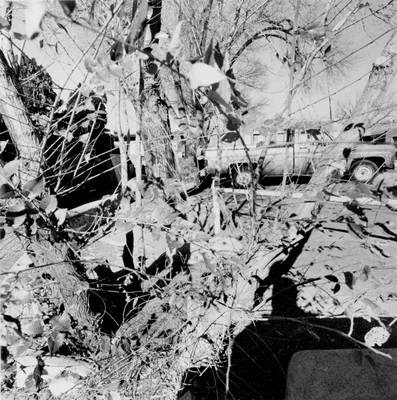
Friedlander snuck his camera into someone's yard like an intruder peering through a confusion of trees at something in the distance. In a jarring collusion of foreground and background, leafy branches brushing the lens are mashed up against a pickup truck and houses in the distance. Fantastic distortions occur. The leaves are the same size as truck tires. Patchy shadows have more substance than houses. Poles, wires, houses and foliage all seem made of the same substance in this collage-like composition. According to Peter Galassi, "These photographs have a patchwork vitality reminiscent of modernist collage from Kurt Schwitters to Robert Rauschenberg, but with a crucial different: the unity of Friedlander's pictures depends upon the finely adjusted logic of their interior arrangements, but it is also the unity of the camera vision."

© Lee Friedlander - All rigths reserved

"1184-03 - Santa Fe, NM" 1995

With so many subjects to photograph on the streets of Santa Fe one wonders why Friedlander chose a featureless adobe wall. Is the subject of this photograph the traffic meter near the center of the composition, the peeling Chevy jutting into the right side of the picture, the adobe wall splashed with sunlight and shadow, or two feathery pine trees behind the wall? Maybe Friedlander's intention is describe what all see, but few would have noticed, the bizarre way tree mirrors tree, and how the shapes of car and meter are doubled by their shadows on the wall.

© Lee Friedlander - All rigths reserved

"1185-09: Santa Fe, NM" 1995

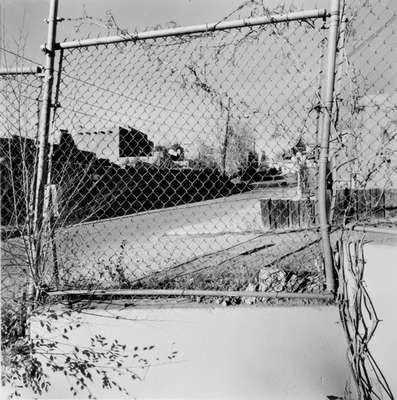
The square metal frame of a hurricane fence entwined with vines fills the photograph, creating a whimsical duplicate of the square picture plane. Diagonal spaces within the weave of the fence create a moiré pattern through which can be seen the remarkably abstract shapes of flat roofed buildings and street, bisected by sunlight and shadow.

© Lee Friedlander - All rigths reserved

"1725-27: New Mexico" 2006

This photograph of a nondescript street in some small town is primarily a study in geometric shapes. Dominating the picture is a stop sign topped by another sign containing the street number. Facing the camera is a corrugated metal building whose false front is shaped like stair steps. In between them the road forms a graceful crescent. This photograph conveys Friedlander's typically cool nonchalance toward his subjects, along with his distanced, yet playful, witty and ironic inquisitiveness.

© Lee Friedlander - All rigths reserved

"1725-24: New Mexico" 2006
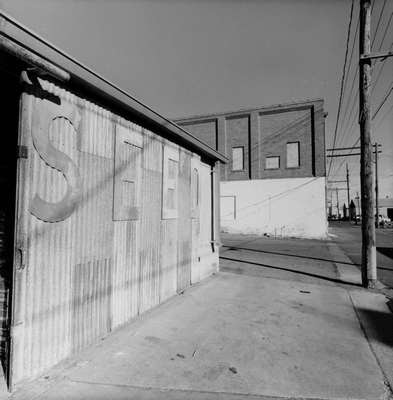
It has been said of Friedlander's photographs "the camera's mindless objectivity can jolt us into seeing things anew." In this image a metal building with the word SEED nailed to its side is one of several structures on a quiet industrial street. Despite the word "seed" there is nothing growing in the scene, not even a blade of grass. The camera lens describes the lackluster architecture according to the laws of one-point perspective. Buildings, sidewalks, telephone poles and wires recede toward a vanishing point somewhere beyond the picture plane. But something about Friedlander's deadpan handling of the scene loosens it from its literalness. The otherwise characterless street suddenly becomes an interesting sequence of rectangles and squares resembling box flaps that could be folded up at a moment's notice.
© Lee Friedlander - All rigths reserved

"1724-13: New Mexico," 2006

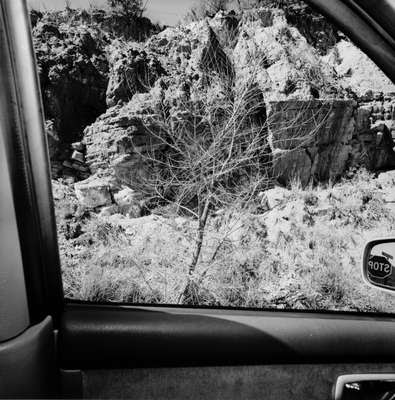
Since the beginning of his career Friedlander has taken photographs from inside his car, using the windows, paneling and mirrors as multiple viewfinders for whatever happens to be outside. In this instance, he stopped to photograph a small, leafless tree growing in prickly grasses below a rock escarpment. The steep, crumbly slope rising nearly to the top of the picture does not invite exploration, nor does it convey anything remotely sublime or pastoral. Though probably a natural geological formation it might just as easily have been thrown up by a bulldozer. In any case, it would be tough to traverse. Even its view is hindered by the scrubby tree in the foreground. Wryly reiterating that everything has come to a dead standstill, Friedlander included the car's rear view mirror with its reflection of a sign containing the single command: " STOP."

© Lee Friedlander - All rigths reserved

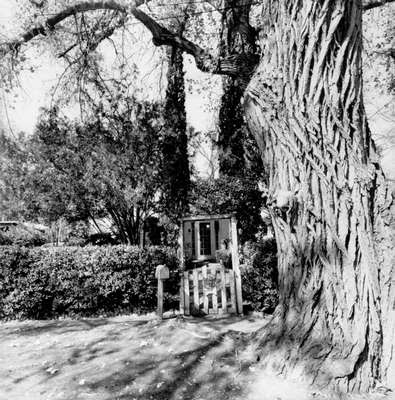
"1726-16: New Mexico," 2006

In a neighborhood bypassed by time and developers Friedlander photographed at close range a massive cottonwood tree with bark resembling thick slabs of clay. Nearby is a dense hedge, an old fashioned mailbox, and a rickety wooden gate leading to a house nearly hidden in the overgrowth of vines and trees. Only the front door is visible and it appears strangely diminutive next to the luxuriant plant life. What makes this photograph interesting is that within Friedlander's enormous body of highly complex images this is a perfectly ordinary shot, almost like a moment of repose. The fact that every so often Friedlander shoots a charmingly picturesque scene merely adds to the breadth of his work and the paradox of his vision.

© Lee Friedlander - All rigths reserved

Gallery hours at 203 W. San Francisco St. location are 10 - 5 Mon. - Sat. Gallery hours at 122 Grant Ave. gallery are 10 - 5 Tues.- Sat.

Andrew Smith Gallery: www.andrewsmithgallery.com/

Liz Kay

Reference:

Peter Galassi, Friedlander: Museum of Modern Art, New York, 2005.

14/12/04

Lee Friedlander at Texas Gallery, Houston - Xmas in Texas

Lee Friedlander: Xmas in Texas 
Texas Gallery, Houston
December 14, 2004 – January 15, 2005
“He was not unlike a traveler walking into a landscape which may prove mirage.”(Patrick White, “Riders in the Chariot”)
Texas Gallery presents an exhibition of photographs by Lee Friedlander – 40 black and white photographs taken in west Texas between 1997 and 2004. Lee Friedlander has been working periodically in Texas since the early 1970’s, focusing on urban settings, the big thicket and desert landscapes. This new group of photographs has two themes: buildings and streets in towns of far west Texas, such as Alpine and Marfa, which focus on Christmas decorations, and from which derives the title of the show; and classic images of landscape: the highland deserts and mountains of Big Bend and the Davis Mountains. Lee Friedlander’s photos are distinguished by a compositional technique of formal organization and complex pattern. Using a square format camera with a flash, the artist achieves clarity with a great depth of field. Lee Friedlander’s photos bring to mind the beautiful intelligence of the works of Walker Evans and Eugene Atget.

Lee Friedlander lives in upstate New York, is a McArthur Fellow and he will have a retrospective of his work at the Museum of Modern Art, NY in June 2005. His most recent publications include “Sticks and Stones, Architectural America” (2004), “Family” (2004), and “Stems” (2003).

TEXAS GALLERY
2012 Peden, Houston, TX 77019
www.texgal.com