Showing posts with label artshow. Show all posts

05/10/24

Maysha Mohamedi @ Pace Gallery, Tokyo - "yesterday I was a tiny tube of toothpaste" Inaugural Pace's Tokyo Gallery Exhibition + Book

Maysha Mohamedi 
yesterday I was a tiny tube of toothpaste
Pace Gallery, Tokyo
September 6 – October 16, 2024
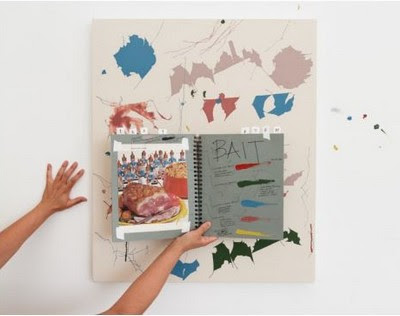
Maysha Mohamedi with sketchbook 
and corresponding painting (Bait, 2023) 
at her Los Angeles studio 
Photo by Megan Cerminaro
© Maysha Mohamedi, courtesy the artist and Pace Gallery

Pace presents an exhibition of new, never-before-exhibited paintings by American artist Maysha Mohamedi to mark the grand opening of its Tokyo gallery in the city’s Azabudai Hills.

The show, titled Maysha Mohamedi: yesterday I was a tiny tube of toothpaste, showcases the artist’s ability to use color and calligraphic abstraction as means for storytelling. To accompany this exhibition, Pace Publishing produces a facsimile of the studio sketchbook she used for the works in her Tokyo show, featuring a new text by writer Brian Dillon.

Maysha Mohamedi
Maysha Mohamedi
yesterday I was a tiny tube of toothpaste
PACE PUBLISHING, 2024
Text by Brian Dillon
Design by Tara Stewart
Spiral Bound Softcover, 72 pages, 11.6 x 9.5 in.
© Image courtesy of Pace Publishing 

Maysha Mohamedi—whose work can be found in the collections of the Metropolitan Museum of Art in New York, the Los Angeles County Museum of Art, and the Institute of Contemporary Art, Miami—is a self-taught artist raised in San Luis Obispo, California, who trained as a neuroscientist before pursuing a career as a painter. Now based in Los Angeles, she is known for her atmospheric abstractions that reflect her own thinking about universal ideas and experiences. In her paintings populated with idiosyncratic, spirited forms that unfold, unspool, and reveal themselves over time, she explores relationships between color, shape, language, matter. Invention and discovery lie at the center the artist’s approach to mark making, and her paintings are invested in a kind of excavation, in which she carves out space around and through contour. A subtle mystery resides in the core of each of her works—for Mohamedi, this essence is what guides her towards different forms in her painting process, leading her to a sort of untouchable, sacred truth that defies easy articulation and rationalization.

Functioning as maps of cognition and experience, Maysha Mohamedi’s compositions are made up of her uncannily crisp brushstrokes and painterly flourishes, which she builds up intuitively and contemplatively. Moments of rupture and embrace can be traced across her abstractions, forged through collisions of her own hand and body with the surfaces of her canvases. Using memories, ideas, words, and feelings as origins for her painted abstractions, she draws from a personal lexicon of geometric shapes to express details and anecdotes from her own life in ineffable, intangible, and universal terms. Mohamedi’s approach to color also grounds her works in her own world—‘collecting’ and archiving colors for her paintings as part of her daily experiences and observations, her chromatic storytelling animates her canvases with a sense of vitality and harmony.

Maysha Mohamedi’s first solo show in Japan and all of Asia, this presentation spotlights paintings produced in 2023 and 2024. For these works, she drew inspiration from her diary chronicling her brief time working in Japan two decades ago. In creating her new paintings—half of which are named for people and places that she encountered and wrote about in her journal during that trip—the artist reentered and reactivated the psychic space of her 20s, weaving together coincidences and serendipitous situations from her formative experience abroad and the present circumstances of her life. In this way, the works on view in Tokyo will shed light on one of the hallmarks of Maysha Mohamedi’s practice: her use of abstraction to forge a patchwork of stories and scenes from her daily life and interpersonal relationships.

Vibrant and playful, MAYSHA MOHAMEDI’s (b. 1980, Los Angeles) innovative practice points toward a new mode of atmospheric abstraction that registers certain conditions specific to Los Angeles—and American life as a whole—in the early 21st century. Reflecting her personal history, everyday experiences, and key constellations in her own cultural matrix, her palette is both purely abstract and directly connected to the patchwork of landscapes, objects, and environments that comprise her life. These range from an Ojai, California playground the artist visited with her children, clippings from cookbooks and magazines, to sea glass found on the shore. Maysha Mohamedi’s works are reflections of her own thinking, crystallized as moments of haptic communion. The artist’s academic background in neuroscience is found in the liveliness and expansiveness of her paintings. Liberated from the constraints and dictates of the threedimensional world, her immersive works exude a sense of freedom and illimitability. For Maysha Mohamedi, the viewer is an equal creator in this shared universe of boundless possibilities.

Maysha Mohamedi received a Bachelor of Science in 2002 from the University of California, San Diego, where she studied cognitive science, specializing in neuroscience, and she earned a Master of Fine Arts in painting from the California College of the Arts in San Francisco in 2011. Maysha Mohamedi’s work has been the subject of solo exhibitions at Parrasch Heijnen Gallery, Los Angeles; Massimo De Carlo, Paris; and The Lodge, Los Angeles. She has also been included in group exhibitions at Blum & Poe, Los Angeles; Fourteen30 Contemporary, Portland, Oregon; Mu.ZEE, Ostend, Belgium; and other spaces. Mohamedi lives and works in Los Angeles.

PACE GALLERY TOKYO
1F; Azabudai Hills Garden Plaza-A
5-8-1 Toranomon, Minato-ku, Tokyo

09/05/23

Matthew Day Jackson @ Pace Gallery, NYC - Against Nature

Matthew Day Jackson: Against Nature
Pace Gallery, New York
May 12 – July 1, 2023

Matthew Day Jackson
Matthew Day Jackson 
Solaris (after CDF), 2023 
© Matthew Day Jackson, courtesy Pace Gallery

Pace presents new works by Matthew Day Jackson at its 510 West 25th Street gallery in New York. This presentation—coinciding with Frieze New York and TEFAF New York—marks Jackson’s debut solo show with the gallery and his first exhibition in New York in a decade. Titled Against Nature, the artist’s exhibition centers on a focused body of work that includes painting and sculpture. 

Through his expansive practice, Jackson explores a wide range of subjects—historical, futuristic, scientific, spiritual, and fantastical. At the core of his work is a deep interest in finding similarities within binaries and dichotomies, particularly the simultaneity of beauty and horror. In his research-based, experimental process, the artist considers conceptual and physical underpinnings equally significant, incorporating combinations of traditional, industrial, and found materials in his work across painting, sculpture, installation, and other mediums.

Named for Joris-Karl Huysmans’s 1884 novel Against Nature—in which a French aristocrat named Jean Des Esseintes departs Paris to indulge his obsessive, insatiable desire for luxury and beauty in the countryside, exploiting natural resources for his own aesthetic ends—Jackson’s forthcoming presentation with Pace in New York will be anchored by ten new landscape paintings. Using a semi-autonomous laser process that imbues colors and forms in these works with an otherworldly feel, the artist mines the history of landscape painting, with an eye towards Caspar David Friedrich, Thomas Cole, Albert Bierstadt, and Thomas Moran. Similarly, the work of 19th century photographer Eadweard Muybridge, known primarily for his studies of motion and his learned expertise in darkroom photography, has informed Jackson’s interest in unearthly landscape scenes featuring perspectival distortions and uncanny coloration. With his new paintings, Jackson eschews stylistic signatures to investigate the complexities of authorship and undermine mythologies of artistic “genius.” As part of a process that combines physical and digital modes of making, the artist brings issues of materiality and form—as opposed to gesture and expression—to the fore of his latest works.

Replete with art historical allusions, the artist’s new landscape paintings also reference the conventions of landscape in science fiction film and literature, where the strange and familiar converge. Jackson creates these composite works by layering images sourced from landscape photography and painting as well as everyday scenes he has captured on his iPhone. As such, tensions between artifice and authenticity; reality and unreality; ambiguity and clarity cut across these highly detailed, hallucinatory scenes, eliciting curiosity and wonderment. Upending viewers’ expectations and initial impressions, Jackson’s complex works—rife with visual paradoxes—invite questions of medium, materiality, and meaning that are only answered through sustained consideration and interrogation.

Uniting visions of suburbia and the sublime, the exhibition’s sensorial offerings extend to the olfactory realm. An ineffable scent—produced by the artist in collaboration with ArtOlfactionLab team at Bestscent—will linger throughout the gallery space. This immersive element transports viewers into the imaginary environments and atmospheres of the landscapes on view.

The presentation also includes a sculptural work that directly references Huysmans’s novel Against Nature, in which the protagonist, Des Esseintes, uses his wealth to enjoy any and all pleasures of the senses within his own hermetically sealed bubble of privilege. At one point in the story, Des Esseintes commissions a Parisian lapidary to encrust a living tortoise with jewels—he is unphased and unmoved when the tortoise dies upon delivery to his home. Connecting this character’s disregard for expense, labor, and conservation with present-day treatment of the natural environment, Jackson will present a ring inspired by Huysmans’s tortoise narrative in his exhibition. Created through a collaboration and trade between Jackson and designer Solange Azagury-Partridge, the ring, which is owned by the artist, will be displayed in a specially built case. With his inclusion of this piece, Jackson draws attention to his own embodiment of Huysmans’s critique, comparing the insularity of an artist’s studio with Des Esseintes’s self-imposed isolation from the rest of the world.

Matthew Day Jackson (b. 1974, Panorama City, California) has cultivated a practice encompassing sculpture, painting, collage, photography, drawing, video, performance, and installation. Jackson’s work, which is often monumental in scale, engages with a wide range of subjects, from the historical and scientific to the futuristic and fantastical. The artist graduated from the University of Washington in Seattle in 1997 and earned his MFA from the Mason Gross School of the Arts at Rutgers University in New Jersey in 2001. He was the recipient of the 2019 Jordan Schnitzer Award for Excellence in Printmaking, and he has participated in residencies at the Chinati Foundation in Marfa, Texas; the Portland Institute for Contemporary Art in Oregon; and the Skowhegan School of Painting &Sculpture in Maine. Jackson lives and works in Brooklyn, New York. 

PACE NEW YORK
510 West 25th Street, New York, NY

03/03/19

Samia Halaby @ Art Dubai 2019 with Ayyam Gallery, Dubai

Samia Halaby
Ayyam Gallery, Dubai
@ Art Dubai 2019
20 - 23 March, 2019

Ayyam Gallery announces its participation in the 13th edition of Art Dubai from 20 - 23 March, 2019 at Madinat Jumeirah with a solo presentation by Samia Halaby.

Born in Jerusalem in 1936, Samia Halaby is a leading abstract painter and an influential scholar of Palestinian art. Although based in the United States since 1951, Samia Halaby is recognised as a pioneer of contemporary abstraction in the Arab world.

Samia Halaby began her career in the early 1960s, shortly after graduating from Indiana University with a MFA in Painting. While teaching at the Kansas City Art Institute in 1964, she travelled to the Eastern Mediterranean as part of a faculty research grant and studied the geometric abstraction of the region’s Islamic architecture, which has continuously factored into her work. During this time, Halaby launched a series of experiments that would initiate a career-long investigation of the materialist principles of abstraction: how reality can be represented through form.

Also influenced by the abstract movements of the Russian avant-garde, Halaby works with the conviction that new approaches to painting can redirect ways of seeing and thinking not only within the realm of aesthetics but also as contributions to technological and social advancement. This underlying notion has led to additional experiments in drawing, printmaking, computer-based kinetic art, and free-from-the-stretcher painting.

Samia Halaby has been collected by international institutions since the 1970s, including the Solomon R. Guggenheim Museum of Art (New York and Abu Dhabi); Yale University Art Gallery; National Gallery of Art, Washington D.C.; Art Institute of Chicago; Cleveland Museum of Art; Institut du Monde Arabe; and the British Museum.

Selected solo shows for the artist include Ayyam Gallery Al Quoz, Dubai (2017);  Birzeit University Museum, Ramallah (2017); Beirut Exhibition Center (2015); Ayyam Gallery London (2015, 2013); Ayyam Gallery Al Quoz, Dubai (2014); Ayyam Gallery DIFC, Dubai (2011); and Ayyam Gallery Beirut (2010). She has participated in recent group shows at the School of Visual Arts, New York, USA (2017); Ayyam Gallery DIFC, Dubai (2017); 3rd Qalandiya International Biennial (2016); Darat Al Funun, Amman (2015); the National Academy of Arts, New York (2015); The Guggenheim Museum, Abu Dhabi (2014); Broadway 1602, New York (2014); and Institut du Monde Arabe, Paris (2009).

From the 1960s until the late 1980s, Samia Halaby taught at universities throughout the United States. She was the first full-time female associate professor at the Yale School of Art, a position she held for a decade. Her noteworthy contributions to American academia include a groundbreaking undergraduate studio art program that she introduced to art departments throughout the Midwest.

Samia Halaby’s writings on art have appeared in Leonardo: Journal of Arts, Sciences and Technology, Jerusalem Quarterly, and Arab Studies Quarterly, in addition to edited volumes, while her independently published survey Liberation Art of Palestine: Palestinian Paintings and Sculpture in the Second Half of the 20th Century (2002) is considered a seminal text of Palestinian art history. In 2017 Schilt Publishing released Halaby’s Drawing the Kafr Qasem Massacre while Palestine Books Inc published Growing Shapes: Aesthetic Insights of an Abstract Painter. In 2014 Booth-Clibborn Editions published the artist’s second monograph, Samia Halaby: Five Decades of Painting and Innovation.

AYYAM GALLERY, DUBAI, UAE
www.ayyamgallery.com

02/09/17

Stanley Whitney @ Lisson Gallery, NYC

Stanley Whitney: Drawings
Lisson Gallery, New York
8 September – 21 October 2017

Stanley Whitney has been exploring the formal possibilities of color within ever-shifting grids of multi-hued blocks and all-over fields of gestural marks and passages, since the mid-1970s. His exhibition at Lisson Gallery New York is the first major presentation of his drawings, highlighting important works from 1989 to the present. Stanley Whitney’s works on paper are a critical component of his practice, in which he develops his spatial structure and experiments with the placement of color.

Stanley Whitney’s signature format revolves around his use of a loose grid and it is within his sketchbooks and drawings that Whitney works through the abstract structure of colored blocks and lines, testing combinations, arrangements, density and transparency of colors to evoke a sense of rhythm and cadence. Whitney has noted: “For me, drawing is a way to understand where things are in space. I felt that I needed to work on space because I didn’t want my color to be decorative. I wanted color to have real intellect.” (*)

In Stanley Whitney’s work, color functions as both the design, creating shape and arrangement, and also as the energy, simultaneously attracting and distracting from the color laid beside it. The colors are meant to be seen next to and in relation to the others, rather than as individual blocks. While the drawings and paintings share the importance of space and sequencing of hue — and the gesture of the paintings maintain a sketching quality with the deliberate presence of the artist’s hand — the works on paper do not adhere to a square format as the paintings do. Instead, they tend to fill the rectangular page. Thus, by their format alone the drawings allow for an entirely fresh approach to the grid and pose a different challenge to creating the desired ‘call and response’ between colors. They incorporate a wider variety of color and texture — Whitney uses mediums including colored pencil, graphite, acrylic marker and crayon on surfaces as varied as Indian paper, Japanese rice papers and cardboard.

In his early drawings Whitney experiments with space in a freer format, with marks that are gestural and loose and the areas of color or space between horizontals are sparse and circular. Following a visit to Italy and Egypt in the early 1990s, he begins to experiment with the density of the color within the structure, as inspired by the classical and ancient architecture of the regions. Building these blocks of color, stacked on top of one another across the horizontal lines, the structure becomes more organized and the grids more precise and angular over the following decades.

To accompany the exhibition, the gallery has published a facsimile of one of Whitney’s sketchbooks, illustrating his working process and the way in which he orchestrates shape and color.   

(*) Stanley Whitney, “Stanley Whitney in conversation with Lowery Stokes Sims,” Stanley Whitney: Dance the Orange, (New York: The Studio Museum in Harlem, 2015), 60.

STANLEY WHITNEY

Stanley Whitney was born in Philadelphia in 1946 and lives and works in New York City and Parma, Italy. He holds a BFA from Kansas City Art Institute as well as an MFA from Yale University and is currently Professor emeritus of painting and drawing at Tyler School of Art, Temple University. Having developed his unique grid format in the late 1980s and early 1990s, Whitney’s work evokes a constant rhythm and profound lyricism deeply inspired by music, and drawing influences from sources as vast as Egyptian architecture and Italian cityscapes to textiles and the Gee’s Bend Quilts. Whitney's works featured in a major solo exhibition ‘Dance the Orange’, at the Studio Museum in Harlem, New York, USA (2015), and he has been included in many prominent group shows such as Documenta 14 in Athens, Greece and Kassel, Germany (2017), ‘Nero su Bianco’ at the American Academy in Rome, Italy (2015); ‘Outside the Lines: Black in the Abstract’, Contemporary Art Museum of Houston, USA (2014); ‘Reinventing Abstraction: New York Painting in the 1980s’, Cheim & Read, New York (2013) and ‘Utopia Station’ at the 50th Venice Biennale (2003). He has won prizes including the Robert De Niro Sr. Prize in Painting (2011), the American Academy of Arts and Letters Art Award (2010) and was awarded a Guggenheim Fellowship in 1996. Whitney was inducted into the American Academy of Arts and Letters in New York in May 2017. Whitney’s work is included in public collections such as the Nelson-Atkins Museum of Art, Kansas City, the Philadelphia Museum of Art, Yale University Art Gallery, New Haven and The Whitney Museum of American Art, New York, among others. This marks his third exhibition at Lisson Gallery, and his first in the New York location. 

LISSON GALLERY, NEW YORK
138 Tenth Avenue, New York, NY 10011
www.lissongallery.com

17/02/17

Holly Hendry @ BALTIC Centre of Contemporary Art, Gateshead

Holly Hendry: Wrot
BALTIC Centre of Contemporary Art, Gateshead
18 February – 4 June 2017

Holly Hendry
HOLLY HENDRY
Gut Feelings, 2016.
Plaster, steel, aluminium, cement, Jesmonite, polyurethane foam, marble, birch ply, soap, chewing gum, rawhide dog chew, motor
Courtesy the artist and Limoncello, London.

BALTIC Centre for Contemporary Art, Gateshead presents the first major institutional exhibition by emerging British artist Holly Hendry.

Holly Hendry (b. London, 1990) presents an entirely new body of work for her exhibition Wrot for the BALTIC level 2 space. Using a variety of materials, from Jesmonite and plaster to foam, wood, steel and water-jet cut marble, she creates a geology of oozy forms peppered with comic elements, such as dog chew bones and spinning plaster teeth. She investigates the underneath and backsides of things, using cross-sectional cuts that make insides become edges, revealing their dirty innards. Her works talk about absence through presence and offer intimacy without proximity. Her sugary colours and cartoon content examine the very human aspects of laughter and death.

The works in the exhibition, including an archaeology of layered fragments like a museum diorama, resist the flatness of surface, pulling us underneath to see the details. Holly Hendry says ‘like the grimy surface of the street at ground level - a striation of all the debris, layers, fragments and time we’ve stomped down’ the layered structure offers a cartoonish impression of the layers of sediment that we usually overlook, under our feet. Surfaces are important in the work - primed, polished and finished - the applications we use to protect and conserve materials and what we use to cover things up or conceal. The title of the show itself Wrot is a definition used in the building trade to refer to timber with one or more sides planed smooth. It also references rotting, decay or breakdown and things happening under the surface that Holly Hendry’s cross sections or slices allow us to explore. Layering, reconstitution of materials, agglomerates and new materials made from old are referenced and how these materials are displaced, dug out and filled, giving rise to the build-up and break down of entire biological and industrial systems.

The works in the exhibition, as is typical of the artist, draw attention to the spatial, material and structural qualities of the architecture and how space is experienced. Her large-scale sculptures are built specifically for BALTIC’s Level 2 gallery space, without referring directly to it. Rather, they rely on the architecture as a framework. They connect to it, as Holly Hendry states, with ‘spatial ligaments, like necklace to neck’.

Holly Hendry’s interest in the architectural qualities of the body itself - our internal structure of bones that supports the surface skin is explored in the exhibition. She considers the physicality of the human body and our attempts through medical science, from prostheses to intimate sutures, to arrest its inevitable decline. Teeth, the body part that is lost more often, appear blown up and looming in the space. Emblematic of the fact that our bodies never remain intact, they are both markers of people and a way to identify remains. More broadly, Holly Hendry is interested in sculpture’s relationship to the memorial. Grave-like cavities puncture Holly Hendry’s surfaces – places where bone and skin turn to dust and where matter changes: the body returning to its material substances, becoming ‘stuff’ again. The exhibition reminds us of the permeability of the body’s periphery and our coagulation as bodies and objects.

HOLLY HENDRY (b. 1990, based in London, UK) gained her BA Fine Art at The Slade School of Fine Art (2013) and her MA Sculpture at the Royal College of Art (2016). Exhibitions include Limoncello Cork St, London (2016) with Kate Owens; Rice + Toye, London, UK (2016); Bosse & Baum, London, UK (2015); The Oval, London, UK; and Gallery North, Newcastle upon Tyne (both 2014). Recent group shows include GL Strand, Copenhagen; Belmacz Mayfair, London, UK; VITRINE, London, UK; The Royal Standard, Liverpool, UK; CBS Gallery, Liverpool, UK; Cowley Manor, Cotswolds, UK (all 2016); Turf Projects Space, Croydon, UK; Chesterfield House, London, UK; Salt + Powell, York, UK (all 2015), S1 Artspace, Sheffield, UK; and Sharjah Art Foundation, Sharjah, AE (both 2014). 

BALTIC Centre for Contemporary Art
Gateshead Quays, South Shore Road, Gateshead NE8 3BA UK
balticmill.com

13/09/98

Delacroix: The Late Work, Philadelphia Museum of Art

Delacroix: The Late Work
Philadelphia Museum of Art
September 15, 1998 - January 3, 1999

In celebration of the 200th anniversary of the artist's birth, the Philadelphia Museum of Art presents Delacroix: The Late Work, an exhibition exploring the final years of the great French painter Eugène Delacroix (1798-1863). Some 70 paintings and 40 works on paper by one of the most important artists of the 19th century, lent by museums and private collections throughout Europe and the Americas, are arranged by theme in six categories—animals, allegory and mythology, flowers and landscapes, literary illustrations, scenes of North Africa, and religion—that reveal the artist's immense achievement during the last 15 years of his life. 

Delacroix: The Late Work sheds new light on this monumental figure in the history of art, whom the renowned French poet Charles Baudelaire described in 1845 as "the most original painter of ancient or modern times." Considered the last "Old Master," Delacroix consciously placed himself in the painterly tradition of Veronese, Titian, Rubens, and Rembrandt, yet he was also the driving force in the French Romantic Movement, a radical new approach to art developed in Paris in the early decades of the 1800s. Delacroix formed the link between the traditions of the past and the modern movements, ultimately having a profound influence upon the Impressionists, particularly Renoir and Cézanne, as well as such 20th-century masters as Picasso and Matisse. Cézanne said that Delacroix had "the greatest palette of France, and no one beneath our skies possessed to a greater extent the vibration of color. We all paint through him."

Eugène Delacroix was a remarkably prolific artist, creating in his lifetime over 850 paintings and more than 2000 watercolors and drawings. This exhibition focuses on the works of the mature artist, from the year 1848 to his death in 1863 at the age of 65. These last years of his life were a time of profound reflection for Delacroix, steeped in nostalgia and swept by deep, erotically charged, emotions. Among the great admirers of Delacroix's talent was the American novelist Henry James, who in 1872 remarked that the painter's "imaginative impulse begins where that of most painters ends."

The exhibition features a selection of Eugène Delacroix's late representations of North Africa, a place where the artist had spent several months in 1832. It was a visit that would have a profound effect on the light, color, and imagery of his painting for the rest of his life. These subjects, reconsidered some 30 years after his actual experience, are a vivid testimony to his love of North Africa and its hold on his imagination. Delacroix will conclude with an exploration of the artist's representations of religious subjects. It is one of the great paradoxes of modern art history that Delacroix, a worldly Parisian who confessed skepticism of any organized religion, should be the greatest religious painter of the 19th century. This exhibition presents a unique opportunity to examine the range and power Delacroix's biblical subjects, such as The Good Samaritan (c. 1850; Waterhouse Collection), which were executed with a deep awareness of similar works by such masters as Rembrandt, Rubens, Titian, and Veronese, as well as the sequence of closely related compositions of Christ on the Sea of Galilee that also look forward to Monet's famous series paintings.

Delacroix: The Late Work presents paintings and works on paper that are multi-faceted and introspective, suffused by an increasingly complex and passionate use of color as well as a renewed spiritual intensity. Soon after the artist's death, Théophile Silvestre spoke to these same qualities in the final years of the artist's life: "Delacroix died, almost smiling...a painter of great genius, who had the sun in his head and storms in his heart, who for forty years played the entire keyboard of human emotion, and whose grandiose, terrible, and delicate brushes passed from saints to warriors, from warriors to lovers, from lovers to tigers and from tigers to flowers."

The exhibition is accompanied by a fully illustrated, 350-page catalogue, with essays on subjects including Delacroix's technique, how the artist was viewed by his contemporaries, and issues of continuity and variation in his work.

The exhibition has been organized by the Philadelphia Museum of Art in conjunction with the Réunion des Musées Nationaux in Paris. The curators of the exhibition are Joseph J. Rishel, Senior Curator of European Painting at the Philadelphia Museum of Art; Arlette Sérullaz, Curator of Prints at the Musée du Louvre and Director of the Musée Delacroix; and Vincente Pomarède, Chief Curator of Paintings at the Musée du Louvre. The Philadelphia Museum of Art is the exhibition's only venue in North America.

PHILADELPHIA MUSEUM OF ART
www.philamuseum.org