Showing posts with label italian artist. Show all posts

07/02/25

Giuseppe Penone @ Serpentine, London - "Thoughts in the Roots" Exhibition

Giuseppe Penone
Thoughts in the Roots
Serpentine, London
3 April – 7 September 2025

Giuseppe Penone working 
on Pressione (Pressure) 
at Musée de Grenoble, 2014 
Photo © Musée de Grenoble / ph. Jean-Luc Lacroix

Thoughts in the Roots at Sepentine South showcases Giuseppe Penone’s continued interest in the relationship between humans and the natural world, featuring works that range from 1969 to today.

A leading figure in the Arte Povera movement, born in Italy in the 1960s, that celebrates the simplicity of natural materials and artistic techniques, Giuseppe Penone experiments with a wide range of materials including wood, iron, wax, bronze, terracotta, marble and plaster, bringing their individual physical qualities to the fore.

Since its launch in the 1970s, Serpentine has maintained a long-standing commitment to bringing art out of the traditional gallery context and into the surrounding landscape, offering an opportunity for artists to engage with the immediate environment of Kensington Gardens.
Giuseppe Penone says: “To breathe the perfume of the leaves that cover the walls of the environment, to inhale the fragrance of the resin extracted from the trees and poured into an empty tree trunk, these are actions that allow us to perceive the space of Serpentine as a continuum with the nature of the park that surrounds it.”

“All of my work is a trial to express my adherence and belonging to nature, and it is with this thought that I have chosen the works for the exhibition. The two paths that I have created, inside the gallery and outside of it, in the park, become two integrated gardens.”
The exhibition will embody the key principles of Giuseppe Penone’s work, namely the synergies between artistic and natural process, and the poetic relationship between humans and nature.

GIUSEPPE PENONE 
Respirare l’ombra (To Breathe the Shadow), 1999 
Wire mesh, laurel leaves, bronze 
Total dimension determined by the space Installation view 
Castello di Rivoli Museo d’Arte Contemporanea 
Photo © Archivio Penone

Since the 1970s, Giuseppe Penone has visualised breath as sculpture through different materials. Highlights will include Respirare l’ombra (To Breathe the Shadow), a sensory installation made of laurel leaves that envelops the walls of the gallery. The artist compares the process of breathing to that of lost wax castings, in which metal flows into the mould and air is expelled from reeds, similar to lungs respiring. Reminding us of the fleeting nature of organic elements, the artwork is conceived as an immersive experience celebrating respiration and dissipating over time as the leaves lose their scent and colour.

Exploring the rapport between nature and body, Giuseppe Penone also uses organic materials to record his own breath. In Soffio di foglie (Breath of Leaves), the artist stacks boxwood leaves and lies down on the pile, breathing air into them. The imprint of his body and respiration is cast on the leaves, recording traces of his bodily presence.

GIUSEPPE PENONE
A occhi chiusi (With Eyes Closed), 2009
Acrylic paint, glass microspheres, 
acacia thorns on canvas; white Carrara marble 
total dimensions 150 × 510 × 8 cm
Installation view at BnF Paris 2021 
Photo © Archivio Penone

The exhibition opens with A occhi chiusi (With Eyes Closed), a work showcasing the artist’s combined interest in exploring the relationship between sight and the act of closing one’s eyes. His first exploration started in 1970 with Rovesciare i propri occhi (Reversing One’s Eyes), a black and white photograph that captured Giuseppe Penone looking directly at the viewer while wearing reflective contact lenses that rendered him blind. With the absence of vision, he creates a space for imagination within the mind. The numerous acacia thorns on canvas echo a synthesis of our senses in connection with nature too.

The vegetal world is a central subject in Giuseppe Penone’s work, citing the tree as the ‘primal and most simple idea of vitality, of culture, of sculpture’. He created his first Alberi (Trees) in 1969, by removing the wood along the outer growth rings of mature timber layer-by-layer. Knots were left in place as they emerged into branches, revealing how the tree would have appeared before it was felled.

The exhibition features Alberi libro (Book Trees), a sculpture consisting of twelve carved saplings placed side by side. ‘Every word for tree collects days of rain, sun mist, contains seasons, memories of places, of times experienced, that have a different meaning from person to person. They are words that fill the woods with their presence, invade the landscape, force us to an interpretation of motion, active, and push us for their correct interpretation in the forest’s care.’

GIUSEPPE PENONE
Gesti vegetali (Vegetal Gestures), 1983-1985 
Bronze, vegetation 
Installation view at Galleria Borghese, Rome, 2023
Photo © Sebastiano Pellion di Persano

Gesti vegetali (Vegetal Gestures) is a series of sculptures that encapsulates the gestures of plants and the movement of the body. Giuseppe Penone created the first drawings of Gesti vegetali in the 1980s, outlining the movement of the human body. He molded the work in clay before casting it in bronze, a material which the artist began utilising after realising the oxidation resembled the same colour as the bark of trees. Each sculpture is placed in a plant pot and positioned outside the gallery windows, in dialogue with the trees in Kensington Gardens.

Designed by Atelier Dyakova, an artist book will be published to accompany the exhibition. Featuring drawings and new writings from Giuseppe Penone alongside the contributions from Ludovico Einaudi and other contextualising texts. The publication also features an extended interview between Penone and Hans Ulrich Obrist discussing the artist’s inspiration and practice.

Giuseppe Penone has a longstanding relationship with Serpentine. He previously worked with Ecologies at Serpentine, which encompasses myriad convenings, networks, infrastructural and long-term research projects which hold ecology and the environment at their core. The artist was a participant in the 2011 Garden Marathon at Serpentine. This two-day event was an exploration of the concept of the garden. He  is also featured in the book 140 Artists’ Ideas for Planet Earth, published by Serpentine and Penguin.
Bettina Korek, CEO, Serpentine, and Hans Ulrich Obrist, Artistic Director, Serpentine, say: “We are honoured to present Giuseppe Penone’s exhibition at Serpentine South. Thoughts in the Roots will celebrate his impressive five-decade practice and uncover the visual, tactile, and olfactory dimensions of the materials he explores. Revealing the fragile and poetic relationships between humans and nature, the exhibition will exemplify Penone’s experimental research and feature new works presented in the UK for the first time and extends into The Royal Parks. Following his participation in the Garden Marathon – our knowledge festive - at Serpentine in 2011 and his contribution to 140 Artists’ Ideas for Planet Earth, we’re thrilled that this leading figure of the Arte Povera movement, has accepted our invitation to bring the Park into the gallery and vice versa. Responding to the Spring and Summer seasons, Penone’s delicate landscape will nurture Serpentine’s mission of building new connections between artists and audiences.”
With a career spanning over five decades, Giuseppe Penone’s (b. 1947 lives and works in Turin, Italy) expansive oeuvre encompasses sculptures, drawings, painting, installations, and photography. Born in Garessio, a village near Cuneo, Italy, he is influenced by the forested region of Northern Italy.

Giuseppe Penone has been featured in solo exhibitions worldwide including at the Fondazione Ferrero, Alba (2024); at the Galleria Borghese, Rome (2023); Centre Pompidou, Paris (2004, 2022); Philadelphia Museum of Art (2022); Villa Medici, Rome (2021); Palais d’léna – CESE, Paris, (2019); Yorkshire Sculpture Park, Wakefield (2018); Chateau La Coste, Le Puy-Sainte-Réparade (2017); Palazzo della Civiltà, Rome (2017); Louvre Abu Dhabi (2017); MART, Rovereto (2016); Rijksmuseum, Amsterdam (2016); Nasher Sculpture Center, Dallas (2015); Musée Cantonal des Beaux-Arts, Lausanne (2015); the Beirut Art Center (2014); the Musée de Grenoble (2014); the Château de Versailles (2013); Kunstmuseum Winterthur (2013); Madison Square Park, New York (2013) and Whitechapel Gallery, London (2013). Giuseppe Penone has exhibited at Documenta V (1972), VII (1982), VIII (1987) and XIII (2012) and at the Venice Biennale in 1978, 1980, 1986, 1995 and 2007.

Thoughts in the Roots is curated by Claude Adjil, Curator at Large; and Hans Ulrich Obrist, Artist Director with Alexa Chow, Assistant Exhibitions Curator.

SERPENTINE GALLERIES, LONDON
Serpentine South + extend beyond the gallery 
to feature sculptures in the Royal Parks
Kensington Gardens, London W2 3XA

02/06/13

Piero Manzoni Retrospective, Stadel Museum, Frankfurt, Germany

Large  Piero Manzoni Retrospective: Piero Manzoni. When Bodies became Art
Städel Museum, Frankfurt, Germany
June 26 - September 22, 2013

Despite his short career, PIERO MANZONI (1933-1963), who died an early death at the age of twenty-nine, is regarded as one of the most consequential representatives of Italian post-war art. The artist would have celebrated his eightieth birthday on July 13, 2013. The Städel will pay tribute to this key figure of the European avant-garde after 1945 with its exhibition Piero Manzoni. When Bodies Became Art to mark the occasion exactly fifty years after the artist’s death. The extensive show will be the first Manzoni retrospective ever to be staged in the German-speaking world and the first comprehensive presentation of his oeuvre in a museum outside Italy for more than two decades. The exhibition, on display from June 26 to September 22, 2013 in the Städel Museum, will highlight the radical character of the artist’s multifaceted position. More than one hundred works from all phases of Manzoni’s career will offer complex insights into a still persuasive and influential oeuvre between Art Informel and the emergence of a new concept of art, Modernism and neo-avant-garde, art and the everyday world. 

Photo by Ennio Vicario
PIERO MANZONI (1933-1963)
Ritratto di Piero Manzoni nel suo studio, 1958
Piero Manzoni dans son atelier de la Via Fiori Oscuri, 1958
Piero Manzoni in seinem Studio in der Via Fiori Oscuri, 1958
Photo by © Ennio Vicario

“Though Piero Manzoni acted as the central hub of the cross-Europe ZERO network and, as a breathtaking innovator of the concept of art, strikes us hardly less avant-garde today, he is far less known than his ZERO colleagues in these parts. This is why we focus not only on the complexity of his oeuvre created within only a few years, but also on its enormous influence on the paradigm change in the field of art in the 1960s,” says Max Hollein, Director of the Städel Museum. 

“Piero Manzoni is no less than one of the pioneers of today’s art, who influenced Body Art, Performance Art, Conceptual Art, and Land Art in equal measure,” emphasizes Dr. Martin Engler, Head of the Städel’s Contemporary Art Collection and curator of the show.  

The exhibition begins with early works by Piero Manzoni, presented together with a selection from some of his contemporaries’ production, like that of Lucio Fontana or Yves Klein. Piero Manzoni’s Achromes, or colorless pictures, represented in the exhibition with about fifty examples, are certainly to be regarded as the central group of works within his oeuvre. Piero Manzoni’s “white” painting, defined by the absence of color, takes a special position in the context of the international ZERO movement and its turn toward monochromy: Piero Manzoni saw his Achromes as paintings in spite of their ultimate reduction on the one hand, yet extended them by everyday elements, the body, and space on the other. In creating them, he did without any direct artistic gesture. Employing unpainterly “white” materials such as gesso or kaolin, synthetic fibers, and Styrofoam, he relied on means with sculptural qualities and thus initiated a transition process from the picture to a third, corporeal dimension. 

A selection from Corpi d’aria (Bodies of Air) and Fiato d’artista (Artist’s Breath), two series Piero Manzoni produced in 1959/60, confronts us with works oscillating between object and concept: the balloons, filled with the owner’s or Manzoni’s breath, related to a body discourse that anticipated the 1970s and was also reflected in other works by the artist like in the performance Consumazione dell’arte (Consumption of Art, 1960), in which he marked hard-boiled eggs with his thumbprint and offered them to the audience to eat. 

Photo by Ennio Vicario
PIERO MANZONI (1933-1963)
Ritratto di Piero Manzoni nel suo studio, 1958
Piero Manzoni dans son atelier de la Via Fiori Oscuri, 1958
Piero Manzoni in seinem Studio in der Via Fiori Oscuri, 1958
Photo by © Ennio Vicario

The provocative impact of Piero Manzoni’s probably best known group of works, Merda d’artista (Artist’s Shit, 1961), is still unbroken even five decades after the artist’s death: thirty grams of the artist’s feces in compact cans, which, priced by weight based on the current value of gold, were offered for sale on the art market. This series is to be understood as a logical consequence of Manzoni’s art consumption performances: the body becomes a medium for the intake and production of art. The outcome is a circle of organic art production which, in its absurd logic, passes comment on the expectations of the art market. 

Also including Piero Manzoni’s Sculture viventi (Living Sculptures, 1961), which declare bodies to be art by signature or by means of a pedestal, the exhibition highlights an approach appropriating man as a live work of art: Manzoni’s concept involved the viewer as an actor and opened the door for the Actionist Art of the 1960s and 1970s. 

The presentation of three contemporary positions ‒ Erwin Wurm (*1954), Leni Hoffmann (*1962), and Bernard Bazile (*1952) ‒ provides an essayistic introduction to the show in the foyer of the exhibition building, a foreword exploring central dimensions of Manzoni’s oeuvre regarding their relevance to the present. 

PIERO MANZONI. WHEN BODIES BECAME ART 
Curator: Dr. Martin Engler, Head of the Contemporary Art Collection, Städel Museum 
Research assistant: Franziska Leuthäußer, Städel Museum 
In collaboration with Fondazione Piero Manzoni, Milan 

Catalogue: The exhibition will be accompanied by a comprehensive catalogue edited by Martin Engler and published by Kerber Verlag. With contributions by Martin Engler, Germano Celant, Massimiliano Gioni, Francesca Pola, Dominique Laporte, and Franziska Leuthäußer, 300 pages 

Städel Museum, Frankfurt, Germany
www.staedelmuseum.de

04/11/11

Artissima 18 2011 Art Fair Turin Italy. The international art fair want to combining business and cultural values

ARTISSIMA 18 - 2011 International Fair of Contemporary Art in Turin, Italy
4-5-6 November 2011 

ARTISSIMA 18, INTERNATIONAL FAIR OF CONTEMPORARY ART, TURIN, ITALY, for the second time under the artistic direction of Francesco Manacorda, runs from 4 to 6 November (a preview was organized on 3 November). Over the years Artissima has made a name for itself in the world of contemporary art, in Italy and around the world, as a leading observatory of the finest research being carried out in the visual arts, and as a great cultural event. Last year, Artissima 17 attracted over 48,000 visitors and 1300 accredited journalists. The international art fair takes place in the spectacular premises of the Oval, an architecturally innovative pavilion with 20,000 m² of naturally lit space made for the Winter Olympic Games of Turin 2006. 

Artissima 2011 Poster
ARTISSIMA 18 hosts 161 galleries (58 Italian and 103 from other countries) in four sections: 

o Artissima Main Section includes galleries on the international art scene (45 from Italy and 57 from abroad) chosen by the Selection Committee.

o Artissima New Entries features young galleries that have been working for less than five years, and that are taking part in Artissima for the first time, chosen by the Selection Committee. At this 18th edition of Artissima, 25 galleries from 11 different countries (2 from Italy, 23 from abroad) have been admitted. During the fair, an international jury will confer the Guido Carbone Award  upon the gallery in the New Entries section that has worked best to discover and promote young artists.  

o Artissima Present Future, devoted to 16 emerging artists invited by a team of international curators, and presented by their galleries. 

o  Artissima Back to the Future was launched in 2010 with the aim of focusing on artists who worked in the 1960s and ’70s and who have enjoyed little recognition in recent decades, but whose work can be seen as particulary significant today. This is an authentic museum-style exhibition of works by a group of artists chosen by an international Committee. Back to the Future shows 20 artists in 2011. 

ARTISSIMA 18: 2011 CURATORIAL PROJECT 
Artissima 18 continues its research into the future scenario of museums, which started up last year with the Casa delle contaminazioni - The House of Contamination.  This year the programme consists of  two different projects, which are independent and yet inextricably linked one to the other: the first, titled Simple Rational Approximations is on view inside the fair, while the other, Artissima outside, in the evenings only. Both projects concentrate on new models and formats for the production, interpretation and circulation of contemporary art. For the "first time at a fair" (according to the press release), they are curated by artists. 

ARTISSIMA 2011 PROJECT SIMPLE RATIONAL APPROXIMATIONS
At the centre of the Artissima pavilion, Simple Rational Approximations is a project for a museum invented by the Turin-born artist Lara Favaretto working with Francesco Manacorda. The title of the project is taken from a mathematical model that defines an interpolation – in other words, the approximate calculation of values of magnitude using known values – which uses rational functions. An approximation, which derives etymologically from “to come near”, also suggests  the underlying theme of the project, which brings together different ideas and attitudes, proposing a fictitious, ephemeral, nomadic organisation that exist only for the four days of the fair. This “provisional  institution” is modelled on some of the traditional functions of contemporary art museums – a permanent collection, a temporary exhibition, a bookstore, an auditorium, an educational department, and a storage – rethinking their way of working through a selection of existing projects or new proposals submitted by individuals, collectives, and institutions, who were selected from the international art world for their inventive ability to re-imagine operational and planning methods.  

ARTISSIMA LIDO: 2011 NEW PROGRAMME OF EXHIBITIONS IN TURIN
For the first time, this year Artissima organises a programme of exhibitions and events in the centre of Turin, outside the fair and outside of its opening  hours. In the mediaeval district of the “Roman Quadrilateral”, a number of not-for-profit spaces run by artists from all over Italy are temporarily move out to a series of city spaces, where they work on their various experimental activities, at the same time and in the same place. The project intends to create a network of spaces and collectives that are often the only organisations that actively promote artistic experimentation in their areas. The aim is to put the international spotlight on a relatively unknown aspect of Italy and of its hidden artistic scene. Imagined as a group exhibition of experimental spaces,  ARTISSIMA LIDO is curated by three Italian artists,  Christian Frosi, Renato Leotta, and Diego Perrone, and it offers a very full, varied calendar of exhibitions, performances, screenings, concerts, and conversations in specially chosen places. ARTISSIMA LIDO's special catalogue was published in collaboration with UniCredit Studio, contain texts by the curators, illustrations, and information about the collectives taking part in the event.
‘We’re working on the experimental mission, and on the innovative potential and international dimension of Artissima through a meticulous curatorial format that builds on last year’s project’, says Francesco Manacorda. ‘Our policy is one of continuation and in-depth examination, without depriving the Fair of its many innovative and spectacular elements. The aim is to create an up-to-the-minute project that can bring out the very best in Artissima, the combination of business and cultural values, which makes this event a powerhouse of the contemporary arts and the ideal meeting place for all those involved.’ 

ARTISSIMA 18 CATALOGUE & FREE iPHONE & iPAD APP
Consistent with the Artissima communication project, this year an ‘Annual Report’ will bring together the texts, essays, images, and statistics about the galleries and the various sections, as well as about the curatorial projects and the events at the Fair and at other venues in Turin. 

Artissima 18 is going onto a multimedia platform for the first time in collaboration with Mousse Magazine. Full information about Artissima 18 are available for the iPhone and iPad. The application is completely free of charge.  


04/07/11

Selma Alacam, Nicolo Degiorgis. Exhibition curated by Luigi Fassi at ar/ge kunst Galerie Museum, Bolzano, Italy

Photos & Videos exhibition: Selma Alaçam - Nicolò Degiorgis
ar / ge kunst Galerie Museum, Bolzano, Italy 
Curated by Luigi Fassi
Through 30 july 2011

NICOLO DEGIORGIS
Nicolò Degiorgis
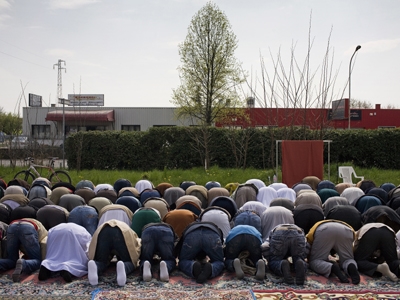
Hidden Islam - Islamic makeshift places of worship in north - east Italy, photographs and slide show (2009-11)
Courtesy of the artist

The artists Selma Alaçam (born 1980, lives and works in Karlsruhe, Germany) and Nicolò Degiorgis (born 1985, lives and works in Bolzano, Italy) analyse within their work the crucial subject matter of the relationship between Islamic culture and contemporary Western culture as it exists in Europe. How informed is mainstream public opinion in Europe about Islamic immigration to the European continent, and about the perspectives on integration of the people who actually come from Muslim countries? Moving from the particular matters of their own cultural perspective, Alaçam and Degiorgis develop individual strategies for their artistic research, with both following the common goal of emphasizing a wide range of elements which are suppressed within the public debate in Europe. In this way, both artists contribute to an increasingly complex and articulated reflection on the subject matter which they deal with.

NICOLO DEGIORGIS
Nicolò Degiorgis
Hidden Islam - Islamic makeshift places of worship in north - east Italy, photographs and slide show (2009-11)
Courtesy of the artist


Hidden Islam (2009-2011) is a photographic project by NICOLO DEGIORGIS, an investigation of Muslim prayer rooms spread all over Northern Italy. Degiorgis' work began as participation within a research project on the instruments and methods of multicultural integration conducted by the University of Trieste. Degiorgis took photographs of the improvised prayer rooms in which the Muslims in contemporary Italy exercise their faith, i.e. spaces found at the outskirts of big cities, abandoned and precarious locations such as former garages and industrial buildings. The photographic selection chosen by the artist connects specific private and cultual details of Islamic religiosity with images that document the diasporic nature of Italian Islam during recent years. Here, precariousness and decline become characteristics of survival, as the iconic signs of an anonymous and hostile metropolitan area. Thus, Degiorgis shows photographic images that are configured much like complex texts, in which the nullification of the architectural and urbanist context of the periphery of Italian cities appears to be subjected to the possible sense of relief determined by the rise of a different and migratory culture – such as the Islamic culture – which nowadays is present across the entire national territory. These images are consistently framed by liturgical scenes of prayers conducted within the places photographed. Breaks of light and improvised details of the image narrate the physical presence of the prayer, the moment of unification and consistency of the collective history of the Muslim communities in Italy. In this way, Hidden Islam traces another complex and problematic picture of contemporary Italy, and reveals the difficulties of this country to conceive itself as a contemporary society that has completely developed a sense of civil progress. 

SELMA ALACAM
Selma Alaçam
Istiklal Marsi / Turkish National Anthem (2010)
DVD loop; 4:28 min
source: YouTube
Courtesy of the artist

The work of SELMA ALACAM is focused on the question of identity. Within her work, the artist analyses in many ways her relationship to her own history as a dual citizen of Germany and Turkey who has grown up in Germany according to the educational models of Islam. Using family documents, ready-mades and self portraits, the artist employs a range of conceptual instruments that deal with a sort of reflection, not far removed from feminism, on the role of identity and social history.

Isolated and Protected (2009) is a video installation consisting of seven monitors on which the artist shows domestic scenes of Turkish Muslim families in Germany. Nonetheless, the visibility of the screen is obstructed by patterns on a curtain which veils the screen. The decorative patterns follow the Arabic tradition of applying them on the outside of windows of private homes in order to protect the residents from being visible to onlookers outdoors. The spectator therefore has only limited and partial access to what is happening, an interrupted visibility that “isolates and protects” the image from the gaze of strangers. In this way it is also a symbol of the complex system of communication and cultural exchange between Western and the Islamic societies in contemporary Europe. 

The video work Haare (2009) also intervenes with a similar aspect, with the artist here showing herself as she combs her hair. At the end she puts a wig on her head which is identical to her own hair. The scene shows a strategy used by many young Turkish women in order to remain loyal to Islamic interdict (which forbids women to show their own hair) while at the same time refusing to abandon the ambition to dress up. The gesture of the artist alludes in this way – quite ambiguously and without direct comment – to a possible modernisation inside Islam as it exists in Europe, and to a young generation of Muslims that are challenged to re-conceive the rules of their own religion in order to participate in Western life.

SELMA ALACAM
Selma Alaçam
Istiklal Marsi / Turkish National Anthem (2010)
DVD loop; 4:28 min.
source: YouTube
Courtesy of the artist

The video work Turkish National Anthem (2010) shows the political sensibility of the artist. It consists of video fragments the artist downloaded from YouTube which display some Turkish children in various private and public contexts while they sing with great emphasis and emotion the national anthem of their country. Left with no comments or alterations, the work provokes a restless sense of discomfort and unease in the spectator, because the national anthem appears as an aggressive instrument, a model of division between those who can identify themselves with it and those who are excluded.

Free entrance

Support: Provincia Autonoma di Bolzano, Alto Adige, Deutsche Kultur
Fondazione Cassa di Risparmio, Alto Adige
Città di Bolzano, Ufficio Cultura

AR / GE KUNST
GALERIE MUSEUM
Via Museo 29
39100 Bolzano
ITALY

www.argekunst.it

02/04/11

Photographs and Drawings from the Galleria Civica Modena Collections

THE GALLERIA CIVICA DI MODENA COLLECTION: PHOTOGRAPHS AND DRAWINGS FROM THE COLLECTIONS
3 April - 17 July 2011 

Davide Tranchina, Gorilla, 2000, 
from the series “Safari metropolitano” (Metropolitan Safari)
Donated to the Galleria Civica di Modena Photography Collection. 
Courtesy of the Galleria Civica di Modena.

On Saturday 2nd April 2011 at 6pm the Galleria Civica di Modena will inaugurate a long-term project aimed at displaying the photographs and drawings of the permanent collections in turn and on a regular basis. Until the 17th July the Sala grande and the Sale superiori of the Palazzo will in fact feature the first display of the collections, organised and co-produced by the Galleria Civica di Modena and the Fondazione Cassa di Risparmio di Modena. 

The Sala grande will host a selection of photographs showing broad views and tiny glimpses of Modena captured throughout the second half of the 20th century by great photographers such as Olivo Barbieri, Gabriele Basilico, Luigi Ghirri and Mimmo Jodice. A number of works from a set of 50 images (part of a major photo shoot on the city in 2009) donated by Jodice to the Galleria Civica di Modena Collection will also be presented here for the first time.

The exhibition then continues with a selection from the 1200 black & white images (which also only recently became part of the Collection), part of Franco Vaccari’s project “C’ero anch’io”, presented on the occasion of the solo exhibition dedicated to the artist in 2007, held between the Palazzina dei Giardini and the Fotomuseo Giuseppe Panini. Among the artists chosen for this show there is also Franco Fontana, the donator of the main corpus of the Collection itself, and who on this particular occasion has donated four of his own personal visions of 1970’s Modena.

From the series “Safari Metropolitano”, (1998-2000), Davide Tranchina has picked out three images that offer an estranging and at the same time ironic vision of the urban outskirts, to be donated to the Gallery.

In the Sale superiori, works on paper by Modenese artists will be displayed, artists whose careers are documented within the Drawing Collection, from the early 20th century right up to the present day. The entrance chamber hosts works in the collection by artists such as Davide Benati, Carlo Cremaschi, Giuliano Della Casa, Franco Guerzoni, Giovanni Manfredini, Wainer Vaccari, right up to Andrea Chiesi and Roberto Cuoghi. The second room, instead, is dedicated to artistic figures who have acquired a historic standing, such as Nereo Annovi, Vittorio Magelli, Mario Molinari, Tino Pelloni, Enrico Prampolini, Pompeo Vecchiati and Mario Venturelli. 

The last two spaces will be given over to Lucio Riva and Gianni Valbonesi, to whom a tribute will be paid – thanks to the heritage of the Collection and the new purchases – in the light of the thorough and coherent artistic activity which he has carried out over the course of the last half century.

GALLERIA CIVICA DI MODENA
La collezione della Galleria Civica di Modena: fotografie e disegni dalle Raccolte 

Palazzo Santa Margherita 
Corso Canalgrande 103 
41121 Modena 


19/02/11

Roberto Capucci' Exhibition - PMA - Philadelphia Museum of Art

Roberto Capucci: Art into Fashion 
Philadelphia Museum of Art 
Curator: Dilys Blum 
March 16, 2011 - June 5, 2011 


PHILADELPHIA MUSEUM OF ART TO PRESENT 
THE FIRST US EXHIBITION OF WORKS BY ROBERTO CAPUCCI

Roberto Capucci, a master of color, form, and innovative silhouettes, was one of the founders of modern Italian fashion in the early 1950s. Today, after six decades of creative achievement, he remains one of Italy’s most influential and imaginative artist-couturiers. Roberto Capucci (b. 1930) captured the attention of the international press at an early age, drawing praise from designers such as Christian Dior when he was still a teenager. His work has appealed to Italian aristocrats like the noblewoman Maria Pace Odescalchi, Italian actress Elsa Martinelli, whom he helped project to fame, and American actresses Marilyn Monroe, Esther Williams, and Gloria Swanson. Today, Capucci fascinates and inspires contemporary designers such as Ralph Rucci, who admires Capucci’s dedication to the purity of his art. 

Covering his couture designs from the 1950s to his recent sculptures, ROBERTO CAPUCCI: ART INTO FASHION (March 16 - June 5, 2011) is the first major survey of his work in the United States. It is organized by the PHILADELPHIA MUSEUM OF ART and the FONDAZIONE ROBERTO CAPUCCI in Florence and will be seen only in Philadelphia.
Timothy Rub, The George D. Widener Director and CEO of the Philadelphia Museum of Art, stated: “Roberto Capucci breaks down the boundaries between art and fashion. The architectural and sculptural quality of his work, his innovative techniques and his extraordinary use of color will have exceptionally wide appeal to those interested in style and design.”
“Capucci is what every designer aspires to be—an artist who is true to himself,” added Dilys Blum, the Jack M. and Annette Y. Friedland Senior Curator of Costume and Textiles at the Museum. “While he was considered an international ‘boy wonder’ during the 1950s, creating wonderfully exciting pieces in the aesthetic tradition associated with the work of Cristobal Balenciaga and Charles James, he ultimately chose to leave the commercial world to pursue interests that went well beyond fashion. In his work one can see the pure joy of creativity.”
Capucci frequently finds inspiration in nature, sculpture and architecture. He considers his dresses to be “habitats” and thus does not restrict his work to the shape of a woman’s body.

Roberto Capucci: Art into Fashion is comprised of nearly 90 works spanning the artist’s career, with supplementary film clips and historical photographs that document the parallels between his designs and the Italian fashion world. The exhibition will trace Capucci’s artistic career chronologically, from his discovery in 1951 to his sculptures from 2007. Early works include a cocktail dress with train from 1952-1953, and the Rosebud dress from 1956, as well as the iconic Nine Dresses (1956), inspired by the rings of water produced by tossing a stone. His revolutionary box silhouette—shaped with four seams instead of the usual two—represented a bold departure from the traditional fitted form of the period and garnered him the prestigious Filene’s Fashion Award in 1958. The international press declared him to be Italy’s best designer and the New York Times lauded his “vigor, imagination, and uninhibited originality.”

BRIEF BIOGRAPHY OF ROBERT CAPUCCI 

Roberto Capucci was born in Rome in 1930 and studied at the Accademia delle Belle Arti. He briefly worked as an apprentice to the designer Emilio Schuberth and opened his first atelier in Via Sistina in Rome in 1950, moving to Via Gregoriana in 1955, where he remains today. During this time, Capucci was introduced to Giovan Battista Giorgini, a buying agent for high-end American department stores who became his champion. Giorgini organized the first Italian high-fashion show in Florence in 1951 and continued to produce shows until 1965. Capucci presented his first collection in the second of Giorgini’s fashion shows in July 1951.

From 1962 to 1968, Capucci presented his collections in Paris to much acclaim and was praised for his inventive use of plastic, his Op Art-inspired designs made from woven ribbons (the 1965 Optical dress) that paid homage to the artist Victor Vasarely, and embroidered evening dresses that glowed in the dark. Upon his return to Rome in 1968, Capucci continued his experimentation with commonplace materials such as raffia, wire, and stones in the tradition of the Italian Arte Povera movement of the same period. In 1978, he created the white satin Colonna dress, modeled after a Doric column. The dress represented a key turning point in Capucci’s career, as he started to explore the idea of dress as actual sculpture. The exhibition will contain dramatic sculpture dresses from the 1980s and early 1990s, such as the intricate Bougainvillea (1989) that reveal the striking use of pleating and exploration of color and form that are now his signature.

As he continued to explore new directions in the use of line, color, texture, and volume, Capucci refused to compromise his vision in the service of purely commercial concerns, and in 1980, he resigned from the Italian couture system. Instead, he presented a singular collection each year in a different city including Tokyo, New York, and Berlin. Since 1992, he has continued to conceive and exhibit unique sculptures, including a landmark series presented at the 1995 Venice Biennale. Among the works on view will be the series of eight dress sculptures, Return to Origins: Homage to Florence, from 2007.

ROBERTO CAPUCCI ART INTO FASHION
Exhibition catalogue, Roberto Capucci: Art into Fashion (ISBN 978-0-87633-229-0; $50), written by organizing curator Dilys Blum, consists of 210 pages with 22 black-and-white illustrations and 182 color illustrations. Cloth cover binding. 

This exhibition is organized by the Philadelphia Museum of Art and the Fondazione Roberto Capucci, and funded by The Women's Committee of the Philadelphia Museum of Art, The Pew Charitable Trusts, The Annenberg Foundation Fund for Exhibitions, the Robert Montgomery Scott Fund for Exhibitions, and The Kathleen C. and John J. F. Sherrerd Fund for Exhibitions.. Additional funding is provided by The Wyncote Foundation as recommended by Frederick R. Haas and Daniel K. Meyer, M.D., Barbara B. and Theodore R. Aronson, Mr. and Mrs. Jack M. Friedland, and Martha McGeary Snider, and by members of Le Capuccine, a group of generous supporters including Marla Green DiDio, Mr. and Mrs. Robert A. Fox, and Mrs. and Mrs. Bernard Spain. Promotional support is provided by NBC 10 WCAU.

PHILADELPHIA MUSEUM OF ART 
Benjamin Franklin Parkway at 26th Street 
Dorrance Special Exhibition Galleries 

www.philamuseum.org

18/02/11

Maria Cristina Carlini' Sculptures in Miami

Exhibition: Maria Cristina Carlini. Miami. 
Sculpt Miami park 
Dade College, Miami International Sculpture Park  
Miami Beach Botanical Garden  
Coral Gables Museum 

It has been postponed till February 28, 2011 the exhibition entitled 
MARIA CRISTINA CARLINI. MIAMI. 


This new stage for the creativity of Maria Cristina Carlini, who, accepting the invitation of the city of Miami, has brought her monumental works to the attention of the public in Florida with several events that highlight not only her production but also her own personality as an artist.

Inaugurated on November 30 as  part of the art show Sculpt Miami 2010 - a side-event of Art Basel Miami Beach – the exhibition goes ahead in full autonomy sustained by the excellent interest shown by art lovers and collectors who till December 5 have been packing the numerous appointments of the fair.

The exhibition is held in four prestigious locations. In the former exhibition park of Sculpt Miami in Wynwood art district are placed two imposing corten steel sculptures: Gran Via,  wonderful alternating volumes along perpendicular and diagonal lines that play with space and void and La Vittoria di samotracia (The winged Victory of Samothrace - about 3 metres high), with the vigor of her forward-thrusting body representing the young goddess Nike, daughter of Zeus. 

MARIA CRISTINA CARLINI. MIAMI
Maria Cristina Carlini 
La Vittoria di Samotracia, 2008 
corten steel, 280 x 200 x 70 cm
Photo © AstudioF


The renown Miami Dade College, the largest university in Florida, which this year celebrates the 50th anniversary of its opening, hosts in its Miami International Sculpture Park Isole (Islands), a perfect marriage between the ductility of the clay and the solidity of the corten steel (300x150x20 cm).

MARIA CRISTINA CARLINI. MIAMI
Maria Cristina Carlini
Isole, 2010
acciaio corten e creta, 300 x 150 x 200 cm
Photo © AstudioF

Inside the luxuriant Miami Beach Botanical Garden the sculpture Mistero (Mystery) finds its ideal location and the birch trunks coming out from the corten steel elements find a true link to the surrounding setting. 

MARIA CRISTINA CARLINI
Maria Cristina Carlini 
Mistero, 2008 
corten steel, birch trunks, 350 x 170 x 20 cm
Photo © AstudioF


At Coral Gables Museum stands Maria Cristina Carlini's sculpture Icaro (Icarus), whose pierced corten steel lightens its massive structure calling to mind the flight.

MARIA CRISTINA CARLINI
Maria Cristina Carlini 
Icaro, 2009 
corten steel , 280 x 250 x 130 cm
Photo © AstudioF


For this tireless artist, it is essential to be given the opportunity to exhibit her sculptures in public places. As it has often been stressed when commenting on the ‘en plein air’ exhibitions of Maria Cristina Carlini’s works, her “culture making”, as well as having aesthetic and artistic implications, is aimed to interact and relate – even psychologically - with the surrounding environment.

Power and materiality are the main features of the monumental works of Maria Cristina Carlini. The Milanese sculptress, always looking for an expressive means and for spontaneous chromaticity, goes far beyond sculpture meant as celebration. 

From quite some time now the artistic development of sculptor Maria Cristina Carlini has enjoyed a breath and echo at the international level, and 2010 proved to be a very significant year for the artist and his art.

A BRIEF BIOGRAPHY OF MARIA CRISTINA CARLINI

Maria Cristina Carlini started working ceramics in the early Seventies in Palo Alto, California. She returned to Europe in 1978. In 1983 she held a solo exhibition in the Rocca Borromea, a Fortress located in Angera.

During the artistic activity of Maria Cristina Carlini, exhibitions in numerous international public and private venues, including the following solo exhibitions: in Rome at  the State Archives; Turin, in the monumental complex of the Royal Palace and at the National Museum of Villa Pisani in Strà-Venice; at the National Library of Cosenza and at the State Archive of Milan.

In 2009 the city of Paris housed her monumental sculptures in the Mairie of the 5th Arrondissement and in the streets of the historic centre. In Loreto she holds a solo exhibition and in Spain several monumental sculptures are housed in the streets of Madrid. In the same year at Guggenheim Collection in Venice there is the presentation of her monograph Maria Cristina Carlini.

In 2010 in Reggio Calabria is held a solo exhibition of her works in the Aragonese Castle and along the promenade. 

On the occasion of the celebrations for the 40th anniversary of the diplomatic relations between Italy and China, her monumental work Viandanti (Wayfarers) was installed permanently in front of the Italian Embassy in Beijing. Always in Beijing, in the  Forbidden City, the solo exhibition “Colloquio tra giganti” (“A Talk amongst Giants”) is inaugurated. Maria Cristina Carlini is the first contemporary sculptress to exhibit in the imperial complex.

On the occasion of the 4th Art Biennial of Beijing her corten steel sculptures, Dancers, is exhibited for the first time. Maria Cristina Carlini is then in Shanghai with two of her monumental sculptures in conjunction with the World Expo 2010. 

In the same period her works are exhibited in Denver, USA and in Cap D’Agde in Southern France.

Her production has been followed by prominent curators and art critics, such as Luciano Caramel, Gillo Dorfles, Yacouba Konatè, Elena Pontiggia.

Some of Maria Cristina Carlini’s large scale sculptures are permanently set in the following places: City Museum of Pesaro, Central State Archive in Rome Eur, Court of Auditors of Milan, new establishment in Rho of Milan International Fair, Pizza dei Valdesi in Cosenza, Paris, Gardens of Porta Marina in Loreto, on Italo Falcomatà Promenade of Reggio Calabria, in the Chinese cities of Beijing, Jinan and Tianjin and in the USA, Denver.

29/12/10

Ghirlandaio: A century-long artistic saga - The Ghirlandaio Family. Italian Renaissance Painters in Florence and Scandicci

The Ghirlandaio Family
Renaissance Painters in Florence and Scandicci
Castello dell’Acciaiolo, Scandicci – Italy
Through May 1st, 2011

ghirlandaio_title

ghirlandaio_image


Always used in the singular, Ghirlandaio is actually the trademark of the dynasty of such artists and entrepreneurs, who, beginning in the second half of the 15th century, dominated the scene of the Florentine Renaissance for a century. DOMENICO GHIRLANDAIO (1449-1494) was therefore the first artist in the Ghirlandaio family of which were also part his brothers DAVID GHIRLANDAIO (1452-1525) and BENEDETTO GHIRLANDAIO (1458-1497), his half-brother GIOVAMBATTISTA, his brother-in-law BASTIANO, and his son RIDOLFO GHIRLANDAIO (1483-1561). Numerous artists who were apprenticed to their school (MICHELANGELO and GRANACCI being the most renowned) contributed to spreading in Italy and Europe their fame as masterly illustrators of Florence and its civitas.

The Ghirlandaio’s workshop was above all a place with extraordinary professionals - very productive and organized according to modern criteria as to skills and roles - where Domenico and Ridolfo were the true creative masters of colour, some were extremely good at painting, and others besides expert in the workshop management.

Such a well-balanced, prolific and long-lived clan is now the focus of an extremely important exhibition, the first one on the family in its entirety, which involves the whole area from Florence to Scandicci as well as various other places in the hinterland. It is the land where the Ghirlandaio family lived and worked, rarely leaving it, disseminating it with masterpieces, so much so as to turn it into a spectacular and diffused museum.

Hence the title of the event: The Ghirlandaio Family. Renaissance Painters in Florence and Scandicci. The venues: the Castello dell’Acciaiolo in Scandicci, showcasing 15 works of art. From here visitors may follow a double itinerary leading them to large and small museums, palazzos and churches, villas and abbeys which house dozens of panel paintings, altarpieces and frescoes. Works which have mainly a religious character and represent the Madonna and Child, the nativity, the annunciation, but which also include portraits and figures that document the Florence of that time.

This implies that the exhibition is made up of a series of exhibitions and venues, ascribable to two well-known cultural projects: that of the Città degli Uffizi, conceived by Antonio Natali, director of the famous gallery, to showcase the immense artistic heritage kept in the Uffizi store rooms and promote the beautiful areas around Florence, and the Piccoli Grandi Musei one organized by the Ente Cassa di Risparmio di Firenze with an expert committee presided over by Antonio Paolucci, which has the aim of promoting the artistic and monumental heritage of the Florentine area.

It was in honour of the Ghirlandaio family that the two aforementioned projects merged. The initiative is promoted by the Special Office for Monuments and Fine Arts of the Polo Museale Fiorentino, the Uffizi Gallery and the Municipality of Scandicci, along with the Ente Cassa di Risparmio, the Regional Office for the Cultural and Landscape Heritage of Tuscany, the Monuments and Fine Arts Office of the metropolitan area (Florence-Pistoia-Prato), the Provincial Administration of Florence, the Municipality of Florence, and the Romualdo del Bianco Foundation. It is under the sponsorship of the Ministry of Cultural Heritage and Activities and involves the collaboration of the Tuscan Regional Administration, the Opificio delle Pietre Dure, the municipalities of Calenzano, Campi Bisenzio, Sesto Fiorentino, Signa and Lastra a Signa. The catalogue is published by Polistampa.

As it is known, the true surname of Domenico Ghirlandaio was Bigordi, and he and his brothers ended up being identified with the nickname of their father, an excellent goldsmith renowned for his special skill in making garlands (ghirlanda in Italian). From Scandicci, their homeland, they moved to Florence in the first half of the 15th century, and in this town, which was then the world capital of art, their workshop became established in the second half of the century. The exhibition tour starts from Scandicci. Curated by the art historian Annamaria Bernacchioni, the exhibition at the Castello dell’Acciaiolo showcases a famous painting by Domenico Ghirlandaio (Saints James, Stephen and Peter), the beautiful Madonna by Ridolfo Ghirlandaio (from the Fuligno Refectory) and another 14 works loaned by various museums in Florence.

From here two different Ghirlandaio exhibition tours start. The one in Florence includes the frescoes in the Sala dei Gigli of the Palazzo Vecchio, the Sassetti Chapel and the Tornabuoni Chapel - respectively in the churches of Santa Trinita and Santa Maria Novella - and the Adoration of the Magi at the Museo degli Innocenti. Numerous other masterpieces by such artists are in the Uffizi Gallery, the Accademia Gallery, the Palatine Gallery and in the Ognissanti and San Marco Refectories, all of which are to be visited even though not part of this specific programme.

The other tour is in the area north-west of Florence, on both sides of the Arno, abounding in works of art that the Ghirlandaio family left behind: in the houses which belonged to the family in San Martino and Colleramole, in the millenary Settimo Abbey, in the Church of Sant’Andrea in Campi Bisenzio, in the Sacred Art Museums of San Donnino and San Martino a Gangalandi. And also Mosciano, Giogoli, San Martino alla Palma, and San Colombano.

A fascinating journey in the Florentine Renaissance.

www.ghirlandaio.it

11-21-2010 / 05-01-2011

17/12/10

Matteo Basile - ThisHumanity Exhibition at Galleria Pack, Milan, Italy before the SAM, Singapore


Matteo Basilé, ThisHumanity 
Galleria Pack, Milan, Italy 
Through January 29, 2011 

MATTEO BASILE, From THISHUMANITY exhibition
Courtesy Galleria Pack, Milano, Italy

Galleria Pack in Milan is hosting an exhibition by MATTEO BASILE entitled THISHUMANITY, inspired by one of the foremost masterpieces of late Gothic Florentine artwork, The Battle of San Romano by PAOLO UCCELLO (1397-1475).

The exhibition includes 10 large-scale photographs by the Roman artist inspired by the famous triptych Paolo Uccello was commissioned to paint in 1438 by the Barolini Salimbeni family in order to commemorate the Florentine victory over troops from Siena allied with Milan that took place on April 1, 1432.

In the Florentine painter’s artwork everything appears frozen in place, ready for the final act. It was precisely this “image capture,” subdivided into three different moments, that inspired Matteo Basilé to create the subsequent frame, in other words the physical clash between its peoples and imaginary armies. In The Battle of San Romano, Paolo Uccello experimented for the first time ever with techniques in perspective that were revolutionary for his day, creating multiple visions within the same scene. The artwork THISHUMANITY is put together following the same rules of perspective employed by the fifteenth-century painter, this time created using postproduction digital photography techniques.

Faithful to his expressive intent, Basilé is creating the sets within which this great battle will be set directly in South East Asia. The artist has lived and worked there for some time now, and has been able to involve a multitude of identities and female characters ready for the clash.

Women are the protagonists of Basilé’s work – their fight for their own identities and independence – connecting two artworks divided by centuries; a female universe ready to take to the field for a world dominated by men. It is a sort of The Rape of the Sabine Women in reverse, in which rather than being raped, the protagonists fight to reveal and protect their own identities. It is a purifying battle in which women of different races and with different pasts face their enemies down in a fight to the last breath in order to escape a destiny that makes them increasingly resemble the opposite sex.

Following the show in Milan, Thishumanity will be put on display in SAM, the SINGAPORE ART MUSEUM.

MATTEO BASILE, From THISHUMANITY exhibition
Courtesy Galleria Pack, Milano, Italy


MATTEO BASILE BIOGRAPHY

Matteo Basilé (Rome, 1974) debuted in 1997, when he was just 23 years old, with a solo show at the Il Ponte Contemporanea gallery in Rome. His artworks have been exhibited in some of the most important art venues in Italy and abroad. He won the New York prize in 2002. In 2007, Basilé had his first solo show in an Italian art institution: the MART in Rovereto. In 2009, he was among the artists selected for the Italian Pavilion at the 53rd edition of the Venice Biennale.

Matteo Basilé is considered one of the foremost protagonists of European digital art. For the past decade he has been blending digital culture with classical iconography, re-inventing the portrait. The artist uses digital photography in order to develop and expand his personal code for contemporary painting, utilizing the computer as linguistic prosthesis in order to expand each vision and lend depth to the splendid surfaces of his artworks. Basilé’s world is an iconographic universe extending between technological mannerism and artistic surrealism. In his case, these two historic art movements mark a novel use of citation that tends towards synthesis and the affirmation of art as a meta-language.

Captured within the digital frame, his subjects become timeless icons. Marks traced upon their skins recount the geography of intimate memories. It is the face understood as voyage, memory as the warehouse for that which Basilé defines as the “archive of the soul.” His collection of faces and bodies tells the tale of a humanity dear to the artist. Women, children, men and the elderly are catapulted into the artist’s timeless imagination with the goal of passing on a three-dimensional verb capable of uniting painting with cinema, writing with material, photography with sound, and scenic space with an audience.

Basilé tests, manipulates and synthesizes his subjects’ DNA, transforming them into martyrs and saints within a world parallel to our own. Startling beauty and marvelous ugliness are blended together within the digital era. Reality and fiction travel side-by-side, ultimately blossoming into a new collective imagination.

CATALOGUE: THISHUMANITY is accompanied by a catalogue published by Damiani Editore (Bologna). The catalogue includes all the artworks from the exhibition, backstage images from the set in Bali, and several texts about the project and Matteo Basilé’s opus.

GALLERIA PACK 
Foro Buonaparte 60
20121 MILAN, ITALY


11-23-10 / 01-29-11

30/11/10

Angelica Porrari, Nude Rovine Exhibition in Modena, Italy

Area Progetto Off, Galleria Civica, Modena, Italy  
Angelica Porrari,
Nude Rovine
Antonio Delfini Library, Modena
4 December 2010 - 6 March 2011

 angelica_porrari

ANGELICA PORRARI, NUDE ROVINE, 2010, (detail from the installation). Courtesy of the artist and Galleria Civica, Modena


An installation by artist Angelica Porrari will be inaugurated on Saturday 4th December at 6pm at the Delfini Library in Modena (Italy). The vernissage of this exhibition marks the begining of the new Area Progetto season – an event dedicated to young emerging creativity promoted by the Galleria Civica di Modena in collaboration with the Ufficio Giovani d'Arte of Modena City Council – curated by Silvia Ferrari, Serena Goldoni and Ornella Corradini.

Now at its third edition, the initiative this time changes formula, taking the creativity of young local artists into spaces external to the Galleria Civica, through the creation of projects designed especially for key sites around the town centre, such as the marketplace in via Albinelli or the public gardens. Yet the first stage is the Delfini Library, based in Palazzo Santa Margherita, the historic building which is also home to the Galleria Civica itself.  A selection of artists from the Archivio di Documentazione Giovani Artisti Modenesi – chosen on the basis of the quality and continuity of their work – were asked to plan a site-specific work which would dialogue with the large and articulate spaces of the library rooms.

The winning project was that proposed by the Modenese videomaker Angelica Porrari. The artist turned her attention to the fragments of frescoes still found in the lunettes of the room used as the children’s library, giving her own interpretation of the subjects, their actions and gestures. Through the use of an original linguistic code, she created a bridge between the ancient and the contemporary, through a space/time shift that the artist also grasped in the evolution of the library itself.

The project, entitled Nude Rovine, will consist of a video and a series of photographs, the result of her reappraisal of the frescoed images, the same shape and size as the ancient lunettes, installed in a space of the same dimensions inside the various vaults of the library ceiling, providing a kind of counterpoint to the originals.

The work proposed is part of the artist’s Gloves' Stories, a broader project which came to light in 2006 and which brings together Angelica Porrari’s entire video production, which focuses on the theme of the glove: an object which speaks of the relationship between the body – the female body in particular – and the outside world.

ANGELICA PORRARI BIOGRAPHY

Angelica Porrari was born in 1985 in Modena, where she lives and works. Her research is developed largely through the use of video while being strongly influenced by performance and theatre. She gained a diploma in Advertising Graphics at the Istituto d'Arte of Modena and then a degree in painting from the Academy of Fine Art of Bologna. In 2009 she came in for special mention at the Special competition (promoted by the Fondazione Cassa di Risparmio of Modena), going on to win the section of the competition dedicated to artists from Emilia Romagna in 2010. Angelica Porrari has taken part in a range of group shows, including: Finalisti Premio Celeste, ISA, Rome (2007); Videoart Yearbook 2008, ex Convent of Santa Cristina, Bologna; Galleria Civica d'Arte Contemporanea, Trento; Festival d'Images Artistiques Video, Ecole des Beaux Art, Algiers (2008); Diari di Anatomia, Gemine Muse, Musei Anatomici, Modena; Biennale dei Giovani Artisti dell'Europa e del Mediterraneo, Skopje, Macedonia (2009); The Scientist, festival di videoarte internazionale, Ferrara (2010).

The project is accompanied by an exhibition brochure with a critical text by Serena Goldoni and colour images of the work.

Angelica Porrari’s installation has been realised in collaboration with the Libraries Service of Modena City Council. The exhibition is open to the public on Mondays from 2pm to 8pm and from Tuesday to Saturday from 9am to 8pm.

ANTONIO DELFINI LIBRARY
Palazzo Santa Margherita
corso Canalgrande 103
41121 Modena, Italy

GALLERIA CIVICA of MODENA

www.galleriacivicadimodena.it