Showing posts with label art exhibition Italy. Show all posts

01/12/13

Architecture photographs and drawings from the Galleria Civica di Modena, Italy

MACHINES FOR LIVING. ARCHITECTURE PHOTOGRAPHS AND DRAWINGS FROM THE GALLERIA CIVICA DI MODENA COLLECTION
Galleria Civica di Modena, Italy
Through 26 January 2014 


MARYLIN BRIDGES
Chrysler Building, N.Y, 1988
Raccolta della fotografia, Galleria civica di Modena
© Marilyn Bridges

The Galleria civica di Modena in Italy presents around 100 works, including paper-based drawings and (often Utopian) architectural projects, along with images of finished architecture as represented by the photographic medium. The exhibition was created entirely using materials to be found in the Gallery’s own collections. 

Studies of single buildings along with urban visions have been selected from the Gallery’s heritage so as to offer an overview of some of the most important representatives of contemporary architecture and its various interpretations by photographers from around the world. 

ANDRE KERTESZ
Puddle, New York, 1967
Raccolta della fotografia, Galleria civica di Modena
© Estate of André Kertész

The drawings (more than 80 works) include sheets by great 20th-century architects such as Carlo Aymonino, Andrea Branzi, Guido Canella, Paolo Portoghesi and Aldo Rossi, as well as figures bound in particular to the Emilian territory, such as Cesare Leonardi (7 unreleased works) and Tullio Zini, to whom two special sections of the exhibition are dedicated, further enhanced by recent donations. Furthermore, great space is also given over to the major Ico Parisi drawing set, from which sketches for three major architectural projects have been taken: 10 sheets from the series ‘I grattacieli’, preparatory studies for the façade of the Guggenheim Museum in Venice and for the town-planning project “Operazione Arcevia”.

Glimpses of the city or of single buildings are the subjects featured in the photographs from the Photography Collection: more than 40 works by a range of different authors, not all of whom dedicate their attention entirely to architecture. Along with the ‘specialists’, there are in fact photographers who address their images simply as an ‘everyday space’, setting up a dialogue and interpreting it from new points of view. 

FRANCO FONTANA
Los Angeles, 1990
Raccolta della fotografia, Galleria civica di Modena
© Franco Fontana

LUIGI GHIRRI
Il cimitero di Modena, 1983
Raccolta della fotografia, Galleria civica di Modena
© Eredi Luigi Ghirri

The exhibition include shots by italian photographers Franco Fontana, Luigi Ghirri, Olivo Barbieri, Mimmo Jodice, the duo Andreoni-Fortugno, Marco Zanta, the architects Paolo Portoghesi and Ico Parisi. On the international side works by André Kertész, Marylin Bridges, Lewis Baltz, Reinhart Wolf, Naoya Hatakeyama and Jun Shiraoka are exhibited. 

The exhibition also feature the projection of 400 shots taken from the photographic census of the historic town centre of Modena commissioned from Paolo Monti in 1973, heritage of the Library of civic art and architecture "Luigi Poletti" in Modena. 

The exhibition is curated by Francesca Mora and Gabriella Roganti, promoted and organised by the Galleria civica di Modena and the Fondazione Cassa di Risparmio di Modena, with support from the Culture Councillorship of the Emilia-Romagna Regional Council.

Galleria Civica di Modena
Palazzina dei Giardini, corso Canalgrande, Modena, Italy
www.comune.modena.it 

21/06/13

Candida Höfer at Galleria Borghese, Rome

Candida Höfer at Galleria Borghese
Galleria Borghese, Rome 
20 june - 15 september 2013

The Special Bureau for Artistic and Ethnoanthropological Historical Heritage and for Rome’s Museum Network presents the CANDIDA HOFER AT GALLERIA BORGHESE exhibition. 

The famous Galleria del Lanfranco hosts seven works by the great artist portraying the original reconstruction of the Borghese collection, which was restored to its origins during the I Borghese e l’Antico exhibition (December 2011 – April 2012, curated by Anna Coliva and Marina Minozzi for Galleria Borghese and by Jean-Luc Martinez and Marie Lou Fabréga-Dubert for the Louvre) which brought back to the Gallery the most important ancient art masterpieces that once belonged to the collection, mostly collected by Cardinal Scipione Borghese at the beginning of the Seventeenth century and currently making up the core of the Paris Louvre Museum antiques collection, following the sale imposed by Emperor Napoleon Bonaparte on his brother-in-law Camillo Borghese in 1807. 

Candida Höfer’s work therefore represents the only existing evidence of the collection in its original set-up, which will never be replicated again: some kind of miracle that will never repeat itself. The underlying concept of the exhibition is that out of the reconstruction of an art masterpiece such as the Galleria Borghese collection in its original makeup, another work of art was created. 

In that occasion Candida Höfer – known for her incomparable way of perceiving places and reproducing them through her camera – had therefore documented the mounting of the exhibition halls through the photos that are now in display in their original location, the Galleria itself. 

The exhibition curated by Mario Codognato, Anna Coliva and Marina Minozzi is an exceptional, unique event and will enable visitors to virtually walk through the halls of “The most beautiful villa in the world” - Antonio Canova’s definition - and experience the fascinating atmosphere generated by the exceptional return to their place of origin of the masterpieces of one of the most distinguished and prestigious archaeological collection of all times.

CANDIDA HOFER EXHIBITION
The seven large-size photos – roughly 180 x 200 centimeters – exhibited in the Lanfranco Hall, portray the Villa and reproduce the setting up of the seventeenth and eighteenth century, when sculptures belonging to the celebrated Borghese archaeological collection were still displayed in the Museum halls, in a charming sequence of images. 

Masterpieces such as The Three Graces and The Sleeping Hermaphroditus feature in Candida Hofer’s photos alonside masterpieces of modern sculpture, such as the The Rape of Proserpina by Gian Lorenzo Bernini and the famous Pauline Bonaparte as Venus Victrix by Antonio Canova.

However, the true protagonists of these pictures are not only these extraordinary sculptures but also the Galleria as a whole: its history, its furniture, its works: all these elements make Candida Höfer’s photographs unique and the exhibition a one-off opportunity.

Candida Hofer’s photos stir up emotions thanks to their historical background, their perspective and the brightness of the place itself, defining its original aspects and raising the images to an eternal, absolute dimension.

The exhibition has been organised by Galleria Borghese thanks to Telecom Italia’s support and with the cooperation of Arthemisia Group. The exhibition has also been sponsored by Borghi Italia – Art Division, Axa Art, Arte Assicurazioni srl, Parco dei Principi Grand Hotel and Spa.

THE ARTIST CANDIDA HOFFER
Candida Höfer features among the most relevant artists of German contemporary photography. She was born in Eberswalde, Germany, in 1944 and is a leading exponent of “the School of Dusseldorf”.  She started her artistic career in 1975 taking then part in several international exhibitions, such as Documenta in Kassel in 2002 and Biennale in Venice in 2003, where she exhibited her work in the German Pavillion. Her works feature in the collections of many international museums, such as Centre Pompidou in Paris, Centro de Arte Reina Sofia in Madrid, Kunsthalle in Hamburg, Museum of Modern Art (MOMA) in New York, Kunthalle in Basel. 

CANDIDA HOFER
Photo (c) Ralph Müller, Düsseldorf, 2011

Candida Höfer is renowned for her shots of public spaces, such as museums, libraries, archives, theatres, offices, banks, waiting rooms, underground stations and other culturally and socially crowded places which however stand out due to the total absence of human presence. As a matter of fact, it is a “non-presence” rather than an absence: the portrayed locations seem to be suspended, waiting, ready to welcome the human being, the real protagonist, enjoying those museums and frequenting those libraries.

Roma, Galleria Borghese
Piazzale Scipione Borghese 5
00197 Roma - Italy
www.galleriaborghese.beniculturali.it

16/10/12

Akbar. The Great Emperor of India, Museo Fondazione Roma


Akbar. The Great Emperor of India 
Museo Fondazione Roma, Palazzo Sciarra, Roma
Curated by Gian Carlo Calza 
23th october 2012 - 3th february 2013

Akbar receiving gifts, 1590
Paper, 21,50 x 15,50 cm
National Museum, New Delhi

An exhibition devoted to the Emperor of India, Jalaluddin Muhammad Akbar (Umarkot, 1542-1605, Agra) one of the greatest sovereigns in history is presented by the Fondazione Roma. This exhibition has never been held before in Italy and, due to the number of works and historical completeness, is unique in the world since it covers the Emperor’s entire reign.  The last exhibition on this theme was held in New York by the Asia Society in 1984-86, showing around eighty works relating to 1571-1585. The Exhibition Akbar. The Great Emperor of India has been promoted by the Fondazione Roma and organised by Fondazione Roma-Arte-Musei with the Arthemesia Group. Curated by Gian Carlo Calza, the exhibition presents a selection of works produced during the reign of Emperor Akbar, in order to illustrate the great historical transformations in an age full of political and social events and to portray the personality of a man who made a particular contribution to artistic, cultural and religious dialogue.  

Akbar reigned from 1556 to 1605.  He was the most important Mughal Emperor and became Akbar – meaning ‘The Great’ – as a result of his military commitment and numerous conquests and also because of his administrative reforms and ability to make different religions live together and to spread culture, art and beauty throughout his realm. 

Sita offers fruit to Rama in the forest of Dandaka-ranya
Illustration from The Adventures of Rama (Ramayana)
Orchha, Bundelkhand, 1600-1605
Opaque Watercolor, ink and paper (gold)
28 x 18 cm
National Museum, New Delhi

The exhibition has a vast collection of works of art that aim to describe the classical India that circulates in the Western social imaginary - formed of Mughal Emperors, Rajas and Maharajahs - and was a destination for explorers, merchants and conquerors who arrived in that mysterious, rich and fascinating land from all over the world. An extraordinary nucleus of over 130 works has been selected to describe the life and act of Akbar, the third and principal Emperor of the Mughal imperial dynasty which lasted until the sub-continent was annexed to the British Crown in 1858.

Couple of ornaments for the ears
Probably Mughal domains. Probably early seventeenth century.
Running in gold kundan work with technical and setting with rubies, diamonds and emeralds with pearls suspended - 8.2 x 6.3 cm
Kuwait National Museum, Al-Sabah Collection

Of Muslim lineage, the Mughal were founded by Babur, the first to have conquered India and descendant of Genghis Khan (1162?-1277) and Timur (1369-1450), who lived from 1483 to 1530 and reigned from 1526 until his death. When Babur died his sons, Kamran Mirza and Humayun, Akbar’s father, divided the territories of his realm, though a civil war soon broke out and drove Humayun into exile in Persia. During his peregrinations, Akbar was born, in 1542, in the Rajput Fortress of Umerkot (now Pakistan) and had to be fostered by an uncle in Afghanistan.  Since the future Emperor grew up hunting and fighting amidst soldiers he was not taught to read or write: though he remained illiterate throughout life, he still developed a taste for art, music, literature and architecture. In 1556, at only thirteen years old, Akbar succeeded his father who had recently reconquered the empire and, due to the military brilliance of Bairam Khan, a valiant and faithful General of the Mughal army, he conquered most of the sub-continent and took control of the realm at nineteen years of age.  Thus a new age opened in India since the young warrior proved to be one of the most enlightened sovereigns in history. 

Arghan Dev brings the case of weapons to Amir Hamza
Illustration from The Adventures of Hamza (Hamzanama)
Mughal School, circa 1570
Ink, opaque watercolor and gold on paper and fabric
79.1 x 63.3 cm
Brooklyn Museum, New York

Akbar, a Muslim, rejected any form of religious extremism and aimed to integrate the various races and autochthonous religions with Islam; he invited eminent exponents of each creed to court and appointed them as ministers; abolished the traditional Jizya tax which all non-Muslims were required to pay and, wishing to form an alliance with the Rajputs - an ancient caste of Indian warriors - he married the daughter of Raja Bharmal, Hira Kunwari.  He also abolished the idea of a State religion and introduced the principles of religious tolerance and equality which, in the entire history of humankind, are still exceptional. Driven by his religious tolerance, he attempted to create a syncretic religion that merged Islam and Hinduism; amongst many cities, Akbar also ordered the building of the capital Fatehpur Sikri, the City of Victory, where he lived for fourteen years (1571-1585); he developed and spread the arts which Humayun, his father, had imported from Persia and, together with several Persian painters, created a study with more than a hundred artists to execute sublime works, the style of which spread through all the provinces of his realm. The exhibition, Akbar. The Great Emperor of India, underlines his cultural and artistic, political and military achievements and profound religious spirit and exceptional broadmindedness. 

Turnover (attr.)
Gods asuras change the ocean of milk into butter
Illustration from the Book of war (Razmnama) 1598-99
Ink, opaque watercolor and gold on paper
29.5 x 16.5 cm
The Free Library of Philadelphia

In conjunction with the exhibition, the Fondazione Roma-Arte-Musei has organised the film review Bollywood Film Meeting Roma which aims to offer a glance at the new trends which are becoming popular in cinema productions in the Hindi language of Mumbai. The review, created by Gian Carlo Calza and curated by Sabrina Ciolfi, Indologist and connoisseur of Indian films at the Università degli Studi in Milan, will be held in the Teatro Quirinetta. 

This event is supported by the Italian Ministry for Cultural Heritage and Activities, and has been accomplished through the involvement of the Italian Embassy in New Delhi and Indian Embassy in Rome.  

05/11/11

Artissima 18 - 2011 – Emerging Artists at International fair of contemporary art in Turin, Italy

ARTISSIMA 18, 2011 

Artissima 18 General Presentation


ARTISSIMA 18: PRESENT FUTURE 
The section dedicated to the international emerging art

Turin, Italy, 4-5-6 November 2011

A collaboration between illycaffè and Artissima for the eleventh year in a row, ARTISSIMA PRESENT FUTURE is a well-established platform dedicated to young talents. Halfway between a collective and a number of one-man exhibitions, the 2011 edition of Present Future proposes  a group of artists from different countries, chosen by a Committee of curators made of Chris Fitzpatrick, Christophe Gallois, Antonia Majaca and Luigi Fassi (coordinator). 

The 16 invited artists are presented by the respective galleries within the exhibition in a dedicated space. The works exhibited at Present  Future, after a close collaboration and exchange of ideas between artists and curators, include new proposals made ad hoc for this occasion, along with new projects shown for the first time in Italy and in Europe. 

During Artissima, a jury made of international museum directors and curators will award the Eleventh Present Future illy Prize to the most significant project.  The winner will receive 10,000 euro cash, and the chance to present his/her project for the Artist “illy Art Collection” coffee cups.  Among artists who won Present Future illy Prize in the past editions are Phil Collins, Mateo Tannatt, Patricia Esquivias, Luca Francesconi, Shizuka Yokomizo, Padraig Timoney, Michael Beutler, and Melanie Gilligan.

ARTISSIMA 2011: PRESENT FUTURE SELECTING COMMITTEE 
Luigi Fassi (Coordinator) Art director, ar/ge kunst Galerie Museum, Bolzano 
Chris Fitzpatrick, Independent curator, San Francisco
Christophe Gallois, Curator, MUDAM, Musée d'Art Moderne Grand-Duc Jean, Luxembourg
Antonia Majaca, Art director, Galerija Miroslav Kraljevic, Zagreb

ARTISSIMA 2011: illy PRIZE PRESENT FUTURE JURY
Anne Ellegood, Senior curator, Hammer Museum, Los Angeles
Tessa Giblin, Visual art curator, Projects Art Centre, Dublin
Beatrix Ruf, Executive, Kunsthalle Zurich, Zurich

ARTISSIMA  2011 PRESENT FUTURE: ARTISTS & GALLERIES
LUPO BORGONOVO, Fluxia, Milan
KATINKA BOCK, Jocelyn Wolff, Paris
MICHAL BUDNY, Johnen, Berlin / Nächst St. Stephan, Rosemarie Schwarzwälder, Wien. Born in 1976 in Leszno, Poland, Michal Budny lives and works in Warsaw, Poland. This artist is renowned in Europe for his minimalist installations mainly made from cardboard. His work is presented in many shows (8 solo exhibitions in 2011). Michal Budny also currently participated at the exhibition Polish! Contemporary, Art from Poland organized at the Künstlerhaus Bethanien, Berlin.
DINA DANISH, Jeanine Hofland, Amsterdam
IGOR GRUBIĆ, Škuc, Ljubljana  
VLATKA HORVAT, Zak - Branicka, Berlin, Cracow
ROB JOHANNESMA, Roma Publications, Amsterdam
ALEK O., Vela, London
JULIEN PREVIEUX, Jousse Entreprise, Paris
YANN SÉRANDOUR, gb agency, Paris
MISHA STROJ, Kerstin Engholm, Wien
MILICA TOMIC, Charim, Wien, Berlin
NICOLINE VAN HARSKAMP, NON, Istanbul
ZAPRUDER, Caterina Tognon, Venice
RAPHAËL ZARKA, Michel Rein, Paris
WALDEMAR ZIMBELMANN, Meyer Riegger, Karlsruhe

Artissima 2011 main post

Artissima 18 Web site: artissima.it

04/07/11

Selma Alacam, Nicolo Degiorgis. Exhibition curated by Luigi Fassi at ar/ge kunst Galerie Museum, Bolzano, Italy

Photos & Videos exhibition: Selma Alaçam - Nicolò Degiorgis
ar / ge kunst Galerie Museum, Bolzano, Italy 
Curated by Luigi Fassi
Through 30 july 2011

NICOLO DEGIORGIS
Nicolò Degiorgis
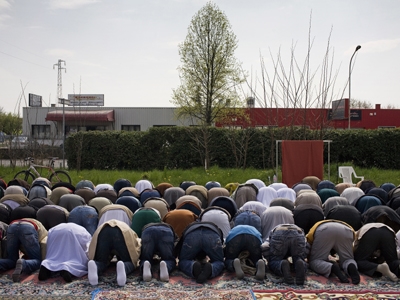
Hidden Islam - Islamic makeshift places of worship in north - east Italy, photographs and slide show (2009-11)
Courtesy of the artist

The artists Selma Alaçam (born 1980, lives and works in Karlsruhe, Germany) and Nicolò Degiorgis (born 1985, lives and works in Bolzano, Italy) analyse within their work the crucial subject matter of the relationship between Islamic culture and contemporary Western culture as it exists in Europe. How informed is mainstream public opinion in Europe about Islamic immigration to the European continent, and about the perspectives on integration of the people who actually come from Muslim countries? Moving from the particular matters of their own cultural perspective, Alaçam and Degiorgis develop individual strategies for their artistic research, with both following the common goal of emphasizing a wide range of elements which are suppressed within the public debate in Europe. In this way, both artists contribute to an increasingly complex and articulated reflection on the subject matter which they deal with.

NICOLO DEGIORGIS
Nicolò Degiorgis
Hidden Islam - Islamic makeshift places of worship in north - east Italy, photographs and slide show (2009-11)
Courtesy of the artist


Hidden Islam (2009-2011) is a photographic project by NICOLO DEGIORGIS, an investigation of Muslim prayer rooms spread all over Northern Italy. Degiorgis' work began as participation within a research project on the instruments and methods of multicultural integration conducted by the University of Trieste. Degiorgis took photographs of the improvised prayer rooms in which the Muslims in contemporary Italy exercise their faith, i.e. spaces found at the outskirts of big cities, abandoned and precarious locations such as former garages and industrial buildings. The photographic selection chosen by the artist connects specific private and cultual details of Islamic religiosity with images that document the diasporic nature of Italian Islam during recent years. Here, precariousness and decline become characteristics of survival, as the iconic signs of an anonymous and hostile metropolitan area. Thus, Degiorgis shows photographic images that are configured much like complex texts, in which the nullification of the architectural and urbanist context of the periphery of Italian cities appears to be subjected to the possible sense of relief determined by the rise of a different and migratory culture – such as the Islamic culture – which nowadays is present across the entire national territory. These images are consistently framed by liturgical scenes of prayers conducted within the places photographed. Breaks of light and improvised details of the image narrate the physical presence of the prayer, the moment of unification and consistency of the collective history of the Muslim communities in Italy. In this way, Hidden Islam traces another complex and problematic picture of contemporary Italy, and reveals the difficulties of this country to conceive itself as a contemporary society that has completely developed a sense of civil progress. 

SELMA ALACAM
Selma Alaçam
Istiklal Marsi / Turkish National Anthem (2010)
DVD loop; 4:28 min
source: YouTube
Courtesy of the artist

The work of SELMA ALACAM is focused on the question of identity. Within her work, the artist analyses in many ways her relationship to her own history as a dual citizen of Germany and Turkey who has grown up in Germany according to the educational models of Islam. Using family documents, ready-mades and self portraits, the artist employs a range of conceptual instruments that deal with a sort of reflection, not far removed from feminism, on the role of identity and social history.

Isolated and Protected (2009) is a video installation consisting of seven monitors on which the artist shows domestic scenes of Turkish Muslim families in Germany. Nonetheless, the visibility of the screen is obstructed by patterns on a curtain which veils the screen. The decorative patterns follow the Arabic tradition of applying them on the outside of windows of private homes in order to protect the residents from being visible to onlookers outdoors. The spectator therefore has only limited and partial access to what is happening, an interrupted visibility that “isolates and protects” the image from the gaze of strangers. In this way it is also a symbol of the complex system of communication and cultural exchange between Western and the Islamic societies in contemporary Europe. 

The video work Haare (2009) also intervenes with a similar aspect, with the artist here showing herself as she combs her hair. At the end she puts a wig on her head which is identical to her own hair. The scene shows a strategy used by many young Turkish women in order to remain loyal to Islamic interdict (which forbids women to show their own hair) while at the same time refusing to abandon the ambition to dress up. The gesture of the artist alludes in this way – quite ambiguously and without direct comment – to a possible modernisation inside Islam as it exists in Europe, and to a young generation of Muslims that are challenged to re-conceive the rules of their own religion in order to participate in Western life.

SELMA ALACAM
Selma Alaçam
Istiklal Marsi / Turkish National Anthem (2010)
DVD loop; 4:28 min.
source: YouTube
Courtesy of the artist

The video work Turkish National Anthem (2010) shows the political sensibility of the artist. It consists of video fragments the artist downloaded from YouTube which display some Turkish children in various private and public contexts while they sing with great emphasis and emotion the national anthem of their country. Left with no comments or alterations, the work provokes a restless sense of discomfort and unease in the spectator, because the national anthem appears as an aggressive instrument, a model of division between those who can identify themselves with it and those who are excluded.

Free entrance

Support: Provincia Autonoma di Bolzano, Alto Adige, Deutsche Kultur
Fondazione Cassa di Risparmio, Alto Adige
Città di Bolzano, Ufficio Cultura

AR / GE KUNST
GALERIE MUSEUM
Via Museo 29
39100 Bolzano
ITALY

www.argekunst.it

01/05/10

Alberto Di Fabio, Over the Rainbow – Exhibition curated by Emanuela Nobile Mino at Galleria Pack, Milan, Italy

Alberto Di Fabio, Over the Rainbow
Curated by Emanuela Nobile Mino
Galleria Pack, Milan, Italy
May 5 - September 11, 2010

For this exhibition, his third personal show at Galleria Pack, ALBERTO DI FABIO has created a project that is bound by a close relationship to the gallery’s recently renovated spaces. Large-scale paintings were created specifically for the show, punctuated by a series of medium-format artworks that highlight a more intimate and fragmented route. Taken as a whole, the artworks are characterized by new chromatic experimentation, including the use of fluorescent pigments and a juxtaposition of shiny tones and dark shades that suggests the idea of a totalitarian vision of landscape, a sort of observatory that provides a view out over the world as a whole: on one hand material and visible (Himalayan landscapes, cosmic geographies), on the other psychological and interior (traces of thought, score sheets for psychic rhythms), leading the viewer’s gaze further, deeper towards the ultra-terrain and as-yet-unexplored regions (luminous interplanetary paths, an enigmatic and celestial predominance of graphic elements).

As the curator EMANUELA NOBILE MINO writes in the critical text for the catalogue: “In referring to the famous song by Harold Arlen and sung by Judy Garland in The Wizard of Oz (1939), as well as by many other singers and musicians (including Ella Fitzgerald, Keith Jarrett, Jimi Hendrix and Rico Rodriguez, the Ramones, Deep Purple, Ray Charles and others), Over the Rainbow intends to suggest the idea of possible ulterior path, one that is parallel, beyond what we can see, transcendent and partially familiar and, precisely for this reason, intriguing. It is an invitation to look beyond contingent reality through imagery that turns abstract, redelivering man to the supernatural dimension (…).

Di Fabio has always led his audience along a backwards voyage from the visible to the invisible, accompanying them into a kaleidoscopic vision that forces the viewer to abandon a macroscopic perspectives and immerse himself in microscopic observation of the world in order to verify formal correspondences, geometric equilibriums and chromatic harmonies between individual natural elements, pointing out how a group of molecules and their organization into sophisticated structures (for example DNA) leads to a qualitative leap, generating that which we commonly refer to as “life.” This kind of process shares an enchanting correspondence with art, understood as the outcome of creation. The verb “create” contains the Indo-European root kere, also present in the Latin form of the verb “to grow” (Italian crescere), and in the name of the Roman goddess Ceres, an immortal being who embodies the principle of growth. Like nature, art is that which is derived from a group of factors and mechanisms, and is in turn capable of producing those of its own. It is a group of abstract units brought together into a single ordered structure (…).

ALBERTO DI FABIO was born in 1966 in Avezzano, Italy, and currently lives and works in Rome and New York. His most recent solo shows include: 2010, Over the Rainbow, Galleria Pack, Milan; Alberto Di Fabio, Gagosian Gallery, New York; (2009), Alberto Di Fabio, Gagosian Gallery, London; Insomnia, Galleria Pack, Milan; Sinestesia, Umberto di Marino, Naples.

Some of the artist’s more important group shows include: 2010, SuperEco, curated by Angelo Capasso, Emanuela Nobile Mino and Edicola Notte, ex-Aranciera del Semenzaio di San Sisto, Rome; 2008, XV Esposizione Quadriennale d’Arte di Roma, Palazzo delle Esposizioni, Rome; Punti di vista, Unicredit Private Banking, Naples; The Big Bang - Il cosmo visto con gli occhi dell’arte, Carlo Bilotti Museum, Rome; 2007, On the edge of vision, Victoria Memorial Hall, Calcutta, India; National Gallery of Modern Art, New Delhi, India; National Gallery of Modern Art, Mumbai, India; 2006, Capolavoro, curated by Angelo Capasso, Palazzo Primavera, Terni; Napoli presente. Posizioni e prospettive dell’arte contemporanea, curated by Lorand Hegyi, PAN, Naples.

ALBERTO DI FABIO
OVER THE RAINBOW
CURATOR: EMANUELA NOBILE MINO

GALLERIA PACK
Foro Buonaparte 60
20121 MILANO - IYALY