Showing posts with label Norwegian. Show all posts

06/03/25

Edvard Munch: Technically Speaking @ Harvard Art Museums, Cambridge

Edvard Munch: Technically Speaking
Harvard Art Museums, Cambridge
March 7 - July 27, 2025

Edvard Munch
EDVARD MUNCH
Two Human Beings (The Lonely Ones), 1894
Etching and drypoint
Harvard Art Museums/Fogg Museum, 
The Philip and Lynn Straus Collection, 2023.559 
Photo © President and Fellows of Harvard College

Edvard Munch
EDVARD MUNCH
Two Human  Beings (The Lonely Ones), 1899 
Woodcut, printed in four colors of ink
Harvard Art Museums/Fogg Museum, 
The Philip and Lynn Straus Collection, 2023.602
Photo © President and Fellows of Harvard College

Edvard Munch
EDVARD MUNCH
Two Human Beings (The Lonely Ones), 1906–8.
Oil on canvas 
Harvard Art Museums/Busch-Reisinger Museum, 
The Philip and Lynn Straus Collection, 2023.551
Photo © President and Fellows of Harvard College

The Harvard Art Museums present an exhibition of works by Edvard Munch that examines the artist’s innovative techniques and the recurring themes across his paintings, woodcuts, lithographs, etchings, and combination prints. Highlighting the collaborative partnership between curatorial and conservation experts at the museums, the exhibition reveals new and ongoing technical research into Munch’s practice and shares recent discoveries about his materials and highly experimental methods. 

The exhibition showcases 70 works, primarily from the Harvard Art Museums collections. Thanks to a transformative gift from Philip A. and Lynn G. Straus, the museums now house one of the largest and most significant collections of artwork by Munch in the United States—a collection that is also distinctive for its technical variety. Key loans from the Munch Museum in Oslo include two paintings and eight examples of the artist’s materials used for printmaking, seven of which have never before been on display in the United States. 

Norwegian artist Edvard Munch (1863–1944) is well known for his innovative experiments in painting and printmaking. He often rendered the same subject matter in both mediums—repeatedly over decades—to investigate their distinctive possibilities. His highly expressive work deals with psychological themes of isolation, separation, anxiety, illness, and death, but also attraction and love. Technically Speaking explores Munch’s fascination with materiality, uncovers new avenues for thinking about his work, and delves into his unconventional techniques and the various themes he returned to again and again over many years.
“This exhibition showcases an exciting selection of Munch’s paintings and prints from a career that spanned more than 60 years,” said Elizabeth M. Rudy. “We are thrilled to present his work through a lens that is perfect for a university museum—one that reinforces our teaching and research mission—by sharing the results of our recent investigations into his techniques and materials.”
The exhibition begins with several iterations of Two Human Beings (The Lonely Ones), depicting a man and a woman standing at a shoreline, side by side yet isolated from one another. First painted by Munch in 1892 (a work later destroyed in an accident at sea), the motif is repeated in an etching from 1894 that depicts the original painting and five subsequent woodcuts that Munch produced between 1899 and 1917. The prints reveal the various intriguing woodcut and etching techniques the artist utilized and also show how he manipulated his jigsaw woodblocks to print different parts of a single work in different colors. They are displayed in the exhibition with the original steel-faced copperplate and jigsaw woodblock that were used to produce the prints. Two paintings on display continue the motif: the artist’s 1906–8 version from the Busch-Reisinger Museum’s collection is based on his woodcuts, and a later (final) version from around 1935, on loan from the Munch Museum, reverts to the composition of the couple used by Munch in his 1892 painting.
Two Human Beings (The Lonely Ones) remains one of Munch’s most well-known subjects, and we are extremely fortunate to be able to trace his engagement with it over a period of more than 40 years and through nine works in our collections, supplemented by the generous loan of his last painting of the motif and two related matrices from the Munch Museum,” said Lynette Roth. “Together, they demonstrate the close relationship between painting and printmaking in Munch’s practice, his dedication to certain motifs over time, and his embrace of chance effects.”
Several other groupings highlight additional recurring themes in Munch’s work and how he experimented with their representation. Three woodcuts from the Woman’s Head against the Shore series show how Munch selectively printed his jigsaw woodblocks, omitting one of the pieces (the water) in one of the impressions. Four prints from The Kiss series—an etching and three woodcuts—portray a couple embracing in front of different backgrounds. Prints from Melancholy I and Melancholy III, on display with a rare example of Melancholy II, which Munch printed himself with his small hand-crank press, are shown with five of the artist’s original carved woodblocks. Four variations of Vampire II demonstrate how Munch sometimes combined lithographs with hand coloring and used woodblocks to add color as well. Also on display are three versions of Man’s Head in Woman’s Hair, including one used by Munch as a poster advertising an exhibition of his work at Diorama Hall in Kristiania (now Oslo).

Over the last several months, the works in the exhibition from Harvard’s collections have undergone technical study, including pigment analysis, selective treatments such as cleaning and varnish removal, and most of the prints were rematted and reframed. The painting Two Human Beings (1906–8) was varnished at some point in its history, which is not consistent with Munch’s practice of leaving his canvases without a unified glossy surface; this varnish has been removed. Train Smoke (1910) needed paint stabilization and cleaning to remove atmospheric grime, and Winter in Kragerø (1915) had its varnish removed to reveal a more vibrant snowy scene. This work was carried out by staff from the Straus Center for Conservation and Technical Studies, including Ellen Davis, Associate Paintings Conservator; Abby Schleicher, Assistant Paper Conservator; and Kate Smith, Senior Conservator of Paintings and Head of the Paintings Lab, and their findings are presented in the exhibition. Additionally, all six paintings on display from Harvard’s collections were reframed with new, historically accurate frames.
“Munch’s deep experimentations in painting and printmaking meant that he was constantly reworking his canvases and layering many different types of print techniques, which can become complicated to describe,” said Peter Murphy. “As research was underway and our conservators and curatorial team were deciphering how he created many of his works, I set out to break down the technical terms we were using in a friendly, digestible way. We hope that visitors will find the glossary useful, not only in the exhibition, but as something that can be kept and referenced beyond the show.”
The exhibition is curated by Elizabeth M. Rudy, Carl A. Weyerhaeuser Curator of Prints, and Lynette Roth, Daimler Curator of the Busch-Reisinger Museum; with Peter Murphy, Stefan Engelhorn Curatorial Fellow in the Busch-Reisinger Museum. This is the first major presentation at Harvard to examine Munch’s techniques and materials through the lens of the Strauses’ collection in 30 years, following the 1983 exhibition and publication Edvard Munch: Master Printmaker (organized by Charles W. Haxthausen and written by Elizabeth Prelinger) and Norma S. Steinberg’s 1995 exhibition and catalogue Munch in Color.

HARVARD ART MUSEUMS
32 Quincy Street, Cambridge, MA 02138

05/02/25

Prints and Paintings by Edvard Munch @ Harvard Art Museums: Gift from the Collection of Philip A. and Lynn G. Straus

The Harvard Art Museums announce an extraordinary gift from the collection of Philip A. and Lynn G. Straus: sixty-two prints and two paintings by the Norwegian Master Edvard Munch (1863–1944)
Edvard Munch Artworks
Left: Edvard Munch, Two Human Beings (The Lonely Ones), 1906–8. Oil on canvas. Busch-Reisinger Museum, The Philip and Lynn Straus Collection, 2023.551. Right: Edvard Munch, Two Human Beings (The Lonely Ones), 1899. Woodcut printed in orange, yellow, black, and dark greenish blue on tan wove paper. Fogg Museum, The Philip and Lynn Straus Collection, 2023.602. Photos © President and Fellows of Harvard College
The Harvard Art Museums announce an extraordinary gift from the collection of Philip A. and Lynn G. Straus; the gift comprises sixty-two prints and two paintings by Edvard Munch as well as one print by Jasper Johns. The bequest is a final act of generosity from the Strauses following a relationship with the museums that began in the 1980s and that includes multiple gifts of artworks over the years; the support of a 1990s-era expansion, renovation, and endowment of the museums’ conservation center; and the endowment of specific conservation and curatorial positions. The Spring 2025 exhibition Edvard Munch: Technically Speaking will feature many of the recently gifted works.

The works by Norwegian artist Edvard Munch (1863–1944) in the Strauses’ bequest join an important concentration of paintings and prints by the artist already at Harvard and build upon multiple past gifts and assisted purchases of Munch’s work by the couple—117 works altogether. The total number of works by the artist in the Harvard Art Museums collections is now 142 (8 paintings and 134 prints), constituting one of the largest and most significant collections of works by Munch in the United States.

Lynn G. and Philip A. Straus (Harvard Class of 1937) have been among the Harvard Art Museums’ most generous benefactors. Both were dedicated patrons of the arts and education, supporting libraries, museums, and institutions affiliated with early childhood education, civil rights, and human services. In 1969, the couple purchased their first print by Munch, Salome (1903), an acquisition that marked the start of their passion for the artist’s work. Following a commitment to a $7.5 million gift in 1994, the museums’ conservation center—the oldest fine arts conservation treatment, research, and training facility in the United States—was renamed the Straus Center for Conservation and Technical Studies. The couple have also supported vital conservation positions of staff who specialize in works on paper, as well as curatorial internship and fellowship positions in the museums’ prints and drawings departments. Philip, a New York investment advisor and portfolio manager, passed away in 2004, and their bequest comes to Harvard following Lynn’s passing in 2023. In total, the couple gifted or enabled purchases of 128 works to the Harvard Art Museums over their lifetimes, including works by Max Beckmann, Georges Braque, Alexander Calder, Timothy David Mayhew, and Emil Nolde.
“We are immensely grateful to Philip and Lynn Straus for their generosity and stewardship over these many years,” said Sarah Ganz Blythe, the Elizabeth and John Moors Cabot Director of the Harvard Art Museums. “Their enthusiasm for the work of Edvard Munch ensures generations of students and visitors can experience and study his prints and paintings here in Cambridge. Through their distinct style of collecting Munch’s prints—seeking out and acquiring multiple images of the same theme—they created a collection that affords deep insights into the artist’s practice and is therefore a perfect match for a university museum with a strong teaching and research mission.” Sarah Ganz Blythe continued: “Their support of the conservators and conservation scientists in the Straus Center has had a transformative impact on the numerous fellows who have trained there, as well as provided a facility where every object in our collections can be cared for and scientifically researched.”
The Strauses’ recent bequest includes Munch’s iconic painting Two Human Beings (The Lonely Ones) (1906–8) and Train Smoke (1910), both of which are now in the collection of the Busch-Reisinger Museum, one of the Harvard Art Museums’ three constituent museums. These paintings join Winter in Kragerø (1915) and Inger in a Red Dress (1896), previously given to the museum by Lynn in memory of Philip in 2012.

In Two Human Beings (The Lonely Ones), a man and woman stand side by side yet still feel isolated from one another, facing toward the sea and away from the viewer, each embedded in a colorfully sedimented landscape. Edvard Munch first painted this subject around 1892 and returned to it repeatedly in his printmaking and painting thereafter. Train Smoke, which depicts nature disrupted but also dynamically animated by the Industrial Revolution, is a landscape unlike those by Munch already in the collection. Both paintings demonstrate Munch’s experimentation with color and surface texture, through his varied use of thick impasto, diluted paint drips, and even areas of bare canvas, a hallmark of Munch’s artistic legacy.
“It is hard to overestimate the significance of Munch’s painting Two Human Beings (The Lonely Ones). Capturing the tension between proximity and distance—spatial as well as emotional—the work addresses the universal theme of the human condition,” said Lynette Roth, the Daimler Curator of the Busch-Reisinger Museum at the Harvard Art Museums. “The Strauses had generously loaned their painting for the inaugural installation of the renovated Harvard Art Museums building that opened in November 2014, and we are thrilled to be able to teach with and display it alongside the other significant paintings from their collection going forward.”
Over the course of 2024, both paintings have undergone cleaning and other treatments by Kate Smith, Senior Conservator of Paintings and Head of the Paintings Lab, and Ellen Davis, Associate Paintings Conservator, both in the museums’ Straus Center. Two Human Beings (The Lonely Ones) had been varnished at some point in its history, which is not consistent with Munch’s practice of leaving his canvases without a unified glossy surface. Train Smoke needed paint stabilization and cleaning to remove atmospheric grime. After careful study, removal of the varnish and grime from the paint surface, and treatment of small areas of paint loss, the paintings are now in closer alignment with their original appearance.

The 62 prints in the Strauses’ recent bequest have entered the collection of the Fogg Museum. The majority are highly prized impressions that Munch exhibited in his lifetime, and they speak to the aesthetic he preferred for the display of his prints: some of the impressions are cut to the image, and adhered to larger, heavy brown paper, which Munch signed and often dated. Also included are multiple states of single compositions. They showcase the range of techniques the artist used in his printmaking practice: drypoint, etching, lithography, mezzotint, and woodcut, and innovations through the addition of hand-applied color such as watercolor, crayon, and oil, or printing with woodblocks sawn into pieces.
“With this bequest, the Harvard Art Museums have become an important destination for the research of Munch’s prints,” said Elizabeth M. Rudy, the Carl A. Weyerhaeuser Curator of Prints at the Harvard Art Museums. “There are innumerable ways the collection offers opportunities for teaching, exhibition, and further study. Noteworthy for its groups of versions, states, and variations of single compositions, this collection offers wide-ranging insights into Munch’s innovative practice as a printmaker.”
Highlights from the Strauses’ recent gift of prints by Edvard Munch include:

• Six prints from the series Two Human Beings (The Lonely Ones), ranging in date from 1894 to 1917, join an impression that the couple previously gifted in 1991. Together, they showcase the various intriguing woodcut and etching techniques the artist utilized and also show how he manipulated his jigsaw woodblocks to print different parts of a single work in different colors. Closely related to this group is the gift of Young Woman on the Beach (1896), which is a rare example of the artist’s brief exploration of the mezzotint technique.

• Three versions of Vampire II, dated 1895–1902 and all either hand colored or printed in color, join a black lithographic state from 1895 that the couple previously assisted with purchasing. These prints show how Edvard Munch sometimes combined lithographs with hand coloring and also used woodblocks to add color.

• Four impressions of Madonna, dated 1895–1902, join a black lithographic state and a drypoint from 1894 that the couple previously assisted with purchasing. The lithographic prints show a range of examples of hand-applied color (drawn/painted) and printed color.

• One impression of the woodcut Woman’s Head against the Shore (1899) joins two other impressions from the same year, both previous gifts from the Strauses: Woman’s Head against the Shore (1899), printed in turquoise-green and pale and dark orange inks; and Woman’s Head against the Shore (1899), printed in red and three different colors of green ink. These prints show how Munch selectively printed his jigsaw woodblocks, omitting a piece from one of the blocks (the water) in two of the impressions.

• Four different self-portraits are the first such representations of the artist to enter the collection: Self-Portrait (1895), lithograph in crayon and tusche printed in black ink; Self-Portrait with Cigar (1908–9), lithograph printed in black ink; Self-Portrait (1911–12), woodcut; and Self-Portrait with a Bottle of Wine (1930), lithograph printed in black ink.

• There are also rare examples of prints that Edvard Munch printed himself with his small hand-crank press, including Melancholy II (1898), a woodcut (sawn in three pieces) printed in black, red, blue, and yellow inks.

The Jasper Johns print included in the bequest, Savarin (1982), is a lithograph and monotype; it depicts a Savarin-brand coffee can filled with paintbrushes of various sizes. The backdrop incorporates the artist’s signature “crosshatch” work of the 1970s, which is represented in other prints by Johns in the museums’ collections. The arm shown at the bottom of the print is a reference to the skeletal arm shown in Munch’s Self-Portrait from 1895—a connection the couple noted by hanging the two prints near each other in their own home.

HARVARD ART MUSEUMS
32 Quincy Street, Cambridge, MA 02138

Updated 06-03-2025

24/05/24

Artist Ida Ekblad @ Peder Lund, Oslo - "ACTIVATED SLUDGE" Exhibition

Ida Ekblad: EACTIVATED SLUDGE 
Peder Lund, Oslo
June 1st - August 31, 2024

Ida Ekblad
Ida Ekblad 
MUD DEVOTION, 2024
© Ida Ekblad,courtesy of Peder Lund

Ida Ekblad
Ida Ekblad 
GOO RAPT, 2024
© Ida Ekblad,courtesy of Peder Lund

Ida Ekblad
Ida Ekblad 
AMPHIDROMIC ECHOES, 2024 
Installation view, ReCollect! Kunsthaus Zürich, Zürich, 2024
© Ida Ekblad, courtesy of Kunsthaus Zürich and Peder Lund
Sludge is a thick wet substance. So is paint. So is glass. They are soupy materials. Liquid visuals. Color materialized. When in their sludgy state, I handle them. Activate them. Hyper-activate them. Hands-on. Fidget with fingers. Hand over my presence. Give them attention. Inattention. Attention. Inattention. Attentin. I forgot the o. Activation. Waste water. Decomposition. Bleed. All over. Goo. I must handle them before they dry, before they cool down. They cool. They dry. They harden.
Ida Ekblad, 2024
Perder Lund presents the exhibition ACTIVATED SLUDGE featuring new works by the Norwegian artist IDA EKBLAD (b. 1980).

For close to twenty years, Ida Ekblad has been one of the most original and influential artistic voices of her generation. Her prodigious and playful imagination has been rooted in a deep reverence for artists such as Odilon Redon, Paula Modersohn Becker, Paul Thek, Harriet Backer, Edvard Munch, Florine Stettheimer, and Helen Frankenthaler. Her resulting works are exquisitely vibrant free-associative compositions pairing dissonance with visual inventiveness; in producing electrically vivid paintings, drawings, and sculpture, along with her forays in performance, poetry, and filmmaking, and now works in glass, Ida Ekblad continually re-invents and re-invigorates her oeuvre, luxuriating in the twenty-first century's hyper-visual and materially oversaturated ethos. She embraces Dionysian excesses and her penchant for overloaded and baroque aesthetics have been critically lauded.

For Ida Ekblad's exhibition, titled ACTIVATED SLUDGE, her second at Peder Lund, she has chosen to include a selection of works in diverse media — new large-scale and intimately-sized oil paintings, an example of her recent production of monumental hand-painted bronze sculpture, and two mesmerizing examples of works in glass — produced in collaboration with a famed furnace in Murano, Italy. These wall-mounted glass works are pushing into new territory for the artist, however, maintain a distinctly "Ekblad-ian" take on the material. Ida Ekblad has evolved her signature colorful, glossy aesthetic, which defines her beloved oil paintings; in this latest endeavor, she ventures into the ethereal realm of hand-blown glass, infusing her creations with a captivating interplay of light, form, and texture.

For her glass works, Ida Ekblad has envisioned mandala-like constellations of repeating forms. Although created to explore a repetition of color and shape, the hand-crafted and somewhat unpredictable nature of glass combines to form individual pieces that retain subtle variations between each other. The circular arrangement reminds one of seeing a zoopraxiscope stopped for just a moment, before continuing to endlessly spin, summoning animated flowers blooming or centrifugal paint being flung from its center. As Muybridge invented his clever device in the early days of motion pictures, here Ida Ekblad has frozen a moment, capturing in exquisite detail the forms that make up the whole. Through Ida Ekblad's exploration of the medium of glass, she invites viewers to immerse themselves in a new dimension of her artistic expression, where the boundaries between materiality and imagination blur.
Painting to me combines expressions of rhythm, poetry, scent, emotion..... It offers ways to articulate the spaces between words, and I cannot be concerned with its death, when working with it as it makes me feel so alive.
Ida Ekblad, 2010
Ida Ekblad
Ida Ekblad 
SWAMP FLUSH, 2024 
© Ida Ekblad,courtesy of Peder Lund

Ida Ekblad's paintings in the exhibition continue her affair with oil paint, a material she has used almost exclusively since 2019. Ida Ekblad's production is extremely time- and labor-intensive. She begins by applying layers of thick oil paint as a base, which eventually forms a fantastically thick foundation of rich pigments. Each layer must dry completely before the next layer can be applied. The process of creating a work can take several months to years because the heavy oil paint needs time to settle in. Once Ida Ekblad is satisfied with these base layers, she finishes each piece with thin layers of glaze, consisting of color pigment suspended in walnut oil, which also must dry between each layer. Through her insistence on using thick and thin layers of paint, the final work has a luminous, enamel-like finish that is only achievable through such extreme dedication to the process. After drying on the floor, the pieces' jewel-like caleidoscope of color subtly exists in a delicate balance with each other, like panes of stained glass set into place, illuminated by an inner glow. As historian Andreas Aubert described Harriet Backer's Blue Interior upon viewing it for the first time, so too can we say that in Ida Ekblad's paintings, "Every atom is color."

Ida Ekblad has noted that her work is often inspired by personal memories, however, in the end, the works created provide an explosive sense of retro-future abstract centripetal release. In the 1974 film "A Woman Under the Influence" by Cassevettes, the character of Mabel particularly resonates with Ida Ekblad; she exemplifies "a sort of domesticity gone bananas" that can be seen in the paintings in the gallery, all finished in 2024. Unapologetically feminine, the paintings tumble through abstracted forms, like rolls of intricately patterned fabrics bundled together, with recognizable petals of roses and pansies or Breton-striped shirt sleeves peeking through. Picasso's Harlequin is present. Whether vertically or horizontally oriented, these paintings provide a dizzying, whirlwind feeling, as if you are stealing a glimpse of one of Ida Ekblad's peripatetic, phantasmagorical nightly dreams.

Finally, the included example of Ida Ekblad's recent production of large-scale hand-painted bronze sculpture succinctly captures many threads of the artist's fascination with material and process. Titled AMPHIDROMIC ECHOES the work was assembled by applying the cubist method of a jigsaw-puzzle-like composition of elements that are outlined in flat surfaces, like the cut-out of a collage.Ida Ekblad reinvigorates the technique and creates a multi-perspective synthesis of mind and memory. By summoning the idea of tidal waves through its enigmatic title, the sculpture invites the viewer to explore its intricate textural and compositional moments fully in the round.

Ida Ekblad
Portrait of Ida Ekblad
Photo © Jacqueline Landvik
Courtesy of Peder Lund

IDA EKBLAD lives and works in Oslo. She is educated at the Oslo National Academy of the Arts (2007) and the Mountain School of Arts, Los Angeles, USA (2008). She participated in the Venice Biennale (2011, 2017), as well as in numerous solo and group exhibitions. In addition to her most recent solo show in 2021 at Kunstnernes Hus, Oslo, her work has been presented at a variety of institutions in solo exhibitions, among them Kunsthalle Zürich, Zurich, Switzerland (2019) and Museo Rufino Tamayo, Mexico City, Mexico (2019); Kunstverein Braunschweig, Braunschweig, Germany (2018); Kunsthaus Hamburg, Hamburg, Germany (2017); National Museum of Art, Design and Architecture, Oslo, Norway (2013); Bergen Kunsthall, Bergen, Norway (2010); Bonniers Konsthall, Stockholm, Sweden (2010).

Together with Matias Faldbakken, Ida Ekblad's work is currently installed at Kunsthaus Zürich for the institution's ongoing exhibitions series ReCollect! which places newly created works by contemporary artists in dialogue with the museum's permanent collection. ReCollect! will continue through the summer.

Ida Ekblad's work is owned by a multitude of important public and private institutions and collections around the world, including the Centre Pompidou, Paris, France; Fondation Louis Vuitton, Paris, France; Kunsthaus Zürich, Zurich, Switzerland; Albright-Knox Art Gallery, Buffalo, NY; Hammer Museum, Los Angeles, CA; Art Gallery of New South Wales, Sydney, Australia; British Museum, London, UK; Louisiana Museum of Modern Art, Humlebæk, Denmark; Moderna Museet, Stockholm, Sweden; KODE Art Museums and Composer Homes, Bergen, Norway; Astrup Fearnley Museum of Modern Art, Oslo, Norway; and the National Museum of Art, Architecture and Design, Oslo, Norway.

PEDER LUND
Tjuvholmen allé 27 - 0252 Oslo 

20/12/23

Andreas Meinich @ Nevven Gallery, Gothenburg - "Gapahuk" Exhibition

Andreas Meinich: Gapahuk
Nevven Gallery, Gothenburg
November 23, 2023 — February 11, 2024

Andreas Meinich
Andreas Meinich 
Finnskogajätten, 2023 
Digitally woven cotton and polyester, wood pole, 
edition 3/3 + 2 AP, 300 x 200 cm
© Andreas Meinich

Andreas Meinich
Andreas Meinich 
Bastuknappen, 2023 
Digitally woven cotton and polyester, wood pole, 
edition 3/3 + 2 AP, 200 x 150 cm
© Andreas Meinich

Andreas Meinich
Andreas Meinich
Ortnevik II (detail), 2023 
Digitally woven cotton and polyester, wood pole, 
edition 3/3 + 2 AP, 200 x 150 cm
© Andreas Meinich

Andreas Meinich
Andreas Meinich Artist Portrait 
© Photo by Magnus Nordstrand
Text by Mattia Lullini

Kaihōgyō is an ancient ascetic practice used to be performed by Tendai Buddhist monks. Thought to have been initiated by Sōō Kashō in X Century Japan, the liturgy consisted in using hiking and running in the mountains as a form of meditation and path to illumination. Complexly structured, this observance took 1000 days to perform, in which the monks were supposed to cover by foot an average of 40 to 80 km per day.(1) In our fast paced yet mostly sedentary lives, endurance sports, and specially the ones involving long distances, like ultra running, through hiking or bikepacking have come back into fashion. While they are considered beneficial for physical health, an aspect mostly undervalued of these repetitive and slow paced, long lasting activities has been their capacity to become meditative and insightful experiences. There, like in the case of Japanese monks, is where the process behind Andreas Meinich’s art becomes relevant also if considered by itself and not only as a means to an end. The Norwegian photographer leaves every Summer for long bikepacking tours of Norway and sometimes Scandinavia at large. He follows some of the old traditional routes, but also ventures into less travelled regions, valleys and fjords, spending weeks at a time biking all day, sleeping in nature and taking photographs. It is in this routine of long miles and frugal living that his art originates.(2)

The subjects of Meinich’s photography then are not exactly what one would expect from such an experience, or maybe even more so, they are too much of what one would expect. Filled with splendid views, towering folk sculptures and local minor attractions, the valleys of Norway teem with grotesque, clumsy or often unexpectedly monumental sights. They might be self-built stave churches (Ortnevik II, 2023), anthropomorphic rock formations (Ombomannen, 2023) or goofy sculptures found outside of saunas in the woods (Bastuknappen, 2023). They are exactly what each one of us, or any tourist, would snap a picture of as a memory, or, with more than just a pinch of irony, a funny Instagram story. The difference is that in Meinich’s photographs these images are presented to us neutrally and with no commentary, setting in motion a different kind of operation. The feeling is that by portraying these hidden and often remote sights, by bringing these idiosyncratic monuments out of their isolation and context, the Norwegian artist is presenting us with a unique depiction of his own country. Ridiculous, bizarre, serious, the subjects of his pictures are spontaneous folk expressions, they channel religious feelings, bigotry, profanity and tradition in equal parts, being honest to themselves and unfiltered. Could these photographs then be considered as a visual essay on Norwegian contemporary folklore? Meinich’s travels bring to mind the legendary accomplishment of Asbjørnsen and Moe and their famous collection of fairy tales Norske Folkeeventyr. Considered still a uniquely important record of traditional folk tales and songs, this collection of stories was the result of extensive travels by the two authors through the most remote parts of 1800s Norway, noting down ancient stories and rhymes transmitted orally only.(3) Seemingly, this is very similar to what Meinich is doing every Summer, only taking outdoor culture in place of oral culture, turning tales into photographs, then translating them again into digitally woven textiles. An operation, this last one, which is not neutral and also materially reminds of his most common subjects, both in monumentality and humour. With the aspect of antique tapestries, and the contrast coming natural to mind between the aristocratic past one would associate them with and the simplicity of their subjects, they themselves could have been considered folk art, tourist’s souvenirs, or an indoor continuation of the outdoor expressions they depict. These grand, beautiful objects that tell us about little things hidden in the vast woods of Norway, take physically the exhibition space with their tactility and their stories, which ironically or not, narrate a land in front of our eyes and yet hidden to most.

Mattia Lullini

(1) For more information: John Stevens, The Marathon Monks of Mount Hiei (1988).
(2) From this activity derives the title of the exhibition: “The Norwegian word gapahuk means a simple shelter made out of wood. There are a lot of gapahuk in the rural part of Norway where I travel by bike and find the motifs for my weaves, and I often find myself using them for shelter on my trips.” (As described to us by the artist).
(3) Peter Christian Asbjørnsen and Jørgen Moe, Norske Folkeeventyr (1844).
ANDREAS MEINICH was born in 1985, Stavanger, Norway. He lives and works in Oslo. The artist obtained a BA in Visual Communication at Oslo National Academy of the Arts (2008-2011).

NEVVEN GALLERY
Molinsgatan 11, 411 33 Göteborg

12/01/22

Impressionism and Beyond @ Saint Louis Art Museum

Impressionism and Beyond
Saint Louis Art Museum
February 1 - July 31, 2022
“Due to a surge of COVID positive cases among our staff and the rapid spread of the Omicron variant, the Museum is closed to the public. At this time, we anticipate reopening to the public on Tuesday, February 1"
Edgar Degas
EDGAR DEGAS
French, 1834–1917
"Ballet Dancers in the Wings", c.1890–1900
Pastel; 28 x 26 inches
Saint Louis Art Museum, Museum Purchase 24:1935

Odilon Redon
ODILON REDON
French, 1840–1916 
"Eyes in the Forest", 1882
Charcoal on pale brown paper; 
framed: 23 x 19 1/2 x 1 1/2 inches 
Saint Louis Art Museum 
Gift of Mr. and Mrs. Morton D. May 234:1959

The Saint Louis Art Museum presents “Impressionism and Beyond,” an exhibition of works on paper drawn exclusively from the museum collections.

Through 59 European drawings, pastels and prints dating from the 1850s to the 1930s, “Impressionism and Beyond” highlights the many conversations occurring in the art world between tradition and innovation, representation and abstraction, and the artist’s studio and the art market.

During this period, European life underwent dramatic social, political and psychological changes, which contributed to significant artistic developments. Artists responded to this fluid environment in many ways—visualizing modern life as it was, but also viewing the world through an imaginative lens.

The exhibition reveals that, at this same moment, new attitudes about artistic practice and expressions of modernity elevated drawing and printmaking to prominence among the avant-garde.

In France, which dominated progressive trends, the Impressionists broke with traditional academic modes of representation through formal experimentation and innovative print and drawing techniques. Mary Cassatt, for example, elevated color printmaking to new heights through her adaptation of the Japanese aesthetic that was taking Paris by storm in the 1890s, while her Impressionist colleague Edgar Degas sought multiple avenues for experimentation in print. Degas and other Impressionists also developed inventive drawing styles that allowed them to capture movement and intense effects of color and light in their works.

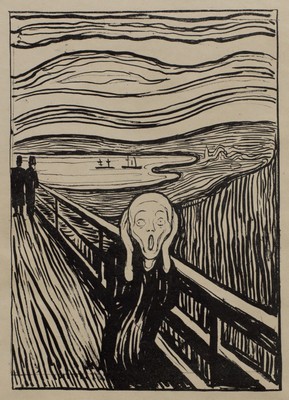
Edvard Munch
EDVARD MUNCH
Norwegian, 1863–1944 
"The Scream", 1895
Lithograph; image: 13 3/4 x 27 1/4 inches, 
sheet: 23 1/2 x 16 3/8 inches
Saint Louis Art Museum 
Private Collection 2019.348

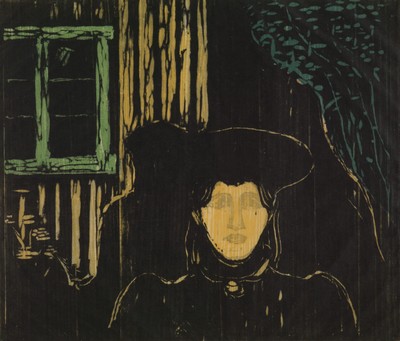
Edvard Munch
EDVARD MUNCH
Norwegian, 1863–1944
"Moonlight", 1896; printed c. 1906
Color woodcut on Japan paper; 
image: 15 13/16 x 18 9/16 inches, 
sheet: 18 7/8 x 23 5/16 inches
Saint Louis Art Museum
Gift of General and Mrs. Leif J. Sverdrup 338:1952

This experimental impulse in turn provided a launchpad for later generations to push formal and technical innovations even further. Paul Cézanne’s early-20th-century watercolors transformed natural environments into abstract washes of color, while Odilon Redon focused on the expressive power of black to create images that blurred the lines between fantasy and reality. Edvard Munch rethought the ancient medium of woodcut printmaking, cutting his blocks into pieces like a jigsaw puzzle to print in multiple colors.

“Impressionism and Beyond” explores several themes that guided artists in their examinations of modernity. Subjects of modern urban life such as the domestic interior and the modern woman of fashion abound during this period. Meanwhile, experimental treatments of figures and landscapes highlight news ways artists viewed the world around them, sometimes giving way to quirky, even frightening, visions.

“Impressionism and Beyond” is curated by Abigail Yoder, research assistant, and Elizabeth Wyckoff, curator of prints, drawings and photographs.

SAINT LOUIS ART MUSEUM
One Fine Arts Drive, Forest Park, Saint Louis, Missouri 63110

25/05/21

Nikolai Astrup @ The Clark Art Institute, Williamstown - Visions of Norway

Nikolai Astrup: Visions of Norway  
The Clark Art Institute, Williamstown
June 19 – September 19, 2021

The Clark presents the first North American exhibition focused on the Norwegian painter NIKOLAI ASTRUP (1880–1928), who deftly wove tradition and innovation into his artistic production. Astrup is considered one of Norway’s most important artists, yet he is largely unknown outside of his homeland. Nikolai Astrup: Visions of Norway features more than eighty-five works celebrating this brilliant painter, printmaker, and horticulturalist.

Nikolai Astrup’s oeuvre is notable for its intense, colorful palette, and the magical realism of his remarkable landscapes. Paintings and woodcuts from all periods of his career are presented in the exhibition, including multiple impressions of print compositions that reveal how Nikolai Astrup modified the mood and meaning of these works through changes in color and the addition or deletion of motifs, often using multiple blocks to create his complex prints.

After training in Kristiania (Oslo) and Paris, Nikolai Astrup returned to his childhood home and pursued his career in the remote region of western Norway overlooking Lake Jølster. Eventually, he settled on a property called Sandalstrand, situated across the lake from where he was raised. There he created a farmstead that served as a source of inspiration for his artistic purposes, sustained his family, and proved an early manifestation of ecological conservation.

The area’s sublime landscape, distinctive atmosphere, and ethereal summer light captivated Nikolai Astrup, while his childhood memories—marked by local traditions and Norwegian folklore—deeply shaped his perception of place. Nikolai Astrup’s work responded to, and helped shape, Norway’s emerging national identity. He created a distinctive visual language that expands on the intentions and achievements of composer Edvard Grieg (1843–1907) and playwright Henrik Ibsen (1828–1906) in Norwegian music and literature, respectively.

Guest curated by independent scholar MaryAnne Stevens, former Director of Academic Affairs at the Royal Academy, London, Nikolai Astrup: Visions of Norway is presented in the Clark’s special exhibition galleries and is accompanied by a catalogue published by the Clark and distributed by Yale University Press:

Nicolay Astrup
Nikolai Astrup
Visions of Norway
Edited by MaryAnne Stevens 
With a prelude by Karl Ove Knausgard, 
essays by Frances Carey, Jay A. Clarke, Robert Ferguson, 
and MaryAnne Stevens, and a chronology by Kesia E. Halvorsrud
July 27, 2021, Hardcover, $50.00

The exhibition travels to the KODE Art Museums, Bergen, Norway, from October 15, 2021–January 23, 2022 and to the Prins Eugens Waldemarsudde, Stockholm, from February 19–May 29, 2022.

Nikolai Astrup: Visions of Norway is organized by the Clark Art Institute, Williamstown, Massachusetts, in cooperation with KODE Art Museums and Composer Homes, Bergen.

THE CLARK ART INSTITUTE
225 South Street, Williamstown, MA 01267
www.clarkart.edu

26/10/03

Knut Asdam at Irish Museum of Modern Art, Dublin

Knut Åsdam 
Irish Museum of Modern Art, Dublin
29 October 2003 - 4 January 2004

An exhibition of two filmworks by the Norwegian multi-media artist Knut Åsdam opens to the public at the Irish Museum of Modern Art on Wednesday 29 October. In this, his first showing in Ireland, Åsdam seeks to demonstrate how the architecture of a city can embody contemporary life.

'Filter City', 2003, is Knut Åsdam most ambitious film/video work to date. The work focuses on two women, their relationship to each other, to a larger social group and to a city that is in constant transformation – architecturally, socially and politically. The film is mostly shot outdoors in modern apartment/housing complexes, using scenes that are interchangeable with different Western cities. Through dialogue and filmic description of places and people, Knut Åsdam brings the characters into a narration with a city that is constantly changing socially and politically. 'Filter City' was first shown at the recent Istanbul Biennial.

The second work 'Cluster Praxis', 2002, deals with dancing as a form of social practice, and particularly as an expression of the desire for collectivety. The work is structured around the sound – a narrative mix of voice and ambient soundscapes – dominated by a five-minute-long poetic monologue. Writing in Artforum, Jordan Kantor, described the work as tracing an ever-deepening subjectivity with the “objective” camera.

Knut Åsdam was born in 1968, in Trondheim, Norway, and studied in London at Wimbledon College of Art and Goldsmiths College. He has exhibited extensively in the US and Europe and was selected for the Nordic pavilion in the 1999 Venice Biennale. His most recent shows include solo exhibitions at Klmens Gasser and Tanja Grunert, New York, the Museum of Contemporary Art, Oslo, and Tate Britain, London.

A publication, with an essay by Simon Sheikh, Curator and Assistant Professor of Art Theory and Co-ordinator of the Critical Studies Programme, Malmo Art Academy, accompanies the exhibition.

IMMA - IRISH MUSEUM OF MODERN ART 
Military Road, Kilmainham, Dublin 8
www.modernart.ie