Showing posts with label Edgar Degas. Show all posts

08/12/23

The Batliner Collection @ ALBERTINA Museum, Vienna - Monet to Picasso

Monet to Picasso 
The Batliner Collection 
ALBERTINA Museum, Vienna 

Claude Monet
Claude Monet
View of Vétheuil, 1881
Oil on canvas
The ALBERTINA Museum, Vienna – The Batliner Collection

Claude Monet
Claude Monet
The Water Lily Pond, 1917-1919
Oil on canvas
The ALBERTINA Museum, Vienna – The Batliner Collection

The ALBERTINA is home to one of Europe’s largest and most outstanding collections of classical modernist paintings: The Batliner Collection. It was turned over to the ALBERTINA by Rita and Herbert Batliner in 2007, opening a new chapter in the museum’s history. From French Impressionism, Pointillism and Fauvism (including works by Monet, Renoir, Degas, Cézanne, Toulouse-Lautrec, Braque, and Matisse) to masterpieces of the expressionist artists’ groups Die Brücke and Der Blaue Reiter (including paintings by Kirchner, Kandinsky, and Nolde) and on to the Russian avant-garde and numerous works by Pablo Picasso, this permanent exhibition presents all of modernism’s revolutionary ideas.

Edgar Degas
Edgar Degas
Two Dancers, 1905
Pastell auf Papier
The ALBERTINA Museum, Vienna – The Batliner Collection

Kasimir Malewitsch
Kazimir Malewitsch
Man in a Suprematist Landscape, ca. 1930/31
Oil on canvas
The ALBERTINA Museum, Vienna – The Batliner Collection

The 2007 decision by Herbert and Rita Batliner to turn their collection over to the public, along with their choice of the ALBERTINA Museum as a partner, enriched the museum landscape in a lasting way for contemporary art, too. Beginning at the turn of the millennium onward the Batliners began collecting the diverse painted output of the present era: Georg Baselitz, Anselm Kiefer, Alex Katz, Imi Knoebel, and Arnulf Rainer.

ALBERTINA Museum
Albertinaplatz 1 - 1010 Vienna

09/10/23

Degas and the Laundress: Women, Work, and Impressionism @ Cleveland Museum of Art

Degas and the Laundress: 
Women, Work, and Impressionism 
Cleveland Museum of Art
October 8, 2023 –January 14, 2024

Edgar Degas
Edgar Degas
(French, 1834–1917)
Woman Ironing, begun c. 1876, completed c. 1887. 
Oil on canvas; 99 x 82.5 cm. 
National Gallery of Art, Washington, DC, 
Collection of Mr. and Mrs. Paul Mellon, 1972.74.1

The Cleveland Museum of Art presents Degas and the Laundress: Women, Work, and Impressionism, on view in the Kelvin and Eleanor Smith Foundation Gallery. The first exhibition to explore Impressionist artist Edgar Degas’s representations of Parisian laundresses, the groundbreaking show includes the largest selection of these works seen together to date, only in Cleveland. The artworks from this series—revolutionary in their emphasis on women’s work, the strenuousness of such labor, and social class—were featured in Edgar Degas’s most significant exhibitions, where they were praised by critics as epitomizing modernity. The nearly 100 works exhibited from over 30 European and American collections reveal that depictions of laundresses by the artist and his contemporaries featured some of the most striking formal innovations of the time.  
“Degas carried out some of the most striking experimentation of his long career throughout his laundress series,” said Britany Salsbury, curator of prints and drawings. “The subject fascinated him beginning as a young man in the 1850s and continuing until his final decade of work as an artist. The images that he created of these women are fascinating for their emphasis on labor itself rather than the stereotypes that persisted about them throughout popular culture. The women who undertook work ironing and washing often did so because they lacked other options, and they endured tremendously difficult working conditions.”
A visible presence in the city, ironing in shops open to the street or carrying heavy baskets of clothing, laundresses undertook some of the most difficult and poorly paid labor at the time, leading some in the industry to supplement their income through sex work. The depictions of these women featured in Degas and the Laundress: Women, Work, and Impressionism provide a surprising contrast to more familiar Impressionist representations of upper-middle-class leisure.

Pierre-Auguste Renoir
(French, 1841–1919)
The Laundre [La Blanchisseuse]ss, 1877–79. 
Oil on canvas; 80.8 x 56.6 cm. 
Art Institute of Chicago, 
Charles H. and Mary F. S. Worcester Collection, 1947.102

Edouard Vuillard
Edouard Vuillard
(French, 1868–1940)
Woman Ironing, 1892
Oil on board; 21.4 x 25.4 cm. 
The Cleveland Museum of Art, 
Nancy F. and Joseph P. Keithley Collection Gift, 2020.119

Pierre Bonnard
Pierre Bonnard
(French, 1867–1947)
The Little Laundress, from Album des peintres-graveurs, 1896. 
Color lithograph on China paper; image: 29 x 19.7 cm; sheet: 45.4 x 33.7 cm. 
The Cleveland Museum of Art, 
Nancy F. and Joseph P. Keithley Collection Gift, 2020.151

Degas and the Laundress: Women, Work, and Impressionism contextualizes Edgar Degas’s laundress series with paintings, drawings, and prints of the same subject by the artist’s contemporaries—including Gustave Caillebotte, Berthe Morisot, Pierre-Auguste Renoir, Henri de Toulouse-Lautrec and Edouard Vuillard, Pierre Bonnard—as well as painters that Edgar Degas influenced and was influenced by, from Honoré Daumier to Pablo Picasso. It also presents ephemera, such as posters, photographs, and books, that reveals the widespread interest that Parisians of all social classes had in the topic of laundresses during the late 1800s.
“The extraordinary works assembled for this exhibition reveal a new and exciting aspect of an otherwise well-known art historical movement,” said William Griswold, director and president of the Cleveland Museum of Art. “The Cleveland Museum of Art’s exceptional holdings of 19th-century French art situate us to present such an inventive exhibition, and we look forward to sharing works of impressive quality—from Degas’s private sketchbooks to some of his most celebrated canvases alongside those by his colleagues—that have never before been seen together.”
Degas and the Laundress
Women, Work, and Impressionism
Exhibition Catalogue
Britany Salsbury ed.
Published by The Cleveland Museum of Art
ISBN: 978-0-300-27322-9
The exhibition is accompanied by a richly illustrated publication featuring thematic essays by scholars of art history, French studies, literature, and history. The 256-page catalogue is the first publication to examine and document Edgar Degas’s portrayals of Parisian laundresses. Edited by Britany Salsbury with contributions by Aleksandra Bursac, Michelle Foa, Gretchen Schultz, Charles Sowerwine, Richard Thomson, and Claire White.
CLEVELAND MUSEUM OF ART
11150 East Boulevard, Cleveland, Ohio 44106

12/01/22

Impressionism and Beyond @ Saint Louis Art Museum

Impressionism and Beyond
Saint Louis Art Museum
February 1 - July 31, 2022
“Due to a surge of COVID positive cases among our staff and the rapid spread of the Omicron variant, the Museum is closed to the public. At this time, we anticipate reopening to the public on Tuesday, February 1"
Edgar Degas
EDGAR DEGAS
French, 1834–1917
"Ballet Dancers in the Wings", c.1890–1900
Pastel; 28 x 26 inches
Saint Louis Art Museum, Museum Purchase 24:1935

Odilon Redon
ODILON REDON
French, 1840–1916 
"Eyes in the Forest", 1882
Charcoal on pale brown paper; 
framed: 23 x 19 1/2 x 1 1/2 inches 
Saint Louis Art Museum 
Gift of Mr. and Mrs. Morton D. May 234:1959

The Saint Louis Art Museum presents “Impressionism and Beyond,” an exhibition of works on paper drawn exclusively from the museum collections.

Through 59 European drawings, pastels and prints dating from the 1850s to the 1930s, “Impressionism and Beyond” highlights the many conversations occurring in the art world between tradition and innovation, representation and abstraction, and the artist’s studio and the art market.

During this period, European life underwent dramatic social, political and psychological changes, which contributed to significant artistic developments. Artists responded to this fluid environment in many ways—visualizing modern life as it was, but also viewing the world through an imaginative lens.

The exhibition reveals that, at this same moment, new attitudes about artistic practice and expressions of modernity elevated drawing and printmaking to prominence among the avant-garde.

In France, which dominated progressive trends, the Impressionists broke with traditional academic modes of representation through formal experimentation and innovative print and drawing techniques. Mary Cassatt, for example, elevated color printmaking to new heights through her adaptation of the Japanese aesthetic that was taking Paris by storm in the 1890s, while her Impressionist colleague Edgar Degas sought multiple avenues for experimentation in print. Degas and other Impressionists also developed inventive drawing styles that allowed them to capture movement and intense effects of color and light in their works.

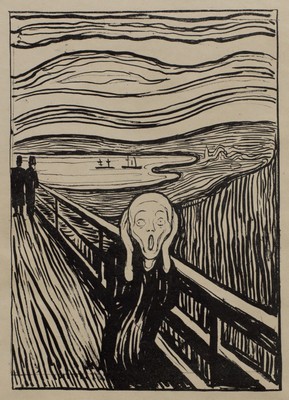
Edvard Munch
EDVARD MUNCH
Norwegian, 1863–1944 
"The Scream", 1895
Lithograph; image: 13 3/4 x 27 1/4 inches, 
sheet: 23 1/2 x 16 3/8 inches
Saint Louis Art Museum 
Private Collection 2019.348

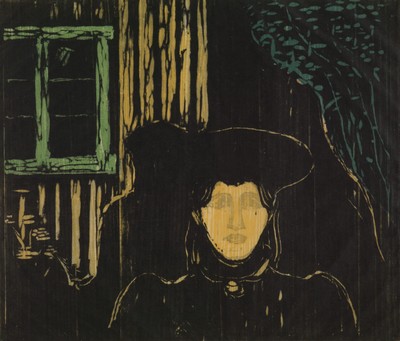
Edvard Munch
EDVARD MUNCH
Norwegian, 1863–1944
"Moonlight", 1896; printed c. 1906
Color woodcut on Japan paper; 
image: 15 13/16 x 18 9/16 inches, 
sheet: 18 7/8 x 23 5/16 inches
Saint Louis Art Museum
Gift of General and Mrs. Leif J. Sverdrup 338:1952

This experimental impulse in turn provided a launchpad for later generations to push formal and technical innovations even further. Paul Cézanne’s early-20th-century watercolors transformed natural environments into abstract washes of color, while Odilon Redon focused on the expressive power of black to create images that blurred the lines between fantasy and reality. Edvard Munch rethought the ancient medium of woodcut printmaking, cutting his blocks into pieces like a jigsaw puzzle to print in multiple colors.

“Impressionism and Beyond” explores several themes that guided artists in their examinations of modernity. Subjects of modern urban life such as the domestic interior and the modern woman of fashion abound during this period. Meanwhile, experimental treatments of figures and landscapes highlight news ways artists viewed the world around them, sometimes giving way to quirky, even frightening, visions.

“Impressionism and Beyond” is curated by Abigail Yoder, research assistant, and Elizabeth Wyckoff, curator of prints, drawings and photographs.

SAINT LOUIS ART MUSEUM
One Fine Arts Drive, Forest Park, Saint Louis, Missouri 63110

11/11/21

Point, Line, Plane: The William B. Jordan and Robert Dean Brownlee Bequest @ Dallas Museum of Art

Point, Line, Plane: The William B. Jordan and Robert Dean Brownlee Bequest
Dallas Museum of Art 
September 26, 2021 – January 9, 2022

Edgar Degas
Edgar Degas
Seated Male Nude (recto), 1856-1858 
Pencil on paper
Dallas Museum of Art 
Bequest of William B. Jordan and Robert Dean Brownlee, 2019.72.21.A-B 

Berthe Morisot
Berthe Morisot 
Harbor Scene (Isle of Wight), 1880
Watercolor on paper 
Dallas Museum of Art 
Bequest of William B. Jordan and Robert Dean Brownlee, 2019.72.39

Rosa Bonheur
Rosa Bonheur
 
Pattes de lion, 1880-1885 
Black crayon on medium-weight wove paper with stumping 
Dallas Museum of Art 
Bequest of William B. Jordan and Robert Dean Brownlee, 2019.72.5 

At the Dallas Museum of Art (DMA), an exhibition honors a remarkable gift from the estate of distinguished scholar William B. Jordan and his husband, Robert Dean Brownlee. Celebrating the establishment of the Museum’s Works on Paper Department, Point, Line, Plane: The William B. Jordan and Robert Dean Brownlee Bequest is composed of approximately 50 works donated to the DMA by Jordan and Brownlee. The exhibition includes drawings, watercolors, prints, photography, sculpture, and decorative arts by some of the most important European and American artists of the past three centuries. Point, Line, Plane is curated by Sue Canterbury, The Pauline Gill Sullivan Curator of American Art and Interim Allen and Kelli Questrom Curator of Works on Paper.
“Bill and Robert were kind, intelligent, and generous souls, invested in creating a lasting impact on the arts in North Texas and at the DMA,” said Dr. Agustín Arteaga, the DMA’s Eugene McDermott Director. “Together they built a wonderful personal collection that shows their admiration for the unique intimacy contained in works on paper. We were honored to be recipients of their generosity, and we pay tribute to their mission by sharing these treasured works with our visitors."
Adolf Hiremy-Hirschl
Head of a Young Woman, 1890s
Black and white chalk on brown paper 
Dallas Museum of Art 
Bequest of William B. Jordan and Robert Dean Brownlee, 2019.72.29

Jean–Baptiste Camille Corot
Jean–Baptiste Camille Corot 
Paysage, n.d.
Charcoal on paper
Dallas Museum of Art
Bequest of William B. Jordan and Robert Dean Brownlee, 2019.72.15

Jordan and Brownlee were key figures in the arts community of Dallas–Fort Worth. While Brownlee’s focus was architecture and interior design, Jordan was a scholar and connoisseur of Spanish paintings. His influence on the region’s arts institutions is immeasurable. Serving as the founding director of the Meadows Museum (1967–1980) and as deputy director of the Kimbell Art Museum (1981–1990), Jordan raised the quality and profile of both collections. He began his affiliation with the DMA as an adjunct curator for European art (1977–1982) and evolved to become an invaluable member of the Museum’s Board of Trustees.

Both deeply interested in art, the couple assembled a collection over decades that included works by Paul Cézanne, Edgar Degas, Rosa Bonheur, Berthe Morisot, Auguste Rodin, Pablo Picasso, Henri Matisse, Salvador Dalí, Jackson Pollock, Josef Albers, Cy Twombly, Ellsworth Kelly, and Robert Rauschenberg, among others. While the collection varied in types of objects and historical eras, works on paper were at its core. Point, Line Plane features approximately 50 works spanning the ancient to the contemporary, demonstrating an enduring fascination with artists’ use of expressive line, the depiction of the figure, and dialogues across media.

Robert Rauschenberg
Robert Rauschenberg 
Autobiography: three works, 1968
Offset lithographs on paper
Dallas Museum of Art
Bequest of William B. Jordan and Robert Dean Brownlee, 2019.72.45.A-C, 
© Robert Rauschenberg Foundation. 
Image courtesy of the Robert Rauschenberg Foundation

Ellsworth Kelly
Ellsworth Kelly 
Untitled, 2001 
Single-color lithograph 
Dallas Museum of Art
Bequest of William B. Jordan and Robert Dean Brownlee, 2019.72.31
© Ellsworth Kelly Foundation, Courtesy Matthew Marks Gallery
“While Bill and Robert collected across several media, it is apparent they appreciated drawings in particular for their immediacy as visible revelations of an artist’s initial concept. It is extraordinarily intimate in that it’s akin to witnessing the birth of the creative spark, no matter how long ago that moment took place,” said curator Sue Canterbury.
The DMA’s Works on Paper Department was established in 2019 through a group of visionary gifts to the Museum: a gift from the estate of Jordan and Brownlee, which provided significant funds to establish The William B. Jordan and Robert Dean Brownlee Endowment to support the department; the creation of a new, endowed curatorial position, The Allen and Kelli Questrom Curator of Works on Paper, made possible through an extraordinary $3 million bequest to the Museum by Allen and Kelli Questrom; and Jordan’s and Brownlee’s donation of nearly 80 works to the Museum, including 58 works on paper as well as antiquities, 20th-century furniture, 19th-century oil paintings, ceramics, sculpture, and silver.

Point, Line, Plane: The William B. Jordan and Robert Dean Brownlee Bequest is organized by the Dallas Museum of Art. 

DALLAS MUSEUM OF ART - DMA
1717 North Harwood, Dallas, Texas 75201

03/11/16

Edgar Degas @ Saint Louis Art Museum & Fine Arts Museums of San Francisco

Degas, Impressionism, and the Paris Millinery Trade
Saint Louis Art Museum, St. Louis, MO

February 12 - May 7, 2017
Legion of Honor, Fine Arts Museums of San Francisco
June 24 - September 24, 2017

Best known for his depictions of Parisian dancers and laundresses, Edgar Degas (French, 1834-1917) was enthralled with another aspect of life in the French capital—high-fashion hats and the women who created them. The artist, invariably well-dressed and behatted himself, “was not afraid to go into ecstasies in front of the milliners’ shops,” Paul Gauguin wrote of his lifelong friend.


Edgar Degas
Edgar Degas, French, 1834-1917
The Millinery Shop´, 1885
Oil on canvas; 39 3/8 x 49 9/16 inches
The Art Institute of Chicago DM003

Edgar Degas’ fascination inspired a visually compelling and profoundly modern body of work that documents the lives of what one fashion writer of the day called “the aristocracy of the workwomen of Paris, the most elegant and distinguished.” Yet despite the importance of millinery within Degas’s oeuvre, there has been little discussion of its place in Impressionist iconography.

Next year the Saint Louis Art Museum and the Fine Arts Museums of San Francisco will bring new light to the subject with the presentation of Degas, Impressionism, and the Paris Millinery Trade, a groundbreaking exhibition featuring 60 Impressionist paintings and pastels, including key works by Degas—many never before exhibited in the United States—as well as those by Pierre-Auguste Renoir, Edouard Manet, Mary Cassatt, Henri de Toulouse-Lautrec and 40 exquisite examples of period hats.

“This groundbreaking exhibition will provide a stunning experience for visitors while advancing scholarship of a little known but important part of Degas’ legacy,” said Brent R. Benjamin, the Barbara B. Taylor Director of the Saint Louis Art Museum. “Degas, Impressionism, and the Paris Millinery Trade will complement Impressionist works in our permanent collection, while giving proper context to Degas’ The Milliners, which the Saint Louis Art Museum acquired in 2007.”


Edgar Degas
Edgar Degas, French, 1834-1917
The Milliners´, c.1898
Oil on canvas; 29 5/8 x 32 1/4 inches
Saint Louis Art Museum, Director´s Discretionary Fund; and a gift of Mr. and Mrs. Wilbur D. May, Dr. Ernest G. Stillman, Mr. and Mrs. Sydney M. Schoenberg Sr. and Mr. and Mrs. Sydney M. Schoenberg Jr., Mr. and Mrs. Irving Edison, and Harry Tenebaum, bequest of Edward Mallinckrodt Sr., and a gift of Mr. and Mrs. S.J. Levin, by exchange

The exhibition will be the first to examine the height of the millinery trade in Paris, from around 1875 to 1914, as reflected in the work of the Impressionists. At this time there were around 1,000 milliners working in what was then considered the fashion capital of the world. The exhibition will open at the Saint Louis Art Museum on Feb. 12, 2017 and at San Francisco’s Legion of Honor on June 24, 2017.

“This exhibition underlines the many facets of our extensive collection, which comprises not only extraordinary paintings and drawings of French Impressionism but also exquisite hats of the same period,¨ says Max Hollein, Director of the Fine Arts Museums of San Francisco. “The show presents a highly important part of Degas’ work in its extraordinary artistic but also social and historical context. It will be a revelation for many!”

Works from the collections of the Saint Louis Art Museum and the Fine Arts Museums of San Francisco will be supplemented by loans from international lenders.

The exhibition is curated by Simon Kelly, curator of modern and contemporary art at the Saint Louis Art Museum and Esther Bell, curator in charge of European paintings at the Fine Arts Museums of San Francisco.

Degas, Impressionism, and the Paris Millinery Trade will be accompanied by a scholarly, full-color catalogue edited by Kelly and Bell. The catalogue includes contributions by the exhibition curators, as well as Susan Hiner, Françoise Tétart-Vittu, Melissa Buron, Laura Camerlengo, Kimberly Chrisman-Campbell and Abigail Yoder. The retail price of the catalogue is $75 for hardcover and $49.95 for softcover.

SAINT LOUIS ART MUSEUM
www.slam.org

FINE ARTS MUSEUMS OF SAN FRANCISCO
www.famsf.org

12/01/15

La toilette, la naissance de l'intime, Musée Marmottan Monet, Paris

La toilette, la naissance de l'intime 
Musée Marmottan Monet, Paris 
12 février - 5 juillet 2015 

Henri de Toulouse Lautrec, "La toilette : Madame Favre (femme se faisant les mains)", 1891 
Peinture à l’essence sur carton, 72 x 76 cm, Suisse, Collection Nahmad 

© Suisse, Collection Nahmad / Raphaël Barithel

Après avoir célébré les quatre-vingts ans de l’ouverture du musée au public à travers les deux expositions temporaires « Les Impressionnistes en privé » et « Impression, soleil levant », le musée Marmottan Monet présente du 12 février au 5 juillet 2015 la première exposition jamais dédiée au thème de La Toilette et à La Naissance de l’Intime.

L’exposition réunit des œuvres d’artistes majeurs du XVe siècle à aujourd’hui, concernant les rites de la propreté, leurs espaces et leurs gestuelles.

C’est la première fois qu’un tel sujet, unique et incontournable, est présenté sous forme d’exposition. Dans ces œuvres qui reflètent des pratiques quotidiennes qu’on pourrait croire banales, le public découvrira des plaisirs et des surprises d’une profondeur peu attendue.

Des musées prestigieux et des collections internationales se sont associés avec enthousiasme à cette entreprise et ont consenti des prêts majeurs, parmi lesquels des suites de peintures qui n’avaient jamais été montrées depuis leur création.

Une centaine de tableaux, des sculptures, des estampes, des photographies et des images animées (« chronophotographies ») permettent de proposer un parcours d’exception.

François Boucher, "L’Œil indiscret" ou "La Femme qui pisse", 1742 ? Ou années 1760 ? 
Huile sur toile, 52,5 x 42 cm, Collection particulière 
© Christian Baraja 

François Boucher, "Une Dame à sa toilette", 1738 
Huile sur toile, 86 x 76 cm, Collection particulière 
© Image courtesy of P & D Colnaghi & Co, Ltd, London 

L’exposition s’ouvre sur un ensemble exceptionnel de gravures de Dürer, de Primatice, de peintures de l’Ecole de Fontainebleau, parmi lesquels un Clouet, l’exceptionnelle Femme à la puce de Georges de La Tour, un ensemble unique et étonnant de François Boucher, montrant l’invention de gestes et de lieux spécifiques de toilette dans l’Europe d’Ancien Régime.

Edgar Degas, "Après le bain, femme nue couchée", 1885-1890 
Pastel sur papier, 48,3 x 82,3 cm, Suisse, Collection Nahmad
© Suisse, Collection Nahmad / Raphaël Barithel 

Dans la deuxième partie de l’exposition, le visiteur découvrira qu’avec le XIXe siècle s’affirme un renouvellement en profondeur des outils et des modes de la propreté. L’apparition du cabinet de toilette, celle d’un usage plus diversifié et abondant de l’eau inspirent à Manet, à Berthe Morisot, à Edgar Degas, à Toulouse Lautrec et encore à d’autres artistes, et non des moindres, des scènes inédites de femmes se débarbouillant dans un tub ou une cuve de fortune. Les gestuelles sont bouleversées, l’espace est définitivement clos et livré à une totale intimité, une forme d’entretien entre soi et soi se lit dans ces œuvres, d’où se dégage une profonde impression d’intimité et de modernité.

Natalino Bentivoglio Scarpa, dit Cagnaccio di San Pietro, "Femme au miroir", 1927 
Huile sur toile, 80 x 59,5 cm, Vérone, collezione della Fondazione Cariverona 
© collezione della Fondazione Cariverona, Italy 


Bettina Rheims, "Karen Mulder with a very small Chanel bra, janvier 1996, Paris", 1996 
C-print, 120 x 120 cm, Signé au dos sur le cartel, Paris, collection de l’artiste, 
© Bettina Rheims copyright Studio Bettina Rheims  

La dernière partie de l’exposition livre au visiteur l’image à la fois familière et déconcertante de salles de bains modernes et « fonctionnelles » qui sont aussi, avec Pierre Bonnard, des espaces où il est permis, à l’écart du regard des autres et du bruit de la ville, de s’abandonner et de rêver.

Commissaires de l’exposition : Nadeije Laneyrie-Dagen, historienne de l’art et Georges Vigarello, historien.

Musée Marmottan Monet 

30/06/13

Starting from Scratch: The Art of Etching from Dürer to Dine, Philadelphia Museum of Art

Starting from Scratch: The Art of Etching from Dürer to Dine
Philadelphia Museum of Art 
Through August 11, 2013

The exhibition Starting from Scratch: The Art of Etching from Dürer to Dine showcases some of the Philadelphia Museum of Art’s finest etchings and includes major acquisitions and masterworks, many on display at the Museum for the first time. The exhibition spans five centuries and features prints by major artists—from Rembrandt and Goya to Brice Marden and Kara Walker—that illustrate the many ways artists have embraced this medium to create original and inventive work.

The development of etching is traced from its first use in metal workshops in fifteenth-century Germany to its application by contemporary American artists. Multimedia and interactive elements demonstrate the characteristics of various etching techniques and offer insight into the artist’s process.

Six works by Rembrandt showcase the innovations he brought to the use of the technique, and include Christ Crucified between Two Thieves (The Three Crosses) (1653-55), an important recent acquisition by the Museum. The great French artist Jacques Callot, a seminal figure in the history of etching, is represented by The Siege of Breda (1627), a grand battle map and landscape that is on view at the Museum for the first time.

Rare first edition prints from Giovanni Battista Piranesi’s portfolio Imaginary Prisons (about 1749) illustrate the effects of combining several techniques to create haunting images of mysterious architecture. Other virtuoso displays of technique are presented in Francisco Goya’s series The Proverbs (Los Proverbios) (1819-23), which showcases his revolutionary use of aquatint in imagery that ranges from whimsical to satirical. A series of dark expressionistic images of World War I by Otto Dix exploits the corrosive qualities of the medium to communicate violence and decay.

Etchings by James Abbott McNeill Whistler and Camille Pissarro demonstrate subtle qualities of light and atmosphere. A sense of nineteenth-century Parisian life is captured in prints by Edgar Degas and Mary Cassatt, who shared a mutual interest in experimental etching. Works on display include Edgar Degas’ Mary Cassatt at the Louvre: The Paintings Gallery (1879–80), an etching that he continually reworked and reprinted, creating more than twenty variations of the image.

EDGAR DEGAS
Mary Cassatt at the Louvre: The Paintings Gallery, 1879-80
Hilaire-Germain-Edgar Degas, French, 1834 - 1917. Etching, soft-ground etching, aquatint, and drypoint, Plate: 11 7/8 x 4 15/16 inches (30.2 x 12.5 cm) Sheet: 14 3/16 x 8 3/16 inches (36 x 20.8 cm). 
Philadelphia Museum of Art, Purchased with the John D. McIlhenny Fund, 1941.
Image courtesy of the Philadelphia Museum of Art

Noted artists have often used etching to explore variations on a theme. Featured in the exhibition are four prints from Pablo Picasso’s Vollard Suite (1930-37), in which the artist repeatedly explores themes of attraction and voyeurism through allegories of the mythological Minotaur, the artist’s alter ego. John Marin’s multiple abstract studies of New York’s Woolworth Building from 1913 show his fascination with what was at the time the world’s tallest building. Several versions of the famous skyscraper are on view from the Museum’s master set of Marin prints, the most complete collection in the world. A selection from the Museum’s unparalleled collection of Edward Hopper prints illustrates the development of the artist’s distinctive style.

Jim Dine's Braid (1972), Brice Marden’s Cold Mountain Series, Zen Study 5 (1990), and a print from Kara Walker's 2010 series An Unpeopled Land in Uncharted Waters trace the medium's enduring legacy through to the present day.

Curators: James R. Wehn, Margaret R. Mainwaring Curatorial Fellow of Prints, Drawings, and Photographs; and Shelley R. Langdale, Associate Curator of Prints and Drawings.

Philadelphia Museum of Art 
Muriel and Phillip Berman Gallery
Museum's website: www.philamuseum.org

07/01/12

Degas and the Nude - Exhibition at MFA Boston and Orsay Paris

Degas and the Nude
Museum of Fine Arts, Boston

Through February 5, 2012Musée d'Orsay, Paris March 12 - July 1, 2012
Edgar Degas, La Toilette, 1884-1886 La Toilette, 1884-86
Edgar Degas (French, 1834-1917)
Pastel over monotype laid down on board
Private Collection
Courtesy, Museum of Fine Arts, Boston

Degas and the Nude is the first museum exhibition devoted exclusively to the extraordinary range of nudes by Edgar Degas. The exhibition traces their evolution from the artist’s early years, through the private and public images of brothels and bathers in the 1870s and 1880s, to the post-Impressionist nudes of the end of his career. Degas and the Nude is presented by the Museum of Fine Arts, Boston (MFA), and the Musée d’Orsay, Paris. On view through February 5, 2012, at the MFA, the exhibition offers a groundbreaking examination of Degas’s concept of the human body during the course of 50 years by showing his work within the broader context of his forebears, contemporaries, and followers in 19th-century France, among them Ingres, Delacroix, Cassatt, Caillebotte, Renoir, Toulouse-Lautrec, Matisse, and Picasso. Assembled from the collections of more than 50 lenders from around the world are 160 works—140 by Degas—including paintings, pastels, drawings, monotypes, etchings, lithographs, and sculptures, many of which have never been on view in the United States.  After its debut in the MFA’s Ann and Graham Gund Gallery—its only US venue—Degas and the Nude will be shown at the Musée d’Orsay in Paris.
The 19th-century French artist EDGAR DEGAS (1834-1917), a founding member of the Impressionist group who gravitated toward realism, is acclaimed for his mastery of a wide range of genres, which he executed in all media using a variety of techniques. In addition to his famous depictions of ballet dancers or racing subjects, Degas’s work also included history paintings, portraits, landscapes, and scenes of urban leisure. This exhibition, however, focuses entirely on his nudes, illustrating the transformation of Degas’s treatment of the human form throughout half a century—from early life drawings in the 1850s, to overtly sexual imagery, to gritty realist nudes, and beyond to the lyrical and dynamic bodies of the last decade of his working life when the theme dominated his artistic production in all media.
Degas and the Nude will be a revelation for our visitors.  It will offer a number of surprises—for instance, we’ll reunite several of Degas’s black-and-white monotypes with the corresponding pastel ‘twins’ for the first time since they left the artist’s studio,” said Malcolm Rogers, Ann and Graham Gund Director of the MFA.  “Visitors will see the progression of his nudes and the very heart of Degas’s fascination with the body and its range of emotion and movement.  He pursued that fascination in portraits, and above all in images of dancers, but in the nude we see the body in its purest form…through Degas’s eye and imagination.”
Edgar Degas, Woman Leaving Her Bath, about 1886 Woman Leaving Her Bath, about 1886
Edgar Degas (French, 1834-1917)
Pastel over monotype
Private Collection
Courtesy, Museum of Fine Arts, Boston.

Degas and the Nude draws from some of the finest collections in the world. In addition to the MFA, Boston, and Musée d’Orsay, Paris—the single largest lender, with more than 60 works—these include the National Gallery and Courtauld Gallery, London; the Musée Andre Malraux, Le Havre; museums and private collections in Germany, Japan, and Switzerland; as well as the Metropolitan Museum of Art, the Art Institute of Chicago, and the Philadelphia Museum of Art, among many other museums and private collections in North America.  The exhibition features such masterpieces as Young Spartans Exercising (1860-62, National Gallery, London) and Scene of War in the Middle Ages (1863-65, Musée d’Orsay, Paris), two of Edgar Degas’s greatest history paintings; and The Tub (about 1886, Musée d’Orsay), a pastel completed at the height of his career and presented at the last Impressionist exhibition in 1886.  It also offers context to this exploration of the artist’s nudes by juxtaposing his works with those created by major artists who influenced—or were influenced by—Degas, including Caillebotte’s Man at his Bath (1884), a masterwork recently acquired by the MFA; Ingres’s Angelica Saved by Ruggiero (1819-39, National Gallery, London); and Picasso’s Nude on a Red Background (1906, Musée de l'Orangerie, Paris).
Edgar Degas, After the Bath, Woman with a Towel, 1893-1897 After the Bath, Woman with a Towel, 1893-97
Edgar Degas (French, 1834-1917)
Pastel on brown cardboard
Harvard Art Museums/Fogg Museum, Gift of Mrs. J. Montgomery Sears
Photo: Allan Macintyre © President and Fellows of Harvard College
Courtesy, Museum of Fine Arts, Boston

More than three years in the making, Degas and the Nude was conceived by George T.M. Shackelford, Chair, Art of Europe and Arthur K. Solomon Curator of Modern Art at the MFA, who co-organized the exhibition with Xavier Rey, Curator of Paintings, Musée d'Orsay. 
“Our project explores how Degas exploited all of the body’s expressive possibilities,” Shackelford said.  “It shows how his personal vision of the nude informed his notion of modernity, and how he abandoned the classical or historical form in favor of a figure seen in her own time and setting, whether engaged in shockingly carnal acts or just stepping out of an ordinary bath.” 
“The first works by Degas to enter the collections of the French State were pastels of nudes bequeathed to the nation by Gustave Caillebotte in 1894,” said Xavier Rey, exhibition co-curator.  “In the ensuing century, the Musée d’Orsay has become the world’s greatest repository of Degas’s depictions of the nude—in paintings, pastels, drawings, and sculpture.  We take pride in co-organizing this major international project, which will be one of the important exhibitions in Paris in 2012.”
Degas and the Nude is organized into six sections, which explore:
o  Degas’s earliest nudes, from about 1855 to 1862
o  The artist’s early masterwork, Scene of War in the Middle Ages, and the studies that preceded it
o  Brothel monotypes Degas executed in the latter half of the 1870s
o  Transformation of Degas’s brothel imagery to scenes of daily life
o  Select works from the artist’s key years of 1884-86
o  Degas’s last years as an artist, from about 1890 to 1905
Edgar Degas, The Morning Bath, about 1887-1890 The Morning Bath, about 1887-90
Edgar Degas (French, 1834-1917)
Pastel on off-white laid paper mounted on board
The Art Institute of Chicago, Mr. and Mrs. Potter Palmer Collection, 1922.422
Photography © The Art Institute of Chicago.
Courtesy, Museum of Fine Arts, Boston

DEGAS AND THE NUDE: THE ARTIST’S EARLIEST NUDES, FROM ABOUT 1855 TO 1962 – The exhibition begins with a selection of the artist’s first nudes, including Study of Michelangelo’s Bound Slave (1855-60, Private Collection), one of Degas’s many studies of works by Renaissance artists that he made in Paris or in Italy, where he drew from live models at Rome’s French Academy. Many life studies and paintings created as part of this early academic training will be on display, as well as drawings made for early figural compositions, culminating in the painting Young Spartans Exercising (1860-62, National Gallery, London), a depiction of girls beckoning or taunting a group of boys, with the landscape of ancient Sparta as a background. 

DEGAS AND THE NUDE: THE ARTIST’S EARLIEST MASTERWORK, SCENE OF WAR IN THE MIDDLE AGES, AND THE STUDIES THAT PRECEDED IT –  One of Degas’s most notable works incorporating nudes, the history painting Scene of War in the Middle Ages, is the focal point of the second section of the exhibition.  The often overlooked masterpiece was the first work Degas exhibited at the official Salon in 1865. It offers an early view of some of the many poses the artist would repeat throughout his career.  Complementing it are more than a dozen of the studies that preceded it, as well as works by other artists who exerted an influence on Degas in the conception and elaboration of the painting, such as Jean Auguste Dominique Ingres (1780-1867), whose Angelica Saved by Ruggiero is displayed along with a masterwork by Eugène Delacroix (1798-1863): The Death of Sardanapalus (1844, Philadelphia Museum of Art).  These two French masters, as well as artists such as Francisco de Goya y Lucientes (1746-1828) and Pierre Puvis de Chavannes (1824-1898), provided inspiration for the young Degas.  Two paintings by Degas from the later 1860s are also shown: Interior (The Rape) (1868-69, Philadelphia Museum of Art) and Peasant Girls Bathing in the Sea at Dusk (about 1869, revised later, Private Collection).  

DEGAS AND THE NUDE: BROTHEL MONOTYPES DEGAS EXECUTED IN THE LATTER HALF OF THE 1870s – This third section exhibited images that are at times caricature-like, ironic, pornographic, or even unexpectedly tender.  These often sexually explicit scenes depict women in brothels: waiting for clients, as in The Serious Client (1876-77, National Gallery of Canada), and engaging in sexual acts, as in Two Women (1876-77, MFA).  Most of these works are relatively small in scale, made as drawings using brush and greasy ink on metal plates, which were then printed to yield one proof (“mono-type”); sometimes a second, fainter, impression was taken.  The monotypes were occasionally touched with pastel; some—more often the second impressions—were completely covered with color to become small pictures, ready for sale or gift.  

Edgar Degas, After the Bath. Woman Drying Herself, about 1896 After the Bath (Woman Drying Herself), about 1896
Edgar Degas (French, 1834-1917)
Oil on canvas
Philadelphia Museum of Art: Purchased with funds from
the estate of George D. Widener, 1980
Courtesy of the Philadelphia Museum of Art.
Courtesy, Museum of Fine Arts, Boston

DEGAS AND THE NUDE: TRANSFORMATION OF DEGA’S BROTHEL IMAGERY TO SCENES OD DAILY LIFE – The evolution of Degas’s nudes shifting from overtly sexual imagery to the everyday, “naturalist” nudes, as seen in the artist’s spontaneous views of ordinary, seemingly unposed women at various stages of undress or performing “la toilette”—bathing, drying, or grooming themselves.  These monotypes highlight the emergence of the bather as a central theme in Degas’s art—one that he would explore from the middle of the 1880s until the end of his career.  The pictures on this post illustrated this part of the work of Edgar Degas. Many of these later monotypes were made in a way that differed from the first ones, showing the artist’s interest in exploring a variety of techniques and materials. Rather than painting his image with a brush, Degas inked the entire plate and “pulled” the image out of the ink with selective wiping and scraping. In this section, some monotypes are united with their corresponding pastels for what is believed to be the first time. These include the monotype Woman in a Bathtub (about 1850-85, Private Collection), the pastel over monotype Woman in Her Bath, Sponging her Leg (1883-84, Musée d’Orsay) and artworks that are reproduced here, courtesy of the Museum of Fine Arts, Boston.  Other pastels and oil paintings are featured here, as well as comparisons to the work of Mary Stevenson Cassatt (1844-1926), Woman Bathing (1890-91, The Metropolitan Museum of Art), and Henri de Toulouse-Lautrec (1864-1901), La Toilette (Rousse) (1889, Musée d’Orsay).  The section culminates in a group of large-scale oil paintings by Degas and his friends Gustave Caillbotte (1848-1894) and Henri Gervex (1852-1929), made between the years 1878 and about 1884. 

Edgar Degas, Nude Woman Drying Herself, 1884-1892 Nude Woman Drying Herself, 1884-92
Edgar Degas (French, 1834-1917)
Oil on canvas
Brooklyn Museum, Carll H. de Silver Fund 31.813
Courtesy of Brooklyn Museum
Courtesy, Museum of Fine Arts, Boston

DEGAS AND THE NUDE: SELECT WORKS FROM THE ARTIST’S KEY YEARS, 1884-86 – Works from this pivotal time in Degas’s career are examined in section five of the exhibition.  Two examples, The Tub (1885-86, Musée d’Orsay) and Woman Dressing Herself (1885-86, National Gallery of Art, Washington, DC) were included in the last Impressionist exhibition, held in Paris in the spring of 1886.  In addition, comparative paintings by Pierre-Auguste Renoir (1841-1919), Woman Combing Her Hair (1882-83,  Private Collection), and Puvis de Chavannes, Young Woman at Her Toilette (1883, Musée d’Orsay), will be displayed, as well as works from the late 1880s that expand upon those created a few years earlier.  Also included is the sculpture The Tub (Musée d’Orsay, 1889 modeled, cast 1920–21), cast in bronze after the artist’s death.  

DEGAS AND THE NUDE: DEGAS’ LAST YEARS AS AN ARTIST, FROM ABOUT 1890 TO 1905

 This section concludes the exhibition.
“During this period, Degas is focused almost exclusively on the bather, with the exception of a few great drawings and sculptures depicting dancers.  His color sense grows bolder, and as he nears the end of the 1890s, his painting and drawing techniques become more experimental and, likewise, more bold,” explained Shackelford.  “Influences of such artists as Gauguin and Rodin are felt in his painted compositions and sculpture.  Sinuous lines, sensual hatchings, delicate blending and shading, and large scale mark his later charcoal drawings of bathers, among the most accomplished sheets in his career, and a radical departure from the carefully rendered nudes of 1855–1865.” 
Featured here is the largest single grouping in the exhibition, which showcases Degas’s masterpieces, After the Bath (about 1896, Philadelphia Museum of Art) and After the Bath (1895-1900, The Phillips Collection, Washington, DC).  In addition, to illustrate Degas’s influence on the next generation of great artists, paintings by Degas are juxtaposed with those by Pierre Bonnard (1867-1947), Henri Matisse (1889-1954), and Pablo Picasso (1881-1973). In the context of Degas’s great nudes of the 1890s, Bonnard’s Indolence (1899, Musée d’Orsay), Matisse’s Carmelina (1903, MFA), and Picasso’s Nude on a Red Background (1906, Musée de l'Orangerie, Paris) take on new meaning, as masterworks by the youthful standard-bearers of Degas’s post-Impressionist style in a new century. 

DEGAS AND THE NUDE: EXHIBITION CATALOGUE
Degas and the Nude (MFA Publications, October 2011) is the first book in a generation to explore the artist’s treatment of the nude from his early years in the 1850s and 1860s, through his triumphs in the 1880s and 1890s, all the way to the last decades of his working career.  It aims to provide a comprehensive interpretation of Degas’s evolving conception of the nude and to situate it in the subject’s broader context among his peers in 19th-century France.  The 336-page book by co-curators George T.M. Shackelford, Chair, Art of Europe and Arthur K. Solomon Curator of Modern Art at the MFA, and Xavier Rey, Curator of Paintings, Musée d'Orsay, features essays by them and contributions by the painter Lucien Freud with author Martin Gayford, and by Orsay curator Anne Roquebert. More than 200 color images present a new look at Degas’s subject in paintings, pastels, drawings, prints, and sculptures. The price is $65 (hardcover) and $45 (softcover).  Degas and the Nude is available in the Museum’s shops and online at www.mfa.org/publications.  The exhibition catalogue was given generous support by the Andrew W. Mellon Publications Fund and Scott and Isabelle Black.
Presentation of the exhibition in Boston is made possible by Bank of America.  This exhibition is supported by an indemnity from the Federal Council on the Arts and the Humanities.

MFA – MUSEUM OF FINE ARTS, BOSTONBoston, MA 02115, USA
Museum's website: www.mfa.org


18/04/98

Degas at the Races, National Gallery of Art, Washington

Degas at the Races
National Gallery of Art, Washington
April 12 - July 12, 1998

Degas at the Races is the first museum exhibition ever devoted to Edgar Degas' lifelong fascination with the theme of the horse and the racetrack, which inspired many of his most striking and innovative works. A remarkable ensemble of more than 120 works, including 40 paintings and pastels, 60 drawings, and 20 works of sculpture, show the full range of Degas' art influenced by the equine form. The National Gallery of Art is the sole venue for the exhibition, which is on view in the West Building.

While the other impressionists saw the racetrack primarily as a distinctly modern form of entertainment, for Degas it was much more: he loved the social spectacle and the excitement of the races, and was intrigued by the controlled nervous tension of the thoroughbred horses in the same way he was fascinated by the lithe agility and discipline of ballet dancers.
"It is singularly appropriate that we celebrate Degas' horses and riders at the National Gallery. This unique exhibition presents master paintings and sculpture in the Gallery's founding collections and twenty loans from Mr. and Mrs. Paul Mellon, as well as generous loans from others," said Earl A. Powell III, director, National Gallery of Art.
Paintings
Major paintings are being loaned by museums and private collections worldwide, including the Musée d'Orsay, Paris; the National Gallery of Canada, Ottawa; and the Hiroshima Museum of Art, Japan, among others. The entire range of Degas' equestrian subjects will be included, from his earliest history paintings and copies after the Old Masters to his last elaborate pastels. One of the highlights will be Degas' great masterpiece, Scene from the Steeplechase: The Fallen Jockey (1866, reworked 1880-1881 and c. 1897) from the Collection of Mr. and Mrs. Paul Mellon. Degas first exhibited the painting in the Paris Salon of 1866 and kept it in his possession until his death. Since then the painting has been rarely exhibited. This will be the first time in more than thirty years that it will be seen in public, and for the first time ever with a group of related drawings and paintings, including a dramatic late variation of the subject, The Fallen Jockey (c. 1896-1898) from the Kunstmuseum, Basel.

Also on view is the well-known, beautiful pair of paintings from the Museum of Fine Arts, Boston: The Carriage Leaving the Races in the Countryside (Carriage at the Races) (1869-1872) and Racehorses at Longchamp (1871; reworked in 1874).

Drawings
One of the most prolific draftsman of the 19th century, Degas worked in virtually every graphic medium throughout his career. Often he used these drawings over long periods of time as preparatory studies for multiple paintings and sculpture. The drawings on view range from very fine early ones, such as At the Races (c. 1865) from the Sterling and Francine Clark Art Institute, Williamstown, Massachusetts, to later dynamic, energetic works, such as Horse Galloping (1885-1890) and two Studies of Horses (1885-1890) from the Nasjonalgalleriet, Oslo.

Sculpture, Waxes, and Bronze Casts
Another major highlight will be the important series of sixteen waxes of horses and riders being loaned by Mr. and Mrs. Paul Mellon and the Virginia Museum of Fine Arts in Richmond. Artists' waxes are normally destroyed during the casting process, but those made by Degas were discovered intact in 1955. Rarely seen by the public, these fragile waxes will be exhibited for the first time alongside three master bronze casts made posthumously: Horse Standing (late 1860s/early 1870s), Horse Galloping on Right Foot and Jockey (1890s), and Rearing Horse, 1880s, from the Norton Simon Art Foundation, Pasadena, California.

The exhibition has been organized by the noted Degas scholar Jean Sutherland Boggs, guest curator; Philip Conisbee, curator of French paintings, National Gallery of Art; and Kimberly Jones, assistant curator of French paintings, National Gallery of Art.

Accompanying the exhibition is a catalogue with essays by Jean Sutherland Boggs on Degas and his depiction of the horse in painting and sculpture. The catalogue will also include an essay by Shelley Sturman and Daphne Barbour, object conservators, National Gallery of Art, on Degas' technique in the making of his wax sculpture as well as their casting into bronze, and an essay by Kimberly Jones, on the history of horse racing in nineteenth-century France. The catalogue is being published by the National Gallery of Art and distributed by Yale University Press, New Haven and London.

National Gallery of Art, Washington DC