Showing posts with label US exhibition. Show all posts

23/07/13

Thomas Bayrle: Chrysler Tapete, CAM, St Louis, MO

Thomas Bayrle: Chrysler Tapete (1970)
Contemporary Art Museum St. Louis - CAM, Saint-Louis, MO
September 6 - October 27, 2013

THOMAS BAYRLE
Chrysler Tapete, 1970. 
Silkscreen print on paper, 15 3/8 x 33 7/8 inches. 
Courtesy the artist and Gavin Brown's enterprise. 
© Thomas Bayrle

This fall the Contemporary Art Museum St. Louis (CAM) presents Chrysler Tapete (1970) by the renowned German artist THOMAS BAYRLE as part of its ongoing Front Room projects series. 

A key figure in European Pop Art—often referred to as Grey Pop—Thomas Bayrle has worked in painting, sculpture, fashion, and graphic design since the mid-1960s. Chrysler Tapete is one of a number of wallpaper works Thomas Bayrle has created since the late ’60s. In it, single elements are repeated until their individuality collapses into a massive whole, suggesting tensions between a positive, collective experience and a feeling of stifling uniformity. 

Thomas Bayrle’s work explores how physical space, scale, and pattern can affect the viewer and provides an emphatic reminder of how our culture of mass production and consumption impacts our understanding of the world. With its dense visual presence, Chrysler Tapete contrasts with the spare forms on view in the concurrent Place is the Space exhibition. Both exhibitions coincide with the tenth anniversary of CAM’s building this fall and provide new ways to consider the space itself. 

THOMAS BAYRLE (b. 1937, Berlin) lives and works in Frankfurt am Main, Germany. His work has been presented in solo exhibitions at the Wiels Centre d’Art Contemporain, Brussels, Belgium (2013), the Museu d’Art Contemporani de Barcelona, Barcelona, Spain (2009), and the Museum Ludwig, Cologne, Germany (2008.) Thomas Bayrle has participated in such significant group exhibitions as documenta 13, Kassel, Germany (2012), Making Worlds, La Biennale di Venezia, 53rd International Art Exhibition, Arsenale, Venice, (2009), and the Fourth Berlin Biennial for Contemporary Art: Von Mäusen und Menschen / Of Mice and Men, KW Institute for Contemporary Art, Berlin, Germany (2006).

Thomas Bayrle: Chrysler Tapete is organized for the Contemporary Art Museum St. Louis by Dominic Molon, Chief Curator.

Contemporary Art Museum St. Louis - CAM
Museum's website: www.camstl.org

30/06/13

Starting from Scratch: The Art of Etching from Dürer to Dine, Philadelphia Museum of Art

Starting from Scratch: The Art of Etching from Dürer to Dine
Philadelphia Museum of Art 
Through August 11, 2013

The exhibition Starting from Scratch: The Art of Etching from Dürer to Dine showcases some of the Philadelphia Museum of Art’s finest etchings and includes major acquisitions and masterworks, many on display at the Museum for the first time. The exhibition spans five centuries and features prints by major artists—from Rembrandt and Goya to Brice Marden and Kara Walker—that illustrate the many ways artists have embraced this medium to create original and inventive work.

The development of etching is traced from its first use in metal workshops in fifteenth-century Germany to its application by contemporary American artists. Multimedia and interactive elements demonstrate the characteristics of various etching techniques and offer insight into the artist’s process.

Six works by Rembrandt showcase the innovations he brought to the use of the technique, and include Christ Crucified between Two Thieves (The Three Crosses) (1653-55), an important recent acquisition by the Museum. The great French artist Jacques Callot, a seminal figure in the history of etching, is represented by The Siege of Breda (1627), a grand battle map and landscape that is on view at the Museum for the first time.

Rare first edition prints from Giovanni Battista Piranesi’s portfolio Imaginary Prisons (about 1749) illustrate the effects of combining several techniques to create haunting images of mysterious architecture. Other virtuoso displays of technique are presented in Francisco Goya’s series The Proverbs (Los Proverbios) (1819-23), which showcases his revolutionary use of aquatint in imagery that ranges from whimsical to satirical. A series of dark expressionistic images of World War I by Otto Dix exploits the corrosive qualities of the medium to communicate violence and decay.

Etchings by James Abbott McNeill Whistler and Camille Pissarro demonstrate subtle qualities of light and atmosphere. A sense of nineteenth-century Parisian life is captured in prints by Edgar Degas and Mary Cassatt, who shared a mutual interest in experimental etching. Works on display include Edgar Degas’ Mary Cassatt at the Louvre: The Paintings Gallery (1879–80), an etching that he continually reworked and reprinted, creating more than twenty variations of the image.

EDGAR DEGAS
Mary Cassatt at the Louvre: The Paintings Gallery, 1879-80
Hilaire-Germain-Edgar Degas, French, 1834 - 1917. Etching, soft-ground etching, aquatint, and drypoint, Plate: 11 7/8 x 4 15/16 inches (30.2 x 12.5 cm) Sheet: 14 3/16 x 8 3/16 inches (36 x 20.8 cm). 
Philadelphia Museum of Art, Purchased with the John D. McIlhenny Fund, 1941.
Image courtesy of the Philadelphia Museum of Art

Noted artists have often used etching to explore variations on a theme. Featured in the exhibition are four prints from Pablo Picasso’s Vollard Suite (1930-37), in which the artist repeatedly explores themes of attraction and voyeurism through allegories of the mythological Minotaur, the artist’s alter ego. John Marin’s multiple abstract studies of New York’s Woolworth Building from 1913 show his fascination with what was at the time the world’s tallest building. Several versions of the famous skyscraper are on view from the Museum’s master set of Marin prints, the most complete collection in the world. A selection from the Museum’s unparalleled collection of Edward Hopper prints illustrates the development of the artist’s distinctive style.

Jim Dine's Braid (1972), Brice Marden’s Cold Mountain Series, Zen Study 5 (1990), and a print from Kara Walker's 2010 series An Unpeopled Land in Uncharted Waters trace the medium's enduring legacy through to the present day.

Curators: James R. Wehn, Margaret R. Mainwaring Curatorial Fellow of Prints, Drawings, and Photographs; and Shelley R. Langdale, Associate Curator of Prints and Drawings.

Philadelphia Museum of Art 
Muriel and Phillip Berman Gallery
Museum's website: www.philamuseum.org

27/03/13

Southeast Asian Art from the Crow Collection, Dallas, US, 2013-2014 Exhibition


Peninsulas and Dragon Tails: Southeast Asian Art from the Crow Collection
Crow Collection of Asian Art, Dallas
Through February 14, 2014

The Crow Collection of Asian Art in Dallas, Texas, USA, is home to a small but engaging group of objects from places that are somewhat obscured by the collective term "Southeast Asia.” The name came into use at the end of World War II to describe a part of the world that had for several generations appeared on Western maps variously as Tonkin, French Indo-China (later North Vietnam and South Vietnam), Dutch East Indies, and various other names and boundaries that have disappeared with the reemergence of independent states, many of which have chosen names to contrast with the colonial period. Burma is officially Myanmar (although Burma is making an internal comeback), Cambodia is Kampuchea, the former Sultanate of Brunei is Brunei Darussalam, Singapore is independent from Malaya, and Malaya is Malaysia. East Timor—which was a Portuguese and Catholic outpost on the island of Timor, claimed by the Dutch after centuries of trade monopoly, invaded by Japan, handed back to Portugal, and then ceded to Muslim Indonesia—is now independent, with claims to large underwater gas reserves in the maritime (always murky) region that separates it from Australia. 

Southeast Asia is a part of the world where boundaries continue to change, and the segments of this complex history portrayed in Peninsulas and Dragon Tails suggest the potential for enriched understanding of the modern world through greater familiarity with the region’s past and current cultural geography. 

Disciples of the Buddha Myanmar (Burma), Mandalay period, 19th century 
Wood with red lacquer and gilt [1979.16] 
Photo Courtesy of the Crow Collection of Asian Art, Dallas

Lacquered wood sculptures of young monks from the Mandalay period of Burmese history conjure the missing object of their devotion, the historical Buddha, who taught renunciation as a path to bliss, even while British colonials expelled the last king and queen, cooled themselves on sultry porches, and oversaw immense plantations of rubber trees on land where there had recently been only forest. A textile from 20th-century Bali reflects ancient associations between fortune, misfortune, time, and spirits, mixed with advice on preferred market days for various goods, local cults, and Hinduism as imported with people arriving from Java. The Crow Collection’s 7th-century sandstone sculpture of four-armed Vishnu, a rare example of early Khmer culture in Cambodia, takes its place alongside several later sculptures from the period of the Angkor sanctuaries. As always, the sculpture seems to occupy more space than its actual measurements would suggest. 

The scope of this exhibition touches on only a few times and places within the rich and complex history of Southeast Asia and its diverse cultures—ethnically varied, speaking localized languages, writing with different scripts, wearing different clothes, practicing different faiths, honoring different social structures. The objects shown are grouped by the modern countries with which they are particularly identified—Thailand, Myanmar, Vietnam, Cambodia, and Indonesia

The exhibition includes maps with boundaries of the shifting cultural spheres that produced the objects on view. The importance of geography to culture in this region emerges: the Himalayan mountains of the Eurasian continent branch to the southeast in fingers of land and terminate in the islands of the “Pacific Ring of Fire,” where the earth’s mantle shakes, and the land, rivers, and seas mete out judgments that are repeatedly honored.

Trammell & Margaret Crow Collection of Asian Art Website: www.crowcollection.org

18/03/13

Inaugural Miami First Friday Art Walk 2013


Inaugural Downtown Miami First Fridays Art Walk 2013
April 5th, 2013

The inaugural Downtown Miami “First Fridays” Art Walk on Friday will take place on April 5th from 6-10pm. This new cultural initiative shines a light on the growing art community and collector market in Downtown Miami, bringing together non-profit arts organizations and local galleries for special exhibitions, artists open studios, tours, exclusive openings, artist performances and an international contemporary art fair, MIA Encore, aboard SeaFair at Bayfront. The Art Walk will be held the first Friday of every month January-June and October-December. The September Art Walk will be held in conjunction with DWNTWN Art Days, September 20-22, 2013. The “First Fridays” Art Walk is organised by the International Fine Art Expositions (IFAE), founders of Art Miami (1991) and organizers of the Miami International Art Fair (MIA), in collaboration with the arts and culture community of Downtown Miami.

The First Fridays Art Walk will showcase over 150 exhibiting artists in fifteen venues, offering an array of art experiences that will reflect multiple mediums, styles, and trends in the art world. Participating organizations include:

MDC Museum of Art+Design
Dimensions Variable
Bas Fisher Invitational
TM Sisters
Turn-Based Press Studio
Artisan Lounge, 26 Artists Studios
Etra Fine Art
Nina Torres Fine Art
Eleazar Delgado Studio
Giants in the City, Presented by Irreversible Magazine
Ocean Bank Art Space
Sculpture in the Park at Bayfront
McCormick Place, 7 Artists Studios
MIA Encore – at SeaFair, 28 International Galleries
Art in Public Places

All participating organizations are conveniently located within two blocks of the Miami Trolley line and Metromover. 


 Downtown Miami First Fridays Art Walk Map


The “First Friday” Art Walk coincides with the debut of the MIA Encore fair, April 5th-7th, a new series of fairs launched by IFAE this spring following MIA fair in January. Each MIA Encore show will gather a carefully selected array of 28 international dealers presenting both established contemporary and emerging artists. Works will be composed of contemporary, cutting-edge art of all media including photography, painting, mixed media, sculpture, jewelry, installation and video. Admission to MIA Encore will be complimentary for the duration of First Friday hours from 6-10pm.

For more information on Miami First Friday Art Walk visit www.expoships.com/firstfridays/

03/11/11

Sarah Braman: Yours, Mitchell-Innes & Nash NYC presents new sculptures and wall works

Sarah Braman: Yours
Mitchell-Innes & Nash, New York
Through December 3, 2011

Sarah Braman: Yours features several new sculptures and wall works. For this exhibition at Mitchell-Innes & Nash, New York, Sarah Braman has deconstructed an entire camper and incorporated slices and chunks of it into a number of different works. The resulting sculptures collapse inside and outside in a way that’s funny and uncanny, familiar and resolutely odd. 

Sarah Braman Sculpture

SARAH BRAMAN, Breakfast, studio view, 2011
Photo courtesy of the artist and Mitchell-Innes & Nash

Sarah Braman’s sculptures are monuments to everyday life, and to the interplay between sensory experience and emotional resonance. She combines parts scavenged from vehicles, old buildings, or furniture with translucent volumes of color and light to construct her precariously balanced sculptures. In their formal construction, they relate to the legacies of minimalism and color field painting. Yet they defy modernist tunnel vision with their joyful immersion in lived experience and emotional life: they suggest themes of home, family, and nature. Sarah Braman's use of materials also takes this dichotomy as a governing principle: colored plexi serves purely as a vehicle for light, volume, and color, while wood and cardboard bear evidence of use and wear.

Braman’s sculptural works are always experienced in the round, yielding multiple vantage points and endless variations. In creating these ever-shifting points of view, Braman asks the viewer to take an active part in creating meaning: the exhibition's title, Yours, connotes an offering or a salutation, but also alludes to the viewer's role in the work.

SARAH BRAMAN has exhibited in museums and institutions in the US and Europe. Her first European solo exhibition was on view in 2011 at MACRO in Rome, Italy. She was included in the 2010 Lisbon Biennal in Portugal and 2005 Greater New York at PS1 Contemporary Art Center in Long Island City, as well as exhibitions in Copenhagen, London, and Berlin. She has had New York solo exhibitions at Canada and Museum 52. She received her MFA from Tyler School of Art in Philadelphia in 1998, and her BFA from Maryland Institute College of Art in Baltimore in 1992.

Mitchell-Innes & Nash
534 W 26th Street, NYC
Web: www.miandn.com

01/03/11

French drawings US traveling exhibition - Storied Past: Four Centuries of French Drawings from the Blanton Museum of Art at The Frick, Pittsburg, The Blanton, Austin and Stanford University Center for Visual Arts

Storied Past: Four Centuries of French Drawings from the Blanton Museum of Art 

This traveling  Exhibition featuring 56 drawings chronicling a 400-year period in France, between 1500 and 1900, makes its debut at the Frick in Pittsburgh, where it is on view through April 17, 2011. Following its showing at the Frick, the exhibition will be on view at the Blanton Museum of Art at The University of Texas from September 18 - December 31, 2011, and the Iris and B. Gerald Cantor Center for Visual Arts at Stanford University from May 28 - August 24, 2012.

The Frick Art & Historical Center, Pittsburg
February 5 - April 17, 2011 
The Blanton Museum of Art, Austin, Texas
September 18 - December 31, 2011 
Iris & B. Gerald Cantor Center for Visual Arts at Stanford University
May 28 - August 24, 2012 

Storied Past: Four Centuries of French Drawings from the Blanton Museum of Art chronicles the full range of artistic uses of the medium, from quick sketches to finished compositional studies, to drawing as an end in itself. The Blanton Museum at the University of Texas at Austin has organized the exhibition from their permanent collection, which was supplemented a bit more than a decade ago by a large gift of drawings. The French drawings from this gift had not received systematic academic study, nor had most of them been published. 

Especially rich in 17th and 18th century drawings, the exhibition illustrates the rise to dominance of the Académie royale de peinture et de sculpture as one of the most dominant cultural and political institutions in Europe.  

The exhibition includes works by François Boucher (1703-1770), Jean-Baptiste Greuze (1725-1805), and Nicolas Lancret (1690-1743), among others, with the nineteenth century represented by choice sheets from François-Marius Granet (1777-1849), Théodore Rousseau (1812-1867), Jean Forain (1852-1931), Théophile-Alexandre Steinlen (1859-1923), and others who reflect shifts in the approach to drawing in the modern era. 

At the Frick, the exhibition find a perfect counterpart in the museum’s permanent collection, which visitors enter as they exit the traveling drawings show. Paintings by Jean-Marc Nattier (1685-1766), Lancret (1690-1743), Jean-Baptiste Pater (1695-1736), Boucher, Hubert Robert (1733-1808), and Nicolas-Bernard Lepicié (1735-1784), are displayed with examples of decorative arts from the period. Interpretation links the Frick’s collection to the Blanton exhibition through specific Collection Connection labels, and with a printed gallery guide. 
Frick Director Bill Bodine comments, “The Frick’s presentation of Storied Past: Four Centuries of French Drawings from the Blanton Museum of Art reflects an institutional interest in French art established by Helen Clay Frick, founder and benefactor of the museum. We are delighted to be the first museum to host this exhibition of the Blanton’s magnificent drawings, many of which are unpublished and unfamiliar to the art world at large. This exhibition also provides us with the opportunity to highlight select French drawings and paintings in our collection that were purchased by Miss Frick and relate to the body of work on loan from the Blanton Museum of Art.”

STORIED PAST: 
FOUR CENTURIES OF FRENCH DRAWINGS 
FROM THE BLANTON MUSEUM OF ART 
ABOUT THE EXHIBITION 

The exhibition begins in a period of transition from the mannerism of the late Renaissance to the Baroque period. Two sheets showing designs for a powder flask made by an artist associated with the School of Fontainebleau show the sophisticated sense of decoration that prevailed among artists working around the court of Francis I. Two drawings attributed to seminal printmaker Jacques Callot (1592-1635) and his circle date to the period he spent in Florence, and show his interest in melding his observations of life around him into his expressive and inventive finished compositions. The fluid chalk Study of a Man with a Turban, c. 1617, attributed to Callot, is characteristic of his elegant figures and displays a masterful ability at controlling light and shade and swiftly capturing the spirit of a figure, as well as its contours.  

The Académie royale de peinture et de sculpture was founded in 1648. Modeled on Italian examples, the Académie provided training for and official recognition of artists, and allowed for artists to categorize themselves more highly than craftsman or tradespeople. Instruction at the Académie was based on a combination of lectures and studio classes. By the 1680s the Académie royale was an extremely influential organization, with well-established rules, a code of practice, lectures, regular competitions and prizes, exhibitions, and life-drawing-classes.  

The Académie, like those in Italy, considered drawing a fundamental part of the training of an artist and a necessary skill for a successful painter. Engrained in the academic system was a hierarchy of importance with history painting (narrative painting of religious, classical or mythological subject matter) being the most important, followed by portraiture, genre, landscape, and still-life painting. As the exhibition progresses through the Baroque period, examples of typical classical, mythological and religious subjects are prevalent, featuring an annunciation by Michel Dorigny (1616-1665) and a fascinating Elevation of the Cross attributed to Raymond LaFage (1656-1684). Religious and mythological subjects, along with the occasional classical landscape, dominate for about 50 years, until the emergence of the Rococo. 

The style of Jean-Antoine Watteau (1684-1721) is represented in this exhibition by Landscape in a Venetian Manner, c. 1715-1716 (Circle of Watteau). Watteau is best known for his fêtes galantes, a term invented by the Académie in 1717 to describe the artist's variation on the traditional theme of outdoor feasts. This drawing depicts the type of classicized, pastoral setting that might have been populated by fashionable couples in one of Watteau’s finished paintings. The artist kept bound albums of his landscape drawings —some made from nature and others copied from earlier artists— which he later incorporated into his painted compositions. This drawing exhibits the distinctive featherlike touch and delicacy of Watteau that suggests life's fragility and transience. 

The drawings of the Rococo period have exceptional crossover in artists and subject matter with the permanent collection at the Frick, both collections include Watteau’s contemporary Lancret, as well as Jean-Marc Nattier and François Boucher, and demonstrate the period’s interest in portraiture, allegory, mythology, and idealized landscapes. The favorite painter of Louis XV’s mistress, Madame de Pompadour, Boucher is represented by two drawings in this exhibition. Mucius Scaevola Putting His Hand in the Fire, c. 1726-1728, an early drawing, shows the influence of his teacher, François Le Moyne (1688-1737), whose work is also included in the exhibition. A later sheet by Boucher, Juno Commanding Aeolus to Unleash the Winds,1769, is executed in a markedly different style than the earlier drawing and was made in preparation for a painting now in the collection of the Kimbell Art Museum in Fort Worth, Texas. 

The neoclassical period is exemplified by François-Marius Granet, who studied in the studio of Jacques-Louis David (1748-1825) along with Jean-Auguste-Dominique Ingres (1780-1867). Granet traveled to Italy early in the 19th century and there developed a market for his works focusing on church interiors, ruins, and monuments. His drawing Monks Entering a Cloister, c. 1802-1819, shows his fascination with the atmosphere of classical architecture, and his typical skill at employing dramatic light effects.

By the mid-19th century, the hold of academic training on the art world began to weaken, and the lure of Italy as the land of both ideal landscape and ideal architecture collapsed as younger artists, like Théodore Rousseau, began to find deeper meaning in creating images of their own landscape. Rousseau’s small charcoal drawing on pink paper A Marshy River Landscape, c. 1845, illustrates his interest in responding directly to nature. The decidedly unpicturesque view of scrubby growth and wintry trees growing alongside a chill and grey looking river bordered by swampy land, has his characteristic manner of close observation combined with sketchy, more poetic passages. The pink paper and the use of white chalk on the horizon create an effect of either sunrise or sunset, and an atmosphere of sublimity and transcendence. As the exhibition concludes at the cusp of the 20th century we see artists exploring a variety of more moderns subjects—from the late realism of Workers Loading Ballast by Frédéric Jacque (1859-1931), to the more academic and conservative orientalism of Alexandre-Louis Leloir (1843-1884) and his Moroccan Girl Playing a Stringed Instrument, 1875, to the graphic sensibility employed by Théophile Alexandre Steinlen in preparatory drawings for his famous lithographs.

EXHIBITION CATALOGUE

A catalogue published by Hudson Hills Press accompanies the exhibition. Storied Past: Four Centuries of French Drawings from the Blanton Museum of Art includes essays by Cheryl K. Snay, the Blanton’s former Associate Curator of Prints and Drawings; Jonathan Bober, Senior Curator of Prints, Drawings and European Paintings; and Kenneth M. Grant, Paper Conservator, Harry Ransom Center. The catalogue includes entries on all works, which are accompanied by full-color images. 


STORIED PAST
Four Centuries of French Drawings from The Blanton Museum of Art
By Jonathan Bober, Kenneth M. Grant, and Cheryl K. Snay
Hudson Hills Press, March 2011 
Hardcover - 304 pages - 10 x 11 in. - 25 x 27 cm 
100 color plates - 30 black & white

Storied Past: Four Centuries of French Drawings from the Blanton Museum of Art is organized by the Blanton Museum of Art at the University of Texas at Austin. Support for the exhibition is provided by Continental Airlines and the Still Water Foundation.  

Upcoming exhibitions at the Frick

A Closer Look: France and the Automobile, 1890-1925
March 8 - April 17, 2011

PAN–Fin de Siècle Prints: Art Nouveau on Paper 
May 21 - September 11, 2011 

Fabergé: The Hodges Family Collection
October 22, 2011 - January 15, 2012 

FRICK ART & HISTORICAL CENTER  
Pittsburgh, PA 15208 

15/11/10

Rita Bernstein and Martine Fougeron at Gallery 339, Philadelphia

Martine Fougeron: After Prom - from the Tête-à-Tête Project
Rita Bernstein: Ghost of Summer
    
Gallery 339, Fine Art Photography, Philadelphia
Through January 29, 2011

Gallery 339 in Philadelphia presents two solo exhibitions through January 29, 2011.

After Prom, the latest chapter in MARTINE FOUGERON’s Tête-à- Tête Project.  In 2005, Fougeron began photographing her sons, presenting the subtle, beautiful details of daily life through informal portraits of these young teenagers.  As the project broadened to consider the relationships between the sons and among their circle of friends, Fougeron observed that most photography about teenage boys has portrayed dysfunction rather than the routine angst, exuberance, and rebelliousness that characterize adolescence.  Continuing to focus on day-to-day moments and seeming non-events, Fougeron chose to present what she saw as a more representative portrait of teenage life—filled not with despair, but with the rich and complex drama of growing up.  With After Prom, Martine Fougeron closes the adolescent phase of Tête- à-Tête, examining a key rite of passage—the post-prom party. Fougeron captures the abandon and the ambivalence of this moment when the comfort of what is familiar begins to slip away.

Ghost of Summer is an exhibition of recent images by photographer RITA BERNSTEIN. The scale and intimacy of these remarkable photographs belie the complexity and daring of Bernstein’s work.  Her images walk a delicate tightrope; they evoke a sense of memory and of keenly felt private thoughts, yet their poignancy is controlled and perfectly modulated by their austerity and ambiguity.  They are tender and mysterious, yet never stray into the sentimental. Bernstein further explores this dichotomy of heart versus mind through her print-making process, which demands a high level of skill yet remains uncertain and serendipitous. The process involves liquid silver emulsion applied to delicate Japanese Gampi paper.  With the fragility of the paper, it is impossible to produce a flawless print or make a print that is identical to an earlier one. Rita Bernstein accepts and even embraces this inability to wholly control the process.  It imparts individuality and subtle imperfections that are in accord with the vulnerability and humanity of her images.

GALLERY 339
Philadelphia, Pennsylvania

November 12, 2010 - January 29, 2011

http://www.gallery339.com

12/10/10

Andy Warhol Headlines Exhibition 2011 2012 NGA

Warhol: Headlines
National Gallery of Art, Washington

September 25, 2011 - January 2, 2012

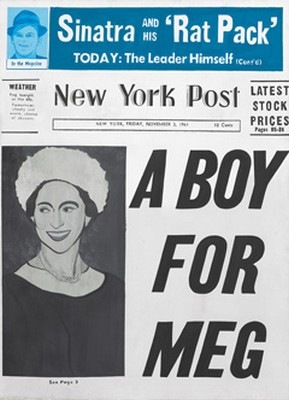
ANDY WAHROL, A Boy for Meg, 1962, oil on canvas, National Gallery of Art  

ANDY WARHOL, A Boy for Meg, 1962, oil on canvas. One of the artist's earliest hand-painted headline canvases. © National Gallery of Art, Washington, Gift of Mr. and Mrs. Burton Tremaine. Courtesy National Gallery of Art.


The first exhibition to examine works that Andy Warhol created on the theme of news headlines will premiere at the National Gallery of Art, Washington. On view from September 25, 2011, to January 2, 2012, WARHOL: HEADLINES will define and bring together works the artist based largely on the tabloid news, demonstrating his career-long obsession with the sensational side of contemporary news media. Source materials for the art will be presented for comparison, revealing Warhol's role as both editor and author. The exhibition is organized by Molly Donovan, associate curator, modern and contemporary art, National Gallery of Art, Washington DC.

The rich headline motif will be traced through some 80 works representing the full variety of its treatment in Warhol's practice, ranging from paintings, drawings, prints, photography, and sculpture to film, video, and television. A major, yet previously unexplored theme running through Warhol's entire career, the headline encompasses many of his key subjects, including celebrity, death, disaster, contemporary events, and the artist as subject.

After Washington, the exhibition will be on view at:

Museum für Moderne Kunst, Frankfurt
February 11 - May 13, 2012

Galleria nazionale d'arte moderna, Rome
June 11 - September 9, 2012

The Andy Warhol Museum, Pittsburgh
October 14, 2012 - January 6, 2013

ANDY WAHROL (1928-1987) is often cited, next to Jackson Pollock, as among the top American artists of the last century. Others name him, alongside Pablo Picasso, as one of the most important 20th-century artists in the world. Wherever one places him, Warhol's reach is indisputable. His visual vocabulary has become a part of the vernacular from which it originally came. Even his prescient 1968 statement "in the future everyone will be famous for fifteen minutes" has become as ubiquitous as the 24-hour news cycle itself.

"Andy Warhol continues to inform our culture in limitless ways through a variety of media," said Earl A. Powell III, director, National Gallery of Art. "We are proud to offer this scholarly, visually compelling exhibition and catalogue of one of the world's most famous and influential artists, providing new information and insights to all visitors, from Warhol specialists to the general public." .

Warhol obsessively scoured newspapers for their stories and images, and he kept many of them in his Time Capsules, most of which he never made into works of art. Those he elevated to the status of art, however, tell a tale that parallels and intersects the artist's own life story at times, collapsing his life and work into one epic account of post-World War II America.

The exhibition opens with the artist's earliest hand-painted headline canvases, including the National Gallery of Art's A Boy for Meg (1962), based on supermarket tabloids—a major influence on American mass culture. From his drawings in the late 1950s while working as a commercial illustrator through his transition into the fine arts in the early 1960s, Warhol explored the powerful underside of journalistic culture. By featuring stories on the joys of celebrity royals, as in A Boy For Meg; Hollywood scandals, such as Eddie Fisher's breakdown in Daily News (1962); and the tragedies of everyday people, as in 129 Die in Jet (1962), in equal measure, Warhol revealed the commodified news value assigned to the passions and disasters of contemporary life. In 1968 Warhol himself became the subject of front page news after he was shot by actress Valerie Solanas. On the occasion of his death in 1987, Warhol was again the subject of the headlines owing to his own celebrity.

Throughout his career, Warhol devoted himself to time-based media (film, video, and television) and even launched his own cable television show (Andy Warhol's T.V.). The exhibition will present the three Screen Tests in which the sitters are reading the newspaper and will show for the first time the artist's 1974 video diary of Factory superstar Brigid Berlin reading the news. Also to be seen for the first time is an outtake from an episode of Andy Warhol's T.V featuring Keith Haring discussing his own use of found tabloid headlines in his first street art interventions.

Later works include black-and-white photographs of newspaper boxes, Warhol's grids of "sewn" photographs featuring newspaper headlines, silkscreened paintings, and his collaborations from the 1980s with younger artists Haring and Jean-Michel Basquiat. 

The exhibition catalogue will include scholarly essays by Molly Donovan; John J. Curley, associate professor of art history, Wake Forest University; John Hanhardt, senior curator for media art, Smithsonian American Art Museum, and Matt Wrbican, archivist, The Andy Warhol Museum, Pittsburgh.

The exhibition is organized by the NATIONAL GALLERY OF ART, Washington DC

www.nga.gov