Showing posts with label exhibition Rome. Show all posts

21/06/13

Candida Höfer at Galleria Borghese, Rome

Candida Höfer at Galleria Borghese
Galleria Borghese, Rome 
20 june - 15 september 2013

The Special Bureau for Artistic and Ethnoanthropological Historical Heritage and for Rome’s Museum Network presents the CANDIDA HOFER AT GALLERIA BORGHESE exhibition. 

The famous Galleria del Lanfranco hosts seven works by the great artist portraying the original reconstruction of the Borghese collection, which was restored to its origins during the I Borghese e l’Antico exhibition (December 2011 – April 2012, curated by Anna Coliva and Marina Minozzi for Galleria Borghese and by Jean-Luc Martinez and Marie Lou Fabréga-Dubert for the Louvre) which brought back to the Gallery the most important ancient art masterpieces that once belonged to the collection, mostly collected by Cardinal Scipione Borghese at the beginning of the Seventeenth century and currently making up the core of the Paris Louvre Museum antiques collection, following the sale imposed by Emperor Napoleon Bonaparte on his brother-in-law Camillo Borghese in 1807. 

Candida Höfer’s work therefore represents the only existing evidence of the collection in its original set-up, which will never be replicated again: some kind of miracle that will never repeat itself. The underlying concept of the exhibition is that out of the reconstruction of an art masterpiece such as the Galleria Borghese collection in its original makeup, another work of art was created. 

In that occasion Candida Höfer – known for her incomparable way of perceiving places and reproducing them through her camera – had therefore documented the mounting of the exhibition halls through the photos that are now in display in their original location, the Galleria itself. 

The exhibition curated by Mario Codognato, Anna Coliva and Marina Minozzi is an exceptional, unique event and will enable visitors to virtually walk through the halls of “The most beautiful villa in the world” - Antonio Canova’s definition - and experience the fascinating atmosphere generated by the exceptional return to their place of origin of the masterpieces of one of the most distinguished and prestigious archaeological collection of all times.

CANDIDA HOFER EXHIBITION
The seven large-size photos – roughly 180 x 200 centimeters – exhibited in the Lanfranco Hall, portray the Villa and reproduce the setting up of the seventeenth and eighteenth century, when sculptures belonging to the celebrated Borghese archaeological collection were still displayed in the Museum halls, in a charming sequence of images. 

Masterpieces such as The Three Graces and The Sleeping Hermaphroditus feature in Candida Hofer’s photos alonside masterpieces of modern sculpture, such as the The Rape of Proserpina by Gian Lorenzo Bernini and the famous Pauline Bonaparte as Venus Victrix by Antonio Canova.

However, the true protagonists of these pictures are not only these extraordinary sculptures but also the Galleria as a whole: its history, its furniture, its works: all these elements make Candida Höfer’s photographs unique and the exhibition a one-off opportunity.

Candida Hofer’s photos stir up emotions thanks to their historical background, their perspective and the brightness of the place itself, defining its original aspects and raising the images to an eternal, absolute dimension.

The exhibition has been organised by Galleria Borghese thanks to Telecom Italia’s support and with the cooperation of Arthemisia Group. The exhibition has also been sponsored by Borghi Italia – Art Division, Axa Art, Arte Assicurazioni srl, Parco dei Principi Grand Hotel and Spa.

THE ARTIST CANDIDA HOFFER
Candida Höfer features among the most relevant artists of German contemporary photography. She was born in Eberswalde, Germany, in 1944 and is a leading exponent of “the School of Dusseldorf”.  She started her artistic career in 1975 taking then part in several international exhibitions, such as Documenta in Kassel in 2002 and Biennale in Venice in 2003, where she exhibited her work in the German Pavillion. Her works feature in the collections of many international museums, such as Centre Pompidou in Paris, Centro de Arte Reina Sofia in Madrid, Kunsthalle in Hamburg, Museum of Modern Art (MOMA) in New York, Kunthalle in Basel. 

CANDIDA HOFER
Photo (c) Ralph Müller, Düsseldorf, 2011

Candida Höfer is renowned for her shots of public spaces, such as museums, libraries, archives, theatres, offices, banks, waiting rooms, underground stations and other culturally and socially crowded places which however stand out due to the total absence of human presence. As a matter of fact, it is a “non-presence” rather than an absence: the portrayed locations seem to be suspended, waiting, ready to welcome the human being, the real protagonist, enjoying those museums and frequenting those libraries.

Roma, Galleria Borghese
Piazzale Scipione Borghese 5
00197 Roma - Italy
www.galleriaborghese.beniculturali.it

16/10/12

Akbar. The Great Emperor of India, Museo Fondazione Roma


Akbar. The Great Emperor of India 
Museo Fondazione Roma, Palazzo Sciarra, Roma
Curated by Gian Carlo Calza 
23th october 2012 - 3th february 2013

Akbar receiving gifts, 1590
Paper, 21,50 x 15,50 cm
National Museum, New Delhi

An exhibition devoted to the Emperor of India, Jalaluddin Muhammad Akbar (Umarkot, 1542-1605, Agra) one of the greatest sovereigns in history is presented by the Fondazione Roma. This exhibition has never been held before in Italy and, due to the number of works and historical completeness, is unique in the world since it covers the Emperor’s entire reign.  The last exhibition on this theme was held in New York by the Asia Society in 1984-86, showing around eighty works relating to 1571-1585. The Exhibition Akbar. The Great Emperor of India has been promoted by the Fondazione Roma and organised by Fondazione Roma-Arte-Musei with the Arthemesia Group. Curated by Gian Carlo Calza, the exhibition presents a selection of works produced during the reign of Emperor Akbar, in order to illustrate the great historical transformations in an age full of political and social events and to portray the personality of a man who made a particular contribution to artistic, cultural and religious dialogue.  

Akbar reigned from 1556 to 1605.  He was the most important Mughal Emperor and became Akbar – meaning ‘The Great’ – as a result of his military commitment and numerous conquests and also because of his administrative reforms and ability to make different religions live together and to spread culture, art and beauty throughout his realm. 

Sita offers fruit to Rama in the forest of Dandaka-ranya
Illustration from The Adventures of Rama (Ramayana)
Orchha, Bundelkhand, 1600-1605
Opaque Watercolor, ink and paper (gold)
28 x 18 cm
National Museum, New Delhi

The exhibition has a vast collection of works of art that aim to describe the classical India that circulates in the Western social imaginary - formed of Mughal Emperors, Rajas and Maharajahs - and was a destination for explorers, merchants and conquerors who arrived in that mysterious, rich and fascinating land from all over the world. An extraordinary nucleus of over 130 works has been selected to describe the life and act of Akbar, the third and principal Emperor of the Mughal imperial dynasty which lasted until the sub-continent was annexed to the British Crown in 1858.

Couple of ornaments for the ears
Probably Mughal domains. Probably early seventeenth century.
Running in gold kundan work with technical and setting with rubies, diamonds and emeralds with pearls suspended - 8.2 x 6.3 cm
Kuwait National Museum, Al-Sabah Collection

Of Muslim lineage, the Mughal were founded by Babur, the first to have conquered India and descendant of Genghis Khan (1162?-1277) and Timur (1369-1450), who lived from 1483 to 1530 and reigned from 1526 until his death. When Babur died his sons, Kamran Mirza and Humayun, Akbar’s father, divided the territories of his realm, though a civil war soon broke out and drove Humayun into exile in Persia. During his peregrinations, Akbar was born, in 1542, in the Rajput Fortress of Umerkot (now Pakistan) and had to be fostered by an uncle in Afghanistan.  Since the future Emperor grew up hunting and fighting amidst soldiers he was not taught to read or write: though he remained illiterate throughout life, he still developed a taste for art, music, literature and architecture. In 1556, at only thirteen years old, Akbar succeeded his father who had recently reconquered the empire and, due to the military brilliance of Bairam Khan, a valiant and faithful General of the Mughal army, he conquered most of the sub-continent and took control of the realm at nineteen years of age.  Thus a new age opened in India since the young warrior proved to be one of the most enlightened sovereigns in history. 

Arghan Dev brings the case of weapons to Amir Hamza
Illustration from The Adventures of Hamza (Hamzanama)
Mughal School, circa 1570
Ink, opaque watercolor and gold on paper and fabric
79.1 x 63.3 cm
Brooklyn Museum, New York

Akbar, a Muslim, rejected any form of religious extremism and aimed to integrate the various races and autochthonous religions with Islam; he invited eminent exponents of each creed to court and appointed them as ministers; abolished the traditional Jizya tax which all non-Muslims were required to pay and, wishing to form an alliance with the Rajputs - an ancient caste of Indian warriors - he married the daughter of Raja Bharmal, Hira Kunwari.  He also abolished the idea of a State religion and introduced the principles of religious tolerance and equality which, in the entire history of humankind, are still exceptional. Driven by his religious tolerance, he attempted to create a syncretic religion that merged Islam and Hinduism; amongst many cities, Akbar also ordered the building of the capital Fatehpur Sikri, the City of Victory, where he lived for fourteen years (1571-1585); he developed and spread the arts which Humayun, his father, had imported from Persia and, together with several Persian painters, created a study with more than a hundred artists to execute sublime works, the style of which spread through all the provinces of his realm. The exhibition, Akbar. The Great Emperor of India, underlines his cultural and artistic, political and military achievements and profound religious spirit and exceptional broadmindedness. 

Turnover (attr.)
Gods asuras change the ocean of milk into butter
Illustration from the Book of war (Razmnama) 1598-99
Ink, opaque watercolor and gold on paper
29.5 x 16.5 cm
The Free Library of Philadelphia

In conjunction with the exhibition, the Fondazione Roma-Arte-Musei has organised the film review Bollywood Film Meeting Roma which aims to offer a glance at the new trends which are becoming popular in cinema productions in the Hindi language of Mumbai. The review, created by Gian Carlo Calza and curated by Sabrina Ciolfi, Indologist and connoisseur of Indian films at the Università degli Studi in Milan, will be held in the Teatro Quirinetta. 

This event is supported by the Italian Ministry for Cultural Heritage and Activities, and has been accomplished through the involvement of the Italian Embassy in New Delhi and Indian Embassy in Rome.  

12/10/10

Andy Warhol Headlines Exhibition 2011 2012 NGA

Warhol: Headlines
National Gallery of Art, Washington

September 25, 2011 - January 2, 2012

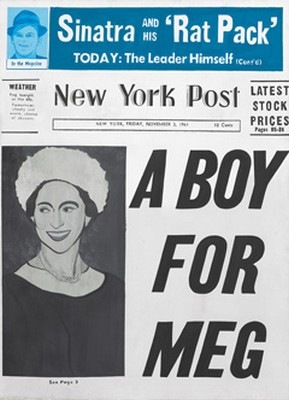
ANDY WAHROL, A Boy for Meg, 1962, oil on canvas, National Gallery of Art  

ANDY WARHOL, A Boy for Meg, 1962, oil on canvas. One of the artist's earliest hand-painted headline canvases. © National Gallery of Art, Washington, Gift of Mr. and Mrs. Burton Tremaine. Courtesy National Gallery of Art.


The first exhibition to examine works that Andy Warhol created on the theme of news headlines will premiere at the National Gallery of Art, Washington. On view from September 25, 2011, to January 2, 2012, WARHOL: HEADLINES will define and bring together works the artist based largely on the tabloid news, demonstrating his career-long obsession with the sensational side of contemporary news media. Source materials for the art will be presented for comparison, revealing Warhol's role as both editor and author. The exhibition is organized by Molly Donovan, associate curator, modern and contemporary art, National Gallery of Art, Washington DC.

The rich headline motif will be traced through some 80 works representing the full variety of its treatment in Warhol's practice, ranging from paintings, drawings, prints, photography, and sculpture to film, video, and television. A major, yet previously unexplored theme running through Warhol's entire career, the headline encompasses many of his key subjects, including celebrity, death, disaster, contemporary events, and the artist as subject.

After Washington, the exhibition will be on view at:

Museum für Moderne Kunst, Frankfurt
February 11 - May 13, 2012

Galleria nazionale d'arte moderna, Rome
June 11 - September 9, 2012

The Andy Warhol Museum, Pittsburgh
October 14, 2012 - January 6, 2013

ANDY WAHROL (1928-1987) is often cited, next to Jackson Pollock, as among the top American artists of the last century. Others name him, alongside Pablo Picasso, as one of the most important 20th-century artists in the world. Wherever one places him, Warhol's reach is indisputable. His visual vocabulary has become a part of the vernacular from which it originally came. Even his prescient 1968 statement "in the future everyone will be famous for fifteen minutes" has become as ubiquitous as the 24-hour news cycle itself.

"Andy Warhol continues to inform our culture in limitless ways through a variety of media," said Earl A. Powell III, director, National Gallery of Art. "We are proud to offer this scholarly, visually compelling exhibition and catalogue of one of the world's most famous and influential artists, providing new information and insights to all visitors, from Warhol specialists to the general public." .

Warhol obsessively scoured newspapers for their stories and images, and he kept many of them in his Time Capsules, most of which he never made into works of art. Those he elevated to the status of art, however, tell a tale that parallels and intersects the artist's own life story at times, collapsing his life and work into one epic account of post-World War II America.

The exhibition opens with the artist's earliest hand-painted headline canvases, including the National Gallery of Art's A Boy for Meg (1962), based on supermarket tabloids—a major influence on American mass culture. From his drawings in the late 1950s while working as a commercial illustrator through his transition into the fine arts in the early 1960s, Warhol explored the powerful underside of journalistic culture. By featuring stories on the joys of celebrity royals, as in A Boy For Meg; Hollywood scandals, such as Eddie Fisher's breakdown in Daily News (1962); and the tragedies of everyday people, as in 129 Die in Jet (1962), in equal measure, Warhol revealed the commodified news value assigned to the passions and disasters of contemporary life. In 1968 Warhol himself became the subject of front page news after he was shot by actress Valerie Solanas. On the occasion of his death in 1987, Warhol was again the subject of the headlines owing to his own celebrity.

Throughout his career, Warhol devoted himself to time-based media (film, video, and television) and even launched his own cable television show (Andy Warhol's T.V.). The exhibition will present the three Screen Tests in which the sitters are reading the newspaper and will show for the first time the artist's 1974 video diary of Factory superstar Brigid Berlin reading the news. Also to be seen for the first time is an outtake from an episode of Andy Warhol's T.V featuring Keith Haring discussing his own use of found tabloid headlines in his first street art interventions.

Later works include black-and-white photographs of newspaper boxes, Warhol's grids of "sewn" photographs featuring newspaper headlines, silkscreened paintings, and his collaborations from the 1980s with younger artists Haring and Jean-Michel Basquiat. 

The exhibition catalogue will include scholarly essays by Molly Donovan; John J. Curley, associate professor of art history, Wake Forest University; John Hanhardt, senior curator for media art, Smithsonian American Art Museum, and Matt Wrbican, archivist, The Andy Warhol Museum, Pittsburgh.

The exhibition is organized by the NATIONAL GALLERY OF ART, Washington DC

www.nga.gov