Showing posts with label pictures. Show all posts

23/09/25

Sky Hopinka: Fainting Spells @ Guggenheim Museum Bilbao - Video Exhibition Overview + Artist Biography

Sky Hopinka: Fainting Spells 
Guggenheim Museum Bilbao
September 18, 2025 – January 18, 2026

Sky Hopinka - Fainting Spells Video
Sky Hopinka
Fainting Spells, 2018
Three-channel color video, with sound, 9 min., 45 sec.
A.P. 1/2, edition of 3
Solomon R. Guggenheim Museum, New York, 
Purchased with funds contributed by the Photography Council, 2021
© Sky Hopinka

Sky Hopinka - Fainting Spells Video
Sky Hopinka
Fainting Spells, 2018
Three-channel color video, with sound, 9 min., 45 sec.
A.P. 1/2, edition of 3
Solomon R. Guggenheim Museum, New York, 
Purchased with funds contributed by the Photography Council, 2021
© Sky Hopinka

The Guggenheim Museum Bilbao presents Sky Hopinka: Fainting Spells, an exhibition in its Film & Video program.

Fainting Spells (2018), a film by the artist Sky Hopinka (Ferndale, Washington, 1984), explores the creation mythology of Xąwįska, or Indian Pipe Plant, also known as “ghost flower” or “corpse plant.” This medicinal plant is traditionally used by the Ho-Chunk people of Wisconsin to revive those who have fainted. It is also emblematic of Indigenous identity, knowledge, and culture and can be linked to the cycles of life and death and the spiritual world. Despite his extensive research, Hopinka could not unearth an origin myth for the plant and instead created one to engage with and reclaim the practice of mythkeepers and mythmaking in his own Indigenous culture.

This three-channel video begins with a handwritten poem that moves across scenes showing expansive colorful landscapes accompanied by lyrical music. The poem, a printed version of which is also showcased at the exhibition, speaks directly to Xąwįska, who later appears personified as a cloaked figure and leads viewers on a walk through the spirit world in different states of consciousness. Filmed in Washington, Colorado, Wisconsin, Oregon, and New Mexico, the film creates a dreamlike visual narrative by collaging together music, poetry, image, sound, and color, inviting viewers into a unique immersive experience created specifically for the Guggenheim Museum Bilbao’s Film & Video gallery.

Sky Hopinka - Fainting Spells Video
Sky Hopinka
Fainting Spells, 2018
Three-channel color video, with sound, 9 min., 45 sec.
A.P. 1/2, edition of 3
Solomon R. Guggenheim Museum, New York, 
Purchased with funds contributed by the Photography Council, 2021
© Sky Hopinka

Sky Hopinka - Fainting Spells Video
Sky Hopinka
Fainting Spells, 2018
Three-channel color video, with sound, 9 min., 45 sec.
A.P. 1/2, edition of 3
Solomon R. Guggenheim Museum, New York, 
Purchased with funds contributed by the Photography Council, 2021
© Sky Hopinka

Sky Hopinka explores Indigenous culture, history, and traditional beliefs through themes like identity, memory, language, and myth. A member of the Ho-Chunk Nation of Wisconsin and a descendent of the Pechanga Band of Luiseño people (California), the Pacific Northwest holds a special place in his artwork, especially as he delves into investigating notions of homeland, personhood, and landscape. His films reflect on the complexities of contemporary Indigenous life by blending non-narrative filmmaking and abstract imagery with an ethnopoetic approach—a response against the ethnographic gaze that has long objectified Indigenous cultures in moving image.

Ethnopoetic cinema examines themes of cultural identity, displacement, and the everyday experience through a combination of documentary and experimental filmmaking techniques, thereby emphasizing the artistic and performative aspects of cultural expression. At the core of Hopinka’s work is a profound commitment to storytelling through his Indigenous perspective, a narrative that has long been marginalized within the Western canon. He explains, “Part of the desire I had to make films was to tell Indigenous stories that were unique to my own community and my own identity.”

Sky Hopinka - Photo Portrait
Sky Hopinka
(b. 1984, Ferndale, Washington)
Courtesy the artist
© Sky Hopinka

Sky Hopinka - Biography

Sky Hopinka was born and raised in Ferndale, Washington, and spent a number of years in Palm Springs and Riverside, California; Portland, Oregon; and Milwaukee, Wisconsin. In Portland, he studied and taught chinuk wawa, a language indigenous to the Pacific Northwest, and began to take an interest in documentary filmmaking. In Milwaukee, he enrolled in a graduate degree in experimental filmmaking and discovered unconventional ways of documentary filmmaking that enabled him to uniquely express his interest in Indigenous languages and Native American life today. He currently lives in Brooklyn, New York, and is an assistant professor in the Department of Art, Film, and Visual Studies at Harvard University, Cambridge.

Sky Hopinka’s work has played at prestigious festivals including Sundance Film Festival, Utah; Toronto International Film Festival, Ontario; Courtisane Festival, Ghent; Festival Punto de Vista, Pamplona; and the New York Film Festival, New York. His work has also been recognized internationally in numerous solo exhibitions at institutions like the Center for Curatorial Studies–Bard College, Annandale-On-Hudson, New York (2020); Saint Louis Art Museum, St. Louis (2020); The Museum of Modern Art, New York (2021); LUMA, Arles, France (2022); San Francisco Museum of Modern Art (2023); Frye Art Museum, Seattle (2024); and Kunsthalle Friart, Switzerland (2024). Moreover, his work was included in the Whitney Biennial, Whitney Museum of American Art, New York (2017); the Gwangju Biennial, South Korea (2023); and the Göteborg International Biennial, Sweden (2023).

Sky Hopinka’s films, videos, and photographs are in the collections of some of the most important museums in the world. Additionally, Hopinka was a fellow at the Radcliffe Institute for Advanced Study at Harvard University, Cambridge (2018–19); Sundance Art of Nonfiction Fellow, Sundance Institute, Los Angeles (2019); Guggenheim Fellow for Creative Arts (2020); Forge Project Fellow (2021); and a MacArthur Fellow (2022). His multiple awards include the Herb Alpert Award in the Arts, Film, & Video (2020); the Infinity Award in Art from the International Center of Photography (2022); and the Persistence of Vision Award from the San Francisco International Film Festival (2025).

Curator: Geaninne Gutiérrez-Guimarães

Guggenheim Bilbao also presents, from October 16, 2025 through February 22, 2026, the exhibition Maria Helena Vieira da Silva: Anatomy of Space.

GUGGENHEIM MUSEUM BILBAO

26/03/23

Dorothea Lange: The Family Collection @ Phillips, NYC

Dorothea Lange: The Family Collection
Phillips, New York
Online Auction: 29 March - 5 April, 2023

Dorothea Lange
DOROTHEA LANGE
White Angel Breadline, San Francisco, 1933
Estimate: $15,000 - 25,000
Image Courtesy Phillips

Dorothea Lange
DOROTHEA LANGE
Women Workers, Richmond Shipyard, 1943
Estimate: $6,000 - 8,000
Image Courtesy Phillips

Dorothea Lange
DOROTHEA LANGE
Street Demonstration, San Francisco (Down with Sales Tax), 1934
Estimate: $3,000 - 5,000
Image Courtesy Phillips

Phillips announces the second session of Dorothea Lange: The Family Collection, a trove of 50 photographs coming directly from the descendants of this seminal American photographer. This sale follows Phillips’ first offering from the Family Collection offered in October 2022. Part Two is open for bidding from 29 March to 5 April, 2023.

The sale features some of Dorothea Lange’s most indelible images from her multi-decade career in photography, as well as many images which will be new to collectors. All were in the photographer’s collection at the time of her death, passed along to her descendants, and represent the entirety of her career, from the first socially conscious images she made outside her portrait studio in San Francisco, through her work for the Farm Security Administration during the Depression, to her post-war documentary projects, much of it done in the company of her husband and collaborator Paul Taylor.


Dorothea Lange
DOROTHEA LANGE
Paul S. Taylor with Farmer, circa 1936
Estimate: $3,000 - 5,000
Image Courtesy Phillips

Dorothea Lange
DOROTHEA LANGE
Migratory Cotton Pickers, Eloy, Arizona, 1940
Estimate: $7,000 - 9,000
Image Courtesy Phillips

Dorothea Lange
DOROTHEA LANGE
Vietnam, 1958
Estimate $3,000 - 5,000
Image Courtesy Phillips

Born in Hoboken in 1895, Dorothea Lange learned to photograph as a young woman before her departure for the west coast in 1918. Talented and ambitious, Dorothea Lange opened a portrait studio that catered to San Francisco’s upper crust. After witnessing first-hand the social upheaval caused by the Depression, she took to the streets with her camera, taking images of labor demonstrations, the newly unemployed, and men, women, and children who were without home or income – images that would set the trajectory for the rest of her career.

During the Depression she traveled the country under the auspices of the Farm Security Administration, documenting the poverty endured by Americans and creating some of the most culturally relevant images of the 20th century. She brought her incisive and empathetic documentary style to a variety of national and international subjects during and after World War II. Dorothea Lange was witness to a world in transition and her camera captured it all. Her photographs show that the story of the 20th century is the story of individuals: their struggle, their success, and their perseverance.

Online Auction: 29 March - 5 April
Auction Viewing: 432 Park Avenue, New York, NY 10022

Estimates do not include buyer’s premium; prices achieved include the hammer price plus buyer’s premium.

PHILLIPS NEW YORK
432 Park Avenue, New York, NY 10022

06/10/22

Deana Lawson @ High Museum of Art, Atlanta

Deana Lawson
High Museum of Art, Atlanta
October 7, 2022 — February 19, 2023

Deana Lawson
Deana Lawson
(American, born 1979)
Hair Advertisement, 2005
Pigment print
Courtesy the artist; Sikkema Jenkins & Co., New York; 
and David Kordansky Gallery, Los Angeles
© Deana Lawson

Deana Lawson
Deana Lawson
(American, born 1979)
Coulson Family, 2008
Pigment print
Courtesy the artist; Sikkema Jenkins & Co., New York; 
and David Kordansky Gallery, Los Angeles
© Deana Lawson

The High Museum of Art presents the first museum survey dedicated to DEANA LAWSON, who is known for investigating and challenging conventional representations of Black identities and bodies through her photographs. Co-organized by the Institute of Contemporary Art / Boston and MoMA PS1, “Deana Lawson” features nearly 60 works made over the past two decades that evoke a range of histories and photographic styles, including family albums, studio portraiture and staged tableaux, and employ documentary pictures and appropriated images.
“Lawson’s works, which are complex not only in their composition but also in the emotions they evoke, challenge us to think critically about Black representation and confront our perceptions of Black identity,” said Rand Suffolk, Nancy and Holcombe T. Green, Jr., director of the High. “Her photographs open important dialogues, and we look forward to bringing them to Atlanta and sharing them with our audience.”
In Deana Lawson’s highly staged tableaux, individuals, couples and families are pictured in intimate domestic spaces and public settings. As they depict these intimate scenes, they also channel broader ideas about individual and social histories, sexuality and spiritual beliefs. Lawson’s practice is global in scope, as she creates her images throughout the African diaspora in locations as varied as Brooklyn, Haiti, Jamaica, Ethiopia, Brazil, the Democratic Republic of the Congo and the Southern United States. This broad geographical range points to the artist’s interest in a collective memory of shared experiences and various cultural histories of the past.

Deana Lawson also uses photography to challenge assumptions about the facts the medium purports to deliver. She carefully composes each scene but does not always disclose details about how she has created them, or even where the photographs were taken. In some cases, she works with found images that depict people she does not know. Her tableaux tend to be composed of people she encounters on her travels rather than family, friends or acquaintances. Despite what certain pictures may suggest, some of the artist’s subjects may not have met before the shoot.

Deana Lawson
Deana Lawson
(American, born 1979)
Nation, 2018
Pigment print and collaged photograph
Courtesy the artist; Sikkema Jenkins & Co., New York; 
and David Kordansky Gallery, Los Angeles
© Deana Lawson

Deana Lawson
Deana Lawson
(American, born 1979)
Black Gold (“Earth turns to gold, in the hands of the wise,” Rumi), 2021
Pigment print with embedded hologram
Courtesy the artist; Sikkema Jenkins & Co., New York; 
and David Kordansky Gallery, Los Angeles
© Deana Lawson
“Lawson is a singular voice in contemporary photography who causes us to question our assumptions about the medium’s relationship to the real,” said Gregory Harris, the High’s Donald and Marilyn Keough Family curator of photography. “Though her photographs appear to be drawn from the happenstance of everyday life, they are rigorously orchestrated portals to a world of Deana’s creation that nevertheless offers deep insight into the lived experience of people across the diaspora.”
The exhibition is arranged chronologically according to when the photographs were created, with themes of familial bonds, the female figure and the allure of popular media images recurring throughout.

DEANA LAWSON (American, born 1979) lives and works in New York and Los Angeles. She received her B.F.A. from Pennsylvania State University (2001) and her M.F.A. from the Rhode Island School of Design (2004). She is the recipient of a Guggenheim Fellowship (2013), an Aaron Siskind Foundation Fellowship Grant (2008-2009), and a New York Foundation for the Arts Grant (2006), among others. In 2020, she was selected for the Hugo Boss Prize, the first photographer to receive the award in recognition of achievement in contemporary art. She is also the inaugural Dorothy Krauklis ’78 Professor of Visual Arts at Princeton University’s Lewis Center for the Arts.

Exhibition Catalogue
The exhibition is accompanied by the first scholarly publication on the artist, surveying 15 years of her photography. Featuring the voices and perspectives of a variety of scholars, historians and writers, the catalogue includes essays by exhibition curators Peter Eleey and Eva Respini, Kimberly Juanita Brown, Tina M. Campt, Alexander Nemerov and Greg Tate, and a conversation between the artist and Deborah Willis.

HIGH MUSEUM OF ART
1280 Peachtree St NE, Atlanta, GA 30309

28/09/22

Photographer Dorothea Lange Family Collection @ Philips, New York

Dorothea Lange: The Family Collection
Phillips, New York
2 - 13 October, 2022

Dorothea Lange
DOROTHEA LANGE
White Angel Breadline, San Francisco, 1933
Estimate: $20,000 - 30,000
Courtesy of Phillips

Dorothea Lange
DOROTHEA LANGE
Street Demonstration, San Francisco, 1933
Estimate $8,000 - 12,000
Courtesy of Phillips

Dorothea Lange
DOROTHEA LANGE
Kern County, California (Olson for Governor), 1938
Estimate $7,000 - 9,000
Courtesy of Phillips

Phillips announces the sale of Dorothea Lange: The Family Collection, a trove of over 100 photographs coming directly from the descendants of this seminal American photographer. The collection will be sold in two separate online offerings scheduled alongside Phillips’ October 2022 and April 2023 Photographs auctions in New York. The first of these two online-only sales will be exhibited at Phillips’ Park Avenue galleries in New York from 2-13 October, with bidding open on 3 October.

The two sales feature some of Dorothea Lange’s most indelible images from her multi-decade career in photography, as well as many images which will be new to collectors. All were in the photographer’s collection at the time of her death, passed along to her descendants, and represent the entirety of her career, from the first socially-conscious images she made outside her portrait studio in San Francisco, through her work for the Farm Security Administration during the Depression, to her post-war documentary projects, much of it done in the company of her husband and collaborator Paul Taylor.

Dorothea Lange
DOROTHEA LANGE
Shipyard Worker and Family in Trailer Camp, Richmond, California, 1944
Estimate $6,000 - 8,000
Courtesy of Phillips

Dorothea Lange
DOROTHEA LANGE
New York City (Man in Raincoat), 1952
Estimate $4,000 - 6,000
Courtesy of Phillips

Dorothea Lange
DOROTHEA LANGE
Selected Images from The Public Defender, 1955
Estimate $18,000 - 22,000
Courtesy of Phillips

Dorothea Lange
DOROTHEA LANGE
Procession Bearing Food for the Dead, Egypt, 1963
Estimate $3,000 - 5,000
Courtesy of Phillips

Highlights of the October offering include a print of one of Dorothea Lange’s earliest and most decisive documentary images, White Angel Breadline, whose central figure embodies the poverty of the Depression and the grit to overcome it. The sale will feature a suite of 16 images from Dorothea Lange’s celebrated Public Defender series of 1955, in which her detailed portrayal of a public defense attorney and his clients set the template for a new kind of photojournalism. It is the largest group from this series to appear at auction.

The sale also includes an unprecedented selection of her international photography, begun in the 1950s, when she traveled with Paul Taylor to Ireland, Egypt, and Asia, creating a panoramic portrait of humanity across all cultures.

Estimates do not include buyer’s premium; prices achieved include the hammer price plus buyer’s premium.

Auction: 3 – 13 October 2022
Auction viewing: 2 – 13 October 2022
Location: 432 Park Avenue, New York, NY 10022

PHILLIPS NEW YORK 
432 Park Avenue, New York, NY 10022

09/02/21

Garrett Bradley @ MoMA, New York

Projects: Garrett Bradley
MoMA, New York
Through March 21, 2021

Garrett Bradley

GARRETT BRADLEY
America, 2019
Dir. Garrett Bradley
Courtesy the filmmaker

Garrett Bradley

GARRETT BRADLEY
America, 2019
Dir. Garrett Bradley
Courtesy the filmmaker

The Museum of Modern Art presents Projects: Garrett Bradley, the artist’s first solo museum exhibition in New York, in the Museum’s street-level galleries. This exhibition, presented as part of a multiyear partnership between The Museum of Modern Art and the Studio Museum in Harlem, features a multichannel video installation, America (2019), a work organized around 12 short black-and-white films shot by Garrett Bradley and set to a score by Trevor Mathison and Udit Duseja. Among her original short vignettes, Garrett Bradley intersperses footage from Lime Kiln Club Field Day, an unreleased 1914 film believed to be the oldest surviving feature-length film with an all-Black cast. With America, Garrett Bradley imagines and pictures Black figures whose lives have been lost to history. Projects: Garrett Bradley is organized by Thelma Golden, Director and Chief Curator, the Studio Museum in Harlem, with Legacy Russell, Associate Curator, the Studio Museum in Harlem.

Garrett Bradley

GARRETT BRADLEY
America, 2019
Dir. Garrett Bradley
Courtesy the filmmaker

The Library of Congress has estimated that 70 percent of the feature-length films made in the US between 1912 and 1929 have been lost. It is in these years that Garrett Bradley’s America finds its footing. Her evocative vignettes cite historical events, ranging from African American classical composer and baritone singer Harry T. Burleigh’s publication of the iconic spiritual “Deep River” in 1917, to the murder of popular jazz bandleader James Reese Europe in 1919, to the founding of baseball’s Negro National League (NNL) in 1920, and more. By including borrowed footage from Lime Kiln Club Field Day, Bradley also shines light on the history of a film radically progressive for its time. Lime Kiln Club Field Day evokes Black intimacy and a convivial sharing of space that celebrates Black vernacular movement and expression. This film had never been seen publicly until 2014, after it was rediscovered and restored by MoMA. By revisiting the recovery of this lost work and by giving lost stories visual life, Garrett Bradley considers how film impacts our ability to imagine history’s relationship to contemporary life. Garrett Bradley has said of her work, “I see America as a template for how visual storytelling and the assembly of images can serve as an archive of the past and a document of the present.”

Garrett Bradley’s Projects exhibition occurs in New York at a time when the status of early-20thcentury racial representations has become a matter of discussion and debate. As a multichannel installation, Garrett Bradley’s America constructs a physical space of invention in which turn-of-the-20th-century Black people and their ordinary lives are made present in ways that exceed the confines of what is available in an official archive.

Garrett Bradley

GARRETT BRADLEY
America, 2019
Dir. Garrett Bradley
Courtesy the filmmaker

GARRETT BRADLEY BIOGRAPHY

Garrett Bradley (born 1986) is an artist and filmmaker born and raised in New York City. Working across narrative, documentary, and experimental modes of filmmaking, Garrett Bradley’s work addresses themes such as race, class, familial relationships, social justice, Southern culture, and the history of film in the US. Her collaborative, research-based approach to filmmaking is often inspired by the real-life stories of her subjects. For Garrett Bradley, this research takes multiple forms—deep dives into historical archives, in-depth dialogues prompted by Craigslist want-ads, or an extended engagement with the communities and individuals she seeks to represent—and results in works that combine both scripted and improvisatory scenes. Garrett Bradley’s films explore the space between fact and fiction, embracing modes of working and of representing history that blur the boundaries between traditional notions of narrative and documentary cinema.

Garrett Bradley received her MFA from University of California, Los Angeles, and a BA from Smith College. Her short films and feature-length projects have been exhibited internationally at museums and festivals including the New Orleans Museum of Art; Whitney Biennial 2019, Whitney Museum of American Art, New York; The J. Paul Getty Museum, Los Angeles; Sundance Film Festival, Park City, Utah; Tribeca Film Festival, New York; Festival du Nouveau Cinema, Montreal; Rotterdam Film Festival, The Netherlands; and SXSW, Austin, Texas; among many others. In 2020 Garrett Bradley became the first African American woman to win the Directing Award: U.S. Documentary at the 2020 Sundance Film Festival, and she has received numerous awards and honors, including a 2019–20 Rome Prize from the American Academy in Rome, and the 2017 Sundance Jury Prize for her short film Alone, which was released by the New York Times OpDocs and became an Oscar contender for short nonfiction filmmaking, included in Academy Shortlist. Garrett Bradley was second unit director on Ava DuVernay’s When They See Us, and in December 2019 she opened her first museum solo exhibition, Garrett Bradley: American Rhapsody at the Contemporary Arts Museum Houston, curated by Rebecca Matalon.

MoMA - MUSEUM OF MODERN ART
11 West 53 Street, New York

20/07/20

Edward Hopper. A–Z, Hatje Cantz

Edward Hopper. A–Z
Hatje Cantz, 2020

EDWARD HOPPER. A–Z
Hatje Cantz Verlag, 2020
Text by Ulf Küster
Graphic design by Torsten Köchlin und Joana Katte
English or German, 120 pp., 40 ills., hardcover
13.00 x 19.50 cm - 18,00€

In Europe Edward Hopper is primarily known for his oil paintings of scenes of urban life, and he is considered one of the twentieth century’s most important artists. His less familiar landscape paintings are now on display in a show at the Fondation Beyeler as well as in the catalogue A Fresh Look at Landscape. In the accompanying volume, Edward Hopper. A–Z, the curator and art theoretician Ulf Küster sheds some light on the ABCs of the artist’s life and work. 

Josephine and Edward Hopper 
in Two Lights Cape Elizabeth, Maine 1927

Edward Hopper began his career as an illustrator, but today Edward Hopper (1882–1967) is mainly known as a painter. His paintings display his virtuosity in the depiction of light and shadow, which formed the basis of a unique aesthetic that went beyond painting into the realms of pop culture, film, and photography.

An atmosphere of melancholy and isolation runs through Edward Hopper’s paintings, and it can also be perceived in his landscape paintings. At the same time they convey a threat, which he portrays in his work by relating landscape to city as the human invasion of nature. This is geometrically clear in the pictorial composition: buildings that make the presence of humans obvious are important elements. Railroads structure the pictures horizontally, while the expanded sky and atmospheric light show the transformation of nature in the still landscape.
“Landscape always shows the influence of humankind on nature, something that Hopper’s pictures subtly reflect in a variety of ways. He created a manifestly modern approach to one of art history’s established genres.,” says the curator Ulf Küster about the significance of Edward Hopper’s landscape pictures.
Edward Hopper ca. 1937
Photo: Harris & Ewing

Appearing concurrently with the show at the Fondation Beyeler, the book Edward Hopper. A–Z sheds light on the biographical details of Edward Hopper’s life, with a view to how they affected his work. From “A,” as in “American landscape,” to “Z,” as in Zero, Ulf Küster entertainingly and informatively tells of important influences and specific places involved in Edward Hopper’s oeuvre. Hence, the reader discovers what kind of influence Goethe’s work had on the painter, or which brand of car the artist preferred, thus gaining enriching insight into his work, which allows for new interpretations.

EXHIBITION: Edward Hopper, Fondation Beyeler, Riehen/Basel, January 26 – September 20, 2020

HATJE CANTZ
www.hatjecantz.de

25/05/19

Carl Chiarenza @ Virginia Museum of Fine Arts, Richmond

Carl Chiarenza
Virginia Museum of Fine Arts, Richmond
Through November 12, 2019

Carl Chiarenza
CARL CHIARENZA (American, born 1935)
Burnham Brothers, Essex, MA, 1962, printed later
Gelatin silver print
Virginia Museum of Fine Arts
Gift of Carl Chiarenza, 2016.516
© Carl Chiarenza, Courtesy of the VMFA

The Virginia Museum of Fine Arts (VMFA) presents an exhibition of works by photographer CARL CHIARENZA, on view in the Photography Gallery. Born to Italian immigrant parents and raised in Rochester, New York, Carl Chiarenza’s interest in photography developed early in his childhood. From 1953 to 1957, Carl Chiarenza studied at the Rochester Institute of Technology under the direction of Minor White and Ralph Hattersley. Since the late 1960s, Carl Chiarenza has been a leading figure in a movement that seeks to expand the conceptual boundaries of photography.

Carl Chiarenza’s photographs have been included in more than 80 solo and 250 group exhibitions since 1957. His black and white photographs, which often contain elements of collage, have continued to challenge notions of landscape, abstraction, visitor perspective, and the very medium of photography itself. This free exhibition is curated by Virginia Museum of Fine Arts Executive Director and CEO Alex Nyerges.

“The Virginia Museum of Fine Arts is incredibly grateful to Carl Chiarenza for his generous gift of works to the museum,” says Alex Nyerges. “I am honored to curate the first Chiarenza exhibition at VMFA, and hope that these twenty-two phenomenal works will offer museum members and visitors an opportunity for a deeper understanding and fresh perspective of the limitless world of photography.”

Carl Chiarenza
CARL CHIARENZA (American, born 1935)
Sulfite White Figure with Spears, 1962, printed later
Gelatin silver print
Virginia Museum of Fine Arts
Gift of Carl Chiarenza, 2016.517
© Carl Chiarenza, Courtesy of the VMFA

Carl Chiarenza is inspired by both the beauty and human connections to landscapes, but has been continuously dissatisfied with traditional outdoor nature photographs. In acknowledging that depictions of landscapes in paintings are constructed, he began to approach his photographs as abstract and emotional constructions that allow us to examine nature in relation to the self.

The key characteristic that came to dominate Carl Chiarenza’s style was nyctophilia, or a preference for and comfort in darkness. His photographs do not offer familiar faces or landscapes; there is no evident cultural or psychological framework for the viewer to build their response. Rather, the lack of specificity and sense of timelessness reminds us that all photographs are constructions of reality that produce various interpretations relative to each viewer. Carl Chiarenza’s work invites individual reflection by forcing us to examine the subliminal workings of the mind. In these photographs, nothing is absolute, leaving all realities subject to each observer. 

VIRGINIA MUSEUM OF FINE ARTS - VMFA
200 N. Arthur Ashe Blvd., Richmond,  VA 23220
www.vmfa.museum

24/05/19

Regina Riveira @ Olympic Sculpture Park, Seattle Art Museum - Octopus Wrap

Regina Silveira: Octopus Wrap
Seattle Art Museum, Olympic Sculpture Park
Through March 8, 2020

Regina Silveira
REGINA SILVEIRA
Installation view of Regina Silveira: Octopus Wrap 
at the Olympic Sculpture Park. 
© Seattle Art Museum. Photo: Natali Wiseman

SAM’s Olympic Sculpture Park presents Regina Silveira: Octopus Wrap, a new site-specific installation for the PACCAR Pavilion. Inspired by the park’s location at the intersection of several busy thoroughfares, Octopus Wrap envelops the building’s walls in a mind-bending tire track pattern that questions our perception of reality. This is the first time the internationally celebrated artist has shown work in Seattle.

Brazilian artist Regina Silveira is renowned for her illusionistic interventions on buildings, city streets, and public parks. These surreal disruptions of public spaces have included exaggerated shadows, swarms of insects, dense clusters of footprints, and nocturnal light projections of animal tracks wandering across building façades. Regina Silveira started her career in the 1950s and has become one of the country’s most revered artists, creating works that investigate the representation of reality and the power of art to transform.

For this installation, Regina Silveira has wrapped the PACCAR Pavilion’s floor, walls, and windows in an improbable pattern of overlapping tire tracks that from a distance recall the arms of an octopus. The installation resolves on the building’s interior mural wall in five toy motorcycles driven by five tiny drivers. Taking the park’s location—zigzagging around busy city streets, railroad tracks, and waterways—as inspiration, Octopus Wrap upends the viewer’s perception of a well-known space, disrupting its austerity with boisterous visual noise.

“Silveira is an extraordinary artist who has inspired several generations of artists in Brazil,” says Catharina Manchanda, SAM’s Jon and Mary Shirley Curator of Contemporary Art. “Her artistic gesture is political in the sense that she aims to disrupt the familiar. Irreverent and fantastical, her immersive installation is like a noisy parade that stops us in our tracks.”

Regina Silveira
REGINA SILVEIRA
Installation view of Regina Silveira: Octopus Wrap 
at the Olympic Sculpture Park. 
© Seattle Art Museum. Photo: John Reed

ABOUT REGINA SILVEIRA

Regina Silveira was born in 1939 in Porto Alegre, Brazil. She received her Ph.D. in 1984 at Universidade de São Paulo, Brazil and has taught there since 1974.

Noteworthy recent solo shows include EXIT, Museu Brasileiro da Escultura – MuBE, São Paulo, Brazil, 2018; Todas As Escadas, Instituto Figueiredo Ferraz, Ribeirão Preto, Brazil, 2018; Crash, Museu Oscar Niemeyer, Curitiba, Brazil, 2015; and 1001 Dias e Outros Enigmas, Fundação Iberê Camargo, Porto Alegre Brazil, 2011. Regina Silveira’s recent group exhibitions include Mixed Realities, Kunst Museum, Stuttgart, Germany, 2018; Imprint, Academy of Fine Arts, Warsaw, Poland, 2017; Future Shock, Site Santa Fe, Santa Fe, USA, 2017; Radical Women in Latin America, Hammer Museum, Los Angeles, USA, 2017; and Consciência Cibernética [?], Itaú Cultural, São Paulo, Brazil, 2017.

Regina Silveira has taken part in over 13 international biennials and received noteworthy grants including Prêmio MASP (2013), Prêmio APCA for her trajectory (2011) and Prêmio Fundação Bunge (2009). The artist also received grants from the John Simon Guggenheim Foundation (1990), Pollock-Krasner Foundation (1993) and Fulbright Foundation (1994).

SAM's OLYMPIC SCULPTURE PARK
2901 Western Avenue, Seattle, WA 98121
seattleartmuseum.org

12/02/19

Jeffrey Gibson @ Seattle Art Museum - Like a Hammer

Jeffrey Gibson: Like a Hammer
Seattle Art Museum
February 28 – May 12, 2019

Jeffrey Gibson
JEFFREY GIBSON
Like A Hammer, 2014
Jeffrey Gibson, Mississippi Band of Choctaw Indians/Cherokee, b. 1972 
Elk hide, glass beads, artificial sinew, wool blanket, metal studs, steel, found pinewood block, and fur, 56 × 24 × 11 in.
Collection of Tracy Richelle High and Roman Johnson, courtesy of Marc Straus Gallery, New York.
Image courtesy of Jeffrey Gibson Studio and Roberts Projects, Los Angeles, California.
Photo: Peter Mauney.

The Seattle Art Museum presents Jeffrey Gibson: Like a Hammer, a major survey of works from 2011 to the present that reflects the artist’s deepening exploration of his Indigenous heritage, legacies of abstraction, and popular and alternative cultures. Organized by the Denver Art Museum, the exhibition features over 65 works produced during a pivotal time in the Jeffrey Gibson’s career, including abstract geometric paintings on rawhide and canvas, beaded punching bags, sculptures, wall hangings, and video. Reflecting the complexity of modern identity, Jeffrey Gibson’s work envisions a more inclusive future.

A contemporary artist of Cherokee heritage and a citizen of the Mississippi Band of Choctaw Indians, Jeffrey Gibson grew up in the US and urban centers in Europe and South Korea. As a young adult, he was involved in queer club culture and interested in popular music, fashion, and design. These experiences inform his vision of exuberant hybridity, in which glass beads, metal jingles, ribbons, song lyrics, and abstract geometric patterns come together. Gibson’s use of materials and references that resonate in modern and contemporary Western art, as well as Indigenous and ancient cultures, establishes a unique visual vocabulary that gives rise to new possibilities and points of connection.

A highlight of the exhibition is 15 punching bags, most of which are from the Everlast series that marked an artistic breakthrough for Jeffrey Gibson. Intricately adorned in beads, fringe, and jingles, and often incorporating text, the punching bags shift gender associations between the masculine and the feminine. They also prompt reflection about the history of violence against Indigenous cultures and signal a call for resilience and perseverance. Like a Hammer also features IF I RULED THE WORLD (2018), which was recently acquired by the Seattle Art Museum for its permanent collection.

Jeffrey Gibson
JEFFREY GIBSON
I PUT A SPELL ON YOU, 2015 
Jeffrey Gibson, Mississippi Band of Choctaw Indians/Cherokee, b. 1972
Repurposed punching bag, glass beads, artificial sinew, and steel; 40 × 14 × 14 in.
Collection of the Nasher Museum of Art at Duke University, Durham, North Carolina. 
Museum purchase, 2015.11.1.
Image courtesy of Jeffrey Gibson Studio and Roberts Projects, Los Angeles, California.
Photo: Peter Mauney

Language plays an important role in Jeffrey Gibson's work, with lines from pop songs and other sources adorning vibrant woven and patterned wall hangings and punching bags. Taken from such diverse sources as James Baldwin, Pete Seeger, Culture Club, and Public Enemy, among others, the phrases take on multiple meanings and speak to resistance, reclamation, and celebration.

Like a Hammer features many of Jeffrey Gibson’s abstract geometric paintings on canvas and rawhide, in which he explores pattern, light, and color, prompting the viewer to see abstraction through the lens of Indigeneity. Also on view are midsize and large figurative sculptures. The colorful “club kid” figures are inspired by his experiences in the queer club scenes of South Korea, London, and New York in the 1980s and ’90s and connect to his interest in performance, theatricality, and communal experiences. By contrast, his “ancestor” figures are draped with elaborately ornamented cloaks and topped with clay heads reminiscent of skulls or ancient Mississippian culture effigy heads. While visually fierce, these works are seen by the artist as teachers and culture-bearers.

Jeffrey Gibson
JEFFREY GIBSON
Someone Great Is Gone, 2013 
Jeffrey Gibson, Mississippi Band of Choctaw Indians/Cherokee, b. 1972 
Elk hide, acrylic paint, and graphite, 91 x 59 in.
Private collection, New York, courtesy of Marc Straus Gallery, New York 
Image courtesy of Jeffrey Gibson Studio and Roberts Projects, Los Angeles, California.
Photo: Peter Mauney.

One gallery is dedicated to the West Coast debut of DON’T MAKE ME OVER, a multimedia installation consisting of cascades of diaphanous rainbow-colored curtains embedded with lyrics from Burt Bacharach’s 1962 song about love and acceptance, made legendary by Dionne Warwick. The curtains encircle an oversized garment adorned with bells and jingles, and a nearby projection plays a video of Jeffrey Gibson wearing the garment, chanting and drumming as he moves within the enclosed curtained space. A series of irregularly shaped diptych paintings on rawhide complete this installation.

At the end of the exhibition is a reading room, where visitors can reflect and read books—including selections for children and young adults—related to the topics explored in Jeffrey Gibson’s work, such as history, politics, culture, and music.

“Jeffrey Gibson’s art is fearless yet playful. His wide-ranging mind transforms myriad influences into provocative work that defies categorization,” says Barbara Brotherton, Curator of Native American Art. “With Gibson, more is more,” adds Catharina Manchanda, Jon & Mary Shirley Curator of Modern & Contemporary Art. “His work is visually and conceptually exhilarating, full of nuance and complexity. Be prepared for a mind-altering experience.”

A 144-page exhibition catalogue (including 106 color illustrations) published by Denver Art Museum and Prestel will be available for purchase in SAM Shop ($39.95). Also titled Jeffrey Gibson: Like a Hammer (ISBN: 978-3-7913-5733-1), it presents six essays on themes found in the artist’s work by Glenn Adamson, Roy Boney Jr., Anne Ellegood, America Meredith, Sara Raza, and John P. Lukavic, the Andrew W. Mellon Curator of Native Arts at the Denver Art Museum, who curated the exhibition and also edited the catalogue. Like a Hammer also features an interview with the artist by Jen Mergel.

Jeffrey Gibson: Like a Hammer is organized by the Denver Art Museum. The exhibition premiered at the Denver Art Museum (May 13, 2018–August 12, 2018) and then traveled to the Mississippi Museum of Art (September 8, 2018 – January 20, 2019). After SAM, its heads to the Madison Museum of Contemporary Art (June 7–September 14, 2019).

SAM - SEATTLE ART MUSEUM
1300 First Avenue, Seattle, WA 98101
www.seattleartmuseum.org

02/02/19

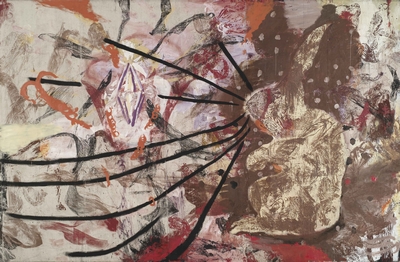
Julian Schnabel @ ARoS Aarhus Art Museum - Aktion Paintings 1985 - 2017

Julian Schnabel - Aktion Paintings 1985 - 2017
ARoS Aarhus Art Museum
Through 3 March 2019 

Julian Schnabel Portrait
Portrait of Julian Schnabel 
Photo: Louise Kugelberg

ARoS presents 40 paintings from 1985 to 2017, entitled Aktion Paintings by American painter Julian Schnabel. This is the largest exhibition to date in the Scandinavian countries of Julian Schnabel’s work. Many of the artworks is from Julian Schnabel’ own collection and have never been exhibited publicly. Julian Schnabel is seen as one of the leading protagonists of painting in the last half of the 20th century and still influences painting today. 

Julian Schnabel
Julian Schnabel
Anno Domini, 1990 
Oil on white tarpaulin, 670,6 x 670,6 cm
Courtesy the artist, Photo from Julian Schnabel Archive, 1990

Julian Schnabel
Installation photo Aktions Paintings
Photo: Anders Sune Berg

ARoS has put in more than two years of work to make this exhibition possible, closely collaborating with the artist and designed by interior architect Louise Kugelberg. Exploring new possibilities and stepping out of our comfort zone is an inherent part of the spirit of ARoS. Consequently, we have enjoyed a great deal of surprises in the development of this exhibition and he has created a structure that will enlighten the museum guests the moment they enter his universe, says museum director Erlend G. Høyersten, ARoS. 

Julian Schnabel
Julian Schnabel 
A Carrot is a Diamond for a Rabbit, 1990
Oil on tarpaulin, 472,4 x 721,4 cm
Courtesy the artist, Photo: Tom Powel Imaging

JULIAN SCHNABEL: ABOUT THE ARTIST


Born in Brooklyn, New York in 1951, Julian Schnabel today divides his time between New York City and Montauk, Long Island. The pivotal role he played in the return of figurative and narrative painting in the late 1970s turned him into its most prominent figure. Throughout his career Schnabel has been exploring the boundaries of painting, and he is known for his constant experimentation with surfaces, scale, materials and great gesture, not only the physical gesture, but the gesture of idea.

Three of the works, at the entrance of the exhibition were made for the Maison Carrée in Nîmes, France in 1990 and resided there for four years. Schnabel has made works for unusual spaces that speak to architecture, most recently 6 - 6 x 6-meter paintings that were installed outside in the courtyard of the Legion of Honor in San Francisco for five months by Max Hollein, director of the Metropolitan Museum of Art in New York.

Julian Schnabel’s work has been presented in many of the world’s most preeminent museums, and is held in major collections, such as the Centre Georges Pompidou, Paris; Tate, London; Whitney Museum of American Art, New York; Metropolitan Museum of Art, New York; Kunstmuseum Basel, Basel; Museo Reina Sofia, Madrid and Museum of Modern Art, New York.

Julian Schnabel
Julian Schnabel
Last Attempt at Attracting Butterflies, 1994 
Oil on canvas, 411,5 x 375,9 cm 
Private collection
Photo: Ken Cohen Photography

Julian Schnabel
Julian Schnabel
Hat Full of Rain, 1996 
Oil and marker on tarpaulin
Courtesy the artist

Photo from Julian Schnabel Archive 1996

JULIAN SCHNABEL: AN OSCAR-NOMINATED PAINTER

In 1996 Julian Schnabel wrote and directed the movie Basquiat about New York artist Jean-Michel Basquiat. Julian Schnabel’s second film, Before Night Falls, won both the Grand Jury Prize and the Coppa Volpi for best actor to Javier Bardem in 2000 at the Venice Film Festival. In 2007 Julian Schnabel directed his third film, The Diving Bell and the Butterfly. Julian Schnabel received the prize for best director at Cannes Film Festival and best director at the Golden Globe Awards, where the film also won the award for Best Foreign Language Film. The Diving Bell and the Butterfly was nominated for four Oscars. Julian Schnabel’s latest film, At Eternity’s Gate, about Vincent van Gogh premiered at the Venice Film Festival in September 2018, where Willem Dafoe won the Coppa Volpi for best actor and Danish actor Mads Mikkelsen gave a riveting performance as the priest responsible for letting Vincent van Gogh out of the asylum.

Julian Schnabel
Julian Schnabel
Big Girl Painting, 2013 
Oil on canvas, 414 x 386,1 cm
Private collection
Photo: Tom Powel Imaging


Julian Schnabel
Julian Schnabel  
Rose Painting (Near Van Gogh's Grave) VIII, 2016
Oil, plates and bondo on wood, 182,9 x 152,4 cm 
Private collection
Photo by Daniel Martinek Pho

CATALOGUE

Director of l’Insitut d’historie de l’art in Paris Eric de Chassey, contributes his profound knowledge of Julian Schnabel’s painting as well as artists Laurie Anderson’s poetic description of her personal relationship with the artist. The catalogue begins with a foreword by museum director Erlend G. Høyersten and Rasmus Stenbakken. The exhibition designer Louise Kugelberg contributed extensively to the catalogue that ARoS publish in connection with the exhibition.

The exhibition is curated and designed by Julian Schnabel and Louise Kugelberg.

Director Erlend G. Høyersten and ARoS wishes to thank Jens-Peter Brask for the collaboration and for introducing the idea of making a Julian Schnabel exhibition.  

For more about Julian Schnabel visit www.julianschnabel.com

AROS Aarhus Kunstmuseum
ARoS Aarhus Art Museum
AROS ALLÉ 2, DK-8000 AARHUS C
www.aros.dk

24/01/19

Emma Kunz @ Serpentine Gallery, London

Emma Kunz
Serpentine Gallery, London
23 March - 19 May 2019

Emma Kunz
Emma Kunz
Work No. 003
Photo: © Emma Kunz Zentrum

Emma Kunz
Emma Kunz
Work No. 004
Photo: © Emma Kunz Zentrum

The first UK solo exhibition by the late Swiss healer, researcher and artist EMMA KUNZ (Brittnau, 1892 - 1963, Waldstatt) is conceived with artist Christodoulos Panayiotou.

Emma Kunz never received a formal arts education, yet from 1938 she produced hundreds of geometric drawings which were first exhibited in the early 1970s.

Her work was inspired by spiritualism and constructed using radiesthesia - a technique using pendulum to plan the structure of her drawings, each of which were completed in a single session.

Emma Kunz
Emma Kunz
Work No. 011
Photo: © Emma Kunz Zentrum

Emma Kunz
Work No. 013
Photo: © Emma Kunz Zentrum

Emma Kunz
Emma Kunz
Work No. 307
Photo: © Emma Kunz Zentrum

Emma Kunz
Emma Kunz
Work No. 513
Photo: © Emma Kunz Zentrum

Emma Kunz considered these drawings as images of energy fields from which she would formulate diagnoses for her patients or answers to questions she posed to her pendulum. Engaging with these varied phenomena, Emma Kunz's work explores philosophical and scientific themes that are not only rooted to her own times but also to the future; she predicted that her drawings were destined for the 21st Century.

Serpentine Gallery
Kensington Gardens, London W2 3XA
www.serpentinegalleries.org

Emma Kunz Zentrum
Steinbruchstrasse 5, CH-5436 Würenlos
www.emma-kunz.com