Showing posts with label Claes Oldenburg. Show all posts

02/07/25

Claes Oldenburg @ Pace Gallery, Tokyo - "いろいろ / This & That" Exhibition

Claes Oldenburg 
いろいろ / This & That
Pace Gallery, Tokyo
July 17 – August 23, 2025

Claes Oldenburg
Claes Oldenburg 
Geometric Mouse--Scale B, 1970-72 
© Claes Oldenburg, courtesy Pace Gallery

Claes Oldenburg
Claes Oldenburg
Miniature Soft Drum Set, 1969 
© Claes Oldenburg, courtesy Pace Gallery 

Pace presents This & That, an exhibition of work by American artist CLAES OLDENBURG, at its Tokyo gallery. Bringing together sculptures and prints that exist in series created by the artist between the 1960s and mid 2000s, this lively survey showcases the importance of multiplicity in Oldenburg’s practice, inviting visitors to immerse in the artist’s madcap world and uncover resonances and touchpoints to Japanese culture. Curated by Pace CEO Marc Glimcher and Maartje Oldenburg—daughter of Claes Oldenburg and his wife and longtime collaborator Coosje van Bruggen, and head of the artists’ estates—the exhibition is organized as part of the gallery’s 65th anniversary year celebration. It is also be Pace’s first major presentation of Oldenburg’s work since the gallery announced its global representation of the Claes Oldenburg estate, the Coosje van Bruggen estate, and the Oldenburg and van Bruggen estate, continuing its commitment to sharing the intertwining legacies and individual achievements of the two artists with its global
audience. 

The Japanese title of the gallery’s presentation is いろいろ (“Iroiro”), which roughly translates to “various,” “variety,” or “miscellany.” Suggesting a mixed-bag or a hodgepodge, “Iroiro” can also be written as 色々, which comprises a repetition of the Kanji character 色 (“Iro”). “Iro” literally means “color,” but it typically refers to the color or hue of things. It can also suggest an object’s general appearance, and even more metaphorically, can refer to the sensuality of a thing (as in the occasional English usage of the word “colorful”). “Iroiro” thus echoes Oldenburg’s almost passionate involvement with banal objects, the way he lovingly coaxed a vast array of ordinary, miscellaneous things from their humdrum existence in the normal course of life—the "this and that”—into subject-matter for serious artistic inquiry.

In a broad sense, Pace’s show sheds light on Oldenburg’s fascination with multiplicity, the act of artistic reproduction, and the mutability of imagery. Widely known for the monumental artworks he realized around the world with Coosje van Bruggen, he also created many domestically sized objects across a wide variety of media throughout his career. “The multiple object,” he once said, “was for me the sculptor’s solution to making a print.”

This exhibition in Tokyo is the first major presentation of Oldenburg’s work in the Japanese capital since 1996. The artist’s only other solo show in the city took place in 1973 at Minami Gallery. Notably, he debuted his large-scale Giant Ice Bag (1970) sculpture, which is animated by mechanical and hydraulic components, in the US Pavilion at Expo 70 in Osaka. Since 1995, Claes Oldenburg and Coosje van Bruggen’s large-scale sculpture Saw, Sawing has been on public view outside the Tokyo International Exhibition Center. Oldenburg’s sculptures Inverted Q (1977–88) and Tube Supported by Its Contents (1983) can be found in the collections of the Yokohama Museum of Art and the Utsunomiya Museum of Art, respectively.

Claes Oldenburg—who presented his first solo exhibition with Pace in 1964—was a leading voice of the Pop Art movement who, over the course of more than six decades, redefined the history of art with his sculptures, drawings, and colossal public monuments that transform everyday objects into idiosyncratic entities. He rose to prominence in New York in the late 1950s and early 1960s, when he was among the artists staging Happenings—a hybrid art form incorporating installation, performance, and other mediums—on the city’s Lower East Side. Collaborative and ephemeral, these environments included The Street (1960) and The Store (1961)—his first solo presentation with Pace featured works from The Store. Following his work with props in these Happenings, Claes Oldenburg began creating his iconic soft sculptures, which charted new frontiers in the medium, upending its traditional contents, forms, and materials.

Claes Oldenburg and Pace’s Founder and Chairman Arne Glimcher maintained a friendship for 60 years, working closely from the early years of the artist’s career up until his death in 2022. Since the 1960s, Pace has presented Oldenburg’s work in some 30 exhibitions and produced seven catalogues dedicated to his practice. The gallery also supported Oldenburg and van Bruggen’s creation of the large-scale sculptures Typewriter Eraser, Scale X (1998-99), which is part of the collection of the National Gallery of Art in Washington, D.C., Balzac Pétanque (2002), which is in the collection of the High Museum of Art in Atlanta, and Floating Peel (2002) at the Cantor Center for Visual Arts at Stanford University, among many other projects.

Claes Oldenburg
Claes Oldenburg
N.Y.C. Pretzel, 1994 
© Claes Oldenburg, courtesy Pace Gallery

Among the works in the gallery’s Tokyo show are some 60 multiples of Oldenburg’s painted cardboard sculpture N.Y.C. Pretzel (1994)—these works will be presented in a vending machine vitrine near the entrance of the gallery space. Other multiples in the exhibition include the artist’s cast plaster Wedding Souvenir (1966), his painted aluminium and brass Profiterole (1989–90), and his sewn canvas Mouse Bags (2007–17), all of which speak to his engagement with the quotidian, from the food we eat to pop cultural icons like Mickey Mouse.

In the way of larger-scale sculpture, This & That features Tied Trumpet (2004), a knotted bright yellow trumpet rendered in aluminum, plastic tubing, canvas, felt, and foam, and Miniature Soft Drum Set (1969), a set of nine sewn screen-printed elements on canvas. Another highlight is Knife Ship 1:12 (2008), an aluminum and mahogany wood reprisal of the monumental Knife Ship that Claes Oldenburg and Coosje van Bruggen presented as part of their legendary 1985 performance Il Corso del Coltello (The Corse of the Knife) in Venice, Italy—this storied, site-specific project, realized by the artists in collaboration with curator Germano Celant and architect Frank Gehry, centered around a boat in the shape of a Swiss-army knife, which was floated down the city’s canals.

Claes Oldenburg
Claes Oldenburg 
Alphabet in Form of a Good Humor Bar, 1970 
© Claes Oldenburg, courtesy Pace Gallery

A 1976 screenprint of the Knife Ship superimposed onto the image of the Guggenheim Museum in New York—an artwork that predates the performance—is also be included in This & That. Other prints on view at Pace in Tokyo will be Alphabet in Form of a Good Humor Bar (1970), which renders the alphabet in the shape of an ice cream bar; The Letter Q as Beach House, with Sailboat (1972), where Claes Oldenburg imagines the letter ‘Q’ as a towering waterfront home; and the artist’s Apple Core prints, each representative of one of the four seasons, from 1990.

Through his iterative and elastic process of translating imagery from one medium to another—and suggesting innumerable possible transformations as part of that process—Claes Oldenburg expanded the possibilities of art by inviting the viewer to look again. Taken together, the works in this exhibition reflect his uncanny ability to render the familiar strange, and to imbue magic and wonder into the most mundane of subject matter.

Maartje Oldenburg is the daughter of Claes Oldenburg and Coosje van Bruggen and is the head of the artists’ estates. A writer, editor, and lawyer, Maartje Oldenburg formally studied Japanese language, literature, and history for many years. She lived and worked in Japan in the 1990s.

Claes Oldenburg (b. 1929, Stockholm; d. 2022, New York) is renowned for his sculptures, drawings, and colossal monuments that transform familiar objects into states that imply animation and sometimes revolt. A leading voice of the Pop art movement, Oldenburg came to prominence in the New York art scene of the late 1950s and early 1960s. His seminal installations The Street (1960) and The Store (1961) launched his career, subverting artistic and institutional conventions while creating a backdrop for happenings and performances under the production name Ray Gun Theater. Initially conceiving of monumental works based on everyday items in drawings and collages, Claes Oldenburg installed his first realized outdoor public sculpture, Lipstick (Ascending) on Caterpillar Tracks (1969–74), during an antiwar protest at Yale University in 1969. He subsequently collaborated for over three decades with Coosje van Bruggen to create largescale projects across the world. Conflating notions of art and banality, and high-brow and low-brow, the investigation of objecthood spans Oldenburg’s earliest production to his work today.

PACE GALLERY TOKYO
1F; Azabudai Hills Garden Plaza-A
5-8-1 Toranomon, Minato-ku, Tokyo

07/12/20

Claes Oldenburg & Coosje van Bruggen @ Paula Cooper Gallery, Palm Beach - There is no such thing as a perfect lamb chop

Claes Oldenburg & Coosje van Bruggen
There is no such thing as a perfect lamb chop
Paula Cooper Gallery, Palm Beach
December 5, 2020 – January 9, 2021

An exhibition of work by Claes Oldenburg and Coosje van Bruggen titled “There is no such thing as a perfect lamb chop” marks the inauguration of Paula Cooper Gallery’s new seasonal pop-up at 243A Worth Avenue opened on December 5, 2020. The couple first began their working partnership in 1976 and, over the course of the next three decades, produced an extensive body of drawings, sculptures, and public commissions. The presentation at Paula Cooper Gallery includes examples from these important collaborative years, as well as works by Claes Oldenburg made before their meeting and after Coosje van Bruggen’s passing in 2009.

In celebration of the vibrant life of Palm Beach and the surrounding area, “There is no such thing as a perfect lamb chop”[1] presents a selection of drawings and sculptures by Claes Oldenburg and Coosje van Bruggen, with a focus on their representations of food, sport, music, and other articles of pleasure. These striking images reinvent quotidian objects, using line and form to playfully merge natural elements with the irreverent and the fantastical. In the duo’s 2007 pastel drawing, an anthropomorphized shuttlecock performs a feat of superhuman acrobatics across the rotunda of the Guggenheim Museum. Elsewhere, Claes Oldenburg’s canvas-and-resin tomates farcies entice and charm viewers with their luscious hue and supple surfaces. In the catalogue for his 1969 exhibition at The Museum of Modern Art in New York, art historian Barbara Rose wrote: “It is his execution, his ability to make form live and to imbue it with a palpable vitality and sense of movement, that distinguishes Oldenburg’s genius […] In his art, the distortion of form, its infinite metamorphoses, becomes a metaphor for the search for truth, an endless pursuit through the labyrinth of illusion. His prime values as an artist are elusiveness, mystery, ambiguity, and multivalence.”

Many of the works on view relate to realized monumental public sculptures by the artists, including the exhibition’s earliest pieces: studies of the mass-produced typewriter eraser. Claes Oldenburg considered the eraser to be a “fine anti-heroic object” and in 1970 he began to make sketches of its form, set in imagined landscapes or personified as ‘Medusa’ or as a ‘Big Guy.’ A large-scale version measuring over eighteen feet high is installed at the entrance of the Norton Museum of Art in West Palm Beach. Imbued with human-like qualities, the object tilts forward as if it were exuberantly speeding away—its bristles blown back like strands of hair. In another work, a drawing from 1988, the couple depicts a broken plate out of which orange slices and expressively cut peels appear to tumble and bounce off the ground, as if caught in stop-motion. This anti-hierarchical form was their proposal for a public commission in Metro-Dade Open Space Park in Miami—a response to the eclectic architecture of the site where the finished sculpture still stands today.

CLAES OLDENBURG was born in Stockholm, Sweden, in 1929. He attended Yale University (1946–1950) as well as The Art Institute of Chicago before moving to New York City in 1956. The artist had his first one-person exhibition at the Judson Gallery, New York, in 1959 followed by shows at the Moderna Museet, Stockholm (1966) and the Museum of Modern Art, New York (1969). “Claes Oldenburg: An Anthology” opened at the National Gallery of Art, Washington, D.C. in 1995 and traveled to the Museum of Contemporary Art, Los Angeles; the Solomon R. Guggenheim Museum, New York; Kunst-und Ausstellungshalle der Bundesrepublik Deutschland, Bonn; and the Hayward Gallery, London. In 2002 the Whitney Museum of American Art in New York held a major exhibit of Oldenburg’s drawings; the same year, the Metropolitan Museum of Art in New York featured a selection of Oldenburg and van Bruggen’s sculptures on the roof of the museum. “Claes Oldenburg: The Sixties” opened at the Museum moderner Kunst Stiftung Ludwig Wien in 2012 and traveled to the Museum Ludwig, Cologne; the Guggenheim Museum, Bilbao; the Museum of Modern Art, New York; and the Walker Art Center, Minneapolis. Oldenburg has been honored with numerous awards including the Wolf Prize in Arts (1989) and the National Medal of Arts (2000). He lives and works in New York City.

COOSJE VAN BRUGGEN was born in Groningen, the Netherlands in 1942. She received a master’s degree in art history from the University of Groningen. From 1967 to 1971 she worked in the curatorial department of the Stedelijk Museum in Amsterdam and was co-editor of the Sonsbeek 71 catalogue. Van Bruggen was a member of the selection committee for Documenta 7 in Kassel, Germany (1982), a contributor to Artforum (1983–88) and Senior Critic in the Department of Sculpture at Yale University School of Art (1996–97). She has also authored books on Claes Oldenburg’s early work as well as on John Baldessari, Hanne Darboven, Bruce Nauman and the architect Frank O. Gehry. Van Bruggen’s first collaboration with Claes Oldenburg was in 1976 on Trowel I located in the sculpture garden of the Kröller-Müller Museum in Otterlo, the Netherlands. In 1978 Coosje van Bruggen moved to New York, where she continued to work with Oldenburg, creating large-scale, site-specific works in urban settings. Their collaboration has extended to include smaller-scale park and garden sculptures as well as indoor installations. Coosje van Bruggen passed away in Los Angeles in 2009.

[1] A statement by Claes Oldenburg from his interview with Barbara Rose in Interview Magazine (December 8, 2015)

Make an appointment to see this exhibition in person.

PAULA COOPER GALLERY
243A Worth Avenue, Palm Beach, FL

________________________


06/12/17

Exposition Pop Art, Musée Maillol, Paris : Collection du Whitney Museum of American Art

Pop Art - Icons that Matter
Collection du Whitney Museum of American Art
Musée Maillol, Paris

Jusqu'au 21 janvier 2018


Ed Ruscha
EDWARD RUSCHA
Large Trademark with Eight Spotlights, 1962
Huile, peinture maison, encre et crayon à mine de plomb sur toile, 170 x 338,1 cm
Purchase with funds from the Mrs Percy Uris Purchase Fund
© Ed Ruscha

Initiée par la célèbre sculptrice et mécène Gertrude Vanderbilt Whitney (1875-1942), la collection du Whitney Museum of American Art de New York offre une véritable anthologie de l’art américain du XXe siècle. Cette collection comporte des pièces maîtresses du Pop Art . Peintures, sculptures, estampes... une soixantaine de ces oeuvres sont présentées pour la première fois à Paris, au Musée Maillol depuis le 22 septembre 2017 jusqu'au 21 janvier 2018.

Des figures majeures du mouvement Pop Art, Robert Rauschenberg et Jasper Johns, aux sculptures et toiles monumentales de Claes Oldenburg, Tom Wesselmann, James Rosenquist et Alex Katz, en passant par les peintures et sérigraphies d’Andy Warhol, les oeuvres de Jim Dine et de Roy Lichtenstein, l’exposition illustre le Pop Art dans l’art américain de l’après-guerre, du début des années soixante à la fin des années soixante-dix. Si l’exposition convoque ses plus grands représentants, elle permet également de découvrir des artistes américains moins connus en France tels que George Segal, Rosalyn Drexler, May Stevens, John Wesley....

L’ensemble des oeuvres réunies au musée Maillol présente ainsi des techniques et propositions artistiques variées et révèle ainsi la diversité des approches rassemblées sous le terme générique et pratique de « Pop Art ».


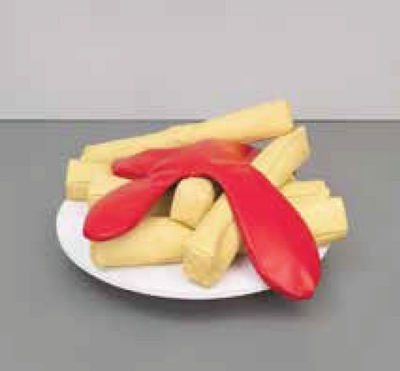
Claes Oldenburg
CLAES OLDENBURG 
French Fries and Ketchup, 1963
Vinyle et kapok sur base en bois, 26,7 x 106,7 x 111,8 cm
50th Anniversary Gift of Mr and Mrs Roberts M. Meltzer
© Claes Oldenburg, 1963

LE POP ART AMÉRICAIN

Au début des années soixante, les États-Unis voient émerger en l’espace d’une décennie une génération d’artistes en réaction à l’expressionnisme abstrait qui domine à l’époque. La société de consommation se développe parallèlement à la croissance économique. C’est dans ce contexte que le Pop Art va émerger. Les artistes du courant Pop représentent généralement les objets du quotidien et les signes de la culture de masse populaire, recourant aux techniques employées dans la publicité, la bande dessinée, convoquant des éléments textuels... Ce mouvement artistique se caractérise aussi par ses aplats de couleurs uniformes dans des tons francs, intenses, tranchants, selon une technique qu’on appellera le hard-edge. Il affirme sa croyance en la puissance des images, et c’est souvent avec humour, parfois avec ironie, qu’il se réapproprie des figures iconiques comme Jackie Kennedy ou Marilyn Monroe et dépeint « the American way of life ».

« Le Pop Art regarde le monde, il semble accepter son environnement qui n’est ni bon ni mauvais, mais différent. Un autre état d’esprit », commente Roy Lichtenstein.

« Le Pop est tout ce que l’art n’est plus depuis deux décennies. Il s’agit véritablement d’une volte-face, un retour à une communication visuelle représentative, se déplaçant à une vitesse ébouriffante dans des modèles récents et pointus. C’est un brutal retour en arrière vers le Père, après une exploration abstraite de l’Utérus pendant 15 ans. Le pop art est un ré-engagement dans le monde. C’est se débarrasser de la bombe. C’est le Rêve Américain, optimiste, généreux et naïf… » résume à sa façon Robert Indiana.


John Wesley
JOHN WESLEY
Compleat Fritz, 1971
Sérigraphie sur panneau, 76,2 x 76,2 x 0,2 cm
Acquis grâce au Comité des imprimés
© John Wesley ; Courtesy Fredericks & Freiser Gallery


Christina Ramberg
CHRISTINA RAMBERG 
Istrian River Lady, 1974
Acrylique sur panneau aggloméré, avec cadre en bois, 89,9 x 79,4 x 4,1 cm
Acquisition grâce à M. et Mme. Frederic M. Roberts à la mémoire de leur fils, James Reed Roberts
© Estate of Christina Ramberg, courtesy Corbett vs Dempsey

LE WHITNEY MUSEUM OF AMERICAN ART, NEW YORK

Le Whitney Museum of American Art a été fondé par la sculptrice Gertrude Vanderbilt Whitney en hommage aux artistes américains. Au début du XXe siècle, les artistes novateurs éprouvent les plus grandes difficultés à exposer et vendre leurs oeuvres aux États-Unis. Dès 1907 et jusqu’à son décès en 1942, Gertrude Whitney consacrera sa vie à acquérir et exposer leur travail : c’est l’une des plus grandes mécènes d’art américain contemporain de son époque.

En 1914, elle fonde le Whitney Studio à Greenwich Village, où elle organise des expositions d’artistes américains vivants dont les oeuvres sont ignorées par les institutions artistiques traditionnelles. En 1929, elle offre une collection de plus de 500 oeuvres au Metropolitan Museum of Art. Après avoir essuyé un refus, elle établit son propre musée avec une mission radicalement novatrice : se concentrer exclusivement sur l’art et les artistes de son pays. Le Whitney Museum of American Art, fondé en 1930, s’installe en 1931 à Greenwich Village.

En 1954, le musée est déplacé vers un site plus important sur West 54th Street. En 1963, les locaux étant à nouveau insuffisants, un bâtiment dessiné par Marcel Breuer est construit sur Madison Avenue pour héberger la collection du musée de 1966 jusqu’au 20 octobre 2014. Dans un souci de grande modernité, un nouveau bâtiment du Whitney Museum construit par Renzo Piano, situé au 99, Gansevoort Street, ouvre ses portes à un public enthousiaste.

Aujourd’hui, la collection du Whitney Museum est riche de plus de 23000 oeuvres, créées par plus de 3300 artistes aux XXe et XXIe siècles.

David Breslin, conservateur et directeur de collection de la famille DeMartini au Whitney Museum of American Art, New York, est le commissaire général de l’exposition.
Carrie Springer, conservatrice adjointe au Whitney Museum of American Art, est co-commissaire de l’exposition.

Cette exposition organisée par le Whitney Museum of American Art, New-York, est produite et réalisée par Culturespaces avec le soutien de Natixis, mécène de l’exposition.

MUSEE MAILLOL
61 rue de Grenelle - 75007 Paris
www.museemaillol.com